The Lone Warrior

The Lone Warrior
© 2016 Paul Fraser Collard
384 pages

The time for grand strategy was over. The moment had come to put faith in an Enfield rifle, a steel bayonet and the exhausted and bloodied soldier who stood behind it.

Jack Lark is a free man,  and restored to his old name.   Although he’s proven himself a warrior,  his skillful bloodlust in battle unnerves him, and that combined with his general disgust with the  army in India,   see him looking for a boat home. That was the plan, anyway.  Enter a new sweetheart, though, and a mutiny that imperils her, her mother, and every Englisher or Indian associate thereof sweeps the subcontinent, and Jack is back in uniform. The Lone Warrior follows Lark throughout the great mutiny of 1857,   in which  pent-up outrage  spurred on by allegations of religious abuse  turns into a country-wide war that threatens to destroy Jack and all those he loves and admires.     The story is much grimmer than usual, with evidence of child murder and mentions of rape as the mutiny turns into a general civil war. Still, as with The Devil’s Assassin, the novel ends with Lark in a very interesting spot, making me want to read on. 

The mutiny catches most everyone by surprise; Lark’s first hints of danger are fired villages on the horizon, and the arrival of raucous, disheveled troops in the city who appear leaderless.   At first the mutiny seems like a local affair that will be put to rights soon enough, but as it spreads,  Jack and other British soldiers find themselves in the middle of fighting retreats,  routs, or sieges.  Jack is in constant danger , losing  much along the way, and his residual faith in the Cause and in his fellow man is constantly eroded by the horrific abuses of human life he sees perpetuated by both the Brits and the Indians, who by the late novel are also fighting between themselves in the sudden power vacuum created by the empire’s retreat.    Another area of interest in The Lone Warrior is the presence of two officers who were historic personalities, their characters based on the conflicting literature about them.  They’re far more complex than usual as a result, worthy of both admiration and contempt at times.   Jack ends the novel wholly sick of it all, but considering how many novels are left,  obviously something drives him back to stand under the flag. I’ll  just have to see what!
Posted in historical fiction, Reviews | Tagged , | 2 Comments

Library Loot Box

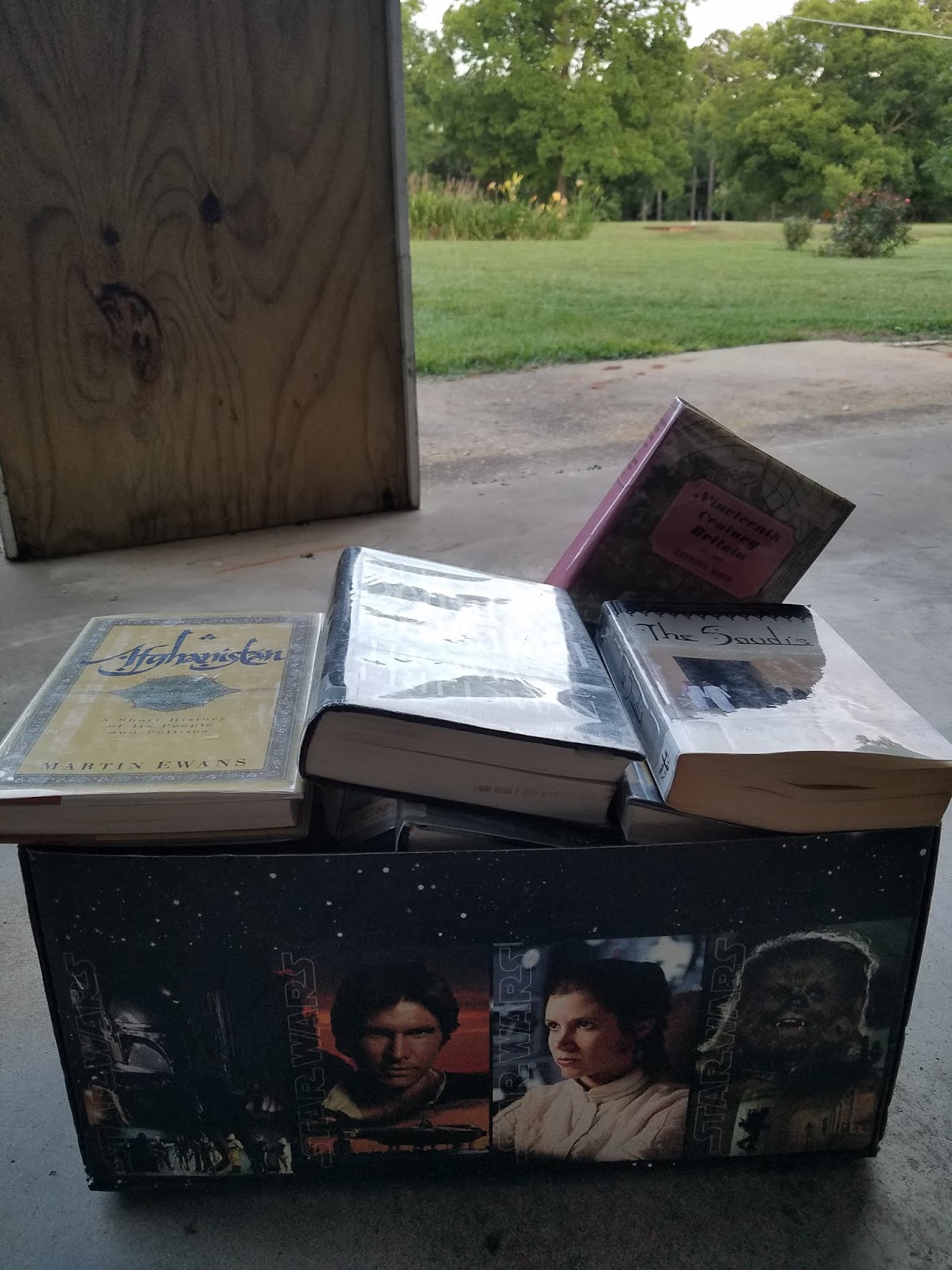
One of the libraries that I use for occasional nonfiction reads is going through a massive summer discarding, and – though part of my brain is steadily kicking me – I’ve taken advantage of it to acquire a box…or two…of books.   Mostly history, as you can imagine. I’ve made a couple of trips, but I missed the week they put out the science stuff, which is disappointing.    Although I’m sure more than few of these will simply be forwarded to Goodwill, I did want to get them while the gettin’ was good. 

The Haul

Familiar Poems, Annotated, Isaac Asimov. I’ve read this one before, but I do collect Asimov as I can.
Brave New World, Aldhous Huxley. Read a couple of times, but it and 1984 are ever relevant. 
The Saudis,  Sandra Mackey
Afghanistan: A Short History of its People and Politics,  Martin Ewans. (There were a lot of books about Afghanistan and the Taliban…all purchased in 2002, all read furiously in 2002-2003, and mostly untouched since.)  
From Beirut to Jerusalem, Thomas Friedman
The Encyclopedia of Evolution
Benjamin Franklin: The First American
The Life of Our Lord, Charles Dickens
Daily Life in the Time of Jesus, Henri Daniel-Rops
The World of Rome, Michael Grant
Europe in Our Time
Medieval Lives
The Middle Ages, Morris Bishop
19th Century Britain
The Nazi Seizure of Power
Kristallnacht
Desert Solitaire, Edward Abbey.  Read this one before, but  the prose roped me into reading more of him and put a yearning to see the Southwest into me.
They Stand Together: The Letters of C.S. Lewis and Arthur Greaves
The Early Ayn Rand: Unpublished Short Fiction


I was doubtful about Europe in Our Time — at best it was published in the 1960s or early 1970s — but  I liked the airplane art on the cover. (In the above picture, it’s the dark blue book to the far right near the tire.)   

Here’s hoping these get read!

Posted in General | Tagged | 6 Comments

American Detective

American Detective: Behind the Scenes of Famous Criminal Investigations
© 2018  Thomas Reppetto
312 pages

I’ve been playing through L.A. Noire lately, and its use of real-life crime (the Black Dahlia case)  prompted me to look for anything written about it. American Detective only mentions the Dahlia case,  using it in  Reppetto’s history of American detective units,  their decline in the late 20th century, and the need for them to make a comeback.  Reppetto writes from both research and experience, having previous been a commander of detectives in Chicago.  American Detective is a mix of straightforward histories of various crimes and enterprises across the United States (mostly in larger cities like New York, Chicago, Los Angeles, and  Cleveland), and including serial killers, bank robbers, and organized crime.    The writing can be dry, especially when it’s just one case after another, but Reppetto does warm up, especially when he shifts from fact-delivery to reflection.

  In covering the rise of municipal detective bureaus, Reppetto attributes their takeover of American policing to the complications of mobility and immigration, both of which required more focused, deliberate, and sustained investigations than ordinary patrolmen could offer.  At their prime, American detectives were an elite force  — patrolling their city, constantly gathering information and building a network of informants who would come in handy in the event of an investigation. Corruption, political and otherwise, coupled with increasing bureaucratization which forced detectives to become specialists who worked cases instead of generalists who worked the city,  diminished their performance , while at the same time  politicians began touting approaches to law enforcement that  emphasized the role of the ordinary patrol officers.  Reppetto believes that “community policing” was never clearly defined, and argues that detective bureaus should reclaim their midcentury prominence. 

As a book, American Detective delivers a lot of interesting back stories behind famous personalities and crimes, along with less interesting ones. That may be a matter of taste, or delivery; I’d liken the book to sitting at a railway intersection and watching a train go by. There’s much of interest, but there are also long stretches of literary boxcars,  fairly featureless.    There’s a lot of little tidbits in here, though, so  if you’re an avid reader of true crime, it’s probably worth checking into.  Personally, having spotted that Reppetto has also done some works on the Sicilian Mafia, I may read a little more of him.

Posted in history, Reviews | Tagged , , , | Leave a comment

AI Spam Comments Volume I

I get so many bizaare or uncanny AI comments these days   that I wanted to share a few. I’ve shared a couple before which were spooky — well written, with no links or hooks, making me wonder what the point of them was — but these are more mixed in style and quality. The spambots just  adore Sharpe’s Rifles and A Life of Her Own, Why?  No idea, but 90% of the spam is for those two posts.

1. ….thank you for sharing that.
“Right away I am going to do my breakfast, afterward having my breakfast coming over again to read other news.”

2. I’m Sorry, Was That English?
“Definitely imagine that which you said. Your favorite justification appeared to be at the net easiest factor to have in mind of I say to you. I certainly get annoyed while other folks consider worries that they just do not recognize about. You controlled to hit the nail upon the highest as well as outlined the whole thing with no need side-effects, other folks can take a signal. Will probably get back to get more. Thank you.”

3. Spambot is Worried About Spam
“When I originally comented I click the Notify me when new comments are added and now ezch time a comment is added I get sevral emails with the same comment. Is there any way yo ucan remove me from that service? Many thanks!”

4. Fake but Real 
” I know this if off topic but I;m looking into starting my own weblog and was wondering what all is required to get setup? I’m assuming having a blog like yours would cost a pretty penny? I’m not very internet smart so I’m not 100% certain. Any suggestions or advice would be greatly appreciated. Cheers

Hmm is anyone else encountering problems with the images on this blog loading? I;m trying to determine if its a problem on my end or if its the blog. Any suggestions would be greatly appreciated.

5. Hard Core IE Fanboy

“Hello. Neatt post. There is a problem with your site in interhet explorer, might check this? IE nontheless is the marketplace leader and a large component of other people will miss your great writing due tto this problem”

6. You Can Write, But You Can’t Read
“Hey there are using WordPress for your blog platform? I’m new to the blog world but I’m trying to get started and create my own. Do you need any coding expertise to make your own blog? Any help would be really appreciated!”
Seriously, “Blogspot” is right there in the URL.

7. More Walls of Text, Please!
“I do trust all the ideas you have introduced in your post. They are very convincing and can definitely work. Nonetheless, the posts are too short for newbies. May you please extend them a bit from subsequent time? Thanks for the post.”

Posted in General | Tagged | 4 Comments

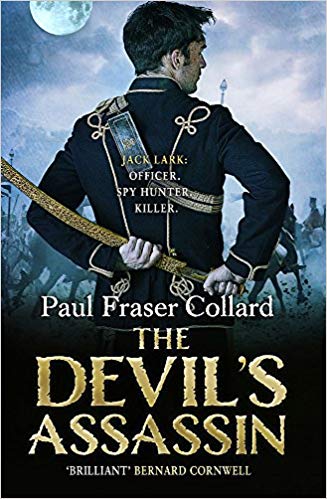
The Devil’s Assassin

The Devil’s Assassin
© 2015 Paul Fraser Collard
336 pages

Jack was filled with the madness. He could feel it searing through his veins. It resonated deep in his soul, every fibre of his being tingling with the insanity of galloping against an enemy horde. The regiment raced forward, their voices roaring out as the men unleashed the cheer saved for this moment. The last yards flashed past and the 3rd Bombay Light Cavalry charged into action.

Following the events of The Maharajah’s General,,  in which Jack Lark’s false identity was exposed but the parties involved silenced by  war, Lark is now a freewheeling rogue, keeping his distance from those who’d recognize him and pretending to be an officer on leave, free to enjoy the pleasures of cities like Bombay.   Though away from the fighting, Jack can’t escape his deceit,  and when he’s cornered and kidnapped by a man working for a secretive British intelligence officer known as the Devil,    his career takes an interesting turn. 
It’s the eve of battle in Central Asia. The once free city of Herat has been suddenly occupied by the Shah of Persia,  in violation  of a treaty and destabilizing the balance of power  between the Empire,   Persia, and Russia in the region.   The army is being organized to go forth and show the flag,  hoping the Shah will withdraw, but what few know is that there’s a leak: someone is keeping the Persians informed  of English troop movements, and the level of fine detail means they’re in the camp itself.    Rooting out rival spies is just the work for the Devil, who drafts Jack and threatens to expose him as a fraud if he doesn’t cooperate.   Despite his acquired talent for deceit, Jack is more at home on the battlefield than he is fishing for information in cloak and dagger affairs.  
The Devil’s Assassin is both a spy novel and a war novel, and largely successful on both ends.  The running battle between the British Expeditionary Force and the Persians takes up most of the middle, as the forces engage and break off. It’s purely a cavalry affair, too, spurred on by the British need to rout the Persians before they build up their strength in the area.  Although the Devil  recruited Lark on his talent for disguise and pretense,   a gift for subterfuge doesn’t necessarily make a good counterintelligence agent – as the Devil learns when Lark runs off on the first rumor he hears and nearly beats a man to death, so disrupting the investigation to no good effect that he and the Devil are both told to leave finding the spy or the spy ring up to naval intelligence.     I’d pinned the spy fairly early on, or thought I did: there’s a little twist where the great reveal proves to still be leaving part of the story in the shadow, so while I was far closer to the target than Lark,   I wasn’t quite there.     
Looking ahead I see Lark has found himself in the midst of the Great Mutiny, the American Civil War, and...the….Wild….West?   Obviously I’ll continue to follow!  
Posted in historical fiction, Reviews | Tagged , , | 4 Comments

The Maharajah’s General

The Maharajah’s General
© 2013 Paul Fraser Collard
339 pages

In The Scarlet Thief, an ambitious but impoverished redcoat saw a way for himself out of the gutter when the officer he served as an orderly became deathly ill on a sea voyage to Crimea.  Assuming the officer’s name and position, Lark launched himself from the ranks – and found that becoming a leader of men was far more different than mocking officers from the ranks, even aside from the challenges of polite society.  But when Lark arrives in Crimea, he finds that news of his ‘demise’ has preceded him. A pat explanation may put  away suspicion for the moment, but the charade is bound to unravel, and when it does the soldier wrestling with his conscience will find himself wrestling with his loyalties, too.   Can he find a way back into the good graces of the army he loves, but which despises him – or will he find glory by serving an  a foreign king, one who resists the increasing British control of India?  
The original novel based on Lark’s fraud saw him thrown into the Battle of the Alma, where he floundered before finally finding his way. Here, the kingdom involved, and the sustained siege and battle at the end, are fictitious, albeit loosely based on the India mutiny of 1857 and meant perhaps as a prelude to them.  Combat peppers the novels, as even before the British and the defiant maharajah meet in battle,  Lark encounters brigands in the wilderness. The finale certainly commands attention, but more unexpectedly interesting was Lark continually wrestling with himself:  he doesn’t like living a lie, even though it’s a fairly harmless one. He is a good officer in a fight,  proving himself to men on both sides of the line:  even those who want him dead admired his skill with a sword. (His skills on a horse…not so much.)  But that acclaim is part of the problem, as Lark wonders if he’s good for anything other than killing.  He can win glory in battle, but a life? 
The Maharjah’s General proved far more interesting than I’d expected, and it ends with Lark in an unexpected position. I’ll have to try The Devil’s Assassin to see where this path takes him.  Although there are certain elements of the plot that are…implausible (like a man with no horseback experience being appointed as commander of the lancers on the strength of his performance during an ambush), but Lark is an unusual character, and he combined with the setting and Collard’s writing override occasional quirks. 

Related:
The Scarlet Thief, Paul Fraser Collard
The Sharpe in India books, Bernard Cornwell. The link is to a list of British Historical Fiction; all the India books are under the Age of Discovery and Early Empire category.

Posted in historical fiction, Reviews | Tagged , | 9 Comments

Metropolis

Metropolis
© 2019 Phillp Kerr
384 pages

At the height of Weimar decadence, young Bernie Gunther is invited to join the Murder Commission. It’s a step up from Vice, and the department needs every watchful eye and quick wit it can get:  the city’s prostitutes and disabled veterans are both being methodically hunted and shot.   With the usual avenues of  investigation producing nothing,  Bernie takes to the streets as a legless victim of the Somme, hoping  he’ll hear words from a little closer to the ground – and from sources who wouldn’t go near the police.    Although this is the last Bernie Gunther novel (his creator having passed just over a year ago),  it’s also a prequel of a kind:  this Bernie still carries  a lot of  bruised, youthful naitive with him: he’s not the cool, jaded detective of the forties and fifties,  and it’s this case that will make him a little more weary of the world.

As much as I’ve enjoyed Kerr’s Gunther novels, I stopped reading them four years ago on the grounds that they were far too depressing.    Gunther’s report from his case in The Lady of Zagreb, for instance, was so gruesome that even Goebbels was unnerved by it.  Metropolis, despite its scalpings and cold-blooded murders, is not quite as morbid as the rest – although it’s definitely shaking for young Bernie, whose sub rosa inquiries take him into a bar popular with some of the most depraved souls in Berlin – and that’s saying something, given that Weimar Berlin  has become popular for the kind of sex tourism that now favors Thailand.    And yet there’s light in the darkness, as  Gunther finds a reason for climbing out of the bottle (he drinks like a Raymond Chandler lead at the beginning).

Like most of Kerr’s novels, Metropolis is not a piece to comfort the soul with warm fuzzies. It’s often disturbing, but the dark humor is here, too, and Kerr’s skillful pen makes even the grim go down sweet.

Posted in historical fiction, Reviews | Tagged , , , | 5 Comments

Top Ten Favorite History Reads

My PC was in the shop this past Tuesday (trying to figure out why a new graphics card wasn’t working — turns out the card itself is defective), so I missed the “Books from Your Favorite Genre” list done on Top Ten Tuesday.    

1. The Airman’s War, Albert Marrin. Marrin’s WW2 trilogy made the war came alive for me,  especially The Airman’s War. (Read ~2001)

2. A Man on the Moon,  Andrews Chaikan. The definitive Apollo history.    (Read 2012)

3. On the Shoulders of Giants, Ray Spangenburg and Diane Kit Moser (Read 2008)
A series chronicling the growth of science from the ancient Greeks until the present day, 

4. The Horse in the City, Clay Shane and Joel Tarr   (Read 2015)

5. Living DowntownThe History of Residential Hotels in America, Paul Groth (Read 2014)

6. With Wings Like Eagles: The Battle of Britain, Michael Korda (Read 2011)

7. 1491: Revelations of the Americas before Columbus, Charles Mann

8. Persian Fire: The First World Empire, Tom Holland (Read 2009)
Holland’s history of the Persian empire (Achaemenid period)  also explores its culture. I found the religious background of Achamenid Persia most fascinating.

9. The Age of Faith, Will Durant (Read 2011)
The Age of Faith was the biggest  of Durant’s volumes in his Story of Civilization, taking readers through not only medieval Europe, but Sasanian-era Persia and the early Islamic period.    I certainly wouldn’t have predicted this volume to be my favorite, but so it is.

10. Life in a Medieval City, Frances and Joseph Gies.  (Read…2003, 2004?)
The Gies did many works about medieval culture, but this volume was the first I ever encountered, and remains the most memorable for me.  Cathedral, Forge, and Waterwheel, one of their works focusing on science and technology in the medieval period,  fundamentally changed the way I thought about the era.  George R. R. Martin also drew on Life in a Medieval City for his books.

Posted in history | Tagged , | 10 Comments

Roswell reboot…initial impressions

I just discovered that there’s a new Roswell — or rather, a show called Roswell, New Mexico, which is loosely based on Melinda Metz’  Roswell High and has no connection to the old CW show beyond also being produced by CW.      Obviously, I had to try it, given how much I loved the original book series in middle school, and my affection for the later tv show.  I was largely surprised by the show, and not in good ways.

 The main premise is the same (three aliens’ lifelong secret is threatened when Liz is shot and Max is compelled by his love for her to heal her), but in this show it happens during a ten-year high school reunion.   Liz is apparently the only character who left town, and those who remain are in very strange spots given their characters in the previous mediums — most notably Alex Manes,  who appears as a USAF airman, despite his well established animosity toward the military.   The one nice change is that Liz Parker has been restored to Liz Ortecho, complete with the tragic dead sister.    
Although I’d hoped to enjoy the reboot show more than I did, its tone is fairly obnoxious: in an effort to make itself more relevant,  the writers chose to throw in reference after reference to Trump, the wall, and immigration.  I’m sure the people of Roswell, New Mexico appreciate being tarred as obsessive racists by CW.  Liz’ restoration has seemingly only happened not to be more faithful to the books (there are no other similarities) , but to  smack the viewer around and poison what could be an entertaining and nostalgia-inducing show with the vile poision of politics.  Immediately in the first episode there’s gratuitous near-sex and forced romantic relationships between characters who have never had an ounce of chemistry before.  Isabel is apparently culpable in the death of Liz’s sister  and two children, to boot!

 Although I’m open to trying episode two,  I strongly doubt I’ll buy the entire series. 

Posted in Reviews | Tagged , | 2 Comments

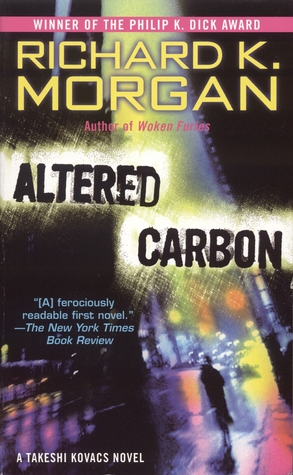
Altered Carbon

Altered Carbon
© 2002 Richard K. Morgan
416 pages

Takeshi Kovacs,  soldier-turned-commando-turned rogue,  is rudely awakened with a job.  Imprisoned for two hundred years, he’s now being offered the chance of parole if he can solve a murder.  Or should it be attempted murder? The victim’s head was blown off, but being rich,  a backup copy of his consciousness was simply downloaded into a waiting clone.    You can do that in the future, you know: your consciousness is stored on a chip within your neck, and if you die…well, if you’ve the means your friends or family  can just copy your consciousness into any available body. (There’s likely to be quite a few, since people imprisoned go into digital storage, their bodies rented out.)    Kovacs’ patron is an exceedingly long-lived and unthinkably rich fellow who wants to find out who killed him, and why they tried to mock it up like a suicide.  Although Kovacs has never been to Earth before,  between his past service in the interstellar military and his training, he’s more than prepared to learn what he needs and solve the mystery.   As cynical as he is, however, Kovacs is about to enter a story grimier than he could have imagined.

I’ve been in a science fiction mood as of late, and recently watched Altered Carbon on Netflix in its entirety.  Finding and reading the original novel was an obvious followup, although the  background of Tak  and of the chief antagonist vary quite a bit between the mediums.  What hasn’t changed is the main plot and premise:  in this future, human civilization is interplanetary,  but the few who need to  travel between  settled worlds  do so by transferring their consciousness to a body-for-hire (a “sleeve”) there. Tak is an expert in sleeve-switching, having done it professionally and usually with a dose of psychotropics that inhance intelligence, creativity,  etc.   A manufactured killer, Tak has enormous incentive to figure out what  who tried to kill his patron — especially when he narrowly escapes being killed by a squad of  hitmen at his hotel. They knew him by name, despite the fact he’s never been on planet and has been on ice for quite some time.

Although Tak’s personality is not exactly winsome, he does have allies, chiefly a cop who keeps showing up. Kristin Ortega has her own reasons for shadowing Tak: he doesn’t know it, but he’s wearing the body of her boyfriend,  imprisoned on suspicion of being a bent cop. Together they explore a story and a world saturated in sex and violence.   It turns out that when you live for century after century,  there’s really no limit to how depraved you can get. Frankly, it makes for disgusting reading at times, and I continued with the show and the book only because the premise  was and continues to be…well, absorbing.  The chip integrated into the neck — the cortical stack — doesn’t just allow for immortality for those with the means and the desire. It allows people to spend time in virtual realities — sometimes against their will, as those being interrogated know. The cortical stack expands the human potential for experience: not only can people explore different bodies, but drugs can be fine-tuned for their specific metabolism.  All this available pleasure creates an atmosphere of jadedness, however, not of contentment, and the sad restlessness that permeates the world here is not all that unfamiliar. The detective story, when it’s not submerged in blood, sex, and sadism, is genuinely interesting —  even considering that I’d already experience the story.   The antagonist has a special connection to Tak in the Netflix series which makes their interactions with Tak all the more tragic in the endgame, but that relationship is absent here, and…well, it makes things less intense.

Despite the frequent…unpleasantness, I imagine Altered Carbon  will be one of those books I can’t forget about at the end of the year. I don’t think I’ll be continue in the series, though  — the sex and violence are too detailed for my tastes.

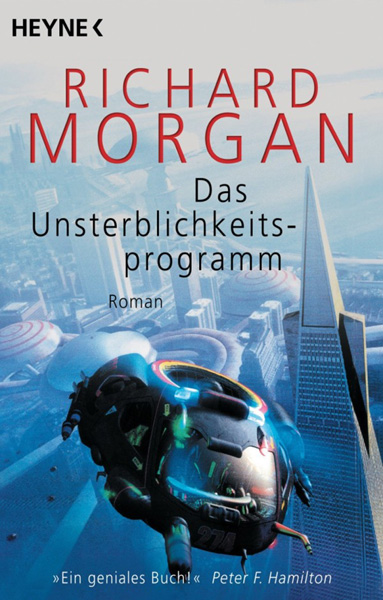
German title, just because it looks cool:

Posted in Reviews, science fiction | Tagged , , | 3 Comments