Farewell to Arms

A Farewell to Arms
© 1929 Ernest Hemingway
355 pages

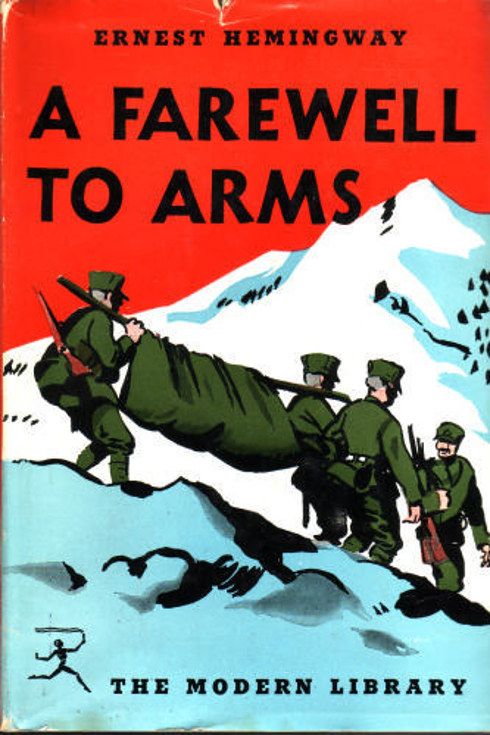
Beyond The Old Man and the Sea and his short story “The Snows of Kilamanjaro”, I haven’t read very much of Hemingway at all.  A Farewell to Arms seemed like a good place to start, being the novel that made Hemignway’s name as a writer.   Set in Italy during the Great War,  Farewell  combines wartime romance and disillusion.  It’s not a war novel in the same way that Jeff Shaara writes a war novel; the war sets the stage and constantly presses in on the characters, but our narrator – an American serving in the Italian army as an ambulance driver —  is rarely in combat,.  After a  slow beginning, the story picked up steam when Henry and his compatriots were shelled in the presumed safety of their dugout.   By the time Henry returns to the front, the war is going south for Italy, and the retreat is made more  dangerous by Italian troops who accuse any straggling retreaters of desertion, and shoot them.  Henry and the nurse with whom he falls in love both have to make tough decisions. 

A Farewell to Arms is considerably more interesting to me than The Sun Also Rises (which I’ve been halfway through for ..er, two years), and while  I didn’t know how it would end, I wasn’t too much surprised at the nature of the finish – which is consistent with the other Hemingway stories I’ve read.  There was humor here, something I’ve not yet encountered with Hemingway, although I don’t know if it’s intentional.  The entire exchange Henry has at a border crossing – his repeated assertion that he enjoys The Winter Sport, and the guards’ argument between themselves as to what constitutes Winter Sport and what town they would recommend he visit to  best enjoy The Winter Sport —    border on the good kind of absurdism.    I think I’ll remember the story, at any rate,  and that’s always a good sign for a novel, even it’s definitely not a favorite.  

Posted in Reviews | Tagged , , | 13 Comments

Top Ten Characters I’d Save the World With

This week’s Top Ten Tuesday is….a character freebie. Okay, fine. I’m Nick Fury and I’m building my own team of Avengers.

1. Richard Sharpe, full stop. Maybe add in Harper so he’d have someone to exchange witty banter with.   Role:   extremely improbable shots and general commando aciton.
(Sharpe’s Eagle, Sharpe’s Gold, Sharpe’s  Rifles, Sharpe’s Company, – etc. Bernard Cornwell.)

2. Uhtred of Bebbanburg.    Ferocious in battle, implacably loyal to his friends. Uhtred not only excels in close-quarters combat but would be  the one to rescue another team member even when reason suggested otherwise.

3. Warprince Elfangor. Not only are Andalites absolutely terrifying in battle — even without the ability to morph into pretty much any animal they’ve touched —   but Elfangor would be the wise leader figure.

(Animorphs, K.A. Applegate)

4.  Rachel.    Not for nothing is Rachel’s nickname “Xena, Warrior Princess” — a name given to her by Marco, who finds her battle rage frightening at times, as much as the team needs it.

5. The Daemon,   because  who doesn’t want a distributed  machine intelligence capable of recruiting its own army on their side?

6. T’Ressa Chen, Star Trek: Greater than the Sum.     Chen is my favorite character from the Relaunch books,  the lone survivor of a Borg attack whose sense of humor defies both that tragedy and her partial Vulcan heritage.   I thought her sophomoric at first, but quickly warmed up.   Surprisingly resourceful.

6. Marcus Yallow (Little Brother, Corey Doctor), because everyone needs a hacker.

7.  Katniss Everdeen, who proved valorous both in battle and out.

8. Dr. Ree, from the Star Trek Titan series. He may be an obstetrician, but he’s also a dinosaur.  So….scare factor, and he doubles as a medic.

9.  Max Evans, Roswell High.    The aliens had more general abilities in the books than in the show;  Max would be able to read emotions, change the constitution of things at a molectual level by hand,  heal, and enter people’s dreamstates to probe for information.  And he doesn’t, Michael or Isabel would.

10. Arthur Morgan and Sadie Adler, Red Dead Redemption II.

I don’t care if they’re not literary characters, if I’m making a team they’re going to be on it. Fury’s Prerogative.

Posted in General | 9 Comments

Terror, Extortion, Revenge, Murder and The Birth of the American Mafia

The First Family: Terror, Extortion, Revenge, Murder, and the Birth of the American Mafia
© 2009 Mike Dash
416 pages

Although Prohibition is generally blamed for the rapid growth of the Mafia,   First Family demonstrates that America’s  mob problem began well before the days of rumrunning.  It follows the rise of an organization known as the Black Hand,  which defies any attempt at romanticization.   Run by a cruel miser named Gisueppe Morello,  the  group specialized in extortion and counterfeiting,  with additional rackets controlling the movement and sale of various vegetable goods.  The amount of Italian immigration into the United States, much of it remaining in  New York,  made that city one of the largest Italian cities in the world, second only to Naples – and many paisanos remained under the thumb of the bullies they thought they left behind.   Not only were they subject to protection rackets, but the After a visceral opening – the discovered of a body stuffed into a barrel —   Dash tracks the history of the group and the various investigations into them. The first, lead by Italian squad leader Joe Petrosino, ended in the latter’s murder in Italy when he visited to obtain the criminal histories of various malfactorsFirst Family  is most effective criminal history, dropping readers in to the chaos of early 20th century New York, and communicating well the problems the local police force had comprehending what they were up against – chiefly, the insular nature of immigrants, coupled with  dialects that would baffle mainland Italians, and  leveraged by a figure who knew how to distance himself from his crimes. Morello’s criminal cleverness was the kind that RICO laws were created to counter.  


Posted in history, Reviews | Tagged , , , | 3 Comments

Welcome!

Something I began planning for in  January has come to fruition, and now ReadingFreely has its own home, with a linked twitter account to boot. I look forward to tinkering with the website as I learn more of the new tools.    I’m still getting posts sorted into the major categories, which will make it easy to view reviews,  survey posts,  quotations, and other writing separately, and I’m hoping to find a way to make the blog roll dynamic like bloggers, instead of just having a static list.  If you see something wrong,  give me a shout, either via a comment here or on twitter (@readingfreely).  Now the site is live I’m going to try to use it more.

Here’s to  the beginning of something  new!

Posted in General | 8 Comments

What Einstein Told His Cook

What Einstein Told His Cook: Kitchen Science Explained
© 2002  Richard Wolke
369 pages

What did Einstein tell his cook?  ..I still don’t know. I have learned, however, that it is possible to make a jello out of champagne;  that concrete sidewalks, even during  a Houston summer,  are unlikely to warm up to the precise temperature needed to fry an egg;    why bottled Coca-Colas can go flat, despite being sealed (the plastic allows Co2 to escape);  and why carmelized onions are called that when they’re fried into delicious brownness.  What Einstein Told His Cook consists wholly of question-and-answer, the question being those lobbed at the author.    The format reminded me strongly of Ask a Science Teacher, but with an adult audience.  In that book, the Q and A was relieved every so often with DYI science experiments; here, variety is added with interesting recipes, including one for champagne jello.  The author brings a strong sense of humor to the table, and is writing for a completely lay audience – -though he does have more technical explanations in parentheses, for readers who have a little more background reading pop science books.   Although not as substantive as I’d hoped,  What Einstein Told His Cook is nonetheless completely entertaining, and there’s more than enough chemistry here to make it a serious read, too.  There is an book on the complete science of booking, but it’s a thousand page mammoth called The Food Lab. I didn‘’t know it existed until it appeared on a friend of mine’s wedding registry.  

Posted in science | Tagged , | 7 Comments

Prepare to Meet Thy Doom

Prepare to  Meet Thy Doom: And Other True Gaming Stories
© 2015 David Kushner
 ~ 5 hours, read by Wil Wheaton


Masters of Doom enthralled me, covering the genesis of modern  PC gaming through its history of id software.   Prepare to Meet Thy Doom is an oddly-titled follow-up that is less a work in itself, and more a collection of articles that are generally related to PC gaming. I say generally, because there’s  pieces here on competitive chess, NeoPets, and bot-augmented online poker.   The more kosher offerings include a follow-up piece on id software,  as well as articles on Spore, Second Life,  and the GTA series.     Drawing on interviews with  designer icons like John Romero and Will Wright,   Kushner’s pieces often dwell on how PC games are continuing  to push the developmental envelope – becoming more complex forms of entertainment, as they allow players to make their own experience. In Spore, for instance, there’s no static content to begin with:  every bit of the animal and civilization that evolve are cobbled and produced by the player..   Rockstar Games is particularly notable for innovation: its latest games, GTA V and Red Dead Redemption II, are less games than ten hour cinematic experiences in which the player is driving the story. The game’s  lead character grows throughout, shaped by the player’s decisions.   
Those who are passionate PC gamers may find this of interest. Given that I effectively got it for free (Audible promotion), I can scarcely complain about it – especially since Wil Wheaton’s  narration was, as usual,  excellent.  The narrator is largely responsible for my having experienced this book at all, given its slimness and the reviews griping about the lack of  more substantial content.   As much as I liked Masters of Doom,     Prepare To Meet isn’t a stellar followup.  

Posted in General | Tagged , , | 2 Comments

Exciting news!

By July 9th,  Reading Freely should be available at the domain I purchased a few months back, ReadingFreely.com.     The transition will mark a big change here, as I plan on redirecting site traffic from thisweekatthelibrary.blogspot.com to the “new” site, which is actually my WordPress backup in the event that Google turns to evil.  I update the backup periodically every month or so, and will do so again when I’ve posted this.    Once we’re live,  people can still comment without registration — we’ll have to see how WordPress handles the bots —  and  there will be no advertisements.    WordPress has been paid off, so it should be free of that kind of intrusion.  Personally, I’m excited about the jump, though I’ve a bit of work to do beforehand,  as the WordPress site will be expanding from simply being a backup to having its own content — and not just book  reviews, as in January I mentioned I’m wanting to include a bit of writing about the pursuit of a meaningful life, as I used to in college when I was trying to figure everything out.  I think I’ve got a better handle on the basics these days, but the world is constantly changing and merits investigation as to how we adapt.   We’re not finished here yet — there will be reviews posted before it all goes live, I’m sure — but I will post additional updates as the day grows near.


Posted in General | 5 Comments

Top Ten Childhood Favorites

Today the Artsy Reader Girl’s topic is…. top ten childhood favorites!

I didn’t realize this before, but boy howdy did I read a lot of science fiction as a kid.

1. The Henry Huggins/Beezus and Ramona books. Beverly Cleary was my first ‘favorite author’. I think I began with a book about Ribsy getting lost.  I was nuts for dogs as a boy, and I think I read everything my library had after that.

2. The Boxcar Children.  Introduced to me through a scholastic book fair,  I found both the initial book — about four orphans doing a My Side of the Mountain type thing in the woods, using an abandoned boxcar as their home — and the mystery series that Warren later developed of interest.  The series got a little odder after the…fourteenth one, I think? That’s when the children suddenly reverted to their early ages and were then stuck like that as the decades rolled on, so whoever followed Warren could just write mystery after mystery without having to fuss with age drama.

3. Bruce Coville’s SF,  namely the series that grew off of Aliens Ate My Homework! One of the sequels was The Search for Snout.    Want to guess what that was based off of?   Conville’s worlds were bizaare to me in a fun way at that age.

4. Goosebumps, Goosebumps, GOOSEBUMPS!   Everyone at school read these, but I had the plots and front-cover taglines memorized. There’s a lot you can do as a kid when you don’t have TV.  I started with Let’s Get Invisible,  in which turning on a mirror’s lamp seems to make persons in front of the mirror invisible.   Stine was known for his end-chapter twists, but especially his end of book twists.  The Monster Blood and Haunted Mask series are probably the most memorable, but no one can forget Slappy!

5. ST TNG: Starfleet Academy.  These novels were stories about the TNG crew when they were younger. Meant for junior readers, they and the adult novels were my primary exposure to Star Trek as a kid.  I saw the show for the first time when I dislocated my elbow and was in traction for three weeks, but since we didn’t have a television I just read the books. A little later on we did have a television — local stations only —  so I was able to watch Deep Space Nine, mostly as it aired.

6. Wishbone
Um…mysteries solved by a dog?  A dog recreating old novels? I can’t actually remember despite having a shelf full at some time.

That’s all the series I can remember from childhood. If we count middle school and beyond, then OF COURSE we’d mention…
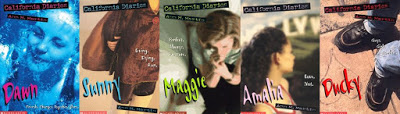

7. California Diaries.     I mention this series a lot, and last year I did a full post on them.  Suffice it to say…at a school in fictional Palo City, California, children are required to maintain journals. The series follows a year at the school, experienced through the lives of five kids — four  eighth grade girls and one 10th grade guy — who all have their personal drama, in addition to the stuff that happens to them.

8. Animorphs.  Another series I loved, this one had the added appeal of rebellion: my parents didn’t like the idea of them, so I came up with ways of buying the books without their knowing,  and traded paperbacks  so I could read more without having to buy more.   I also managed to buy a couple of VHSes when the shows became a series, but those were much harder to enjoy without parental knowledge. I think I had to watch them early in the morning when my mom was at yardsales.

9. Roswell High.   I’ve also given Roswell High its own post,  and like California Diaries it gets mentioned incessantly.

10. Fear Street. My sister collected these, and I don’t know if my parents knew what they were about. For a sheltered kid, I wound up reading an awful lot of grisly murder stories thanks to this series.  Oddly, they inspired me to write fiction of my own — stuff in the same genre, mostly monster, slasher, and ghosts.   The only one I remember clearly involved a monstrous spider living in a swamp.

Countdown.   I’d like to read this series again, actually: it was the most ‘mature’ series I read in my youth, following the aftermath of all the adults and kids turning into buttles of goo when the new millenium began.   So…it’s a world run by teenagers, who have to rebuild society and figure out WHAT THE HECK HAPPENED.

Posted in General | Tagged | 6 Comments

Progress report

Well, dear readers, we’re sixth months in to 2019, and that’s a good time to do a little check up on my challengs. 


First up,  Science!    For the past few years I’ve organized my science reading into diverse categories to stay out of my well-established biology/anthropology rut.   I’m doing well, with six categories fulfilled, one extra, and two other categories set with planned reads.    Right on target,  though one of the six has a review waiting.

Next…the Classics Club, or more specifically my ambition to read twenty of my remaining 21 books this year. April was a dead loss,  as Red Dead Redemption II  claimed all of my time: not only did I not read any classics that month, but I read very little altogether.     June…well, I’m still working on June. I’m halfway through two Hemingway novels, Catch 22 being unavailable.  (Also: I  dislike Catch 22. I’ve tried it at least two times in the last three years…)   I’ll get through them. Grapes of Wrath, July’s designated read, should be much easier: I’ve already read it once and know the story.   My copy of the book is the same I had in September 2001, when our English class discussion of the novel  was interrupted by breaking news in New York.  
And finally, the TBR of Doom:  I’ve read four books from it this year, so that’s subpar. I did strike quite a few books from the list when  I gave them to Goodwill, though, so I’ve made progress regardless.  
  I’d also planned to do an interesting “American Summer” series that focused on odd bits of American culture – the rise of distinctly American-Chinese food, the role of the Catholic church in the frontier period,   odds and ends like this – but I’ve imposed a moratorium on myself as far as buying books goes*, so…that’ll keep.  I’d like a few more in the set, anyway. 
 All told, I’d give myself a B-.  
*BookBubs discounts excepting. I’m never too scrupulous to pass by a $1 book. 

Posted in General | 2 Comments

The Thinking Man’s Gangster

Meyer Lansky: The Thinking Man’s Gangster
Revised and expanded reprint of Little Man: The Gangster Life of Meyer Lanksy 
457 pages
© 2019 Robert Lacey

There’s no such thing as a lucky gambler. There’s only winners and losers, and the winners are the ones who control the game.

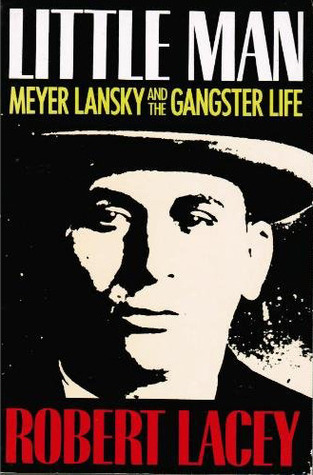
Meyer Lanksy is the mob associate of legend,  considered with Charles Luciano as the co-creator of the Commission governing the Sicilian mob in America. If Lansky had gone straight, an anonymous FBI agent is supposed to have said,  he could have been the chair of  General Motors.   Judging from Little Man, however,  that may not be the case: every time Lanksy tried to go straight, investing in television distribution or hotels, he lost money. Admittedly, it wasn’t always his fault; he wasn’t the only one to lose millions on Cuba when it went red.   Lanksy was, from childhood on, a gambler:  he had his introduction as a kid, watching craps games and realizing how it really worked, and  the whole of his fortune at his peak was built on casinos and gaming rooms — whether in Florida, Nevada, or Cuba.  But Lanksy wasn’t just the brains behind the brawn, the grey eminence in the background. Little Man  demonstrates that Lanksy was more than capable of being the brawn himself: he was a teenage union thug who  also tried to make a living for himself as a pimp — but then came Prohibition, and the partnership with Luciano that would get Lanksy running.   Robert Lacey’s biography is far more thorough than I had expected, though not in the most constructive of ways, and — presumably, given its sources —   cleans and makes  as presentable as possible its subject.

To  be sure, Lanksy is an interesting fellow, with a character much different from those of other gangsters or mob associates. When the FBI first began a detailed investigation of him, they found a quiet man who preferred good, but not flashy, suits — the kind that any respectable insurance broker or bank executive might wear.  The same was true for his house, which was comfortable but modest.  Lanksy himself was the epitome of self-control and reserve, so much so that his doctor thought such qualities were the cause of his stomach ulcers.   Lanksy left school early, but he was a devoted reader and used his adult wealth to retain a tutor.  The bulk of his illegal income, after Prohibition, came from gambling — and in the thirties and forties,  law enforcement largely turned a blind eye or was an active participant.   In the fifties, however, moral and red panics meant more stringent and targeted laws, active enforcement, and constant investigation into  Lansky’s deep-gray affairs.   Cuba allowed for a partial recovery, at least until Castro destroyed most businesses following his seizure of power —  and it was downhill from there.   The last stages of the book see a weary Lanksy taking refuge in Israel, only to be ousted after two years when he applies for citizenship; he’s eventually  apprehended while trying to make for Paraguay,  although in the resulting trial he’s acquitted. The state’s evidence consisted largely of testimony from a gross loan shark who few on the jury believed.  Eventually cancer would do what the state could not.

Lacey’s treatment of Lanksy is interesting; though not denying Meyer’s association with men who did evil things, sitting in the shadow of evil and cooperating with it to his own gain, he largely depicts Meyer’s business as being in the deep grey area, rather than darkly criminal.  Beyond his youth,  Lacey doesn’t depict Lansky as doing anything more than promoting gambling and dodging taxes,  which would hardly make him a bad guy in many readers eyes. I’m sure there was more to him than that, but one can’t deny Little Man’s depth of coverage into Lansky’s family life and the trials. The problem, I think, is that Lanksy’s accomplishments were  so under the table — no flashy murders or robberies, just subtle manipulation of funds — that there’s no positive evidence of him. Even his family didn’t even really know how much he was worth, since he seemed to live near poverty for much of his endgame despite the FBI claiming he was worth $300 million.   What I appreciated most about Lacey’s work is that he avoided the cutesey nicknames like Lucky and Bugsy in favor of proper ones, like Charlie and Ben. 

If someone is interested in Lansky and doesn’t object to  movies with violence, Mobsters may be of interest. I watched it during my Mafia obsession, bought it later on, and have watched it since.   Lansky is depeicted second on the left — without a Thompson. (In order, the actors are playing Charlie Luciano, Meyer Lansky,   Ben Siegel, and Frank Costello.) Of interest is the presence of Michael Gambon, playing one of the two bosses that Luciano disposes of on his rise to power.  The weird thing about this movie is that it refers to Marazano as Faranzano. I haven’t the foggiest idea as to why.

Posted in Reviews | Tagged , , , , | 10 Comments