Is Reality Optional?

reality

“The curious task of economics is to demonstrate to men how little they really know about what they imagine they can design.” – F.A. Hayek

From economist and cultural critic Thomas Sowell come this amusingly-titled collection of essays,  loosely gathered under the theme of pointing out inconvenient truths. The title caught my eye because society seems to become more of an obscene cartoon, a farce on the stage,  with every passing year. The essays are  presumably drawn from columns Sowell contributed to newspapers over the years,  spanning the seventies through the nineties, on a spectrum of topics:  sex ed, crime & punishment,  race, sex,  and the virtues of map projections. The title essay opens the book, as Sowell points to various movements within the US which, however well-intentioned in their motives, are unrealistic in their aims —  and irresponsible, as their actions affect not only them, but the public interest.  Also within the collection are sketches, intended as humor, with varying results.

Sowell is first and foremost an economist; I first encountered him via Basic Economics, and he uses economic principles to inform his critiques of society and culture,  particularly the observation that there are no solutions, only trade-offs. this not only means every action taken by a government, business, or person will have negative consequences,  it means we usually have to weigh things in the balance. Do we want safety?   How much safety? How many inconveniences are we willing to endure, how much are we willing to pay?   No two households come to the same balance, and will chose different options depending on how how much risk they’re willing to court, and how much money they’re willing to pay. The balancing act can be applied to anything, and it often appears in the essays — applied in his evaluation of a environmental movement, and its  useless denunciation of both fossil fuels and the only meaningful alternative, nuclear energy. (Solar & wind are not as expensive as they once were, but they’re not serious options for carrying the base load of any modern society.)

There is no point trying to appease the anointed by giving in on some particular issue they raise, because that only shifts the fight to some other issue. The basic underlying problem is that they do not live in the grubby world of trade-offs with the rest of us. They live in the loftier realms of their own minds where “solutions” prevail.

Sowell’s attitude is one of pragmatism and prudence:   it if ain’t broke, don’t fix it. People may experiment on themselves at their leisure, but trying on new social theories every other year is hubristic and irresponsible. Sowell points to the frequent changes in educational theory, in  crime mitigation, etc and to their repeated failures. Too often, he says, we replace what works with what sounds good. This is the third Sowell work I’ve read, and I find him of such great interest that I hope to continue exploring his considerable output as time goes on. Sowell’s perspective is especially powerful when writing on matters of civil rights and race, because he lived through the death of Jim Crow, the arrival of affirmative action, and so on.  As a black intellectual himself, he encountered and triumphed over both racism and ideologies which deny minorities real agency — instead insisting, ever so patronizingly, that they are the state’s wards who need special hand-holding.   (I’ve come to realize in the last ten years that the government acts like some demented jailer in regards to the working class….raising barrier after barrier to prevent people from prospering, like imposing cosmetology licensure requirements on hair-braiders, and then expecting worship when it offers half-cocked solutions to the problems of its own making — like helping the Saudis bomb Yemen, then offering aid to the survivors.  )

Unfortunately, although these essays date from the seventies, only their statistics are dated. Foolhardiness of past decades has been surpassed by even more outrageous social movements  and proposals today today, like the ‘green new deal’, a product so divorced from reality when its details are considered  that only a sheltered politician could propose it, and certain social movements in which mental issues are attempted to be ‘fixed’ by surgeries and chemical bombardment.  To believe that sex is malleable is to believe that reality itself has no substance, that the world can be made to confirm to our will.  It would be nice if we could transform the world that easily,  but reality   is obdurant. Evidenced by Sowell’s writings,   this is not a new problem with the human race, though it’s certainly a greater issue now than ever before.  At least the ancients knew that if one appealed to the gods to give them what they wanted, great sacrifice would be necessary. We seem to think it can happen with the simple passing of legislation, and the liberal application of other people’s money.
Posted in Reviews, Society and Culture | Tagged , | 6 Comments

Mary Roach in bed, Frank Underwood’s crib notes, and a love story for libraries

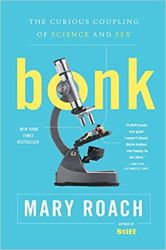
It’s been a week of …very different books here. First up, Mary Roach’s Bonk: The Curious Coupling of Science and Sex. All of Roach’s previous other works, all mostly-humorous attempts to review the science of taboo or often overlooked subject, have appeared here, and now the set is complete. After beginning with a history of how we have mostly ignored intercourse from a scientific point of view until the last century or so, Roach shares a series of narratives about her traveling across the world to meet various experts in this-or-that. The subjects included are on the niche side of things, and are often unexpected: I learned far more about pigs than I’d expected to. Roach’s works are not generally structured (the exception being Gulp, but a book on the digestive system does come with an obvious ‘tract’ to follow — in one end and out the other), and this is par for the course. If you want more..er, specifics, there are more detailed reviews on goodreads. Awkward and amusing in turn.

dict
Recycling an image! I’m so green.

Next, and one I’ve been dragging my feet through for weeks, is The Dictator’s Handbook, easily the most depressing book on politics I’ve ever read, though its lessons on power dynamics apply equally to any large organization, be it a Fortune 500 company or the Sicilian mafia. The authors open with the suggestion that instead of trying to understand politics through conventional means, ideology and whatever tall tales being paraded about on television, we should view it instead as an exercise in practical, grim self-interest. Politicians pursue whatever course is most personally expedient to them, whatever allows them to pay off their supporters and stay in power. The payoff can be obvious loot, in the case of dictators, or more subtle in the case of democracies. The authors’ core lesson is that we must view political support in terms of essential supporters, influentials, and interchangables; autocracies and corporations that rely on only a small handful of essentials behave very differently from democracies and corporations with larger boards, though the authors caution us against relying too readily on labels: often democracies have an underlying structure that makes the number of essential supporters far smaller than it actually is. In the case of Iran, for instance, the people do choose between opposing candidates — but those candidates were prescreened by the Guardian council. Even in a ‘real’ democracy, though, the savvy politico can get away with an astonishing amount of graft. Instructive and soul-scarring.

Lastly, I read Palaces for the People, which caught my eye instantly given its use of Andrew Carnegie’s description of libraries. Eric Klinenberg concerns himself with “social infrastructure”, or the places that draw people together in a community and allow them to encounter by chance or design, people who are different from them — and build a rapport or even friendships through repeated encounters or casual activities. Drawing on the social science of Robert Putnam (Bowling Alone: The Decline of American Community) and the urban analysis of Jane Jacobs (The Death and Life of Great American Cities), Klinenberg argues that one of the reasons American society is so bitter and divided these days is that support for places like libraries that build community is disappearing. Although he’s primarily thinking of falling public funding for libraries, parks, etc, it sometimes brushes against the Jim Kunstler’s Geography of Nowhere first made this point, though his own scathing rebuke of American sprawl, with its worship of efficiency and isolation, is not cited here. The book hits a sweet spot for me, and not just because libraries are worshiped in nearly every chapter, but it needed more heft, or focus: the most salient lessons of the book apply to the importance of community in general, and place in giving people meaning, support, and identity. Klinenberg looks at only a small piece of a much larger problem. Even so, I greatly enjoyed the new material here, like the role of community in public health; that connection is made several times here, most poignantly in the chapter on the opioid crisis.

Posted in Politics and Civic Interest, Reviews, science | Tagged , , , | 8 Comments

Firefly: Generations

Firefly: Generations
© 2020 Tim Lebbon
384 pages

A map won in a card game, given importance by River’s intuition, Kaylee’s recognition of an old name, and the fact that several people tried to murder Mal to take the map back, leads the crew of Serenity beyond settled space — to the rings of a gas giant where something ancient is waiting for them. Could it be possible that some remnant of Earth that was is still intact? If the rumors are true, and there is a derelict colony ship out there for the salvaging, Mal and the rest could finally get the One Big Score they’ve been needing after months of scraping by. Generations provides a tantalizing look at Firefly’s background in another novel involving the crew, but will be more memorable for its premise than its execution.

The previous three Firefly books all featured strong ensemble showings and an excellent grasp of the crew’s mannerisms and voices. Generations, with a different author at the helm, doesn’t live up to those standards: Book and Inara disappear early on, and while the Firefly folks are definitely recognizable the energy is definitely different. Even Zoe puts in a subdued performance. That said, the premise of the novel was a winner, and I enjoyed seeing Kaylee as someone secretly fascinated by stories of Earth-that-was. For her, the idea of seeing an Earth engine, of walking in corridors deserted for centuries, is awe-inspiring. The plot also connects more immediately to Firefly’s backstory, and at one point the crew are menaced by “Two by Two, Hands of Blue”. I can’t speak for other readers, but I would have been more interested in a plot that was more unique and tied to the derelict, rather than giving River more background. She’s a great character to play with, but she borders on being over-emphasized in the books.

In summation, Generations is enjoyable enough, but not

Posted in Reviews, science fiction | Tagged , | 3 Comments

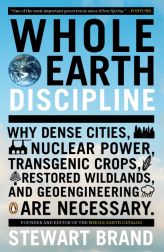
Whole Earth Disicpline

Whole Earth Disicpline: An Ecopragmatist Approach
© 2010 Stewart Brand
344 pages

Sustainability is context, not a gadget or a single technology. From Stewart Brand, a lifelong environmentalist and creator-editor of the Whole Earth Catalog, comes this fascinating argument that the environmental movement has for too long been wrapped up in romanticism, rejecting avenues to effective change out of misfounded prejudice — particularly nuclear energy, urbanization, and GMOs. Discipline is a constantly-evolving work, with multiple editions and added content that stray from the original premise, but offers a unique, balanced perspective.

Brand opens with the book by stressing the urgency of action, pointing in particular to positive feedback loops in nature which might quickly accelerate catastrophic environmental & climactic changes too quickly for us to adapt. We must adopt a trident approach: avoidance, mitigation, and amelioration. When one of the largest contributors to emissions (and pollution in general) is the use of coal, shifting to nuclear — with zero emissions and whose lifetime toxic output per person per lifetime amounts to material small enough to fit inside a can of Coke — would have an enormous impact on reducing C02 emissions. Cities and GMOs both tremendously relieve pressure on land and natural systems by allowing us to do more with less, and in the case of cities, innovation and wealth both are increased tremendously, opening options for responding to problems as they appear. If we were to take these seriously as anti-climate tools, we could do far more still: imagine cities with rooftops optimized for reflecting heat instead of absorbing it, or engineered bacteria which could digest and render neutral pollutants. Brand also addresses the criticisms levied against these (nuclear energy and GMOs, as he has not always been a proponent: he confesses to being one of the environmental movement’s most active anti-nuclear proponents in this youth, and it’s only through his study of their case – -including visits to places like Yucca Mountain — that he has changed his mind to argue that nuclear is potential gamechanger. In each chapter, Brand addresses common criticisms of nuclear power, genetic modification, etc, and shares how he came to change his mind based on what he’d studied and observed.

Having previously read titles which argued for the green virtues of both nuclear energy and cities (A Bright Future and Green Metropolis, respectively), I was delighted to find a dyed-in-the-organically-sourced-wool proponent of the same. The book wasn’t as focused as I initially expected, but given the open nature of the book (it’s had multiple editions, and its footnotes are hosted online to ensure currency), that’s not an enormous surprise. The last few sections seem more miscellaneous, and honestly the GMO connection to environmentalism is weak: as someone who used to be more critical of them, I appreciated reading an argument in their favor from someone who had shifted in their opinion. While Whole Earth Discipline is surpassed, content-wise, by the books mentioned previously, it has an unparalleled value in that its author has changed their mind about the issues and can see both sides fairly and argue on facts rather than prejudice and sentiment.

Posted in General | Tagged , , , , , | 4 Comments

Drowning in books

This is something of a catch-up post. I’ve been slowly reading The Dictator’s Handbook, an impressively cynical analysis of political science, and had hoped to finish it by Election Day so I could post an amusingly-timed review. Between the hurricane and my own fatigue of the topic, though, I’ve just been plodding. I need to finish it up, though, because I’ve had three library holds come in simultaneously, as well as two books arrive in the mail. Oh, and one of my preorders (Kindle) was just delivered.

In read-but-not-reviewed, during the power outage I finished re-reading Prelude to Foundation and Harry Potter and the Philosopher’s Stone. The latter is noteworthy because it’s actually the British edition. I didn’t realize how attached I was to the distinctive font and illustrations of the first American editions until I began reading that one. I bought it to see if the vocabulary was very much different in that one, but the only thing I noticed was “jumper” instead of ‘sweater” — and I don’t even know if the American first edition even used sweater! Prelude was a re-read from twelve years ago, and this time I noticed how Asimov deliberately did more world-building and sociological commentary, creating distinct regional cultures on Trantor and using it to more firmly tie the Foundation and Empire books together. New to me was David McCullough’s The Pioneers, a history of the settlement of the Ohio-Indiana region which focused on a couple of families who were instrumental in establishing its institutions. It was more biographical than topical, I thought, without much dwelling on the challenges of frontier life. Perfectly enjoyable, but not as stellar as I expect from McCullough.

And what’s up the pike? Well, I’m reading The Dictator’s Handbook and a charmingly-titled book called Un— Yourself, which mostly consists of “Stop whining and do something about it”-type advice. In holds, I’ve got Palaces for the People, on “social infrastructure”; Blood, Bones, and Butter which I will leave to your imagination because it’s more amusing that way; and Talking to Strangers. Firefly Generations is an ebook preorder that just zapped its way onto my phone, and two new books for the Pile of Doom are Big Roads (a history of the interstates) and Whole Earth Discipline, the latter a title on sustainable living that involves big cities and nuclear energy.

It’s a good thing I still don’t have internet access at home, because I wouldn’t have a chance at tackling all this were I to be distracted by youtube!

Posted in General, history, science fiction | Tagged , , | 7 Comments

Top Ten Nonbookish Hobbies

Today’s TTT should be especially fun, and perhaps more varied than these lists usually go – -we’re talking about Nonbookish Hobbies!

  1. PC Gaming. A hobby, a vice, call it what you will; if I’d put as much time into anything as I’ve put into gaming over the years I’d be a master. I don’t know if my perfect mastery of Mafia’s vehicle physics counts. I mostly play games that let me fart around, either by exploring an open world (GTA, Mafia, RDR2) or by giving me a sandbox to play with (The Sims, SimCity 3000, ). I tend to play games I get a lot of mileage of: many of my favorites I’ve played regularly for nearly twenty years, and I don’t mean series but games themselves. (Civ3, The Sims 2,and Mafia).
  2. Photography. Although I’m not a serious shutterbug (I don’t own a camera with detachable lenses, and I can’t tell you the first thing about exposure or shutterspeed, anything like that), I occasionally have a good eye for shots and am perfectly willing to wake up at four am on a vacation so I can take advantage of the right light. This frequently dovetails nicely with…
  3. Hiking. Although my area of Alabama is fairly featureless, there are a few trails within driving distance and more than I can count in northern Alabama. I’ve enjoyed hiking since middle school, when I joined the Boy Scouts (ever so briefly, the local troop didn’t do much besides play kickball). A coworker of mine and I try to go out at least once a month.
  4. Cycling. This one is more occasional, as my area isn’t particularly cycle-friendly: the few times I’ve tried cycling into town I’ve nearly been hit by large trucks and the like. I keep my eyes open for quiet country roads that I can wheel about on, though!
  5. Singing. I don’t know if singing counts as a hobby so much, but I do it every day, and have been since I was a kid in church. I favor older musical styles that emphasize melody and lyrics, so I’m especially given to Sinatra standards, hymns, and folk songs. My interest in folk music was inspired by both Star Trek (“The Minstrel Boy”, featured in TNG “The Wounded”) and Civil War reenactments.
  6. Cooking/baking. This is a newer hobby, something I’ve been interested in trying for years but never did until late last year when I wanted to impress a woman. I’ve been trying new recipes this year and keeping notes in an Excel spreadsheet, and am looking forward to contributing to our ongoing obesity and diabetes crises in December by giving everyone cookies.
  7. History. “History” is an odd one because it interlaces with a lot of my other hobbies; reading being the prize example, but it’s also mixed up with my singing interests. I often listen to historical recordings, or recreations of what earlier music might’ve sounded like. For me, knowing the literature and songs that formed people’s minds in earlier decades and centuries is an important part of understanding them. I also visit history museums and sites when I can, and if I can get moving on a video project I have in mind, then history will also form the backbone of another minor hobby, since it would be the subject.
  8. Writing has been a lifelong passion, presumably fed by my similarly-aged passion for reading. Although my brain is constantly playing with stories in my head, I absolutely hate reading every attempt at fiction I’ve ever made. Maybe it’s the equivalent of hearing yourself talk in a recording? Mostly I scratch my writing itch here, though I also do Nanowrimo from time to time.
  9. Cinema, or “movies” if I’m not being pretentious. I know everyone likes movies, but when I’m watching I pay attention to the production side — to how shots are created, to sound design, to plotting and the like. I also enjoy watching cinema-related channels that discuss this sort of thing on youtube. I’m not much for the big blockbuster titles; I’ve seen few superhero movies since The Dark Knight Rises, and my last Avengers title was…The Avengers. My favorite films include The Philadelphia Story, Groundhog Day, and West Side Story. Not very highbrow, I know, but I like what I like. Two I’ve seen for the first time this year that I’ll absolutely watch again are Noises Off! and Clue.
  10. PC modding/repair. I got into messing around with PC innards after my nephew bought an oversized graphics card to upgrade his computer, and I wished I could have helped him avoid that expensive mistake. So last year I learned, and I practiced on both my PC and some older units I had lying around, replacing a hard drive here, an optical there, and upgrading several parts in my own PC. This particularly hobby has stalled in 2020 because I was saving for a new car (and am now paying for a new car), and my next potential upgrade requires buying several parts together. (If I want a better chip I need a better class of motherboard, and if I buy a new motherboard I can’t use my existing RAM, but new DDR4 sticks.) There’s also the problem of diminishing returns: the only upgrade that would have a significant and instantly noticable effect on my life would be switching to an SSD. I plan on doing this once the price for a 2-terabyte SSD isn’t so high. (Here’s hoping for black friday luck!)

Posted in General | 10 Comments

Scaling Mount Doom: October 2020

So hey, it turns out having COVID is really good for working on one’s literary goals. I realized when trying to reconcile my list with goodread’s that I never reported reading The Demon’s Brood: A History of the Plantagenet Dynasty here, which was technically a TBR since I bought in March for Read of England, and then never got to it. That was a September read!

TBR Books Read in October (Previous Month: 11)

The Persian Puzzle, Kenneth Pollack. Purchased in St. Augustine in…2017, I think.
The German War: A Nation Under Arms, Nicholas Stargardt. Purchased Sept 2018.
Command and Control: Nuclear Weapons, the Damascus Incident, and the Illusion of Safety, Eric Schlosser. Purchased on sale in 2019.
Any Approaching Enemy: A Novel of the Napoleonic Wars, Jay Worrall. Purchased in early 2020 for Read of England.
Navajo Weapon: The Navajo Code Talkers, Sally McClain. Lent to me in March 2020, right before the bottom fell out. I’ve been meaning to read it so I could give it back…
Star Trek Vanguard: Storming Heaven, David Mack. Purchased on sale in…2018.
Star Trek Vanguard: In Tempest’s Wake, Dayton Ward, Ditto.
Who Killed the Constitution?, Tom Woods & Kevin Gutzman. Purchased June 2017.
A Bright Future: How Some Countries Have Solved Climate Change, Joshua Goldstein & Staffan Qvist . Purchased in late ’18 I think.
The Pioneers: The Heroic Story of the Settlers Who Brought the American Ideal West, David McCullough (picked up at library bookstore in early 2020)

TBR Scheduled for November
Atomic Awakening: A New Look at the History and Future of Nuclear Power, James Mahaffey
Forgotten Continent: A New History of the New Latin America, Michael Reid

Reward Books Purchased:
The Big Roads: The Untold Story of the Engineers, Visionaries, and Trailblazers Who Created the American Superhighways, Earl Swift
Whole Earth Discipline: An Ecopragmatist Approach, Stewart Brand

Posted in General | Tagged | 2 Comments

Zeta Aftermath

Well, when my coworkers and I bid each other goodnight on Wednesday, we didn’t realize it would be nearly a week before we came back! Although we knew the system was headed our way, we’ve had so many gulf systems impact us this year that it was difficult getting worked up over yet another. We did the library equivalent of battening the hatches (throwing tarps over our bookcases in leak-prone areas) and went our separate ways.

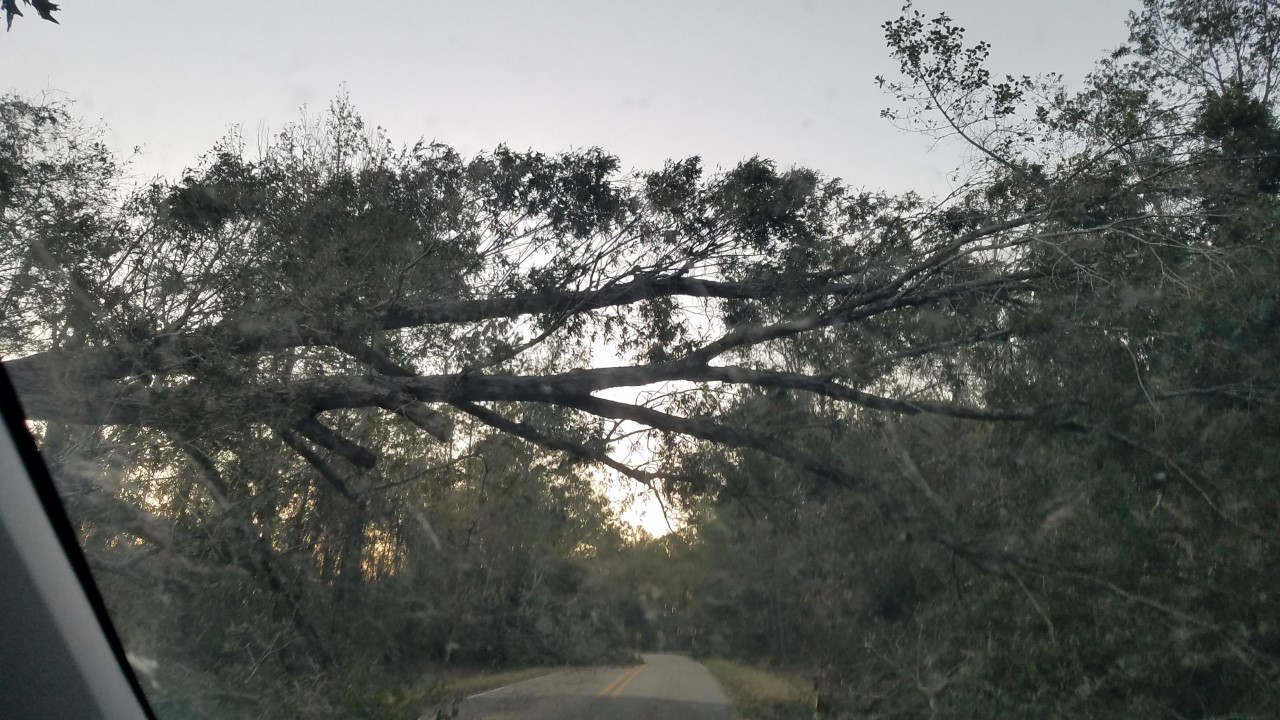
Tree slalom, soon to be added to rural sports like hunting and mudding

I fully expected Zeta to be nothing but wind and lots of rain, same as the other hurricanes that have come our way this year. The wind picked up before midnight, and we lost electricity roughly around that time. I still remember the wind from Hurricane Ivan, back in 2004, and the ominous constant popping of trees in the pine forests around my grandmother’s house. This time, the wind itself drowned out any sounds of falling timber: it sounded like the sustained rumble of a passing train, and at first I thought it was: where I live, it’s not unusual to hear the trainyard, either from passing freighters or from cars crashing into one another as a train is built. But this roar lasted nearly three hours, with more distinct bursts of wind.

While one of my housemates monitored the storm on their phone, the other pair of us stood watch on the porch in hopes of being forewarned if a tree was about to fall. The wind was exhilarating at first, but with so much stuff flying around we wound up standing just inside the house with our heads peeking out. By three o’clock, the worst in our area was over. Having been surprised by the wind, I was relieved that nothing had fallen on the house or our cars — especially my new one!

The road is completely covered by trees. That dirt area to the side goes up a hill where some people live (and who were trapped there by treefalls further up the dirt path) , but I could get around the side here.

From phone calls throughout the night and early the next morning, I realized that I’d been stupidly lucky: many of my relatives had trees on their homes or cars, and at the “family home” (where my grandparents began keeping house and having kids, now one of my aunts lives there), the big shed was wiped out when the massive pecan fell. Everyone was out of power, and a lot of roads were impassible. I therefore kept put that day, reading The Pioneers by David McCullough and cooking up all the breakfast sausage in my fridge to prevent wastage. I avoided using my phone, but late that evening once I’d learned that one highway was clear, I went for a drive there to recharge. I found that one town in Elmore was apparently untouched, with its lights shining bright, so I used that to start checking on people and check in.

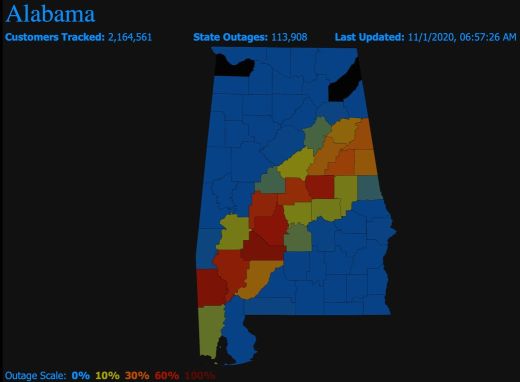
Guess what path the hurricane followed.

Because I still had water and gas, I sat far more comfortably than most who are or were still powerless: my eldest sister, for instance, is reliant on electricity for her well water, and since her county was one of the two hardest hit, she’s been having to fill up jugs of water from other places for daily cooking and cleaning, and use a propane setup to heat them. (I think for Christmas I’ll give her a rain barrel…). On Thursday night, I checked a few stores that stock camping supplies in hopes that they had a fireside percolator: they didn’t, but they might have originally. The camp stoves and propane/butane canisters were all sold out in the three places I checked. I did buy instant coffee for the first time; I found it tolerable when I tried it Friday morning.

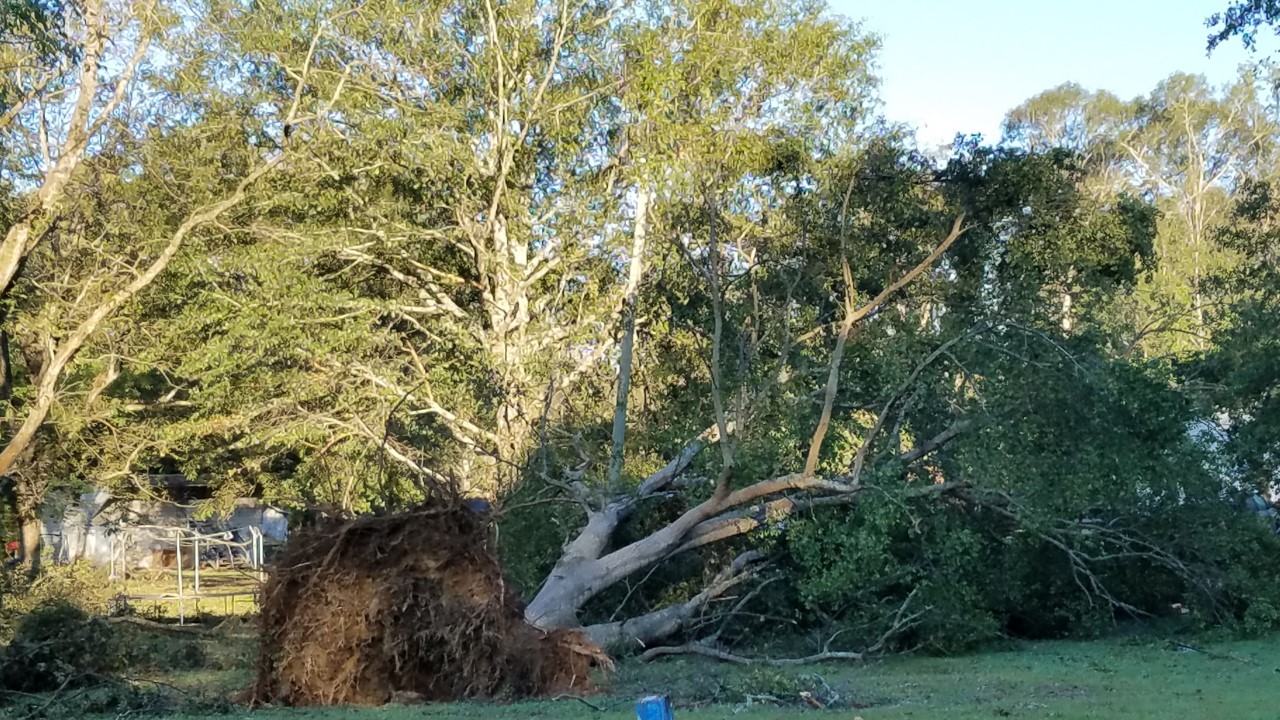
Not even Ivan felled this many trees in our county.

My Zeta experience has been relatively mild: no damage to my home, and no serious inconveniences that I wasn’t prepared for already by having a gas cooking setup and canned goods at the ready. I rather enjoyed being able to talk to neighbors on my morning walks, who would otherwise be inside planted in front of televisions and the like, and I spent of the weekend hanging out with powerless friends and enjoying the “eat it before it thaws and ruins” feasts of sausage and the like. Part of me liked the roughing it, seeing the house lit with lamps and watching the stars come out, no longer drowned by the many amber lights of my neighborhood. That said, I was very relieved to come home from a night with friends on Friday night to find lights on….if only for music!

Posted in General | 4 Comments

Zeta

Zeta hit last night. Surreal 3 hrs, I will say. Total power loss in county. Will be days before I’m back online. No damage to my home but many friends and famy were not so lucky. I’ve been cleaning up my yard today, dragging tree sized limbs into woods. Drove to a walmart several counties away to use wifi and charge my phone on the drive. Hope to post from pc before next week.

Posted in General | 12 Comments

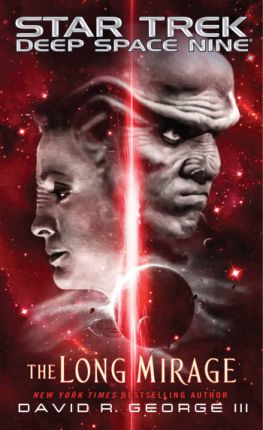
ST: The Long Mirage

Star Trek Deep Space Nine: The Long Mirage
© 2017 David R George III
300 pages

Bajor is a planet in crisis, as a sect which argues that that Prophets are not gods is growing in prominence, commingling with the revelation that one of Bajor’s moons is a construct, with an apparent connection to the wormhole. Into this controversy, Kira Nerys has re-appeared after several months missing in the wormhole, where she experienced years of another life, one spent freeing slaves in Bajor’s distant past. Onboard Deep Space Nine, things are less fractious, but trouble could be in the offing: as Quark and Ro Laren travel in search of a missing Morn, and Nog works to save a friend from oblivion, a Jem He’Dar cruiser is on course for the station from the Gamma Quadrant. Although I haven’t kept current with the Niner relaunch books since The Fall series (read in 2017-8, pub. in 2013), through recaps and a strong emphasis on character-stories, David R. George III kept me nose deep in this one.

Three separate stories hurtle along in The Long Mirage, but what invested me as a reader who knew nothing of what was going on was the characters. Kira, Ro, Quark, and Nog are the primaries here, and one of the subplot concerns the fate of Vic Fontaine, which delighted me to end. Vic is the arguably sentient lounge singer who everyone on DS9 regards as a friend, but something went wrong after the original DS9 was destroyed, and one of the threads involves both holoengineering and the Vegas mob. One of the reasons I haven’t kept current with Niner lit despite it being my favorite series is that I’m profoundly un-interested in the long-running Bajoran religious drama arc that’s been going for what seems like a decade. But because Kira had reappeared from the wormhole in the midst of it, and feeling as though she was there for a reason but uncertain what it could be, I found it compelling if only for her part in it. The B&C plots unexpectedly converge, and it’s in the Ro-Quark arc that I found the novel at its most compelling, in showing off how these characters have matured so greatly in the last ten years.

The Long Mirage is far and away my favorite Trek novel this year, something of a feat given how much of its backstory I needed to absorb through recaps and my own googling. (The book directly follows Sacraments of Fire and Ascension.) It helps to center on some of my favorite characters, of course (Kira and Ro, especially), but the amusing link between Quark’s attempts to find Morn, and Nog’s mission to recover Vic, really gave the book’s last half new energy.

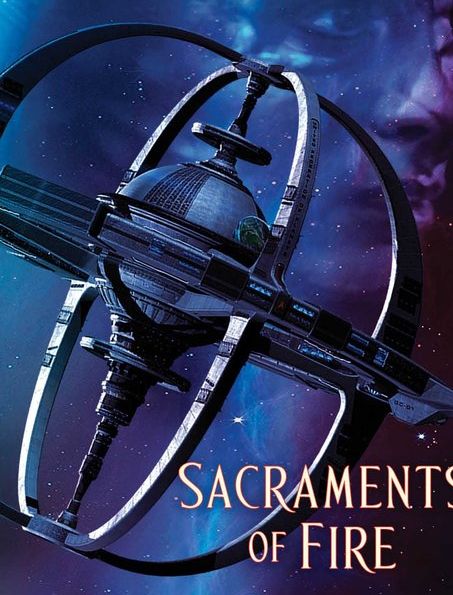
Oh, and this is what the new station looks like. Love how it evokes the original!

Posted in Reviews | Tagged , , | 2 Comments