
Napoleon: Life and Legacy
© 2011 Alan Forrest
403 pages
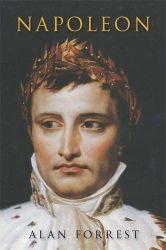
Napoleon is an unavoidable figure of European history, and enjoys no shortage of admirers even today. For years he dominated a continent, using native talents given abundant opportunities opened by the revolution to make himself and his family into Europe’s leading royal family — for a time. Napoleon is a highly accessible survey of his his life and work, with a focus more on politics than military matters, which also examines (in brief) his enduring legacy, as l’empeurer continues to fascinate us.
Much of Bonaparte’s origins are well known to educated readers: his family upbringing on a small island named Corsica, linked to Italy by culture by annexed by France only a few years before Bonaparte’s birth. Between masters Corsica was an independent Republic, and the Bonapartes established themselves as prominent members thereof. That exercise in republican government had been crushed by the time Napoleon came of age, but it left its mark — and when he began working for his and Corsica’s future, it was through the new French Republic, in service as an artillery officer. The French revolution overthrew the nobility and church, and gave French society the chance to recreate itself. although it mostly committed itself to a prolonged spat of self-destruction. Napoleon’s rise to power through his proven talents on the battlefield during the early Wars of the Coalition is fairly boilerplate, but Forrest also introduces readers to Napoleon as a young man, a pseudo-intellectual, writing revolutionary tracts. Napoleon’s pretensions would grow once he’d become First Consul and Emperor, having himself included in the ranks of the French academy.
Napoleon is only a brief survey, so military campaigns are not considered in depth; battles like Abukir, Jena, Austerlitz, etc are dispatched in a sentence or two. Waterloo proves an exception, earning a few paragraphs. Forrest keeps context in view, providing commentary on the ever-evolving Empire, beginning as it did with a militant republic and taking on another form altogether. Forrest notes with surprise that the French people weren’t fussed in the least about the last vestiges of the Republic being scrapped and a new monarchy imposed. Possibly this owes to Napoleon’s new creature in the Empire, which mixed revolutionary ideas with some nods to the past. One example of this would be the Concordant with Rome, which ended the revolutionary efforts to destroy every aspect of Christian culture and Catholic influence from France, but at a price: the Church would henceforth be markedly subordinate to the State, and those bishops who had actively resisted the revolution were barred. Only quisling clericals were allowed to remain in their offices. Although Napoleon was not a friend of republican government or Enlightenment-era liberalism, his status as a usurper meant that he had to obtain legitimacy through compentency, and his commitment to staffing the Empire with the most able men he could find (so long as they were loyal) created the buzz of a meritocracy in Napoleonic Europe. As Forrest notes, during Napoleon’s hundred day comeback tour, l’empereur acknowledged his imperial abuses and pledged himself to the straight and narrow, resuming the good fight against the resurrected abuses of the Bourbon restoration. This, Forrest argues, is part of the Corsican’s enduring popularity in France: he was reinvented as a standard bearer of republicanism against the heavy weight of inefficient and arbitrary traditional authority in Europe.
Although I hadn’t expected to read this book (a patron ordered it via ILL and it caught my eye before I sent it back), and although I’m not a fan of Napoleon, I rather enjoyed this survey. I especially appreciated Forrest’ efforts to deliver a full picture of Napoleon, his times, and the nature of the empire he and so many others forged, rather than being bogged down with countless reviews of military maneuvers.











 Reading Freely