Germans: terror and tedium

In the past week I’ve read or mostly-read, in the case of The Vampire Economy, two books with a German connection.
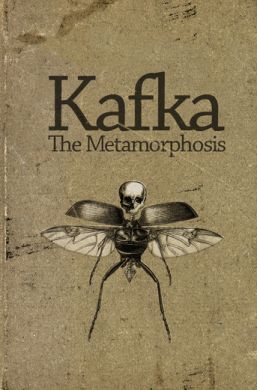
The first, The Metamorphosis by Franz Kafka, was by far the most interesting of the two. I read this almost entirely thanks to Marian’s interest in Kafka. The book is more a short story, and opens with a poor man (Gregor Samsa) who during a night’s sleep has turned into a hideous vermin, one with a hard back and lots of sticky little legs. How or why this happened isn’t the point of the novel: instead, it visits how poor Gregor and his family deal with this sudden inexplicable horror. There’s a layer of surrealness here, as once Gregor has realized that yes, his body is not what it once was and that no, staying in bed won’t help, his thoughts fix on how on Earth he can get dressed and go to work as a salesman now. Surprisingly, his employer is just as obsessed with this question as he is: fifteen minutes past the time he was expected at work, someone arrives at his apartment to scold him for playing hooky. Although Gregor looks horrible on the outside, the reader never confuses this with Gregor’s true nature: although he has been caught in the rat race, plowing away at a job he doesn’t especially like, he does it for noble purposes, to support his aging parents and little sister — and it’s the sudden loss of his income, not necessarily his reduced dating prospects or new dietary challenges, that Gregor mourns. The story has a tragic ending, but it’s one worth reading and thinking about.
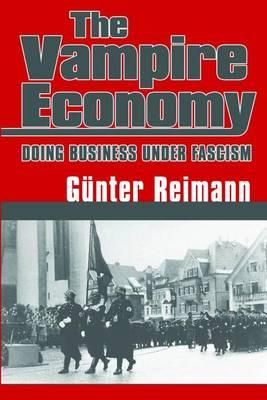
Far less compelling was The Vampire Economy, an extremely detailed analysis of how Nazi policies deformed the German economy through the Hitler years. When I say extremely detailed, every chapter examines some narrow economic subset — bank managers, industrial planners and the like — and comments in depth on how these businesses were changing as a response to Nazi policies. The book was published in 1939, so its critique of the Nazi state is based on its economic malpractice rather than Hitler’s expansionism or his murder camps. Most interestingly, the author was a Communist resistor to the Nazi state, giving additional heft to his observation that the Nazis’ economic policies were no more market-friendly than Stalin’s; in both cases, the economy was stretched, rearranged, and generally contorted in the hopes of meeting the political authorities’ national goals, with deleterious and sometimes absurd results. (Absurd, like businesses who were unable to obtain rubber because of military directives buying new cars instead, then using the tires and scrapping the vehicles. Imagine how badly deformed an economy is when buying an entire car is more cost-effective than bribing officials to buy the rubber outright!) The general effect is that all else fell to an aristocracy of pull; businesses were forced to hire advisors who were a mix of lawyer and salesman, finessing Nazi authorities and giving businessmen advice on how best to navigate the obstacle course. Although the book clearly demonstrates how Nazi economics was in the same family of economic garbage as Lenin-Stalin-Maoist approaches, it’s so detailed that the casual reader may tire of the repeated lesson.

Achtung! Excerpts!

“When we consider that Hitler himself came not from the ranks of organized labor, but from the ruined middle class or the fifth estate, what guarantee have we that he will not make common cause with the bandits whom he has put into uniforms? The difference between this and the Russian system is much less than you think, despite the fact that officially we are still independent businessmen. […] Some businessmen have even started studying Marxist theories, so that they will have a better understanding of the present economic system.”

“The capitalist under fascism has to be not merely a law-abiding citizen, he must be servile to the representatives of the State. He must not insist on ‘rights’ and must not behave as if his private property rights were still sacred. He should be grateful to the Fuehrer that he still has private property.”

“Under fascism, it is not primarily the power of money which corrupts, but rather does corruption spring from the power of the State. Whereas in democratic countries the businessman may use his money to influence legislation and public opinion and thus operate as a source of power and corruption, in fascist countries he can exist only as the subject upon whom State power operates. The corruption in fascist countries arises inevitably from the reversal of the roles of the capitalist and the State as wielders of economic power.”

“In the old days he decided for himself what he should buy and where he would sell, without asking anybody for a permit—especially not someone residing in Berlin. Today he cannot move hand or foot without a permit or certificate, quota or allowance. He cannot make the smallest purchase abroad without first taking into account a hundred new decrees and laws and filling out a score of application forms and petitions. No longer is his the pleasure and profit of buying raw materials abroad when they are cheap; he can buy only when he can get foreign currency.”

“The skill of the firm’s representative in advertising its patriotism and military fervor is often more important than anything else as a means of impressing a patriotic bureaucrat who makes the decisions of the distribution board.”
Posted in Classics and Literary, General, Reviews | Tagged , , , , | 3 Comments

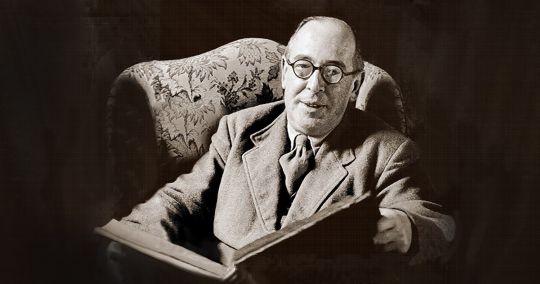
CS Lewis, a reader’s gift to readers

Recently, while slogging through a dull but sometimes promising book, I turned to Lewis for help: relieve me, Jack, from the tedium of Nazi economics! He delivered, though my review will wait until the Lewis-themed week coming up in a few…

“Those of us who have been true readers all our life seldom fully realise the enormous extension of our being which we owe to authors. We realise it best when we talk with an unliterary friend. He may be full of goodness and good sense but he inhabits a tiny world. In it, we should be suffocated. The man who is contented to be only himself, and therefore less a self, is in prison. My own eyes are not enough for me, I will see through those of others. Reality, even seen through the eyes of many, is not enough. I will see what others have invented.”

“Literary experience heals the wound, without undermining the privilege, of individuality. There are mass emotions which heal the wound; but they destroy the privilege. In them our separate selves are pooled and we sink back into sub-individuality. But in reading great literature I become a thousand men and yet remain myself. Like the night sky in the Greek poem, I see with a myriad eyes, but it is still I who see. Here, as in worship, in love, in moral action, and in knowing, I transcend myself; and am never more myself than when I do.”

“The first demand any work of any art makes upon us is surrender. Look. Listen. Receive. Get yourself out of the way. (There is no good asking first whether the work before you deserves such a surrender, for until you have surrendered you cannot possibly find out.)”

“Naturally, since I myself am a writer, I do not wish the ordinary reader to read no modern books. But if he must read only the new or only the old, I would advise him to read the old. And I would give him this advice precisely because he is an amateur and therefore much less protected than the expert against the dangers of an exclusive contemporary diet. [….] A new [theology] book is still on its trial and the amateur is not in a position to judge it. It has to be tested against the great body of Christian thought down the ages, and all its hidden implications (often unsuspected by the author himself) have to be brought to light.”

“We may be sure that the characteristic blindness of the twentieth century—the blindness about which posterity will ask, ‘But how could they have thought that?’—lies where we have never suspected it, and concerns something about which there is untroubled agreement between Hitler and President Roosevelt or between Mr. H. G. Wells and Karl Barth. None of us can fully escape this blindness, but we shall certainly increase it, and weaken our guard against it, if we read only modern books. Where they are true they will give us truths which we half knew already. Where they are false they will aggravate the error with which we are already dangerously ill. The only palliative is to keep the clean sea breeze of the centuries blowing through our minds, and this can be done only by reading old books. Not, of course, that there is any magic about the past. People were no cleverer then than they are now; they made as many mistakes as we. But not the same mistakes. They will not flatter us in the errors we are already committing; and their own errors, being now open and palpable, will not endanger us. Two heads are better than one, not because either is infallible, but because they are unlikely to go wrong in the same direction.”

Posted in quotations | Tagged , | 1 Comment

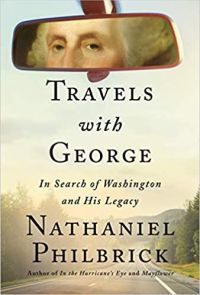
Travels with George

Travels with George: In Search of Washington and his Legacy
© 2021 Nathaniel Philbrick
400 pages

Travels with George couldn’t help but be interesting, what with its premise of the author following George Washington’s footsteps in an reenactment of his tour of the  united States during his first term in office.   Its promising mix of history and travel is marred (to what degree may be determined by the reader’s taste) by the author’s frequent inclusion of irrelevant stories about himself, and even more chronic infusion of contemporary politics with the text.    As a work of history,  I was not impressed in the least by the text, but it was frequently interesting, comparable to Sarah Vowell’s history tourism but with her dry humor replaced by constant fretting ruminations on slavery and American history. 

Washington is the American Demigod.  His stature dwarves all others, and countless places in the United States are named in his honor – including a certain city along the Potomac which hasn’t deserved the honor in decades.   Philbrick took this journey in hopes of meeting the human Washington, however, the traveler who would be grappling with storms, delays, and bad taverns, not necessarily questions of national consequence.  Washington’s role as President and Father of his Country sat on him regardless of travel demands, though, for as the Constitution was still being ratified by two last holdhouts, the new polity’s nature was his to imbue with authority and legitimacy.  His ‘journey’, or rather journeys, were practical in that Washington had to travel to the moving capital – first to New York, then to Philadelphia, and then to a site upon the Potomac that would be called the Federal City in its first decades    Although the author is ostensibly focused on covering Washington’s horse-and-carriage tour of the nation, a lot of other revolutionary and other history is woven in,  some of it connected to Washington and some not. (The author keeps trying to work in Henry and Bess Truman, as well as John Steinbeck, into the text,  when he’s not sharing his own travel experiences, few of which are interesting except for his sailboat encounter with a tornado while sailing to Newport.)  

Despite its flaws, I mostly enjoyed Travels with George, largely because of its premise and the strength of the central subject, who I count  as one of the most admirable men in history.  I found it deeply flawed, though, both by Philbrick’s inability to stay on topic and by his very-Whig history approach to the national story.  Most odiously, he dismissed all critics of the early Constitution as southern slaveholders, as though Sam Adams and Luther Martin didn’t exist, and that no motives could possibly exist for opposing the centralization of power aside from the self-interest of an economic minority.  (Author is also apparently oblivious to the existence of southerners besides the slave-holding patricians,   as are most people. Vanishingly few books have been written about southern yeomen or poor whites.)     While I don’t necessarily recommend the book,  it’s enjoyable enough, and there are numerous drinking games which could be fabricated from the author’s frequent mentions of his dog, irrelevent sidelines, and political lectures.  

Posted in history, Reviews | Tagged , , | 6 Comments

When Harry Became Sally

When Harry Became Sally: Responding to the Transgender Movement
© 2018 Ryan Anderson
251 pages

In the summer of 2015, a former non-issue affecting an extreme minority became, seemingly overnight, a mainstream talking point. All manner of individuals suddenly began announcing they were lopping off body parts and bombarding themselves with chemicals to change their sex, and instead of this being treated like a previously ignored mental issue, it was instead exhalted to the heights — it became a civil rights matter, with strongarm action by the Obama-driven state to boot. When people began getting hit with fines for refusing to use proper pronouns, I realized: we’re deeper in the abyss than I realized. Attempting to make sense of all this is When Harry Became Sally, a criticism of trans-activism which is compassionate, but pointed – so much so  that Amazon pulled it from stores, throwing down the memoryhole. No independent thoughts for you, peasant!  Watch our latest sex-and-violence filled show, instead. 

When Harry Met Sally is not a condemnation of those individuals who experience or claim to experience gender dysphoria;  Anderson draws from interviews with people in transition, and frequently reminders readers to be respectful and considerate of people’s pain. His target is the inappropriate medical and governmental response to the issue of dysphoria, which often prevent afflicted individuals from potentially overcoming their distress, while permanently marring victims’ bodies and forcing  all of society to pretend A is not A, and that a man in a dress is not a man, but in fact a woman — often under penalty of fines or being condemned as a bigot. (Pro tip:   to avoid caring about such judgment, identify as a straight white male. You will then be written off so often as a racist, a sexist, a chauvinist, a –phobe of varying prefixes, that clatter of condemnation will simply fade into the background as irrelevant noise, like traffic.)  

Anderson begins by presenting and evaluating the claims of trans activists, an extremely vocal minority whose opinions do not represent most of those allege dysphoria. He then features  interviews from people who have de-transitioned, or tried to —   medical and surgical alterations in this case are usually irreversible to some degree, as surgically removed parts won’t grow back, synthetic parts are limited,  and broken voice boxes or sabotaged testes do not self repair.  In his final section, Anderson covers the legal changes sought for or obtained by the previously mentioned minority, and comments on the ramifications – -the increased exposure of women to sexual violence, for instance, and the disappearance of man/woman as meaningful language.  (The results of that are sometimes as amusing as they are exasperating – witness the sudden invasion of women’s sports by men in drag.  How’s that for progress, ladies?)  Anderson draws from a wide spectrum of individuals, none of whom could be conceivably connected to social conservatism by any stretch of the imagination.  

There are several criticisms of trans-activism developed within the book, but I’ll share only a few.   Anderson attacks the goals of activists as well the results. No one has ever ‘transitioned’ from male to female, or the reverse; at best,  what has been achieved is the masculization or the feminization of one’s appearance.  Biological sex is fundamental to the development of a human being, and is oriented with a purpose; male and female are not random variations like darker or lighter skin, or attached versus free earlobes,  but  instead are critical for reproduction. There is no generic human being; we are inherently formed by our sex. There are cultural and individual variations as to how masculinity or femininity are expressed, but the core nature is there.  Anderson then  examines how treatment of dysphoria is severely distorted:  intervention in the form of chemical treatments begins almost immediately, after one or two meetings with a psychiatrist, despite the fact that dysphoria often has psychological roots which individuals can recover from on their own, or in therapy. Many of the women interviewed here discovered that their dysphoria was really self-hatred or internalized misogyny, for instance. (Not mentioned, but of interest: Ted Kaczynski once began the sex change process, but backed off after realizing a misplaced desire for feminine connection had created the desire.)  This potential for recovery is derailed by aggressive use of hormones to masculinize or feminize one’s appearance, reinforcing the dysphoria rather than abating it.   The fact that intervention does little to help dysphoria is sadly evidenced in the tragically high suicide rate among transitioners.  Despite all this,   political forces seem hell-bent on making gender fluidity  sacrosanct, beyond question – like the efficacy of surgical masks against viruses, another new dogma which our new tech-overlords will purge you for questioning.  

For those seeking to learn more about the claims of the activists, or to understand what actually happens to those in transition, and what a mess is being made of language and civil liberties in the name of justice, When Harry Became Sally recommends itself. It could have easily been a screed, pointing the finger at those suffering from confusion and demanding reaction. It was not, and the author goes out of his way to appeal to our better angels, not our worse ones, despite that the positions advocated by some activists amount to theft, political persecution, and child abuse. After reading it, I cannot fathom why Amazon would bar it from shelves, but such is the state of current mass society. The ideals of the American republic have been forgotten and thrown away, not only by DC but by Americans themselves, who seem just as eager to devour one another in ideological hatred as the Chinese of the cultural revolution.

Posted in Politics and Civic Interest, Reviews, Society and Culture | Tagged , , , | 9 Comments

October 2021

“October should be a fun month,” I said. Hah! It certainly went a different way than I expected, but I didn’t let a little ol’ thing like medical incarceration keep me down. Despite or perhaps because of my near-two week stint locked up from my computer, I was able to make solid progress on the Classics Club, Mount Doom, and even did a couple of bonus science reads. I’d say I have excellent chances of meeting my hoped-for goal of reading 25 of 50 classics in year one of the Classics Club Strikes Back, making it much easier to do the full course in three years as intended.

Classics Club Strikes Back:
Northanger Abbey, Jane Austen
The Death of Ivan Ilyich, Leo Tolstoy
The Hitchhiker’s Guide to the Galaxy, Douglas Adams (mostly — to be finished)


Climbing Mount Doom:
Good Reasons for Bad Feelings, Randolph Nesse
Erasing Death, Sam Parnia
For all the Tea in China, Sarah Rose
The American Way of Eating, Tracie McMillian

Southern History and Literature
Natchez Burning, Greg Iles
The Five Capitals of Alabama, Tom Bailey

October theme: Science Fiction, Fantasy, Horror, and Germans
Star Trek: The Enterprise War, John Jackson Miller
Star Trek Picard: The Dark Veil, James Swallow
Natchez Burning, Greg Iles

Didn’t Quite Make It:
I’d hoped to read Hitler’s Monsters and The Vampire Economy in time for the end of October — a perfect mix of German history and supernatural references — but I’m still working on one and haven’t even begun the first one properly. I’d also planned to read The Metamorphosis for Halloween, but wound up trying to watch The Little Shop of Horrors instead. I’ve yet to finish it because I fall asleep before “Audrey Jr” has been dispatched….or eaten everyone in the shop. Taking a day-long road trip to northern Alabama (nearly to the TN border) in search of autumn colors also consumed some reading time. The big loss was how little of my theme I was able to visit. I’d planned to hit my SF classics, plus add some videogame-themed novels, and add perhaps a book about the Sopranoes. The hospital sojourn, though, meant I mostly worked from my TBR stack and added some library books.

Noped Out
Mortal Fear, Greg Iles. A serial killer who sexually mutilates his victims. One chapter was enough of that.

November:
Marian and I will be doing a buddy read of The Great Gatesby in the first two weeks; it’s a re-read for both of us, but I haven’t read it since 2004 or so I don’t remember a thing. In the fourth week of November I intend to do a “Week with Jack” theme with three C.S. Lewis-related titles slotted, I’d meant to do that last year, but the only thing I read then was A Grief Observed.

Posted in General | Tagged | 2 Comments

For all the Tea in China

For all the Tea in China: How England Stole the World’s Favorite Drink and Made History
© 2010 Sarah Rose
272 pages

A love of tea is one of the great English stereotypes, at least in the United States, so I thought it might be fun to look at how that connection got started. For all the Tea in China is a popular history focused on the travels of Robert Fortune, an English botanist who was hired by the East India Company to penetrate China and discover the origins of Chinese tea and its manufacture.  His journey was fraught with peril; not only were westerners not allowed into the Chinese interior, well away from the open port cities, but China’s social order was tenuous. Rebellion against the outside Qing dynasty growing, and pirates and brigands often plagued people. Adopting Chinese dress and even bracing the queue-and-tonsure mandated  by the Qing government,  Fortune and his hired Chinese staff made their way deep into the forbidden country,  posing as a mandarin from a province ‘beyond the Great Wall’.  

Tea had already become an English passion by the time Fortune sought his name in his Chinese journeys, but much about it was a mystery. Did green and black tea come from different plants altogether? How were they prepared? Was it at all possible to transplant  seeds or young plants and transport them abroad, like to the East India Company’s plantations in India?   Although English naturalists had begun to develop methods for preserving plants for overseas travel, the tea plant was particularly fragile, its seeds almost always arriving  dead from their voyages.  Fortune’s first attempt to send seeds and seedlings to India and England, for example, was a comprehensive failure: only a dismal few of the thousands of plants survived.  His travels in China are divided into two sections, as Fortune first studied the green tea industry, followed by the black tea industry.  He learned that the two products came from the same plant, and were processed differently. Green tea intended for export, he was horrified to learn, was given heavy and potentially poisonous additives to amplify its color.  In addition to plants, Fortune also took notes on how leaves were prepared and turned into commercial tea product, and secured the tools the Company would need to begin processing in the Chinese fashion.  

For all the Tea in China is an interesting mix of science, adventure, and commercial ambition. Fortune cuts a fine figure despite his initial dismissal of the Chinese, given his methodical documentation,  careful searching, and inventiveness.  Not only did Fortune improve upon existing methods for preserving and transporting seeds and plants for long-distance travel, finally allowing for English oaks to propagate worldwide and for Darjeeling tea to become a thing,  but when intercepted by a pirate flotilla, he  improvised a way to spook the maritime ne’er do wells into withdrawing.  Rose supplements the main narrative with some interesting asides on the Indian Mutiny, which  finished off the East India Company’s rule in India, and the attempt by DC to create a tea industry in the South.   The South’s bid for independence and the war which followed put an end to that, as labor first disappeared and then became far too expensive to be a self-sustaining concern.    This was a fascinating little jaunt into the early days of a global economy, at a China that was being opened to the world whether she wanted to  or not.  

(This was a Read of England acquisition that has lingered on Mount Doom for most of this year. Progress!)

Posted in history, Reviews | Tagged , , , , | 4 Comments

Something’s coming, something good

I love West Side Story. I was exposed to the “Tonight” quartet in high school music appreciation, and after checking out a VHS tape from the library, I promptly watched it five times in two weeks and began looking for the music online. I’ve watched it periodically over the years, and until Groundhog Day and The Philadelphia Story, it was my favorite movie, period. The last time I watched a film in theaters was the Aladdin remake, so I’m absolutely excited about this. (I would have watched The Many Sons of Newark, the Sopranoes prequel, but apparently missed my window while I was imprisoned by medical authorities…)

Posted in General | 5 Comments

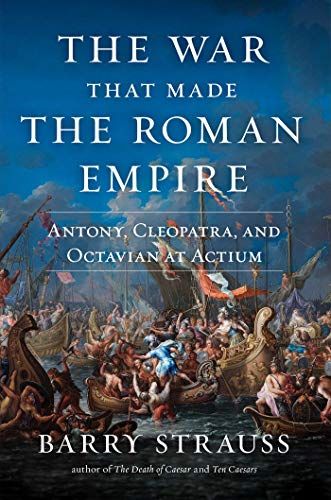
The War that Made the Roman Empire

The War that Made the Roman Empire: Anthony, Cleopatra, and Octavian at Actium
© 2022 Bary Strauss
368 pages

Rome, at the death of Julius Caesar, was no stranger to internal war.  A functioning, healthy republic had long vanished,  torn in pieces by the rivaling ambition of men like Sulla and Marius.   Caesar was part of that destructive tradition, having sparred with Pompey, and for his part in corrupting the Republic into a dictatorship he was justly killed.  In the aftermath, another pair of men took up arms against the other – but this time, the conflict would end in a lasting, if not eternal, peace.   In The War that Made the Roman Empire,   author Barry Strauss invites readers to consider the political manipulations and military campaigns that followed when two of Caesar’s own,  his nephew Octavian and the late dictator’s longtime lieutenant Mark Anthony, rivaled for power.    

How did a young man with so little experience as Octavian overcome a seasoned and often victorious military leader like Mark Anthony,  who had the resources of wealthy Egypt at his disposal, and the political cunning of Cleopatra herself, the wife of one Caesar and the mother of another, who seemed destined to become the Queen of a Mediterranean empire?   Strauss suggests that while a relative stranger to the arena of military operations,  Octavian’s political instincts allowed him to turn Cleopatra’s alliance with  Mark Anthony into a liability; this, coupled with Anthony’s own  indecisiveness on the battlefield,  led to total triumph for the young Caesar, and death for Anthony, Cleopatra, and little Caesarion – the last of the Pharaohs.   Octavian carefully presented his war not as a political struggle against Mark Anthony, but a war against a foreign power – namely, Egypt, whose decadent queen had aspirations for  further aggrandizing herself through usurpation Rome.  Perhaps more importantly, however, was Octavian’s ready use of  Marcus Agrippa,  one of Caesar’s veterans who would be to Octavian more valuable than a right hand. Agrippa was equally accomplished on land and sea, and forced Mark Anthony to pay dearly for every misstep.    

The decisive battle was fought off the western shores of Greece, but the story would not end until Octavian had arrived in Alexandria, confronting the royal couple who pretended at being deities. Strauss suggests that the Roman Empire was born there, in Alexander’s city on the Nile delta.  The War that Made the Roman Empire succeeds both as story and history; as story, it could scarcely fail to keep a reader’s attention, given the towering personalities here and  the stakes of their context. The political wrangling was a little wearisome, but the careful analysis of the battle was far more compelling.   Strauss’s careful use of multiple sources to figure out the truth as best he can – readily admitting when things are too cloudy,  or too reliant on a biased source like Octavian’s own memoir – and presenting multiple possibilities when there’s no clear idea of the truth. We know nothing of how Octavian and Agrippa took the city of Menthone in Anthony’s rear, for instance, a pivotal strike that interrupted the logical flow from Egypt and  forced Anthony’s army into starvation; we only know that the city was taken.  Strauss details several possible strategies Agrippa and Octavian might have pursued.   This is as comprehensive a look at one of the pivotal battles of western history as can be imagined, and recommends itself to students of Roman history.

Posted in history, Reviews | Tagged , , , , , | 8 Comments

Top Ten Tuesday Freebie: Frightfully Good Reads

Today is a freebie, and I’m going with Halloween-appropriate books because ’tis the season.

Spook, Mary Roach.  A playful examination of scientific attempts to discover our fate after death.

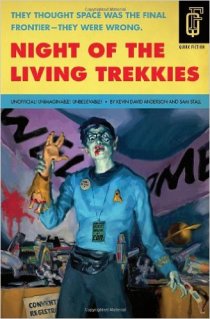
Night of the Living Trekkies,  David Anderson.  Easily the funniest zombie book I’ve ever read, this follows security guard Jim Pike’s attempt to restore order after a zombie apocalpyse unfolds at a Star Trek convention.  

World War Z: An Oral History of the Zombie War, Max Brooks. A fascinating ‘novel’, this one is rendered as a nonfiction account, collecting testimonies from across the world when a scientifically-based zombie outbreak harrows the world.

Sphere, Michael Crichton. One of the creepiest SF titles I’ve ever read, taking place deep under the ocean.

Pride and Prejudice and Zombies, Jane Austen and Seth Graham. Silly, creepy, and hilarious.  

Christine, Stephen King. One of my favorite King novels. Christine is especially uncanny because of the ambiguous nature of the car’s evil. 

Daemon, Daniel Suarez.  My favorite techno-thriller ever, Daemon depicts a machine intelligence waking up and recruiting human agents to rebuild the world.

The Fear Index, Robert Harris. Harris’ rare book that isn’t a historical fiction thriller;  The Fear Index  involves machine intelligence and the global financial marketplace.

The Grid, Phillip Kerr. Probably one of my favorite premises ever: a skyscraper that’s embedded with the 1990s  conception of an internet of things or smart architecture…..starts killing its tenants.  

The Stand, Stephen King. I had The Andromeda Strain in this spot, but then I realized: I can’t not mention The Stand. It was the first Stephen King novel I ever tried, an epic post-apocalyptic novel about a world remade by a pandemic few understand.

Posted in General | 11 Comments