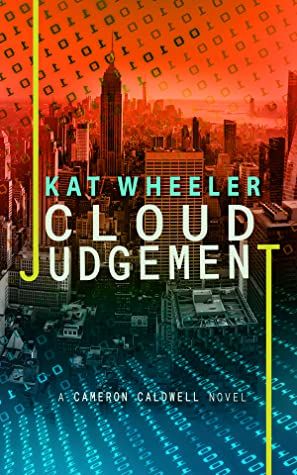
Cam Caldwell was a conscientious saleswoman whose interest in a product defect inadvertently threw her into the middle of a murder mystery. The culmination of that drama in There is no Cloud cost Cam her job, and nearly her life. Now, despite running her own consultancy and steering clear of her old job, Cam is being drawn back in – lured in by both an interesting-looking fella, a compelling mystery, and the possibility of having more money than the pocket change she’s currently living off of. Cloud Judgment sees Cam drawn into two mysteries, both equally dangerous, and is a fun sequel to Kat Wheeler’s debut novel.
I much enjoyed There is no Cloud last year, as computer-technical thrillers are a relatively rare breed (who writes them besides Doctorow and Russonovich?), and Wheeler used that novel to explore the even-more untapped world of ‘smart’ homes and IoT gear. That trend continues in Cloud Judgment, as the central mystery Cameron chews over involves a series of house fires that appear to be connected to IoT equipment – though there’s no obvious pattern to the equipment used. The other mystery inaugurates the novel, as Cam is approached by a handsome chap who makes her heart go pitty-pat and solicited for cybersecurity work. When beginning the job, she realizes something isn’t kosher and bolts, reporting the incident to her ex-boyfriend, a cop, who doesn’t take her seriously but instead asks her for help with the arson case. Relationship tension pervades the novel, not only between Cam and her two love interests / consultees, but between Cam and people she consults: one relationship proves to be particularly important during the novel’s finale. There’s also a lot of humor in the novel, as Cam and her colleagues frequently rib one another: no one can understand how a saleswoman keeps getting herself mixed up in abductions, conspiracies, and desperate grapples.
If you are looking for a relevant technical thriller that doesn’t get into the weeds like the Jeff Aiken series, the Cam Caldwell books should be of interest, prompting thought about the kind of tech we admit into our homes unsecured. I know it’s kept any interest I have in one of Google or Amazon’s smart speakers properly squelched!
Fifteen years ago, Apple inaugurated a technical and social revolution when it released the first iPhone. It did so in close partnership with Google, advertising the inclusion of its Maps and YouTube apps with the device. Within five years, however, Steve Jobs regarded Google as a treacherous competitor, for promoting a competitor to his new wunderkind. The growth of Android isn’t as simple as being a copycat iphone, though, and in Dogfight Fred Vogelstein argues that the competition between these two tech giants has done consumers a service, even as he speculates that one day the fight will conclude in one giant owning an effective monopoly, like Microsoft in the 1990s.
‘Smart’ phones and tablet computers were not a new concept in the early 2000s, as numerous tech companies from IBM to Apple had tried and failed to make them a reality. By the 21st century, though, miniaturization and battery technology were just advancing to the point that pocket devices could become a functional possibility. Prior to the iphone announcement, Google had been at work on its own smartphone, using a newly-acquired mobile OS, Android. The release of the iphone made Google developers realized their prototype device ‘Sooner’ would be an inadequate alternative, relying as it did on the same D-pad navigation that digital cameras, cellphones, and similar devices were still employing. Despite Jobs’ showmanship and the sharp look of the iphone, though, Android developers could see shortfalls in Job’s new baby – its outdated cellular radio, for instance, and the inability to add custom apps – or indeed, customize anything. The smartphone market was too lucrative to abandon to Apple, especially given that iOS was a closed system, pushed out to consumers as a finished product that they needn’t worry their pretty little heads about modifying or changing. In response, Google created the Open Handset Alliance, bringing together industrial manufacturers, network providers, and software developers to create a less proprietary ecosystem. Apple didn’t rest on its laurels: not only did it begin aggressively using patent lawsuits to slow the growth of Android, but it released the iPad – a revolution in its own right, one that began fundamentally altering people’s relationship with media, just as the iPod had ten years prior. The rivalry between Apple & Google thus forced each to improve the quality and scope of their own offerings.
Dogfight is only a partial history. The author believes that the Google-Apple rivalry will one day end in one party have the final victory, but a decade after this book’s release that seems unlikely. They continue to spar – Apple attempting to create alternatives to Google services like AppleTv and Apple Map, Google abandoning the pretense of being strictly a software developer and creating not only a line of Pixel devices, but the ChromeOS as well – and have developed two rival ecosystems, but that competition is contained mostly within the United States. Globally, Android prevails – and Google arguably has a larger target in its sights, competing with Microsoft with Workspace & Chrome. Although Dogfight is more oriented toward corporate deals and lawsuits than the technically-based One Device, it’s an interesting look back at a fight that continues to transform our world. Neither Apple’s signature devices nor the Android alliance are ignorable.
If you can’t tell, dear readers, I’m in something of a reading funk — nibbling at many books but not immersed in any. Life has gotten busy recently: I’m now officially on a transplant list, a friend was just married, and I’m studying 3-4 hours a day for Google & CompTia certifications. The only days I’m not absorbed in exercise or lectures on network protocols are dialysis days, when I’m too tired and spacey to concentrate on anything besides the latest episode of Better Call Saul. (Speaking of which: I am bitterly disappointed to learn that Gus Fring wears clip on ties. )
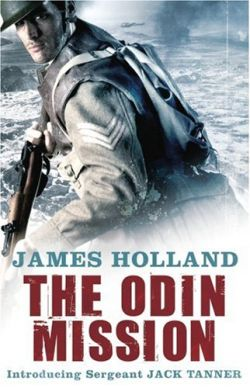
Two weeks ago I started what I trust will be an excellent series, reading James Holland’s The Odin Mission on Cyberkitten’s reccommendation. A World War 2 espionage and small-group action thriller, it’s set in the early days of World War 2 (the invasion of Norway, specifically), and follows a small group of British rangers who were cut off from their unit and then stumbled onto a mission of vital import for the war: guiding a mysterious Norwegian scientist to safety. As the British expeditionary force stumbles backwards in defense, crippled by lost supply ships, German forces envelop the country. We follow Sergeant Jack Tanner and his men as they survive the harsh Scandinavian landscape, made all the more savage by the lingering winter, and work desperately to evade capture by German forces. The task is made all the more challenging by an incompetent French lieutenant who asserts command, and the presence of a traitor within the ranks. I’ve got the other books in the series on order from Britain and hope to dive into them soon.
One of my last RoE reads was intended to be Bandersnatch, a guide to collaboration inspired by the Inklings. The book reviews different aspects of the Inklings’ shared writing lif, like the inspiration and criticism Lewis and Tolkien offered the other, for instance, or joint projects like Lewis/Tolkien’s intended space-and-time travel set. The book attempts to divine tips for successful collaboration from the study of these men, but I was reading it purely for the company: I’m very fond of the Lewis brothers and Tolkien. Thanks to DT, owner of Broad Street Books, for lending me that!
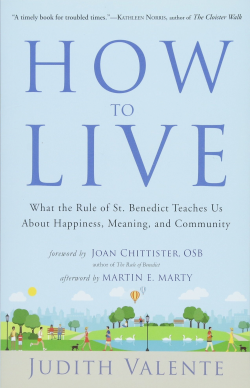
For devotional reasons, I re-read a book I read last year: How to Live, an introduction to Benedictine spirituality. The author, Judith Valente, is a journalist working for NPR who is also an oblate at a monastery. The book is a walkthrough of Benedict’s Rule, and a reflection on how non-monks can infuse their own spiritual lives with its wisdom. A lot of the content is focused on attention and mindfulness: Benedict and Valente urge us to wake up, to pay attention to the sacred in one another and to the present moment, to live in awareness of our own mortality and of the limits of our power. We are urged to create space for contemplation, by dropping out of the sea of noise that is modern life — creating sabbath moments for ourself to meditate, pray, and even sing. Valente also reminds us that the cultivation of virtue within us, the realization of holiness, is a constant battle — and that we must keep in mind that every moment is a choice. Valente also shares insights on the importance of building community, and exercising fair and humble leadership. I’ve been more deliberate in my approach to the spiritual-philosophical life in recent weeks, inspired by this in part: one rule I’ve incorporated is to meditate and go for a walk before I have coffee or turn my computer on, allowing me to start the day focused and energized naturally and not bombarded with stimulation from the word go.
A smaller work I also read was The Tao of Tranquility, an appraisal of the Quinjing Jing, a short work in verse that combines Taoist and Buddhist themes. The Buddhist insights were more obvious and easier to appreciate ( the connection between desire and suffering) than the Taoist ones. I’ve read a commentary on Taoist writing before and still find it a bit mysterious. How to Live often connected Benedictine insights to those of other wisdom traditions, and I found myself thinking again about the overlapping approaches of men like Buddha, Gandhi, and Jesus — and their differences.
Moving from philosophy to the utterly prosaic, I’ve read several books on computers.
Teach Yourself Visually: Chromebooks is a guide not only to Chromebooks, but the Chrome browser and Google’s various services the chromebook relies on – particularly Gmail, GoogleDocs, and GoogleDrive. I’m presently pursuing a Google certification via Coursera, and hoped this would contain something about the Google ecosystem I was unaware of. No such luck on my end, but this would be a good resource for your self-proclaimed “computer illiterate” relation who wants some basic competence at using chromeboooks.
Teach Yourself Visually: Windows 11 was an item I checked out to see if it documented changes from Windows 10 to Windows 11, but the book looks fairly identical to its Windows 10 predecessor: McFedries explains the basics of the Windows userspace, and offers visual guides to using its features and included apps. Nothing for the serious user, but it’s ideal for beginners given the heavy visual guidance. I recently upgraded my laptop (not my gaming PC!) to Win11 to start getting familiar with it. It’s really more of a facelift than anything else.
Windows Command Line Beginner’s Guide by Jonathan Moeller is not a visual guide, because it’s all about learning to use the Windows terminal, also known as the C:\ prompt or the MS-DOS prompt (if you’re of a certain age). I started practicing with this before I even began studying for the CompTia, in part because I was awed by LGR’s fluency in MS-DOS operations and wanted learn to interact with the computer at that level. It also helps at work: we used to have frequent issues with IP conflicts, and then I learned how to use the C:\ prompt to remedy that. (IPCONFIG Release/Renew did the trick.) Although I’m still getting used to the language of the command prompt & powershell (practicing mostly with powershell), I thought the guide especially useful for beginners, because it’s not a list of commands and switches and a terse description of their use. Moeller explains the context of commands, so in the chapter on networking tools, he explains what an IP address is, how it’s assigned, etc. He has a similar book on the Linux terminal which I’ll probably be looking at as well: the current course I’m taking, Becoming a Power User, will test users on basic command line/terminal operations in both operating systems.
Welcome to the world, baby boy, I’ll paint you red and white and blue
The indoctrination starts as soon as you come out the womb
Pretty quick we’ll make you stupid with curriculums at school
And if the classroom doesn’t do the trick, we’ll make you watch the news
Pick your team, right or left, pick the red pill or the blue
You can vote, but even if you win, still everyone will lose
Don’t forget to buy designer because Gucci makes you cool
We prioritize material belongings over truth
Get a job that you can’t stand so you can buy some cans of food
Go overseas and die for freedom, there’s some oil we could use
Our democracy exists so that you think that you could choose
But our algorithms make you do what we want you to do
What’s the problem, you’re depressed? Society has you confused?
We got medication for you that you’ll probably abuse.
Tom MacDonald has the most world-relevant lyrics of any artist I’ve heard. I love how he targets aspects of post modernity — the capture of humanity by consumerism, big pharama, identity politics — without falling neatly into any political tribalism. He’s not a republican, a democratic, a socialist, a libertarian — he’s just Tom, a guy singing truth to a compelling beat.
April on ReadingFreely is always marked by Read of England, my annual focus on English literature and history. This year it was half history and half historical fiction.
Climbing Mount Doom: Dr. Johnson’s London, Liza Picard Dangerous Passions, Deadly Sins: Learning from the Psychology of Ancient Monks, Dennis Okholm Lionheart, Ben Kane The Age of Fighting Sail, C.S. Forester
Science Survey / Readin’ Dixie / Classics Club
Zero, nada, bupkis. I should have done some English classics, but I was in a history-and-adventure mood, as the RoE list demonstrates!
It’s been raining buckets this weekend, but after lunch the sun came out, and I threw on my gym shorts and beaten tennis shoes and hit the road. Water covered lawns, filled ditches, flooded the street — but the bright sun shining off the recently fallen rain made everything all the more beautiful. I did my usual four-mile walk, and as I returned home I was turning over a phrase in my mind, something I’d heard before but could not place: “What are you doing with your one beautiful life?” A google search led me to Mary Oliver, whose nature poetry I’ve loved for years (“Wild Geese” being my favorite).
Who made the world? Who made the swan, and the black bear? Who made the grasshopper? This grasshopper, I mean– the one who has flung herself out of the grass, the one who is eating sugar out of my hand, who is moving her jaws back and forth instead of up and down — who is gazing around with her enormous and complicated eyes. Now she lifts her pale forearms and thoroughly washes her face. Now she snaps her wings open, and floats away. I don’t know exactly what a prayer is. I do know how to pay attention, how to fall down into the grass, how to kneel in the grass, how to be idle and blessed, how to stroll through the fields which is what I have been doing all day. Tell me, what else should I have done? Doesn’t everything die at last, and too soon? Tell me, what is it you plan to do With your one wild and precious life?
EDIT: I figured out where I encountered the poem first! It’s quoted in How to Live, an intro to Benedictine spirituality.
Run while you still have the light of Life, that the darkness of Death may not overtake you.
How to Live: What the Rule of St. Benedict Teaches Us about Happiness, Meaning, and Community.
Amid the bloodshed and chaos of the French revolution, a singular figure has emerged: General Napoleon Bonaparte, a minor Corsican nobleman who distinguished himself on the field of battle and now has an increasing command over France’s destiny. Now he has invaded Egypt, and his object can only be to compromise British interests in India. Captain Charles Edgemont is commissioned to rendezvous with an agent of the Crown and deliver him safely abroad, a mission which will take months, and is made far more difficult by Edgement’s new ship, Cassandra. Her previous captain was both a hard and neglectful disciplinarian, frequently abusing his crew but failing to maintain their training, and it will take every bit of Edgemont’s charisma and creativity to put things to rights. The sequel to Any Approaching Enemy, A Sea Unto Itself is happily without some of the more improbable aspects of that book’s plot, and deftly combines maneuvers at sea with espionage.
It’s been over a year I read Any Approaching Enemy, but I remembered it fondly enough to try its sequel. Captain Edgemont is unusual among most military protagonists in that he’s married to a pacifist, a Quaker woman who does a poor job of hiding her severe disapproval of his chosen occupation. Perhaps his frequent arguments with the Mrs. give him practice in independent reasoning and debate, for he engages in both throughout A Sea Unto Itself: not only does he have to manage a rebellious and shoddily-prepared crew, but once he’s in the middle of things, he’s pitted against the local admiral – who dosn’t take Edgemont’s spy mission, or the French threat, seriously in the least. Edgemont has to commit to his reasoning and conscience and keep Cassandra ahead of an admiralty ship bearing orders for his arrest. The African setting adds its own interest, especially in this time when varied European powers were active in different parts of the east African coast and the nearby islands: Cassandra pays visit to a Genoease colony, for instance, where an Italian femme fatale (sorry, donna fatale) plays an important part in distracting or trying to distract Edgemont from his mission.
A Sea Unto Itself is perfectly enjoyable as a light naval read: not Hornblower quality, but it serves well enough.
Our voices rose to the bright blue sky. We charged. Thirteen men against ten thousand, our battleground a crimson-stained patch of ground outside the walls of Joppa, in the sun-wasted land they call Outremer. In baking temperatures, through the soup-thick air we rode, heedless of our own safety, glorying in the moment. Following the Lionheart.
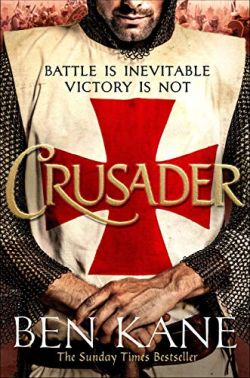
Lionheart introduced readers to Rufus, an Irish noble turned household knight in the court of England’s own King Richard. Exiled to England as a surety for his father’s good behavior, made an orphan by insurrection and the malice of an old enemy, Rufus’s best hope for returning home as lord of his own lands is in faithful service to the king – and even were it not an option, he would serve Richard nonetheless, for what young man of ambition could resist the opportunity to stand in the ranks besides such a man – one who not only looked every inch a king, but acted like it as well? It is such devotion that leads Rufus to accompany his lord far from the British islands, into southern France, Spain, and across the wide Mediterranean – to Jerusalem, in hopes of redeeming the city of God from the hands of the Saracens. Crusader is a more-than-worthy sequel to Lionheart, offering constant military action in addition to diplomatic and personal intrigue in Richard’s court.
Crusader opens with Richard’s long anticipated but much delayed departure for the Holy Land. Although leery of leaving England in the hands of petty subordinates, especially with his weaselly brother John skittering around, Richard can’t ignore the demands of duty – or his own appetite for war. His entire progress towards Outremer (the Crusader states) is marked by violence, arguably defensive: the people of Sicily despise the English who overwinter with them, and their antagonism requires response. Cyprus, too, is hostile, held by a would-be Byzantine emperor who has to settle for being the head honcho of his little island – at least until Richard and company arrive. The eastward journey is also marked by political tension, as Richard and the French king’s temporary alliance is constantly tested by the kings’ mutual arrogance, and then there’s Rufus’ private drama. In addition to carrying on a secret affair with the king’s sister (the widowed Queen of Sicily, yet!), Rufus and a fellow knight are mortal enemies, each hiding their enmity from their lord, each watching for the opportunity to dispatch the other to Hell – and Rufus’ furtive liaisons with Queen Joan only heighten his exposure to the other’s mischief. The other man, FitzAldelm, also spends a curious amount of time speaking in whispers with Frenchmen, making Rufus’ private war with him all the more important.
Crusader‘s multiple drama-streams feed into one another, creating a story that brims over with interest and excitement. There’s so much done right in this book, from the action scenes to the skillful use of medieval terms to add to the period flavor. (Mostly skillful: Rufus refers to the Arab/Turkic forces before them as ‘the accursed race’ so often that if you created a drinking game out of it, you’d be drunk as a lord before the book’s completion.) Even the love affair, which I normally complain about, was compelling — though it helped that Rufus is skirting disaster by falling for a member of the court. (Rule of Acquisition #112: Never have sex with the boss’s sister.) There’s enormous appeal, too, in the settings: Sicily, Crete, and Outremer are much different worlds than the British isles, and Rufus is fascinated by them — as is Richard. Although they both savor battle with the Saracens, they also find the culture they’re immersed in of great interest, and Rufus even spares the life of a young Arab so that he might learn more. As the action in Outremer peters out, Richard learns of schemes happening back in Europe: I for one am looking forward to King, and the completion of this trilogy.
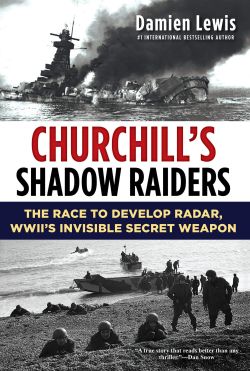
A decade ago, in reading Electric Universe, I was delighted to learn about Operation BITING, one of World War 2’s more extraordinary stories. Having learned of an advanced German radar station, British command dispatched a unit of paratroopers, in addition to radar specialists with airborne training, to dismantle the thing and spirit it back to England. The details of the operation – -a scientist suddenly given military rank and raining joining hardened commandoes, a desperate fight on the beach trying to escape, the last minute rescue by Scottish highlanders screaming Gaelic battle-cries — made it unforgettable, and wholly worthy of a book-sized treatment. That is what Damien Lewis delivers in Churchill’s Shadow Raiders, appraising the raid in the context of both England’s SAS operations and the ‘Battle of the Beams’. Although it doesn’t quite live up to its title, being more about the SAS and the raid than the advancement of radar, it’s enormously fun pop history.
The radar bag-and-grab was crucial for England in two respects; despite mounting evidence that Germany’s aerial operations against the British military and her people were radar-assisted, its role in winning the Battle of Britain (allowing RAF command to make the most of its meager resources by concentrating flyers where they were needed) had created a conviction that radar was a British weapon, not something the Germans could use. Recon, though, made it difficult to ignore the array of unknown installations – and closer inspect made command realize that the Germans not only had radar, but they had gone beyond British technical capabilities. Seizing a device would make it possible to understand what the Germans were capable of, and to allow the creation of countermeasures. The raid also salvaged the reputation of the Special Air Services, however, in the wake of its first mission, COLOSSUS, which Lewis treats in the first half of this book. There, a drop into the Italian winter went badly, making it impossible for the men to fully realize their objective of destroying an aqueduct. Unable to communicate with their operatives, SAS command assumed the men were captured, and their pickup boat was called off.
The narrative at the time was that COLOSSUS was an abject failure that proved airborne operations were overreach for Britain, but Churchill and others doggedly insisted they be retained: Britain needed a way to strike back at Hitler, instead of remaining on the defensive. Lewis attacks the failure narrative, arguing that the men performed outstandingly despite equipment shortfalls, and achieved more success in their attempt than was admitted at the time. Even so, BITING, covered in the second half of the book, went far to redeem the potential of SAS, showcasing what is capable of – and Lewis’ full treatment of BITING corrects some parts of the story as featured in Electric Universe while offering far more detail in general. The dramatics of it are no less successful, however, and Shadow Raiders made for great real-adventure reading.







 Reading Freely