Space Camp 2022

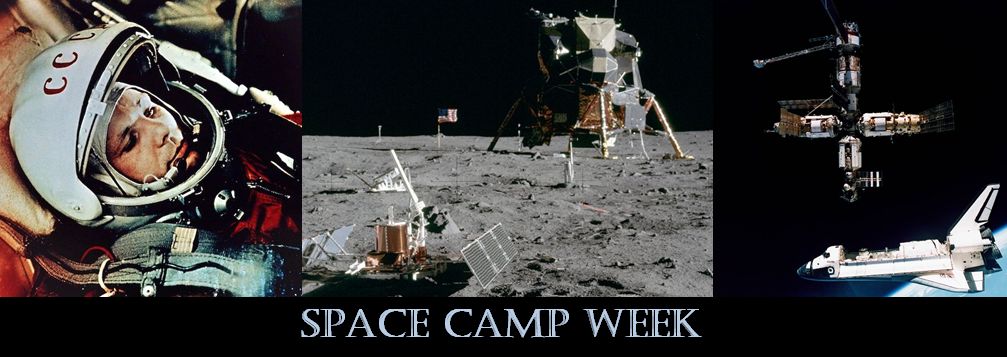
Last year, in observance of the anniversary of Apollo 11’s successful lunar landing on July 20, 1969, I planned for a week of space-exploration reading. I may have gotten a little carried away and kept reading astronaut books until the mood finally passed in late August, but it’s time to go to space camp once again! I’ve got 2-3 titles planned, with one almost read already. I’ve updated last year’s list with the 2021 reading, and they’re arranged not in the order read, but in the period they cover, roughly. The huge omission is nothing for Skylab, which I hope to remedy in the future: Forever Young would be the ideal book, as Young has the distinction of serving as an astronaut on an Apollo mission, on Skylab, and in the Shuttle fleet. Bolded titles are particular favorites, and A Man on the Moon is the boldest of the bold. I can’t recommend it highly enough. For new readers, “Space Camp” takes its name from a summer program for kids hosted by the Marshall Space Center in Huntsville, Alabama. If you want to do your own space camp, check out this list on goodreads!

PREVIOUS SPACE CAMP READING

Rise of the Rocket Girls, Nathalia Holt (Civilian Support – Mercury onwards)
We Could Not Fail: The First African-Americans in the Space Program, Richard Paul and Steven Moss (Civilian/Support – Mercury onwards)
Deke! US Manned Space Flight from Mercury to the Shuttle, Deke Slayton (Mercury-Apollo and onwards)
Soviets in Space: The People of the USSR and the Race to the Moon, Colin Turbett (Sputnik forward)
Two Sides of the Moon, Alexei Leonov and David Scott (Mercury/Sputnik – forward)
Men from Earth, Buzz Aldrin and Malcolm McConnell. (Mercury through to the early Shuttle years.)
A Man on the Moon: The Voyages of the Apollo Astronauts, Andrew Chaikin. THE Apollo history. (Gemini-Apollo)
Moon Shot: The Inside Story, Alan Shephard and Deke Slayton (Mercury – Apollo)
Lost Moon: The Perilous Voyage of Apollo 13, Jim Lovell (Apollo)
Into the Black: The Extraordinary First Flight of the Space Shuttle Columbia, Rowland White (Shuttle)
Through the Glass Ceiling to the Stars, Eileen Collins (Shuttle-ISS)
The Ordinary Spaceman, Clayton Anderson (Shuttle-ISS years)
Sky Walking: An Astronaut’s Memoir, Tom Jones. (Shuttle-ISS years)
Riding Rockets, Mike Mullane (Shuttle-ISS)
Spaceman: An Astronaut’s Unlikely Journey, Mike Massimino (ISS Years)
Endurance: A Year in Space, A Lifetime of Discovery, Scott Kelly (ISS)
Back to Earth: What Life in Space Taught Me About Our Home Planet, Nicola Stott (ISS)

Posted in General | 4 Comments

Of Darwin, dinosaurs, and Denisovians

I expect to leave the recovery-suite of the hotel at the end of this week and eturn home, though I’ll be returning to Birmingham every two weeks for checkups for the next few months. During this multiweek siesta, I’ve mostly occupied myself with IT classes on Coursera, watching Star Trek, and reading. Some of that reading has been science.

Most recently, I read Kindred: Neanderthal Life, Love, Death, and Art, an appraisal of contemporary Neanderthal research that argues Neanderthals were far closer to us in their behavior than previously appreciated. Their range was broader, for instance, with Neanderthal remains found in every climate but wetlands, and their tool-making abilities were still sophisticated (making use of composites), if not up to Sapiens standards. I was personally amazed by how intricate some of the science involved here was, allowing researchers to read the history of a given community through recovered teeth, for instance, or rebuilding the layout of Neanderthal camps through studying the soil. The writing is often exquisite, far more poetic than one would expect from a book on archaeology. A sample:

“Time is devious. It flees frighteningly fast, or oozes so slowly we feel it as a burden, measured in heartbeats. Each human life is marbled with memories and infused by imaginings, even a”s we exist in a continuously flowing stream of ‘now’. We are beings swept along in time, but to emerge and view the whole coursing river defeats us.”

Shortly before Kindred, I read through Lisa Randall’s Dark Matter and the Dinosaurs, an impressively ambitious work that spans disciplines from cosmology to geology. After first explaining to the reader what dark matter is and why it ‘s important to understanding the universe, Randall shifts to a history of our local solar system and argues that fluctuations in the Milky Way’s own cloud of dark matter periodically send space debris into our neighborhood, leading to events like the destruction of the dinosaurs. We mammals owe part of our existence, then, to something which doesn’t interact with light. The cosmology was a bit over my head, though admittedly trying to read it in the hospital probably didn’t help.

Lastly, Darwin Comes to Town was my favorite among this lot. While we tend to think of cities as something apart from nature, that’s wrong on two levels: first, the human built environment is no less natural than the termite-built environment, or the beaver-built environment, at least in principle. All three involve the building species in question using and altering the natural environment to better suit their needs, and all three result in an altered ecosystem that alters the gameplan for other species. Secondly, our cities are saturated with nature, and are increasingly more diverse than the countryside immediately outside them, marked as that area is by farms reliant on monocultures. Cities aren’t patchwork quilts of ecosystems: they’re far more intricate than that, being fragmented mosaics of thousands of micro-ecosystems: every back yard in a given neighborhood has its own array of species, to say nothing of the variety of mini-environments that cities offer to animals looking for new opportunities. There are often similarities between the environments animals’ genes are conditioned for them to thrive in, and the environments they find themselves working : some birds are as perfectly happy flitting around bike racks as they would be around shrubs, or using window ledges and rooftops as the cliffaces of their ancestors. The book reviews ways in which living in the human environment is pushing evolution, creating subspecies that are perfectly adapted to the new environment: there are subspecies of mosquitoes, for instance, that live only in London subway tunnels! I finished this one shortly before going into the hospital and it will remain one of my favorite science books for the year, I think.

Coming up: hospitals, insects, and C.S. Lewis.

Posted in Reviews, science | Tagged , , , , , , | 8 Comments

Letters to an American Lady

Letters to an American Lady
(c) 1967 C.S. Lewis, ed. Walter Hooper
150 pages

I was pleased recently to discover that Letters to an American Lady, a collection of letters from C.S. Lewis written to an anonymous southern woman in the 1950s and 1960s, was on sale. None of the letters are especially long; most, in fact, are nothing more than a paragraph dashed in haste, as Lewis was increasingly popular at the time and beset with bags of mail, especially around Christmas and Easter. Readers are only privileged to see one side of the conversation, though Lewis usually refers directly to the contents of the lady’s — “Mary’s — letters in his own, so some context can usually be discerned. Those who are familiar with Lewis’ prose and nonfiction will find a different Jack here, one who is merely writing to a friend on the ordinary events of life. Jack and Mary talk about their cats, and commiserate over the bad weather or their respective health problems: Lewis likens them to failing automobiles, who after decades of service continually need their parts replaced. For Lewis, though, the letters were also something of a ministry: matters of spirituality are a mainstay in the letters to Mary, as they were in Lewis’ letters to Dorothy Sayers, though Lewis appears to provide more succor to Mary than the other way around. His letters to her no doubt helped him remind himself of that which he already knew: he frequently encourages Mary to not compound the problems of life by worrying over them incessantly, but instead take things one day at a time and live in the present as much as possible. He even references Marcus Aurelius, though sadly not in this context: the Stoic emperor-philosopher reminded himself of that same lessons in his Meditations. Also included in this collection are one letter written to Mary by Joy Davidman, who reflected on the grace she’d experienced in her own infirmity, and some (in ’63) written to her from Walter Hooper, Lewis’ late secretary who had the unenviable responsibility of keeping Mary up to date on Lewis’ declining health as he entered into a coma in late summer ’63. As someone who regards Lewis not merely as an author, but as a strange kind of friend — someone I’ve “gotten to know” through his letters, books, etc — this was a welcome look into Lewis’ less academic side, and one which was especially moving as he entered, unknowingly, the last few months of his life and did so counseling Mary on how to face her own death with grace and dignity.

Quotes:

“The precious alabaster box which one must break over the Holy Feet is one’s heart. Easier said than done.”

“The only reason I’m not sick of all the stuff about——is that I don’t read it. I never read the papers. Why does anyone? They’re nearly all lies, and one has to wade thru’ such reams of verbiage and “write up” to find out even what they’re saying.”

“We are all members of one another and must all learn to receive as well as to give.”

“The great thing, as you have obviously seen, (both as regards pain and financial worries) is to live from day to day and hour to hour not adding the past or future to the present. As one lived in the Front Line ‘They’re not shelling us at the moment, and it’s not raining, and the rations have come up, so let’s enjoy ourselves”. In fact, as Our Lord said, ‘Sufficient unto the day'”

Related:
Letters of C.S. Lewis

Dorothy and Jack. Draws heavily on the Sayers-Lewis letters.

Posted in Religion and Philosophy, Reviews | Tagged , , , , | Leave a comment

Joy Davidman on infirmity and humility

Once I would have pitched in and helped my housekeeper—but now, because I have to walk with a stick and have only one hand free, I’m more nuisance than help and can only sit on the sidelines and give advice and be a pest. It is difficult having to accept all the time! But unless we did, how could the others have the pleasure, and the spiritual growth, of giving? And—I don’t know about you, but I was very proud; I liked the superior feeling of helping others, and for me it is much harder to receive than to give but, I think, much more blessed. Then, too, it’s only since I’ve been ill and helpless that I’ve realised just how good people in general are, when they have a chance. So many people have taken trouble over me, and gone out of their way to give me pleasure or help! It’s very heartwarming—and humbling, for I remember how cynical I used to be about humanity and feel a salutary shame.

Letters to an American Lady
Posted in quotations | Tagged | 1 Comment

Two for forensics

Readers of Sherlock Holmes may remember that fictional character had such a command of diverse sciences and skills that his assistant Watson was impelled to innumerate them. American Sherlock introduces readers to the life of Edward Oscar Heinrich, a real-life and self-taught polymath who was forced at an early age to distinguish himself professionally so that he might take care of his widowed mother. Beginning as a young pharmacist who learned his trade on his own — passing the examination to be certified, but never studying pharmacology in a formal setting — and moving through several other technical professions, he began assisting police in the investigation of crimes and created his own laboratory for the work. American Sherlock is a partial biography of Heinrich, but one focused on his case history, as his work investigating several lurid trials of the 1920s and 1930s saw the creation of several forensic tools that researchers now take for granted, like the study of blood splatter. In addition to this, there’s also the voyeuristic appeal of reading about those crimes themselves: in one, three brothers attempt the last great train robbery of the west (it goes….poorly). In another case, Heinrich investigates the strange death of a young woman in Fatty Arbuckle’s suites, a death that destroyed Arbuckle’s career despite his popularity. Readers interested in forensics or Prohibition-era crimes will find this of great interest.

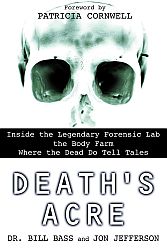
Relatedly, I read Death’s Acre by Bill Bass, co-authored by Jon Jefferson. This is a history of Bass’s lifetime of work as a forensic anthropologist. Although a professor who teaches academically, Bass’s expertise in reading dead bodies — understanding the story that a body’s state of decay could tell police investigating a death — sees him assisting in cases throughout the United States. Forensic anthropology not only allows bodies far gone to be identified, using anatomical clues to distinguish not only men from women (shh, no one tell Kentaji Jackson), but to determine the race and approximate age of the deceased. Valuable clues could also be derived about whether the person had died at the location, how long they had lain there, and how they’d perished. Although Bass’s academic background gave him his start, he and his students also created a unique research facility that consisted of a fenced-in acre of Tennessee in which donated bodies were deliberately exposed under varying conditions so that the progress of decay, or factors related to decay, could be studied directly. This research gave investigators the ability to pin down how long a body had been decaying, for instance, by the insects or insect waste present upon it. If you were watching TV in the 2000s, you may have seen one or many of the forensic shows that were so popular back then, chiefly CSI. I remember CSI vividly because it was unique, and to my delight in reading this, I noticed that some of its cases were inspired by Bass’s own work. Forensic writers like Patricia Cornwell also drew from Bass’s research. Death’s Acre has great interest for those fascinated by forensics, but considering the subject matter (death and decay), readers should know that Bass doesn’t spare any grisly details.

Posted in history, Reviews, science | Tagged , , , , , | Leave a comment

Bonaparte’s Invaders

Bonaparte’s Invaders
(c) 1998 Richard Howard
320 pages

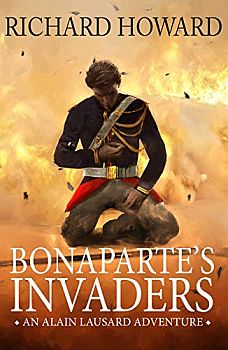
It is the year 1799, and Napoleon Bonaparte’s triumphant army, having recently earned the Corsican glory and loot in Italy, has now boarded a fleet of ships and sailed east — destination unknown. Bonaparte has his eyes on Egypt, where he believes he can inflict a fatal blow on England’s Indian empire and expand the blessed lights of the Republic and modernity to the backward Middle East. The Egyptians will welcome freedom from the Turks, and flock to the tricolour of the Republic — surely! After a quick stopover in Malta for loot, Napoleon lands an army of 18,000 in the sands of upper Africa. If the expedition had been well-organized at the beginning, though, something fell apart in those many weeks crossing the Med: Napoleon’s army stumbles as ashore for an exercise in prolonged torture, as they must endure weeks of scarce water and food and long marches under an unforgiving sun that blinds as many as it kills directly, all the while being harassed by Bedouins. Bonaparte’s Invaders is a tale of misery, pain, and failure: we follow Alain Lausard and his fellow dragoons as they try to hang on to their lives, any scrape of idealism having burned away under the African sun. It has the merit of dramatizing a period of the Napoleonic wars that few know anything about (being pre-Empire), but it makes for grim reading.

In Bonaparte’s Sons, Richard Howard began a Napoleonic war series that had the interesting twist of being set on the French side, following a unit of dragoons who were criminals granted amnesty provided they served in the army of the Republic. Sons was great fun, featuring a motley crew of men allied against a despicable officer, and full of adventure and fun. Bonaparte’s Invaders sees those same men slowly tortured: as unhappy as they are aboard the boat, things grow far, far worse once on land. Supplies are lost, horses are nowhere to be found: the dragoons march as infantry, doing Napoleon’s bidding with almost no water or food, baking under the sun for weeks at a time. Napoleon also brought along a small contingent of civilians (academics, poets, etc) who eat with the future Emperor and occasionally get into trouble, causing the dragoons to do even more plodding back and forth across the desert wastes. Death — slow, excruciating, torturous death by exposure and malnutrition — is their constant companion, and the few battles offer little relief. To the dragoons and the army, the Egyptian expedition is evidence that the Directory and Napoleon are no better than the Bourbons who preceded them: the common man is just a pawn for them to use up in the pursuit of their own glory.

Bonaparte’s Invaders is certainly interesting if you know nothing about the Egyptian invasion (true for me — I only knew Napoleon deserted his army there), but as a story it’s …draining, making the reader follow the slow dissolution of a once-proud army who make their lot worse by constantly bickering with one another.

Coming up: Darwin, dinosaurs, and forensics.

Posted in historical fiction, Reviews | Tagged , , , , | 4 Comments

The Ghost Brigades

The Ghost Brigades
(c) 2006 John Scalzi
384 pages

“We’re in the wrong universe for fair.”

John Scalzi’s Old Man’s War introduced readers to a harsh future, in which humanity competes for space in a crowded galaxy, fighting tooth and nail against a variety of alien baddies. Out of sheer necessity, the Colonial Defense Forces have been forced to create an army of augments — but within its ranks are even more altered troops, the Special Forces — or, as common soldiers call them, the Ghost Brigades. Scalzi’s expansion of the Old Man’s War story focuses on them specifically, beginning with a betrayal and a desperate scramble for answers. The CDF’s attempt to find out why one of their own researchers would fake his own death and join alien ranks sees them attempt to infuse a recording of the traitor’s consciousness into the body of a newly-grown clone, in hopes that the clone will give them answers. Instead, the clone — Jared Diroc — becomes his own person, and takes his place in the Special Forces. Before long, though, the dormant personality within Jared will begin to assert itself, and lead him down an entirely separate road.

I commented in my review for Old Man’s War that its most interesting element was consciousness transferal, and that takes center stage here, driving the plot and creating both our main character and his antagonist. The Ghost Brigades are interesting in their own right, however, from a techno-humanist perspective: they’re not only genetically augmented, but have internal brain implants that allow them to process and absorb information rapidly, almost like Neo in The Matrix, and connect them to one another so that squads are tightly integrated. Jared Diroc is perfectly happy with his squadmates as they tend to the business of the Defense Forces — killin’ aliens — but an experience on shore leave suddenly brings to life the other man inside his brain, and there the action really picks up. Humanity was already in trouble, facing a potential alliance of three alien races at once, but once Jared begins to struggle with his alter-consciousness, he realizes the danger is even more acute than previously realized. This leads to a desperate gamble in which everything goes wrong — but results in a seat of the pants action thriller all the way to the end.

Although I found the premise of Old Man’s War interesting enough, having read The Ghost Brigades I’m sold on reading the rest of the series. Plot developments herein point to a far more interesting galactic scene than previously thought!

Posted in Reviews, science fiction | Tagged , | 6 Comments

Of shotgun riders and serial killers

Medical update: I saw the doctor today and he was extremely pleased with my progress. According to him, my blood chemistry could not look better! I managed a 4-block walk today from the hospital back to my hotel room, after using the shuttle bus to arrive for my appointment.


Temperance Brennan is a forensic anthropologist with academic associations in North Carolina, but has a current position with Canadian law enforcement in Quebec. When a shallow grave reveals a collection of body parts collected in trash bags, she has a sickening feeling that this death and dismemberment might be connected to several prior cold cases. Pursuing the hunch against the disdain of the police, who feel this civilian is overstepping her office, she soon finds herself exposed to a serial killer’s obsession. Deja Dead is first in a series of forensic mystery novels by Kathy Reichs, who like her main character is both an academic and a forensic detective. The result is a forensic thriller with no shortage of grisly detail, though as a story there are a few very-convenient plot twists. I think I’ll try a few more in this series once I return home, to see if the author’s skills matured.

Shotguns and Stagecoaches is a collection of biographical sketches, drawn from some of the colorful riders, shotgun messengers, and detectives who defended Wells Fargo’ cargo, especially gold bullion. There are some golden tales in here, my favorite being the guard who was set up by a pretty lass in cahoots with highwaymen, but resolved he’d still marry her if he met her again. As the author noted, if that story is not true, it should be. Another musing story involved one shotgun messenger tricking his friends into a jail cell so he could launch into a long-winded story about his more recent exploits with a captive audience. As a proper history, Stagecoach: Wells Fargo and the American West is better, but for fans of the Old West this is replete with fun stories of robberies, manhunts, and shootouts. The author adds an epilogue that takes Wells-Fargo for trying to sanitize its history and downplay the dangers its officers faced, and the triumphs they achieved in the fight against highwaymen. This is great fun for a casual history reader who has an interest in the Old West.

Posted in history, Reviews | Tagged , , , , , , | 4 Comments

Beauty and the Werewolf

500 Kingdoms: Beauty and the Werewolf
(C) 2011 Mercedes Lackey
408 pages

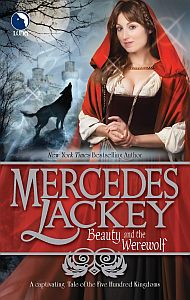
Isabella Beauchamps is accustomed to being the mistress of her house, keeping the servants and her twin stepsisters in line while her stepmother spends her days gazing out the window and gossiping. A chance encounter with a werewolf in the woods, however, sees her taken by the king’s guards and effectively imprisoned in a remote rural manor house that looks more like a fortress than a residence. There she learns that her new host, Duke Sebastian, was the werewolf who bit her — and that for the sake of the region’s safety, she’s to be secured here for three months to ensure that she has not been werewolf’d herself. Not content to be an idle prisoner, Bella immediately goes to work putting the Duke’s household to order, including his dozens of invisible spirit-servants. Her arrival into the sleepy household and its absentminded lord’s life begins to expose the mystery of the Duke’s curse, and threatens the life of both. With a cover that brings to mind Little Red Riding Hood, but a story that’s definitely more of a spin on Beauty and the Beast, Beauty and the Werewolf is interesting but limited as a novel. A lot of space is given to Bella simply trying to understand the setting, to the point that we’re seeing Lackey’s worldbuilding as she hammered it out. That could be interesting in its own right, but it seems like filler within the novel itself. The big bad of the novel is also telegraphed fairly early on, although Lackey does her best to misdirect readers halfway through. The story isn’t helped by Bella being obnoxious and bossy to the point of imperial. Still, I liked the idea of the traditional Beast being a werewolf.

Next up: I’m still plodding along in Dark Matter and the Dinosaurs, and have recently received two books that will complete a series I started in…erm, 2011.

Posted in Reviews | Tagged , | Leave a comment

The Sleeping Beauty

A Tale of the Five Hundred Kingdoms #5: The Sleeping Beauty
(c) 2010 Mercedes Lackey
352 pages

Rosamond has the bad luck to be an orphaned princess in a wealthy little kingdom surrounded by larger, hostile enemies, any one of whom will invade at the news that her warrior-king father has finally surrendered to battle exhaustion and depression over losing his wife, her mother, the sainted Celeste. Still worse, Rosamond lives in a region where narrative magic is an active force in the lives of all, constantly attempting to entrap people into reliving and fulfilling stories from Tradition. Princesses are doomed to become prey to evil stepmothers and find themselves locked in towers or trapped in deep sleeps, waiting for the kiss of some prince charming, and young men are forever having to prove themselves in battle against dragons decimating the countryside. Now, with her parents dead, Rosamund stands fully exposed to the whims of Tradition — and even her fairy Godmother can only do so much to corral the chaos. The Sleeping Beauty is a unique spin on several fairy-tale stories, featuring several strong characters who are determined to live their own lives despite the forces attempting to push them down predetermined paths.

From the cover alone, this is not the kind of book you’d normally find me reading: it looks for all the world like a romance. The book and its connected series were given to me by a friend, though, one who recently introduced me to Into the Woods and Shrek the Musical, both of which also play with fairy tale tropes. The setting at first appears a conventional medieval-fantasy arena: castles, horses, men-at-arms, dragons, magic, that sort of thing. What makes the Five Hundred Kingdoms series is that the people who live within the novel are aware (to varying degrees) of how The Tradition can alter their lives: certain castes like royals, young men, and innocent shepherdesses are especially exposed to it. The masters at reading and manipulating tradition are Godmothers, who advise kingdoms and attempt to help their wards bend to The Tradition without being broken by it. Godmother Lily is the star here, being an especially talented Godmother whose expertise has been forced by having to advise a kingdom in constant mortal and magical peril: after Rosamund disappears in the woods, fleeing a treacherous servant in the pay of an unknown mischief-maker, she creates a grand contest to secure the Kingdom and Rosamond once and for all. Although the title of this book hints that Rosamund is fulfilling the Sleeping Beauty story, there are other narratives mixed in, including those from Norse mythology: The Tradition isn’t necessarily picky about which Path it forces on young princesses, so long as they find themselves far enough down one path to fulfill it.

The Sleeping Beauty surprised me: I expected something of a chick book, to be honest, but this was imaginative and funny, with about as romance as I usually encounter in one of my more ‘manly’ war stories. I’m interested in reading more of this series.

Posted in Reviews | Tagged , , | 3 Comments