Teasin’ with W.B. again

The old bucket has hung there through many autumns, and the leaves have fallen around it and some have fallen into it. Rain and snow have fallen into it, and the fallen leaves have held the moisture and so have rotted. Nuts have fallen into it, or been carried into it by squirrels; mice and squirrels have eaten the meat of the nuts and left the shells; they and other animals have left their droppings; insects have flown into the bucket and died and decayed; birds have scratched in it and left their droppings or perhaps a feather or two. This slow work of growth and death, gravity and decay, which is the chief work of the world, has by now produced in the bottom of the bucket several inches of black humus. I look into that bucket with fascination because I am a farmer of sorts and an artist of sorts, and I recognize there an artistry and a farming far superior to mine, or to that of any human. I have seen the same process at work on the tops of boulders in a forest, and it has been at work immemorially over most of the land surface of the world. All creatures die into it, and they live by it. [ ….]

However small a landmark the old bucket is, it is not trivial. It is one of the signs by which I know my country and myself. And to me it is irresistibly suggestive in the way it collects leaves and other woodland sheddings as they fall through time. It collects stories, too, as they fall through time. It is irresistibly metaphorical. It is doing in a passive way what a human community must do actively and thoughtfully. A human community, too, must collect leaves and stories, and turn them to account. It must build soil, and build that memory of itself – in lore and story and song – that will be its culture. These two kinds of accumulation, of local soil and local culture, are intimately related.

The World-Ending Fire: The Essential Wendell Berry, ed. Paul Kingsnorth
Posted in General | Tagged , , , | 1 Comment

Somewhere Between Heaven and Hell

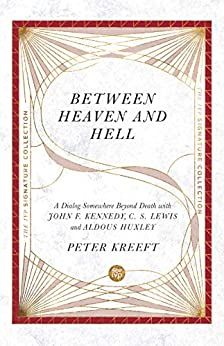
Between Heaven and Hell: A Dialog Somewhere Beyond Death with John F. Kennedy, C.S. Lewis, and Aldous Huxley
© Peter Kreeft 1982
182 pages

The scene: ….well, we’re not sure. Somewhere out in the ether. The players: C.S. Lewis, Aldous Huxley, and JF-Serial-Adulterer-Kennedy. Open on all three personalities standing, confused. They’re dead, having all shuffled off or having been shoved off the ol’ mortal coil on November 22, 1963. They have found neither eternal bliss nor everlasting torment, however. They have found…an argument, and for all three this is a welcome diversion while they ponder their fate. A discussion of ‘where the hell are we?’ quickly turns into a theological debate between Lewis, representing traditional Christianity; Kennedy, representing liberal humanistic Christianity (or secularism); and Aldous Huxley, representing pantheism. It’s a two-stage debate, with Lewis first squaring off with Kennedy on the necessity for believing in core Christian doctrines versus modern hedging, and then Lewis debating Huxley on Christianity’s distinction and fundamental incompatibility with other religions. The first is essentially an expansion of Lewis’ “Lord, Lunatic, or Liar” argument from Mere Christianity, and the latter was a thought-provoking argument for why Judaism and Christianity are so markedly different from all other religions, save those that borrowed from them — Islam being viewed as an imitator or a Christian heresy. As you might imagine from a Catholic author, Lewis presents the strongest case — though Kreeft does not permit himself to write Kennedy and Huxley as converts; they’re somewhere in the “I get the argument but I still can’t believe it” neck of the woods. I was hoping Kreeft would get more into the weeds of Lewis pointing out the implications of the men’s worldviews, as he looked to the logical extension of relativism in The Abolition of Man, but Kreeft keeps things confined to the two major debates. I haven’t read enough of Kennedy or Huxley to know if he captured their voices, but Lewis was fairly recognizable — though it helped that Kreeft often had Lewis quoting himself, either consciously or unconsciously. I do love the premise of the book, though, and it appears Kreeft has another with Socrates arguing with modern philosophers.

Next up: Wendell Berry’s How it Went and The World Ending Fire. Stories and essays…

Posted in Religion and Philosophy, Reviews | Tagged , , | 3 Comments

Postcards from Ed

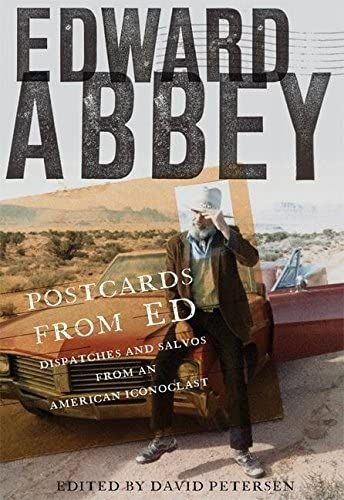
Postcards from Ed: Dispatches and Salvos from an American Iconoclast
© 2007 ed. David Petersen
337 pages

“Saving the world is only a hobby. Most of the time I do nothing.”

Although I was first drawn to Ed Abbey by his nature writing,  over the years I’ve become more fascinated with Abbey as a person.   Books like Obey Little, Resist Much demonstrated how complex a man he was –  one impossible to pigeonhole,  accused of being a reactionary from some quarters and a tree hugger from others.    Postcards from Ed,  incorporating nearly four decades of his personal and public letters,   puts this genuine American character squarely center-stage,  where readers can grow to know him better.   It’s less of a book and more of a visit with a friend, seeing him through moods of bliss and melancholy, of  passionate work and even more impassioned philosophizing under the stars. 

When I first read Desert Solitaire, knowing nothing of Abbey beyond his name, I made the same mistake most who read a little bit of Abbey do:   I immediately sorted him into a convenient box,   that of the Environmentalist. “Thoreau in the desert,”   I decided.  (That was a two-part mistake, for I later realized that Thoreau, too, was too unique a character for a slapdash label to stick to easily.)     The more I read of Abbey, the more varied I discovered his work was – and the more interesting. His central subject was not The Environment, or even the western wilderness that Abbey loved,  defended in words and action – but rather, the fate of man and nature in the hands of the techno-industrial machine. In this he’s more like Kaczynski than Thoreau,  though much more fun to be around, and much less dangerous to receive mail from. On that subject,  Postcards is a curated collection  of  letters and postcards,  sent from various spots in Arizona and Utah, and largely originating in the 1970s and 1980s.   They’re a good mix of personal letters, which themselves range from philosophical reflections to accounts of recent hikes in the wilderness, and more publicly-oriented missives,  in which Abbey writes presidents, governors, and letters to the editor.   A few from Abbey’s early years are included, but most from this period were lost to disaster.   That’s a shame, since the late teens and early twenties are a transformative time, especially for an active thinker like Abbey, who was an irritant to the alphabet goon squads from his early twenties onward.  (He began by publicly urging college men to mail their draft cards back to D.C. at a protest against both the war in Vietnam and the conscription being used to carry it out.) Good luck to the reader attempting to stick Abbey in a box; he was a man of great passion and sometimes divided opinions, calling himself an anarchist yet urging the government to do more to protect the west — cursing liberals and corporate tycoons in the same breath.

Postcards from Ed shows us the growth of a young man who journeyed West from ruined Appalachia, who arrived in time to see the canyonlands of southern Utah and its sister states come under the sights of industrial development – wherein the landscape was mined, logged, and dammed.    Abbey wrote about it publicly, in books like Desert Solitaire and The Monkey Wrench Gang; he worked with organizations like the Sierra Club and Earth First! to raise awareness and spark resistance, and if you believe his and his friends’ claims, he actively engaged in sabotage in his numerous wilderness wanderings.    To Abbey,  the diversion of public money for private gain (in the creation of infrastructure that only one company would use) was offensive enough that action was warranted, but  knowing that such infrastructure was enabling the plunder and ruin of a huge swath of the country  made him apoplectic.  Another key bugbear was the ranging of private cattle on public land, which he viewed not only as parasitical, but destructive to the west’s ecology:   cattle consumed food that should have been the province of mule deer and elk.  He argued this not because he was a hunter, but because he believed the creatures of the West had more a right to be there than sandal-wearing golfers who wanted a desert view from their Colorado-draining irrigated golf course. Although not a religious man, Abbey venerated the undespoiled wilderness  and defended it consistently for decade after decade.    Despite his melancholy over the future of that wilderness, , which  seemed destined to disappear under ore mines and ticky-tacky residential developments,   Abbey maintained that he was an optimist.    The unsustainable, by its nature, is doomed: sooner or sooner,  the growth-bubble that was industrialization civilization would pop and the likes of Tuscon and Phoenix would disappear like dust in the wind.   Growth for growth’s sake is the ideology of the cancer cell, he maintained, and like a cancer   reckless overdevelopment would destroy the very civilization spurring it on.  He preferred that we avoid a catastrophic die-off by tapering our numbers down ,but viewed the ultimate triumph of reality  as inevitable. 

Postcards is a fascinating book, one that I was pained to be finished with – because we don’t just experience the  jeremiad-levying  Abbey, the wilderness wanderer Abbey. We find Abbey the friend, Abbey the literary critic, the doting but often firm father, the disappointed epistoler, the humorist, someone who wanted to write a novel in honor of the working men whose stock he came from.   I was delighted to find him exchanging letters with Wendell Berry (one wonders what Berry’s half that correspondence entails!)  and responding to articles from papers and magazines all over the country — always with a mix of temper, steely intelligent, and mocking humor. This book makes him more real — in his humor, his abrasiveness, his righteous anger, his deep wonder and profound appreciation for the wild that remained. I will count it as one of my very favorite reads from this year, and one alone in being one I had to start reading again the moment I finished it — just to spend more time with Ed. Why do such interesting men leave us soon and the bores and cads linger for decades?

Quotations to follow this week…

Posted in Politics and Civic Interest, Reviews | Tagged , , , , , | 3 Comments

Teasday Tuesing with W.B.

This morning’s tease comes from a Wendell Berry anthology, The World-Ending Fire.

The idea was that when faced with abundance one should consume abundantly – an idea that has survived to become the basis of our present economy. It is neither natural nor civilized, and even from a ‘practical’ point of view it is to the last degree brutalizing and stupid.

The difference between a path and a road is not only the obvious one. A path is little more than a habit that comes with knowledge of a place. It is a sort of ritual of familiarity. As a form, it is a form of contact with a known landscape. It is not destructive. It is the perfect adaptation, through experience and familiarity, of movement to place; it obeys the natural contours; such obstacles as it meets it goes around. A road, on the other hand, even the most primitive road, embodies a resistance against the landscape. Its reason is not simply the necessity for movement, but haste. Its wish is to avoid contact with the landscape; it seeks so far as possible to go over the country, rather than through it; its aspiration, as we see clearly in the example of our modern freeways, is to be a bridge; its tendency is to translate place into space in order to traverse it with the least effort. It is destructive, seeking to remove or destroy all obstacles in its way. The primitive road advanced by the destruction of the forest; modern roads advance by the destruction of topography.

Posted in General | Tagged , , , , | 5 Comments

Lost on Purpose

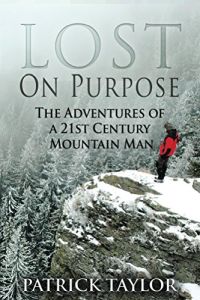
Lost on Purpose: The Adventures of a 21st Century Mountain Man
© 2015 Patrick Taylor
187 pages

The real adventure for me was letting go of everything I had defined as important and conducting another experiment with my life.

Lost on Purpose is the account of one man, Patrick Taylor’s, attempt to follow the trail of Lewis and Clark over the Rockies. He chose to do this during the same season as the Corps of Discovery, despite knowing this meant he would be climbing as winter’s first snowstorms moved in. The scope of this ambition impressed, appalled, and bewildered the Idahoans Taylor met — though they were mostly impressed. The account is highly and constantly detailed, Taylor sharing with readers how he whittles little stacks to pen a fish in place so that he can grill it properly, or describing the various layers he was wearing. There are some readers who are drawn to that kind of detail, of course, but if you’re looking more for Ed-Abbey style descriptions of the landscape, be warned there’s more mention of not just the trees than the forest, but the pine needles and the bark. Taylor also incorporates excerpts from Lewis and Clark’s journals, which indicate that much of this unforgiving landscape is as it was two centuries ago. The sheer ambition of Taylor, makes the details slog worthwhile, as he describes making his way up the mountains, losing the trail as a blizzard moves in, and — undoubtedly the book’s highlight — relives with the reader his few days spent with a trapper, a kindred spirit who lived by himself most of the time and spent his nights skinning pine martens. After two months of wilderness trekking, Taylor uses his emergency comms to have himself picked up, but his feat suitably impressed a local enough that Taylor was hired on to take care of a remote property during the winter months. (One hopes it wasn’t The Overlook hotel.)

Posted in Reviews | Tagged , , , | 2 Comments

Unsettled

Unsettled: What Climate Science Tells Us, What It Doesn’t, and Why It Matters
© 2021 Steve Koonin
320 pages

Over the last twenty years, ‘climate change’ has been subject to the same abuse as ‘terrorism’: it’s levied so often with such enthusiasm that it’s lost much of its effective meaning.  In 2005 and 2006, for instance, a sudden rise in hurricane activity was attributed to cycles that played out over decades:   when another spurt happened ten years later, gone were the mentions of El Nino or Atlantic Multi-Decade Oscillation. No, the one and only factor responsible was Climate Change –  nevermind that the preceding decade had been quiet and that climate change was happening then as well.  For those of us lay citizens who take both science and the potential threats posed by environmental turbulence seriously, this leads to a frustrating scenario, in which valid information is drowned by overzealous claims, and a threat is watered down through boy-who-cried-wolf antics.   In Unsettled, Steve Koonin examines the data we’ve gathered, the models used create projections of what the future holds, and offers a pragmatic view of how we should respond to the anticipated threat.

Readers should be warned from the outset that this is not a casual book. The majority of it consists of chewing over data, so if you’re a liberal-arts major who echoes J.K. Rowling (“Oh dear, maths”),  this is going to be a bit of a challenge. I have to count myself in that category as well.  To sum up Koonin: the Earth is warming, and humans are contributing to this. We don’t know exactly how much of the warming is directly attributable to human activity, however, because climactic conditions are complex:  human activity creates both heating and cooling effects,  and there are factors outside humanity at play. It is extremely different to untangle human contributions from other sources. The models used to create projections are limited and flawed, often unable even to recreate known results from older data. Any ordinary citizen who has paid attention to the repeated doomcasts of Al Gore and the like (how many times have we been told the ice caps will be gone in a decade?) already appreciates the limits of our future-casting ability. The plugged-in person, however, who lives entirely in the updated-by-the-moment newsfeed of pseudo-reality,  may be surprised that the confident predictions of paid gabbers are nothing more than what Hayek called the pretense of knowledge.  Such pretense is especially on display when predicting agricultural and economic doom, popular grist for the news and political mill, generating ratings and campaign energy, but only loosely moored in reality. The findings of scientific endeavor pass through an array of filters — precis of studies, scientific journalists, talking heads badly summarizing the science journalists, political opportunists mischaracterizing the media’s own summaries — so that certain facts are blown up out of proportion, or ignored completely, becoming that convenient political beast…The Science. We’ve seen that mephistan creature growing ever larger and more aggressive in the last few years of coronamania.

Ultimately, Koonin offers, we can’t say with confidence what will happen – not to the temperature, or to the seas, or to agriculture. All we can do is plan prudently now and adapt to the future as it happens, as humans have always done.  That’s not a prescription I can dispute, although the fact that Koonin is telling me what I already believed sets some alarm-bells klanging.

Posted in science | Tagged , | Leave a comment

Sean of the South and the Old Man’s Boy

Sean Dietrich and his wife Jamie’s collective world was shaken when their doctor said the C word.  Cancer.  The emperor of all maladies,  the ticking timebomb in each of us.   Rather than crumbling into a  weeping ball of woe-is-me,  Jamie looked at Sean and suggested that now was the time for them to do Something Big. Something like cycling the Great Allegheny Passage.  Nevermind that neither were cyclists, let alone campers,  and that Sean’s back problems limited him to a recumbent bicycle.   If there was ever a time to seize the day, this was it – and so they took it. You Are my Sunshine is the memoir of that journey,   of the arduous trek through mountains blasted by a hurricane,   the couple weighed down by gear and the thoughts of what the future might bring, but buoyed by the beauty of nature, the strength of those they’d met who had overcome similar battles,   and the joy of  their daily little triumphs over the mountain – snakes included.  This proved a quick read, and I liked the mix of travel and personal reflection. Dietrich’s honesty about his and his wife’s past and present sufferings was more compelling than the humor, which ranged from the slightly corny to the genuinely amusing. Dietrich’s accounts of his repeated interactions with another cyclist on the trail who was fighting cancer, as well as his talks with a traveling priest, were especially touching. As a hiker and sometimes-cyclist, sometimes-camper, the travel accounts were interesting all around. I was greatly amused by the thought of a recumbent bike tackling mountain trails, and it holds up about as well as one might expect – -poorly. I’d never heard of Dietrich until he appeared at my library to a sell-out crowd, and after listening to him on a few podcasts will be trying some of his other works in the future to see what the buzz is about him.

Back in 2020 I stumbled on what would become one of my favorite books, Robert Ruark’s The Old Man and the Boy.  The collection invited readers into a young boy’s childhood, one spent roaming the woods and coasts of the Carolinas in the twenties and thirties,    absorbing lessons on life – from philosophy to the best approaches to hunting duck.  The book’s star was the Boy’s grandfather,    who could be both comic and stern at the same time, dispensing both folk wisdom and dissecting Montaigne over a single snort of whiskey.  Although he’s the Boy’s guardian, he takes young Robert seriously, as the young man he might become. Ruark seems to spend most of his childhood in the company of the Old Man and his hunting friends, which is just as well: the one time he goes out on an adventure with his school friends, they end up with a live deer in a Tin Lizzie. The Old Man’s Boy Grows Older consists of a few more similar stories, this time in conjunction with Ruark’s own tales of his hunting expeditions in India and Africa,    as he connects life lessons the Old Man imparted to his adult adventures.  In this mix it’s rather like The Lost Classics,     as each combined boy-Ruark and adult-Ruark adventures and connect them with wisdom from the Old Man – -but Lost Classics was far more dominated by the overseas adventures. The Old Man is as funny and insightful as ever, and I especially enjoyed Ruark’s account of determining to buy his grandfather’s house and restore it after a foreclosure, so that it might bring future generations the joy he found as a boy.

Posted in Reviews | Tagged , , , , , , , | 4 Comments

An old man’s Tuesday teases

Today’s Teases come from The Old Man’s Boy Grows Older.

“You know any more rich people?”
“No,” I said. I was beginning to feel depressed.
“That’s where you’re dead wrong,” he said quietly. “You know two rich people. You and me. We’re both rich, right now. Richer than them Willies-off-the-pickle-boat. Richer than any of them cotton people. Stinkin’, filthy rich you are, and so am I.”
“What’s rich, then?”
“Rich,” the Old Man said dreamily, “is not baying after what you can’t have. Rich is having the time to do what you want to do. Rich is a little whisky to drink and some food to eat and a roof over your head and a fish pole and a boat and a gun and a dollar for a box of shells. Rich is not owing any money to anybody, and not spending what you haven’t got.”

We had a difference of opinion, as I recall, my people and I, and I determined to run away and embark on a life of piracy, rapine, and highway robbery. I was a red-hot six years old, and the Irish was showing. The whole world was wrong, and you could have called me Parnell. “Good-bye, cruel world,” I said, more or less, and departed for a life of shame. I must say that the Old Man took it in stride when I announced my intention to trek.
“You sure you going to give us all up and run off to live with the Injuns?” he said gently. “I mean, we don’t get no chance to mend our ways and maybe keep you with us until you get out of the sixth grade?” The Old Man had a dirty twinkle, but this was dirtier than usual, and made me even madder.
“You’ll be sorry when I’m gone,” I said. “There won’t be nobody around the place to fetch the firewood and run the errands and clean the fish. You’ll be sorry, all right.” The Old Man heaved a sigh.
“That’s what I was afeard of,” he said. “Without I got you, they”—he gestured in the general direction of Miss Lottie and the other grownups—”they’ll be making me do your work. Maybe I could run away with you?”
“No sir.” I was very firm. I figured even at my tender age that running away was something a boy had to do all by himself or it didn’t count.

Posted in General | Tagged , , , | 1 Comment

November 2022 in Review

Well, this has been an interesting month for reading.  My best-intentioned plans to read more southern literature finally woke up after attending a lecture by Dr. Wayne Flynt on Harper Lee, leading to my reading his memoir about his friendship with her,  followed by Go Set a Watchman, a biography of Atticus Finch, a look at the Civil War, and a Rick Bragg binge.   Mix that with a hangover from October’s focus on mental health and substance abuse (that’s …continuing), plus some science fiction and it was a varied month.

Classics Club:

(helpless shrug)

Science Survey:

Together: The Power of Human Connection in a Sometimes Lonely World. Debatable, as it draws on science heavily but is not itself A Science Book.   

Readin’ Dixie
Afternoons with Harper Lee
Atticus Finch: The  Biography
Go Set a Watchman
The Politically Incorrect Guide to the Civil War
Somebody Told Me: The Newspaper Stories of Rick Bragg
My Southern Journey

Climbing Mount Doom:
The Politically Incorrect Guide to the Civil War
San Fransicko:  Why Progressive Policies Ruin Cities
(review to follow tonight)
Sid Meier’s Memoir 

The Unreviewed:


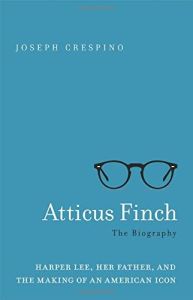
Atticus Finch: The Biography deserves more than a one-paragraph write-off here, but my thoughts on it and the titles that bookended it shared so much common ground that I didn’t want to repeat myself. This is a curious book, though — beginning as a biography of Harper Lee’s father, A.C. Lee, who inspired the character of Atticus Finch. A newspaperman and legislator, his character is plumbed in the opening before the author moves on to Harper’s struggle to reconcile the moral ideals of the South with the antagonism inherent in segregation. From here we review the character of Atticus Finch as he evolves in first To Kill a Mockingbird, its movie, and then Go Set a Watchman. Of great interest to Harper Lee and TKAM fans, obviously, but I most enjoyed the survey of A.C. Lee’s editorials, a look at the Depression and World War 2 through the critical and learned eye of a leading citizen of a small southern town.

New Acquisitions:

……

Yep, nothing.  I’ll have you know I was sorely tempted, too. There were several Star Trek Voyager novels on $1 sales, and I wanted them.   I’ll see about my Mexican dessert reward later this week.  The book-buying ban will continue with the bribe repeated. 

Plans for December:

Expect at least a couple of titles relating to southern lit and a nod to the Pacific War. The focus will be TBR titles.

Posted in General | Tagged , , | 5 Comments

Sid Meier’s Memoir

Sid Meier’s Memoir: A Life in Computer Games
© 2020 Sid Meier
304 pages

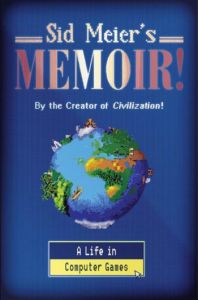
Dear readers, I cannot tell you how much of my life has been spent in worlds of Sid Meier’s making –  discovering his talent for historically-grounded but  still-compelling gameplay in Gettysburg,   becoming a convert in full with Civilization III, and then exploring more of his works with Pirates  and Railroads.     His name is a legend in the industry, for he was there from the beginning – and at least since the 1980s, that name has been used to sell games, a guarantee of quality.  Although this wasn’t Meier’s idea,  he’s apparently learned to live with it, using the convention playfully for the title of his memoir. The same playfulness is present throughout this chronicle of his life in the gaming industry, as the text is peppered with literary Achievements, like having read the word “Civilization” a hundred times. 

It is as its subtitle declares, “a life in games”:  the focus is on Meier’s  work, not his personal life, though one inspires the other.  We learn about how and why Meier and his coworkers were inspired to try a particular game or challenge, the difficulties of realizing their vision, and trivia about the games themselves. It’s at its strongest in the 1980s and 1990s, though,  with increasingly little detail on  later  titles that he was linked to only in a supervisory role.  The biggest disappointment is his lack of commentary on his collaboration with Will Wright, another gaming legend:   the two have a similar interest in modeling complex systems like  cities, train networks, skyscraper ecosystems, etc in computers, and making said systems fun to tinker with, so I would have loved more content about their joint project, SimGolf.   Throughout the work, Meier comments on his approach to programming games – above all, make the player the star and their experience fun – and his thoughts on the creative process.   Although I missed all of his early titles (not even being aware of computer games in the 1990s),   someone who’s thoroughly enjoyed every title I’ve tried by him,   this was an enormously rewarding book with surprising details – like Meier’s  professional connections to both Robin Williams and Tom Clancy. 

Related:
Masters of Doom: How Two Guys  Created an Empire and Transformed Pop Culture, David Kushner
Replay: The History of Video Games,  Tristan Donovan
Prepare to Meet thy Doom! And Other True Gaming Stories, David Kushner
Jacked!  The Outlaw Story of Grand Theft Auto, David Kushner

Posted in Reviews | Tagged , , | 8 Comments