
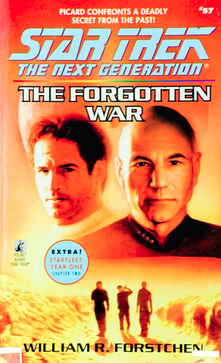
Centuries ago, in the days of legends like Captain Pike and Captain Murat, the Federation fought an undeclared war against an aggressive reptilian warrior-race called the Tarn. The war ended in an armistice that established a small no-fly zone between the Tarn and Federation’s respective spheres of influence, but now an atomic bomb has been detected within the zone. The zone no one is supposed to be in. Investigating, Captain Picard is astonished to discover that the survivors of two ships – one Starfleet, one Tarn – that both crash-landed on a desolate planet have been carrying on their own war for centuries. The timing couldn’t be worse, as the Federation and Tarn were preparing to revisit the armistice and establish a more lasting peace on top of it. Nevertheless, Picard must try to put an end to the hostilities between the two factions, whose progress up the tech-tree of history has arrived at World War 2, complete with P-51 Mustangs and M1 Garands. When he loses contact with the landing party – including a Tarn representative who goes native – things deteriorate.
Kid-me loved this novel, because he was obsessed with all things World War 2 – but especially P-51 Mustangs, about which he wrote a paper. (Strictly speaking he partially plagiarized a paper, quoting at length from Albert Marrin’s The Airman’s War but forgetting the niceties like proper citation marks.) Adult me is far more dubious about the ability of humans living in underground tunnels and caverns to have the manufacturing base necessary to create P-51s and rifled carbines, let alone that of psychopathic lizard-people to create the equivalent of the Manhattan Project from nothing but ‘stone knives and bear skins’, as Spock might’ve put it. The humans, for their own part, are disturbing to the Enterprise crew: while they still identify with something called The Federation, reproducing its uniforms from their ship’s databases, they are a society that has been shaped by desperate warfare for centuries. Their civilization is a mix of mythic memory and feral warfare, and they have no desire to make nice with the Tarn despite the lizards having a-bombs that amplify their many logistical advantages over the humans. Still worse, the landing party inadvertently gave away the location of the main human base, and the on-planet Tarn are going to capitalize on that to crush their long-chased prey. And then there’s the Tarn representative, who is so excited about the prospect of fighting war The Old Way (in Stukas, as God intended) that he forgets he’s meant to be telling these people that their war ended a long time ago.
This was a fun novel to revisit, completely absorbing. The premise is a bit silly, yes, but I enjoyed the world-building Forstchen did in regards to the Tarn: while they could be written off as crazier-than-usual Klingons-who-happen-to-be-lizard-people, their clan-oriented society is interesting in itself and creates lots of opportunities for political drama. The big hitch in that is the Tarn envoy, whose entire reason for being is to hate the Federation. Do they make a speical room for him so he’s comfortable? Pathetic weaklings. Did they win a battle against his ancestors? Treacherous cowards! Are they trying to establish peace on the planet? Losers! – or wait, unless Picard is stalling for time to bring in reinforcements, in which case Starfleet is treacherous again. There’s no winning with him, no depth to him, and no interest in him. On the bright side, the author leads heavily into TNG’s highbrow nature, with lots of poetry being quoted, and the story ends in a full spread of Federation goodness.
On a WILD sidebar note: I read this author (William R. Forstchen) in the 2010s and didn’t clock his name at all until I pasted in the cover for this review. You wouldn’t expect a guy writing doomer fiction (post-EMP survival) to also do Star Trek, though admittedly the premise of this does overlap a bit with survivalism.


