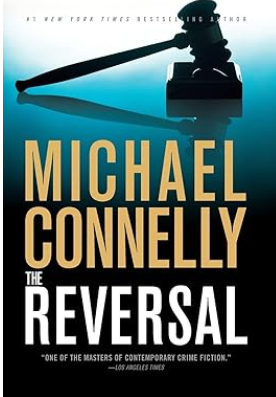
Mickey Haller has been asked to do the unthinkable: to cross the aisle and serve as a prosecutor. The reason is simple: an old case is being re-tried, and for propriety’s sake, the City of Los Angeles wants to bring in someone who can work the case without any old prejudices and without suspicion of trying to hide any old mistakes. Mickey agrees on two terms: one, his ex-wife Maggie McPherson be his assistant counsel; and two, he gets to choose the police investigator who helps him build the case. His choice? Harry Bosch, the star of Connelly’s prior novels and Mickey’s half-brother. Haller and Bosch have run into each other a few times at this point in their respective series, but this is truly a family reunion with each brother’s daughters getting to be friends and sometimes sheltering together when it appears the case might be getting personal.
The Reversal is a legal novel, by and large, with some ‘creepy’ elements in that the accused has strange nocturnal habits; he parks in strange places around the city, sitting alone with a burning candle. Bosch has the grim suspicion that the accused was in fact a serial killer, and that the man is visiting sites related to his prior kills. Haller has a lot of his own plate, revisiting evidence that’s decades old, and trying to figure out what angle the defense might take. The pace is fast, spurred on by a judge with no tolerance for time-wasting theatrics, or for lawyers who play games – and the more the story develops, the more dangerous the circumstances grow for those involved in the case. The ending is right out of left field and is more in Bosch’s ballpark.
This was an enjoyable return to Bosch & Haller, though I imagine readers’ reactions to the end will vary wildly.
John Adams: “If you [John Quincy] do not rise to the head of not only your profession, but of your Country, it will be owing to your own Laziness, Slovenliness, and Obstinacy.”
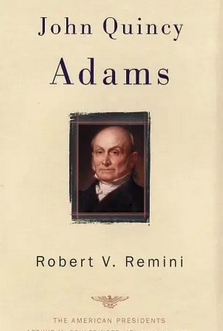
In his biography of Abraham Lincoln, Jon Meacham referred to John Quincy Adams — hereafter referred to as Quincy, following John Adams’ practice — as “the personification of the nation’s story”. That’s a hell of a epithet, one so striking I had to scribble it down. I am somewhat familiar with the Adams clan, beginning from John himself all the way to Henry Adams, and tend to like them, especially John and Quincy, who were bookish, moralistic, and prone to irritating people. After reading a series of books on John and Abigail Adams years ago, I’ve always intended to tackle their eldest son — and am glad this history project is giving me additional drive to do it. I’m beginning with a shorter one in The American Presidents series (they’re all about 200 pages), but can readily imagine follow-ups and circle-backs.
Bless John Quincy Adams: he had ‘tiger parents’ who rode him incessantly and insisted he had to be the very best. John Adams himself came from humble circumstances and made himself a notable through hard work and an invictus-like attitude; he expected more from his son, who grew in more privileged soil. His mother Abigail was equally demanding, and little Quincy was pressed into public service at the tender age of 14, assisting America’s diplomatic mission to Russia. Diplomacy would mark his early political life; even after he returned to America and graduated from Harvard, he would achieve early distinction serving Presidents Madison and Monroe, in the latter case helping to formulate the Monroe Doctrine that declared the Americas closed to future colonization. Remini’s book puts this doctrine into context: as the peoples of South America began rebelling against their Spanish overlords, the Republican administrations of Madison and Monroe saw a new chapter beginning in American life. The rule of the Old World’s monarchies in the New was over; now it was time for American republics to shine. This was not an example of early American ‘imperialism’; it was Republican idealism, and an idealism that Adams’ own presidency would exhibit when he tried to send ambassadors to a pan-American conference to discuss matters of mutual importance. President Quincy would be so hindered by the already-sectional Congress that by the time his ambassador arrived (one died en route) the Conference was already over.
Quincy is a fascinating president to study; despite his diplomatic accomplishments before, and his storied career in Congress after the office, he was not an effective president. He was marred from the beginning: he ran against a man who he’d actually defended, Andrew Jackson, but despite Jackson winning the popular vote the electoral college was undecided with no majority: Henry Clay cast the decisive vote to give Adams the presidency, and when Clay was awarded with a Cabinet position the opposition cried foul and accused Adams of conducting a corrupt bargain. Never mind that Clay hated Jackson and would have never voted contrary; the circumstances were such to give energy to the accusation. Quincy also dealt with difficult issues in office, from diplomatic affairs to the apparent willingness of Georgia to declare war on the Creek nation on its own if the federal government wouldn’t get around to evicting them. Adams had a strong sympathy for the plight of the Creeks, especially given that one treaty signing over land was created by such a brigand than the Creeks killed the man upon learning what he’d done to them, and acted in a way that annoyed everyone. To make matters worse, he signed off on the ‘Tariff of Abomination’ which would lead to a sectional crisis during Jackson’s administration when South Carolina threatened to secede over tariffs that transparently made the South pay premiums to protect the North and Northwest’s emerging industries.
What makes this interesting, though, is that Quincy’s commitment to integrity made his job worse: he retained people in office who hated him and actively campaigned against him or undermined his policies because they were effective in their posts: he would not remove people for purely political reasons, and his inherited postmaster general was so devoutly Jacksonian in bias that Jackson made the man a Supreme Court justice after Old Hickory hisself was in office. Adams also retained the Founding-era contempt for politicking, and refused to do things like appear at the 50th anniversary of Bunker Hill, or the opening of a canal. He was a man of intelligence and integrity who refused to court public opinion — and lost the next election rather handily. Despite suffering the losses of his father and two sons in this period, Adams was nonetheless courted to become a legislator, and there he achieved lasting glory as a stalwart against the expansion of slavery. It is his actions there that he is largely remembered.
Several volumes in this series have been fascinating, but this one was especially so for me because I was familiar with Quincy already. I didn’t know how much family tragedy he encountered: Remini remarks that alcoholism was a family curse, claiming one of Quincy’s brothers and two of Quincy’s sons. (His son Charles Frances famously overcame his namesake uncle’s predilection for the bottle and became an accomplished diplomat himself, though Southerners may wish contrariwise.) While one is reluctant to start fossicking around in psychology, the intense social pressure the Adams clan put on one another is no doubt part of the problem. Quincy was told by his father that he had no barriers to success beyond his own moral degradation, and he himself administered that same moral whip to his sons. Remini, while sympathetic to Quincy, regards him as a failure as a father and husband for failing to see his sons than anything other than scions of an accomplished house who were obligated to live up to their reputation. The man told his sons not to come home for Christmas when he saw their Harvard report cart and viewed it unsatisfactory. All the same, Remini regards Quincy as a man of unparalleled integrity whose adamant stance against the expansion of slavery redeemed his reputation for the ages.
This is the first book on JQA I’ve read, but I doubt it will be the last. The man is both difficult and interesting, a combination ripe for future reading.
WHAT have you finished reading recently? John Quincy Adams, Robert V. Remini. Also finished listening to a production of The Importance of Being Earnest that featured Stephen Fry as Lady Bracknell.
WHAT are you reading now? About to finish The Reversal, a Michael Connelly novel that features both of his series characters (Bosch and Haller), and I am listening to John Cleese perform The Screwtape Letters. I’m also still working through With Malice Towards None, a Lincoln biography.
WHAT are you reading next? I have Valiant Ambition, about George Washington and Benedict Arnold, checked out — but I don’t know if I can get to it before it expires. I also need to read some nonfiction that isn’t history: history accounts for 100% of my nonfiction reading this year. I’m expecting a le Guin piece on writing in the mail today — Steering the Craft. It’s fairly short and possibly consists of writing exercises in part.
Today’s TTT is “Top Ten Bookish Discoveries Made in 2025”, which is not a topic I feel confident I’ll be able to fulfill, but we shall see. First up, the Teaser Tuesday.
Abigail [Adams’] biting words only prompted John Quincy to come to [his fiancée] Louisa’s defense. He and he alone, he responded, must be accountable for his choice of a wife. If he waited until his mother approved of his selection, he would certainly be doomed to perpetual celibacy. JOHN QUINCY ADAMS
(1) The delight of game warden stories. CJ Box’s Joe Pickett series consumed my reading for 2.5. months and led to not only another game warden series, but to game warden nonfiction. CJ Box is a proper menace.
(2) I’m getting to be a bad Star Trek fan. Not only did I only read two ST novels last year, but I didn’t even finish watching the long-awaited season 3 of Strange New Worlds. I am slowly remedying that: I am halfway through.
(3) 2025 would be remembered as the year of Paul Kingsnorth (an ecological/social critic who is also an Orthodox mystic who lives on an off-grid farm) were it not for my CJ Box obsession. I read through all of Paul’s nonfiction works in 2025, including his most recent release and alleged magnum opus, Against the Machine.
(4) Donald Honig as a baseball historian. I’ve read three of his books detailing baseball from the 1920s to the 1950s.
(5) A YA novel series I read in high school is a lot ‘spicier’ than anything I’ve read as an adult.
(6) Most of James Gandolfini’s filmography, thanks to a biography I read of him, Gandolfini. I watched as many of his movies as I could find last year.
(7) Bell Irwin Wiley as a Civil War social historian. I’d read Wiley before but really got into his works back in 2025.
(9) HARRY POTTER FULL CAST AUDIO EDITIONS ARE AS WONDERFUL AS CHOCOLATE FROGS. I listened to one in December and two this month; I intend to listen to the rest as they come out. Yes, I’ve read the series multiple times; yes, I’ve watched the movies multiple times; yes, I’ve listened to Jim Dale and Stephen Fry both read audio books of the series; yes, I’ve watched CallMeKevin play all the games (a bean!!). It doesn’t matter, I love these productions.
(10) Dead presidents. So…..finding an interesting chap on youtube led to my dormant Civil War obsession from high school being reignited, which led to me reading about the prelude to the Civil War, leading to me reading a lot about the presidents from the 1830s to the 1850s, leading to me reading antebellum history for one, two, three months now. Ah hah hah.
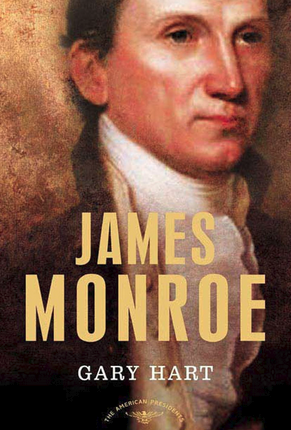
What do I know of Jimmy Monroe? I retain from Founding Rivals some notion of Monroe as a fundamentally military man, in opposition to his strictly-political allies like Jefferson and Madison, and that he was the last of the “Virginia Dynasty”. As it turns out, while Monroe did not theorize about politics as much as his more literary predecessors, he was quite good at practicing it. An early biographer argued that Monroe was unique among the founding generation in that he did not have a ‘retiring’ idea of America; he saw navigating European relations a vital part of creating a future for the fledgling nation. Managing both the departments of State and War during the War of 1812 made that grimly clear. Navigating relations could take different forms, of course — working with his Sec. State John Quincy Adams to propagate the Monroe Doctrine, which declared the Americas off-limits to future colonization — as well as navigating Russian claims along the West Coast, and figuring out how to respond to the burst of Bolivarian republics as South America began driving the dons out. Given how acrimonious relation had been between the Federalists and Republicans, Monroe’s ability to work with men like Adams and Jackson is a pleasure to witness. Monroe and Adams were rivals, but accomplished collaborators — prompted by Monroe’s realism and Adams’ inherited sense of duty and responsibility. Monroe strikes me in this book as an independent actor: despite being a soldier devoted to his commander in chief, Monroe was not afraid to push back against some of Washington’s policies, and he exchanged letters with Jefferson, another mentor, arguing about foreign policy. After leaving office, Monroe was greeted with tragedies — the deaths of his wife and son-in-law — and died in near poverty some five years after Thomas Jefferson — but, like Jefferson and Adams, on July 4th. All told, this is a very compact but readable and fair guide to Monroe’s presidency, and it has some fun surprises like Jackson seizing Pensacola just because he could, and Monroe having to break up a duel between two men whose spat began with the apparent quoting of Shakespeare.
Quotes
Though an ardent revolutionary, Paine had complained to the Directory against the execution of the French king and had been incarcerated in the Luxembourg prison for his troubles. Monroe secured his release and gave him lodgings on the condition that Paine refrain from pamphleteering against U.S. policy. Paine returned Monroe’s hospitality by promptly using confidential conversations with Monroe as grist for his anti- Washington mill.
The story is told of a ministerial dinner at which the British minister Sir Charles Vaughan saw the French minister Count de Serurier, directly across from him, bite his thumb every time Vaughan made a remark. “Do you bite your thumb at me, Sir?” Vaughan finally challenged. “I do,” was the Frenchman’s reply. They promptly withdrew and were at sword points in an adjoining hall when President Monroe arrived and threw up their swords with his own. Their carriages were called, and Monroe sent them, separately, away.
John C. Calhoun perhaps best described the workings of Monroe’s mind: “Tho’ not brilliant, few men were his equal in wisdom, firmness and devotion to his country. He had a wonderful intellectual patience, and could above all men, that I ever knew, when called on to decide an important point, hold the subject immovably fixed under his attention, until he had mastered it in all of its relations. It was mainly to this admirable quality that he owed his highly accurate judgment. I have known many much more rapid in reaching a conclusion, but few with a certainty so unerring.”
I’m trying to figure out if thumb-biting was legitimately offensive, or if these guys just took Romeo and Juliet very seriously. For those who don’t get the reference:
ABRAHAM: Do you bite your thumb at us, sir? SAMPSON: I do bite my thumb, sir. ABRAHAM: Do you bite your thumb at us, sir? SAMPSON: [Aside to GREGORY] Is the law of our side, if I say ay? GREGORY: No. SAMPSON: No, sir, I do not bite my thumb at you, sir, but I bite my thumb, sir. GREGORY: Do you quarrel, sir? ABRAHAM: Quarrel sir! no, sir. SAMPSON: If you do, sir, I am for you: I serve as good a man as you. ABRAHAM: No better!
Ross: Inter arma enim silent leges. Bashir: “In time of war, the law falls silent.” Cicero. So, is that what we have become – a [new] Rome, driven by nothing other than the certainty that CAESAR CAN DO NO WRONG?
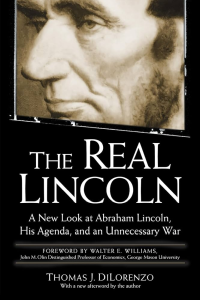
Jon Meacham’s And There Was Light was a fairly flattering biography of Lincoln, seeing him as a visionary who checked his hatred of slavery only for politics’ sake, and who was finally allowed to lean in to and even weaponize it during the Civil War. The Real Lincoln takes a far more critical approach, firing two barrels: the first shot argues that Lincoln was far more interested in saving and consolidating the Union than he was bothering with slavery; the second argues that Lincoln committed gross abuses of power in service to said saving and consolidation. Cleverly, DiLorenzo draws on sympathetic sources to feed his charge of Lincolnian tyranny — putting men who argued that Lincoln was a benevolent tyrant on the stand, rather than Southern critics who could be unthinkingly dismissed. While I have absorbed knowledge of Lincoln’s wartime abuses over the years, I was intrigued by the prospect of Misesian criticism of Lincoln’s economic opinions. Though at times this book functions purely as a hit piece, with no quarter given, the economic angle remains novel enough — and the abuses of civil liberties remain serious enough — to warrant serious consideration. I’ll confess my interest in this book was ignited somewhat by learning of Lincoln’s treatment of Clement Vallandigham, who was exiled to Canada for daring to attack ol’ honest Abe, while studying the life of President Pierce.
Key to understanding The Real Lincoln as more than a catalog of “Lincoln behaving badly” factoids is DiLorenzo’s emphasis on the” American System”. Championed by Henry Clay—Lincoln’s lifelong political idol—this program combined a national bank to manage the money supply, heavy spending on internal improvements, and high protective tariffs intended to foster domestic industry. Lincoln embraced this agenda early, declaring himself for Clay’s system even before he had been admitted to the bar. DiLorenzo argues that Lincoln’s devotion to the American System helps explain both his economic views and his willingness to concentrate power at the federal level. The aims of the system were not difficult to sympathize with: canals and railroads promised progress, and a young nation sought economic independence from Britain. But as later experiments with protectionism and import substitution would demonstrate, such policies often carry severe trade-offs. An economic program can be reasonable in its goals while proving deeply destructive—or inhumane—in its consequences, a tension DiLorenzo sees at the heart of Lincoln’s political legacy. DiLorenzo argues that the American System proved dysfunctional from the start: numerous northern states who tried kindred policies found themselves grappling so much corruption that they adopted amendments to bar the state government from monkeying around with improvements and state-controlled banks. One of Lincoln’s chief critics, Clement Vallandingham, attacked not only Lincoln’s civil liberties abuses, but the ‘great emancipator’s’ consolidationist, Clay-driven economic policies — policies that passed a Congress largely empty of critics, either because those dissident voices had seceded or were in prison, in the case of New York and Maryland. These included the National Banking Acts and increased tariffs that would shelter northern industry for decades after the war. These economic policies marched along with the bullet and bayonet in service to make these United States into one dominion controlled by DC.
And now, the spice. War is the health of the state; its mothers milk, its sweet succor. Nothing expands the state like war: if we applied Stephen Jay Gould’s punctuated equilibrium theory of evolution to the evolution of the state war is most certainly those ‘punctuation’ marks where suddenly a great deal of change happens all at once — and contra to the hopes of the people and the claims of the politicians, power once seized is rarely laid down. At best, some of it returns — but the government has still grown, and its appetite remembers the feasts-days of war’s horrors. Much of the book is given over to documenting the long train of abuses Lincoln committed in the name of ‘saving’ the Union — of dismantling those freedoms that the young were dying en masse to protect, if I may borrow from Dr. Bashir. Where do we begin? The arrest of legislators in Maryland to ensure they do not vote the wrong way? The mass imprisonment of those who dared to criticize Lincoln or the war. The attacks on New York newspapers that did not follow the Lincolonian line, outright closing them down? These are not criticisms raised by that dreaded spectre, the ‘neo-Confederate’: they were raised by men at the time, including President Franklin Pierce and men like Clement Vallandigham, a man accused of treason and exiled to Canada. DiLorenzo finds and corrals so many crimes committed by Lincoln or in his name that it is easy to think his statue in DC ought to included him gripping a fasces and feature depictions of the vanquished bowing at his feet, as in Rome. This is a hard section to evaluate, to be honest: I would counter DiLorenzo and say that the Constitution does allow for the suspension of habeas corpus in times of rebellion and insurrection — but DiLorenzo fires back, arguing that the Supreme Court ruled during the war that such suspension is not the president’s to conduct: only Congress could. (Congress did, after the fact.) There is a great deal, though, that cannot be explained — and Lincoln’s ‘iconic’ status means it will never really be addressed, only ignored. The Civil War, DiLorenzo writes, was the final triumph of Hamilton over Jefferson — of the Union over the Nation, of the State over the people.
Can a reader give this a fair appraisal? My basic preference for decentralization and libertarianism is thirteen years old at least, and my distrust for the centralizing preferences of Hamilton, Whiggery, and Lincoln is reflexive. All the same, I think the argument suffers for its sheer zeal: DiLorenzo throws charge upon charge upon Lincoln, does not admit the defense into the well, and uses the war crimes of others to attack Lincoln on the basis that as commander in chief, their behavior was his responsibility. I doubt that most admirers of Lincoln would have their minds changed by this: they will come away sputtering, “But — but — but!”. I can understand that viewpoint: I once used to argue with someone more libertarian than I, who saw in Lincoln nothing but a devil: I could at least understand that Lincoln, voted as president of the Union, could not countenance allowing it to fall apart while he was steward. That does not mean I condone what he did in that effort: I was and remain a deep critic of Lincoln, even if I find much to admire about him. I am the same way about other figures, like Napoleon. And I yet I come away from this book more sure in my own conviction that the postwar Union was as different from the prewar Union as the prewar Union was from the Articles of Confederation. A new thing had been created, and it was a thing that would, only within a few decades, become first a world empire and then a world superpower. That road, I think, begins with Lincoln’s creation of a new union as he tried to ‘rescue ‘from the fires of war the old.
Vallandigham’s “crime” was making a speech in response to Lincoln’s State of the Union Address in which he criticized the president for his unconstitutional usurpation of power. For this he was declared a “traitor” by Lincoln and imprisoned without trial. The Democrats in Ohio (a loyal Union state and home to Generals Grant and Sherman) were so outraged that they nominated Vallandigham for the office of governor even though he had been deported.
LINCOLN PURSUED the peculiar policy that it was necessary to destroy constitutional liberties in order to preserve the Constitution, redefining “the Constitution” to mean “the Union,” which is not at all what the founders intended.
I hope readers will forgive me the Deep Space Nine at the beginning of this post. I’m fairly certain that episode was when DS9 started making me think critically about politics: it was the reason that when the War on Terror began, I became a civil libertarian, and then later a regular cranky (and sometimes uncivil) libertarian. The scene for your consideration:
Given that I’ve listened to all three of the full-cast audio productions in the last month and have active plans to enjoy the rest as they’re published this year, I greatly enjoyed this. If you’ve been intrigued by the reviews, it may give you some idea of the vocal talent at work. I haven’t heard any of the ‘older’ actors yet — the children change actors beginning in book 4 — so it was fun to hear a preview of them — and to SEE these voices in my head. I knew Mark Addy’s voice was familiar, but I’d rather thought it was because he was trying to stick so close to Robbie Coltrane — not that I’d known him from Still Standing. (Also, Hugh Laurie looks distressingly old. I always imagine him as Bertie Wooster, never Dr. House…..and now he can do a very good Dumbledore. I actually like him more than Richard Harris or Gambon, to be frank.) If nothing else, click here to experience Kit Harrington as Gilderoy Lockhart. He was such fun to listen to.
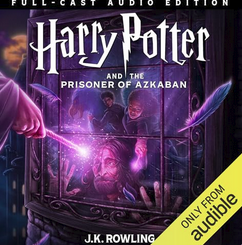
Harry Potter is in a bit of trouble: he’s accidentally blown up an awful woman, his uncle’s sister, and now he’s on the lam and expecting to be expelled from Hogwarts. (She’s blown up like a balloon, I should say, not like C4.) When ministry officials find Harry at the Leaky Cauldron, they’re surprisingly relieved – and not at all wrathful. There’s a serial killer on the loose, it seems, and one who has a connection to the awful night that Harry Potter’s parents were killed and Harry himself was left with a strange scar on his forehead. Although there are many funny bits here, Azkaban starts the series’ ramping up of drama and seriousness – or should I say siriusness? There’s an increasing feeling of forebodingness and besiegement here, as the spectral ghouls who are ‘guarding’ the castle from the killer Sirius Black drain joy and hope from the kids, and fear soars when Black appears to have been able to find a way to sneak inside the school regardless.
Reviewing this title almost seems a pointless exercise, following so closely on the heels of my other full-cast audio reviews. We have some new voices now, of course, primarily Remus Lupin and Sirius Black. Lupin’s casting is excellent, I think; Black took some getting used to, but part of his ‘roughness’ may owe to the story itself. Ditto the casting of Trelawney: her breathy voice, varying tone and inflections are all profoundly irritating, but given her interactions with the trio – especially Hermione – I think that’s intentional. Snape’s voice actor continues to underwhelm, especially when he’s being emotional: this is funny in one scene, where he’s positively whining to Fudge that he simply doesn’t appreciate what a nuisance Potter is. I think the ambient or atmospheric sounds – characters reacting in the background, trunks being opened, crickets chirping – has been raised a bit, but I am not positive. I listened to the previous books while driving in my car, so they were contending with the motor, the highway, and so on, whereas I listened to a lot of this book from my PC soundbar. There were a couple of scenes in which the amount of simultaneous audio (effects, music, and dialogue) pushed into interfering with one another, but only to a minor degree. Music, as mentioned in my first review, is used sparingly and typically to good effect..
All told, this was another wonderful entry in the full cast series. The books are going to get darker and longer, but even so — I look forward to the upcoming releases — one a month from February until May.
Today’s Long and Short Reviews blogging prompt is funny book titles. I sometimes begin drafts for posts weeks in advance and accidentally posted this week’s last week — so, now I have to post last’s week’s topic this week! But first, WWW Wednesday!
WHAT have you finished reading recently? James Madison by Richard Brookhiser; Harry Potter and the Prisoner of Azkaban, full-cast audio edition. (SO GOOD.)
WHAT are you reading now? Three Philosophies of Life, Peter Kreeft; With Malice Towards None, Stephen B. Oates. The former is a study of Ecclesiastes, Job, and the Song of Solomon; the latter is a biography of Abraham Lincoln. I’m mostly done with The Real Lincoln but am trying to investigate some of its claims, so I haven’t finished it yet. With Malice is also huge, so place your bets on if it appears next week. Believe it or not, I am tiring a bit of the mid-19th century…
WHAT are you reading next? Your guess is as good as mine! I got an early birthday present from the ladyfriend, a biography of Theodore Roosevelt, but I’ll probably wait on him until I’ve finished the pre-Civil War presidents. (Remaining: Monroe, John Quincy Adams, and Polk.)
L&S review’s prompt is an interesting one for me because I grew up in a Holiness church that did not allow televisions: they were “worldly entertainment”. The strictness of this rule, though, varied by the preacher, so my parents had a TV when I was very young, got rid of it when I was around 5, accepted a black and white set from a cousin when I was a bit older, got rid of that set when the preacher changed, and so on and on until at some point computers and the internet overwhelmed those strictures. (I left that church at 20 and do not have a TV: my parents now constantly watch tv or tv programs on their phones. Go figure.) Anyhoo, I have very dim memories of watching Rescue 911 when I was young and we still had a tv, but they’re hazy. I know for sure I watched a lot of Full House as a young kid, because we’d literally drive to a family member’s house to watch it with them.
Daily writing prompt
Write about your first name: its meaning, significance, etymology, etc.
My name is Stephen, which translates to something like ‘crown’. I was named after the Biblical personage of St. Stephen, who is regarded as the Church’s first martyr — stoned to death for preaching. (Or, as one jokster-pastor put it, ‘rocked to sleep’.) I’ve known STEPHEN means ‘crown’ since I was a kid, though in St. Stephen’s case I wonder if that’s not a crown of martyrdom. According to Etymonline, only monks used the name in Anglo-Saxon England: the name became more broadly popular after the arrival of the Normans. According to that same source, Stephen and ‘nephew’ are tied together in a particular way, as their use of ‘ph’ is atypical in English usage. I spell my name the traditional way, of course, or as I sometimes say — the right way.
Today’s TTT is “goals for 2026”. Hmm – well, I’m sure I won’t get to ten. But first, two teases from James Madison by Richard Brookhiser:
Madison showed intelligence and humor. One evening he proposed an experiment to see how many bottles of champagne it would take to induce hangovers the next day. (No result was recorded.)
“The wine,” wrote one dazzled Federalist senator, “was the best I ever drank, particularly the champagne, which was indeed delicious. I wish [Jefferson’s] French politics were as good as his French wines.”
(1) Finish my second Classics Club. It should not be difficult: only a couple of of the books on my current list are girthy challenges (The Shahnameh and Tocqueville’s Democracy in America). The trick is getting started.
(2) Do proper justice to my America @ 250 challenge for this year.
(3) Complete The Bible in a Year challenge following Fr. Mike Schmitz’s program. I am currently on track. Fr. Schmitz’s approach isn’t a straight read through; instead readers get different books concurrently (Genesis and Job, for instance) with a splash of Psalms or Proverbs at the end of the day for flavor. It keeps one from getting bogged down in laws and “begats”. I think there are also some liturgical calendar considerations at work: right around Easter, for instance, there’s an abrupt switch from the book of Judges for a “Messianic Checkpoint” week spent in John.
(4) Continue to avoid reddit. I’ve never been a compulsive user of social media — I use facebook and instagram very sparingly — but when I “stumbled on” reddit a few years back I found it had the same addictive and poisonous effect on me that other social media platforms have on others. This year I decided to quit it cold turkey and am so far holding out.
(5) More writing. Given how active this blog is, I realize that may sound like a strange goal, but I have a local history blog I created a few years ago and have done little with – including publicizing it, because I haven’t been able to post there consistently enough to justify promoting it – and last year I began to share a series of local-drama short stories I’d written. I don’t know that anything will come of the later, aside from my own joy, but I’d like to continue exploring that as ideas come to me.
(6) I’ve been wanting to expand my role as a local history expert for a couple of years now: to a degree, this is working insofar as I’m the go-to person for people writing books that touch on my town, but I’m wanting a more integrated expertise – one that incorporates our surrounding counties, since my town’s prominence came from having been an ‘in-gathering’ site for the region: we were the place everyone else sent crops to sell, and the place that received goods from outside for people to purchase. Expanding this role would entail me attending historical societies meetings in those counties. I’ve begun networking with people in a couple of counties but have yet to attend a proper meeting, let alone establish myself as a regular, predictable presence there.
(7) Read Johnny Clegg’s autobiography – or rather, the first part of it. Unfortunately, we lost Johnny before he could properly finish it. Clegg’s music was literally the first time I ever watched a movie’s credits because I wanted to find out who sang that song. (“Dela”, from George of the Jungle. Yes, I was in middle school – but I still love it.)
(8) Return to purposeful tech training. I used to be fairly intense about staying up to date with tech, but then near-death, dialysis, and transplants happened and I got thrown off — despite constantly studying during my transplant recovery. I just saw the CompTia A+ is doing 1201/1202 tests and I haven’t even reviewed all the new stuff on their 1101/1102- gen material. It wasn’t just medical issues, of course: COVID + bitcoin mining really disrupted tech prices and I don’t know that they’ve ever normalized.
(9) Re-reading. I began trying to make this a habit last year; there are books I’d like to revisit just to see how I respond to them 10-15 years later.



 Reading Freely