Teaser Tuesday, war and body parts edition

This is a paraphrase instead of a quote, I’m afraid..

“What have they done to you? Lieutenant in His Majesty’s Armed Forces?!”
“I think they must have killed all the others off, sir.”

Hellfire, James Holland. Jack Tanner #4.

But when we socialise in disembodied ways online, even as biotech promises total mastery of the bodies we’re trying to leave behind, these efforts to abolish sex dimorphism in the name of the ‘human’ will end up abolishing what makes us human men and women, leaving something profoundly post-human in its place. In this vision, our bodies cease to be interdependent, sexed and sentient, and are instead re-imagined as a kind of Meat Lego, built of parts that can be reassembled at will. And this vision in turn legitimises a view of men and women alike as raw resource for commodification, by a market that wears women’s political interests as a skin suit but is ever more inimical to those interests in practice.

Feminism against Progress, Mary Harrington
Posted in General | Tagged , | Leave a comment

Nonfiction November

I just spotted a reading challenge over at Marianne of Let’s Read’s, called “Nonfiction November“. Given that my nonfiction reading reliably counts for 60% to 70% of my reading, it caught my attention: it looks like a series of reflections about nonfiction. Since I am a bit late to the a party, I’m going to answer both available prompts.

Week 1 (10/30-11/3)

Your Year in Nonfiction: Celebrate your year of nonfiction. What books have you read? What were your favorites? Have you had a favorite topic? Is there a topic you want to read about more?  What are you hoping to get out of participating in Nonfiction November?

I don’t want to say too much here because we’re not that far from end-year wrap-up posts, but it’s been a good year. Completed the science survey early, read into English history, went on a baseball streak, enjoyed Space Camp, went crazy for US presidents for a bit, and finally started reading some books on social media and big tech that had been on the list for a while. And then there was all the other stuff — even with all of the 1990s kidlit I read in early July for the “Blast from the Past” series, nonfiction is over 62% of my reading so far. Favorite NF so far would be Will Storr’s Adventures with the Enemies of Science.

Week 2:

Choosing Nonfiction: What are you looking for when you pick up a nonfiction book? Do you have a particular topic you’re attracted to? Do you have a particular writing style that works best? When you look at a nonfiction book, does the title or cover influence you? If so, share a title or cover which you find striking.

There are some topics I visit on a regular basis: I try to get a nice cross-section of science and nature reading with the Survey, I often focus on Anglo-American history in the spring and summer, etc. Although a fair bit of my nonfiction reading is done purely for pleasure and understanding, what unites much of my reading is the attempt to understanding what the flourishing life is for human beings, and how we might achieve it — something that unites seemingly disparate interests in say, evolutionary psychology, urban design, Stoic philosophy, and sociology. Titles and covers definitely make a contribution as far as attracting my attention: How I Killed Pluto (and Why It Had it Coming) being a prize example.

Posted in General | Tagged | 1 Comment

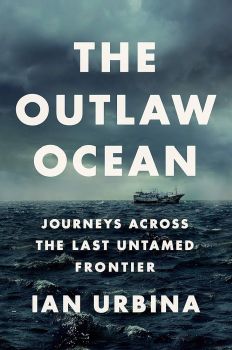
The Outlaw Ocean

The Secret Life of Groceries was a disturbing wake-up call for me last year, exposing as it did how slavery is a core part of the fishing industry that supplies seafood the world around — in which men are trapped on boats and denied an avenue for escape, because their ships never go into port, instead receiving supplies and offloading goods to other ships that frequently service the big trawlers. The Outlaw Ocean takes that kind of exposure and runs with it, diving into the murky spectrum of human behavior that flourishes in the wide open spaces of the great oceans, where the law strains to reach and enforcement of it is difficult in the extreme. Here we find environmental vigilantes chasing poachers, luxury cruise liners dumping trash into the ocean, repo men commandeering boats, slave-based fishing ships operating with impunity, and armed ships fighting for fishing rights in the South China Sea. Here, amid the hardships of life at sea made worse by the cruelties that men inflict on one another, we aslo find little dashes of heroism — men who document sights they could be killed for sharing, and others who sabotage poachers’ equipment and hound them on the high seas. Ian Urbina is crazy, admirable, and tough. Working on the high seas is dangerous and wrenching work by itself, given the sheer force of wind and wave that assails ships and seamen, but in chasing stories, Urbina embedded himself for weeks at a time aboard various ships and sometimes made himself a target through his inquiries, and Outlaw Ocean records a few harrowing moments when he was very possibly the target of some bad actor’s plans. Illegal activity abounds on the high seas for a multitude of reasons: incentive, for one, as there’s always money to be made….and that applies closer to land, as Urbina encounters evidence of gangs/alleged governments/gang-state entities overlooking their own ‘laws’ to reap profit in the form of bribes. The sheer size of the ocean also makes enforcement difficult, as ne’er do wells sometimes turn off their transponders: one of Sea Shepherd’s vessels had to patrol an area the size of Australia while trying to find a Japanese fishing trawler operating illegally in international waters. This was definitely an eye-opener into the complexities of marine law and the debasement its weaknesses allow for.

Related:
The Crimes Behind the Seafood You Eat“, recent New Yorker article by Urbina.
The Secret Life of Passwords”, Ian Urbina. Same author. He’s an interesting journalist.

Posted in Politics and Civic Interest, Reviews | Tagged , , , | 3 Comments

Highlights from People vs Tech

Moments ago, I finally posted a review for a book I read back in September, The People vs Tech.

We won’t witness a repeat of the 1930s, everyone’s favourite analogy. Rather, I believe that democracy will fail in new and unexpected ways. The looming dystopia to fear is a shell democracy run by smart machines and a new elite of ‘progressive’ but authoritarian technocrats. And the worst part is that lots of people will prefer this, since it will probably offer them more prosperity and security than what we have now.

Being always under surveillance and knowing that the things you say are collected and shared creates a soft but constant self-censorship. It might not feel like that when people are screaming abuse on Twitter – but for every angry troll there are hundreds of quiet users, lurkers who watch but don’t post, for fear of the angry Twitter mob, the data collectors, a nosy employer or the hordes of professional offence-takers who shark around the net waiting to be upset.

Developing the faculties to think for oneself requires that people say controversial things, make mistakes and learn from them. But social media creates a strange form of performative politics, where we all act out certain roles and acceptable public responses (this idea is bad! This person is good!), which limits the room for genuine personal growth.

Numbers are intoxicating, because they hold out the promise of a pure, exact, judgement-free answer. Algorithms are doubly so, since they appear to be logical and objective calculating machines which draw on millions of examples.

Nearly five million Brits have already used the voting app ‘iSideWith’ in multiple elections. The fact that five million people asked an app that they barely understood how to fulfil their most important duty as a citizen bothered exactly no one.

McLuhan, the great prophet, was far too smart not to hedge his bets. He also said that conflict and disharmony was possible in a world where everyone was connected to everyone else, because information-at-all-times would be so discombobulating that it would spark a mass identity crisis. ‘The day of political democracy as we know it today is finished,’ McLuhan told Playboy Magazine in a 1969 interview. ‘As man is tribally metamorphosed by the electric media, we all become Chicken Littles, scurrying around frantically in search of our former identities, and in the process unleash tremendous violence.’2 CEOs, high-profile endorsers, hangers-on, early technologists and politicians all tended to ignore this bit, because these sorts of people much prefer optimism to tremendous violence.

At times ‘post-truth’ has become a convenient way to explain complicated events with a simple single phrase. In some circles it has become a slightly patronising new orthodoxy to say that stupid proles have been duped by misinformation on the internet into voting for things like Brexit or Trump. In fact, well-educated people are in my experience even more subject to these irrationalities because they usually have an unduly high regard for their own powers of reason and decision-making.

Kahneman’s main point was that there are two basic systems that govern human behaviour. ‘System one’ thinking is fast, instinctive and emotional. It’s the reptilian brain, running on instinct. By contrast, ‘system two’ thinking is slow, deliberative and more logical.7 It sometimes, but not always, acts as a check on those wilder rages. Modern democracies aspire to run on ‘system two’ logic, and its ideal citizens are McLuhan’s literate man. Its institutions are arranged to arrive at logical, thought-out, fact-driven decisions. The internet, by contrast, more closely resembles ‘system one’: everyone and everything is immediate, instinctive and emotional.

In 2001, cyber-psychologist John Suler explained why this was, listing several factors that allow users of the internet to ignore the social rules and norms at play while offline. Suler argues that because we don’t know or see the people we are speaking to (and they don’t know or see us), because communication is instant, seemingly without rules or accountability, and because it all takes place in what feels like an alternative reality, we do things we wouldn’t in real life. Suler calls this ‘toxic disinhibition’. This is what all the articles about ‘echo chambers’ and ‘filter bubbles’ miss. The internet doesn’t only create small tribes: it also gives easy access to enemy tribes. I see opposing views to mine online all the time; they rarely change my mind, and more often simply confirm my belief that I am the only sane person in a sea of internet idiots.

Over the last 200 years, individual liberty and wealth have grown hand-in-hand, because freedom was good for the economy, and that economy produced more well-off people who valued freedom. What if that self-reinforcing cycle was weakened? What if economic growth in the future no longer depended on individual freedom and entrepreneurial spirit, but on capital and the ownership of smart machines that can drive research and entrepreneurship? What need would the rich then have for the poor they neither knew nor liked? In this scenario, ‘universal basic income’ wouldn’t be a dreamy utopia of satisfied and empowered citizens, but instead a very neat way for the millionaires to keep the poorest in society from rebelling.

The iPhone and web browsers we now all use have carried the Californian Ideology around the world, infecting us all with the alluring idea that disruption is liberation, total individualism is empowerment and gadgets equal progress.

That’s the final realisation of the crypto-anarchist fantasy. A world of lonely one-per-centers, freed from all constraints and social commitment – anonymous ghosts in the machine.

Posted in quotations | Tagged | 1 Comment

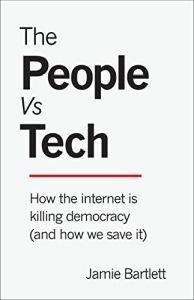
The People vs Tech

249 pages

Democracy must bring big tech to heel, adapt itself to thrive despite big tech, or perish. Born of different times, with different expectations, they cannot coexist in their present date: the latter will surely destroy the other. In The People vs Tech, Jame Barlett examines six aspects of a healthy democracy that big tech is already challenging, or will in the future. These include independent-minded citizens, a shared culture based on a common reality, free elections, an economy allowing for participation and good-enough equality, and trustworthy authority. There is considerable food for thought here, and it’s presented in admirably nonpartisan fashion, so that even if a reader disagrees with Barlett, his view is approachable and understandable.

Much is discussed in his chapters on these six pillars. We begin with how tech nudges us into compulsive behavior, chilling or warping our thinking, and aiding and abetting in our self-infantalization by doing mental work for us. You don’t want to read a pdf? Bing has a helpful new AI companion which will reduce it to a few bullet points to memorize and forget. Were there sudden flashes of insight you might have gotten in reading the article and unexpectedly drawing connections to your own experiences or other reading? Oh, well, that’s life. We move on to how through our own choices and the recommendation engines, users of platforms like YouTube and Facebook sink into narrower and narrower worldviews, losing common frames of reference with citizens beyond their in-group. We see, too, how the hurricane of stimulation that sweeps over us online, the constant demands to Respond! Now! undermines our ability to think deliberately. How can we understand someone else’s worldview when our own has not been developed purposefully, but is instead a pile of reactions? Similarly, the data profiling of consumers which allows micro-targeted ads can be uses to sell politicians based on a single issue instead of people voting on a broad, cohesive platform. We then move into what big tech might do to society at large, if automation creates hyper-inequality and leaves most of the population with no meaningful way to contribute economically, and by moving every bit of civil society onto its platforms. Finally, Barlett examines the potential perils of cryptography: if the main reason people tolerate the state’s incursion to their rights (its taxes, its self-asserted monopoly on violence, its prisons) is security, and cryptography undermines the state’s ability to find and police bad actors, what then?

As someone whose young adult mind was formed by tech critics like Neil Postman and Nicholas Carr, I can’t offer any serious arguments against Barlett here, on the whole. Much of what he says has already been on my radar, although the last two chapters were new to consider, and the latter was particularly thought-provoking given my conflicted sympathies. There was much in here I appreciated being reminded of, of lessons updated for the current day — what we give away in agency and maturity when we rely on machines to do more of not merely our manual labor, but our mental work as well. I’m not convinced that automation will lead to the extreme inequality he predicts, though I can appreciate why he sees that coming. His example of Silicon Valley as a hyper-equal community was off, though: homelessness abounds in southern California not because Google and Facebook’s execs are distorting the labor market, but because the mild climate attracts those in need, and the local governments are generous — to a fault, both in what they give and what they tolerate, behavior wise. One limitation of the book is that Barlett doesn’t offer much in the way of solutions, though these are big problems and the nature of them precludes easy answers. How do you put the crypto-graphical cat back in the bag?

Related:
The Dark Net, Jame Bartlett. On the darker parts of humanity released by the internet, especially the parts hidden from public view.
Player Piano, Kurt Vonnegut. In an automated future, the only people with anything to do are those who manage the machine.
Them: Why We Hate Each Other, Ben Sasse. Chapter on “anti-tribes” is especially relevantt to one of Barlett’s points.

Posted in Politics and Civic Interest, Reviews | Tagged | 3 Comments

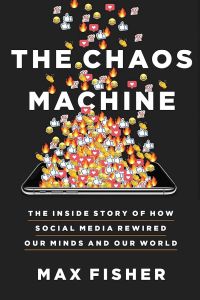
Chaos Machine Highlights

A few minutes ago I posted a review for The Chaos Machine: How Social Media Rewired Our Minds. Below are selected highlights from it.

The thought process that went into building these applications,” Parker told the media conference, “was all about, ‘How do we consume as much of your time and conscious attention as possible?’” To do that, he said, “We need to sort of give you a little dopamine hit every once in a while, because someone liked or commented on a photo or a post or whatever. And that’s going to get you to contribute more content, and that’s going to get you more likes and comments.” He termed this the “social-validation feedback loop,” calling it “exactly the kind of thing that a hacker like myself would come up with, because you’re exploiting a vulnerability in human psychology.” He and Zuckerberg “understood this” from the beginning, he said, and “we did it anyway.”

That digital amplification [of the Newsfeed introduction] had tricked Facebook’s users, and even its leadership, into misperceiving the platform’s loudest voices as representing everyone, growing a flicker of anger into a wildfire. But, crucially, it had also done something else: driven engagement up. Way up. In an industry where user engagement is the primary metric of success, and in a company eager to prove that turning down Yahoo’s billion-dollar overture had been more than hubris, the news feed’s distortions were not just tolerated, they were embraced.

“There’s this conspiracy-correlation effect,” DiResta said, “in which the platform recognizes that somebody who’s interested in conspiracy A is typically likely to be interested in conspiracy B, and pops it up to them.” Facebook’s groups era promoted something more specific than passive consumption of conspiracies. Simply reading about contrails or lab-made viruses might fill twenty minutes. But joining a community organized around fighting back could become a daily ritual for months or years. Each time a user succumbed, they trained the system to nudge others to do the same. “If they bite,” DiResta said, “then they’ve reinforced that learning. Then the algorithm will take that reinforcement and increase the weighting.”

And he’d joined Facebook to change minds, not to fight. He was getting into animal-rights activism, he said, and thought “it seemed like an interesting platform to be able to spread messages and persuade people.” But often he ended up expressing outrage at them instead. He was behaving in ways, he came to see, that had little chance of advancing the cause and, however fun in the moment, made him feel like a jerk afterward.

She had allowed the platforms to bring out in her the very behavior she otherwise loathed, she said. “And I just don’t see how any of this […] gets any less toxic without more of us realizing that, in our worst moments, we can be that bad guy.”

Online public shaming tended to be “over-determined,” she argued, poorly calibrated to the scale of the crime, and “of little or questionable accuracy in who and what it punishes.”

“I’m telling you, these platforms are not designed for thoughtful conversation,” Wu said. “Twitter, and Facebook, and social media platforms are designed for: ‘We’re right. They’re wrong. Let’s put this person down really fast and really hard.’ And it just amplifies every division we have.”

This thinking was widespread. Goodrow, the YouTube algorithm chief, had written, “When users spend more of their valuable time watching YouTube videos, they must perforce be happier with those videos.” It was a strange assumption. People routinely act against their self-interests. We drink or eat to excess, use dangerous drugs, procrastinate, indulge temptations of narcissism or hate. We lose our tempers, our self-control, our moral footing. Whole worlds of expertise organize around the understanding that our impulses can overpower us, usually to our detriment.

“If your job is to get that number up, at some point you run out of good, purely positive ways,” a former Facebook operations manager has said. “You start thinking about ‘Well, what are the dark patterns that I can use to get people to log back in?’”

The data revealed, as much as any foreign plot, the ways that the Valley’s products had amplified the reach, and exacerbated the impact, of malign influence. (She later termed this “ampliganda,” a sort of propaganda whose power comes from its propagation by masses of often unwitting people.)

The more her team parsed the gigs of data provided by the platforms, she said, the surer she became “that it didn’t matter so much whether it was Russia or anti-vaxxers or terrorists. That was just the dynamic that was taking shape as a result of this system.” For months, there had been signs of a great convergence on what had once been called “the Russia playbook” but increasingly looked like users and groups simply following the incentives and affordances of social media. The line had blurred, maybe for good, between groups that strategically pushed Russian-style disinformation and users who gave rise to it organically. Propagandists had become unnecessary; the system, DiResta feared, did the real work.

The ruthless specificity of YouTube’s selections was almost as disturbing as the content itself, suggesting that its systems could correctly identify a video of a partially nude child and determine that this characteristic was the video’s appeal. Showing a series of them immediately after sexually explicit material made clear that the algorithm treated the unwitting children as sexual content. The extraordinary view counts, sometimes in the millions, indicated that this was no quirk of personalization. The system had found, maybe constructed, an audience for the videos. And it was working to keep that audience engaged.

Posted in quotations | Tagged , , , , , | Leave a comment

How Social Media Rewired Our Minds

She had allowed the platforms to bring out in her the very behavior she otherwise loathed, she said. “And I just don’t see how any of this […] gets any less toxic without more of us realizing that, in our worst moments, we can be that bad guy.”

One of my core beliefs is that we live in a world which we made for ourselves, and yet which is not fit for ourselves. Our eyes expect to see what they do not see, our arms reach for which they cannot find to grasp, and our brains writhe under the stimulation of the unexpected and the starvation of the desperately needed. Just as industrial food products mesmerize our brains by adding the right chemicals to tickle our synapses and hit us with dopamine, so to does social media — but to the pleasure of connection, it adds the insidious pleasure in being vengefully and righteously indignant. The Chaos Machine is an interesting analysis of the different ways social media plays on our minds, and a sometimes sloppy history of that manipulation’s effects on societies across the globe — though largely focused on the United States. It ranges from chilling to insulting, and will nevertheless be one of this year’s more memorable reads.

Chaos Machine opens with a mother trying to find out more information on a vaccine discovering that facebook was rife with groups discussing nothing but the evils of the same, and it pushed her into ever more of them as she explored with morbid and astonished curiosity. Not a naif, she realized straightaway that she’d unwittingly stepped into some kind of engagement treadmill. From here, Fisher switches into how that engagement treadmill was built, beginning with a history of Silicon Valley but quickly shifting into the neurological factors at play, which we encounter as the history develops.The great strength of the book is that assessment — beginning with how a website or app is assigned to trigger dopamine from likes, addicting us like casino junkies. More critical, though is that this is social media: humans, as social animals, are highly tuned to pay attention to how we are regarded by the communities we are in, with an inner sociometer that tries to assay our standing. Mechanisms like the “like” button engage it directly, which is why we feel rewarded or crushed when a status update or a photo doesn’t receive the attention we believe it merits. Our attention to social feedback also makes it possible for us to work one another into outrages, in which our behavior becomes more antagonistic toward The Other — especially if we believe our group or its values are being attacked. Even more cruelly: while contact theory used to hold that people from different groups could moderate their opinions if they were exposed to others, it turns out there are specific contexts required for that to happen — like neutral territory and a shared task. If people from disparate groups are shoved together on the same platform, then what happens is not United Nations dialogue, but the rancor of soccer fans and the online hooliganism that follows. Basic psychological tools that our natural history has given us for self-domestication, like shaming and reprisal, are allowed to bloom cancerously large on social media platforms, their natural checks absent altogether. Still worse is that the platforms have a huge interest in maintaining this kind of engagement, because user engagement means ad revenue — and at this point, Google and Facebook’s engineers aren’t even doing the driving. Their algorithmic engines were trained to increase user engagement, and if that means sending people into Q-anon groups or offering them playlists of children in bathing suits, so be it.

The Chaos Machine is brilliant when analyzing how social media hijacks our brain, using our primordial instincts to maximize User Engagement at the price of weaponizing those platforms, polarizing users, allowing misinformation to profligate, and providing a silky-smoothy highway to mass violence. Although no book is truly free of bias, Chaos Machine‘s own grows steadily more pronounced as the book develops, however, with outright falsehoods written into the narrative — asserting that Candace Owens promote violence, for instance, and claiming that Jordan Peterson instructs young men into blaming their problems on others. Anyone who has watched Peterson will quickly realize what a lie that is, given that he attacks the blame-game attitude and encourages men to find meaning through responsibility to others. There are token efforts at being equal-opportunity earlier in the book. Take, for instance, when Fisher shares the case of a black college student who claimed a guard was racist for asking her to leave an empty lunchroom — not only did video evidence show that the security guard (called by the janitor, per policy) was perfectly polite and explained to her that this particular lunchroom was reserved for children, but she named the wrong man as the janitor in question. The man was harassed and suspended for her attention-seeking shenanigans, and yet the ACLU still hosts her vainglorious harrumph-harrumph article without mentioning the author’s willful misinterpretation of the events. By the midpoint, though, Fisher drifts into full partisanship with the aforementioned inaccuracies. It’s a pity he couldn’t stay more in the middle: realizing how poisonous social media is is vital for everyone, not just those who care about it because they think it and it alone led to the Dreaded Orange Man’s winning the elections. All this would matter regardless of one’s own politics, both the personal addiction and the effects on societies at large. Personally, I stopped using twitter at the beginning of this year and de-politicized my reddit feed because I realized how routinely angry and edgy it made me.

Posted in history, Politics and Civic Interest, Reviews | Tagged , , , , | 8 Comments

October 2023 in Review

October was a fun month! The highlight was reading some classic SF of the 1970s and 1980s, particularly True Names, Shockwave Rider, and Neuromancer. I was also able to revisit some favorite contemporary authors — Scalzi, Doctorow, and Suarez. I can see doing a big SF focus on an annual basis, though perhaps more in September than in October. Horror and German history need their space, after all.

Mount Doom:
Metatropolis, ed. John Scalzi
Discarded: Food of the Gods, H.G. Wells. I read this for a bit and decided to let it go. It’s on Gutenberg, so I can try it again later.

Science Fiction Sweep:
The Dispatcher & Murder by Other Means, John Scalzi. Read by Zachary Quinto
The Shockwave Rider, John Brunner
Millennium, John Varley
True Names and the Opening of the Cyberspace Frontier, Vernor Vinge.
The Heinlein Interview (and other Heinleiniana), J. Neil Schulman
Astounding: John W. Campbell, Isaac Asimov, Robert A. Heinlein, L. Ron Hubbard, and the Golden Age of Science Fiction, Alec Nevala-Lee
ST TOS: In Harm’s Way, David Mack
ST TOS: A Child of Two Worlds, Greg Cox
Neuromancer, William Gibson
Metatropolis, ed. John Scalzi
Influx, Daniel Suarez

Classics Club:
The Shockwave Rider, John Brunner
Neuromancer, William Gibson

Coming up in November:
I’m aiming for a TBR broadside, since I have two titles already halfway finished. I also recently realized that (as I’m going to grad school) I have access to some TBR titles via the uni library, either physical or electronic, so I may go after a few that I still want to read, but whose physical presence I no longer wish to coexist with. Expecting science to have a strong presence.

Posted in General | 3 Comments

Ten Year Book Tag (2023 Edition)

Cyberkitten and Marian recently posted a “Ten Year Book Tag”, which I missed because my weekend consisted of horror movies and a six-hour karaoke party . This should be fun, because 2013 was a banner year here at Reading Freely, with book after book on various topics that drastically altered my thinking.

What was your favorite book read in 2013?
Okay, foul. Foul, foul, foul. Look at this list. Do you see how many bolded titles there are on it? Bolded titles are my rare five-star absolutely loved it, best of the best reads. 2013 was the year Jane Jacobs upended my worldview, the year I encountered counterculture conservatives*, the year I discovered Wendell Berry and E.F. Schumacher — the latter of which whose mention of the Catholic social doctrine of distributism would lead to my love affair with Catholic culture. Believe me, as an ex-Pentecostal who spent years as an agnostic/atheist, I never saw that coming. I suppose since I frequently refer to Jayber Crow as my favorite novel, I’ll name it here.

What is your favorite book of 2023 (so far)
Adventures with Ed, biography/memoir of a friendship with Ed Abbey.

What was your least favourite book in 2013?
Hmm…I’m usually very picky about what I read, believe it or not, so it’s rare that I read a stinker. Harry Turtledove is on the list, though, so I’ll say his Things Fall Apart. It was part of his Supervolcano series, which was so lazy that it inspired me to give up on Turtledove altogether despite reading a lot of his stuff in the early years of the blog.

What is a book published in 2013 that you still want to read?
I had to google for nonfiction published in 2013, and there are several on this list by the Post that are on my interest list. The End of Power is actually in my TBR pile, though.

What is the book published (to be published) in 2023 you want to get before 2024?
Eh, none really. My priority is the TBR. There are several titles this list I plan on reading, especially The Six (about the first six female American astronauts), and Tom Holland’s new book on Rome, but TBR takes priority.

What is a genre you used to read a lot of that you don’t read as much of anymore?
Hmm….that’s hard to say. My religious-spiritual reading was more varied ten years ago, though, because from 2007-2012, roughly, I was reading about all kinds of religions and philosophies to understand man’s search for meaning — to learn what different religions and philosophies had in common, and what they didn’t to find out what they said about human nature and the cosmos and how to live in it. I was still informing and forming my own worldview. These days my religious reading is almost wholly Christian, and usually from Catholic or Orthodox sources, though there’s a lot of other philosophy that feeds into how I understand the world and pursue goodness within it.

What is a new genre you’ve discovered since 2013?
That’s a difficult question. In 2013, I think I’d still say “Oh, I’m not really a SF fan, I just like Star Trek and Isaac Asimov”, but ten years later with SF consistently the runner-up fiction genre, I can’t say that. I’m also a little more prone to reading fantasy than I was ten years ago, when I’d only read the Harry Potter series and started on LOTR.

What is a reading or book habit you are hoping to leave behind in this decade? 
Not reviewing books. I’m done pretty good this year, but last year I was terrible at forgetting to post reviews.

What is a new reading goal or habit you want to create in the upcoming decade?
Mm….reading books faster than I buy them.

[*] Reading that review of Crunchy Cons is fascinating and funny now, in part because Dreher is one of the few authors whose books I will willingly buy new-on-release, and whose substack was the first I ever did a paid subscription for. Reading it opens a fascinating window into a me-in-transition, to someone whose humanism was shifting from “ethics without religion” to one that was broader, more historically rooted, and deeply concerned with human flourishing and a meaningful life — which, as I believe completely now and was strongly suspecting then, involves active resistance to becoming a simple consumer-creature.

Posted in General | Tagged | 5 Comments

Influx

Jon Grady is ecstatic. Tonight he has ushered in a new era in human civilization. He’s created antigravity. A thousand years from now, schoolchildren will recite his name alongside Newton and Einstein. Or….they would, if a strike team from a secret government organization weren’t standing by to disappear him. The Bureau of Technology Control monitors scientists and technical innovators with the potential to realize ideas or create tech that might be catastrophically disruptive, and then…sequesters them. Oh, the ideas aren’t squished — just controlled. Limited to the BTC itself, which uses its clones, holograms, and fusion generators to maintain its ability to seek out and contain innovation. Scientists who agree to work for the BTC can still see their technology realized, even developed further, but not allowed to escape into society at large. Grady is horrified to learn of an unelected group trying to manage humanity, even as they show him models that predict catastrophes for this-or-that tech being released. Refusing to work for them, he is instead shoved into a nightmarish prison, turned into a test subject to create the next generation AI — but even here, in a cell without doors, there is resistance. Influx is a SF thriller with horror aspects and an ending worthy of a Marvel movie — as captivating as all of Suarez’ work, though diminished by an antagonist who’s rather overtly villainous.

I wasn’t reading this immediately before Halloween on purpose, but that certainly proved appropriate. We open in excitement turned to terror, then lulled into wonder and ease as we learn of the insular world of the BTC. When they realize that Grady isn’t someone who will go along with them, even though he tries to fake agreement (only to be exposed by their tech), it quickly turns to truly disturbing horror on both body and psychological levels. If Top Ten Tuesday ever does a “Top Ten Characters Who Will Require Deep Psychological Care Post-Plot”, Grady will be at the top of mine. Although the horror section begins innocently enough, when Grady resists further…yikes. Imagine being alone, with nothing but an inquisitive AI for company, one that won’t hesitate to stimulate your nervous system into thinking it’s on fire, and which will delete the memories that you might otherwise focus on for comfort and sanity — and imagine further that this AI periodically arrests you with tentacles and forces a tube down your throat to provide sustenance and extraction. Yeah. Fortunately, there is a resistance, and before too long we’re in action-thriller territory again.

Influx succeeds at creating an emotionally powerful novel with a fascinating premise, one that explains why cold fusion always seems to be just around the corner. It’s very cinematic, especially in its ending and the extreme polarity of its characters — with Grady as utterly heroic, and the BTC honcho as absolute evil. There’s some level of more greyness, especially because BTC is very compartmentalized so that most of the organization doesn’t know what most of the organization is doing, allowing for the head to get up to seriously evil misdeeds — as do the AIs that BTC uses. What makes this novel really interesting, though, is the sheer level of scientific topics discussed. Physics, genomics, machine learning, and especially cognition come into play. These more than made up for my occasional grouses, like the comically evil antagonist.

Highlights:

“I told you. Would you please stop pointing that gun at me?”
She didn’t lower it. “You just told me you’re dead. I’m not in the mood
for crazy today.”

She collapsed in a leather chair. “We need to inform the president.”
“No. We don’t.”
“He’s going to notice that parts of Detroit are missing.”

“I’ve always been your friend, Alexa. Now go. I will try to kill you as
unsuccessfully as I can.”

Posted in Reviews, science fiction | Tagged , , | 2 Comments