The Storied Life of A.J. Fikry

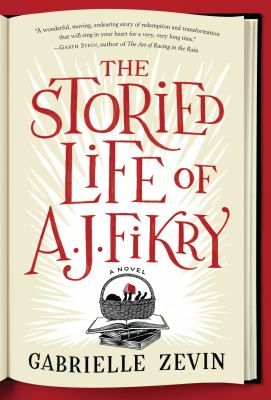
A.J. Fikry is a widower with a bookstore and an increasingly serious drinking problem. (He’s not an alcoholic, he says, he just drinks to the point of passing out at least once a week.) The one bright spot: he has Tamerlane, a rare volume from Edgar Allen Poe that could fetch hundreds of thousands of dollars once the economy shapes up a little. Then it’s stolen, and a two-year old appears in his store with a note asking him to take care of her. Well…crap.

Last year I checked out one of Ms Zevin’s titles but never got around to reading it, something I intend to repair immediately: I have no idea how she packed so much growth into such a little novel, growth whose substance I didn’t appreciate fully until I watched the movie version of this (immediately after finishing the book) and seeing how rushed the characters were by comparison. The A.J. who opens this book is a deeply troubled fellow who is absolutely hilarious to read, but who would be a pill to know in real life. There is something in him, though, that flowers when a child is introduced to his life –for what he thinks is a weekend, but which will become a lifetime. His soul is dislodged from its rut of depressed snarking and drinking and, forced to expand itself to include another person, and set free to flourish. He becomes a father, yes, but the leads to further growth, to friends, to changes in the bookstore that allow it and his community to flourish – and so, more impressively, we get the growth of other characters, and of the town itself. A man who appears very minor will be one of the main supporting characters by book’s end, and then of course there’s Maya. Parents would judge this better, of course — that particular door has never opened to me — but Maya begins this novel as a two year old and is a teenager at its end, and she grew physically and emotionally in a very plausible fashion. I can’t imagine that’s easy to pull off. And, of course, there’s the fact that this is a book about books and writers, with one especially delicious minor twist. Wonderful read!

Highlights:

“Yes,” said the cop. “It wasn’t anyone’s fault.”
“People like to say that,” A.J. replies. “But it was someone’s fault. It was hers. What a stupid thing for her to do. What a stupid melodramatic thing for her to do. What a goddamn Danielle Steel move, Nic! If this were a novel, I’d stop reading right now. I’d throw it across the room.”
The cop (who was not much of a reader aside from the occasional Jeffery Deaver mass-market paperback while on vacation) tried to steer the conversation back to reality. “That’s right. You own the bookstore.”

“My wife and I,” A.J. replied without thinking. “Oh Christ, I just did that stupid thing where the character forgets that the spouse has died and he accidentally uses ‘we.’ That’s such a cliché. Officer”—he paused to read the cop’s badge—“Lambiase, you and I are characters in a bad novel. Do you know that? How the heck did we end up here?

“If this were a short story, you and I would be done by now. A small ironic turn and out. That’s why there’s nothing more elegant in the prose universe than a short story, Officer Lambiase. If this were Raymond Carver, you’d offer me some meager comfort and
darkness would set in and all this would be over. But this . . . is feeling more like a novel to me after all. Emotionally, I mean. It will take me a while to get through it. Do you know?

“I’m sorry about before when I referred to you as an ‘unimportant supporting character.’ That was rude and for all we know, I am the ‘unimportant supporting character’ in the grander saga of Officer Lambiase. A cop is a more likely protagonist than a bookseller. You, sir, are a genre.”

“Let’s get married,” he says with an almost pained expression. “I know I’m stuck on this island, that I’m poor, a single father, and in a business with somewhat diminishing returns. I know that your mother hates me, that I’m quite obviously crap when it comes to hosting author events.”
“This is an odd proposal,” she says.

“It is the secret fear that we are unlovable that isolates us,” the passage goes, “but it is only because we are isolated that we think we are unlovable. Someday, you do not know when, you will be driving down a road. And someday, you do not know when, he, or indeed she, will be there. You will be loved because for the first time in your life, you will truly not be alone. You will have chosen to not be alone.”

How to account for its presence when I know it is only average? The answer is this: Your dad relates to the characters. It has meaning to me. And the longer I do this (bookselling, yes, of course, but also living if that isn’t too awfully sentimental), the more I believe that this is what the point of it all is. To connect, my dear little nerd. Only connect.
Posted in Reviews | Tagged , , | 6 Comments

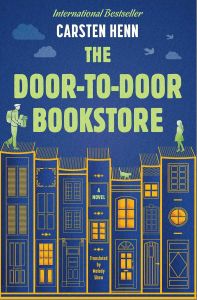
The Door to Door Bookstore

© 2023 Carsten Hen; trans. Melody Shaw

In the city of Munster, after the bookshop closes for the night, an aging fellow named Carl begins his rounds. Walking the city’s cobblestone paths, he visits a village within the metropolis that only he is aware of: a little community of ardent readers who Carl knows only by the literary names he’s given them, like Mr. Darcy. These readers prefer receiving their ordered books at home, hand-delivered (and hand-wrapped) by Carl, whose genial company and recommendations they welcome. Times are changing, though: the owner of the bookstore is in declining health, and his daughter, who regards the book delivery service as a waste, is eager to dismiss him. If one young woman sees him as a relic who needs to be forcefully retired, another — younger still, a ten year old girl named Schascha –  finds him fascinating. She’s watched him make his rounds in the evening and has decided he could do with some company, and begun tagging along with him whether he likes it or not. A curious friendship develops between the old and young, the reserved and the exuberant: although he despair of her at first, thinking her a noisy intruder whose questions threaten the privacy of his customers, they soon grow attached to one another, and through her impetuousness Carl will be shaken from his reserve and become more involved in the lives of the little community that’s grown around him, even as his new boss is pushing him out the door and regarding him with so much contempt that you might think he shot her dog and kicked it for good measure. Ultimately Carl will meet his own trial and need to rally through his connections to Schascha and his little community.  Door to Door Bookstore is an utterly sweet story. I enjoyed the inter-generational friendship and its slow growth enormously, especially because Schascha disrupts routines and sparks character and relational growth between Carl and all of his customers — and those customers themselves are to a man (and woman) interesting characters, especially the nun who lives in a closed cloister and can’t leave it because the authorities will board up the door the moment she steps outside to get the groceries. The book is checked only by the inexplicable hostility of Carl’s boss; there are some scenes that shed some light on why she’s so defensive, but overall she just comes off like an appointed villain. Another lovely little read!

Highlights:

Schascha took a deep breath, because what she was about to say needed
to be announced in a full voice. “You need to take different books to your
customers!”
Carl frowned—a facial expression he could make to great effect, since
he had acquired a great deal of forehead over the years. “But I take them the
books they order.”
“They’re all ordering the wrong ones.”
“Aren’t they the best people to know what they want?”
“Hah!” Schascha barked out a laugh. “Hah! I want to eat ice cream all
day, but is that good for me? No!”
“But books aren’t ice cream. They don’t hurt your stomach.”
“You don’t understand!” Schascha would have stamped her feet, if only
her legs could reach the ground.
“So you’re saying I deliver the book equivalent of a stomachache?”
“Books are much, much more dangerous than ice cream! They hurt your
head. Or worse, your heart.”

Posted in Reviews | Tagged , | 4 Comments

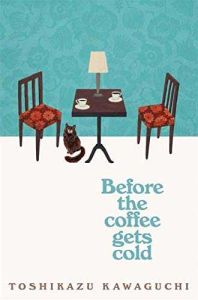
Before the Coffee Gets Cold

There is a little underground cafe in Tokyo where, if you sit at a certain chair under the right conditions, you can find yourself in that chair in that cafe at some other time, where you can meet someone who was in that cafe at that time. You cannot change the past, but you can revisit it: you can see someone who is now gone, ask questions that lingered on the tip of your tongue for too long but never found life in breath. What happens in that seat cannot change the past, but it can change you — but you have to make the most of the time, completing your business before the time-changing coffee before you grows cold.

This is a fascinating little volume of stories, all tied to the same place: a chair that inexplicably serves as a limited time-travel device when paired with a certain blend of coffee. There are many rules to this travel: you can’t move from the seat when you arrive in the past, you have to be there to meet someone who was there in that moment, etc. In addition to the rules, there is a challenge: there is a ghost in the chair, a woman in white intently reading a book who responds to no one but the shop owner, who offers her periodic refills. She doesn’t look like a ghost — she looks human and living, and she’s physical to the point of being touchable – but she’s otherwordly, and only when she takes a brief bathroom break can anyone else saddle up and sally forth into time. Given the limitations — and the risk of being trapped like the woman in white – only someone who had serious emotional baggage to unpack would dare try, and those are the stories we get here. The stories are often sad, but sweet, and there are interconnections. One character, for instance, is a steady presence in the cafe, appearing in every story: we learn in a later piece that he continues coming in hopes of going back to see his wife so he can give her a letter, but how we learn this is that his wife comes in to go back in time herself: he has Alzheimers, and she wants to return to when he didn’t so she can find out what letter he’s wanting to give her.  I most appreciated the fact that this is not a series of set pieces in which the cafe owner meets a series of randos who want to time-travel: most of the characters appear in several stories because they’re regulars of the cafe, and their lives are bound up together. The interconnectedness makes the cafe and the people’s dramas feel real, despite the fantasy elements like the woman in white.

This was a fascinating little collection of stories, and I see that it’s part of a series which I may continue exploring.

Posted in Reviews | Tagged , , , | 5 Comments

What You Are Looking for is in the Library

I realize it’s a bit early in the year for this, but What You are Looking For is in the Library will most likely be my favorite novel of the year. Of course, it’s not quite a novel, more of a series of interconnected short stories, in which characters who range from young people to the recently retired find their way into a library in search of something — skills for a possible new career, some place to go to and be around adults that also can keep a toddler entertained, an excuse to get out of the house. What they find is a reference librarian who, putting down her felting project, gives them exactly what they needed — even if they didn’t realize it at the time. In addition to giving them books related to their direct query, she will often throw something else in — an unexpected book recommendation that will change their lives. A young women frustrated by progress in her career receives a children’s book that inspires her to take up a new craft and regain her passion: a woman who came for children’s books is also given one on astrology that, while she doesn’t believe in, gives her perspective to reframe her own vocational frustrations. The beauty of it, though, is that this change is not something being imposed on people from a mystical source: the librarian merely provides the catalyst for a change that was waiting to happen, a change that was instigated by the people themselves who are often hovering at a transition point in their lives. The subjects range in age from young to old, at varying points of their lives, and as the book develops the reader will begin to see connections between the stories via shared characters, illustrating how we can impact those around us without knowing directly. This is a book about positive transformation through books and relationships, and it’s one I can see myself returning to or gifting.

Highlights:

“Madam Mizue put down her spoon. ‘Ah, Ms Sakitani, so you’re on the merry-go-round, too,’ she said gently.
‘The merry-go-round?’
With a chuckle she smiled at me. ‘It’s a very common condition,’ she said with apparent relish. ‘Singles are envious of those who are married, and married couples envy those with children, but people with children are envious of singles. It’s an endless merry-go-round. But isn’t that funny? That each person should be chasing the tail of the person in front of them, when no one is coming first or last. In other words, when it comes to happiness nothing is better or worse – there is no definitive state.’

Madam Mizue took a sip of water. ‘Life is one revelation after another. Things don’t always go to plan, no matter what your circumstances. But the flip side is all the unexpected, wonderful things that you could never have imagined happening. Ultimately it’s all for the best that many things don’t turn out the way we hoped. Try not to think of upset plans or schedules as personal failure or bad luck. If you can do that, then you can change, in your own self and in your life overall.’

Then she looked off into the distance and smiled.

While rolling the felted globe in my fingers, I was struck by an idea: Ptolemaic theory and Copernican theory; geocentrism and heliocentrism. Aeons ago, people used to believe that the Earth was stationary and the heavens moved around it. When in fact it was the Earth that rotated. Something clicked. That’s it. I was forced to move from Mila to the information resources department. And I have to do housework and childcare. If I put myself at the centre of everything, does that mean I always see myself as a victim? And why I always end up wondering why can’t people do things that work for me.
I stared at the blue sphere on my palm. The Earth moves. Morning and night don’t stay – they go.

What do I want to do now? Where do I want to go?

~~~
Still looking at the rice ball in her hand, Yoriko continues, ‘I remember
sitting in the passenger seat, looking at you and feeling devastated because
I’d been fired, when in fact I hadn’t lost anything. I myself was no different
from before. I’d simply left the company I worked for. That’s all. I still had
the option to derive joy from my work and happiness from spending time
with my loved ones. It all just depended on me, and what I did from then
on. That’s when I realized that I wanted to work freelance in future.

Posted in Reviews | Tagged , , | 12 Comments

Teaser Tuesday Ice Storm Delay Edition

“It’s funny. No matter where you go, or how many books you read, you
still know nothing, you haven’t seen anything. And that’s life. We live our
lives trying to find our way. It’s like that Santōka Taneda poem, the one that
goes, ‘On and on, in and in, and still the blue-green mountains.’ ”

Days at the Morisaki Bookshop, Satoshi Yagisawa. Trans. Eric Ozawa

Then I raise my eyes to a signboard made from styrofoam that is pinned
above the box, and experience a sudden jolt. Below the words ‘river crabs’ written prominently in red is a line in smaller black lettering that says, ‘For deep-frying! For pets!’  For pets …?

It is natural in the food section to expect that crabs would be sold for consumption, but when suddenly presented with the option of keeping them as a pet instead, I don’t know what to think. Be eaten or be loved. A lump forms in my throat at the thought of the utterly different fates awaiting these crabs huddled together in the plastic box. When I worked for the company, what kind of crab was I, I wonder? While still inside the box I was raised to be a manager, but ultimately wasn’t my fate to be eaten up by the organization?

What You are Looking for is in the Library, Michiko Aoyoma

Posted in General | Tagged | Leave a comment

Days at the Morisaki Bookshop

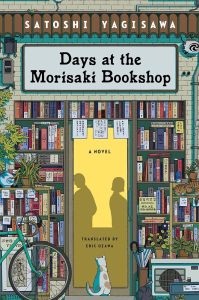
Takako’s boyfriend has just unceremoniously dumped her after announcing he’s engaged to his other girlfriend, the real one — the one she’d never heard about, but one whose existence now seems obvious in retrospect. Why was it they never had tea at his apartment, always hers? Suddenly at a loss for what to do with her life, she accepts an offer from her uncle to help him with his bookshop. Moving into a little room above the shop and struggling with depression, she begins slowly habituating herself to her odd uncle and his place here in Tokyo’s Jimbocho neighborhood, saturated with used bookstores and coffee shops. Although at first she’s merely there out of resignation — she needs a place to stay, after all — as the time passes she opens herself up to both the people around her in the shops and to the books within, and begins rebuilding herself. Days is all about human connection, experienced through literature and conversations and (frequently, in this novel) conversations about literature. Although the prose and its translation are very plain — unornamented, as Asimov used to describe his own style — there is nevertheless richness and beauty here. The settings, which range from cozy shops to the beauty of the mountains, are always vivid, and the relationship drama was compelling — about love and finding one’s way. I thought it lovely in its simplicity.

Posted in Reviews | Tagged , , | 5 Comments

A year after the Selma tornado

A year ago I paused to take a quick shot of the turbulent sky, a mix of gloom and glory, of bright morning light and dark storm clouds. I posted it to Instagram with the caption “Skies, current mood: conflicted”. The tornado came from the south, a roaring scythe that destroyed thousands upon thousands of trees and hundreds of homes along Dallas Avenue before dog-legging into Old Town and destroying much of the state’s largest contiguous historic district, followed by much of East Selma for a second course, and then finally cut across the bypass that directs freight traffic around the north of the city to plow up areas around 14 East. It took perhaps half an hour to visit more devastation than this city has seen since the Yankees burned it at war’s end in 1865. It was surreal that so much had happened so quickly. Now, a year has passed, and where do we stand?

Video taken while helping a friend remove things from his destroyed house two days after the storm

I’m no expert in these matters, of course, just a citizen who sees things. Cleanup is largely done: what which is still unfinished will remain so, like the exposed houses standing with their walls and roofs open to the elements whose absent owners couldn’t even be bothered to return and tarp them. Support from surrounding areas was enormous following the tornado: the town was flooded by utility workers who had power on in most places in only a few days, which is incredible considering the mount of damage. There were private utility companies, government agencies, and armies of volunteers helping to wrestle the remains of trees off of houses and cars, tarp homes, and start pushing things in the direction of normal. For weeks and months some streets were lined with barriers of fallen pine limbs because of inter-governmental issues, but they eventually disappeared. The main issue now is abandoned homes with absentee landlords: there are blocks in both Old Town and East Selma where ruins just sit, constituting eyesores and fire hazards. Although a lot of people have left Selma in the last year because of the storm damage, I suspect most of these absentee landlords were either gone already. Although there are groups like the United Methodist Committee on Relief who are partnering with locals (Church Street Methodist, St Paul’s Episcopal, etc) to rebuild new homes, it’s hard to imagine people wanting to move into neighborhoods marked largely by neglected ruins – which attract wildlife and pests, including teenagers with a penchant for arson. The fallen walls of the historic cemetery, Old Live Oak, have still not been repaired, which is a disgrace considering that the picturesque park is one of Selma’s tourism assets: the statue of Elodie Todd Dawson, Abraham Lincoln’s half-sister in law, is one of the most photographed in the state. Today, because history or nature have a wicked sense of humor, we’re again watching for tornadoes — though the threat level has been shifted from “Enhanced” to “Slight”. 

Posted in General | Tagged , , | 5 Comments

Distracted by Alabama

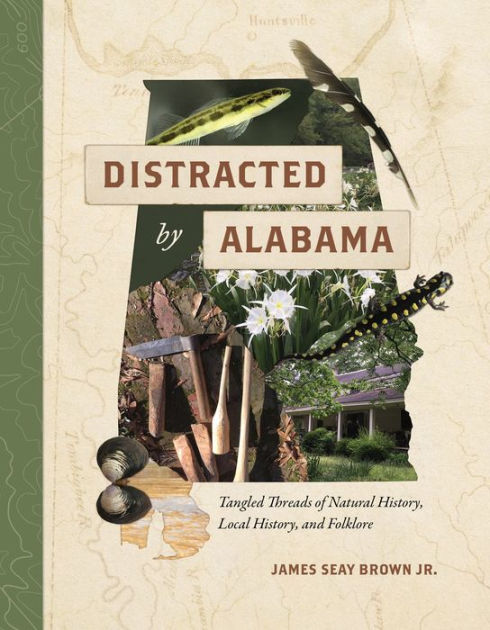
Jim Brown moved to Alabama in the 1970s to teach history at Samford University, and became fascinated by Alabama, both by its wild biodiversity and its people and their folk traditions, from shape-note singing to basket-weaving and herbalism. Distracted by Alabama is twelve essays with ample illustrations about different aspects of Alabama: it is an unusual book with a wondrous mix of topics. waist deep in both ecology and folklore, and often in the same essays. Although there are some essay-chapters that are strictly about folk traditions and crafts, like the one on the songs of railroad construction men used to coordinate their strikes together when building the lines, there’s more mixture than strict separation, hence the ‘entangled threads’: another entanglement is that the men and women that Brown explores these areas with are themselves not fixated microspecialists, but people whose passions frequently take them between disciplines. A historian Brown is friends with and explores the history of the Cahaba river with, for instance, as they fish its banks, may introduce him to another subject and experts thereof, who will (as Brown forges a friendship with them) introduce him to still other tributaries and streams of interest and tradition. Here covered are rivers, salamanders, fish, birds,  herbalism, railroad songs, and folk crafts like basketweaving and shape-note singing, just for starters. It’s quite the collection with enormous interest to any Alabamian, and has added both to my hunt-down-and-read and hunt-down-and-visit-on-the-weekend lists.

Posted in Reviews, science, Society and Culture | Tagged , , , , , | 1 Comment

The Exchange

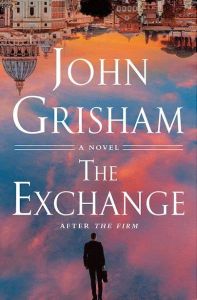
Over twenty years ago I saw a fat paperback with an interesting cover depicting a businessman caught in strings above his head. That book, The Firm, was an absorbing thriller about a young lawyer who begins working at a boutique tax firm, only to find that it’s tightly connected with the Mafia. For me and millions of other readers, The Firm was an introduction to John Grisham as breakout star in the world of legal fiction, building such a reputation in the 1990s and early 2000s that he has been able to coast on it since. The Exchange livens things up a bit by taking readers into the world of international law and arbitration (with a terrorist state, no less), but its use of Mitch McDeere from The Firm is disingenuous and hollow, serving no point but bait for we schmucks, the consumer-readers. Mitch is the character from The Firm, fifteen years later, but his status as a man who took down a Mafia firm has no bearing on the plot whatsoever beyond making him uncomfortable when he goes down to Memphis to have a pro bono case pitched at him. (This entire sequence is completely irrelevant: the case subject involved is Epsteined, and despite a really interesting potential plot being wiggled before the reader, Mitch is soon back in New York to start this novel’s story.) The novelty of this book — the plot of which involves a kidnapped lawyer (an Italian beauty, because pretty women and children make the best hostages) being taken by terrorists does a fair bit of service to make the book more interesting than its actual writing. It’s unusual terrain for Grisham, to say the least, though the teased-at story involving DEA agents who were ambushing and murdering drug carriers would have been more interesting, in my opinion. I was fully prepared to see Mitch fighting for justice and defying threats from goonie boys, but I suppose that’s more Greg Iles’ style. Truth be told, not much happens in The Exchange after the first hundred pages, and most of what happened before was wholly irrelevent to the plot. We do get more information into Mitch and Abby’s background, though, and Abby pops out as a character in her own right when the terrorists choose to approach her to convey ransom demands to Mitch. Why they wouldn’t just contact Mitch is a question for Grisham’s nonexistent editor, but Abby was a strong part of Mitch’s efforts to take down the Mafia in The Firm, and I suppose he thought readers would be offended if she was relegated to the background here. The book was a servicable if disappointing diversion that achieved such benign mediocrity by the international aspects of its story.

Posted in Reviews | Tagged , , | Leave a comment

Top Ten Tuesday: Books to be Published this year!

 The Sher-dar madraseh is yet another sign that Islam in the Iranian world is like a woman’s plain chador worn over party finery, a cloak that covers, disguises, or incorporates much traditionally Iranian, pre-Islamic, Zoroastrian belief. This time, General Alchin Yalangtush Bahadur had let the veil slip and revealed his real religious underwear.

In Search of Zarathustra


This week’s Top Ten Tuesday is releases we are looking forward to in the first half of 2024. Given how many books there are already printed that I want to read, I am not in the habit of looking for new releases — but I did write down a few titles last year as I heard about them.

The Anxious Generation: How the Great Rewiring of Childhood Is Causing an Epidemic of Mental Illness, Jonathan Haidt

Bad Therapy: Why the Kids Aren’t Growing Up, Abigal Schrier

Wolves of Winter, Dan Jones. Sequel to his Essex Dogs.

ST TNG Pliable Truths:     A DS9 prequel novel in which Picard mediates between Bajorans and the withdrawing Cardassians.  And there’s Ro Laren

Those were the ones that made my radar. What follows are books from Amazon’s ‘to be released’ list:

The Tusks of Extinction. A SF novel about….resurrecting woolly mammoths. Cool!

Not the End of the World: How We Can Be the First Generation to Build a Sustainable Planet, January 2024.

Filterworld: How Algorithms Flattened Culture, Kyle Chayka

Our Moon: How Earth’s Celestial Companion Transformed the Planet, Guided Evolution, and Made Us Who We Are

Making It in America: The Almost Impossible Quest to Manufacture in the U.S.A (and How It Got That Way).

The Pursuit of Happiness: How Classical Writers on Virtue Inspired the Lives of the Founders and Defined America

Posted in General | Tagged | 19 Comments