Valens is courage, not lust

“Do you ever wonder….what your life would be like, if you …if you never met your wife?”
“If I wonder if I’d be better off without her?”
“No, I didn’t mean –“
“No, it’s all right. It’s an an important question. Because you’ll have bad times. But that will always wake you up to the good stuff you weren’t paying attention to.”
“And you don’t regret….meeting your wife.”
“Why? Because of the pain I feel now? No. I’ve got regrets, Will, but I don’t regret a single day I spent with her.”
“So….like, when did you know what she was the One for you?”
“October 21st, 1975.”
“Jesus Christ, you know the day?”
“Oh, yeah. Game six of the world series. Biggest game in Red Sox history. My friends and I slept out all night to get tickets. Day of the game, we”re sittin’ in a bar, and in walks this girl. Amazing game. Bottom of the eighth, Carbo ties it up with 6-6. Went to 12. Bottom of the 12th, in steps Carlton Fisk. Old Pudge. Steps up to the plate — he’s got that weird stance — and then, BOOM! He clocks it, hard, foul ball up the left field line! — 35,000 people on their feet, Fisk is yelling at the ball like a madman, and 35,000 fans, they rush the field —“
“I CAN’T BELIEVE YOU HAD TICKETS TO THAT GAME!!! DID YOU RUSH THE FIELD?!?!?”
“What? No. I wasn’t there. I was in a bar, having drinks with my future wife.”
“YOU MISSED PUDGE FISK’S HOME RUN TO HAVE SOME DRINK WITH A GIRL?!”
“You should have seen her. She was a stunner.”
“I DON’T CARE IF SHE WAS HELEN OF TROY — your friends let you GET AWAY WITH THIS?!”
“They had to. Just slid my ticket across the tablet, and said — sorry guys, I gotta see about a girl.”
“You gotta see about a girl?! You’re kiddin’ me.”
“No, I’m not kiddin’ you. That’s why I’m not talkin’ right now about some girl I saw at a bar twenty years ago and how I always regretted never talkin’ to her. I don’t regret the 18 years I was married to Nancy. I don’t regret the six years I had to give up counseling when she got sick, and I don’t regret the last years when she got REALLY sick. And I sure as hell don’t regret missin’ a damn game. That’s regret.”
Posted in General | Leave a comment

Top Ten Tuesday: Things in Stories I Love

Today’s TTT is a love freebie. But first, teases!

“The Camptown ladies sing this song, doo dah, doo dah. Camptown racetrack’s five miles long, oh, doo dah day.”
“Shut up, Kurtis. Do you hear me inflicting my perverted folk fetish on you?”
“Perverted Folk Fetish would be a good name for a band,” said Theo’s voice.

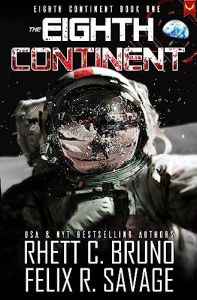
The Eighth Continent

She kept the peacock only out of a superstitious fear of annoying the Judge in his grave. He had liked to see them walking around the place for he said they made him feel rich.

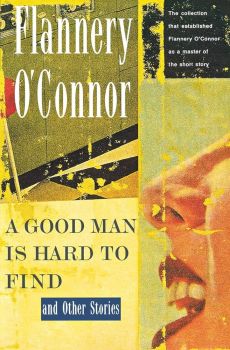
A Good Man is Hard to Find and Other Stories, Flannery O’Connor

And now, ’love’. Let’s go with ‘elements in books that tend to make me love it’.

(1) Small town settings.  I’m a sucker for them regardless of medium. I love Vicar of Dibley and Little Mosque on the Prairie for the same reason I go for Wendell Berry’s Port William and John Grisham’s Clanton, Mississippi stories. (And, presumably, the same reason Stardew Valley has been the only ‘new’ PC game I’ve gotten into in recent years.) It’s not just the setting itself, but the repeated use of it that really makes it an element to love: when I “know” characters from multiple novels — when I begin seeing them in 3D, with different stories showing different aspects of their personalities – the story really comes alive for me. (I’m currently trying to compose a collection of short stories set in a fictional southern town exploring different aspects of hyperlocal living — petty church politics, the tension between wanting to chase success or meaning, etc.)

(2) The redemption trope. I prefer stories to end in grace regardless, but I especially love when someone who has gone down a dark road — selfishness, depression, hatred, vice, whatever – finds their way back to the light again, growing in humility and resolving to fight harder against their own weaknesses.

(3) ”Love” in relationships that is not confused with romance/sex/etc. One element of modern ‘storytelling’ that I hate-hate-hate-double-hate-loathe entirely is the reduction of so many relationships to romance-pairings. I can forgive this if the story is good otherwise: With Love from London was telegraphing one obvious pairing well before it ended, but the daughter’s discovering of her mother’s side of the story in the main plot made it tolerable. (Stories about relationships that are frayed or broken and then becoming whole again are always attractive.) A story is more interesting to me when strong bonds exist outside that predictable pairing: mentor bonds, for instance, or a case of unrequited love that matures beyond adolescent pining into genuine agape for the other person, wanting what’s best for them regardless. This is one of the reasons Jayber Crow is one of my favorite novels.

(4) A strong sense of Place. This is partially related to the small town trope, but I like when characters are not just nondescripts on a flat stage, but people whose lives are strongly influenced by Place — a building in their town, the town itself. 

(5) Eccentrics. I like characters who are weird. Not characters who are weird for weirdness’ sake, for whom Being Weird!!! is their whole identity, but characters whose self-confidence or focus is such that they don’t care about being regarded poorly by society at large. These can be artists, intellectuals, or ordinary cranks.

(6) Art in story. This one is a little more difficult to articulate, but I really like it when some piece of music or art intersects with the story and even drives it a bit, so it’s inspiring characters or themes in the story, and the reader’s enjoyment of it is magnified if it inspires them to look at the art or listen to the music themselves. 

(7) Man vs…whatever. I like stories about a singular hero raging against the State, against a corporate dictatorship, fighting for survival in a disaster, etc. 

(8) Unusual travel. I like reading stories (fiction or non) about people going across the country on trains, horses, bicycles, etc.

(9) Extremely immersive historical fiction. (Looking at you, Bernard Cornwell.)

(10) Great dialogue. (Again, looking at Cornwell..)

Posted in General | Tagged , | 16 Comments

A Good Man is Hard to Find and Other Stories

I was introduced to Flannery O’Connor perhaps twenty years ago when taking English 101 & English 102 at the community college, and I have never quite forgotten the two stories we discussed — “A Good Man is Hard to Find” and “Good Country People”.  Or rather, there are startling elements within those stories that seared themselves into my head, even I’ve forgotten the plots in detail. As it turns out, Flannery O’Connor is good at that — provoking, shocking, horrifying. A Good Man is Hard to Find and Other Stories collects ten of O’Connor’s stories, a third of her work in that area of literature. The collection is saturated with race and religion: at least two characters masquerade as figures connected to religion (a Bible salesman, say), and if you made a drinking game out of racial epithets then I hope your will is current, because if you survive the alcohol poisoning your liver won’t be long for this world. O’Connor’s stories are filled with characters rendered in strange and frequently ugly detail – sometimes both at the same time. Horror of varying degrees is present throughout, but especially in “A Good Man is Hard to Find”, as the reader realizes what is happening far more quickly than the grandmother who features so prominently: as one progresses further into the collection and sees the sorts of things that happen, then tension starts mounting the moment a stranger shows up. There’s no obviousness to what will happen in any story, though. The most interesting new-to-me story was “The Displaced Person” in which an aging widow takes on a Polish refugee and his family as a farmhand: his work ethic, either natural or need-driven, immediately leads to tension with the widow’s other help (poor whites and blacks), and the widow is torn between benefiting from his work and her desire to keep her ‘people’ content. Violence makes its face known in this story and in many others. This is a collection to return to, in part because there’s more substance to them than mere plot-happenings, and in part because I’m still recovering from an illness and not thinking all too clearly.

Posted in Reviews | Tagged , , , | 3 Comments

The Eighth Continent

Nick is a commercial diver who, as a side gig, volunteers with a rescue organization to save people during flood disasters. There are a lot of those these days: rising waters, frequent hurricanes, and people who continue to build houses on the coast (presumably because they have taxpayer-funded flood insurance to support them in their moronic decisions) mean there’s no shortage of people to save. During one op, Nick rescues a woman whose daughter is involved with a commercial venture on the moon, creating a new lift system that will reduce the coast of shipping materials from Luna to Earth enormously, and she offers him a job. Nick’s stamina, resilience, and quick-fix engineering skills would be perfect for their current project, and so presently he finds himself amid that magnificent desolation, working to create a new future. Unfortunately, he and the crew are unwitting pawns in a fight for power and money between multiple corrupt corporations and an equally corrupt government, none of whom mind breaking a few dozen eggs provided they can claim the entirety of the lunar omelette for themselves. Nick and company land without all their needed kit and are soon racing against the clock to complete their work, all the while accidents and emotional volatility claim life after life: to the inherent challenges of living and working on the moon are added the stress of not knowing what’s really going on, and the ever-real spectre that they’re pawns who will be abandoned to die as soon as their work is finished. The Eighth Continent is a ‘hard’ SF novel because of its heavy emphasis on detail — a bit like The Martian, but with dread pervading instead of humor – but also hard because there’s so little to enjoy. It’s all death, gloom, and stress, and I found the deeper I got into it, the slower I moved – -rather like I was struggling through the over-mounting piles of lunar dust. Although I like the idea of this, particularly since lunar developments are more plausible than Martian ones, as a story it was too grim to enjoy. Perhaps in a different mood and another time it would have landed with me better.

Posted in Reviews, science fiction | Tagged , , | 2 Comments

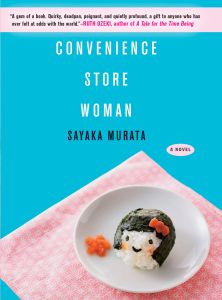
Convenience Store Woman

Keiko has known since she was a little girl that she wasn’t quite normal. Her reactions were not like those of her peers, and they were different enough to cause her family alarm. Upon discovering a dead bird, her first thought was that it might be good for her father’s dinner: when one of her teachers was in an emotional uproar, Keiko addressed the situation by pulling down the teacher’s dress. So far, so quirky. It’s a little more disturbing when, annoyed by a crying baby, she ponders a nearby knife as a solution. Fortunately, Keiko has found a place where her strangeness is not disruptive: where her need for social scripts and routine is perfectly matched — the Convenience Store. There, she finds a literal manual for how to behave. There, she finds a consistent array of things that need to be done properly, with enough variety that she doesn’t lose interest. She is a perfect cog in the machine, and she lives and breathes its needs and atmosphere. There are converging factors, though, that will combine to disrupt her place: her age, for once, as she continually reflects on how the Convenience Store’s worker-cogs are replaced once they’ve worn down, just like unsold rice balls; her family’s continued prodding that she should really get a real job or at least a husband after eighteen years of the convenience store routine; and the final of an utterly obnoxious and soon-to-be-fired coworker who nonetheless prompts her to try something new. This is not, however, some predictable novel about love and inspiration. 

Given its length (scarcely over a hundred pages), I suppose it’s not saying much that I read this in one sitting. But perhaps it is saying something that I didn’t even bother to freshen my drink, or to go outside and have a look at the moon as I do when I’m reading at night and get restless just sitting. I read it in one go, utterly spellbound, and then I began listening to the audiobook version just to see what it had to offer. (Totally worth it. Not only did I get to hear the pronunciation of “Irasshaimase!”, which is a staple of the book, but the narrator Nancy Wu also portrays the difference between Keiko’s ‘real’ voice, the flat narrator, and her public voice, which was modeled on listening to her coworkers’ cadence and expression.) Although the novel’s blurbs and some reviews refer to this as comic, I don’t get that at all. For me, it was a thoroughly sympathetic and engaging account of a young woman whose brain is not set in the same mold as everyone else’s trying to be normal – in part so people will stop prodding at her to be normal. She doesn’t want to be an object of such interest and distress to her family. Because she doesn’t think or relate to people and the world around her the way that most do, she relies on acting to lower her profile and not be noticed: she labors to discern social scripts and follow them, she imitates the voices and emotions of those around her, and she relies on her sister for tips on what to say to avoid various lines of inquiry. She also thinks about society in a very abstract, detached way, which is one of the few things she has in common with a character who is otherwise an inexplicable connection for her. As obnoxious and abhorrent as he is, they’re both outsiders in their way. As mentioned, though, the novel does not settle for a nice ending, which I appreciated. This joins Ready Player One and Cold as Hell as books I had to experience in two mediums.

Convenience Store Woman was a fascinating little novel — tragic, sympathetic, and compelling.

Related:
Marian’s review @ Classics Considered

Posted in Reviews | Tagged , , , | 5 Comments

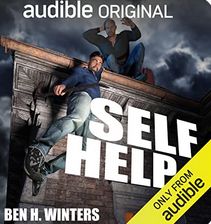
Self Help

Narrated by Wil Wheaton & Ron Perlman
~ 4 hours
© 2022

Jack Diller is a loser in denial, a failed actor who keeps the bills paid (barely) by delivering food to Los Angeles’ upper middle classes, staring in awe at their mansions while trying not to think about the tiny rental house filled with old pizza boxes and empty Mountain Dew cans that waits for him after twelve hours of driving. Jerry spends much of his shift staring at his phone, and one night sees an obnoxious ad for an audiobook. It’s a self-help book by Hector Bruno, an action movie star from the 1980s. Although Jack isn’t much for audiobooks, out of curiosity he gives it a shot, and……finds Hector talking to him. Jack’s not just listening to a washed-up actor give vague life advice, he’s being confronted and coached by a man with such an audio presence that he can’t help but listen — and as Jack does, he finds something rising in him: THE KILLER INSTINCT. The polite pushover finds a sudden and inexplicable fount of self-confidence and cunning, and is soon well off the straight and narrow, culminating in a flight to the desert with a young hostage. (Not to worry, Iris, Jack’s really a nice guy. Really. ) 

Self Help made me hurt with laughter, though it helps that I’ve been in bed for several days with a savage chest cold so any amount of laughter hurts a bit. The voice acting in this is utterly brilliant, and I’m sorry that there’s no excerpt on YouTube to share, and that the ‘sample’ on Audible only demonstrates Wil Wheaton’s performance, and not Ron Perlman. I know Perlman chiefly through his role on Sons of Anarchy, where he plays King Claudius in a Hamlet-meets-bike-gang crime drama, and it was hilarious to hear him here, hamming it up with a soundtrack and turning a listless failure into an assertive if bumbling criminal. Wil Wheaton has never disappointed me in his audio performances — he is, in fact, the reason I’m an Audible member at all – and he’s up to his usual standards here. Although there’s some interest from the reader/listener wondering what the nature of the audiobook is (is Jack hallucinating? Is it some some of AI?), given that it appears to be conscious and reacts to Jack’s real-world choices, the meat is Wheaton’s delivery of a man-child discovering how to assert himself and move toward a goal, but quickly going off the rails and rationalizing all along the way. It’s dark, funny, sometimes surreal, and always thoroughly entertaining.

Posted in General | Tagged , , , , , | Leave a comment

Teeesing Tooosday

After delving through them, I discovered three local history books, none of any significant value. I offered him £15 for them. He told me that he’d never been so insulted and that he was going to donate them to the Old Bank bookshop. It’s remarkable that a man who was clearly in his eighties had ‘never been so insulted’. I’d been on the receiving end of considerably worse insults by the time I was five years old.

Remainders of the Day, Shaun Bythell

Perhaps the most beautiful of all of these lessons, and the one that deserves to be shouted from the rooftops and heard by everyone, is that we should all pay attention to the mingled beauty and ridiculousness of the people around us; that we should seek to understand them through humor, which, as in the stories of Flannery O’Connor, is at its best and most effective when it is equal parts deadly weapon and act of grace.”

Lauren Groff, preface to Flannery O’Connor’s “A Good Man is Hard to Find and Other Stories”.
Posted in General | Tagged , | Leave a comment

From London with Love

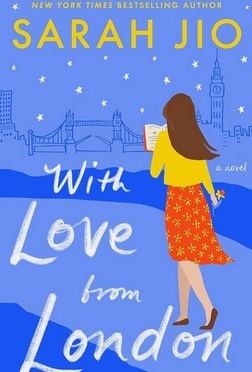
Valentina was just a girl entering her teens when her mother disappeared — to London, her dad said. The years passed and nothing was heard from her. Now, as Val reels from the death of her marriage, she receives word of another death: her mom, who has left her a bookstore in Primrose Hill. Although Valentina knew her mother was originally from England, she’s never had any real interest in going, but now she has nothing keeping her from making the trip and finding answers. Why did her mother leave her, and who was she, really? Such is the story of From London with Love, which is told in two parts: we follow Valentina as she makes her move to London and begins engaging with her mother’s friends and neighbors in Primrose Hill, trying to understand who her mother was and how she could have meant so much to the people around her when she’d abandoned her husband and daughter years before. Val will make her own connections to those people, and to her mother through a series of scavenger hunts that introduce her to the people and places of Primrose Hill — but, in alternating chapters the reader also follows Val’s mom Eloise from her own youth forward to her death. We get to know her in full far before Val does, leading to a wonderful sense of anticipation as Val gets closer and closer to the truth of who her mother was. It’s as if we’re standing across a street, watching two dear friends approach the same place from perpendicular roads, destined to bump into one another as they round the corner.  This also means we get to witness other sides of Val’s new friends’ lives through the eyes of someone who knew them longer and more deeply. With Love is also (as the name would hint) a love story, or rather multiple love stories: Eloise falls in love but ultimately chooses to marry someone else, wrangling with those consequences, and Valentina is intrigued by handwritten comments in a copy of her favorite book, going on a little hunt to see if she can track the person down. I thought there was some fairly obvious telegraphing of who she would wind up with, despite the red herrings, but Jio teased just enough to keep me on my toes. I didn’t realize halfway in that I was reading a romance novel of all things, but the mother-daughter relationship is front and center, and that combined with the whole “librarian inherits a bookstore, finds community” angle worked to make this a wonderfully sweet story, even for someone whose fiction reading generally involves shooting, stabbing, or science fiction.

His voice trailed off as he turned his attention to the night sky. “Look at the stars up there, fighting to be seen through all these city lights. It’s like a battle between two opposing forces: eternity versus modernity.” I smiled up at him curiously. “Eternity for the win?” “Eternity always wins,” he continued. “And that is the greatest comfort, isn’t it?”

“The fact of the matter is bad things happen to good people. They do. All the time. But it’s our choice whether we wallow in them for the rest of our lives, or whether we accept the invitation.” I furrow my brow, confused. “The invitation?” “Yes, to begin life’s grand second act. You see, that’s what your mother learned. Once she stopped looking back, she could finally move forward.”

Posted in Reviews | Tagged , | 2 Comments

The Lunar Missile Crisis

“It happens to the best of us,” [Neil] Armstrong said. “Watch yourself on the way out. There’s one small step.”

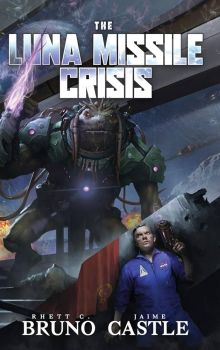
The moon race began in earnest when Yuri Gagarin launched off the pad in April 1961. It ended really quickly when he collided with an alien spaceship and exploded, leading to a full nuclear launch by the Soviets which failed in the presence of the spaceship and which turned everything between Berlin and Moscow into a radioactive hellscape. When American, Soviet, and alien forces collide attempting to pick up a piece of the alien spacecraft, Sgt Kyle McCoy stumbles into making first contact and leads to a new age in human history. Unfortunately, his twin brother Connor has gotten in trouble with the mob, and figures that faking Kyle’s identity to go to an international conference will be as good an escape route as any. Kyle forgot to mention, though, that said conference is on the moon, and no one was expecting outright shenanigans there. Soon, both brothers are internationally wanted men, fleeing mobsters, flesh-eating mutants, and Vice President Nixon. The Luna Missile Crisis is a unique SF/alt-history title that examines both the best and worst of humanity, ending in frustration with a brief bit of hope.

I’ve previously read Bruno and Castle before, in their Black Badge collab that features an undead bounty hunter roaming the Old West and taking out forces like werewolves and vampires. Luna Missile Crisis is quite the genre shift, although there are similarities with nonhuman intelligences and otherworldly energy. LMC takes place in the late sixties, in which humanity has not only landed a man on the moon, but built an international base there, as well as quarries. A little deal has been struck with the aliens: in exchange for help repairing their ship, they’re willing to share some tech with humanity, tech that will lead us to other worlds before we’ve even invented the TCP/IP protocol. The alien arrival has essentially ended the Cold War, and even created a bipartisan presidency, with Nixon seconding his former rival. That’s not to say everything is hunky-dory, given that many humans are alarmed about the aliens, especially their influence on Earth governments — hence the aforementioned shenanigans. As far as SF goes, this is deeply on the ‘soft’ side: the aliens can communicate with humans telepathically, or at least once they have some practice, so the real issues in xenocommunication are reduced to much easier cross-culture problems. The alt-history side is developed well enough, though I’m not sure why the author felt it necessary to kill off LBJ and replace him with Nixon: granted, an alternate history where LBJ’s odiousness never touches the presidency is one I’m happy to read about, but it’s not as if Nixon’s presence is necessary. There’s a little nod to the history that might have been — the Earth-Luna ships are named Apollo, and Captain Neil Armstrong is the commander of that service. More interesting are the psuedo-horror elements, especially present when one of the McCoys crash-lands in the Dead Curtain, the hellscape created by the Soviet nuclear backfire. 

All told, this was a fun little novel, with a nice mix of various elements — humor, horror, SF interest, etc — but its ending was disappointing despite the hope spot.

Coming up this week….I accidentally read a romance, so look forward to some mood whiplash, and I’m currently two more SF titles

Posted in Reviews, science fiction | Tagged , , , , , | 8 Comments