As promised, I read This Book is Overdue! How Librarians and Cybrarians Will Save us All, by Marilyn Johnson. Before getting into it, though, I found a very quick work on KU that amused me, so I’m sharing it here as well: I Work in a Public Library.
If you’ve ever worked at a public library for any length of time, you’ve no doubt encountered some strangers and even stranger incidences: my two favorites are the time traveler and the man who wandered inside wearing no pants or shoes but holding a belt. I assumed this would be along those lines, and I was correct — complete with some recurring characters, like “Cuckoo Cathy”. The book is a collection of funny quotes from patrons (the sort of thing you’d find at Overheard Everywhere Else, but library-focused) as well as amusing & bizaare anecdotes. Sheridan closes with more heart-warming stories, like of a man who returned to the library with gifts to thank libarians for helping him find a job, that sort of thing.
Quotes:
MAN: The volume. It keeps quacking instead of ringing. It’s really embarrassing. I think my grandkids got hold of it. ME: I think I can fix that. [I take the phone, quickly go through the settings, and make a few changes. Then I show him the switch to quickly turn on and off the ringer.] MAN: You are a miracle worker! If only you could fix my grandkids. They could use an on/off switch. Or a kick.
FIVE-YEAR-OLD: You got books on Al Capone? He led a crime cinnamon. MOTHER: Syndicate.
And now, the real subject of this post: This Book is Overdue! As a librarian who doubles as an IT dude, I was immediately drawn to this title. Written in 2007 or so, it’s a general tribute to librarians but especially those who were taking advantage of the computer & networking revolution to radically rethink approaches to library work. We start off slow, Johnson documenting the trials and tribulations of a library system changing its patron & collection management software, visit librarians who were playing with then-new software tools like chatboxes, and eventually find ourselves in “Second Life”, where librarians were creating digital libraries that offered the texts of materials that members of Second Life were looking for but couldn’t find in their own systems — or, for reasons of privacy or security, were afraid to ask for in person. The setting in the early terror war period also gives librarians a chance to shine as frustrators of the goonie-boys: one section here features three anonymous librarians refusing to comply with orders from the fibs to hand over patron records. In more fun sections, Johnson dives into the digital world that librarians were creating — invading the bloggosphere and creating a community of blogs commenting on serious issues, venting steam about patrons and city councils, or just goofing off. Unfortunately, most of the blogs mentioned are long since dead, though it’s possible to use the Wayback Machine to gain some limited access. One blog that is still extant is “Tales from the Liberry“, though it’s dormant. My guess is that the social energy of the library-blogging sphere shifted into things like facebook groups, as I’m a member of so many library-focused groups that my feed is sometimes nothing but library programming ideas, book displays, baseball news, and photos of trains. This was a fun look back at how libraries began embracing the digital revolution, with a lot of laughs.
Another post consisted entirely of “signs we never thought we’d need to make,” each of which told its own condensed story: While waiting for your ride home, do not set fire to your homework to keep warm. You may not take the Sports Illustrated Swimsuit Issue into the washroom. Iguanas are not allowed in the building. If you are out of diapers, do not open the soiled diaper, scoop out the turd, leave the turd on a shelf, and then ask the librarian to tape the newly cleaned diaper closed again….
I was spending my life trying to focus on what was new in librarianship: new attitudes, new targets for outreach, the new issues and possibilities that computers in libraries represented. I didn’t want to be sitting in a sticky chair thinking about poop. Children, the homeless, smuggled-in soda bottles that spill all over the stacks, poop—these were all problems, as the academics would say, beyond the scope of my inquiry. And yet, here was poop.
Writers seldom just stop writing. We’re like serial killers in that way. You have to stop us, because we cannot stop ourselves.
During the height of the debate about the Patriot Act, some librarians posted signs that were “technically legal,” slyly warning patrons that their privacy might be compromised: THE FBI HAS NOT BEEN HERE (watch very closely for the removal of this sign).
Searching for obituaries is the most frequent kind of local history request I field at the library, and I like to joke when I’m disappearing into the archives room that I’m off hunting for dead people. I’ve noticed over the years that obituaries often rise to the quality of literature, and so I was immediately interested in this title. Written in the very early 2000s, it delivers both its intentional interest — obituaries and those that write them — as well as unintentional interest, in looking back to when the internet hadn’t ravaged papers big and small, and when the internet itself was a different experience: there’s an entire chapter here on the Usenet for obituary enthusiasts. Johnson examines obituaries in both the United States and Britain, and interviews notable obit-writers whose skill at capturing the life of the recently deceased had brought them some slim measure of fame. There is an art to the obituary in finding the appropriate facts & stories to create a sense of the person who perished, not merely reprise a staid series of facts about a funeral home entry. Although we read of celebrity deaths here, there’s a good focus on ordinary lives as well, especially in the section on 9/11 and the way the New York Times began honoring the lives of those murdered that day. Johnson also visits England’s principal papers, incuding The Economist, to see how their approaches vary. I enjoyed this title, but I suspect its audience is limited.
Coming up: another title by Johnson, this one on the messy tango between librarians and computers.
In these mercenary days, others might lower the high ideals of the brave old days and become worshipers of Ba’al, but not he. In the country of his youth and young manhood, Honor was king and kindness, courtest, truth, and courage were his ministers. What wonder, then, that these ruled his whole life and made him noted throughout the Black Belt of Alabama. To offer him an insult was to take a Numidian lion by the beard: and he has been known as one that would uphold his principles on the field of honor. And now the brave and generous heart is stilled forever. We shall not soon forget him, for he was a rare man and one whose like we shall not soon see again. May he sleep restfully under the magnolias until that final day when each shall receive his just reward.
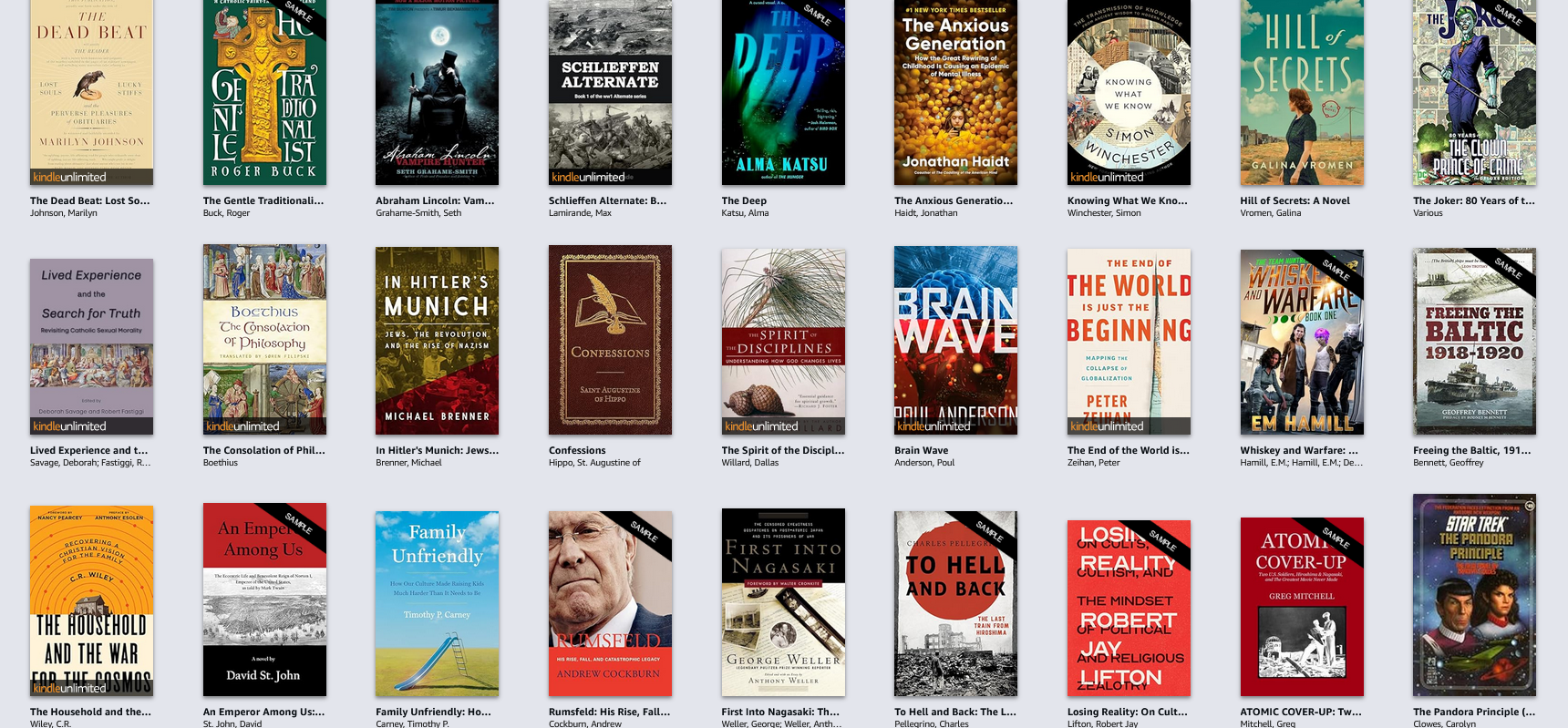
WHAT are you reading? Um. I just finished a book and haven’t gotten into anything just yet. Well, I’m still technically reading The Anxious Generation but I’m overwhelmed with schoolwork at the moment and can’t take anything too serious. This is the absolute randomness that is my Kindle bookshelf at the moment:
WHAT have you finished recently? The Dead Beat, a tribute to obituaries and obituary writers.
WHAT are you reading next? Really should be All Power to the Councils! or Germany 1923, for my planned Germany Between the Wars series of reviews, but as mentioned I’m crazy busy with school and reading about Communists and Nazis hijacking Germany’s first democracy is not an ideal counterpoint to all of the articles I’m having to read and digest and turn into a paper.
Today’s prompt from Long and Short Reviews is: What has improved since you were a kid? and I can only answer: MY ACCESS TO MUSIC. Before the internet, my music experience consisted of listening to terrestrial radio with a cassette tape at the ready so I could hit record when I heard a song I liked, and buying $10 cassette tapes and $15 CDs at Walmart. (My first cassette: Best of Beethoven. First CD….Charttoppers of the 1950s.) Once the internet became a thing, not only was it a lot easier to explore new music — like hypothetically typing in an artist’s name into Limewire and then listening to different tracks, not that I ever did such a thing. Someone who did might realize that a lot of people are quite stupid and will label a track as being by Frank Sinatra or Perry Como when they’re actually by Tony Bennett. I don’t speak from direct experience, of course. Then Pandora came along and could create playlists based on songs you liked, using their ‘musical genome’, and then Youtube and Spotify and all that came into being as well. Youtube has become the main way I find new music via the ‘related’ section.
And here are five artists I found via YouTube.
Merle Haggard said heaven was a drink of wine, but I’d settle with watching Rachael Price sing.
I was born on this mountain, this mountain’s my home She holds me and keeps me from worry and woe Well, they took everything that she gave, now they’re gone But I’ll die on this mountain, this mountain’s my home
Allison Young is so adorable.
I want you one last time Another hit to ease my mind I don’t want you to be over yet Won’t you be my last cigarette?
If I ever find myself in New Orleans, Chloe will be to blame.
And by “top ten”, I mean “the first ten books that floated up from the depths of memory”. But first, the tease!
The professional whistler” alone would make the obit interesting, but to also have Hitler, Frank Sinatra, and a sex-change operation (in a Cairo clinic!) is outrageous. The business about dying “aged 80” sits in the middle of the sentence, British style. (The Dead Beat: Lucky Stiffs, Lost Souls, and the Perverse Pleasures of Obituaries).
Okay, so — books I read because of school!
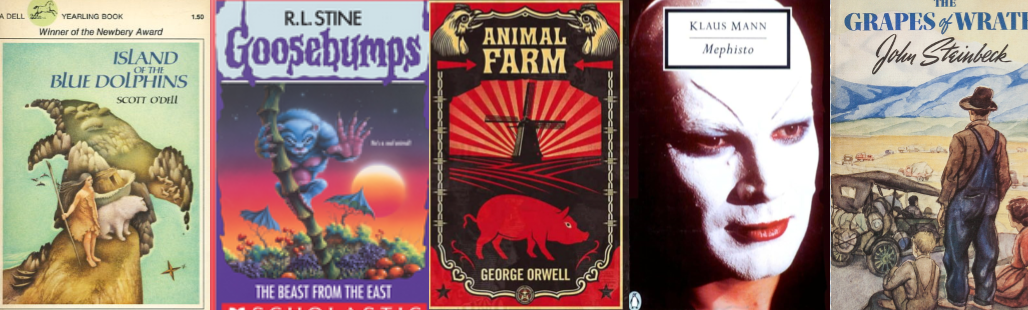
(1) Island of the Blue Dolphins. I remember nothing about this book other than being surprised I liked it.
(2) Bridge to Terabithia. Assigned summer reading. Can’t remember a blessed thing about it.
(3) The Lion, the Witch, and the Wardrobe. Assigned summer reading in between 3rd and 4th grade. My first encounter with C.S. Lewis, though I didn’t read the series in full until much later — when I was beginning my thirties.
(4) Where the Red Fern Grows, Wilson Rawls. My fifth-grade teacher read this to us over the course of a few weeks and it remains one of the most leaky-eyeball books I’ve ever read.
(5) Animal Farm, George Orwell. Read in fifth or sixth grade, and it improved enormously when I re-read it in high school after becoming familiar with the Soviets. This is one I should revisit.
(6) The Grapes of Wrath, John Steinbeck. This book is forever linked to 9/11 for me, because my class discussion of it was interrupted by an aid from the office coming in to tell the teacher the news. Read it again a few years ago and enjoyed it tremendously.
(7) Goosebumps: The Beast from the East. Why my brain remembers that my fifth grade teacher read this specific Goosebumps title to us, I have no idea. (I suspect it has something to do with kid-me having a teacher crush.)
(8) The Tragedy of Julius Caesar. Listening to my teacher bring scenes to life in tenth-grade world literature is the first time I remember being impressed by a teacher’s skills. She really made me aware of how much is happening in the scene in which Caesar is stabbed — people shouting questions and vying for his attention.
(9) Mephisto. Read for a college-level German history course. The chilling story of an artist who sells his soul to the Nazi party for pelf & place. Re-read a few years ago.
(10) A Life of her Own, Emile Carles. The memoir of a French woman from a rural village who became a teacher through two world wars: this book was my introduction to the left, libertarianism, and pacifism. It made me much more critical of the state and far more interested in reading about political philosophy, and it’s one of my few college class books that I’ve retained. One to re-read.
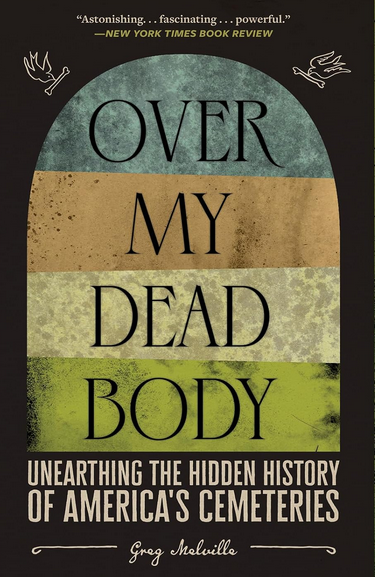
“There is glory in graves; there is grandeur in gloom”. So begins a poem inscribed on an elaborate tombstone in my favorite cemetery, Selma’s own Old Live Oak. Perhaps it was growing up in a city with such a picturesque cemetery that gave me my interest in them — at least, old ones. Modern cemeteries made for machines — and specifically, with no monuments and memorial stones designed so that lawnmowers can pass over them — hold zero interest for me. Given that it’s spooky season, I thought it might be interesting to look for a history of cemeteries. Over my Dead Body is a mix of cemetery history and cemetery tourism, though the history is sketchy and the tourism is mostly prominent places like Hollywood’s celebrity necropolis or — interestingly — Central Park. I enjoyed it in parts, but not consistently, and developed an acute dislike for the author’s frequent personal anecdotes about eating vegan at his friends’ house or boring his daughter wih dad-jokes. Other readers’ taste may vary.
Although there’s a chronological orientation to this book, it’s not a straightfoward history of American cemeteries. We do begin with Mississippi mound-builders and the graves at Jamestown and end with a modern push for ecologically-friendly burial practices, but in between it’s more focused on the ‘hidden history’ aspect, and not so much American cemeteries in general. There’s a chapter on the destruction of native American gravesites, for instance, a look at segregation’s expression in burial practices, the role of Chinese labor in the west, and so on. A few chapters do serve to illustrate American funerary practice in general, like the section on how the American Civil War changed perceptions about death and began leading to embalming becoming more popular, to the point that the grotesque practice is now the default option in the US (and no where else, thankfully), but it’s more focused on special subjects. I enjoyed the book when it was focused on the cemeteries, as the more I read the more suspicious I became about its merits as a history: he attributes Lincoln’s speech at Gettysburg National Cemetary to bolstering the president’s reelection bid, and not, say, Sherman’s successful drive into Georgia during the election season. His treatment of the Civil War is uniformly egregious, so that’s not surprising.
While I enjoyed this in parts, I found the author more annoying than not — in his frequent off-topic anecdotes, in his modern contempt for anyone in the past who didn’t have the right politics — and was disappointed by the book’s contents, which focus either on small topics or are only connected to metropolitan cemeteries. There’s little here on the ordinary history of cemeteries, or how they may reflect their region’s culture — like the use of shells as decor in coastal cemetaries, say. There are some interesting stories in here, like Central Park’s popularity as a place to disperse ashes, but it’s not one I’ll remember and reccommend.
Coming up:…I’m going back to a book I started last year for spooky season, a celebration of obituary writers. I’ve read the author previously, so I’m looking forward to it.
Cremation in the ancient world was difficult and dependent on an ample supply of trees. The human body is two-thirds water, after all, and it takes about 1,000 pounds of wood to produce enough heat to turn one person to ashes.
For me, romance involves seeing dead people. For my wife, Ann Marie, a physician who generally likes to keep people alive, not so much.
A body buried in America today doesn’t actually become food for worms or push up daisies. Typical graves are like mini Superfund sites. America deposits about 4.3 million gallons of toxic embalming fluids—including 800,000 gallons of formaldehyde—into the ground yearly, according to the Green Burial Council. We also inter 20 million board feet of wood, 1.6 million tons of concrete, and 81,000 tons of metal. In addition, human remains contain mercury from fillings, metals from pacemakers and other devices, and potent pharmaceuticals like chemotherapy drugs, which leach into the soil. Then there are the chemical fertilizers, herbicides, and pesticides cemeteries use to keep the grass above the graves looking pristine, which requires regular mowing from exhaust-belching, fossil-fuel guzzling machines.
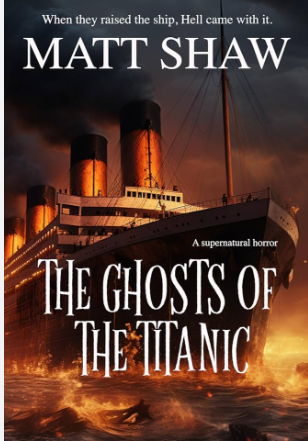
Billionaire Jackson Riggs has a plan: raise the Titanic! Currents and bacteria are steadily eating away at it, so if the Mary Rose can be brought to surface, why not the big T? (Well, 40 feet versus 12,500 feet….) So he does, to no international friction whatsoever beyond a reporter asking him if he feels strange at all disturbing a mass grave. The ruin (presumably just the bow, since the stern is a crumbled mess) is put on display in the very shipyards that built it, and the locals — demonstrating an astonishing knowledge of history — are a bit uncomfortable with that. It’s like the doomed ship has come back to haunt the community that built it. And…so it has, because not only do bits of the ship begin falling off and destroying people (tut tut, they should’ve worn gloves and helmets), but then people began committing suicides-by-drowning at 2:20 am, the very minute that Titanic surrendered to the cold deep of Oceanus. Evidently the ol’ girl still possesses the spirits of those who died aboard her, and they’re taking out their revenge on the descendants of those who built her!
…and that’s the story. It’s really just a novella. Can’t say I was impressed by it: the initial premise is interesting, but there’s no consideration given on how difficult an enterprise raising a substantial part of the Titanic would be, either from a physical point of view or from the fact that outcry would be huge. At the moment robots can photograph the interior of the bow and do shot-for-shot comparisons, seeing things as they were — if sunk. Begin moving the ship, though, and all manner of disturbance is going to happen inside, so I can imagine the scientific community alone getting incensed about this prospect. We see none of that here, though, and the mass suicides are only creepy when we witness the first one, and after that there’s a lot of cops wandering around thinking all this is really weird, and then someone else dies a different way and the story ends. There’s no unearthly whispering, no ghostly eyes of Captain Smith staring in recrimination at the billionaire, nothing really horror-like save for the first drowning scene. It’s not a developed story, to be frank.
On the bright side, this book made me aware that the Mary Rose wreck exists!
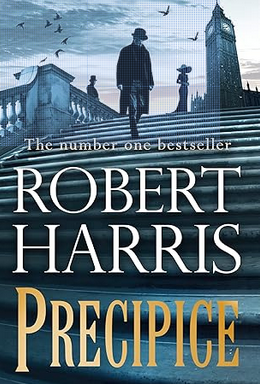
WHAT have you finished reading recently? Precipice, Robert Harris. I found it enjoyable enough to finish, but it was distinctly underwhelming.
WHAT are you reading now? In addition to the things I’ve started but have not yet continued in earnest, I just picked up a Mafia history called Borgata: Rise of Empire, A History of the American Mafia. It’s a history of the Mafia by someone who was imprisoned for being a member of la cosa nostra. While I’m not particularly impressed by the tone (it’s extremely casual for a history), so far I’ve liked his dive into Sicilian history and its importance in shaping the origins of Mafia culture. I should not be reading about the Mafia, I should be reading about inter-war Germany.
WHAT are you reading next? In addition to the things I should be reading, I just saw another Titanic horror novella (how is this a genre), an alt-history in which Germany seizes Paris early on, annnnd Abraham Lincoln but with vampires. The last title would be of no interest except for the fact that it’s October, i.e. Spooky Season. Amazon also gave me a book for being a Prime subscriber, which is about the Very Secret Science being done at Los Alamos in the 1940s. I should pair it by watching Oppenheimer. Oh, and I’ll probably start The Grandest Stage, a history of the World Series, this month, given that the series will be starting in a few. My Red Sox didn’t make it, so I’ll be rooting for the Braves (my closest regional team) and the Orioles (who have a local boy playing).
Today’s prompt from Long and Short Reviews is….”something that was better when you were a kid”. Well, I didn’t have to listen to people’s inane phone conversations literally everywhere there are people. That was nice. Even better, people were walking around, not shuffling along staring down at a device 10 hours a day, or blocking an entire aisle in the store because they’d decided that This is The Place to have an extended conversation about medical matters while their cart is parked sideways. Nevermind the strangers who just want to get past and get some coffee or pickled okra or what-have-you. (Yes, I’m a crank. I’d tell you to get off my lawn but I’d honestly be relieved you were outside instead of screen-bathing.)
Summer 1914: there’s a man dead in Sarajevo, and ominous rumors of war are drifting from eastern Europe. Across the Continent, war machines are slowly cranking up. At 10 Downing Street, though, the long-serving Prime Minister has more pressing issues: why hasn’t his young quasi-girlfriend written back yet? Three letters a day he writes her, and she’s getting very bad about responding promptly. Such a wicked girl! But so loving, and sympathetic, and – oh, why won’t she write already?
Precipice is Richard Harris’ latest novel: though he’s known for thrillers, Precipice isn’t exactly exciting. It’s an interesting through-the-keyhole kind of novel as we witness the first two years of the Great War as experienced by Britain’s leadership: Winston Churchill and Admiral Fisher are prominent characters, and Lord Kitchener (you know his face even if you don’t know his name) also appears quite steadily. The novel takes us through the war through its two principal characters, Prime Minister H.H. Asquith and Venetia Stanley, a woman his daughter’s age. The PM and Venetia have an interesting relationship going on, reminiscent of courtly love: while they’re not physically intimate they frequently go on drives and write extraordinarily emotional letters to one another. We experience much of the war not through debates in Cabinet — though there are plenty of scenes there — but through the news that Asquith shares (quite inappropriately) to Venetia, including forwarding her classified letters and telegrams. Because Asquith has a horrible habit of chucking them out the window (littering as well as being negligent with state secrets!), some of these telegrams are found, the police are involved, and —
Here’s the thing. If all this hadn’t happened, there could have been an interesting story here in which a prime minister’s affections for a young woman half his age leads to public scandal, his resignation, and a change in the war: instead, Harris sticks to the facts and we get a mild soap opera with no serious drama. British intelligence knows about the passing-on of intelligence, but they appear more interested in learning about the war via the letters than they do reminding the PM of his duties toward the Realm. Oh, one could argue that the PM distracting himself with this courtship undermined his effectiveness as PM, and Harris certainly tries to tie the reckless treatment of telegrams to the logistics issues Britain was having, with some characters commenting to the prime minister that boy, wouldn’t it be nice to have Kitchen’s reports on munitions before addressing Parliament? Don’t you think you could find the letter, Prime? Perhaps write another letter to Venetia and ask her to retrieve it from the shoebox she’s keeping state secrets in! In the end, the story simply….ends. Frankly, I think Harris would’ve been better served with a fully fictional novel inspired by these events, where he would be at liberty to have exciting arrests and powerful speeches and wrenching sobs and all that. As it was, this novel was interesting enough to keep me reading, and it does offer the slightly voyeuristic pleasure of reading a prime minister’s love-letters.
Today’s TTT is Bookish Brags and/or Confessions. But first, the tease!
“Imagine it — to be the King-Emperor of nearly five hundred million subjects and to be able to locate the twelve dullest, then gather them together around one table. It takes a special kind of genius.”
“The government seems to be very popular. You’d think we’d already won.” “I don’t much care for it,” said the Prime Minister. “It reminds me of Walpole’s remark before the war with Spain. ‘Today they are ringing the bells; soon they will be wringing their hands.'” (Precipice, Robert Harris)
So….bookish brags and confessions. I’m going to kick off with a brag and alternate!
(1) I have read War and Peace, and in my review I posted “Bragging rights for life”.
(2) It took me three attempts to finish Catch-22and that was with partial help from some CliffNotes-like web resource.
(3) I read The Glory and the Dream, a 1400 page social history of America in the 20th century, in middle school. I suspect I was the only kid in the history of the school to do it!
(4) The version of Hunchback of Notre Dame I read from in my library turned out to be abridged. I’ll have to do the full thing at some point, maybe if I get in a French mood. Rewatching Mon Oncle may do the trick. (Click to listen to its delightful, ear-wormy soundtrack.)
(5) In 2007, I read the entire Harry Potter series through for the first time in about a month: the back half of August and the first week of September, specifically, being delayed slightly by Deathly Hallows still being a waiting-list book.
(6) In the 2012 Bookish Confessions top ten Tuesday post (holy cow, we’ve been doing this for a while), I said:
.Although I’m hostile toward digital readers, I’ll probably wind up buying one within the next five years. My rising Luddite tendencies notwithstanding, my job as a reference assistant often entails helping people with computers, and increasingly their own wireless devices. If touch-screen interfaces are the way of the future, I need to learn to navigate them to function out in the world. Of course, at home I can be as tech-free as I want.
In February 2016, responding to an essay I’d written critical e-readers called “Go Go Gadget Literature?“, I sheepishly admitted to having bought a Kindle in 2015 at some point. Today ebooks generally claim about half of my reading, though I haven’t used my actual Kindle in years. The Kindle app on my phone & the Kindle Cloud Reader are my main e-reading sources. And be it noted, I’m not quite ‘tech-free’ at home: for the last few years I’ve used a Google Nest Hub as a virtual photoframe and an object I can demand the time from in the middle of the night. (I use British Racing Green as my Google voice. I like having a posh personal assistant, even if she’s hopeless with Spanish place names like “Valley Grand-dey”). 2012 me also knew which way the wind was blowing: I’m absolutely fluent in both ioS and Android.
(7) My highest-bookcount year remains218 in 2009. Looking at the list, it’s easy to see why: lots of fiction, as that was the year I discovered Greg Iles, Steven Saylor, and Robert Harris — not to mention plowed through the entire Series of Unfortunate Events. I was also obsessed with religion and philosophy that year, reading books on Buddhism, neopaganism, Christianity, and Stoicism.
(8) I once had an entire bookcase devoted to nothing but Isaac Asimov (five shelves!) but in time have reduced it to two shelves. Most of the discards were science essay collections I’d knew I never re-read — or read, seeing as some of them I’d procured in lots from eBay and were hopelessly outdated.
And because I don’t resist puns, here are our last bookish Braggs and Confessions.
I will literally not resist an opportunity for a pun.
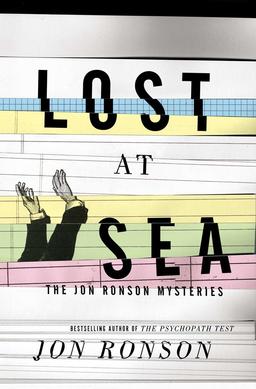
I’ve been wanting to revisit Jon Ronson and Will Storr, whose books visiting extremists and cranks were both amusing and thought-provoking: October seemed an appropriate month to do so, given their tendency to visit the strange. This collection of pieces from the 1990s and early 2000s is varied both in subject and quality, ranging from the amusing (Ronson re-creating James Bond’s Aston Martin drive across France in one movie, complete with matching him drink for drink at a hotel) to the disturbing, as when he spends time with a convicted serial pedophile who got a relatively light sentence because of his fame. It appears to be more a collection of miscellany than anything else: although the “hanging out with people who believe weird things” is a consistent presence here, it’s not dominant enough to be the main theme. The only thing that links them is Ronson himself, whether he’s talking to a man once arrested for trying to split atoms in his garage, or talking to cruise ship crew about a young woman who disappeared from the boat at sea. Although there’s humor here, between the child molestation and the debt-induced family slaughter and suicide, this was generally fairly grim and uncomfortable reading.
“Don’t think of her as psychotic,” Bruce says. “Think of her as a three year-old. If you try to interview a three-year-old, you’ll think after a while that they’re not living in the same world as you. They get distracted. They don’t answer. Hang on.” He does some fiddling with Bina48’s hard drive.
I spent a week sending e-mails: “Dear Lady, I’ve read that, if the portrait in your drawing room is moved, a ghost is apparently disturbed and manifests itself. Recently I have been contacted by the pop star Robbie Williams who would like to spend a night in a haunted house and so Iwonder whether he and I can pay a private visit.” I expected not to hear back from anybody, but, in fact, once I invoked Robbie’s name, owners of country piles started flinging their ghosts at me as if they were their debutante daughters
Six of last year’s middle school elves, now aged thirteen, were arrested back in April for being in the final stages of plotting a mass murder, a Columbine-style school shooting. The information is sketchy, but apparently they had elaborate diagrams and code names and lists of the kids they were going to kill. I’ve come to North Pole to investigate the plot. What turned those elves bad? Were they serious? Was the town [of North Pole, Alaska] just too Christmassy?
Coming up….Robert Harris’ latest, Precipice, following a lovelorn p.m, as he tries to steer Britain through the Great War.