
– F. Murray Abraham as Salieri
“Is it ….not good?”
“IT IS MIRACULOUS.”
– Again, F. Murray Abraham as Salieri.
In 2011, I posted some thoughts about why I had a dislike for e-readers, and my fears of what they would do to book culture in general, under the name “Go Go Gadget Literature“. Five years later, I sheepishly admitted to having bought a Kindle Fire, which I’d been reading a little on: I’m not positive what prompted the decision, though it was between the library beginning to offer ebooks and my needing to get familiar with the tech, and the fact that a lot of authors were starting to publish on Kindle exclusively. I first installed Kindle for PC on my computer when Niall Doherty, a YouTuber minimalist whose thought-provoking questions I liked, published an ebook exclusive called Disrupting the Rabblement. Well, today I received an email from Amazon congratulating me for having been a Kindle Unlimited member for 5+ years, or more than half KU’s life. Ebooks began growing as part of my reading beginning in the late 2010s and in the last few years has remained a close rival to physical books — sometimes leading, sometimes trailing. I suppose I drifted over through ease of use, but the ever-expanding Kindle Unlimited library and frequent sales also helped.

157 is an absurdly low number given that ebooks have consistently constituted half of my reading in the last few years (over half, in some): I think they’re only counting books I’ve read to 100% on, and it’s not like I’m reading the index. THAT, or they’re only counting books I’ve read on my Kindle Fire itself, and it’s rare that I know where it is. Since acquiring my first smartphone (a Galaxy S7 in 2017), I’ve used it almost exclusively as my e-reader: currently my Pixel 6 is serving in that capacity, but I will say the S7 was a better size for reading. The Pixel is a bit too large to hold in one hand comfortably for long stretches. Of course, I do a lot of Kindle Cloud reading, too.
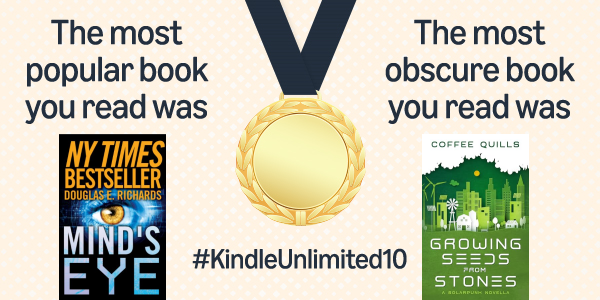
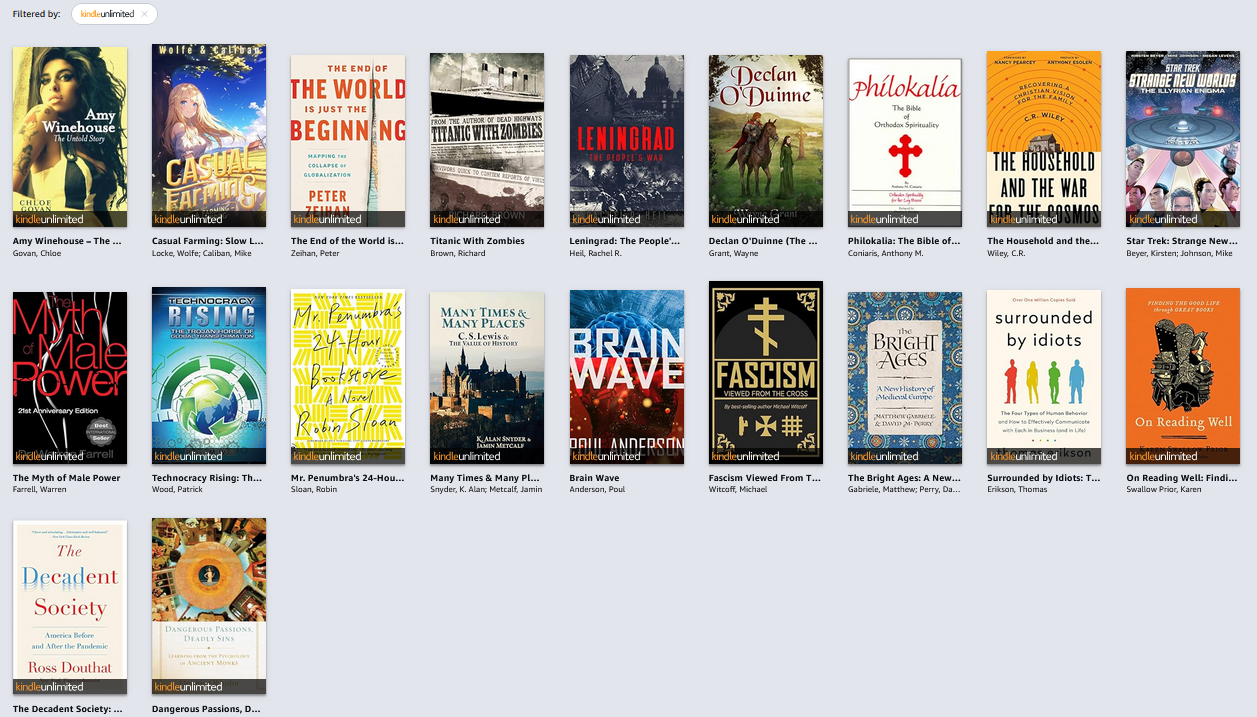
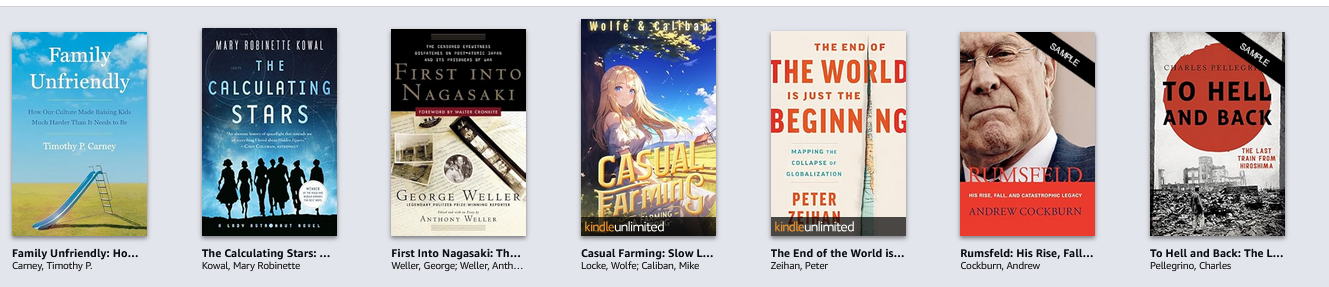
The first was a library book, the second some solarpunk on Kindle Unlimted I found earlier in the year. I definitely get my money’s worth out of Kindle unlimited, and there’s a reason it constitutes the second-biggest category in my book stats under the “Source” column. This is my current KU shelf. We’re allowed up to 20 titles, but in my experience I tend to have 15 books that have been on there for months, whereas I’m actively looking at 2-3 of them. Some of the odder titles in here: a litrpg novel based on cozy farming games; an analysis of fascism from the Eastern Orthodox perspective; and Titanic with Zombies. (There are three Eastern Orthodox titles in here, I just realized….Dangerous Passions and Philokalia being the others.)
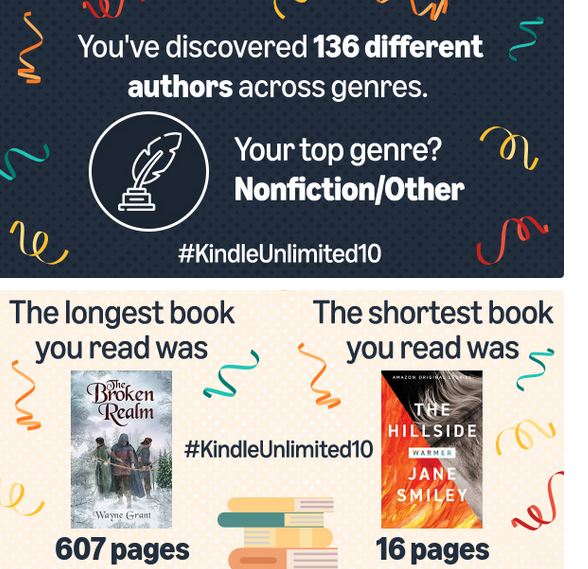
This is quite misleading: easily the largest title I’ve e-read was The Jewish Annotated New Testament, and “The Hillside” was a short story part of the Warmer collection.
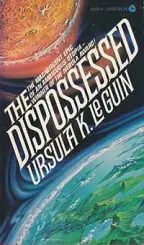
So you say you want a revolution? Well, brother, you must be the revolution. Shevek of Anarres is a brilliant physicist who is on the cusp of a breakthrough that could revolutionize humanity’s use of space and time, but he’s increasingly obstructed by members of his society, for reasons he can’t quite understand. Is it personal jealousy? Fear? Or has the anarcho-syndicalist society in which he lives simply begun to ossify? Shevek makes the bold decision to return to the planet that his forefathers fled from generations before, Urras, to break down the walls of silence between the two societies and perhaps find room to finish his work. He finds a startlingly different society, both intriguing and disturbing in turns, but realizes the answer he seeks isn’t there, either. The Disposessed is a fascinating work of political science fiction that offers the reader much to think about, amid a compelling drama about a man searching for the truth while trying to remain true to his values.
The Disposessed follows an interesting structure, with alternate chapters taking place on either of the two worlds and on different, but related timelines. In even-numbered chapters, we follow Shevek on Annares and learn about its culture and anarcho-syndicalist approach to society. It is highly collectivist without being authoritarian, using cultural and social pressure to push its members towards behaving. The individual is so downplayed that possessive pronouns are regarded as suspicious. Although people often do the work they’re declined to do (physics, for Shevek; biology, for his partner), one organization called DivLab also assigns needed work on a rotating basis, so people are frequently pulled away from “their” work to do what is needed, regardless of what that might mean for romantic pairs like Shevek and Takver — and their daughter! In the odd-numbered chambers, we follow Shevek as he explores Urras, the planet his people fled from seeking a revolutionary new way of life. Urras is capitalistic but also highly militaristic, and is engaged in a proxy war with its Soviet Union-esque rival in another nation. It’s interesting to find a bit of SF that has a planet without a unified government, at least in my limited experience: this one has at least the three, plus Anarres on the moon. Urras’ society is relatively ‘normal’, though there are some interesting fashion choices like women going around with shaven heads and bare torsos save for navel jewelry. Shevek is bewildered by how wealthy life on Urras is, although he realizes as the plot wears on that he’s only seeing on how one fraction of the planet lives: after sneaking out with help, he sees what happens to those in this society without resources or the ability to acquire them: think Down and Out in Paris & London or The Jungle. After realizing that the powers on this world want to use his breakthrough to create tools that will allow them to dominate the others, Shevek has to bolt.
The book’s subtitle is An Ambiguous Utopia, and that makes more sense the further along Shevek goes, as we’re seeing not a Perfect Society arrayed against an Imperfect one, but two societies that both have their flaws. Personally, I’ve long stopped believing that any human society can be stable in the industrial-technological age, and a stable society wouldn’t even necessarily be a good or perfect one, just stable. By book’s end, Shevek still vastly prefers his world of meaningful, peaceful poverty to the riches and lusts of Urras, but actions unfolding on Anarres prove that it has changes to make as well. To be honest, I wish I’d read this back in 2010/2011 when I still identified as a left-libertarian: I don’t think it would have greatly changed the evolution of my political thinking, but it would’ve definitely had an effect and would have resulted in a fascinating review to read in retrospect. This book’s multiple rewards (and Cyberkitten’s multiple reads of it over the years) definitely make sense, and I intend to revisit le Guin!
SFF Book Bingo Slot: “Best Buds“, a book read with friend or club. Another bingo!
Related:
The Moon is a Harsh Mistress, Bob Heinlein. The story of a revolution on Moon, drawing from both the American Revolution and the Soviet seizure of power.
The Great Explosion, Eric Frank Russell. An amusing short novel about a distant State trying to impose itself on colonial worlds, in which an aggressively anarcho-libertarian planet plays a big part. Myob!
Anthem, Ayn Rand. An individual emerges in a collectivist world. As with le Guin and Orwell, language is used to corral thought: “I” is not even a known pronoun.
Highlights:
“Speech is sharing—a cooperative art. You’re not sharing, merely egoizing.”
“I never thought before,” said Tirin unruffled, “of the fact that there are people sitting on a hill, up there, on Urras, looking at Anarres, at us, and saying, ‘Look, there’s the Moon.’ Our earth is their Moon; our Moon is their earth.”
“Where, then, is Truth?” declaimed Bedap, and yawned.
“In the hill one happens to be sitting on,” said Tirin.“No—no, I’m not. I’m trying to say what I think brotherhood really is. It begins—it begins in shared pain.”
“Then where does it end?”
“I don’t know. I don’t know yet.”“I want to learn, not to ignore. It is the reason I came. We must know each other.”
“The Odonians who left Urras had been wrong, wrong in their desperate courage, to deny their history, to forgo the possibility of return. The explorer who will not come back or send back his ships to tell his tale is not an explorer, only an adventurer, and his sons are born in exile.”
“You can’t crush ideas by suppressing them. You can only crush them by ignoring them. By refusing to think, refusing to change.”
“What’s wrong with pleasure, Takver? Why don’t you want it?”
“Nothing’s wrong with it. And I do want it. Only I don’t need it. And if I take what I don’t need, I’ll never get to what I do need.”
“What is it you need?”“If you can see a thing whole,” he said, “it seems that it’s always beautiful. Planets, lives…But close up, a world’s all dirt and rocks. And day to day, life’s a hard job, you get tired, you lose the pattern. You need distance, interval. The way to see how beautiful the earth is, is to see it as the moon. The way to see how beautiful life is, is from the vantage point of death.”
“You have, we do not have. Everything is beautiful here. Only not the faces. On Anarres nothing is beautiful, nothing but the faces. The other faces, the men and women. We have nothing but that, nothing but each other. Here you see the jewels, there you see the eyes. And in the eyes you see the splendor, the splendor of the human spirit. Because our men and women are free—possessing nothing, they are free. And you the possessors are possessed. You are all in jail. Each alone, solitary, with a heap of what he owns. You live in prison, die in prison. It is all I can see in your eyes—the wall, the wall!”
They were all looking at him.”
“There’s a point, around age twenty,” Bedap said, “when you have to choose whether to be like everybody else the rest of your life, or to make a virtue of your peculiarities.”
“Or at least accept them with resignation,” said Shevek.He had thought to bargain with them, a very naïve anarchist’s notion. The individual cannot bargain with the State. The State recognizes no coinage but power: and it issues the coins itself.
To him a thinking man’s job was not to deny one reality at the expense of the other, but to include and to connect. It was not an easy job.
You cannot buy the Revolution. You cannot make the Revolution. You can only be the Revolution. It is in your spirit, or it is nowhere.
“We’re only just beginning to feel what it’s like to be revolutionaries, as Shev put it in the meeting today. And it isn’t comfortable.”
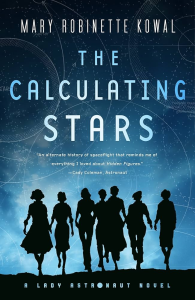
The night is young and you’re so beautiful, can’t we get into the swing of – what was THAT?! The Calculating Stars opens with a rocket scientist and a math genius/former WASP pilot having a romantic night in the mountains, only to witness from afar a fireball embroiling DC. These science-savvy scientists quickly realize it’s not an atomic bomb, though, but a meteorite. They soon learn that DC and the American government have just been snuffed out and the eastern seaboard is completely devastated. It gets worse, though: when Elma begins seeing photography of the strike zone, she realizes that humanity is possibly facing an extinction-level event. The amount of water vapor added to the atmosphere means that, after the dust all settles, Earth will experience runaway greenhouse effect, leading possibly to the oceans themselves boiling away. Looks like it’s time to boldly go where no man or woman has gone before. The Calculating Stars is an alternate history of the push toward the moon, beginning ten years earlier and under far different circumstances. Written with counsel from actual astronauts, it’s a compelling if sometimes irritating story that sticks the landing. At its best, we’re seeing a fun take on the space race, set when computers were people and not machines, where the star is an intelligent and driven woman who becomes an unwitting celebrity in her desire to push the United States into leading humanity’s first real steps into the final frontier. At its worst, we get characters with anachronistic expectations maneuvering in an altered world that doesn’t make sense in some ways, where the promise of the general premise is somewhat wasted in preaching. It’s a fun story, just flawed.
One limitation of the book, I think is that it’s trying to do a lot at once — creating an alt-history world and following it over a few years, engaging in a little science fiction speculation, a lot of critique of 1950s culture from a 21st-century lens, plus the usual plot & character drama that novels need. That is a lot to juggle, especially when the author is more interested in certain elements than others. The core of the story is Elma’s determination that women take part in the space struggle: after all, if Earth is going to create colonies, it’ll need women. and the more quickly they begin establishing their space legs, the better. She meets nothing but total resistance, inspired by everything from basic 1950s culture to personal grudges. She breaks through eventually, in part because she accidentally makes herself into a minor celebrity by appearing as “The Lady Astronaut” on Mr. Wizard, inspiring young girls and older women alike to dream of a future in rockets. Her progress is dogged by an anxiety disorder, though, and when she begins taking a pill to manage it she has to worry if it will invalidate her as an astronaut candidate — and given that one of the key men in the astronaut office despises her for reporting him for sexual molestation during WW2, it could almost certainly be used against her as blackmail. This is the strongest thread in the book, and brings with it the second-most prominent thread, dismissal of 1950s mores by a 21st-century author. This leads to Elma being obsessive about the diversity of the female astronauts chosen, and her becoming angry that none of the seven women who make the cut are black. In a strictly American context, this would be fairly easy to explain: the astronauts had to have so many hours of flight time, and the white WASP-experienced women would overwhelm the pool. Given that the astronaut organization is more international in this, that’s an explanation that falls short, but how much so is hazy because there’s no clear idea as to how much non-American participation there is in the program. There are a few non-Americans who pop up now and again, but it’s a bit like Star Trek peppering its crews with aliens in a token effort at showing the diversity of the Federation. This is connected to the hazy worldbuilding in general: every so often something is mentioned to remind us this is an altered world (“Why are the generals worried? The Soviet Union dissolved”), but the altered world doesn’t really show itself in the story, and some of the mentions are extremely improbable, like the Chinese in the 1950s creating a space program. The Chinese in the 1950s had just recovered from Japanese occupation and civil war and were still trying to create an industrial economy, so that seems unlikely.
Although the historical messiness detracted from my enjoyment of the book, the notes appended afterward make it clear that Kowal was serious about the technical aspects, and I did thoroughly enjoy the story — beginning it at lunch and then reading it nonstop after work. Interestingly, Kowal was aware of the likes of Jackie Cochrane and Jerri Cobb, even though they’re no-shows in the text aside from slightly inspiring the development of two minor characters. I like the premise, appreciated a few of her historical in-jokes, and am on board for the next one despite the over-abundance of space-talk combined with bedroom scenes and rocket puns. I hope she starts developing further and making better use of the premise, though.
Related:
Fighting for Space, Amy Shira Teitel. A history of Jackie Cochrane’s efforts to get NASA to recruit female astronauts in the 1960s. Also see her Breaking the Chains of Gravity, a history of 20th century rocketry and space interest before NASA.
The Lunar Missile Crisis, Bruno & Castle. Alt-history in which humanity is actively creating stations & settlements on the moon.
Fly Girls: How Five Daring Women Defied the Odds and Made Aviation History, Keith O’Brien
Lucifer’s Hammer, Larry Niven. Asteroid apocalypse novel.
WHAT have you finished reading recently? Disaster!, Dan Kurtzman. A re-read for me, a mixed oral/narrative history of the San Francisco earthquake and fire of 1906.
WHAT are you reading now? The Dispossessed, Ursula le Guin. Should finish tomorrow. (I could finish tonight, but Wednesday is a designated movie night with a friend of mine.)
WHAT are you reading next? A 30-page article on COVID and library policies. Oh, for fun? I remembered last night I’d intended for September to have a SF focus (reprising the SF Sweep of last year), so something in that neighborhood. Most likely Becky Chambers’ Long Way to a Small Angry Planet.
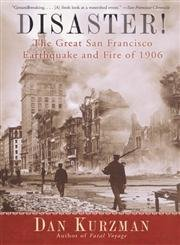
I stumbled upon this title nearly twenty years ago while touring my community college’s library and checking out what it had to offer. I found a couple of titles (Disaster! and Good Life in Hard Times: San Francisco’s Twenties and Thirties) that I enjoyed so much that I later bought my own copies. Recently while contemplating any possibility of inflicting some order on one bookcase, I spotted this and wound up giving it a re-read. It’s a narrative & oral history of the Great San Francisco fire, which destroyed over 80% of the city. The fire began in the immediate aftermath of a significant earthquake, which also compromised the city’s water infrastructure and made it extremely difficult to staunch the flames. The city’s fire chief had been warning against this possibility, but he died from wounds inflicted during the quake and was not able to tell the mayor “I told you so.” The story of the quake, fire, and chaotic week of death and confusion that followed them is told here through the reports of those who witnessed it — a cross-section of humanity that includes newlyweds, a corrupt mayor, a desperate Chinese immigrant, an aspiring banker, and an Italian opera singer who couldn’t believe he escaped the flames of Vesuvius just to wind up in another disaster. On my first reading of this, I absolutely loved the immersion into the world of 1901, and the strange characters living in San Francisco. For me, it was a dive into what living in a 20th century city was like, and the photographs helped. Reading this again as an adult, I was mostly struck by how much death and mayhem was inflicted by the state itself, specifically through the Army troops who were illegally ordered into the city to restore order, but who themselves became agents of chaos. Countless citizens witnessed soldiers looting stores all the while shooting any citizen suspected of doing the same, without even bothering to ask things like “Hey, bub, is this your house?”. The casual shooting quickly escalated so that people were shot for letting their horses drink from open hydrants or ‘refusing’ to join work details and clearing streets. At the same time, the general who had declared his own martial law in the city was also having them blow up block after block, sometimes creating fires in the process or blowing themselves up because they were stumbling drunk at the time. There are “hope spots” in the text — people helping one another across racial lines, opening their homes to those in need — the constant unnecessary death-by-government makes the book increasingly grim. Although I enjoyed this re-read, adult me is more sensitive to the book’s need for editing: the structure could be tighter, and details were sometimes repeated unnecessarily. This is a fairly fast read. There’s a modern book called San Francisco is Burning which I may try to see if contemporary scholarship has added any new insights.
Related:
Disaster 1906: The San Francisco Earthquake and Fire, Edward F. Dolan. Purchased while trying to find this book.
Isaac’s Storm, a history of Galveston being flattened by a tornado.
Disaster by Choice: How Our Actions Turn Natural Hazards into Catatrophes

Well, happy September, folks. There have been a couple of mornings in the past few weeks when the temperature wasn’t already over 90(32) as soon as I walked out the door, so here’s hoping summer’s wrath is abating. Not that it’s really going to cool down: one could call this season CHAOS, given how unpredictable it will be until January. (And even then, it may very well be 70 degrees with tornados, as we learned in 2023!) On the reading front, I enjoyed “Blast II the Past” again, mostly for California Diaries. Progress on my reading challenges was fairly dismal, including SF book bingo, with the exception of Readin’ Dixie.
Favorite Quote/Highlight:
“Your vocation is not your friend. It’s not a consolation for someone you lost once, or even a way of passing the time. It doesn’t care whether you’re happy or sad. You must not betray it, Marge.” (Miss Benson’s Beetle, Rachel Joyce)
Classics Club, The Science Survey, Science Fiction Book Bingo:
…….
Readin’ Dixie
The Dixie Frontier: A Social History, Everett Dick
Historic Pensacola, John Clune & Margo Springfield
The Unreviewed
Family Unfriendly: How Our Culture Makes Having and Raising Kids Much Harder Than it Needs to Be, Timothy Carney. Just finished this one.
New Acquisitions:
Historic Pensacola, which I immediately read.
First into Nagasaki, ditto.
September Plans:
Mm…..give CC, the Survey and SF bingo some love. No themes planned beyond that. I’m going to be visiting Pensacola on the weekend of the 20th!
Literally every movie I watched in August was watched with friends, which I think is a first..
Yojimbo, 1961. A rogue samurai wanders into a town and discovers that it’s divided between two gangs: realizing that a lot of them are guys who need killin’, he plays one side off the other for two hours. Enjoyed this more than Seven Samurai in part because it’s not four hours long and there’s a much smaller cast of characters to keep track of.
Nights on Earth, 1991. Not a film per se, but a collection of five shorts, featuring stories of taxi drivers working in LA, NY, Paris, Rome, and Helsinki. All are very different stories: the only one I didn’t like was Rome, because the driver was absolutely obnoxious and he dumps the body of a priest who he talks to death in his cab. Winona Ryder appears as a young cabbie who is offered an acting gig, but refuses because she finds happiness in driving cabs and working on cars, and has no interest in the limelight. Another Jarmusch for me.
Kansas City, 1996. A small-time hood robs some associate of a gang leader and is subsequently captured and lectured to by Harry Belafonte doing a Marlon Brando impersonation for two hours. Meanwhile, the hood’s girlfriend kidnaps the wife of a crooked politician in hopes that said politician will use his influence to get the gang to let the hood go. It doesn’t end well, but the viewer gets LOTS of nice jazz and pretty ‘30s cars. Really liked Jennifer Leigh’s tough-gal act.
Fast Times at Ridgemont High, 1982. Just a teen drama movie, a bit like Grease but without musical bits. Centered on a high school and a mall. Saw a lot of actors like Sean Penn and Nicholas Cage who would be much bigger later. Jennifer Leigh is a principal character and Boothy from ST TNG is a grumpy teacher who was one of my favorites.
Niagra, 1953. A young couple trying to combine a honeymoon with a business trip run into Marilyn Monroe and her estranged beau, a man who is described as neurotic but who the viewer realizes has a healthy appreciation for MM’s tendency to cheat on him. Beautiful in color: Marilyn Monroe was not an icon for nothin’. I’m more of an Audrey fella, though.
A Clockwork Orange, 1971. Disturbing film about a teenage psychopath who is treated and made to feel revulsed at the thought of violence or lust, but who after his release is continually assaulted by those he offended which (as the movie ends) appears to lead to the mental conditioning failing. If I had known how much sexual violence there was in this, I might not have bothered. It proved quite interesting, but the beginning was….insane.
Before Sunset, 2004. Sequel to Before Sunrise, which had two young people meeting on a train and then deciding to spend an afternoon & evening exploring Prague together. Now they meet again, nine years later. I had my doubts if it was possible to capture that magic again, but the sequel works. It’s not the same magic, but it’s different magic — the experience of two slightly older people meeting again and struggling with their choices and of how they’ve changed over the years, navigating between cynicism and romance and responsibility.
Match Point, 2005. Directed by Woody Allen. A tennis coach (discount Jude Law) falls in with Matthew Goode, his hot fiance Scarlett Johannson, and Goode’s sister what’s-her-face. Discount Jude Law become an item with whats-her-face because DJL rather likes Matthew Goode’s set, but after Goode dumps Scarlett Johannson DJL begins an affair with SJ. Unfortunately for DJL, Scarlett gets knocked up and insists on his doing the right thing, but he’s gotten rather comfortable flying in Matthew Goode’s social circles, so he opts to kill her with a shotgun so she won’t be such a bother. Discount Jude Law, as IMDB revealed to me afterwards, was Johnathan Rhys Myers, who I knew as Bishop Heathmund in VIKINGS. Interesting film…watched it for Scarlett and Goode, mostly. Matthew Crawley’s mother from Downton was also a character. Oh! And Armstrong from Armstrong and Miller was also in it as a bit player. Standard!
First Man, 2018. Interesting biopic about Neil Armstrong and Gemini-Apollo. Visuals and music are stunning: I liked that they restricted the POV to what Armstrong was seeing, and there’s a great shot of him standing alone on the moon, just…..experiencing the moment. A man alone on a lifeless planet, surrounded by the cold blackness of space. Liked the guy who played Deke Slayton (you may remember him as the cretinous FBI agent in Wolf of Wall Street’s boat scene) and the comms were either original recordings or impressive recreations. Character-wise it was stranger: I found it hard to relate to Armstrong and his wife. After the death of their daughter. They were….cold. Even when he comes back from the Moon, they just stare at each othr through the glass. Also found it amusing that different characters would pronounce Gemini differently, so sometimes it was “Jiminiy” and sometimes “Gem-in-I”. The latter is correct, but IRL some astronauts would say Jiminiy, so I liked the nod to historic, if not linguistic, accuracy. Pretty sure I liked the Apollo landing in From the Earth to the Moon better, but that series is one I will NOT SHUT UP ABOUT.
Frankenstein Meets the Space Monster, 1965. Watched this because it has some fun footage of 1965 Cape Canaveral. NASA is prepping for its first mission to Mars and is sending a robot-astronaut who passes for a human. Alas, “Frank’s” rocket is shot by aliens who have arrived on Earth to kidnap its blonde beach babes. Frank is injured in the crash and runs amok a bit while the aliens (some of whom look like space goblins, some of whom appear human) are also going around kidnapping said beach babes. Eventually Frank is fixed and set on the aliens, overcoming their caged-up space monster. Fun vintage footage and music. Definitely worthy of the MST3k treatment.
Fargo, 1996. A shady car salesman who is getting into a bit of trouble concots a nice scheme to solve his problems: hire two criminals to kidnap his wife and demand a ‘ransom’ which he can get from his rich father-in-law. Unfortunately, said criminals are impulsive and violent, leading to a series of murders which are doggedly-investigated by a very chipper and very pregnant Brainerd city sheriff. I was greatly amused to realize that her “Oh, you betcha, yea” is used as the sign-off clip on one of my favorite Youtube Channels (You Betcha!). It was also fun seeing Brainerd, because of my long familiarity with Chuck Marohn, who began as an urban planner in Brainerd before formulating the concept of the Suburban Ponzi Scheme and shifting to a critic of auto-oriented urbanism.
The Triplets of Belleville, 2003. A French animated film about a cyclist who is kidnapped along with two other leading cyclists at the Tour de France, so some French mobster can enslave them in some underworld betting thing. The cyclist’s mother-figure goes in search, encounters three aging singers who used to be a big thing, and….well, things happen. Weird, but interesting. Entirely possible to understand without subtitles. Especially interesting because it begins with Steamboat Willie-type animation before shifting into something far more modern.
Cloverfield. Watched without knowing anything about it, which is probably the best way. A “found footage” film that begins as the innocent documenting of a good-bye party and ends with witnessing a monstrous attack on Manhattan. Gotta wonder how Manhattan audiences reacted to it, only a few years after 9/11. Effective horror-action film save for some implausibilities like the camera’s battery and film lasting for 10+ hours. My second found-footage film (the first being Blair Witch Project).
Short films:
Spring Fever, a 1919 film about love with a lot of physical comedy. Great music.
11, 9, 2001. About a Pakistani family in the wake of 9/11, whose missing son is regarded a terrorist before it’s revealed he died trying to help those in the Towers.
WHAT have you read recently? First into Nagasaki, a memoir of a journalist interviewing Nagasaki survivors and POW survivors. Very dark.
WHAT are you reading now? Just starting The Dispossessed by Ursula le Guin, a buddy read with Cyberkitten. Also still reading Family Unfriendly because I keep getting distracted. Also still technically reading two books on volcanos. (See aforementioned note about distractions.)
WHAT are you reading next? as the Beach Boys said, “God only knows”. Here’s what the Kindle shelf looks like:

Hmm….I used to have a short-hair chihuahua named Hippie that looked exactly like the Yo Quiero Taco Bell dog, and somewhere there is a photo of 8th grade me wearing an embarrassing “Yo Quiero Taco Bell” t-shirt with the dog ON the shirt, while simultaneously holding the dog. This dog used to get under the coffee table, knock his head on the underside of the table, then go roaring at the door because someone had knocked. He had a long-haired son, Charlie, who I had all the way into college. Charlie was much more mellow than his Napoleon-complex father. During COVID I adopted another dog, Idgie, named for Idgie Threadgoode.

In the Tales of the Black Widowers series, every month a group of professionals from different fields meet to dine and talk together, and the host is allowed to bring a guest — who, in payment for his free meal, must submit to a grilling that always begins: Mr. _________, how do you justify your existence? Well, earlier in the week Vera over at Dark Shelf of Wonders participated in a Goodreads TBR cleanup with these rules created by MegaBunnyReads:
- Go to your Goodreads want-to-read shelf.
- Ask Siri to pick a number between 1 and however many books are on the list.
- Go to that book and look at it and the 4 after it, for a total of 5.
- Read the synopses of the books.
- Decide: keep it or should it go?
- Discuss here.
So, I called upon the name of the Bard, and lo! It answered….12. However, being a wicked libertarian, I played with the rules a bit and asked Bard for five random numbers instead of just using 12 and the 4 after it.
#12 Games People Play, Eric Berne. Added December 23, 2011.
We play games all the time–sexual games, marital games, power games with our bosses, and competitive games with our friends. Detailing status contests like “Martini” (I know a better way), to lethal couples combat like “If It Weren’t For You” and “Uproar,” to flirtation favorites like “The Stocking Game” and “Let’s You and Him Fight,” Dr. Berne exposes the secret ploys and unconscious maneuvers that rule our intimate lives.
Keep or cast into outermost darkness? I say keep. We have this at my library and I eye it ever so often. The funny thing is that “Let’s Him and You Fight” is a tactic employed in the Civilization series — getting into war with a foreign power, getting another foreign power to join in, then ducking out and letting the two waste their strength on one another.
#87: On the Road with St. Augustine: A Real-World Spirituality for Restless Hearts
his book shows how Augustine can be a pilgrim guide to a spirituality that meets the complicated world we live in. Augustine, says Smith, is the patron saint of restless hearts–a guide who has been there, asked our questions, and knows our frustrations and failed pursuits. Augustine spent a lifetime searching for his heart’s true home and he can help us find our way. “What makes Augustine a guide worth considering,” says Smith, “is that he knows where home is, where rest can be found, what peace feels like, even if it is sometimes ephemeral and elusive along the way.” Addressing believers and skeptics alike, this book shows how Augustine’s timeless wisdom speaks to the worries and struggles of contemporary life, covering topics such as ambition, sex, friendship, freedom, parenthood, and death. As Smith vividly and colorfully brings Augustine to life for 21st-century readers, he also offers a fresh articulation of Christianity that speaks to our deepest hungers, fears, and hopes.
Ooh! I could pair this with a Confessions re-read.
#154: The Ugly Truth: Inside Facebook’s Battle for Domination
Given that I read a massive history of FB last year (Facebook, Steven Levy), I can see dropping this one, but re-adding it in a few years.
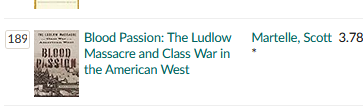
#189: Blood Passion. I think I’d keep this. First heard of Ludlow via Woody Guthrie’s song on it.

#203: Asperger’s Children. Pretty sure I added this during one of my tangent-moods. It’s not something I’d tackle now, but maybe later — a bit like An Ugly Truth.
So, we managed to confirm 3 and…..hem and haw our way on two more. Oh, well.
 (Alabama does catfish and mud-bugs. I will eat mud-bugs (craw-dads) at a social event but the appeal of them baffles me.)
 Reading Freely