Teaser Tuesday (16 November)

Teaser Tuesday time!

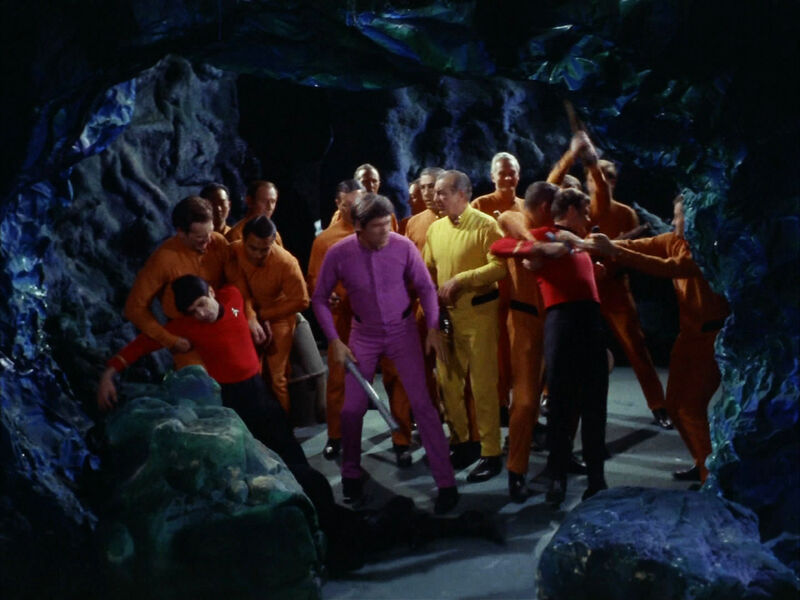
“You are only the first of the androids I plan to manufacture. It will take a large number of us to carry out Doctor Korby’s plan.”

 KIRK laughed. Derisively, Brown thought.

“One of me is enough,” he said. 

Page six, Double, Double by Michael Jan Friedman.

Historians like a quiet life, and usually they get it. For the most part, history moves at a deliberative pace, working its changes subtly and incrementally. Nations and their institutions harden into shape or crumble away like sediment carried by the flow of a sluggish river. English history in particularly seems the work of a temperate community, seldom shaken by convulsions. But there are moments when history is unsubtle; when change arrives in a violent rush, decisive, bloody, traumatic; as a truck-load of trouble, wiping out everything that gives a culture its bearings — custom, language, law, loyalty.  1066 was one of those moments.

p. 66, A History of Britain: At the Edge of the World?, Simon Schama

A note to my regular visitors: last week I was taken ill with an extended sinus infection that kept me from reading, but I’m finally recovering and read more today than I have in the past five days put together.

Posted in General | Tagged | 5 Comments

Booking through Thursday: War Stories

Booking through Thursday asksIt is November 11th, known here in the U.S. as Veteran’s Day, formerly Armistice Day to remember the end of WWI but expanded to honor all veterans who have fought for their country, so …do you read war stories? Fictional ones? Histories?

Being male in the United States,  I am expected to be interested in war,  and so I can easily answer ‘yes’ to both. The first history books I read outside the classroom were military histories of the world wars and the American Civil War: Albert Marrin’s The Airman’s War remains my favorite book from this period, and it is the reason why every history professor I sit under at my university will at some point read a paper on aerial warfare in the Great War. Additionally, for all of high school and junior college, ‘historical fiction’ meant ‘military fiction’, chiefly Michael and Jeff Shaara’s novels set during the major American wars.

As I grew older, I developed more of an interest in cultural, political, and social history than military matters. I wanted to understand how and why societies changed through time, being particularly fascinated by the growth of modern cities during the industrial period. I began to see war as a consequence of other parts of history, or as a means to effect economic or other gains. Consequently I grew cynical about war, disinterested in reading about it as anything other than a pestilence and hesitant to read fiction that glorified or sanctioned it.

My studies of the Great War in particular moved me toward pacifism, and while I grudgingly accept the idea of self-defense, I believe violence deforms people and society. I still read military history, but now I read soldiers’ accounts, for I want to understand what their lives are like: I want to know what motivates them, particularly to understand why they would surrender any part of themselves to the state.  Though I tend to read ‘around’ military or combat sections in historical novels, I still read some novels that are expressly about combat — typically because the setting of the book is fascinating. This year, for instance, I’ve read the Hornblower books set during the Napoleonic Wars and am apparently starting in on Bernard Cornwell’s medieval fiction.

And for all my moralizing against war, I cannot deny a certain fascination with combat. Perhaps it’s my primal instincts surfacing — those instincts which feel somewhat out of place in a civilized world, and can appreciate the ‘struggle for existence’  that war seems to emulate. Unfortunately for those instincts, they are out of place in modern warfare as well — for if reading the memoirs of soldiers from the two world wars has taught me anything, it is that defeat and victory in war for the common soldier have more to do with luck than skill.

Notable books:

  • The Airman’s War, Albert Marrin
  • Once an Eagle, Anton Myrer
  • With the Old Breed, Eugene Sledge
  • All Quiet on the Western Front Erich Maria Remarque
  • Homage to Catalonia, George Orwell
  • Marine Combat Correspondent,  Samuel E. Stavisky
  • The Influence of Airpower Upon History, Walter J. Boyne
  • The Killer Angels, Michael Shaara.
Posted in General | Tagged | 7 Comments

This Week at the Library (3 November – 10 November)

This past week I tried planning my reading around English culture, but unfinished business with Jules Verne and the inability to resist a history of modernization in the Islamic world meant I only read two of the three English-themed books I’d planned to read. I did make progress in Schama’s history of Britain, but gave most of my attention to trying to finish The 70 Great Mysteries of the Natural World. I didn’t finish that, but I did make more progress than I have in four weeks. (The trick was skipping the section on how various forces in the earth’s core create a magnetic field and going to the first section that interested me, then reading from there). Now I just have ten or so sections in the middle to finish, but I had to return the book to the library today and will tend to that unfinished business next week.

Next Week’s potentials…

  • I’ll be finishing Schama’s history of Britain (to 1600).
  • The Confessions, St. Augustine; as per a friend’s request.
  • The Last Kingdom, Bernard Cornwell; a tale of Vikings and King Alfred.
  • Mapping Human History: Discovering the Past Through Our Genes, Steve Olson
  • Frank: the Voice, James Kaplan. FRANKIEEEE!  Readers who know me personally know of my fondness for Frank Sinatra, and I use an icon of him everywhere online except for here (where I use Robert Ingersoll). The icon is cropped from a poster I have hanging on my bedroom door, where he stares across the room at another poster of the Beatles crossing Abbey Road.  This was just released at the start of the month.


Posted in Reviews | Tagged | Leave a comment

Heretic

Heretic
© 2003 Bernard Cornwell
355 pages

The year is 1347, and the English armies of Edward III are prevailing in France, having invaded to protect old Norman lands and capture new ones like the new port-city of Calais. The Hundred Years’ War is ten years old, and as the Black Death works its way up the French coast, truce is in the air. The peace is not so firm that the English can’t get away with the odd raid, though, which is why Thomas Hookton — bastard son of a priest and a master of the longbow — has been sent by his master the Earl of Northampton to seize an old family territory in southern France. The goal is not the castle or the surrounding county, but the most precious relic in Christian legends, the Holy Grail. It was rumored by Hookton’s father to last rest in the castle, and the Earl believes it still lies there or nearby. Finding the Grail would be a propaganda boon to the English, especially in times of pestilence, and so Hookton and his men — a few knights, supported by men-at-arms and longbowmen —  launch a daring attack against the castle. They aren’t alone in seeking the grail, for Thomas’ homicidally zealous cousin  and his French kinsmen also want to find the Grail — and they’re willing to forge a new one if need be. Thomas is alone, deep in enemy territory and surrounded by raiders, ambitious nobles, and corrupt priests — and after he is excommunicated for saving the life of a young woman condemned to burn to death for violating  orthodoxy,  even his friends turn against him.

Heretic is the first bit of medieval fiction I’ve ever read, though I’ve long been tempted to try any of Cecelia Holland’s various novels. I’ve read Cornwell before, in Sharpe’s Eagle, and enjoyed him — but this book is first-rate. I have read few historical novels that drew me into their environment like this; I could feel the cold rain constantly drizzling, smell the damp hay, hear the constant flurry of arrows and clang of swords against armor while in the distance, a cannon named the Hell Spitter booms with intermittent fury. Hookton is both authentic and likable,  and travels through a land rich in details.This book is apparently part of a trilogy (my copy doesn’t have the red bar atop it advertising it as such), but the book has enough subtle background information in it to stand alone. I had no idea how the book would end, particularly in regards to the grail, and as soon as I thought I knew Cornwell’s angle he changed tacks.

Easy recommendation to historical literature readers with an interest in the medieval period: I’ll definitely be reading more Cornwell.

Posted in historical fiction, Reviews | Tagged , , , , , | 2 Comments

The Prisoner of Azkaban (Audio)

Harry Potter and the Prisoner of Azkaban

10 discs, approximately 12 hours.
© 2000 J.K. Rowling, Listening Library
Performed  by Jim Dale

Last week I finished listening to my first audiobook, Harry Potter and the Chamber of Secrets. I don’t know why I started with book two instead of book one, but I did and that’s that. I enjoyed the experience well enough to try listening to the next book in the series, and I am even more impressed. Prisoner of Azkaban is one of my two favorites from the Potter series (the other being The Half-Bood Prince), and as I listened I enjoyed all the little things that add up to a wholly pleasant experience: the friendship between Harry, Hermione, and Ron; the concern their teachers have for them, the coziness and adventure of another year living and studying at Hogwarts among friends; the abounding humor; and the excitement of a Quidditch match. In Azkaban Harry learns more about his parents’ demise when the man convicted for betraying them, Sirius Black, escapes with the apparent goal of killing Harry to please Voldemort. Professor Snape’s background is also explored in more detail, and we begin to see him as a bitter and abused man who is capable of commanding both sympathy and disgust. Dale’s performance here — and it is a performance, not just a reading — is better than the last, with practically no sentences being read without what I thought was their appropriate emotional context,  and the numerous characters allow Dale to show off his range of voices. Peter Pettigrew is an outright triumph for the narrator, I think.

Last week I mentioned that as much as I enjoyed the performance, I couldn’t see paying so much for audio books. They’re beginning to grow on me, though, and if I saw a good used price on Amazon I think I’d buy a set of CDs for my listening pleasure. The books are so lovely as a reading experience, but the experience only lasts a few hours — and is shorter still with the movies. Listening to the CDs allows for prolonged enjoyment of the story, and when Dale ended the presentation by thanking me for listening, I wanted to immediately start playing another CD. I will be continuing in this audio experience, no doubt!  Very much recommended.

Posted in Reviews | Tagged , | 5 Comments

Teaser Tuesday (9 November)

This Tuesday Teaser is brought to you by the Hundred Years’ War (and Should Be Reading).

He shot without thinking. Without aiming. This was his life, his skill, and his pride. Take one bow, taller than a man, made from yew, and use it to send arrows of ash, tipped with goose feathers and armed with a bodkin point. Because the great bow was drawn to the ear it was no use trying to aim with the eye. It was years of practice that let a man know where his arrows would go and Thomas was shooting them at a frantic pace, one arrow every three or four heartbeats, and the white feathers slashed across the marsh and the long steel tips drove through mail and leather into French bellies, chests, and thighs.

p. 16, Heretic. Bernard Cornwell.

“Why would the people need a priest when God is everywhere?”

“To keep us from error,” Thomas said.

“And who defines the error?” Genevieve persisted. “The priests!”

(184, the same.)

Posted in General | Tagged | 9 Comments

20,000 Leagues Under the Sea

20,000 Leagues Under the Sea
© 1870 Jules Verne
382 pages

 Scarcely a year after the end of the American Civil War, Professor Pierre Aronnax of the Museum of Natural History in Paris is  preparing to return to his native France following the conclusion of some research when he learns that the  Abraham Lincoln, a fast frigate, is about to set forth on a mission to track down and destroy a mysterious sea monster that has been plaguing seagoing traffic for several months. Aronnax — author of several books on the life of the oceans — sees the mission as the opportunity to identify and study the fascinating creature, which he believes must be a narwhal of some previous unknown type.  This perception changes when the Abraham Lincoln discovers the beast to be made of iron:  Aronnax’s narwhal is a submarine!  The frigate is swiftly destroyed, but Aronnax, his servant, and a Canadian fisherman find refuge aboard the strange machine. The captain of this vessel, a nationless eccentric billionaire who identifies himself as ‘Nemo’, informs them that although he will extend to them every courtesy of a guest, no one who boards his Nautilus is permitted to leave. Professor Aronnax is thus given the opportunity to study the world’s oceans up close and in an unbelievable vessel.
So begins an adventure at sea and a fascinating bit of science fiction. As Nemo and Aronnax sail through the world’s seas, they explore underwater forests and submerged volcanoes and fight off creatures of the deep — all of which are described in great detail. When I first read a children’s version of this book, the Nautilus seemed to me a version of the Enterprise, underwater. It had a museum, a library, and at least one viewing gallery in which the crew and (accidental) passengers were separated from the ocean depths and all the wonder they contained by a few inches of glass. As an adult, I find the book all the more fascinating given its time. Nemo’s machine needs to surface every five days to replenish its air tanks, but otherwise gains all it needs from the sea itself. It moves at fifty knots, which far surpasses the first US nuclear-powered submarine (the USS Nautilus), and other modern ships, like the USS Abraham Lincoln and even  destroyers like the USS Bainbridge.  Verne’s imagination is astounding: the submarines of his days were primitive things, mostly wooden and useful only for drowning their crews.  What powers this amazing ship is Electricity. I took this for granted, but Aronnax is infatuated by the idea — and well he should be, for the electric dynamos of 1866-1870 were hardly worthy of the name. Not for another decade or two would electricity begin to used in lighting and electric motors. To Verne, electricity is a thing of the future, and its capacity is boundless. It is the source of infinite energy, and he uses it as energetically as Isaac Asimov used ‘atomic energy’ in the Foundation series. 
20,000 Leagues incorporates more science and technical explanation than any other science book I’ve yet read, and I can only imagine how riveted 1870’s audiences were by his explanations of the Nautilius’ electric engine, and his descriptions of what the waters of Earth contain and might contain. I kept wanting to put the book down and watch David Attenborough’s Blue Planet, so catching was Aronnax’s joy at seeing whales, kelp forests, coral reefs,  underwater tunnels through the earth, lost ships and sunken cities.  Leagues isn’t quite as readable as Around the World in 80 Days, and I don’t quite know why. The abundance of scientific and technical descriptions contributes, but the translator approached the book knowing it was known for troublesome translations and so I must assume he would have earnest on making the book readable.  Even so, there are some odd turns of phrase: at one point, Ned Land laughs while moving his jaws up and down ‘very significantly’.  I think this was because he was teasing someone about eating him. (The characters’ conversations about cannibalism were some of the more humorous passages of the book, in part because they read so strangely.)
20,000 Leagues under the Sea deserves to be read again and again, combining natural wonder with the story of a mysterious man who built a superior machine. While story is interesting of itself, considering its optimism and Verne’s imagination in historical context made it most impressive. His Nautilus is a superior construct of the mind, making today’s cramped vessels still seem primitive by comparison. 
Posted in Reviews, science fiction | Tagged , , , , , , , | 3 Comments

A Singular Destiny

Star Trek: A Singular Destiny

© 2009 Keith R.A. Decandido
384 pages
Only days have passed since the culmination of Destiny. The Federation and the Klingon empire, still licking their wounds from the Dominion War, have been ravaged: billions are dead, and large portions of both their fleets are destroyed or remain only as shattered hulks. Although other powers contributed ships to the Battle of the Azure Nebula,  the Borg’s collective wrath (ho, ho) targeted the longtime allies. Now, overwhelmed by refugees and the detritus of war, both the Klingon chancellor and the Federation president are working overtime with too few ships to maintain a semblance of civilization.
Unlike most Star Trek books, A Singular Destiny focuses on civilians — the Federation president, a university professor who moonlights as an diplomat, and the supervisor of a civilian mining operation. (Most civilians seen in the Star Trek and TNG shows wear strange uniforms, run science and mining posts in the middle of nowhere, and show up only when their planet or their sun is about to be destroyed in some way.) Starfleet isn’t absent from the book, as Captain Ezri Dax and the Aventine’s efforts tie the book’s various subplots together to reveal that in the wake of the Federation and Klingon defeats, other minor nations are attempting to take advantage of the power vacuum…and the result will change Alpha-Beta quadrant politics forever.
Singular Destiny ties together the now-laid-to-rest Borg-themed TNG relaunch and the next generation of Relaunch books. In essence, it’s a light political mystery in which professor/diplomat Sonek Pran sees a pattern emerging from various incidents — mine explosions, diplomatic snubs, and trouble for the Klingon Empire after a border polity declares war on them and uses ships sporting Breen disruptor’s and Romulan shields. DeCandido works Destiny into the overall continuity nicely: before sending the Aventine to Romulus,   we get a neat recap of the civil conflict and secession that resulted from the death of Shinzon: there are now two Romulan factions, the old Star Empire under Shinzon’s co-conspirator, and the new Imperial Romulan State under Donatra, the captain who assisted Picard at the end of Nemesis.   DeCandido uses letters, memos, casualty reports, and news service articles to tell the story of the week following Destiny, and works subtle references to other Trek books into them. The casulty lists mention two people who are officially dead but who aren’t really, referencing the events of Kirsten Beyer’s Full Circle and Unworthy
A Singular Destiny was…good, though it pales beside Destiny, Full Circle, and Greater than the Sum. I knew the grand revelation beforehand, which may have spoiled my reading. The author is one of the regulars in the Relaunch series, though, so I expect I’ll read more of him sooner or later. I wonder if we’ll be seeing more of Pran, his…fascinating Bajoran/Vulcan/Betazoid/human character who has pointed ears, a Bajoran nose, a Vulcan’s philosophical disposition, and a human kind of folksiness — complete with slang and a banjo. According to DeCandido’s annotations, he’s based on Arlo Guthrie.

On a minor note, I was amused and pleased to see that Doctors without Borders is around in the 24th century. 

Related:
Posted in Reviews | Tagged , , | Leave a comment

The Mother Tongue

The Mother Tongue: English & How It Got That Way
© 1990 Bill Bryson
270 pages

“More than 350 million people around the world speak English and the rest, it sometimes seem, try to.”
While I’m reading this as part of a general English-culture theme this week, I would have inevitably picked it up at some point:  language has fascinated me since high school, and I’m forever writing down words and turns of phrase in my journal to look up their derivations at a later point. I know Bill Bryson only through A Short History of Nearly Everything, which I remember favorably even if I don’t recall too much about its contents, having read it perhaps five years ago. 
Although I anticipated The Mother Tongue being a history of the English language, it’s more than that. Bryson begins with the development of speech and evolution of languages before moving swiftly to Europe to describe the various German, French, Viking, and  Celtic histories that coalesced in the British isles to give rise to a genuine world language,  English. After this initial history, he dedicates separate chapters to the development of words, accents, pronunciations, spelling habits, grammar, names, profanity, and wordplay before tracking English’s spread as a world language and contemplating on its future.  
Bryson is an entertaining author, providing humor in bounds. The book only suffers once or twice from long paragraphs of examples, these being exceptions to the general rule of readability. Bryson’s information paints a picture of English changing through the ages detailed enough to provide surprises to even a word-nerd like me. I expected that irregularities in spelling would be ironed out by the introduction of the printing press, but I was not aware that many of English’s  Latin spellings (in debt and doubt, for instance) were imposed long after the language came into its own by those who wished to ennoble English — to root it in the old classical tongues and make it something other than ‘vulgar’.  Various attempts have been made to make English orthodox, but nothing appears to stop it from steadily growing and assimilating other languages. The Mother Tongue reveals English to have a long, storied history, one that has given its current versatility and humorous contradictions. I’ recommend it if you are at all interested in the subject proper, etymology, or Bill Bryon’s work in general. 
Related:

Posted in history, Reviews | Tagged , , , | 2 Comments

What Went Wrong?

What Went Wrong? Western Impact and Middle-Eastern Response
© 2003 Bernard Lewis
180 pages (adopted from lectures)

In essence, this collection of modified lectures is a brief history of modernization in the Islamic world and its aftermath. The fist three chapters focus on the Ottoman Empire’s attempts to modernize in the light of its military defeats at the hands of presumed barbarians, but Lewis moves to the Islamic world as a whole in the latter half of the book. Initial attempts to modernize were limited to military arms and techniques, though later the Ottomans and other powers attempted to build western-style economies with little real success; exports remain limited to chiefly oil outside of Turkey, and according to Lewis,  Iranian and Arab businessmen prefer to invest their money in the west or in Asia.

Beyond the historical aspect, Lewis’ work is at its most useful when explaining the disconnects between the ways the western world and Islam have approached ideas of tolerance, freedom, and human rights.  It’s not as if these things don’t exist in Islam,  Lewis explains, but they’re approached from different ways. Freedom means freedom from incompetent or abusive rulers; human rights is what is ‘divinely-sanctioned’.  Lewis also explains that Islam historically has lacked both an organized church and thus a distinction between matters of religion and matters of state.

Despite nearly a century of attempting to catch up, Lewis believes the Islamic world continues to fall behind: now it is no longer following behind the west, but being lapped by it and post-colonial or rebuilding powers in Asia. He describes this as a lack of answering the right questions: for too long,  Muslims concerned about their regress have asked ‘who did this to us’ and not ‘how can we set ourselves right’.  Lewis doesn’t go into any amount of detail explaining what leads to terrorism, only why the Islamic world has so far failed to utilize and benefit from modernity in the same way as Japan and similar cultures. He is not optimistic about the future of Iran and similar nations, believing them to be locked into a negative cycle of self-pity and lashing out at threatening foreigners.

Not as thorough as I would’ve liked, but I was expecting more emphasis on modernization and its influence on terrorism. What Went Wrong is suitable for  brief history of Turkish modernization and an explanation of intercultural tensions between the West and Islam.

Related:

Posted in history, Reviews | Tagged , , , , | Leave a comment