This Week at the Library (10-24 November)

Week before last I fell ill with a sinus infection the day after going to the library, and I didn’t read a thing for nearly a week. Last week’s reading was all carryover. Frank by James Kaplan and The Last Kingdom by Bernard Cornwell made for lively reading, which I needed given that I was and still am working through Augustine’s Confessions.  He’s a very somber fellow. I also read most of Mapping Human History, which I’ll finish shortly, and the first Titan novel which was good fun. Selected passages from the week’s reading will follow…

Next week’s potentials:

  • Mapping Human History by Steve Olson, which I’m almost done with. Interesting mix of anthropological history and genetics.
  • The Confessions, Augustine of Hippo. He’s been a very bad boy.
  • The Naked Lady Who Stood on Her Head, Gary Small. (I’m almost tempted to leave you with that, but it has more in common with The Man Who Mistook His Wife for a Hat than Playboy: The Calisthenics Issue.
  • The Pale Horseman, Bernard Cornwell. Sequel to the Last Kingdom. Looking forward to more Norse heartiness.
  • The Eye of the World, Robert Jordan. A couple of friends recommended this to me. One of them even begged.
  • The Earth Shall Weep: A History of Native America, James Wilson I wanted to read some history this week, and badly, but I couldn’t find anything compelling. This one did attract my attention three times while browsing, though.

Selected Passages & Quotations:

Henry dispensed his famous, breezy charm rather like the English weather, in sunny intervals alternating with long, cloudy spells and sudden bursts of thunder. The charm was of the rib-poking ,back-slapping, arm-around-the-shoulder, punch-in-the-belly kind, which, depending on the mood of the week, could betoken either rapid promotion or imminent arrest. Henry wallowed in the praise droolingly lavished on him by his courtiers and foreign ambassadors: Henry the gallant, Henry the clever, Henry the nimble, Henry the superstar, He was the only king with his personal band, hired to go touring with him and featuring the eighteen-year-old as lead singer-songwriters. 

(History of Britain, Simon Schama)

Afterward Bacon congratulated Harry James on his new boy singer. “Not so loud,” James replied. “The kid’s name is Sinatra. He considers himself the greatest vocalist in the business. Get that! No one ever heard of him. He’s never had a hit record. He looks like a wet rag. But he says he is the greatest. If he hears you compliment him, he’ll demand a raise tonight.”

 (p. 78, Frank: the Voice, James Kaplan)

“Just call out the tunes,” [Dorsey] told Sinatra, “and Joey will play `em for you.”

This went fine for three or four numbers, Bushkin said — until Sinatra turned around and said, ‘Smoke Gets In Your Eyes”. The lovely Kern-Harbach tune has a notoriously tricky middle section, a chord modulation that looks great on paper but can be hell to pull from memory. Under pressure, Bushkin simply blanked. “Next thing I know, Frank was out there singing it all by himself…a capella. I was so embarrassed. I mean, Jesus, all the guys were looking at me, so I just turned around and walked away from the piano!”

The cream of New York society — gents in dinner jackets, dames in gowns; a few hundred fancy prom kids, all dressed to the nines — stood hushed, craning their necks to see, while the skinny boy with the greasy hair filled the big room with song, all by himself.

“And that is the night,” Joe Bushkin said, “that Frank Sinatra happened.”

(p. 111, Frank)

And Frank Sinatra had one more astounding thing at twenty-three: a plan. He was going to knock over Crosby. He knew it in the pit of his gut. Not even Nancy knew the true height of his hubris. 

(Frank)

Posted in Reviews | Tagged | Leave a comment

The 100 Book Challenge

There is an interesting note going around in which people claim the BBC believes people have only read six of the below books. This is probably not true, for there is no mention the book list on the BBC website, and  the list itself suffered from poor editing: The Complete Works of Shakespeare is mentioned, but so is Hamlet; The Lion, the Witch, and the Wardrobe is present, but made redundant by The Chronicles of Narnia
Instructions: Copy this if you would like to play. Bold those books which you’ve read completely.  Italicize those which you start but  did not finish.  
 ————————————————–
1. Pride and Prejudice – Jane Austen 
2. The Lord of the Rings – JRR Tolkien
3. Jane Eyre – Charlotte Bronte
4. Harry Potter series – JK Rowling 
5. To Kill a Mockingbird – Harper Lee 
6. The Bible
7. Wuthering Heights – Emily Bronte
8. Nineteen Eighty Four – George Orwell 
9. His Dark Materials – Philip Pullman
10. Great Expectations – Charles Dickens 
11. Little Women – Louisa M Alcott
12. Tess of the D’Urbervilles – Thomas Hardy  
13. Catch 22 – Joseph Heller
14. Complete Works of Shakespeare
15. Rebecca – Daphne Du Maurier
16. The Hobbit – JRR Tolkien
17. Birdsong – Sebastian Faulk 
18. Catcher in the Rye – JD Salinger 
19. The Time Traveler’s Wife – Audrey Niffenegger
20. Middlemarch – George Eliot 
21. Gone With The Wind – Margaret Mitchell
22. The Great Gatsby – F Scott Fitzgerald 
23. Bleak House – Charles Dickens 
24. War and Peace – Leo Tolstoy 
25. The Hitch Hiker’s Guide to the Galaxy – Douglas Adams 
26. Brideshead Revisited – Evelyn Waugh
27. Crime and Punishment – Fyodor Dostoyevsky 
28. Grapes of Wrath – John Steinbeck 
29. Alice in Wonderland – Lewis Carroll 
30. The Wind in the Willows – Kenneth Grahame
31. Anna Karenina – Leo Tolstoy
32. David Copperfield – Charles Dickens
33. Chronicles of Narnia – CS Lewis 
34. Emma -Jane Austen
35. Persuasion – Jane Austen
36. The Lion, The Witch and the Wardrobe – CS Lewis 
37. The Kite Runner – Khaled Hosseini 
38. Captain Corelli’s Mandolin – Louis De Bernieres
39. Memoirs of a Geisha – Arthur Golden 
40. Winnie the Pooh – A.A. Milne
41. Animal Farm – George Orwell 
42. The Da Vinci Code – Dan Brown 
43. One Hundred Years of Solitude – Gabriel Garcia Marquez
44. A Prayer for Owen Meaney – John Irving
45. The Woman in White – Wilkie Collins 
46. Anne of Green Gables – LM Montgomery 
47. Far From The Madding Crowd – Thomas Hardy
48. The Handmaid’s Tale – Margaret Atwood
49. Lord of the Flies – William Golding
50. Atonement – Ian McEwan
51. Life of Pi – Yann Martel 
52. Dune – Frank Herbert
53. Cold Comfort Farm – Stella Gibbons
54. Sense and Sensibility – Jane Austen 
55. A Suitable Boy – Vikram Seth
56. The Shadow of the Wind – Carlos Ruiz Zafon
57. A Tale Of Two Cities – Charles Dickens
58. Brave New World – Aldous Huxley
59. The Curious Incident of the Dog in the Night-time – Mark Haddon
 60. Love In The Time Of Cholera – Gabriel Garcia Marquez 
61. Of Mice and Men – John Steinbeck
62. Lolita – Vladimir Nabokov
63. The Secret History – Donna Tartt 
64. The Lovely Bones – Alice Sebold 
65. Count of Monte Cristo – Alexandre Dumas
66. On The Road – Jack Kerouac 
67. Jude the Obscure – Thomas Hardy
68. Bridget Jones’s Diary – Helen Fielding
69.Midnight’s Children – Salman Rushdie
70. Moby Dick – Herman Melville
71. Oliver Twist – Charles Dickens
72. Dracula – Bram Stoker
73. The Secret Garden – Frances Hodgson Burnett
74. Notes From A Small Island – Bill Bryson 
75. Ulysses – James Joyce
76.The Inferno – Dante
77. Swallows and Amazons – Arthur Ransome
78. Germinal – Emile Zola
79. Vanity Fair – William Makepeace Thackeray
80. Possession – AS Byatt
81. A Christmas Carol – Charles Dickens
 82. Cloud Atlas – David Mitchell 
83. The Color Purple – Alice Walker 
84. The Remains of the Day – Kazuo Ishiguro
85. Madame Bovary – Gustave Flaubert
86. A Fine Balance – Rohinton Mistry
87. Charlotte’s Web – E.B. White
88. The Five People You Meet In Heaven – Mitch Albom 
89. Adventures of Sherlock Holmes – Sir Arthur Conan Doyle
90. The Faraway Tree Collection – Enid Blyton
91. Heart of Darkness – Joseph Conrad
92. The Little Prince – Antoine De Saint-Exupery
93. The Wasp Factory – Iain Banks 
94. Watership Down – Richard Adams 
95. A Confederacy of Dunces – John Kennedy Toole
96. A Town Like Alice – Nevil Shute 
97. The Three Musketeers – Alexandre Dumas
98. Hamlet – William Shakespeare
99. Charlie and the Chocolate Factory – Roald Dahl
100. Les Miserables – Victor Hugo
Posted in General | Tagged | 1 Comment

Teaser Tuesday (23 November)

Tis Teaser Tuesday time!

Feeling the words, and remembering how Billie could tell you her whole life story in the glide of a note, Frank began to sing the lyrics as if he really meant them, and something happened.

The girls, dancing with their dates, began to stop mid-step and stare at him.

p.59, Frank: the Voice. James Kaplan

“Jack, we’re in trouble,” Sinatra said.

It was his one phone call. He and Ava were in the Indio police station, feeling much soberer than they had an hour before, when, whooping and hollering, they had both emptied their pistols, then reloaded and emptied them again, shattering streetlights and several store windows. Then there was the town’s single unfortunate passerby, drunk as the shooters, whose shirtfront and belly had been creased by an errant .38 slug.

p. 374, Frank: the Voice.

Posted in General | Tagged | 4 Comments

Top Ten Holiday Books

Ten books to read for the holidays? Well! I don’t know ten Christmas-themed books, so I’ll also tack on a few books I may read during the next month.

1. A Christmas Carol, Charles Dickens

RUN, WESLEY!


This story is one of my very favorites. I watch the Patrick Stewart version every year (several times) and last year read the novella for the first time. I plan to do so this year and every year hereafter.

2. Skipping Christmas, John Grisham

Luther Krank is starting to believe this whole Christmas thing is one big racket. Why on earth should he spent thousands of dollars on banal gifts and parties, or put himself through hours of stress decorating and throwing said parties, for the sake of a single day? Shouldn’t he enjoy the season? And so Luther Krank blows seasonal madness a raspberry,  arranges to go on a cruise, and happily spends November and December working on his tan and preparing himself to look good in a speedo while his neighbors fume. And it almost works…until the phone rings.

3. The Stupidest Angel: A Heartwarming Tale of Christmas Terror,  Christopher Moore.

Moore wrote Lamb and A Dirty Job, both of which were riots, so I’m expecting good things.

4.  Santa & Pete: A Novel of Christmas Present and Past, Christopher Moore.

Didn’t know this was even in the library. Maybe I’ll read it. I have no idea what it is about, but as mentioned prior I like Moore.

5. Dress Your Family in Corduroy and Denim, David Sedaris

Sedaris’ essay collections are always good for a laugh, but this book contains a section (“Six to Eight Black Men”) about Christmas in the Netherlands which is seasonally appropriate and hilarious of course. Listen to him read it here. (“Wait, St. Nicholas would kick you?”)

6. Holidays on Ice, David Sedaris

Home of the SantaLand diaries!

7. The Grand Design, Stephen Hawkings

Science is awesome.

8. The Kobayashi Maru and The Romulan War: Beneath Raptor’s Wings by Martin & Mangels

I’ve had these for going on a month now, but I’m still waiting on another before starting in.

9. The Age of Faith, Will Durant

I have fallen right off the Story of Civilization treadmill, but I aim to get back on.

10. Typhon Pact: Zero Sum Game, David Mack

I did it! I said I’d catch up with the Relaunch books this year, and here I am planning to read a book released just in October.

Honorable mentions: Isaac Asimov’s Christmas and his Twelve Frights of Christmas. These are not by him, but edited. I’ve never read them, but I found their book covers when googling for a picture of him dressed as Santa Claus.

(I was, alas! Unsuccessful.)

Posted in General | Tagged , | 9 Comments

Frank: The Voice

Frank: The Voice
© 2010 James Kaplan
786 pages

“I’ve been a puppet, a pauper, a pirate, a poet… a pawn and a king,  I’ve been up and down and over and out, and I know one thing — each time I find myself layin’ flat on my face, I just pick! myself! up! and get back in the race! (From the tune that made me love him, “That’s Life“)

All my life, I’ve known who Frank Sinatra was. He died in 1998 and I saw him on television — he wore a tuxedo and sang, and everyone called him “Ol’ Blue Eyes”.  When Deep Space Nine introduce the character Vic Fontaine — a 1960s lounge singer who sang Sinatra standards — I realized I really liked the music Vic sang. I ddn’t know what it was called — swing? — but I knew I liked it and I knew Frank Sinatra was famous for it. So in 2004 I bought “The Very Good Years”, Sinatra’s reprise collections, and I’ve been wild for his music ever since. So naturally, when I saw Frank grinning at me from the library’s new books section, I checked the book out immediately.

In my obsession with Sinatra, I’ve read more than a fair few biographies of Frank, and there are none more thorough than this. Frank isn’t a complete biography, but covers his meteoric rise, fall (“Icarus”) and resurgence (“Phoenix”), culminating in his Academy Award for Best Supporting Actor in 1953. Kaplan’s website refers to this as the ‘first’ volume in his biography of Sinatra. If it’s anything like this, I’ll be reading it. Drawing from numerous biographies (Frank’s, Ava Gardener’s, and others) as well as official new sources,  Kaplan paints a picture of Sinatra as a scrappy kid from Hoboken who, driven by a domineering mother and his own staggering ambition, clawed his way to national prominence through determination and a gift for making music.  Regardless of what else you might say about him, says Kaplan, Sinatra was an artist dedicated to the craft of sharing music. He poured himself into the songs, performing them rather than singing them — and this earnestness, combined with his fixation on greatness and a gift for making the right friends,  sent him to the top.

Sinatra’s sudden decline and fall in the late forties and early fifties is usually panned in other biographies I’ve read: his voice cracked and his career tumbled downhill as mysteriously as he rocketed up the first time, they say. Kaplan sees it as a change in the public mood following the conclusion of World War 2. No one wanted to hear Sinatra artfully yearning — they wanted gaiety and novelty numbers, and Sinatra’s cockiness — chasing women though he was married,  unrepentant partying, and occasional fisticuffs with the press — lost him the adoration of a nation. If he wanted it back, he’d have to work for it — and that he did.  I’ve never read a biography with so much attention on Sinatra’s decline, fall, and triumph, and for that reason alone I’d recommend this to Sinatra fans. This book is more on Sinatra the man than Sinatra the legend,  and he has his virtues as well as his vices. Kaplan describes Sinatra a man full of feeling: when that feeling was released into his music, he was majestic — but terrible when he released his feeling by chasing women or punching aggressive photographers.

Would this book have made me a fan of Sinatra if I just heard the man’s music today? I’d still be impressed by his strength of will, that never-giving-up attitude that pushed him through advertising, the spirit I heard in “That’s Life!”. I probably wouldn’t so keen on the skirt-chasing and arrogance borne of success, but it seems from the biography that the ‘Icarus’ years gave him some degree of humility. He matures with age and exits with grace. I look forward to Kaplan’s furthering the story — the best is yet to come.

Related:

  • Eight-page excerpt, Vanity Fair
  • Mr. S: My Life with Frank Sinatra, George Jacobs
  • The Way You Wear Your Hat: Frank Sinatra and the Lost Art of Livin’, Bill Zehme
  • Frank Sinatra: an American Legend, Nancy Sinatra
  • Frank Sinatra: My Father, Nancy Sinatra
  • My Father’s Daughter: A Memoir, Tina Sinatra
  • Sinatra: the Artist and the Man,  John Lahr.  This has one of my favorite stories of young Frank staring across the river at New York and saying, “I’m gonna make it. One of these days I’m going to leave this place, and I’m going to be big in New York”. I’m paraphrasing of course, but the idea of him standing in a run-down neighborhood and staring the glittering lights of New York City, making his mind up that he was going to succeed, has always stuck with me.
  • And there are the Ratpack books, like Shawn Levy’s Rat Pack Confidential.

We’re grateful to those flocks who wear the bobby socks, ’cause without them we both must agree —
…we never would have made it with our personality! (Frank Sinatra and a friend, “Personality”)
Posted in Reviews | Tagged , | 1 Comment

The Last Kingdom

The Last Kingdom
© 2005 Bernard Cornwell
333 pages

My name is Uhtred. I am the son of Uhtred, who was the son of Uhtred and his father was also called Uhtred.[…]   I look at those parchments, which are deeds saying that Uhtred, son of Uhtred, is the lawful and sole owner of the lands that are carefully marked by stone and by dykes, by oaks and by ash, by marsh and by sea, and I dream of those lands, wave-beaten and wild beneath the wind-driven sky. I dream, and know that one day I will take back the land from those who stole it from me.

I picked The Last Kingdom up to read after lunch today, and it maintained my attention all through the afternoon as the sun sank into the horizon.  It was a pleasure. I’ve  read a couple of Cornwell novels before and have enjoyed them, but none so much as this!  The Last Kingdom is the story of Uhtred, a young Northumbrian boy captured in battle by a Danish war chief who took such delight in the sight of a ten-year-old boy charging him with a sword that he adopted him as a son. Uhtred grows up with the Vikings as they subdue one Anglo-Saxon kingdom after another, until at last only one stands against them: Wessex, led by the young King Alfred who assumed the throne after the death of his elders in battle.

Though Uhtred is a Northumbrian noble,  he grows to love the Danes who adopted him, and for good reason: dialogue and characterization convey the sense that the Danes are a people “unafraid of live”,  ever wild  and exuberant.  Their unbound pleasure is infectious. Despite his adoration for his new father and brothers, Uhtred still feels in his bones a loyalty to his family’s lands in Northumbria, and he intends on ruling there regardless of which side claims him as their own. When he fights, he does so for himself — for the joy of the hunt, to avenge himself upon those who have wronged him, to prove himself a man and a lord of men. Judging from the book’s inside cover I thought Uthred would simply make one decision to return to the side of Alfred, but Cornwell’s tale is not so simplistic. Uthred is truly his own man, and I look forward to continuing in the series.

As mentioned before, Cornwell’s use of language conveys the energy of the Danes: though ‘villains’, I enjoyed their every appearance. As I suspect is usual for Cornwell, the world is rich in detail, and quite immersive. England in the 800s is a land between cultures: Rome’s legacy still stands, and the Anglo-Saxon warriors who seized Britain from the Celts following the Empire’s departure are slowly growing into the notion of being a country ruled by law rather than swords. Alfred is the exemplar of this trend, possessed by the desire to bring order to the chaos and establish a single English state. The Danes laugh at the civilized virtues and at Alfred’s ‘womanly religion’, preferring instead the starkness of a fight and the religion of their ancestors. They aren’t alone, for more than a few Anglo-Saxons have not yet been Christianized and silently pay homage to Woden rather than Jesus. Uhtred is such a one.  Even so, they’re not stock villains:  they pillage and raid, and they seek to conquer England and make it their home, but Alfred’s ancestors did the same to the Celts and would receive the same in kind from the Normans in two hundred years.  (England is a dangerous place to live during the early medieval period…)

Rollicking good read —  I’ll be continuing in this series and recommend Cornwall to historical fiction readers with gusto.

Posted in historical fiction, Reviews | Tagged , , , , , , | 5 Comments

Taking Wing

Star Trek Titan (Book One): Taking Wing
© 2005 Michael Martin & Andy Mangels
370 pages

On the cover: Johnathan Frakes as Captain William Riker; Dina Meyer as Commander Donatra; Marina Sirtis as Commander Deanna Troi; and Jude Cicolella  as Commander Suran.

The last Next Generation movie, Nemesis, saw most of Picard’s senior staff move on to different assignments after the mass-assassination of the Romulan Senate by Shinzon, who was stopped only by the death of Commander Data among dozens of others.  William Riker finally accepted a command of his own — the new USS Titan — and his newly-wed partner Deanna Troi joined him there as the ship’s chief counselor and diplomatic officer.

After a long ten years fighting the Borg and the Dominion, Riker is excited about the Titan’s place in history: the Luna-class ship is part of a class dedicated to scientific enterprise and exploration, and Riker and his crew will be setting forth on a long-term mission that will take them far beyond the Federation borders.  Even before they are underway, however, the admiralty informs Riker that they need him to take a page from his mentor’s book and head for Romulus to meditate between various ambitious factions in the post-Shinzon Romulus who want a say in where the Empire goes next. The new leader Tal-Aura rules a divided camp and does not yet have the support of the Romulan fleet, while the long-oppressed Remans simmer on the edge of revolt.

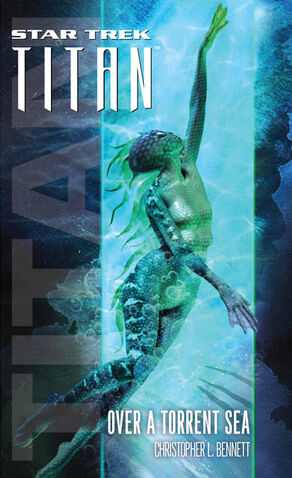
Titan introduces a wealth of new characters into the new extended universe, and from a variety of species: Riker’s chief medical officer “superficially resembles” a dinosaur who specializes in obstetrics, and another officer hails from a race who live underwater. Since the Titan crew featured in Destiny, I already know some of them, but the variety is fascinating.  While the political plot turned me off the first time I “tried” to read this in  2005 (I gave up after twenty pages, which baffles me now), it is not as bad as I remembered  or feared,  and another thread following a Starfleet operative disguised as a Romulan and attempting to make contact with the Romulan underground — who is caught, imprisoned, and forced to organize a little prison riot — allows a favorite character of mine to join the Titan crew. The Remans themselves are given some life by Martin and Mangels: in Nemesis they only existed as mooks and as an evil viceroy.

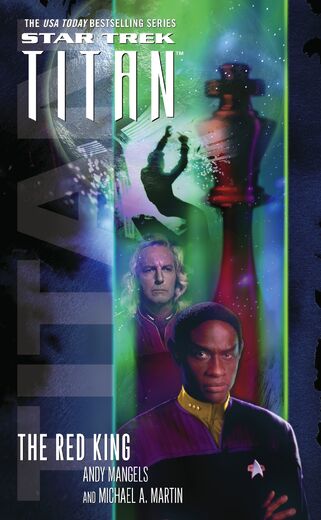
The Titan series has been popular with Trek literature readers, and though I’ve not experienced it in full, Taking Wing offers a taste of what’s to come. There’s no scientific exploration, but the characters have my attention. The plot kept me interested even though I thought I knew how it would end (I didn’t), and I’ll definitely be continuing in the series. I keep thinking I bought The Red King (#2) five years ago as well, but I didn’t see it in my box of Trek books from that period, and I’m not sure I bought it. My next Titan read will thus be Christopher L. Bennett’s Orion’s Hounds, and er..well, the reason I revisited the Titan series was so I could read more of him.  I’m looking forward to it.  I’m also looking forward (next year) to continuing in the A Time to  series which lead up to Nemesis, as judging from this book both the Federation and Picard were put through the wringer.

Posted in Reviews | Tagged , , , | 2 Comments

Britain: At the Edge of the World?

A History of Britain: At the Edge of the World? 3500 B.C. – 1603 A.D.
© 2000 Simon Schama
414 pages

Image from audio-book version, as I could not find a suitable image for the standard cover. I get the feeling that Schama has name recognition in Britain, judging by its size on the cover.

During the summer I read Simon Schama’s twice-recommended Citizens in honor of Bastille Day, and when I learned that Schama has also produced works in English history, I realized how appropriate it would be to read from him during the week of Guy Fawkes Day in Britain.  A History of Britain: At the Edge of the World? is the first volume in Schama’s series on British history, this volume spanning early Celtic societies to the death of Queen Elizabeth. Although titled a history of Britain, England receives the lion’s share of attention: Ireland, Scotland, and Wales are usually only mentioned in connection to English history, although one chapter (“Natives and Aliens”) catches the reader up on Scotland  during the Wars of the Roses and another section in “The Queen’s Body” follows Mary’s flight into England.

The tone of At the Edge of the World?  is more personal than Citizens’: Schama’s fast-paced narrative is lively enough, but he often pauses and focuses on particular scenes, inviting the reader to imagine what history must have felt like to the people who lived it. Perhaps owing to the book’s origin in television, Schama also enjoys treating the reader to salacious gossip, especially during the Tudor period. (Henry VIII,  I must admit, lent himself well to such stories.) Schama is delightful to read here, reminding me of Alistair Horne’s La Belle France. This is an exhilarating charge through English history, full of dashing figures immensely sure of themselves. Though I am somewhat versed in English history, Schama managed to throw a few surprises my way — I had no idea that an early English historian tried to connect England’s history to classical mythology by presenting the settlers of the Welsh, Scots, Irish, and Anglo-Saxons as grandchildren of Aeneas, the young Trojan who — if you believe Virgil —  fled the wrath of the Greeks and established a new Troy, Rome, along the banks of the Tiber.  The book’s illustrations are a high point: the text is replete with large prints of paintings, sketches, and medieval texts alongside photos of English architecture, typically castles and cathedrals. The resolution of the scanned documents is sufficiently detailed that I could read  from the first chapter of the Gospel of John in its Tyndale translation.

Good book for someone looking for an introduction to English history, and those familiar with the subject can still enjoy its humor, not to mention those gorgeous illustrations.  My only fault with the book is its treatment of the Hundred Years War, which is scarcely mentioned. It barely managed to hang on to background status.  Perhaps the war is worth mentioning more in French history texts than in English surveys?  If you’re curious, I’d recommend Desmond Seward’s The Hundred Years War: the English in France.

Related:

  • Peoples of the British Isles: from Prehistoric Times to 1688, Standford E. Lehmberg.  My English history professor assigned this when I took English history two years ago. He also assigned its succeeding volumes for the second half of that course in the spring.  (Not that we needed them, his exams are always pulled from the lectures.) 

Posted in history, Reviews | Tagged , , , | 3 Comments

Booking through Thursday: Borrowing

Booking through Thursday wants to know: Who would you rather borrow from? Your library? Or a Friend?(Or don’t your friends trust you to return their books?) And, DO you return books you borrow?


Most of my reading comes from libraries, either public or university: this blog originated from a series of posts detailing my weekly trips to the library, whence the name. I borrowed the majority of the Timeline-191 and parts of the WorldWar series by Harry Turtledove from the acquaintance to encouraged me to read them, but beyond this I have borrowed little from friends: The Moscow Option, Mere Christianity, and The Compleat Gentleman are the only three examples that come to mind, and I did not enjoy the latter two because the acquaintances wanted to know immediately how I liked the books. I like to mull things over, and — well, I didn’t enjoy either book, and being diplomatic but honest is difficult.

Back in middle school I became interested in the Animorphs series (in which middle-school kids engage in guerilla warfare using the ability to morph into animals), but my parents forbade me from reading them. Naturally I read them anyway, and devised a clever (so I thought) way to buy the books without my parents being privy: when we entered a shopping center, I left one door of our car unlocked, bought the books I wanted, hid them inside the car, locked the door, and then infiltrated the store once more to browse as normal. I couldn’t do this for every book in the series so I started a borrowing/lending group among my friends, and in that way I was able to stay caught up. (I still have a journal from that period detailing which books I currently had lent out, the name of the persons who had them, and the books I was currently borrowing and from whom.

I have only lent two books in the last couple of years: Anton Myrer’s Once an Eagle to the acquaintance who let me borrow his dozen Turtledove books, and Marx in Soho by Howard Zinn, to an overworked sociology professor I’m fond of. I still haven’t gotten that one back after a year, but I consider it a gift to him by now. Goodness knows he’s worth it, considering the lectures, book discussions, and other conversations with him I’ve enjoyed and learned from these past years. Besides, he’s a Marxist and I figure reminding him about the book over and over again will earn me a wry joke about property.

Posted in General | Tagged | 2 Comments

Top Ten Villains, Degenerates, Criminals, and Dastardly Cads

This week’s top ten list features the best of the worst — check it out at the Broke and the Bookish. Gul Dukat (below) is my favorite villain, but he doesn’t appear in many books. Presented in no real order.

And it’s so easy when you’re evil!
This is the life you see, the Devil tips his hat to me.
I do it all because I’m Evil, and I do it all for free —
Your tears are all the pay I’ll ever need!
(“When You’re Evil“, Voltaire)


1. Elsevan Dupris, Roswell High (Melinda Metz)

Roswell High introduced Dupris as a sleazy tabloid journalist who effects an air of southern gentility, ambling around town with a walking stick, white suit, and straw hat while interviewing people with an oily charm. His habits of knowing a little too much about people and leering at teenage girls make him creepy enough, but he turns into the series’ second presiding villain — a sadistic religious revolutionary with a strange obsession with the 1950s, who caused the Roswell crash.

Most iconic scene: Dupris, torturing people in a replica of the Brady Bunch home while 1950s sitcoms play in the background.
Cover:  Actors portraying Michael Guerin, Max Evans, and Maria DeLuca.

2. Iago, Othello (William Shakespeare)

What’s a villains list without Iago? Iago is the master villain, full of bitterness and malice who destroys lives with sinister touches and soft whispers while masquerading as an honest, good friend.

Most iconic scene:  When I think of Iago, I don’t think of a particular scene as such, but of these lines: “I hate the Moor; And it is thought abroad, that ‘twixt my sheets he has done my office: I know not if ‘t be true; but I, for mere suspicion in that kind, will do as if for surety.”

3. Aubrey, In the Forests of the Night (Amelia Atwater-Rhodes)

In the Forests of the Night is the story of Risika and Aubrey, two vampires with a mutual hatred spanning two centuries. Aubrey helped destroy Risika’s family when she was still Rachel, a mortal girl living in colonial New England, and he oversaw her conversion into a creature of the night.  The two ripen in their powers to become the two most powerful vampires alive, though neither can long tolerate the other: Risika hates Aubrey, and only her fear of being destroyed prevents her from attacking him. When he begins to attack the few things of beauty she still enjoys as a vampire, they start toward a final confrontation.

Most iconic scene: A repeated visual of Aubrey standing in front of Risika, staring at her with cold, smug eyes and tossing a silver knife carelessly in his hands — daring her to attack him.

Cover: I believe that is Aubrey on the cover of Demon in my View, but I always imagined him as David Foley from “Blast from the Past”…but sinister and evil. I think it’s because of their dress sense. Aubrey is always described as a deliberate dresser with a particular style, and one of Foley’s suits reminded me me of this.

4. Count Olaf,  A Series of Unfortunate Events (Daniel Handler)

Hilarious and sadistic. At first Count Olaf appears to want the Baudelaire fortune, but as the series progresses it appears the fortune would have  just been an ancillary benefit to killing off all of his old enemies and anyone who knew about his life of dastardly plots and villainous deeds.

Most iconic scene: Olaf, stuffed in a cage and promising the kids that if they betray their mutual hosts/captors and let him out,  they can be his servants once he defeats the villagers and declares the island they’re stranded on to be Olaf-land.

 5. Clarence Potter, Timeline-191 series. Harry Turtledove

Potter serves as a foil to Jake Featherson, a Hitler-figure who takes over the southern confederacy during the Second Great War. (What do you mean, you have no idea what I’m talking about?) Intelligent but patriotic, Potter swallows his pride and contempt for Featherson’s beliefs and demagogic approach to gathering power because he believes Featherston can be used to restore the Confederacy to its pre-Great War glory. He becomes an intelligence officer and one of Feather’s few confidants. Potter remained likable for most of the series, but his actions in the endgame soured on me. I never liked what he fought for, but I respected him for it until he led an atomic attack on Philadelphia.

Most iconic scene: Potter planning to assassinate Featherson at a rally, and having instead to save the man’s life from an incautious socialist revolutionary to prevent chaos from ensuing.

I should note that the above image is not of Potter, but of a rebel artillery captain from the film Gettysburg, played by James Patrick Stuart. I always used his face for Potter, in part because I liked the characters. Stuart shows up immediately as the artillery commander  in this clip.

6. Courtney Massengale, Once an Eagle. (Anton Myrer)

Though both Sam Damon and Courtney Massengale  join the US Army at the start of the Great War, Sam earns his commission through hard work, leadership in the trenches, and persistent displays of superior character while Courtney relies on family influence to arrange a cozy job far from danger. Courtney is a political animal, a schemer, who sees war and martial prowess as a means of gaining glory and prestige: Sam just wants to keep his men alive and do good. The book follows them through to the start of the Vietnam War, when both are generals — surviving depression and another calamitous fight in their own ways. I’ve read that the military adores this book.

Most iconic scene: I haven’t read the book in four, perhaps five years, so many scenes and their details have left my mind. The introduction of Massengale sets the stage, as the snobbish lieutenant turns his nose up at bedraggled Sergeant Sam Damon and his men, fresh from the front lines of the trenches.

7. The Mule, Foundation and Empire. Isaac Asimov.

The Mule isn’t so much a villain as he is a wrench in a good man’s plans. Asimov didn’t write villains: his antagonists tended to be people whose desires and ambitions simply ran counter to those of the protagonist, and sometimes both sides made mistakes. I don’t remember the Mule as being evil, unless you count occasional mind-control as mean, but he had to be stopped for the sake of the galactic human race.

Most iconic scene: The Mule was mostly a grim spectre in Foundation and Empire, rarely showing up in person. (That the reader knew of!) There are thus few scenes with him in the book, but I first realized how good he was at getting his way when he managed to turn his prisoners into his personal bodyguard, and the ship he’d been held in irons on into a personal transport.

8. Cataline, Cataline’s Riddle. Steven Saylor; Conspirata, Robert Harris.

If you believe Cicero, Cataline ate babies for breakfast and murdered as a leisure activity. In real life, Cataline  was accused of conspiring to lead an insurrection against Rome’s aristocratic elite on behalf of the plebeians, which isn’t far-fetched considering both the elite and the dispossessed were constantly trying to kill the other’s leaders and achieve supremacy.  Saylor’s Catalina isn’t so much a villain as an intriguing character.  Is he plotting against the Roman state? Probably. Is that a bad thing?  Is Cataline wrong for wanting to strip away the authority of the aristocrats, who dissolved the people’s tribunes and have killed their every advocate?

9. Great Benefit, The Rainmaker. John Grisham.

The financial officers of Great Benefit have figured out the perfect way to make lots of money: sell cheap insurance to low-income families and automatically deny any and all claims filed to collect on that insurance. Even if their ‘customers’ could overcome their distrust of lawyers, they probably can’t afford to pay one to sue on their behalf. On the off-chance someone does sue, employees who know anything and who are willing to talk can be shut up through legal and illegal means.

The Rainmaker is the story of a young, wet-behind-the-ears law graduate who takes on a massive insurance company and exposes their methodical plan to prey on those who can’t defend themselves. It is one of my two favorite Grisham works (the other being The Last Juror), in part because profiteering corporations are a lot more likely to hurt people than a Hitler-wizard. And speaking of which…

10. The Malfoys (Harry Potter series, J.K. Rowling)

“Do remind me. Have I made a sneering remark about your wealth or breeding yet?”

Do Lucius and Draco Malfoy deserve to be considered as villains? Probably not. They’re despicable people, easy to hate, and I devoutly wished all manner of unpleasantness upon them while reading the books — but they’re just bullies who would be nothing without their support of Lord Voldemort. Today’s list isn’t just about villains, though: it’s also about degenerates.  In every scene the Malfoys featured, they managed to be cruel,arrogant, petty, and obsessed by power and appearance. Every time I read the Half-Blood prince, I am astonished that Rowling manages to make me feel sorry for pathetic Draco.

Honorable Mention: Dolores Umbridge is similarly contemptible, personifying everything anyone has ever disliked about government officials or authority figures. She deserved much worse than she got.

Most iconic scene: The Malfoys were contemptible every time we saw them, but sending Hagrid to Akaban and nearly getting Buckbeat killed in Chamber of Secrets and Prisoner of Azkaban were particularly…mean-spirited moves. Jason Isaacs is so very good at playing contemptible characters.

Posted in General | Tagged | 10 Comments