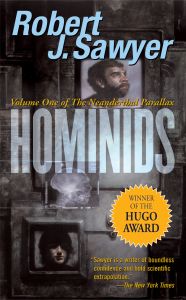
Hominids
© 2003 Robert Sawyer
448 pages
“You manage to comfortably feed six billion people with plants?”
“Well, ah, no,” said Mary. “About half a billion people don’t have enough to eat.”
“That is very bad,” said Ponter, simply.
Hominids
© 2003 Robert Sawyer
448 pages
“You manage to comfortably feed six billion people with plants?”
“Well, ah, no,” said Mary. “About half a billion people don’t have enough to eat.”
“That is very bad,” said Ponter, simply.
Space Chronicles: Facing the Ultimate Frontier
© 2012 Neil deGrasse Tyson; edited by Avis Lang
384 pages
On July 20th, 1969, America mesmerized the world by landing men on the Moon. For the first time in history, human feet stepped on the soil of another planet. But on July 21st. 2011, the Space Shuttle Atlantis touched down on the runway and the United States ceased to be a spacefaring nation, for the shuttle program had ended. Space Chronicles collects essays by astrophysicist and science advocate Neil deGrasse Tyson which looks back on the history of the American space program and reflect on its legacy both to science and the human endeavor before arguing that the United States need to return to space with bold ambitions.
Tyson first caught my attention a few years ago when a book described him as “the next Carl Sagan”. Here, he lives up to expectations as a passionate science communicator: he is earnest, witty, and urgently excited about the matter at hand. Although ostensibly about the exploration of space, Chronicles is more fundamentally a book about the value of science — and not just the knowledge itself, which enriches human experience and provides the spark for material progress, but of scientific thinking — skepticism and wonder. The epilogue, which stresses the value of the “Cosmic Perspective”, practically channels Sagan.
Science advocacy is the message, but Tyson uses the inspiring and exciting adventure of space exploration as the messenger. Although enthusiastic about humanity’s accomplishments thus far, Tyson avoids being labeled a starry-eyed optimist by consistently stressing the pragmatic aspects of space exploration, the technological boons. It’s not the spin-off products like Velcro that Tyson has in mind, though: he points out that NASA’s endeavors have effected progress in other fields through “cross-pollination”: one example he uses is that of the Hubble research team pioneering methods to put together meaningful conclusions from scant data while the telescope was impaired, methods that were adopted by cancer researchers to improve their analyses of mammograms. More strikingly, though, he makes no attempt to interpret the space race of the 1960s as a bold, purposeful step forward in human exploration: instead, he sees it as being motivated by the desire for economic and military gains. Tyson emphasizes this not to convey cynicism about space exploration, but demonstrate how much was accomplished even though the motivations were less than inspiring, and to to point out that aerospace can continue to be a source of economic progress today.
In fact, aerospace is a source of progress for humans today, but not for Americans. Americans, Tyson laments, have gone backwards by standing still. Other nations are becoming the technological leaders of tomorrow, and Tyson — an American, writing to motivate his fellow citizens to start believing in and working for the future again — despairs of this. He sees hope in China’s aggressive ambitions in space: if competition with Russia sent us to the moon back in 1960s, perhaps competition with China will take us further.For the time being, however, even our past accomplishments are beyond us now.
Space Chronicles sees Tyson communicate a great deal — the history, motivation, and practical aspects of space flight, the value of science, critical thinking, and wonder, the United States’ emphatic need to re-prioritize science, mathematics, and industry — and do so with style. There is a slight weakness in the fact that Chronicles is an edited collection of essays and interviews, and not a monograph written as a cohesive whole. Repetition of certain facts, examples, and so on exists, but this is a weakness only and not a glaring flaw. As it stands, Chronicles is impressive and engaging, of interest to both space enthusiastic and critics.

Last week, Britons celebrated or observed Guy Fawkes Night on 5 November, a date I usually try to do some English-themed reading around, just as I do readings for the Fourth of July and Bastille Day. This year’s reading consisted of my finishing off Bernard Cornwell’s excellent King Arthur trilogy, along with two nonfiction works: Bill Bryson’s Notes from a Small Island and Kate Fox’s Watching the English: the Hidden Rules of English Behaviour.

To start off my set, I decided to take a tour of Britain with Bill Bryson, an American humorist author who lived in England for twenty years, beginning in the 1970s. Before returning to the United States, Bryson decided to mull over his adopted homeland by traveling over it, in part repeating the journey he made upon first arriving. Bryson is a riotous author for me, and here he’s of course an entertaining guide, cheerfully rambling through the country, offering commentary that varies from serious reflections on English culture to absurd thoughts and irrelevant tangents. At the outset, when repeating his initial 1970s travels, the commentary compares the Britain of his youth to Britain today, though the changes he notes (in the flowering of chain stores, the destruction of older architectural for modern boxes) are scarcely for the better. Even so, this is a delightfully fun book.

Kate Fox’s Watching the English takes a more serious tack, slightly so. The author has a earnest endeavor — scrutinizing English culture with an anthropologist’s eye — but she offers a spirited analysis. Although her intent is to discern the rules governing English behavior by watching how Britons act, she’s no passive observer, instead turning her fellow Brits into lab rats and experimenting on them. She devotes afternoons to jumping queues (cutting into lines) and bumping into people on purpose, noting how many of them automatically apologize. As she studies one area of English life after another — work, hobbies, sex, shopping — patterns emerge, rules which interact with one another, and eventually the patterns create a cohesive analysis of English culture. Fox declares that the English are fundamentally socially anxious, and that many English behaviors act to counter that awkwardness. The weather, for instance, is not actually all that interesting to English folk, regardless how how incessantly they speak of it: instead, talking about the weather is a way to be social without being impolite, to make a human connection without seeming weird. Fox sees her countrymen and women as being desperate for fellowship, but denied it by a culture that encourages emotional coolness — reserve, moderation, and the respect of privacy. Other aspects of English culture she touches on are the prevalence of class consciousness (which is ubiquitous, being expressed and betrayed not just by the word you use to describe household furniture, but which items you are willing to buy from a Mark’s and Spencer), English humor, and a fundamental belief in fair play. While I can’t judge her book against personal experience (not yet having traveled to England’s green and pleasant land), I found it utterly engaging and entertainingly written.
The Long Earth
© 2012 Terry Pratchett, Stephen Baxter
400 pages

Suppose there were an infinite succession of Earths, and travel between them was as easy as taking a step. A new age for humanity begins when a reclusive scientist posts plans for a “Stepper” online, a relatively simple piece of machinery that is remarkable only for the potato it uses as a power source. Suddenly, the borders of states are irrelevant, and the very idea of scarcity is outmoded. Travel to the other Earths has few limits: iron can’t make the passage, and stepping between worlds induces nausea for most. But not for Joshua Valentine, a strange boy raised in an orphanage by nuns who “read Carl Sagan before they read Genesis”. When a globe-spanning corporation of infinite power and aggressive curiosity decides to launch a mission into the “Long Earth”, the chain of infinite planets humanity is now spreading into, they come to Joshua for help.

The presence of two other actors is a highlight for me: Billy Connelly, who played Uncle Monty in A Series of Unfortunate Events, is a professor here, rather like Monty except that his penchant is for medieval history instead of snakes, and David Thewlis, who is the project head for the Amoral Corporation. You may know him as Professor Lupin. Predictably, the movie is poor history: the opposing armies each wear uniforms, red for the villainous English and blue for the valiant French. Each speaks modern English or French, with the only barrier to communication being that a French woman doesn’t understand Marek’s euphemisms when he attempts to chat her up. “Am I seeing anyone? I see you…”
Timeline doesn’t do justice to the book, and it’s not a particularly good movie by itself, but if you’re really in the mood for swords and bows, it should prove entertaining, especially seeing as it features Gerard Butler, who I became a fan of while watching it. You might be better off with Men in Tights, however, which has as much historical integrity and much better acting.
Excalibur: a Story of Arthur
© 1999 Bernard Cornwell
436 pages

In Britain’s darkest hour, a man named Arthur came to rule. With the high king dead and enemy Saxons filling the shores looking for land to settle, he confronted the tremendous challenge of uniting the feuding British kingdoms and guiding them to victory against a foe superior in numbers and in spirit. He faced adversaries from within his camp, as well, as even longtime companions proved treacherous when tempted by ambition. Now Bernard Cornwell tells the final story of Arthur with Excalibur, a fitting conclusion to an extraordinary trilogy.
The trials that Arthur has faced would break lesser men, even other heroes. It would be easy to give into despair, to abandon hope — but here in Excalibur, Arthur again looks adversity square in the face. Although an uneasy peace prevails at the start of the book, the aftermath of Enemy of God’s epic ending, for Arthur and his ally (our narrator, Derfel), the growing might of the Saxons will soon need to be reckoned with. The unity Arthur fought for seems to have dissolved, but he remains determined to defy the inevitable, and this culminates in the Battle of Baden Hill, which is incidentally the only historical reference we have to an Arthur of any kind. But Baden Hill is not the end, for this King Arthur trilogy is inspired both by history and by myth, and the final battle is between Arthur and a final betrayal, that of the dark prince Mordred. The conclusion is masterful, beautifully appropriate: this being a trilogy about King Arthur, it could not end but with a flourish.
Excalibur lives up to Cornwell’s usual legacy, but reveals an additional strength of this trilogy in particular: character evolution. Although Cornwell doesn’t shy away from writing evil characters, in the Arthur trilogy the lines between heroes and villains isn’t a clear cut. Guinevere, for instance, was utterly despicable in Enemy of God, but moves toward redemption in this final volume, while someone who has been Derfel’s friend since his childhood becomes monstrous, continuing a trend that began in Enemy of God. It points to the complexity of life, of people and our motivations, and the fact that nothing can be taken for granted.
…nothing, that is, except for the quality of a Cornwell novel. This trilogy has been absolutely stunning, and I’m sad to have finished it. Happily, though, it can always be re-read.
The Mark of Athena
© 2012 Rick Riordan
608 pages
In The Son of Neptune, Percy Jackson — a demigod, the son of a human mother and Poseidon — discovered another population of half-blood like himself, a veritable city called New Rome. The Romans are hostile to Percy and his Greek brethren, but the two sides must unite against Gaea and her plans to destroy life and create it anew — which is unfortunate, because Percy’s plans for an alliance soon crumble into war. The Lost Hero introduced Jason Grace, the leader of the Romans, and in The Mark of Athena he and Percy (joined by five other demigods drawn from both of the camps) have to score a victory against Gaea before the Romans reach Camp Half-Blood and destroy it. Their quest takes them to the old world where Annabeth Chase must descend into the bowels of Rome on a private mission from Athena, one that offers the hope of achieving peace between the demigods and preventing the real city of Rome from being toasted by two campy giants.
Riordan’s novels tend toward the episodic, with a monster milestone threatening to destroy life next week if the kids can’t scamper across the continent (or the world, in this case) in two days and win out, but Heroes of Olympus has already established itself as a different beast altogether from Riordan’s previous Greek and Egyptian series. The first two novels read very similarly to the previous series: there were three characters, each trio had a private romance, and the group had to accomplish ludicrously big things alone. But Heroes of Olympus is developing into a more mature series. Now there are seven characters, each with a fascinating story to tell, and tension between them is rife. Jason and Percy are accustomed to leadership, for instance, and subtly vie for the role of alpha male. While a monster-killing mission usually drives these novels, here it’s incidental, just a very small part in the larger scheme of things, and marginalized by Annabeth’s solo mission. There are of course lots of monsters; the book writhes with urgent fight scenes against all manner of unpleasant beasts, from giants with snakes for legs to American tourists. Happily, not every fight is resolved with strength; sometimes clever escape is the best option, and the book ends by depriving two heroes even that, giving readers something of a somber cliffhanger.
Heroes of Olympus continues to delight.