“My wife and young children live on the main road to Boston, fewer than five miles from the full might of the British Empire. Should they sit and wait for Gage and his SAVAGES to rob them of their home, their possessions, their very lives?! No,sir! Powder and artillery are the surest and most infallible conciliatory measures we can adopt! – John Adams, “Independence”, HBO’s JOHN ADAMS
When people ask me, a son of the Deep South, why I root for the Red Sox, my usual answer is that I began wearing their hat decades ago because I liked the look of it, and then they went and won a world series for the first time in eighty years so I had to keep following them. That’s ..true, and part of the affection, but as a history-addled child I loved reading about the Revolution, and Boston has inarguable pride of place there. The revolution without Boston is France without Paris. It was there that Hancock, Dr. Warren, and the Adams cousins crafted resentment into rebellion and revolution — there that British soldiers first faced off against their American subjects, and not far from there that the first shots were fired at Lexington and Concord. Boston in the American Revolution is an informal history of the Hub City’s role in the Revolution, one that often addresses the reader directly and ends each chapter with almost a bit of tour-guide content. Photos of the prominent places mentioned are included, with instructions on how to find them and added information like “This isn’t actually where the Boston Massacre happened, but it’s close enough you won’t get run over here.” These highlighted sites are all part of “The Freedom Trail”.
The book is also an anti-mythic history, as it demonstrates that a lot of Boston patriots were…um, a bit unhinged. Not the aforementioned men, but Bostonians had a tendency of clustering into mobs, chasing men they did not like into their homes , throwing whatever they could find at the house and into the windows, and then retreating back into taverns after the object of their rage started shooting at them. We hear in popular stories of the Boston Massacre, but not of the Rope-Makers drama which is almost hysterical: a British soldier inquires at a rope-making place if they need any extra hands, because he’s paid practically nothing; he’s insulted and gets in a fist-fight in with the insulter and loses. He comes back with friends, a brawl ensues, the Brits lose. They come back with dozens of friends, they get in a brawl, they lose. Some of these same rope-makers would be in the Boston Massacre crowd squaring off against and antagonizing British soldiers! The amount of violence leading up to the Revolution — a decade before 1776 — was surprising to me, in part because histories of the Revolution tend to highlight a few key moments and then blur the years together, so that readers are left thinking this was a sudden eruption of conflict, and not a steadily-boiling pot of the same that finally began roiling in 1776. It reminds me a bit of the sectional crisis that came to a head nearly a century later, but which had slowly been percolating since the 1820s. I also found it interesting to learn that part of Britain’s slow resistance to armed rebellion was the fact that Thomas Gage had been under-reporting rebel sentiment for years to make it appear as though he was managing things better than he actually was.
Although the book was quite entertaining, I did raise my eyebrows a few times: the author describes Bunker Hill as the war’s bloodiest battle (…maybe by the rate of British casualties, 40%, but by no other metric), and is ocasionally much too informal, once adding a ‘Meow’ comment to a quotation in which General Washington dismisses the haggard-looking officers of the Continental Army. I could see this working very well for someone who is planning a visit to Bahston, and I enjoyed the close focus on the town itself, but I can reccommend it only with caution.
The Classics Club, now thirteen years strong, posted a fun-looking survey yesterday morning.
When did you join The Classics Club? How many titles have you read for the club so far? Share a link to your latest classics club list.
I joined the Classics Club for the first time in 2015, completed my first list in a timely manner, and then began anew in 2020. Last year I effectively “paused” my read and am counting 2026 as the “last” year for my current list,The Classics Club Strikes Back. I’ve read 84 titles to date, 50 from the original list and 34 from the current one.
What classic are you planning to read next? Why? Is there a book first published in 1926 that you plan to read this year?
I’m feeling most drawn to The Confessions by St. Augustine, which I’d planned to re-read during Advent.(I read it over a decade ago, but I suspect I would enjoy it far more now — and not only because it’s translated by my favorite Latinist, Anthony Esolen.)
Classic author who has the most works on your club list? Or, classic author you’ve read the most works by?
Jane Austen and John Steinbeck are tied at 4 (in the two lists), I think. I have read all of Jane’s main works (ignoring juvenalia) save for Mansfield Park.
If you could explore one author’s literary career from first publication to last — meaning you have never read this author and want to explore him or her by reading what s/he wrote in order of publication — who would you explore? Obviously this should be an author you haven’t yet read, since you can’t do this experiment on an author you’re already familiar with. Or, which author’s work you are familiar with might it have been fun to approach this way?
I’m not sure if this counts, but I’d love to do a deep dive of Solzhenitsyn. I’ve read his Gulag Archipelago, of course, and A Day in the Life of Ivan Denisovich, but I feel certain I haven’t gotten more than knee-deep into what he offered.
First classic you ever read?
My first classic was also my first ‘adult’ novel: I received a Great Illustrated Classics edition of Jack London’s Call of the Wild. I read it all day that Christmas.
Which classic is your most memorable classic to date? Why?
I could say Gulag Archipelago again, but instead of double-dipping I will mention Jane Eyre because of an outstanding quote from it that lives in my head. “I will hold to the principles received by me when I was sane, and not mad — as I am now. Laws and principles are not for the times when there is no temptation: they are for such moments as this, when body and soul rise in mutiny against their rigour; stringent are they; inviolate they shall be. If at my individual convenience I might break them, what would be their worth? They have a worth — so I have always believed; and if I cannot believe it now, it is because I am quite insane — quite insane: with my veins running fire, and my heart beating faster than I can count its throbs. Preconceived opinions, foregone determinations, are all I have this hour to stand by: there I plant my foot.”
Least favorite classic? Why?
In my wrap-up post for my first list, I specifically called out The Sun Also Rises. “The appeal of this was entirely lost on me,” past-me declared.
Favourite movie or TV adaption of a classic?
My initial thought was Great Expectations with Ioan Gruffud and Ian McDiarmid, and I’ll still stand by it — but the ladyfriend and I recently watched a version of Little Women that was awesome. And I’ve read both of those for the CC!
Favorite biography about a classic author you’ve read, or the biography on a classic author you most want to read, if any?
I think the only biography of a classic author I’ve read would be about CS Lewis.
Favourite classic author in translation? Do you have a favorite classics translator? What do you look for in a classic translations?
I honestly don’t pay sufficient attention to the translator, unless I’m reading a Russian novel in which case it can make a huge difference. The only exception is Anthony Esolen: while he’s written many books on Christianity, society, and culture, he’s also a Latin translator who has covered The Confessions, The Divine Comedy, and The Nature of Things. His translation of the Commedia was especially helpful because he combined it with annotations that explained medieval cosmology, Italian politics, etc.
Do you have a favorite classic poet/poem, playwright/play? Why do you love it?
One of my odder hobbies is memorizing poems, or at least reciting them and trying to memorize them. The first poem I memorized was “The Tyger” by William Blake, in part because I was obsessed with tigers as a kid and in part because the cadence of the poem bewitched me. I can almost hear it as a song, or at least an eerie chant. (Tennyson’s “Charge of the Light Brigade” followed, thanks to Star Trek Deep Space Nine.) Though “The Tyger” may be beautiful, it doesn’t have the meaning for me that other poems do. I’m thinking specifically of “Invictus” — which I’ve been reciting for nearly twenty years now — and “Breathes There the Man”. I also love Epistle II of Pope’s “Essay on Man“, for this bit:
Plac’d on this isthmus of a middle state, A being darkly wise, and rudely great: With too much knowledge for the sceptic side, With too much weakness for the stoic’s pride, In doubt to deem himself a god, or beast; In doubt his mind or body to prefer; Born but to die, and reas’ning but to err; Alike in ignorance, his reason such, Whether he thinks too little, or too much:
Which classic character most reminds you of yourself? Which classic character do you most wish you could be like?
Maybe Davita, from Davita’s Harp. That may sound outlandish, but I strongly sympathized with her coming from a secular background, raised by parents obsessed with creating a socialist revolution, and being instead drawn to her grandparents’ Jewish faith. Off-list, Larry Darrel from The Razor’s Edge was another character consumed by the search for Meaning.
What is the oldest classic you have read or plan to read? Why?
If a sudden announcement was made that 500 more pages had been discovered after the original “THE END” on a classic title you read and loved, which title would you be happiest to see continued?
You know, I think Melville could have written more about whales in Moby-Dick.
Favorite edition (or series) of a classic you own, or wished you owned, if any?
The version of Little Women I read had a wonderful cover.
Do you reread classics? Why, or why not?
It depends on the classic — I’ve reread several Londons and Steinbecks, for instance, and I’ve read The Bible many times — the Protestant one, anyway. Years ago I’d begun trying to read all of the deuterocanonicals but my attention wandered off. It’s not as if they’re that numerous, but you know me….my brain is a dog chasing six rabbits at once. The ladyfriend and I are doing the Bible in a Year program with Fr. Mike Schmitz, so it will be interesting to see if he includes those.(It appears he does!)
Has there been a classic title you simply could not finish?
I wound up switching to an abridged version of Hunchback of Notre Dame. I should do it proper at some point.
Has there been a classic title you expected to dislike and ended up loving?
Loving is too strong a word, but I was very much surprised by The Jungle. Until the end, where the main character disappears listening to endless political blathering, it’s a fairly compelling story.
List five fellow Classic Clubbers whose blogs you frequent. What makes you love their blogs?
I follow so many book blogs and substacks I would be hard-pressed to pick the CC members out!
If you’ve ever participated in a readalong on a classic, tell us about the experience? If you’ve participated in more than one, what’s the very best experience? the best title you’ve completed? a fond memory? a good friend made?
Marian and I read The Great Gatsby together back in 2021, which is strange because it feels like I just read that last year. (Probably because I did watch the DiCaprio film last year.) The ladyfriend and I are plotting a readalong of Little Men if I can find my copy.
If you could appeal for a readalong with others for any classic title, which title would you name? Why?
The Confessions by St. Augustine. Would be interesting to read it with Christians of different denominations (Orthodox, Catholic, Protestant) to see the different responses.
What are you favourite bits about being a part of The Classics Club?
I like the camaraderie, and the ability to discuss the same books with people who have also read it. I live in a small town, so it’s difficult to have good bookish conversations — and that’s even true despite my working in a library, because no one else reads the books I want to talk about!
What would like to see more of (or less of) on The Classics Club?
I’d like to see more of me reading from my list, since my last CC entry was from 2024.
Question you wish was on this questionnaire? (Ask and answer it!)
Characters from Classics you’d like to have lunch, or at least a walk, with. I choose Willie Talos/Willie Stark from All the King’s Men. If he had any of Huey Long’s charisma he’d be a hoot and a half.
I was instantly intrigued by John Tyler when I learned that his entire Cabinet, with the exception of the Secretary of State, had resigned on him in protest of his actions and that he had been declared excommunicate by his party. Heavens to betsy, what could he have done to merit such opprobrium? (He vetoed his own party’s legislation for being unconstitutional, like some maniac who takes the presidential oath of office seriously.) John Tyler was the nation’s first vice president to assume the responsibilities of president in the wake of the president’s death; largely chosen as a geographic asset, giving the South a reason to support the “Tippecanoe and Tyler, Too” ticket, he set precedents and took such delight in annoying both factions in DC that John Adams might’ve chuckled from his grave. (Mr. Adams’ son, John Quincy, would not like that comparison, but in my reading I have not encountered anything Quincy did like outside of being a moral scold.) President Without a Party is a look at the life of John Tyler, an “Old Republican” who ended his life in a most astonishing way — as a Confederate congressman.
Key to understanding Tyler is that he regarded himself as an “Old Republican” — that is, a Jeffersonian. His father had viewed the Constitution itself with suspicion and malice, seeing it as a worrisome document that destroyed the sovereignty of the states in favor of the national government. John Tyler would grow up with that view, and as a younger Congressmen set his standard against “consolidation” — or the reduction of the States into mere administrative units of the central government. Consolidation’s march has been a continual one from at least McCullough v Maryland, hastening during Lincoln and Wilson’s administrations, but in the early 19th century it was still a threat that could be sighted and fired upon, instead of an overwhelming presence as we have today. Tyler’s resistance to central authority made him sympathetic to the Jacksonian temper: Jackson and his Democrats stood against policies that aggrandized DC, like a national bank and heavy investment made in “internal improvements”. Jackson, however, was not Jacksonian when his own person was concerned: Tyler viewed his authoritarianism and heavy-handedness with contempt, and so found himself drifting into Whig circles.
The Whig party was not one with its own coherent ideology; it was largely a coalition of people opposed to Jacksonianism, but with different motives. They did tend to be more on the side of banks and internal improvements, though, and when Tyler found himself inheriting the responsibilities of the presidency a month into his new job as vice president, he was set against the very people who had effectively put him into office. They expect him to govern for the Whig party; he intended to govern as though he’d won office himself. He boldly assumed that the vice president did not merely inherit the responsibilities of the president: the vice president assumed the office itself, and by taking the oath and moving into the White House Tyler set precedents that all other inheriting veeps down to LBJ have followed. In office, Tyler followed his own policies, not those of Whiggery: after continuing to veto bank bills that he viewed as unconstitutional, Tyler was read out of the Whig party and faced with total Cabinet resignation.
He would soldier on, though, and make the annexation of Texas a key priority. While early advocates for Texas’ admission to the union emphasized its value to the entire country, Tyler’s new secretary of state John C. Calhoun was the paladin of the South and saw it as the Southland’s bulwark. After leaving office — and allowing his more popular successor Polk to finish the work of taking Texas, Tyler retired to a farmhouse he called “Sherwood Forest”, a delightful touch that showed how he leaned into his status as a pariah. It helped, of course, to have the company of a new, young wife: his beloved Letitia had died while he was in office (being yelled at by everyone), but he’d chanced to meet a young woman thirty years his junior who was not only devoted to him, but quite wealthy. It did help that she inherited a fair bit of money from her father who died during a cruise of the USS Princeton that killed several Cabinet members as well. Mr. Tyler did not have a happy time in office — with the exception of his last eight months, where he was joined by a new young wife who kept him busy during his long retirement chasing babies. Tyler’s inability to keep out of politics, though, led to him following Virginia out of the union and (almost) into the Confederate Congress: he died before serving there, and is presumably unique among American presidents in serving a ‘foreign power’ after his tenure in office.
Although this book sometimes got deep into the weeds of policy decisions, its opening and ending thirds are very readable, and I rather liked Tyler by the end of it. Because he had a litter of children from his 2nd wife, nearly thirty years his junior, Tyler had until recent a living grandson: unfortunately, that link to the past died this past May. The Tylers are also unusual in that their family has been able to maintain their historic property: although the Yankees did try to set Sherwood Forest on fire after ending their occupation of it, family servants were able to squelch the flames. This was an unexpectedly fun look at a man who defied party and expectations, preferring the comfort of his conscience to that offered by following his peers — and did so often with a sense of humor. (Possibly my favorite anecdote here is Tyler throwing a big wedding celebration, and as the wine flowed he remarks to a colleague that he could no longer be accused of ‘not having a party’. Ho, ho, ho.)
Readers who grow weary of dead presidents may take comfort in knowing that my next read will probably be on Boston during the American Revolution, or John Grisham’s latest novel.
Quotations
“[Tyler] was an Old Republican who pledged fealty to the states’ rights bible of the Virginia and Kentucky Resolutions, but beyond that it was difficult to pin him down. He became a Jacksonian Democrat but consistently opposed President Jackson. He became a Whig but usually opposed the party’s nationalistic agenda. When he did so in the White House, party members banished him, making him a president without a party. Charges of partisan disloyalty never troubled Tyler. In fact, he seemed to enjoy his reputation as a political renegade.”
“[G]ood and able Men had better govern than be govern’d,” the elder Tyler declared, in a succinct statement of his denition of noblesse oblige. Men of ability should not “withdraw themselves from Society” lest the “venal and ignorant” succeed.
It would be absurd to think he could have done anything else. Custom dictated that he express affection for Letitia rather than passion, because admitting passion meant a man had lost his head, that emotions had overtaken reason, which then called into question his suitability as a husband.
Tyler’s tenure in the House, then, was marked more by what he opposed rather than what he supported. He was not the type of legislator who was willing to do the hard work of crafting a bill and then assemble the coalition needed to secure passage. He was not interested in building consensus, unlike his more rightly celebrated colleague Clay. Tyler was an obstructionist, as all of the Old Republicans were—a member of a principled minority who wore their status as a badge of honor. His constituents sent him to Washington because he agreed with them ideologically and because they knew he would fight tooth and nail against consolidation. It did not even matter if he was destined to lose that war. What mattered was that he gave a voice to the Old Republicans in national politics and defended the people of Virginia—and the South—against unconstitutional encroachments on their liberties.
“Let my fate be what it may,” [Tyler] declared, “I have discharged my duty, and I am regardless of the consequences.”
Tyler purchased a farm from his Virginia neighbor Collier Minge for $10,000 called Walnut Grove which he soon renamed Sherwood Forest. Tyler fancied himself a Robin Hood–type figure who enjoyed his outlaw status with the Whig Party.
The proprietor had initially reserved the “President’s House” for them, but an “immensely fat” lady had arrived from New Orleans shortly before they did and insisted that she be allowed to stay there because it was the closest residence to the dining room, declaring that she could not occupy any other and go to her meals unless a railroad were contrived. No tracks having been laid from the cottages to the dining room, the woman was allowed to settle in where she wanted.
My first movie for 2026 was Train Dreams, a beautiful but tragic story of a man who found happiness, then saw it ripped away from him, and then was forced to grapple for meaning like Job. After dealing with an allergic reaction to something that induced lots of eyeball leaking, I declared on facebook: this is the best movie I will see all year! Then I sought out the story it was based on, and …uh.
Just..uh.
“When you was a boy, did you ever get on a stump and love a cow? They all did it over where I’m from. It’s not unnatural down around that way.”
I’m sorry, but what the hell? Train Dreams as a written story is quite different from Train Dreams the movie, and while I do not wish to go on comparing the two stories, it is difficult considering I watched them in the same evening and my brain insists on making Venn diagrams. Doing my best to treat Train Dreams as a novella in its own right, though, it is an odd story — a look at the Old West within the Pacific Northwest, a realization that the Past can continue within the Present (or the Future) for far longer than many might suspect. The Future comes slowly to rural places, especially to those occupied by men like Grainer who still live deeply in the past. One cannot fault Grainer: he was a logger with a wife and a small child, and he worked for them during the logging season and pined for them when he was away, taking solace in the fact that he was providing for them. But then something happened and there was no longer a them to provide for, and he was forced to persist — to work, to wonder. And strange things happened to him. There is a scene where he thinks his daughter is a wolf with a broken leg. I do not know that I would have finished it without having watched the movie in the same evening, to be honest. Well, here’s the trailer for Train Dreams. You may anticipate my comments on it in a month’s time.
“Beautiful, ain’t it?” “What is?” “All of it. Every…bit of it.”
Some Quotations because it did have its merits
Grainier waited. A full minute passed, but Peterson stayed silent. “That just tears it then,” Grainier said, quite agitated. “I’m pulling this team up, and you can walk from here, if you want to beat around and around the bush. I’m taking you to town with a hole in you, and I ask a simple question about how your dog shot you, and you have to play like a bunkhouse lout who don’t know the answer.” “All right!” Peterson laughed, then groaned with the pain it caused him. “My dog shot me in self-defense.”
“His heart was his fate,” Mrs. Pinkham said. “You could looked right at him anytime you wanted and seen this.”
Grainier asked him, “Do you really know how that motor works inside of there?” “I know everything.” Heinz sputtered and fumed somewhat like an automobile himself, and said, “I’m God!” Grainier thought about how to answer. Here seemed a conversation that could go no farther.
In a civilized place, the widows don’t have much to say about who they marry. There’s too many running around without husbands. But here on the frontier, we’re at a premium. We can take who we want, though it’s not such a bargain. The trouble is you men are all worn down pretty early in life. Are you going to marry again?”
“If you’re prowling for a husband,” he said, “I can’t think of a bigger mistake to make than to get around me.” “I’m in agreement with you,” she said. She didn’t seem particularly happy or sad to agree. “I wanted to see if your own impression of you matched up with mine is all, Robert.” “Well, then.” “God needs the hermit in the woods as much as He needs the man in the pulpit. Did you ever think about that?”
This year the United States of America will celebrate its 250th anniversary. I was too young by a decade or so to celebrate the Bicentennial, and unless future medicine is very magic I doubt I will witness the Tricentennial. So, I shall be making hay of this year and the “Semiquincentennial”. I am making wild plans to celebrate in reading along three ‘tracks’. While I would normally be reluctant of making grand plans, given my track history (ho ho), this involves primarily history so I think it’s a fair bet I will make progress among at least one of them. I may also try to emphasize American literature I’ve not explored, like Vidal’s Narrative of Empire series, but we’ll see.
Track One: American History. While this is a fairly broad category, I want to approach it from a bit of an oblique, looking at areas of American history I know little about — like the South in the Revolutionary War, or the the Cherokee in the Civil War. I have started doing this already with the sectional divisions of the pre-Civil War era
Track Two: Americans of interest. “All history is biography,” said Emerson. Will be reading about American lives. Biographies, in other words, and intending to represent a cross-track of Americans I admire or am curious about, with a range of vocations. Some of this will muddle with Track One, but I imagine I’ll also be looking at musicians & such who wouldn’t fall into this category. Many years ago I played with the idea of doing an “American History in 50 Lives” series that would begin with say, Columbus, and then incorporate figures like Jefferson, Clay, Tubman, Carnegie, etc to deliver a rich crossection of American history – buuuuuuuuuuut that’s more ambitious than I can take at the moment. Like my “A Century in a Year” idea, which would have begun January 1 in 1900 and concluded in December at 1999, it would entail not only identifying but SOURCING an insane amount of books. (I’m good at thinking up great reading projects, but not so much at executing them.)
Track Three: American Cities. I am playing with the idea — and again, this muddles with Track One — of exploring American history through cities that embody particular eras. So, Boston for the Revolution, Philadelphia for the early Republic, New York for the age of immigration and commerce, Chicago for industrialism, San Francisco for expansion west, etc. I am still mulling over themes and applicable cities. I like reading city histories, so I am cautiously optimistic about this one.
PRELIMINARY reading idea:
Boston: colonial America
Philadelphia: revolutionary America
Charleston & New Orleans: the South-dominated early republic
Industrialism and civil war: New York, Richmond, and Atlanta
The drive west: Chicago, San Francisco, Los Angeles
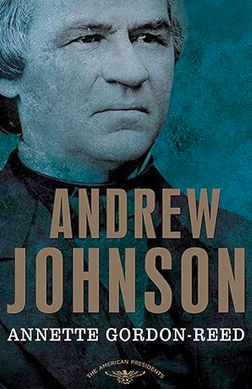
Well, December was a heckuva month, that’s all I can say. I read twenty books this month alone, though quite a few entries were ‘short’ — I’ve been making my way through The American Presidents series, all volumes of which are compact, and of course there was Narnia and a few science books I choose specifically because they were short and matched categories I needed to fill for the Science Survey. My Christmas was fairly uneventful: my family couldn’t make any plans, as we are still waiting for the arrival of my great-nephew, so I spent the day sitting on a porch with friends. I spent the majority of the month working on my current obsession, understanding sectional politics in the 1840s – 1850s leading to the Civil War. I made major strides on a presidential reading list, and am currently devouring a volume on John Tyler. Tyler is an unusual character: two decades after his presidency ended, he was part of the convention that voted for Virginia to secede from the Union, and he was elected to the Confederate congress, only to die before he could take his place. My Advent reading was lackluster, but not as lackluster as prior years; I did, at least, read a few titles — a history of the Book of Common Prayer, and the last two books in the Narnia series, both of which are Advent appropriate.
Nonbook Commonplace Quotes
It’s not a feelgood book, but I don’t read and watch movies to feel good; I do it to learn more about the mysteries of the world. Rod Dreher, “Budapest, Mon Amour“
Some people ask me why I get such pleasure from reading books that others would find distressing (e.g., a history of the Great War and cultural decline, Weimar, the Apocalypse). The answer is because nothing makes me happier than gaining deeper understanding of God and the world. – ibid
Moviewatch
What Did Jack Do? David Lynch interrogates a capuchin monkey for 20 minutes in what feels like an exchange of nonsequitors. Short film.
The Wonderful Story of Henry Sugar and More. A collection of little-known Roald Dahl stories brought to life by Wes Anderson and actors with serious chops like Ralph Fiennes, Benedict Cumberbatch, and Ben Kingsley.
The Big Short. A dramatization of the 2008 economic crisis that led to the Great Recession from the point of view of investors who saw it coming and were determined to capitalize on it. Not as good as Margin Call, but it had a good acting bench. Margin Call was such a tight story, focusing on a few men and women over a single weekend, all managing to make staring at their computer scenes riveting. Jeremy Irons and Kevin Spacey certainly went a long way. Also, I watched Big Short on YouTube for free and it was heavily censored, resulting in high-powered business executive screaming about “dog doo”. (Even better are hip hop lyrics that rhyme doo doo with boo boo.) Brad Pitt is an unexpected broker-turned-doomer with an organic garden and a lot of opinions. The movie occasionally uses cameos like Margot Robie, Anthony Bourdain, and….Selena Gomez? ….. to explain some of the concepts involved. This always breaks the fourth wall, but it works, especially when the explainer is in the scene and the camera just focuses on them. Also, Marisa Tomei plays a bit part!
Bring it On, 2000. Continuing in my quest to watch the movies that everyone else in middle and high school was watching but that I missed, Bring it On is about a cheerleading competition. Kirsten Dunst just inherited her squad from Big Red, who is now going off to college, and at the beginning of the movie she gets a shock: all of her squad’s cheers have been copied by some school in the ghetto by Big Red. Said other school has a new captain, too, and she’s determined to make it to nationals and destroy the squad of rich girls who have been stealing her chants. I enjoyed it for retro tech (like a Gameboy Pocket with a Gameboy Camera attached), the period music, etc.
Gettysburg, 1993. I love this movie; I have watched it I don’t know how many times, and that is a feat given that it’s four hours long. I bought it in high school, along with the book it was based on (though I did not know that at the time). Its characterizations have been in my head for two decades; it was my introduction to actors like Martin Sheen, Sam Elliot, Jeff Daniels, and more. Shaara’s The Killer Angels’ has a style that influences my own fiction, when I write it. There is so much about this movie that is….exquisite. The landscape, as it was filmed in Gettysburg National Park; the battle scenes, using reenactors who knew what they were doing; the divine music, but perhaps most of all for me….the characterization. The characters themselves are so strong – Chamberlain’s sense of duty and justice, coupled with humility; General Amistead’s devotion to his friend General Hancock across the lines, his sobbing horror to learn on Day Three that Hancock had been wounded – Longstreet’s deeply conflicted demeanor, Pickett’s exuberance and warmth and pain. When I was a teenager, I was deep in a Civil War phase and experienced this alongside Sid Meier’s Gettysburg and loved the battle scenes; as I have matured, or at least aged, I find the character drama ever more compelling.
“I’m sorry, sir, the general’s down. He’s been hit.” “No! Not…..both of us! Not….all of us! Please, God!!!”
Richard Jordan, who played General Armistead, died before this film finished post production.
The Lincoln Lawyer, 2011. Matthew McConaughey, Marisa Tomei!, William Macy, and – – BRYAN CRANSTON? Oh, and Bob Gunton, who played Captain Maxwell in ST TNG’s “The Cardassians”. Matthew McConaughey plays a ‘street lawyer’ of sorts – representing all sorts of genuine criminals who are scattered so widely across greater LA that he spends his days in Lincoln towncar. A potentially lucrative case has an uncanny resemblance of one of his earlier cases, and M.M. begins wondering if he isn’t actually defending a monster.
True Grit, 2010. Technically a rewatch, though it’s been 15 years. Based off the Charles Portis novel, which it is far more faithful to than the John Wayne movie, buuut I watched the John Wayne/Robert Duvall film first, so I’m still partial to it. Young Mattie Ross has come to Texas to settle her father’s affairs and avenge his murder; she hires a marshal with a reputation for meanness and drinking to pursue the treacherous Tom Chaney ‘til his death.
“Who is the best Marshall?” “I’d have to weigh that. William Waters is the best tracker — half Comanche. Something else to see him cut a track! The meanest is Rooster Cogburn. He’s pitiless, double-tough. Fear don’t enter into his thinking. Does like to pull a cork. The BEST is probably L. T. Quinn. He brings his prisoners in alive, believes even the worst of men is entitled to a fair shake.” “…..where can I can find this Rooster?”
Gods and Generals (2003). This is a prequel to Gettysburg, just as the novel that it’s based on is a prequel-in-spirit to its own inspiration, The Killer Angels. Gods and Generals is an altogether different experience, though: instead of following a battle, it covers nearly three years and its first hour is set wholly before the war begins. The pace is slower, and Stonewall Jackson dominates the film in a way that no one could in Gettysburg. Lang steals any scene he is in, even in the slower ones that give the viewer a rest between First Manassas, Fredericksburg, etc. I watched the extended version, which adds a John Wilkes Booth chain of scenes that culminate in both him and his costar Harrison deciding to help the Confederate cause in their own ways. Sharp-eyed viewers will recognize this Harrison as the same man who was the scout in Gettysburg, though I do not know if he is based on a real person. I also am very wary of how closely this film’s Stonewall Jackson is based on the real man, because he often talks like one of the Nashville Southern Agrarians of a half-century later — especially when commenting that the war may bring the triumph of the banks — rather than the actual general. I have not read a great deal into Stonewall, but I’m fairly certain that element would have crossed my radar by this point considering that I have read the Southern Agrarians.
I’ll Be Home for Christmas, 1998. This was a family favorite growing up, mostly because we were really into Home Improvement. Jonathan Taylor Thomas of HI fame plays Jake, an inconsiderate rich kid who gets some comeuppance when some bullies kidnap him, glue a Santa hat, beard, and suit to him, and leave him in the middle of the desert without any way of knowing where he is or how to get home. More than that, his girlfriend Jessica Biel thinks he’s stood her up and reluctantly decides to accept a ride back across the country with Adam LaVorgna, the same bully who deserted JTT. JTT has to charm and swindle his way back home – from Cali to New York – so his girlfriend doesn’t dump him forever. Also, his dad promised him a Porsche if he came home for Christmas: JTT has been avoiding the homefront since dad (Lumberg from Office Space) remarried following the death of JTT’s mom. Along the way JTT learns the meaning of Christmas. I knew all of the principal actors as a kid – JTT from Hompe Improvement, Biel and LaVorna from Seventh Heaven – so I loved this. Rewatching with the ladyfriend was fun.
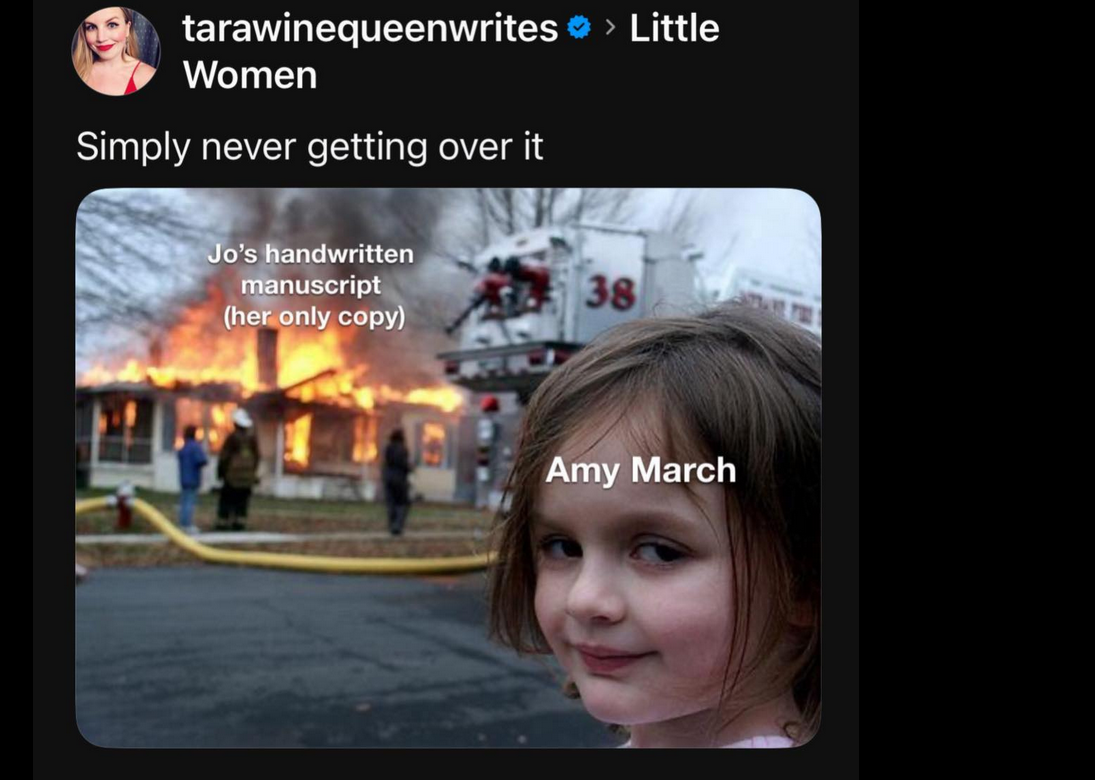
Little Women, 1994. While I have seen a version of Little Women before, I’m fairly certain it wasn’t this one, because it’s all kinds of charming and I would’ve never forgotten it. It’s absolutely delightful, what with the opening Christmas scenes, the girls acting out what Jo was writing, and Young Batman being a bit scampish. The book and novel follow the March girls as they mature and navigate society’s expectations of them, as well as their own passions. Lovely music, and quite cozy. Lots of star power – Susan Sarandon, Winona Ryder, Christian Bale, and a very young Claire Danes. A feature with the LF.
The Heavenly Kid, 1985. A Fonz-like character accidentally dies in a car stunt and finds himself in a smoky restaurant called “Midtown”. He’s not wicked enough to go Downtown – just a stupid teeanger, really – but he also wasn’t a good enough guy to go Uptown. He’s consigned to ride the subways for nearly two decades until he’s sprung loose in the 1980s and told to befriend a teenager – a total spazola – and help him out. Fonz starts trying to give the kid lessens in charisma and confidence, but then realizes: the kid’s mom is his old girl! The girl he got killed trying to impress, even though she told him “You don’t come back from Dead Man’s Currrrrvveeee!”. What he doesn’t know? The spazola is his kid. This was a film I watched several times as a kid, and when I began working and had money, it was one of the first films I bought on DVD. Rewatch with the ladyfriend.
Housesitter, 1992. A rare Steve Martin film that I have NOT seen. Cowatch with the LF. Martin plays an architect who runs into a girl who decides to ….uh, move into a house he built and then pretend to be his wife, and then hilarity ensues, especially as Martin tries to use the fake-marriage to aid and abet his desire to woo his ex-girlfriend by demonstrating how good a husband he is. (Ignore the whole cheating thing.)
A League of their Own, 1992. During World War 2, an all-woman baseball league is formed to keep the sport alive while Teddy Ballgame, Joe DiMaggio, & others are running bases around the Germans. Despite the number of times I’ve watched Tom Hanks’ “There’s no crying in baseball!” scene, this is a first time for me. Lots of 1940s swing music, which was a definite plus, and the acting ‘bullpen’ as it were was great fun. I especially liked seeing Lori Petty — who I knew from In the Army Now — appear here as Kit, the younger sister of the main character Dottie. Their sibling rivalry is a major part of the movie; another arc is Tom Hanks’ slowly-kindling relationship with the team. He’s a washed-up ballplayer who ruined his prospects through liquor, and resents being made to babysit a bunch of “girls”: eventually he starts appreciating their passion and talent for the game. Wonderful way to close the year out! This would’ve made the movie top ten list (in place of The Lincoln Lawyer) had I not posted said list so early.
Books in bold are superior favorites. I’ve been trying to whip one of my drafts of Provoked into shape fit for posting but am still not happy yet. It will happen, though. I’m close.
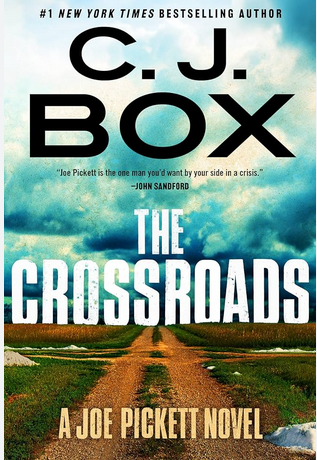
Here we are at the end of another year. After the distressing takeover of fiction in 2024, I was determined to not let that happen again. Then entered CJ Box, whose 26-strong Joe Pickett series lassoed my intentions off their horse and carried them into the wilderness where I was happily lost for several months. Nearly all of April and May’s reading were CJ Box, and I almost got sucked into another game warden series but was saved by the fact that my library doesn’t have as many Doirons as it does Boxes. In all, it was a strong and I think varied year, with chaotic alt-history, Grease, and crime mingling with my usual staples.
I began the year with great aspirations. I was going to tour Europe through history books, learning about the days when Sweden and Poland were major players. I was going to finish my second Classics Club—and I was going to re-read a bunch of books that were formative for me to see how another decade of life had changed my perspective. I read exactly one book in the Grand Tour, forgot the Classics Club list even existed, but did re-read a few titles. Not the main one I’d intended, Death and Life of Great American Cities, but I’ll take the pitches I can get over the plate.
Blogwise, I’m generally pleased with my activity as a scribbler: I reviewed virtually everything I read, I don’t think I missed a single Teaser Tuesday/WWW Wednesday, and I began experimenting with a feature called Saturday Shorts that last about as long as many other features I’ve played with over the years. I’m still divided on it: I liked the idea of featuring short stories on occasion, but it’s also been my habit the last few years to withdraw from the blogging world on weekends to focus on that ‘real life’ thing people still talk about. Maybe as a monthly feature.
I began the year with expectations I’d have my usual 60/40 or 70/30 split favoring nonfiction. CJ Box almost made that not happen, but Nonfiction reasserted its dominance by the end, if barely.
My standing goal is to keep the number of purchased books under 10%, so I failed miserably there. However, Kindle Unlimited is definitely paying for itself.
Ebooks overtook physical this year, but they’re fairly back and forth in recent history. Audiobooks are consistent with last year’s 11%.
History is…er, double its amount from last year. Granted, it has a slight boost because I combined it with Biography, given my amount of biographies-read-for-historical interest.
History
History had a strong year, with well over FIFTY titles by itself and closer to seventy if biographies are included. That’s not unusual: history is typically queen of the stacks, nonfiction or otherwise. An early standout for me was Susan Besser’s Selma: An Architectural Field Guide, which gave an architectural analysis and history of hundreds of buildings in my city’s historic business and residential districts. Given that I’m a local history librarian, this was both a godsend and something I was able to contribute to. The year’s early history offerings were mostly baseball oriented, a favorite being Memories from the Microphone, a history of baseball broadcasting. I listened to this as an audiobook and highly enjoyed the narrator’s impersonations of Dizzy Dean, a pitcher-turned-sportscaster. I also thoroughly enjoyed Ty Cobb, Charles Lehrson’s thorough biography of the great ballplayer. After that, it was fairly varied: the Mob in Cuba, Rome, medieval Europe, etc, and so on until I went on a Civil War binge the last two months of the year. The highlight of that, and a highlight of the year in general, was Battle Cry of Freedom by James McPherson, with The Life of Billy Yank by Bell Irwin Wiley not far behind it. I read several of Wiley’s social histories of the war after Billy. Biographies were a bit thing this year, even before my history binge in November and December: I had fourteen biographies for the year, including two other top-ten favorites, Benjamin Franklinand Gandolfini. The latter wound up guiding my movie-watching for the rest of the year as I began devouring Gandolini’s film presences.
Mysteries and Thrillers
Man alive, was I obsessed with CJ Box’s Joe Pickett series. I have never just married a series the way I did the Pickett stories, nor dedicated a post to raving about it. Joe is such a likeable character, I loved the storytelling that used the Wyoming landscape to full effect, and the books manage to hit all the emotions throughout the series. I also read some Paul Doiron, another game warden novelist, but held myself back to allow nonfiction to catch up. Expect more of him next year, though. Box got me to reading some game warden nonfiction, too. He’s one of those authors like Asimov or Cornwell who just completely changed my reading life the year I found them.
Historical Fiction
HF is usually one of my strongest categories, and after a strong start I thought it would be sitting pretty at year’s end. Then CJ Box happened, I think, and I was trying for the rest of the year to avoid fiction running away again. The year’s opening book, Sword Brethren, is the beginning of a most promising series – that of an English nobleman who is betrayed and forced to seek fame and fortune in Eastern Europe. That’s an area I know vanishingly little about prior to the 20th century, I’ll be looking for more by that author. 2025 also marked my returning to Steven Saylor after a long break, in part because I was in a serious Roman mood for a bit that led to me buying an enormous Augustus Caesar biography. I also returned to an old favorite, Max Hennessey, and read a couple of his aviation novels. Marce Catlett could fall in the area of historical fiction considering that it begins in 1907 and ends (I think) somewhere in the middle of the 20th century. It was another of my top ten favorites, another Port William story.
Science
Science started off with a bang, with three entries in January alone, followed in February by two more. And then, mysteriously in the late spring, it dropped off the radar and only a deliberate push in late December allowed me to finish the year with my head up and not hanging. Some of my ‘science’ titles were also not purely science – Storm of the Century and Bringing Back the Beaver – but they had enough science content to pass muster. Although Primate Made put up a good fight, I think The Light Eatersprevails as my favorite science book of the year. I am getting closer and closer to finishing Neil deGrasse Tyson’s works: I think the only one I’m lacking now is his entry on science and the military-industrial complex.
Science Fiction
SF was also weak, unless we count the Roswell High YA series that I re-read, in which case it had a strong year by the numbers. I listened to a few short stories by Arthur C. Clarke, but the only SF titles I’ll remember from this year are Husk and SHELLI: MurderMind, the latter being a sequel to the SF mystery-thriller I enjoyed so much last year. I also read Scalzi’s latest, though it was more of a lark than anything else. I’d expected a big boost in SF in November, but between a Narnia re-read and the Civil War, that did not happen. Relatedly, I only read two Star Trek books. I’m not sure how to account for the falloff: certainly the fact that fewer Trek books are being published helps, alongside the literal death of the extended litverse I loved so much from 2004 until the return of Trek to the screen. Now we’re seeing the return of The Aliens of the Week, which honestly makes me feel contemptuous. We had characters with history, alien races with histories and developed cultures, and now — now it’s back to Planet of Hats.
Politics and Civic Interest
This was an interesting category this year. I began it with Strong Towns: The Book, which I’d anticipated reading for a few years – having follower of the author for sixteen years now. I read a couple of titles on the Biden administration, neither of them compelling, and enjoyed digging into The Nixon Conspiracy. That almost kicked off a Nixon binge, as I have two Nixon titles waiting to be finished and keep eying Being Nixon on the shelves of my local indie bookstore. Midyear I began thinking about America @ 250 Reading, and consequently read a few more presidential biographies, my favorite being Man of Iron. And then there’s Paul Kingsnorth, whose works partially touch on politics, but more on him later. The big kahuna in this category, though, is Scott Horton’s Provoked, a history of DC-Russia relations since the ‘end’ of the Cold War. I listen to Horton’s podcast, so I thought I’d be familiar with most of the content….but brother, I didn’t know the half of what mischief DC has perpetuated in Europe. Here I thought it saved its chaotic energy for destroying the middle east! I have several drafts of a review and am still faintly hoping to I also took a deep dive into political history at the end of the year, studying the personalities involved in the sectional strife of the early 19th century that ultimately led to Civil War. That will continue into the New Year, I think, as I’m deep into a Tyler biography and am anxious to start on Chorus of the Union.
Yes, he gets his own category, because he’s too singular a writer to be filed anywhere else. Imagine Wendell Berry refracted through Eastern Orthodoxy and the lived experience of a former political activist. After meeting Kingsnorth at a conference last year and hearing him speak about Against the Machine—which he described, without irony, as his life’s work—I went back and read his earlier nonfiction, even knowing he regarded those books as preparatory steps. Kingsnorth resonates deeply with me because he articulates questions I’ve been worrying at for most of my adult life. Like Berry, he writes powerfully about our alienation from creation and the personal, social, and political costs of that severance. Where writers like Neil Postman and Nicholas Carr focus on technology’s effects on attention and cognition, Kingsnorth pushes further, weaving those concerns together with Matthew Crawford’s insistence on our nature as embodied, working creatures and with Berry’s ecological and moral vision. His critique of “the machine” is not merely technological or political, but civilizational—and spiritual. He’s definitely my favorite discovered author of the last few years. His Against the Machineis on my top ten list for the year, butSavage Godswas a precursor that I liked enormously. One No, Many Yeses and Real England were also interesting, but not not a patch on Savage Gods or his ecological memoir from last year.
2025 was a big year for reading, and while I didn’t make progress in my goals, I had a lot of fun and am currently digging ever deeper into a “history hobbit hole”. That will continue into the New Year, especially since it’s part of my America @ 250 project, but the 19th century will lose its monopoly on my reading once the New Year hits. I always like for January to be a nice mix of subjects: on the off chance that anyone views my “What I’ve Read This Year” tab, I like to give them an idea of the chaotic variety here. As far as 2026 goes, I do not have any huge reading plans: America @ 250 will begin in earnest, and I’ll share more details about that in the days to come. It will be joined by my “fifth” year working on my second classics club list, as well as the usual science survey.
WHAT are you currently reading? President without a Party, Christopher Leahy. An ….incredibly…..detailed….policy history of the Tyler presidency. Also, Jon Meacham’s biography of Andrew Jackson. I am trying to resist reading more of President without a Party so it can be 2026’s first read, but I really want to move on from the level of exhausting political detail.
WHAT are you reading next? Most likely Chorus of the Union: How Abraham Lincoln and Stephen Douglas Set Aside their Rivalry to Save the Nation, Edward McClelland, but with the New Year coming, who knows? I like January to be a grab-bag of books.
Marce Catlett The Force of a Story takes a life we’ve visited with previously and then visits with it for a while, learning how the story of Andy Catlett was really a continuation of a story in which his grandfather Marce and his father Wheeler had been swept up in prior. This is a theme in Berry’s writings, really: “there’s always more to tell than can be told.” Readers who have delved into the Port William series know that no matter how stirring one particular story within it, the story always grows in richness when other Port William stories are read alongside it, for we begin learning the history of these people and their town. Marce Catlett goes for that effect in a single volume, as we follow the plight of independent farmers from the turn of the 20th century to the time of Andy Catlett, a man whose life has previously been used to shine a light on the community’s ‘dismemberment’. We already know that Andy goes to college and begins to learn of ‘modern agriculture’, only to walk away in disgust after realizing its methods are divorced from the land and particular the love of it – bearing more resemblance to industrialism than stewardship and husbandry. Marce Catlett goes a bit deeper, though, taking us back to a day in 1907 where a man’s entire year of labor, care, and pain disappeared at the auction-house – prices driven so low by one buyer eating up all the others that the crop appears to have not been worth planting at all. This connects to the later theme of Port William books – the brutalization of farming and of towns like Port William by those whose only motivation is the efficient ‘use’ of land, not its care. This was like many Port William stories, beautiful, tragic, and humane. Unusually, though, towards the end it slides into what sounds like one of Berry’s many essays, but one lightly illustrated by Andy, Wheeler, and Marce’s lives.
So in their memories the way went: a passage through the dark, undertaken familiarly by men of their kind in their time. So Marce remembered it to Wheeler, who told it to Andy, who in a world radically changed needed a long time and great care to imagine what he heard, but as he has imagined it he has passed it on to his children, for the story has been, as it stil is, a force and light in their place.
“[Hers] was an old mind, as he would come to understand. It was contemporary insofar as it had acquired the knowledge of younger people, but it was also continuous with minds that had come and gone long before hers.
For [Marce], morality began with a mortal fear of the waste of daylight, particularly of the morning light. He believed with the passion of old custom and his own long observance that at four o’clock in the morning, a man should be awake, on his feet, and at athe barn, caring for what needed care, feeding what needed to be fed.
In those days nobody knew he was a boy who belonged to a story. In those days he did not know it himself.
Port William’s fatal mistake was its failure to value itself at the rate of its affection for itself. Gradually it had learned to value itself as outsiders — as the nation — valued it: as a ‘nowhere place’, a place at the end of the wrong direction. So far as Andy has learned, the Old Order Amish, alone in all the country, have had the wisdom – the divine wisdom, it may be — to give to their own communities a value always primary and preserved by themselves.
As people have grown helpless and lonely, they have come to be governed by those most wealthy, who rule by the purchase of nominal representatives, who, having no longer the use of their own minds, do not know and cannot imagine the actual country by the ruin of which they and their constituents actually live.