
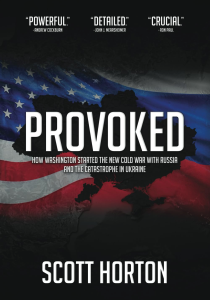
“The 1980s are now calling to ask for their foreign policy back. Because the Cold War has been over for 20 years! ” – Barack Obama, 2012
“The West is leading Ukraine down the primrose path, and the end result is that Ukraine is going to get wrecked.” —John J. Mearsheimer, 2014
“I knew Scott knew a lot of stuff. I didn’t know he could just sit there and go three hours like a James Michtener novel getting into the details, but without losing the audience. ” – Bob Murphy, 2024
“The title is PROVOKED, not JUSTIFIED.” – Scott Horton, 2024
Coming of age amid 9/11 and the terror war made me obsessed with DC’s foreign policy – understanding its actions in the world, and their consequences. The government’s line that “[terrorists] hate us for our freedoms” fell apart pretty quickly for me, as I read Zinn and Kinzer and began seeing how often DC has behaved like a bully while hiding under virtue’s cloak. Over the years I began realizing that news stories I encountered as fragments – war in Chechnya, some fracas over Georgia in 2008 – were really part of a larger story, and it was a story that made more sense as I encountered more pieces and puzzling out the order of them. Provoked is Scott Horton’s attempt to tell that story within a larger history of all that DC has done within Eurasia since the dissolution of the Soviet Union. It is a doorstopper of a book with over ten thousand endnotes, and some chapters that carrying a thousand endnotes on their own. The names, events, and interlocking crises can feel overwhelming at times, but Horton’s clear passion and command of the subject made this a much easier read than might be expected. I do not know how the Russo-Ukraine war, nearing its fourth year, will end – but Provoked is a solid introduction to how it started.
The western narrative regarding the war is a very tidy, neat, and emotionally suasive one. Poor, innocent Ukraine was shamelessly attacked by the nogoodnik Putin, intent on recreating the Russian Empire as though he’d been possessed by the spirit of Kaiser Wilhelm II. Horton regards this narrative as simplistic and naive, and – to those in authority doing the telling – self-serving. The history begins with the promising end of the 1980s: Reagan and Gorbachev agreeing to destroy 90% of the world’s nuclear arms; the fall of the wall in Germany; the dissolution of the Soviet Union observed by a savvy George H.W. Bush who promised not to dance on the remains of the Berlin wall. There were many in the United States who argued for a return to being a ‘normal country’ – but that did not happen. Blame it on the military industrial complex, or the hubris of DC’s elite who viewed this as America’s time to step fully into the sun and become the world power – the global peacemaker and arbiter of order. This had already begun by the end of Bush I’s administration, and the aggrandizement only intensified with every succeeding president. Horton attributes this to the ‘iron triangle’, a joint effort of think tanks, lobbying firms, and the defense industry.
We learn of Clinton openly sending people to involve themselves in Russia’s first elections, of dumping foreign aid carelessly into the hands of men who would become Russia’s oligarchs, and of Clinton taking advantage of Russia’s sudden withdrawal to begin meddling in Bosnia. At first, this Bosnian adventure seems like a strange detour, nowhere near the gates of Kiev or the Kremlin, but it serves two purposes in Horton’s narrative. First, it shows that rather than winding down NATO or becoming a “normal country,” DC chose to bask in its unipolar moment and rebrand itself as a global peacekeeper—resolving disputes largely in its own interests. NATO, in turn, became a tool to keep Europe aligned with DC’s strategic vision, just as the European Union was starting to take shape. It would be a bit and bridle keeping Europe trotting to DC’s lead. Second, the stated justification for U.S. and NATO intervention in the Balkans—the protection of an ethnic minority from a belligerent majority—is exactly the precedent Vladimir Putin cited when he announced the invasion of the Donbass to protect the lives of Russian Ukrainians from a hostile government.
I am not going to attempt to precis a book this large and so overflowing with details, but one running theme for me was how invasive and often destructive DC’s elites have been. I have been a cranky libertarian for fifteen years now; before that I was reading Howard Zinn and Stephen Kinzer. I thought I was as cynical about DC as it was possible to be, but Horton treated me to a new course in stunned outrage. Learning about the US role in how Russia stumbled from Soviet cronyism to kleptocratic cronyism was one thing, but seeing Clinton aiding and abetting jihadist groups in Yugoslavia – and ditto Bush in Chechnya later on – made me furious, frankly. In pursuit of “global dominance”, under the color of spreading “democracy”, DC has armed and funded bad actors year after year. There’s one shocking statement in here where, witnessing the Taliban takeover of Afghanistan, a state department official muses that this situation could work quite well for us: Afghanistan might become another Saudi Arabia. We get oil and stability; the women get burkas. In addition to the main geopolitical coverage – covering how DC essentially resurrected NATO’s reason for being by antagonizing Russia into belligerence – Scott also looks at the way DC’s propaganda machine has managed public opinion at home. One golden example of this is the Washington Post crying foul because Trump was ending support to an “anti-Assad” group in Syria. The group? al-Queda. So much for “never forget”.
It should be noted that Horton writes not in defense of Russia’s actions, but as an explanation of how Putin came to a tipping point where he decided expending men and material to secure Russian interests in the Donbass was more prudent than not. It is an exercise in literary realpolitik. But just as Ron Paul was hissed at by John McCain for suggesting that US foreign policy had led to terrorism becoming an active threat, so too are any critics of the DC-Brussels narrative dismissed as Putin apologists. As Horton said in an interview about the book, though, “The title is Provoked – not Justified.” Time and again we see DC deliberately shoving its weapons into Russia’s personal space – in Georgia in 2008, and especially in Ukraine in 2014. The Maidan ‘coup’, or ‘revolution’ – which noun the reader uses depends on how seriously they take DC and its corporate media allies’ version of the facts – is most important here, because it led directly to the 2022 move by Russia. The democratically elected president of Ukraine was overthrown and a hostile anti-Russia figure installed in office: Russia, in response to a declared enemy on their borders, rushed to secure its bases in Crimea. Ever since then, Russians in the Donbass regions – regions appended to Ukraine by the Soviets, not historically connected to Ukraine – have been antagonized by ‘their’ government in Kiev. Readers may say Russia should have operated through diplomatic channels, but when the DC-Eurocracy is actively promoting anti-Russians on Russia’s borders, why are they surprised when Russia retaliates? DC even promoted Islamic terrorists within Russia during the early War on Terror! Provoke a bear, and it swats back angrily; it does not matter to the bear that you think it is somewhere it ought not to be. This is most visible when Hillary Clinton declared that Russia was doing things in NATO’s backyard – because NATO had pushed its backyard into Russia’s patio. Pray tell, what relation do Poland and Ukraine have to the North Atlantic?
Provoked is not an easy book: in size, in density, or in its challenge to mainstream narratives. There are many for whom Russia is simply the villain, full stop, and its geostrategic interests and fears do not concern them a wit. I doubt this book will sway them—not as though they’d pick up a 700-page book contra to their own opinion to begin with. But for those willing to sit with complexity, Horton offers something vital: a way to understand Putin’s actions without excusing them. The “Provoked, not Justified” distinction matters. One can recognize that DC spent three decades treating Russia like a defeated enemy rather than a potential partner, even laughing at its application to join NATO, and that it armed jihadists and staged coups and pushed NATO right up to Russia’s doorstep—and still condemn the invasion of Ukraine. Understanding why someone does something is not the same as endorsing it. But if we don’t understand the provocations, we’re left with a Saturday-morning-cartoon version of geopolitics where Putin is just a villain coldly swiveling around in his wingtip chair, stroking a cat, and that shallow narrative makes it impossible to prevent the next disaster.
I’ve listened to Scott’s podcast for years, so I thought I knew how the pieces fit together, more or less—but Scott goes into deep detail on ancillary things like Bosnia and the Balkans, all new terrain for me. Even those who think they know this story will find Provoked teaches them something. And for those coming to it fresh, willing to question what they’ve been told? It will both enrage and edify. For anyone trying to understand how the post–Cold War world curdled into a new cold war—and why Ukraine became the flashpoint—this is a daunting but monumentally useful account.
NOTE: Read in June 2025. Re-read in stages in the last six months. This is a big ol’ book.
Related:
The Limits of Partnership, Angela Stent
“Why the Ukraine Crisis is the West’s Fault“, John Mearschimer, 2014. Foreign Affairs.
“Zelensky Vs the Ukrainian Orthodox Church“, The American Conservative. Jan 2023.
All the Shah’s Men, Stephen Kinzer.
Overthrow: America’s Century of Regime Change, Stephen Kinzer.
Scott Horton on Israel & Iran, appearance on the Tom Woods show


I *really* need to start on my stack of Ukraine related books sooner rather than later…. I HAD hoped that the war would be over by now as (much like a TV series that might get cancelled at any point) I like to be able to look back at the complete thing without having to wait possibly years for the reasoned conclusion……
As did I — I thought the ‘halt’ to Ukraine aid would cause SOMETHING to change, but both P and Z are dug in and married to their causes, I suppose.
Well, one’s a cynical land grab and the other is fighting off an existential threat… so I don’t think that the Ukrainians are going to be giving up any time soon. Personally I think we should be giving the Ukrainians pretty much everything they ask for….
Of course the quickest way for the war to end is for Russia to leave and stop attacking another sovereign nation – but that’s not the world we live in…. apparently….
And that’s the problem with the west — I believe Putin believes HE is fighting an existential threat to Russia because of perceived encirclement from NATO, who as Horton documents have continually pushed in on Russia with knives drawn. The “Putin is Hitler” or “Putin is Napoleon” stuff is laughable — the same commentators keep saying “If we don’t fund Ukraine, Putin will take over Europe” and then fifteen minutes later, “Putin is on the ropes! Two more weeks to stop the spread! I mean, invasion!”. Ultimately I think Putin will get what he wants — the Donbass and a neutralized Ukraine — but at the cost of FAR more men and material than he expected, and poisoning Russia’s reputation with Europe for at least a century. Considering the amount of men being thrown away and Russia’s dismal birthrates, even if he wins it’s Pyrrhic at BEST. It’s accelerating both of their ruins.
The idea that NATO expansion is an existential threat to Russia is nonsensical. Where exactly is the threat? The countries around Russia wanted to join NATO because of the threat FROM Russia. They KNOW what Russian occupation is like. That’s why they joined. For their own protection from Russian expansionism… Russia has NO right to a ‘sphere of influence’ where they control/influence the fates of neighbour nations against their wills. We got rid of that colonial idea (or should have!) 100+ years ago.
Russia has certainly over extended itself in Ukraine and has, no doubt, done itself lasting damage – maybe even fatal damage in the medium term and for what? It is beyond stupid. When its finally over Russia *might* get parts of the Donbass but as part of that agreement I think Ukraine should get into the EU and be put on a confirmed track for NATO membership – that would be one hell of a security guarantee!