Sycamore Row

Sycamore Row
© 2013 John Grisham
464 pages

 I have been less than impressed with John Grisham’s books in recent years; The Racketeer made me suspect Grisham or his publishers were merely milking the success of his name.  Sycamore Row, however, is a return to the Grisham of yore; set in his fictional Clanton, Mississippi, the site of many of his better novels.  A direct sequel to his first novel, and building off many others, Sycamore Row is good work, a legal thriller and a story of restoration and forgiveness.

Sycamore Row picks up only two years after the climax of A Time to Kill, in which Jake Brigance defended a black father who meted out shotgun justice to two white hooligans who beat and raped his young daughter. No one expected Brigance to triumph, not in a town like Clanton where racial tensions ran deep. But he did,  and the storied reputation he earned as  a progressive lawyer of integrity earned him the job that begins in Sycamore Road. On a fine Sunday morning, a local businessman, Seth Hubbard, is found hanging from a tree on his property; the next day, Brigance receives a letter from the man appointing him the executor of his will, a handwritten document that cuts out the man’s family and leaves his enormous fortune to…the maid.  The black maid.  Once again Jake is thrown into a controversial trial that some want badly to turn into a good ol’ race war. Jake  has no interest in that kind of legal battle;  the Hailey trial saw his house and dog perish in flames set by the Ku Klux Klan.

Although the premise sounds a bit much like The Testament — where another rich old man left a handwritten will that disinherited his family and dumped the fortune on someone who no one had ever heard of, namely a missionary in South America —  the legal battle turns into a historical mystery that comes into light only late in the novel. The legal question of whether Hubbard was sane enough to produce a legally valid will is resolved not by trial arguments, but by historical fact as the characters struggle to discover what Seth Hubbard knew. The characters include not only Jake, but other Clanton favorites like Harry Rex Vonner, a cranky if wise divorce lawyer, and Lucien Wilbanks, who is the last of a noble clan of gentry, a disbarred southern scion with a taste for sour mash and a proud member of the NAACP — just to rile folks up.  Sycamore Row‘s  enmeshment with the other Clanton novels will make this work especially attractive for Grisham readers, especially those like myself who’ve been disappointed by works like The Associate and The Racketeer.   The presiding judge is Reuben V. Atlee, whose own will will cause a stir in  The Summons which it neglects to mention $3 million sitting around in boxes in his basement. Even Willie Traynor, who owned the newspaper whose story was told in The Last Juror, makes a few steady appearances.

For those not enamored of the greater Clanton story, Sycamore Row is still superior to many Grisham works because it’s not idle entertainment.  Grisham develops a theme of forgiveness throughout, and the final resolution is magnificent. There’s no preachiness, no lectures from the main characters nor wisdom dispersed from a town savant; forgiveness and restoration are written into the character’s very actions.  I was spellbound, and hope Grisham returns to Clanton again.
Posted in Reviews | Tagged , , , , , | 2 Comments

The Redneck Manifesto

The Redneck Manifesto: How Hicks, Hillbillies, and White Trash Became Amerca’s Scapegoats
© 1998 Jim Goad
272 pages

Rednecks of the world, unite! You have nothing to lose but your bills.   Jim Goad’s The Redneck Manifesto is a raucous mixture of southern pride and Marx-esque social criticism which examines the plight of working whites. Although few would take seriously the concept of white plight,  in Goad’s eyes ‘privilege whites’ constitute a minority of American whites;  most are working-class slobs like himself who have been treated as miserably throughout American history as any minority,  even slaves.  His aim is to expose anti-prole bigotry, by shock therapy if need be, and demonstrate that America’s big problems are rooted in class, not ethnic tension.

His history might echo A People’s History if Howard Zinn had focused on working whites and were give nto telling the reader to “f*** off”.  It is a history rooted in class conflict: since time immemorial, a wealthy few have kept most of the power in their hands, and America is no different. Though our national legend involves Pilgrims seeking liberty, in the fact of the matter is that most whites who immigrated came against their wills; they were the poor pushed off the fields, scraped off the streets, and shanghaied across the Atlantic to toil as indentured servants.  Volunteering or conscripting in the Revolution, they died to help create a Constitution which had no place for them, and the centuries of progress that followed brought only more of the same. The Civil War destroyed the economy of the south, but did little to displace the power-elite; industrialism proved even more lethal than the killing fields of Europe’s Great War, at least for Americans,  as thousands died every year from factory and mining accidents. The rest of the century was no better;  homes were blown apart as companies tried to crack open the Appalachian mountains like a walnut, with no mind given to the people who lived there, and free trade agreements saw the disappearance of jobs which remained.  To add insult to injury, institutions that persecuted blacks, like slavery and Jim Crow laws, were somehow blamed on the impoverished working class, despite it being just as disenfranchised by local elites. (Documents like the 1901 Alabama Constitution remain equal-opportunity oppressors of the working poor.)  While the 20th century saw various populations gain media shielding and political protection, the white working class remained a common horse to beat on,  a pleasure shared by both formerly-marginalized minorities and the elite.

Against all this, Goad doesn’t call for sensitivity; no self-respecting working man would whine. What he does want is for everyone to leave rednecks the hell alone. Making fun of his kin on TV is one thing; everybody likes their scapegoats. What he has his sights on is excessive tax burdens; let the government be paid for by people who receive the services, or the propertied —  and the United States’ foreign policy, which typically involves sending the sons and daughters of the poor to fight  to fulfill the elite’s ambitions.  War is the harvester of the home, and nothing else.  In addition to calling for an end to death and taxes, Goad celebrates the culture of the white working family,  with chapters given over to “Playing Hard” and  even to “Praying Hard”, despite Goad’s firm belief that religion and politics are both full of it.

The Redneck Manifesto may have a serious intent, but it’s hard to take the delivery as such. Goad is deliberately and enthusiastically vulgar, employing racial slurs throughout to goad the reader, hopefully forcing them to see ‘redneck’ and ‘hillbilly’ as pejoratives on the level as  kike, Chink, and yea, even the dreaded “N-word”.  That’s artistic license,  but his seemingly schizophrenic style —  alternating between informal if serious analysis and seemingly insane ranting,  throwing in nicknames for personalities and employing colloquial spelling randomly  —  can easily throw a reader off. It’s surely deliberate; Goad’s whole purpose in writing the  book is defy conventional attitudes.

The Redneck Manifesto is a fascinating if problematic book; it’s not a perspective I’m used to hearing. Class is a taboo topic now, relegated only to Marxists — and few working men would give Marx’s conflict theory of society a moment’s consideration after a half-century of being assured by the TV that in America we’re all one big happy middle-class family.  Good luck, too, finding the self-described Marxist who would go anywhere near ethnic consciousness if they are white. As a product of the white working class with a sympathy for Marxist social critique, I had a ball reading this — even while wading through the eccentric treatment of the English tongue. It’s funny, cringingly inappropriate, and yet thoughtful at the same time; a tirade with a point. There’s tremendous value in looking at an often ignored segment of the impoverished population, but considering the abuse Goad hurls out, readers other than southerners looking for a sympathetic voice — of which Goad’s is surely one — might put it down early.

Posted in history, Reviews, Society and Culture | Tagged , , , , , , | Leave a comment

Daily Life in Anglo-Saxon England

Daily Life in Anglo-Saxon England
© 2008 Sally Crawford
224 pages


            Who were the Anglo-Saxons? For a people conquered in 1066, their culture seems strangely dominant;  the land the Normans conquered remains England, not Greater Normandy, and Norman French is only an influence on the more native English, never having displaced the old language.   Daily Life in Anglo-Saxon England examines the earthy details of the Anglo-Saxons’ lives; the construction of their homes, the styles of dress, the culture they practiced at home and in community with one another. Separate chapters address both the material, like tools and towns, and cultural (religion and governance).  While some sections are based on physical artifacts, other evidence is documentary, taken from older histories like Bede’s, or inferred from miscellaneous documents.  The assertion that the Anglo-Saxons valued family care is drawn both from the presence of an adult skeleton who was born missing an arm and various descriptions of personalities in histories and graves as doting kinsmen and the like.   The book has a somewhat slow start (save for readers who are utterly fascinated by the difference between sunken-earth homes and free-standing  houses as archaeological sites), but on the whole is quite engaging.  The main point of the author’s writing is to rescue the Saxons from the perception that they were filthy peasants, knuckle-dragging their way around mud huts until the arrival of Christianity and the Norman French.  Her survey of their social life certainly illustrates how rich a life their culture possessed, and how sympathetic they can be even to modern readers.
Posted in history, Reviews | Tagged , , , , , , , , | Leave a comment

On Desire

On Desire: Why We Want What We Want
© 2007 William Irvine
337 pages

Why do we want what we want? William Irvine’s On Desire examines the nature of desire, exploring first how profoundly it affects our lives, then surveying psychological inquiries into its basis before at last turning to consider how religions, philosophies, and odd ducks have attempted to grapple with it.  Irvine is author previously of A Guide to the Good Life,  a manual on the practice of Stoicism, and the two works have a common subject and a likely audience.  On Desire  is one part science and another philosophy,  thorough but concise. 
We are not merely what we think deliberately;  anyone can realize their mind has a life of its own with a simple experiment: simply shut your eyes and attempt to count slowly to ten.  The count will not even reach five before thoughts start floating up and competing for attention. Where do these distractions come from?  After a brief introductory section in which Irvine comments on how profoundly our life can be changed by desires beyond our control —  falling in love, for instance —   the second part of the book offers that desires are ultimately the result of our instincts, a kind of biological incentive system that’s had a cobbled-together evolutionary history. 
That our minds are driven by evolutionary forces is natural, but not ideal;  following every desire is not the road to happiness. Indeed, even if the desires didn’t lead to our immediate destruction (like the urge to pet a sleeping lion), heeding every impulse leaves a person constantly in need of stimulation. That in mind, it is no accident that virtually every religion, and most moral philosophies, have addressed the matter of desire, and in the third section of the work Irvine examines Abrahamic, Greek, and Buddhist approaches. While the Abrahamic religions typically couch mastery of desire so that people can attain heaven and everlasting bliss,  the Greek schools (Stoicism and Epicureanism) and Buddhism have a more this-worldy approach:  desire is countered to achieve tranquility or to maximize enjoyment.   After surveying the advice given to students by such luminaries as Augustine,  Seneca, and Henry David Thoreau,  Baxter notes that despite the variety of contradictions, there are some common lessons that can be distilled.

The foundational observation is that desires should not be trusted. If we practice mindfulness, we will immediately realize their impermanence;  like a child blowing bubbles,  one desire will be a phantasm among dozens, constantly moving, eventually fading. Desires compete with one another, and so thick are they that our intellect is crowded out; it plays ‘second fiddle’. The most potent desires are the ones we have the least control over, but no desire is really insatiable.   Even though they cannot be fulfilled, they can be resisted; our biological incentive system may try to punish us, but it’s not the end the world. Ultimately, the only way to truly fight desires is to change ourselves to learn to appreciate — through philosophy, religion, etc — what we have, to  use techniques both ancient and modern to strengthen our minds against the distractions of the moment.  Irvine covers a lot of varied practices within the text for those who develop an interest.

On Desire is a superb work,  quite attractive to anyone with an interest in mindfulness. My own Stoic leanings predispose me to enjoy it, of course, but I think it laudable also for demonstrating how our evolutionary history has consequences in our present life; although we’d like to think that natural history is history, a closed book, in truth we are driven by the same instincts today that wrote that book. The thoughtfulness of a work such as this gives us the ability to avoid much of the suffering that nature’s book is replete with.  

Related:
Irvine’s own The Good Life: the Ancient Art of Stoic Joy, any book in Stoicism

Posted in Reviews, science | Tagged , , , , , , , | 1 Comment

This week at the library: Chimpanzees, El Niño, and simple living


This week at the library I’ve been working through a lull, having finished my last Stack o’ Books and having not yet gotten another one. My plans to fetch said stack were modified after I did a twelve-mile hike through hills on Saturday and consequently spent Sunday in bed watching episodes of The Office on DVD. Turns out I’m not as rough and ready as I thought.  I’ve been waiting for some books to arrive in the post;  one was ordered weeks ago from Georgia. I could walked over and gotten it by this point! Happily it arrived today. I’ve been biding my time reading a book on composting.  
In the last couple of weeks I’ve read two science books which won’t quite get full comments. The second was Frans de Waal’s Good-Natured, which concerns empathy in animals and  particularly chimpanzees. Considering how much of the book focuses on the same chimpanzees and topics covered in previous works, it’s somewhat redundant; throughout he argues that animals like elephants and chimpanzees are quite socially intelligent,  and delivers example after example to demonstrate how monkeys and chimpanzees act in anticipation of one another’s emotional states, motivated by personal attachment as well as selfish concern.  It’s eye-opening and wondrous if you’ve not read de Waal before, but…I have, and very recently. 
On a different note I read through Brian Fagan’s Floods, Famines, and Emperors, which first attributes the decline of various nation-states to El Niño periods. Considering that in dirt another scientist pinned the decline of some of the same nation-states on their used-up soil,  Floodis something of an example of specialists interpreting everything according to their unique focus. Midway he looks at the stresses climate change has put on historic nations in general, but that is done with more punch in Jared Diamond’s Collapse.  I much prefer the humility of dirt, which offered soil exhaustion as one source of decline, but not The One True Reason.  Fagan remains unique in the field of paleoclimatology, or archaeological meteorology, however.
Presently, I’m reading a delightful book on simple living, and anticipate receiving The Metropolitan Revolution through interlibrary loan shortly enough. Some reviews are in the works for Daily Life in Anglo-Saxon England and On Desire, the latter being nearly finished.  Daily Life took some getting into; the first chapter is a formidable treatment of sunken earth homes which even I couldn’t take to. Happily after that there’s trade, family life, and other such merriment.  Now that I’ve read about the Anglo-Saxons, I’m free to read The Vikings: can’t put the cart before the warhorse!

So, after a busy weekend outdoors and in, the lull is passed and it’s on for a few more interesting books. Happy reading, all!

Posted in history, Reviews, science | Tagged , , , , , , , | Leave a comment

dirt

dirt: the erosion of civilizations
© 2007 Peter R. Montgomery
295 pages

            Civilizations rise or crumble on the soundness of their dirt, says David Montgomery. The life of a people is tied to the life of its soil, in its ability to manage it well. In dirt: the erosion of civilizationshe delivers a history of societal collapses. Humanity is not a species known for moderation, and the pages of history are checkered with fallen empires whose demand for food has strangled the golden goose. After opening with a few chapters on science (beginning with Charles Darwin’s discovery that worms are responsible for reducing organic matter to humus) that explain why soil works the way it does,  subsequent chapters trace human agriculture and soil management from Egypt to modern times.  It is largely a history of failure, as great empires and minor chiefdoms alike exhaust their ground – from Rome to Easter Island.  We have not fared better in our age of scientific and technological mastery, either, as the Dust Bowl proved and as the rapidly diminishing returns of the Green Revolution bear out. Ultimately, Montgomery writes, the story of soil demonstrates that there are limits to growth and ambition; we must learn to adapt our agricultural approaches to the land that is ours, not force one convenient style of farming on every place we discover.   dirt is fascinating if a bit esoteric.


Posted in Reviews | Tagged , , , , , , , , , | Leave a comment

Look Homeward, America!

Look Homeward, America: In Search of Reactionary Radicals and Front-Porch Anarchists
© 2006 Bill Kauffman
250 pages

“The Little Way. That is what we seek. That — contrary to the ethic of personal parking spaces, of the dollar-sign god — is the American way. Dorothy Day kept to that little way, and that is why we honor her. She understood that if small is not beautiful, at least it is always human.”  p. 39

           Look Homeward, America collects the stories of eccentric individuals who, in a century marked by the advance of corporate and state power, rebelled against the machine. Planting their flag above small towns and in the countryside, they held on what they regarded as valuable and defied or attempted to resist the march of a more inhumane world. Bill Kauffman is a sympathetic soul, a die-hard “placeist”. He calls himself the anarchist love-child of Henry David Thoreau and Dorothy Day, and Look Homeward is his tribute to peaceable troublemakers like his ‘parents’. They are farmers and social workers, politicians and miners, men and women whose faith is the family and the local community. They champion self-reliance, local interest, and peace; they scorn war, industrial agriculture, big business, and government bureaucracy.  The expression thereof varies; some are hands-on activists, like Day and Mother Jones,  others very frustrated political candidates, still others authors who sing the song of their places and peoples in novel and verse.No political labels apply here; although most are out to protect traditional expressions of civil society, or are vigorously insisting that the powerful leave them be, these conservatives and libertarians are joined by men like Eugene Debs. A book that can honor the six-time presidential candidate for the Socialist party in the same breath as Wendell Berry (a Kentucky farmer, novelist, and proponent of agrarianism)  is wonderfully eclectic. A strong sense of the meaningful life pervades and is carried forth by both religious personalities (Catholic Dorothy Day, featured prominently) and the irreligious, like Robert Ingersoll.   (The great agnostic only receives a mention, which is too bad; his view of the American republic was quite Jeffersonian.) The expression of this common spirit differs from In essence, Look Homeward is a lively championing of localism, a tribute paid to people whose lives were a great raspberry in the face of war and modern alienation. It’s a ball to read, not only because Kaufman is so personable,  but because of his colorful-but-not-obscene vocabulary.

Related:

“….this institution of the home is the one anarchist institution. That is to say, it is older than law, and stands outside the State. By its nature it is refreshed or corrupted by indefinable forces of custom or kinship.”  – G. K. Chesteron, What’s Wrong with the World?

Posted in Politics and Civic Interest, Reviews | Tagged , , , , , , , , , , , , , , , , | 1 Comment

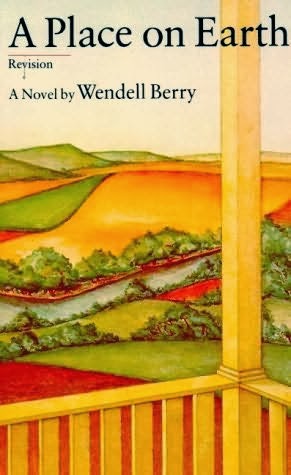
A Place on Earth

A Place on Earth
320 pages
© 1983 Wendell Berry


“I ain’t saying I don’t believe there’s a Heaven. I surely hope there is. That surely would pay off a lot of mortgages. But I do say it ain’t easy to believe. And even while I hope for it, I’ve got to admit I’d rather go to Port William.”  

Remember thou part but dust, and to dust thou shalt return. Between a great war and a terrible flood, A Place on Earth is a hauntingly sad look on the true cost of war to human communities, and a perfectly appropriate book to read on an occasion like Ash Wednesday. A novel of the Port William membership, in A Place on Earth Berry follows the experiences of several men as the war festers and life goes on around it.  Mat Feltner takes the lead, as his soul is tormented by the challenge of coping with his son Virgil’s disappearance and presumed death on an island far from his people. He is not alone;  he has the companionship of his card-playing buddies, and one has experience the same loss as himself. Ultimately, however, the only way to address the pain is to live with it for a while, to let it sink in. A Place on Earth is more than any book in the series so far a reflection on death.

Although the war claims the sons of Port William in other books (Mat Feltner’s son Virgil is the husband lost in Hannah Coulter), Death is a more active character here. As the war ends a great flood sweeps the area, taking with it young lives and sending more families into distress, and another character Jayber begins to be groomed as the village gravedigger. His working himself into the role, and constantly thinking on the life and death of the town, develop throughout the book.  Although the hope of the largely Christian west is that death is restored by life eternal in the Hereafter,  A Place on Earth‘s title hints to the conviction of the townsfolk, religious though they may be, that heavenly pie in an ethereal sky isn’t up to taste. What matters most to them is the connection they have with each other, now, in the course of living their lives. Their sons and daughters are not just personalities to be around, they are people whose lives are depended on as the town goes on, day by day.  Even given the predominant theme of death and meaning, there’s a little levity to be found here; the retiring gravedigger provides a lot of comic relief as he, in the full knowledge that he is aged and allowed to be eccentric and a little mean, lampoons the preacher who is trying to put him out to pasture before his time. Seeing the preacher struggle to dig a grave that promptly floods, he inquires: is this a burial at sea?   A Place on Earth, like Jayber Crow, is beautifully written yet sad, a story of making peace.

Posted in historical fiction, Reviews | Tagged , , , , | Leave a comment

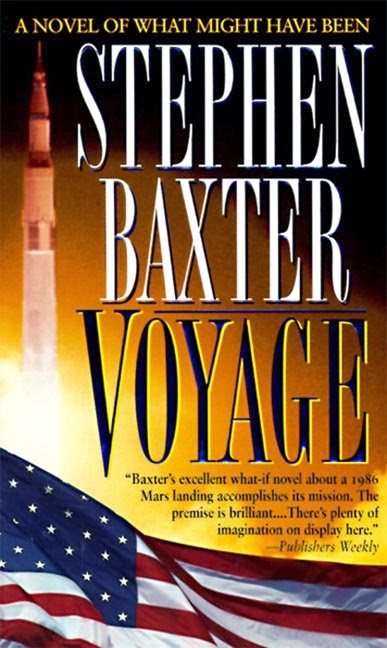
Voyage

Voyage: A Novel of What Might have Been
© 1996 Stephen Baxter
511 pages

            On November 22nd, 1963, John F. Kennedy narrowly escaped assassination while touring Dallas, Texas. A gunman’s assault left his wife Jacqueline dead and the president hospitalized, but he lived to see the fulfillment of the mission he set before the American nation in early 1961:  land a man on the moon and return him safely home before decade’s end. During the famed ‘phone call to the moon’,  JFK issued another challenge:  Mars.  Voyageis an alternate history of the American space program in novel form,  the story of man’s successful journey to Mars.   Voyage impresses, not only with its technical detail, but that combined with its even-handed reflection on what a Mars program might have meant in the 1980s.  

Baxter writes Voyage in two paths that rendezvous in the 1980s: after opening with the Mars-bound flight’s liftoff and following its initial  burns and maneuvers to go for Mars orbit,  he switches to 1969, to the beginning of another more arduous journey, when America steeled itself   for a greater challenge and tried to find a way to make it happen.  Going to Mars isn’t easier than the moon shot, and even the momentum gained by  triumph at the Sea of Tranquility evaporates away as the program is stymied by physical requirements. The crew that goes to Mars will need to be self-supporting for over a year, not just a week;  and though they will be far from rescue they can’t afford to take on too many supplies or incorporate too many  backup systems.  When escaping Earth’s gravity well, every gram counts. Politics and economics complicate matters further;  as the Vietnam War escalates and recession worsens, the government is anxious to cut costs. The war and other government programs might cost far more, but NASA’s expenses are as obvious as their rockets climbing into the sky.  The program carries on through sheer grit, urged on lightly by the aging JFK and pushed by the aerospace industry, wholly dependent on the manned program.

And therein lies the rub, for though Baxter makes clear in his afterword that he regrets the lack of an historic push for Mars,  the timeline of Voyage doesn’t shy away from the fact that such an effort would have been a mixed bag.  The will required to make Mars saps energy for everything else; not only are many of the later Apollo landings scrapped, but the exploration of the solar system by probe is missed altogether, and the Space Shuttle is shelved.  The aerospace industry, rather than diversifying to meet the different challenges needed for advanced probes, the shuttles, and the like, is fixated on one line of technology. It’s not a recipe for a healthy industry, either in business  terms or for personnel:  at least one character is hospitalized as a result of the stress.  The turmoil caused by the constant overwork, in addition to all of the challenges of the seventies, makes the weary United States in Voyagea tired, ailed nation indeed;  will those footsteps on Mars be worth it?

In addition to the story of the United States as a nation, meeting this challenge and coping with the consequences good and bad,   Voyage is a personal encounter, one driven by the ambitions and stubbornness of the astronauts who will make the journey. While some characters are historical (Chuck Jones,  who here stays in NASA instead of joining Sealab), most are invented, including  Joe Muldoon, who relegates poor Buzz Aldrin to nonexistence. The crew that lands is entirely fictional, including the book’s chief viewpoint character Natalie York, who is NASA’s first science-astronaut who sees space, since Harrison Schmitt never flew. Natalie is also the first female, and she’s somewhat sensitive about the fact that she’s breaking into a career dominated by fighter jocks. Part of her own voyage is learning to deal with NASA on its own terms:  the space program isn’t going to stick an unspaced rookie onto the Mars team without her finding a way to be indispensable.         

Space junkies will be most pleased with Voyage; I’ve read at least a half-dozen astronaut memoirs, and the technical detail incorporated into the storyline is on part with the astronauts’ actual accounts. This is definitely on the ‘hard’ side of science fiction, based on real  science, including the NERVA rocket. There are many references to the history-that-might-have-been, from  the head of the Mars program quoting Deke Slayton (“The first men to step on Mars are sitting in this room”) to another hanging a lemon in the window of the Mars lander to indicate that he isn’t pleased,  echoing Gus Grissom and Apollo.  The modules produced for the Mars programs take familiar names, names like Endeavor and Discovery —  names that the Shuttle fleet used.  Like the Apollo program, there are tragedies, some grievous; but while the Challenger of our timeline proved a source of sorrow,  Baxter’s Challenger marks humanity’s greatest accomplishment. It — the ship and the book —  are a fitting salute to the men and women of the space program, and a solid read.

Related:
The Martian, Andy Weir.   Voyage wouldn’t have caught my eye were it not for reading this a week or so ago, the story of a man stranded on Mars in the near future.
Contact, Carl Sagan. Natalie York may have been a redhead, but I imagined and heard her as Ellie Arroway.
Mission to Mars, Buzz Aldrin.

Posted in Reviews, science fiction | Tagged , , , , | 2 Comments

Excerpts from "A Place on Earth"

From Wendell Berry’s A Place on Earth,  the story of a great flood and a terrible war.

In the preacher’s words the Heavenly City has risen up, surmounting their lives, the house, the town — the final hope, in which all the riddles and ends of the world are gathered, illuminated, and bound. This is the preacher’s hope, and he has moved to it alone, outside the claims of time and sorrow, by the motion of desire which he calls faith. In it, having invoked it and raised it up, he is free of the world. But it is this hope — this last simplifying rest-giving movement of the mind — Mat realizes he is not free, and never has been. He is doomed to hope in the world, in the bonds of his own love. He is doomed to take every chance and desperate hope of hope between him and death, Virgil’s, Margaret’s, his. His hope of Heaven must be the hope of a man bound to the world that his life is not ultimately futile or ultimately meaningless, a hope more burdening than despair.  

 p. 94-95

The last words for Tom  ain’t in the letter from the government, and they won’t be said by the preacher. They’ll be said by me and you and the rest of us when we talk about our old times and laugh about the good happenings. They won’t all be said as long as we live. I say that a man has got to deserve to speak of the life of another man and of the death of him.  […]
‘Rest in peace’. That’s not the way these accounts are kept. We don’t rest in peace. The life of a good man who has died belongs to the people who cared about him, and ought to, and maybe itself is as much comfort as ought to be asked or offered. And surely the talk of a reunion in Heaven is thin comfort to people who need each other here as much as we do. I ain’t saying I don’t believe there’s a Heaven. I surely hope there is. That surely would pay off a lot of mortgages. But I do say it ain’t easy to believe. And even while I hope for it, I’ve got to admit I’d rather go to Port William.  

p. 100-101

Without boat or a light, what could he do to save Annie if she should, by whatever miracle it might be, answer him? And he damns himself, with a willingness that startles him, for turning the boat loose, for having taken no precaution to keep the matches dry. Taking the matches out of his pocket, he finds that the heads are either already gone, or they crumble as soon as he touches them to see if they are there. But he continues to take the dead sticks out of his pocket one at a time and to stand them upright inside the sweatband of his hat. It is though his mind, which like his body has begun to work apart from his will, is gambling that absurdity will be more bearable than reasonableness. 

 p. 119

Posted in quotations, Reviews | Tagged , , | Leave a comment