Lost Enlightenment

Lost Enlightenment: Central Asia’s Golden Age from the Arab Conquest to Tamerlane 
© 2015 S. Frederick Starr
618 pages

Lost Enlightenment takes readers back to a time when Central Asia was the crossroads of the world, a hub of both commercial and activity. Here are celebrated the lives of cities which, in this time, were hosts to capitals, universities, and more.  Now they are dust, at best eroded columns in a desolate landscape. In Lost Enlightenment, readers follow Starr east to Baghdad, Merv, and a few other jewels. Though he touches on the political highlights of the region between the Arab conquest and the death of Tamerlane, they are important here only as far as their role in fostering the  arts and sciences.    Although diminished slightly by the complete lack of maps — and in Central Asia, surrounded by the great mass of Eurasia, there are precious few borders to define the area —  Lost Enlightenment is a weighty accomplishment.

Most readers have heard of the ‘silk road’, though much more than silk traveled its routes. The sheer bounty of thinkers and creators here, many of them polymaths and ‘renaissance men’  — though with no need for the renaissance bit.  Starr marks the beginning of this enlightened period with the Arabic invasion, but not because the Arabs came bestowing wisdom among the poor benighted natives. The area was already culturally rich and commercially sophisticated, and its geography frustrated any attempt at sustained conquests. Thus the Islamic Arabs and Central Asians of diverse ethnicities and religions —  Buddhists, Christians ,and Zoroastrians just for starters —  lived with and engaged with one another, iron sharpening iron.   There, philosophies and religions from across Eurasia came together, drawn to the trade cities of Central Asia like a savanna water hole. (They were, literally, water holes — most were near oases). Long used to weighing opposing ideas against one another, Central Asia even tolerated (at times) freethinkers who spoke out against virtually everyone. Here, in this intellectual marketplace of ideas, this constant mental competition, the arts and science flourished — for a time.

What caused their end?  Something as complex as a society doesn’t lend itself to easy answers, and there’s no shortage of little things going wrong for the area of central Asia. The most obvious agent of downfall were the Mongols, who didn’t merely raid civilization: they often destroyed it utterly.  Some regions lost an estimated 90% of their population, and those who were not murdered were driven away in fear.  Genghis Khan should be condemned by all mankind if only for his destruction of Baghdad,  then a shining city upon the banks of the Tigris and Euphrates, but he cut a bloody path jut getting there, leaving behind him ashes and blood-soaked dust. Khan emptied Central Asia, but even before that the arteries were hardening, people receptive to arguments made by theologian-intellectuals like al-Ghazali, who rebuked philosophical materialism in his Incoherence of the Philosophers.  This hardening meant that even when the leaders stumbled upon something revolutionary, like the printing press, it never flared into potency as it did in Europe.

Lost Enlightenment is a considerable survey, mostly intellectual and cultural with a pinch of politics. I certainly welcomed it,  knowing virtually nothing about this area. It is astonishing to hear of places like Afghanistan being hubs of civilized thought, but such is the way of history. Civilizations rise and fall, flower and perish.

* “Central Asians” seems as clumsily artificial as “Yugoslavians” , but the author uses it in lieu of anything better. I suppose it’s easier than “Iranian-Turkic peoples”.

Posted in history, Reviews | Tagged , , , , , , , , | 2 Comments

TW on the Road: Mountain climbing in Alabama?

Three and a half hours north of me, and perhaps an hour or so east of Birmingham, lies Talledaga National Forest and Cheaha National Park.  The above shot is of Pulpit Rock, the apex of the park’s most challenging trail.   I hastened up today, Black Friday, because I figured the  autumn scenery would be gorgeous. I also assumed I’d have the park largely to myself, since everyone else would be out shopping.  I was gloriously right about the scenery, and utterly wrong about the crowd.  The road was lined with parked cars and campers.

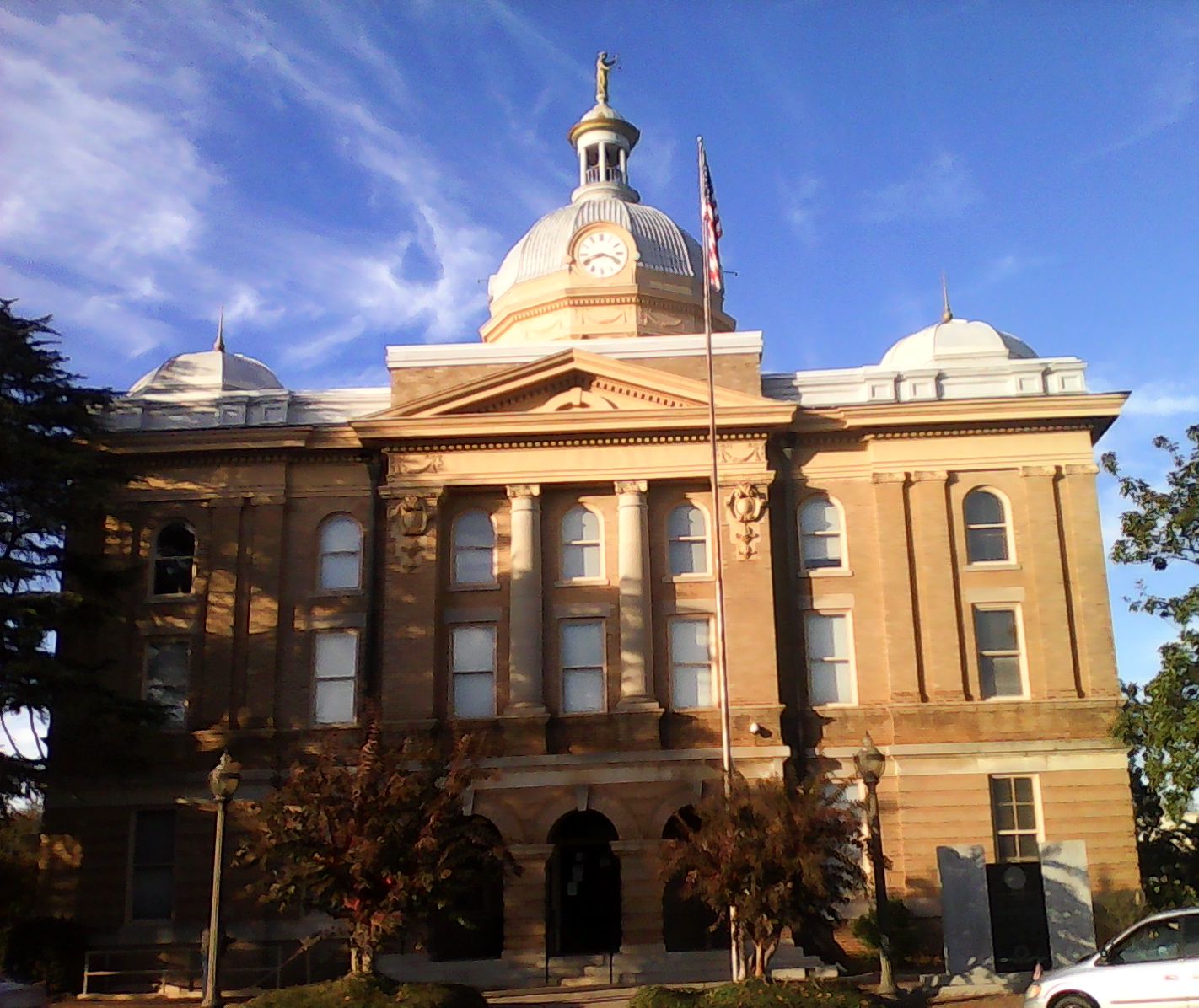
While I took many shots, most of them of the view, and that really doesn’t translate into cameraphones very well.  Although traveling with a couple of friends, I parked myself  on a rock and gazed into the distance for a good while. I haven’t seen an expanse that vast since standing atop Carlsbad Caverns, the wind blowing the grass sideways. On the way home I passed through the cozy square of Ashland, Alabama, and spotted a courthouse so lovely it demanded I swerve into a parking lot and take admiring photos.

With Christmas approaching, it may be a month or so before I jet off again. I passed right by the entrance to DeSoto Caverns today, though…

Posted in General | Tagged , | 6 Comments

The Works

The Works: Anatomy of a City
© 2005  Kate Ascher
240 pages

Cities are, for my money, mankind’s most astonishing invention. Their complexity is stupefying — system within system, handling tons of material at any given time, whether the subject is cars across a bridge or the contents of a thousand home’s flushing toilets. And the stakes are always high, with the health and happiness of millions on the line — or at least, thousands. The Works is a dream of a book, a visual-rich guide to the many systems that keep cities thriving.  Author Kate Ascher throws light not on just the expected — roads and utilities, say — but also minor things like the postal service.  Using New York City as case study, Ascher explores systems for transportation, energy, communication, and sanitation in turn.

The Works stunned me again and again with its visuals. Readers are treated to an astonishing array of informative little diagrams: cutaways that show what’s inside the Holland tunnel, for instance, or the underbelly of a street-sweeper, or the waterworks inside your average skyscraper. The pictures also demonstrate systems — the chain of equipment required to convey power from a generating station into the average home, the links involved in a cell phone conversation,  Some of the visuals are clever: for instance, to illustrate the variety of goods a train might carry,  a cartoon representation of a real train runs along the bottom of every page in the chapter, each car marked with its contents. The same tactic is used to illustrate the electromagnetic spectrum in the chapter on communication.  The bounty of visual information here is ludicrous — showcasing fleets of sanitation vehicles and subway cars,  mapping out train yards and container ship docks, — it’s staggering, really.  Statistics are presented visually, too, and of course there are tons of maps — including one that shows all the traffic cameras in the city. There are a few sample pages on Streetsblog, all from the chapter on streets.

That’s not to say The Works is merely a picture book, because there’s no small amount of text here explaining the importance of all these systems, reviewing their evolution within New York City, and sharing the particulars of their operation.  Reading this book is kind of like reading Gone Tomorrow, Picking Up, The Grid,  Flushed! On the Grid, etc, all at once, all rolled into one, and with gobs and gobs and gobs of illustration.   It does lack a chapter on  the infrastructure of the internet, which isn’t an oversight that would be made if it were published today.

Posted in history, Politics and Civic Interest, Reviews | Tagged , , , , , , , , , | 4 Comments

Truck This For A Living

Truck This for a Living: Tales of a UK Lorry Driver
© 2014  Gary Mottram
226 pages

After hand-manufacturing woodwind instruments for thirteen years, Gary Mottram was laid off. So naturally, he took up driving. Working through a temp agency, he delivered all manner of loads via vans and small trucks before trying for Class 2 and Class 1 licenses. Truck This for a Living  collects stories from his workdays as he took on ever-more ambitious jobs. Beginning as a lowly delivery man who has to schlep around boxes and do his own unloading, Mottram eventually hits the big-time: hauling containers and then cozying up with a DVD while other guys take over.  
While this is a self-published memoir, the writing is very serviceable and even includes little illustrations to convey the difficulties inherent in squeezing a trailer with a mind of its own into a tight spot.  Having grown up among drivers — my father and uncle — I’m fairly familiar with American trucking and was most curious about driving in the United Kingdom and Europe. As it happens, Mottram never quite makes it to Europe — a buddy of his gets that gig —  but I still picked up a wealth of British trucking lingo. At first  I thought an “artic” might be a refrigerated trailer, but it proved to be short for ‘articulated’, or a tractor-trailer.   All of the vehicles Mottram mentions were cabovers, like that on the cover. That was a change, as the only time I ever see those on American roads are buses or Isuzu daycabs. Mottram is definitely unlike any truck driver I’ve met, constantly fretting about the environment and  holding fast to a vegetarian diet. He carries a little pot with him and cooks on the road! From the faint horror he had for most of his fellow drivers, I’m going to guess Mottram is atypical in the UK as well.  I’m waiting for a similar book in the post, memoirs from a driver who has worked in both Britain and across Europe. 
Related:

Posted in Reviews | Tagged , , , | 2 Comments

The Motel in America

The Motel in America
© 1996 Jefferson S. Rogers, John A Jakle, and Keith A. Sculle
408 pages

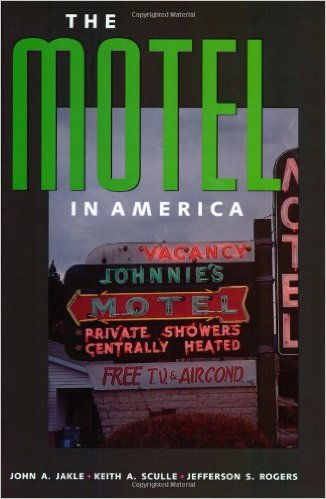
At some point in high school I pulled out a dictionary to find out what, exactly, was the difference between a motel and a hotel. They seemed much the same to me: “A place to sleep when traveling”.  A motel, the dictionary informed me, was typified by guests’ easy access to their cars.  It was cars that built motels, or rather motorists: The Motel in America is a history of how the first “auto camps” came into being, in a fairly organic fashion, which follows their maturation from mom and pop shops to national franchises. Also included are special sections on the evolution of the motel room, and a case study of motels and their impact on urban form, using Albuquerque as a case-study.  It’s thus a mix of topics with some popular appeal (social history) interspersed with more academic sections, like the comparative brand distribution of various chains.

The story of motels begins decades before the auto-oriented boom of the 1950s,   Americans began touring by car almost as soon as there were roads fit to drive on — sometimes before —  but downtown hotels didn’t lend themselves towards motoring hospitality. They were enmeshed in an urban fabric, after all;  their travelers disembarked from downtown passenger rail stations and got where they needed via trolley or on foot. That ‘urban fabric’ meant a lot of buildings in a small space, with precious  little to spare for parked automobiles. So people began improvising and camping out on the outskirts, and through the magic of free enterprise, a new business was created to cater to them. One woman who allowed travelers to camp in a grassy area near her gas station put up small cottages for rent — followed by more cottages, until the cabin rentals were better earners than the gasoline. ‘Campgrounds’, initially roped-off areas created by cities to keep motor-gypsies from running amok,  attracted food-and-service vendors and quickly became a commercial form in their own right. The first ‘motels’ were essentially campgrounds with little cottages or cabins that motorists rented for the night; the owner-operators, typically a family, often served meals on the premises. Kentucky Fried Chicken actually began its life as the lunch option of the Sanders Motor Court.

 These auto camps, motor courts, or ‘motels’ flourished in the Great Depression even as the downtown hotels struggled under the burden of the economy and urban reformers out to destroy them. World War 2 put expansion on pause, but after that — and especially given the free range of the in-progress interstate system —  the business quickly grew into the network of massive chains  that now fill the continent.  The strings of cabins largely gave way to more space-efficient barracks, though they were organized around pools and prettied up in pastel.While the loss of mom and pop shops can easily be mourned, the chains came into being largely because it was more beneficial for motels to exist as part of a network. That network could be built from the ground up (in the manner of Best Western) or organized from the top down, if  one motel was owned by an especially ambitious and savvy man as in the case of the Alamo line.  Networks of motels could refer travelers along a route to one another,  present a united front against other motels by maintaining uniform standards, and lower their prices through bulk purchases.(They might even purchase the same ‘room sets’, as furnishings were standardized.)  The authors also cover the franchise approach, used as effectively in motels as in fast food restaurants.

The Motel in America proved itself an interesting little bit of history, demonstrating another facet of the genuinely revolutionary impact automobiles have had on American urbanism. The case study of Albuquerque — a city which was known primarily as a train layover until it began expanding rapidly through Route 66 and the interstates, with gobs and gobs of motels to service them — was a welcome surprise.

Related:

Posted in history, Reviews | Tagged , , , | 3 Comments

When It Was Worth Playing For

When it was Worth Playing For: My Experiences Writing About the TV Show, ‘Survivor’
© 2015 Mario Lanza
466 pages

THIRTY-NINE DAYS, SIXTEEN PEOPLE, ONE SURVIVOR!

Once upon a time, there was a show called Survivor, which promised to chuck sixteen Americans on an island and give $1,000,000  to the last man or woman standing.  Or so Mario Lanza thought. Turns out the show was more like high school meets the World’s Worst Camping Trip (with narration!), but it still fascinated people from a psychological point of view.   After all, CBS was going to  be encouraging sociopathy on live television. Who wouldn’t want to watch it? (They tune into elections every four years, don’t they?) Sure enough, its finale would be one of the most-watched shows in television history, rivaling those of sitcoms which had cultivated audiences over a span of decades. Mario Lanza was watching Survivor from the beginning, and found it so interesting he had to write about it, eventually being partner in a site that featured a Survivor contestant as a writer. In When the Game Was Worth Playing, Lanza reviews the first three series — the ‘pure’ ones — highlighting the most extraordinary moments as the game evolved.  Those ‘moments’ aren’t just ones witnessed onscreen, as central to Lanza’s writing is the fan experience, the gossiping and spoilers — and he also includes a few tales from the production side, having interviewed several contestants.

What Lanza quickly realized about Survivor, especially during season two, was that it wasn’t so much a story as a confluence of them —  at least seventeen, those of the contestants and those of the producers.  Survivor is not reality television, Lanza says by way of the producers, but ‘unscripted drama’: the show’s producers create storylines out of the contestants’  camera footage. More than one villain has been created solely through judicious editing.  This is always done in the name of better television, of course,  creating drama to stave off boredom. (Or creating the pretense of drama, as with the constant previews that the dominating Tagi alliance was fracturing, or that Kucha in Australia were on the verge of an epic comeback.)   Lanza comments at length on moments when the game changed — the ambush of Gretchen demonstrating that this was a game of  ruthless politics, where those outside the power alliance were doomed regardless of their survival skills or personableness.   But Lanza’s theme is the fan experience, and he contends that the second season can’t be appreciated without the first — for there the players were attempting to differentiate themselves from the original contestants.  Derided as merely the “new” incarnations of favorite characters — Mad Dog as the new Rudy,   Elisabeth as the new Colleen —  and unhappy with the Machiavellian triumph of the Tagi alliance — Colby, Tina, and others tried to make it to the end with their honor intact.     I didn’t begin watching Survivor until Thailand,  and so especially enjoyed this glimpse into the speculative life of the fans in the first few seasons of the game, constantly teased as they were by the producers’ tricks. (A graphic of the ‘final four’ was released that proved to have nothing to do with the actual final four)  Also of interest is Lanzo’s speculation as to how the third season altered every Survivor which followed. It introduced twists, which the producers use to squelch power-alliances from running amok, and led to a return to more predictable island settings that didn’t actually jeopardize contestants’ lives. According to Lanza, one Australia player — not just Mike Fall in a Fire Skupin — was airlifted out for malnutrition.

While I haven’t watched Survivor since the days of Guatemela and Fiji, I knew from the moment I saw this book that I’d enjoy it. I discovered Lanza’s writing years ago, via his Survivor Funny 115, and have revisited that list of Survivor’s 115 funniest moments several times since. Not only that, but I have DVD copies of Borneo and Australia and have watched them both….several times. I know who wins each and every challenge, but I still like to watch them for the sheer goofiness.  How can you beat Greg Buis bursting into “Who Knows?” from West Side Story, or running around the beach after discovering a  bloody chicken corpse, demanding to know who counted the chicken before it hatched?    I’m therefore an utterly biased audience, one who stayed up until 2 am to finish the book and didn’t even care so much about the time. Definitely a fun one for Survivor fans.

Psst, in joke:  the first sentence of my review for Lord of the Flies was taken straight from Jeff Probst’s intro Survivor Borneo, with a little adaption.

Posted in Reviews | Tagged , | 1 Comment

The Road Taken

The Road Taken: The History and Future of America’s Infrastructure
336 pages
© 2016 Henry Petroski

What, exactly, is The Road Taken?   Its title declares it a history, which is mostly true. It does have a bounty of historic sketches on the creation of paved roads and interstates in the United States, along with material on the evolution of traffic lights, curbs, and sidewalks. But there are loving tributes to bridges in New York and San Francisco here, with much chatter about cantilever versus suspension. There’s even a chapter or two with a focus on finance, which is quite brave indeed — there’s a reason Jim Kunstler titled his own chapter on property taxes in Home from Nowhere, “A Mercifully Brief Chapter On A Frightening, Tedious, But Important Subject”. The ending chapter looks to the future of infrastructure, but with the exception of cement mixtures that heal themselves (cracks open and expose bacteria to water, bacteria produce limestone), that’s really more about the future of cars than roads.   It’s all interesting, but the further along the reader gets the more miscellaneous  it all seems. The author obviously believes that interstates and bridges are a good thing and produce jobs, but the book itself isn’t an argument.  He doesn’t try to make any connections between infrastructure and economic growth; the jobs mentioned are always in building interstates.

I’d say this is for people who want to read a chapter about the history of interstates instead of a whole book. It’s right between the chapter on asphalt and the chapter on stop signs.

Related:
Fighting Traffic, Peter Norton;  Divided Highways, Tom Lewis

Posted in Politics and Civic Interest, Reviews | Tagged , , , , | 16 Comments

Ad Astra Per Aspera

A reading from Carl Sagan’s Pale Blue Dot, set to utterly perfect music.

We were hunters and foragers — the frontier was everywhere. We were bounded only by the earth, and the ocean, and the sky. The open road still softly calls; our little terraqueous globe is the madhouse of those hundred thousand, millions of worlds. We, who cannot put even put our own planetary home in order, riven with rivalries and hatreds, are we to venture out into space? 

 By the time we’re able to settle even the nearest planetary systems, we will have changed., The simple passing of so many generations will have changed us. Necessity will have changed us. We’re… an adaptable species.  It will not be we who reach Alpha Centauri, or the other nearby stars —  it will be a species very like us, but with more of our strengths and fewer of our weaknesses. More confident, far-seeing, capable, and prudent. For all our failings, despite our limitations and fallibilities, we humans are capable of greatness.

What new wonders, undreamt of in our time, will we have wrought in another generation, and another? How far will our nomadic species have wandered by the end of the next century, and the next millennium? Our remote descendants, safely arrayed on many worlds in the solar system and beyond, will be unified — by their common heritage, by their regard for their home planet, and by the knowledge whatever life may be, the only humans in all the universe come from Earth.

They will gaze up and strain to find the Blue Dot in their sky. They will marvel at how vulnerable the repository of all our potential once was, how perilous our infancy, how humble our beginnings — how many rivers we had to cross before we found our way.

====================

Posted in quotations, Reviews | Tagged , | 2 Comments

I’m a Stranger Here Myself

I’m a Stranger Here Myself: Notes on Returning to America after Twenty Years Away
© 1999 Bill Bryson
288 pages

“It’s been a funny  old night, when you think of it. I mean to say, wife drowns, ship sinks, and there was no Montrachet ’07 at dinner.I had to settle for a very middling ’05.”

After living in Yorkshire for twenty years, Bill Bryson and his family decided to go for a change of scenery and moved to America. For him, it was a return, though not to his home.  To be sure, New Hampshire was much different from his native Iowa, but America itself had changed in the intermin, in ways both bewildering and delighting.  I’m a Stranger Here Myself collects various columns Bryson wrote about life in late-90s America, most of them funny.  Bryson is not the cranky old man of Road to Little Dribbling, but here only a late-middle age father who insists on inflicting his childhood memories on his children, only to discover that dumpy motels and drive-in movie theaters aren’t nearly as fun as they used to be. There are also a couple of satirical pieces — fake computer instructions, fake IRS directions, and a morbidly funny story from the last night of the Titanic. (Inspired, no doubt, by the move release.) A few of the pieces are personal in nature, merely Bryson making fun of himself for being an absent-minded fuddy-duddy who has a tendency to  mail his pipe tobacco instead of his letters and frequently needs to phone his wife to be reminded why exactly he’s in town.  Other times, he is more serious, as when he comments on the loss of local accents and the impending doom threatened by everyone driving everywhere instead of walking, like the English do. (The one time he tries walk across the street  in America, he is nearly run over.)   There’s also a chapter called ‘Our Town’, which mourns the loss of small-town America — which I was happily surprised by. I’ve been thinking about buying Bryson’s book about travels through small towns,but assumed Bryson would sneer at them for being provincial. Instead, he’s as sentimental about them as I am, so don’t be surprised to see The Lost Continent pop up here within the next few months or so.

Posted in Reviews | Tagged , | 3 Comments

Armistice Day

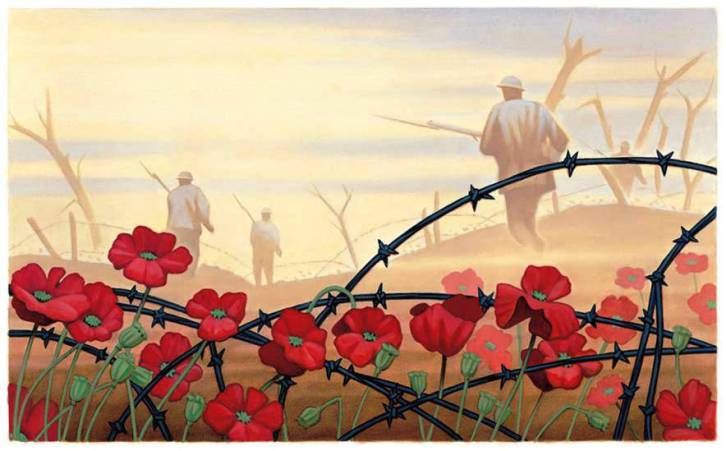
The sun’s shining down on these green fields of France
The warm wind blows gently and the red poppies dance
The trenches have vanished long under the plow
No gas, no barbed wire, no guns firing now
But still in this graveyard that’s still No Man’s Land
The countless white crosses in mute witness stand
To man’s blind indifference to his fellow man
And a whole generation were butchered and damned

Did they beat the drums slowly, did they play the fife lowly?
Did they sound the death march as they lowered you down?
Did the band play “The Last Post” and chorus?

Did the pipes play “The Flowers of the Forest”?

And I can’t help but wonder now, Willy McBride
Do all those who lie here know why they died?

Did you really believe them when they told you the cause?
Did you really believe this war would end war? 
Well, the sufferin’, the sorrow, the glory, the shame,
The killin’, the dyin’, it was all done in vain —
Oh, Willie McBride, it all happened again
And again, and again, and again, and again.


Posted in Reviews | 2 Comments