The Dark Net

The Dark Net: Inside the Digital Underworld
© 2015 Jamie Barlett
320 pages
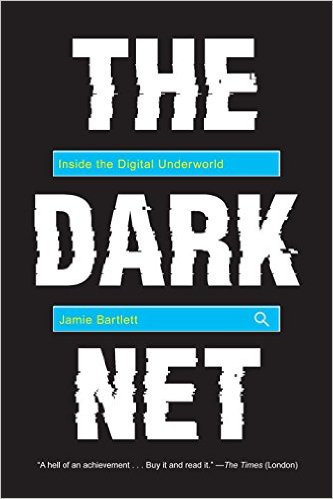
In middle school, the Internet was a distinct place, a world apart from ‘real life’.  Now it has grown so ubiquitous that it’s as exciting as the paved street outside my house.  When I first heard of the dark net a few years ago, I caught a whiff of the old excitement – there are still places that haven’t been bulldozed into boringness! While I had no interest in exploring the dark alleys of the internet, I took comfort in knowing they were there.  Jamie Barlett’s  The Dark Net promises to reveal a little of what goes on in the digital shadows,  but its true real subject is the human condition, and how it is interacting with the possibilities that the internet and its shadows provide.  Barlett mixes criminal voyeurism and philosophical debate about the nature of freedom to great effect.

Barlett examines two different ‘dark nets’; the first is the submerged internet, websites which are only accessible with certain programs and certain knowledge.  Virtually all of the websites we use on a daily basis exist both above the surface and a little below it; for instance,  banks  have ample public areas for potential customers to explore, but certain rooms, like our individual account pages, are slightly submerged and accessible only through our username and password. But there’s a deeper level to the web,  websites that require specific browsers and knowledge of their URL to appear. (One address  Barlett finds here actually requires a series of cookies from other websites:  users must visit a set of websites in a particular order before being able to load the target successfully, otherwise, an attempt to load the address will produce a completely-different looking site.)  On these hidden pages — accessibly only through secure browsers — anything is for sale, from illicit drugs to lives, but there are also safe havens for whistle-blowers to upload documents to the media, or hide from opinion-policing.

Connected but not limited to this is the second ‘dark’ aspect that Barlett explores, the effect that the internet’s anonymity and diverse opportunities have on the human psyche. Here he catalogs support groups for destructive behavior: websites promoting anorexia and suicide, for instance,  or which radicalize political opinions and produce bombers out of disaffected coeds.  The websites he explores here operate on the surface net — places like 4chan and reddit — but the behavior promoted reveals the darkness inside the human soul itself,  its capacity for brutality.  In one case, a woman who foolishly posts a photo of herself without clothing is identified by background information, and the 4chan residents promptly start sending the photos to everyone on the woman’s facebook page to publicly humiliate her.

Despite this catalog of horrors, from child pornography to terrorist communities, The Dark Net  is not a polemic against the evils of new-fangled technology.  Early on, he writes about the enthusiasm early adopters had for the internet, the generation of ‘cypherpunks’  who viewed the digital world as their long-waited escape from the medieval dreariness of nation-states and castles of control and surveillance. The internet was anonymity and freedom — liberty.  Although the internet was normalized relatively quickly in the 1990s and early 2000s, saturating the geeks’ playground with boring e-businesses and teenagers posting their journals online, technology did arrive to give the cyphers more of what they wanted: anonymous browsing via browsers like Tor, and secure modes of payment like Bitcoin.  Just as the lightless ocean depths create extraordinary creatures, so to have the pressures of illicit marketplaces created  new ways of communicating and doing business, creating payment structures that  allow some degree of trust but without legal exposure.  Just as PGP encryption for secure messages has filtered down into email clients like Thunderbird, so too  may multisignature escrow accounts for online payments one day appear above the surface for those who prefer not to use credit cards online for mundane security reasons.

The Dark Net is disturbing reading at times, particularly the chapter on child pornography.  There are lessons to be learned here, though, like the ways that highly specific interest groups amplify their members’ devotion as they enter into an echo chamber where increasingly more strident views and increasingly more antagonistic behavior are viewed as perfectly acceptable. (Barlett believes, for instance, that child pornography grows off of increasingly compulsive consumption of ordinary pornography, as the user requires increasingly more provocative content to engender excitement.) The conclusion is worth reading in itself, as Barlett uses two people — a technohumanist and an anarcho-primitivist — to examine different views of freedom. Although both view the present state of things as unattractive for shared reasons, their solutions are utter opposites.  Ultimately, although there’s much here to give one pause about human nature, I still find myself faintly relieved to know (as I did in reading A Renegade History of the United States) that rebellion lives.

Related:
The Internet Police: How Crime Went Online, Nate Anderson
#Republic: Divided Democracy in the Age of Social Media, Cass Sunstein. Book about how highly specific internet filters and communities lead to increased polarization and disaffection.
Spam Nation, Brian Krebs

Posted in Reviews | Tagged , , , | 6 Comments

Visiting Harper Lee

On Saturday I visited the boyhood home of Hank Williams in Georgiana, and then decided — since I was in the neighborhood — to drive a bit further into the woods and go to Monroeville, the hometown of Harper Lee. Its former courthouse was used as the model for To Kill a Mockingbird’s courthouse, and the building is now used as a museum.  The above photo depicts three Depression-era children reading To Kill a Mockingbird. 


Although I arrived in town long after the museum’s scheduled closing at 1 PM, out of utter luck the museum was hosting a production of a Mockingbird stage play that night, and was subsequently open until ten.  The two classic cars to the right of the building are used in the play; a would-be lynch mob arrives in them.

The second floor houses the courthouse and rooms dedicated to Harper Lee and Truman Capote (both of whom grew up in Monroeville), while the first floor shows off general history, with a model lawyer’s office circa 1930.

Posted in Reviews | Tagged , , , | 4 Comments

Best 100 Books I’ve Read in the Last Decade

Dear readers, today is a special today — the tenth anniversary of my writing about books!  In the next few days I will have some reflective posts,  but today I’d just like to thank my regular readers for your digital company over the years — and especially Cyberkitten, who has been coming by at least since 2008.

Five years ago, I celebrated my five-year blogging anniversary by posting a list of fifty of my favorite or most memorable books. It’s  time for another round!   In chronological order, the fifty most memorable books read since 2012:

  1. Bowling Alone: the Collapse and Revival of American Community, Robert D. Putnam
  2. Asphalt Nation: How the Automobile Took Over America and How We Can Take It Back, Jane Holtz Kay
  3. Lucifer’s Hammer, Larry Niven and Jerry Pournelle (Fiction)
  4.  Blood, Iron, and Gold: How Railroads Transformed the World, Christian Wolmar
  5. Nickle and Dimed: On (Not) Getting By in America, Barbara Ehrenreich
  6. A Conspiracy of Paper, David Liss
  7. Fast Food Nation: The Dark Side of the All-American Meal, Eric Schlosser
  8. Suburban Nation: the Rise of Sprawl and the Decline of the American Dream, Andres Duany, Elizabeth Plater-Zyberk, and Jeff Speck
  9. Consuming Kids: The Hostile Takeover of Childhood, Jennifer Linn
  10. The Great Good Place: Cafés, Coffee Shops, Bookstores, Bars, Hair Salons and Other Hangouts at the Heart of a Community, Ray Oldenburg
  11. The Green Metropolis: Why Living Smarter, Living Closer, and Driving Less are the Keys to Sustainability, David Owen
  12. John Adams, David McCullough
  13. A Man on the Moon, Neil Chaiken
  14. No Logo: The Case Against the Brand Bullies, Naomi Klein
  15. Waste and Want: A Social History of Trash, Susan Strasser
  16. The Arthur Trilogy, Bernard Cornwell
  17. Pedaling Revolution: How Cyclists are Changing American Cities, Jeff Mapes
  18. Straphanger: Saving Our Cities and Ourselves from the Automobile, Taras Grescoe
  19.  The Death and Life of Great American Cities, Jane Jacobs
  20. The Plain Reader: Essays on Making a Simple Life, edited by Scott Savage
  21. Jayber Crow, Wendell Berry 
  22. The Conservative Mind: From Burk to Eliot, Russell Kirk
  23. Religion for Atheists, Alain de Botton
  24.  The Righteous Mind: Why Good People are Divided by Politics and Religion, Jonathan Haidt
  25. small is beautiful: economics as if people mattered, EF Schumacher
  26. Starship Troopers, Robert Heinlein 
  27.  Look Homeward, America: In Search of Reactionary Radicals and Front Porch Anarchists, Bill Kauffman
  28. Human Scale, Kirkpatrick Sale
  29. Ninety Percent of Everything: Inside Shipping,  Rose George.’
  30. Antifragile: How Some Things Gain from Disorder, Nassim Nicholas Taleb.
  31. Jesus and the Jewish Roots of the Eucharist, Brant Pitre
  32. A Short History of Byzantium, John Julius Norwich
  33. The Cult of the Presidency, Gene Healy (Politics)
  34. The Iron Web, Larken Rose (Political Thriller)
  35. Happy City: Transforming Our Lives through Urban Design, Charles Montgomery
  36. The Horse in the City,  Clay McShane and Joel Tarr
  37. How I Killed Pluto and Why It Had it Coming, Mike Brown (Science)
  38. Picking Up:  On the Streets and Behind the Trucks with the Sanitation Workers of New York City, Robin Nagle
  39. Future Crimes:  Everything is Connected, Everyone is Vulnerable, and What We Can Do About It, Marc Goodman
  40. The Moon is a Harsh Mistress, Robert Heinlein 
  41. Great Expectations, Charles Dickens 
  42. The Chosen, Chaim Potok 
  43. Driving with the Devil: Southern Moonshine, Detroit Wheels, and the Birth of NASCAR, Neil Thompson
  44. Sphere, Michael Crichton 
  45. All the Shah’s Men,  Stephen Kinzer
  46. The Porch and the Cross, Kevin Vost
  47. Tolkien’s Sanctifying Myth: Understanding Middle-Earth, Brad Birzer
  48. Musonius Rufus on How to Live, adapted Ben White. 
  49. The Twilight of the Presidency, George Reedy
  50. Fear no Evil, Natan Sharansky
Posted in Reviews | 6 Comments

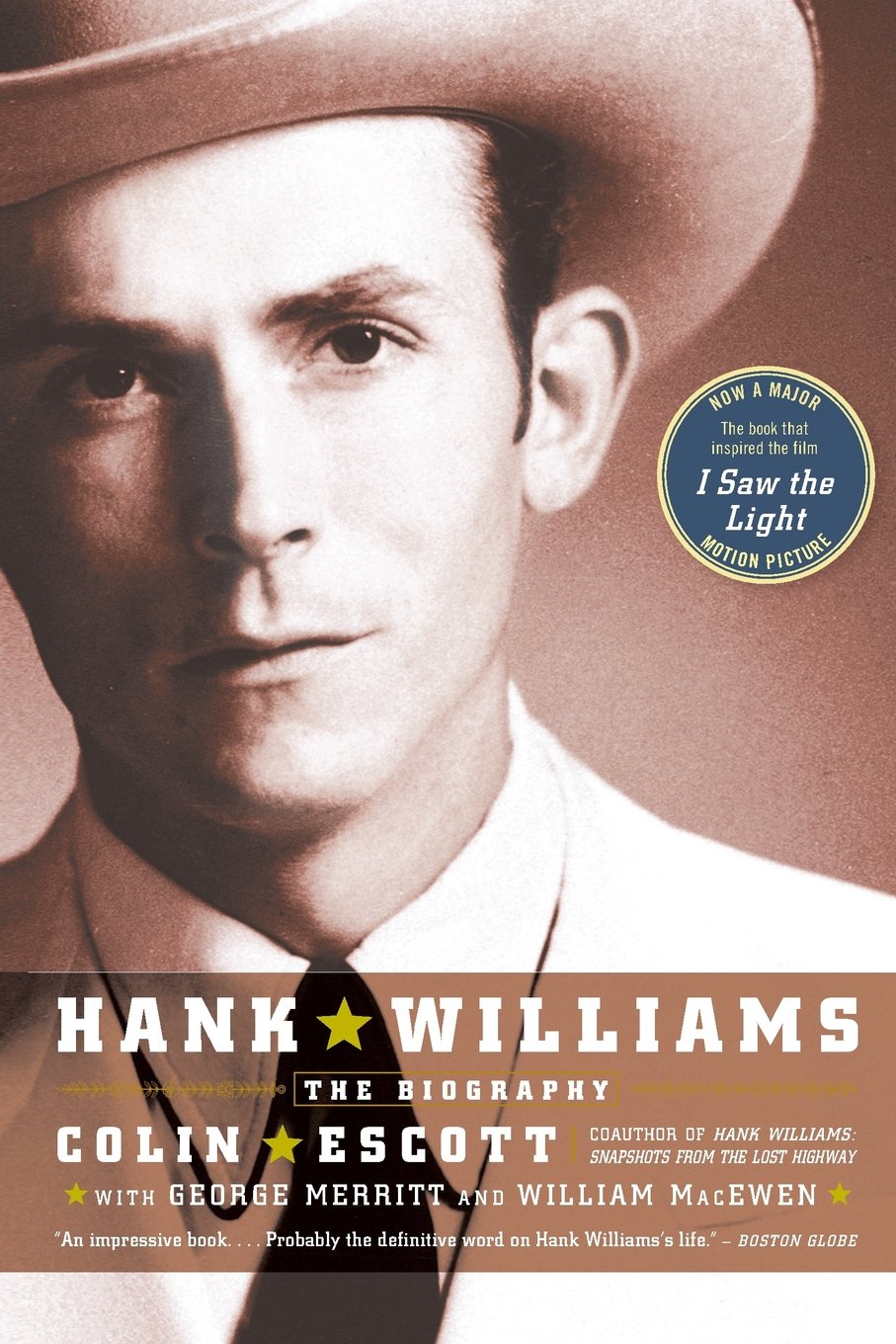
Hank Williams

Hank Williams: The Biography
© 1994 Colin Escott
320 pages

You don’t have to call me Mister, mister —  the whole world calls me Hank.”


Hank Williams is the legend of country music. I’d heard of him long before I ever heard him;  my father (who stopped listening to country in the 1970s) took me to visit his grave in Montgomery back in the early nineties, and Williams was a constant Presence in the music I grew up on,  haunting the singers of pieces like “Midnight in Montgomery” and “The Ride”.      Hank Williams: The Biography renders a thorough and sober account of Williams’ life,   one that appraises the man without romanticism.   It is exhaustively detailed, utilizing interviews with those who remember the “Lovesick Blues boy”, and also features some commentary on Williams’ musical craft.

Part of the legend of Hank Williams’ life is that he died young and tragically — alone, in the back of his car,  his heart destroyed by a mixture of alcohol and haphazardly-dosed medicine   Easily the most surprising aspect of The Biography is that Williams’ chronic alcoholism was not the result of his fame and fortune, but something he fought with for most of his life.  From the time a thirteen year old Hank raided some loggers’ booze hoard buried in the woods,  the young singer would have bouts with the bottle. He did not drink constantly, but  once he started on a bender he was hopeless for weeks. Time and again he submitted himself to sanatoriums,  especially when he needed to focus on his career, but every time he would stumble.  Although there was no shortage of excuses — constant strife with his wives, the pressure of the road, the constant agony of spinal disease —    Williams’ problems were only amplified by his success,  not created by them.

Williams was a genuine country boy, the son of poor strawberry farmers who lost everything they had in a fire,  a man whose first memories were of living in a boxcar. The Williams moved from place to place in search of a living:  after his father was stuck in a VA hospital, the family got by selling peanuts and taking in boarders.  That’s where Williams got his start singing and selling , down in a little town called Georgiana.  Hank was a sickly boy, born with a spinal disease, and that diminished his ability to take part in the roughhousing and hard labor so common to southern men. He could sing, though, and after the family moved to Montgomery he began promoting school shows — something that would grow into a career.  From schoolhouses to bars,  Williams became a local star who grew into a southern icon — and after his death, a national figure.  His success was partially his own,  from his ability to turn his constant troubles, particularly with his wife,  into plaintive songs rendered in simple melody that resonated in the hearts of his country audiences.  Although Williams would mature as a writer in his brief window of fame,  his re-use of old melodies retained a sense of familarity.  He also owed success to his domineering mom, however, who opened her home to his band and who personally sold tickets at early concerts. (His wife Audrey, though she tried to use him for her own ill-conceived musical career, was also a forceful personality who replaced his mother as a manager of sorts after they moved from Montgomery to Shreveport.)  

Escott mentions that Williams came along at just the right time when radio was allowing hillbilly music to reach larger audiences, and become of interest to popular   musicians: indeed,  many of Williams’ songs were performed by men on the national stage, like Tony Bennett.  Although Williams’ financial success came from record sales — concerts were hit and miss when he was on a bender — he seemed to think of himself primarily as a songwriter, and was drafting lyrics even on the night his body surrendered to a bad mixture of painkillers and booze. Escott also notes coldly that Williams died at just the right time:  his back pains had only increased as time wore on,  as had the stress of performing on the road, and despite steady record sales his career seemed to be stalling and on the verge of sinking when he perished.  Instead of living to become a forgotten washout, a star that blazed briefly before being eclipsed,  Williams became a tragic figure.

As a history of Hank Williams, this appears to be the definitive work, and pads the detail with humor. (One favorite: Escott comments that if everyone who claims to have been in the car with Hank the night he penned “I Saw the Light” was, he would have needed a touring buss to accompany them. Escott also describes Audrey’s show house as a tribute to what bad taste and good money can accomplish.  Another lady is described as being someone who, if she had been born a canary, would have still sung bass.)  

Image may contain: 1 person, standing, hat and outdoor
(Photo taken by me, Sept 2012. Downtown Montgomery.)

When the wind is right, you’ll hear his song, smell whiskey in the air
Midnight in Montgomery,  Hank’s always singin’ there…


(Photo taken by me, May 2017. Georgiana.)

Funny story: The first time I listened to Hank Williams knowingly was after hearing my childhood preacher rail against country music for its sad songs and use of alcohol, using “There’s a Tear in my Beer” as his example. Naturally I had to give it a listen,

Some songs:
Lovesick Blues”, the song that made his career.
Lost Highway“, my personal favorite

Related:
Don’t Get Above Your Raisin’: Country Music and the Southern Working Class,  Bill Malone

Posted in Reviews | Tagged , , , | Leave a comment

Podcast of the Week: Butterfly Spanish

My podcast time in recent weeks has been largely devoted to listening to lessons on YouTube;  I’ve been trying to restore my high school Spanish for several months now, using an app called DuoLingo on a daily basis and studying Madrigal’s Magic Key to Spanish as well as Spanish Made Simple.  One of my favorite Youtube channels for Spanish is hosted by a young woman named Ana. who is as personable as can be imagined.  She teaches Spanish like she’s in high school, talking to her friends and goofing off along the way.

Another interesting channel, Bueno Estonces, uses music to teach. 

The publishers choose slower tempo songs that give viewers time to read the lyrics & translation posted on the screen, with grammar connections highlighted. 

Posted in General | Tagged , | 5 Comments

El Narco

El Narco: Inside Mexico’s Criminal Insurgency
© 2012 Ioan Grillo
336 pages

El Paso, Texas, can boast one of the lowest metropolitan crime rates in the United States. Immediately opposite it on the Rio Grande, however,  Ciudad Juarez, has until recently been regarded as North America’s murder capital.  Juarenses are not exceptionally violent people. but their city is one of the battlegrounds in a decade-long melee for money.  El Narco, the product of a journalist who has reported on Mexico for years, covers the origins and growth of drug-trafficking  gangs in this country so far from God and so close to the United States.   Grillo’s review of the guerra contra los drogas  reveals how far-reaching the cartel wars are, not only creating a horrific bodycount, but eroding the legitimacy of government and civil order, and creating subcultures obsessed with death.

In the beginning, Mexico’s narcotics farmers were surprisingly like Appalachian hill people,   who found corn liquor a lot is easier to make money off of than corn. Like America’s hill people, they were organized by familial clans and sometimes competed for territory.  Prohibition in both the United States and Mexico led, in due time, to organized groups superseding the clans in many respects, but not until the end of Mexico’s one-party state did the cartels run wild.   From 1929 to 1994, the ‘institutional revolutionary party’ held complete command in Mexico, with control so complete  that Grillo maintains throughout the book that Mexican democracy only began in 1994.  When they finally ceded power, however, their systems for maintaining order — corrupt as they were — disappeared with them, and ever since Mexico’s leaders have been trying to fill the vacuum.

I don’t live anywhere near the US-Mexican border, but in an age of global news it’s hard to miss occasional stories of massacres. The most bloody violence pools around the main routes northward, as Mexico’s gangs are not only moving their own goods but transporting merchandise from South America.  Because the industry is so lucrative, it’s highly attractive to men and women from economically depressed areas, despite the violence. Gangland allure works its usual magic,  as disadvantaged people are drawn to the spectre of wealth, influence, and the aura of being a tough guy.  That aura is aggrandized by the Mexican tradition of corridos,  ballads that tell stories and celebrate or mourn the lives of their subjects.   Cartel smugglers and gunmen have become the heroes of a growing  library of narcocorridos,  celebrated as poor men who have made it rich by defying the man.  Considering how much of Mexico’s local and state governments in the contested areas are compromised by the cartels — sometimes local police work directly for the gangs —  one wonders how much of the man there is to defy.   Certainly the federal government and army are doing their best, but the narcos are creating their own variants of Mexican culture: one  cartel seems to have its own cult,  and another psuedo-catholic cult is centered on the worship of a female Death Angel.  As the cartels branch out into other areas of crime, like extorting protection money and kidnapping for ransom, Grillo warns that what Mexico is facing is less than a prolonged spat of gang fighting, and more like a Syrianesque insurgency.

As Grillo documents, Mexico has tried valiantly to crush the narcos through sheer force,  targeting leaders and using the movement of money to trap them.  Grillo believes that prohibition ultimately creates the financial incentive fueling these gangs, but there’s little grounds for hope that drug prohibition in the US will end anytime soon: while many states are giving up on marijuana, the present attorney general is an implacable supporter of the drug war police state.  And even if a miracle happened, how long would it take for Mexico to recover from this poison that has been seeping into its soil for twenty years?

Disturbing but gripping reading.

Posted in Reviews | Tagged , , | 4 Comments

The Adventure of English

The Adventure of English: The Biography of a Language
© 2011 Melvyn Bragg
336 pages

In The Adventure of English, Melvin Bragg delivers a mythic history of the language that treats our lingua franca as a living personality — battered and now triumphant.  Beginning with the arrival of the Angles and company in Britain and continuing well past Indian independence,  this ‘adventure’ is one of a peasant tongue turned phonic empire.

English’s survival was, as Wellington said of Waterloo, a damn close-run thing.   After establishing a home for themselves in Britain,  the English kingdoms were nearly extinguished by the Norse invasion centuries later. They were not so lucky in 1066, when England was invaded and taken by William and his Normans. Although the vast majority of English’s 100 most common words are survivors from the old Ænglisc,  Bragg estimates that eighty-five percent of the old English vocabulary was lost in the Norman invasion, being supplanted by their version of French.  The  foisting of a French ruling class upon an Anglo-Saxon peasantry created classes of words;   French monopolized administration, religion, law, and so on,  leaving the rude basics of life like farming to the old tongue.   English survived, however,  and even captured the Normans:  their children picked up English from nurses and other servants. As  England and Normandy grew further apart amid politics and war,  and England and France became one another’s favorite enemy,  English reemerged as the language of court and law.   It would struggle mightily to take over religion, aided chiefly by Henry VIII’s libido,  and by the  late 16th century had started to become self-conscious, with an increasing number of people insisting that there was a Proper English, and you ain’t speakin’ it.   Then it took over the world.

The last half of this English history largely concerns itself with the diverse vocabularies developed by Anglophones as they spread across the globe via the English empire. In North America,  settlers happily acquired words from various Amerindian languages and other colonial powers.  In the Caribbean,   slaves from scattered African tribes used bits and pieces of English to create  pidgin tongues — and in India,  English was used to establish a common language between lingual populations who found embracing a common enemy easier than embracing an intimate rival.   English’s growth wasn’t merely in geography and population, however; as the English became the predominant commercial and technical power of the world,  the language became important in its own right:  to learn it was to gain access to the reams of new knowledge being acquired in the heady days of the  scientific and industrial revolutions.

Bragg’s colorful history of English brims over with memorable lines, like “Shakespeare threw words into bed together who had never before shared even a common acquaintance”, and his regular anthropomorphizing the language — treating it as a person, with desires and ambition —  may annoy historians and linguists alike. But for lay readers who have an interest in their mother tongue — and wonder why, for instance, it has so many French words, and uses Latin for science, and  is brimming with a wondrous amount of spelling and pronunciation quirks —  The Adventure of English is one to set out on.

Related:
The Mother Tongue: English and How it Got that Way, Bill Bryson

Posted in history, Reviews | Tagged , , | 4 Comments

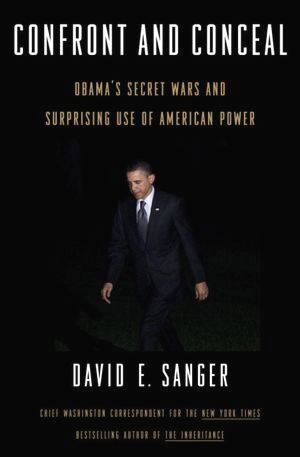
Confront and Conceal

Confront and Conceal: Obama’s Secret Wars and Surprising Use of Power
496 pages
© 2012 David E. Sanger

Barack Obama may have been the only Nobel Peace Prize winner in history to order lethal force used on a regular basis, but things could have been worse. Confront and Conceal attempts to make a case for an “Obama Doctrine”, one which avoids epic disasters like the destruction of Iraq, but still asserts American influence via surgical operations and international organizations.  Sanger reviews the actions of the Obama White House regarding Iraq, Afghanistan, Pakistan, North Korea, China and Iran, with a special section on drones and cyberwarfare. He relies on extensive interviews with administration officials, including then-secretary of State, Clinton, as well as State Department cables which were made available via Wikileaks.  He creates a picture of an Obama who — though mocked for his weakness or aggression, depending on the mocker —  attempted a cautious but efficacious approach  to foreign policy.  Considering Sanger’s access — interviewing heap-big chiefs  as high as as the secretary of state- –   it is perhaps no surprise that the representation rendered here is admiring, on the whole.

Obama encountered no shortage of foreign policy crises during his first time. He began it faced with the deathly tar pit of Afghanistan,  further complicated by the amount of trouble-makers hiding in the western fringes of Pakistan.  Excising the United States from Afghanistan wasn’t as simple a matter as cutting losses and leaving, for neither the DC nor Pakistan desired a power vacuum between Pakistan and Iran.  The Arab spring, which forced DC to choose between its interests and its proclaimed values, further muddied the waters. The cascade of populist revolts took everyone by surprise, including the President who was determined to restore the American reputation in the middle east.  To avoid messes like Iraq and Afghanistan, Obama  preferred to use a light footprint approach: if American interests were at risk, then action must be taken –but the action should be swift and precise, using new tools like drones and cyberwarfare.   Diplomacy was preferable to brute force, however: Obama was also a genuine internationalist, who preferred using global organizations to apply pressure to ne’er do wells like Qaddafi, and to effect change.  This was not always possible;  the Iranians didn’t trust his intentions and regarded him as timid; the international community remains divided over Syria, with some supporting Assad and others supporting the rebels and ISIS.   Ditto for North Korea: as vexsome as they are to all of their neighbors, China included, they won’t just go away. Leaving the north in the hands of the Kim family cult isn’t an attractive option for China, but it’s more attractive than millions of malnourished and uneducated refugees streaming into China.

Anyone who has followed my reading for any length of time may have picked up on the fact that I am not a fan of DC, in any administration.  I did have a grudging respect for much of  Obama’s foreign policy, however,  at least until he began getting the country more entangled with Syria and resurrecting Cold War tensions.   That respect was validated here, as Obama seems to have approached DC’s expanse of empire with the desire to do as little damage as possible. I don’t know how strong willed and idealistic someone would have to be to sit in the One Chair of the west wing, surrounded by the whispering host of the DC establishment,  faced with a neverending series of crises and commitments, and say “To hell with you, I’m not playing this game”, and start manipulating the Titanic of state  away from its inevitable course of empire.  Obama seems to have resisted it for several years: agreeing to escalate in Afghanistan, but only with a pre-determined date to cut losses and run;  continuing Bush’s development of the Olympic Games project, which would give him  more options in Iran;  and using drones instead of conventional bombing and strike team, because those were the only options DC produced. (The targets were ‘terrorists’, of course.  DC wouldn’t casually assassinate just any reichsfeinde. That would never happen, no sir.)

Cantankerous sarcasm aside,  Confront and Conceal was a varied and endlessly fascinating history given the range of topics and their (unfortunately) continued relevance.  The Kims are even more problematic now than they were;  Syria continues to exact a morbid fascination for the establishment, and China…well, it’s still there. So too are the opportunities for mischief the digital world has opened, as this weekend’s crippling wave of digital attacks (chiefly in Britain) have shown all too well.   I would take its general admiration for the establishment with no small level of salt, however.  Foreign-policy wise, I think it’s especially helpful for the material on the US-Pakistan relationship.

Related:
Playing to the Edge, Michael Hayden. Another keyhole light inside  the establishment.

Posted in Reviews | Tagged , , , , , , , | 3 Comments

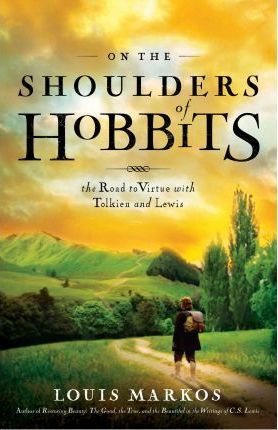
On the Shoulders of Hobbits

On the Shoulders of Hobbits: The Road to Virtue with Tolkien and Lewis
© 2012 Louis Markos
235 pages

Fairy tales don’t teach children that dragons exist; they know dragons exist. Fairy tales teach children that dragons can be defeated.  GKC declared that, and Louis Markos would support it. Here he demonstrates that fairy tales have much to teach even adults. In On the Shoulders of Hobbits,  Markos uses the Chronicles of Narnia and the Lord of the Rings to guide readers through the Virtues — four Classical, three Christian — using the imagery of the Road (complete with obstacles and diversions) to guide the reader along.

 Given his ‘on the road’ subtitle, it’s only appropriate that Markos begins by examining both the Narnian books and LOTR in the light of characters making a hero’s journey, confronted with obstacles and monsters, and eventually fulfilling their destiny.    Some of these application of virtue will be obvious to any reader;   main characters from both series frequently demonstrate courage in the face of adversity, for instance.   Others are less expected, even by the author.  Markos  was raised in a tradition that barred alcohol and tobacco on the grounds of morality, and yet in the world of Tolkien he found characters gaily enjoying pipeweed and strong drink – from time to time.  Their temperance was the temperance of the ancients, the practice of the golden mean. That mean, or balance,  is a necessary component of the practice of the other virtues; for instance, courage is a balance between cowardice and recklessness. Without temperance, courage would not be itself.   The exercise of other virtues distinguishes Tolkien and Lewis’ heroes from their opponents:  for instance,  Faramir practices a prudence about the One Ring that his brother Boromir,  lacks — though both are equally courageous.  A smaller ending section examines other common lessons the Lewis and Tolkien books teach; the consequences of making a deal with the Devil, for instance,  as illustrated by Narnian characters who view the White Witch as a useful ally, sometimes even as they admit she is tyrannical.  (As a real world example, Markos points to the West’s alliance with Joseph Stalin, whose penchant for mass murder was even more thoroughly exercised than Hitler’s.)

Although On the Shoulders of Hobbits makes for easy reading, it’s not superficial. Markos has penned several works on classical education, C.S. Lewis, and philosophy, and here he exhibits a familiarity with the ethical writings of philosophers and popes alike.

Posted in Reviews | Tagged , , | 5 Comments

Astrophysics for People in a Hurry

Astrophysics for People in a Hurry
© 2017 Neil deGrasse Tyson
200 pages

Astrophysics for People in a Hurry is exactly what it says on the tin, a brief cosmological primer that presents the basics of cosmology, explains the ways we are continuing to learn about the cosmos, and ends with a Saganesque hush meditating on what the cosmic perspective has to offer. Neil deGrasse Tyson is an active science popularizer, the creator and primary host for StarTalk Radio, which has grown beyond a podcast to become a video series and book – not to mention his day job as director of the Hayden Planetarium in New York City.

Astrophysics is a review of what is known about the big picture, and avoids string theory, m-theory, branes, and other things best considered by people not in a hurry. Tyson does include a section on dark matter and dark energy, however, since the math of our current model of universal expansion doesn’t make sense without including them . Tyson is quick to defend against the idea that ‘dark matter’ – accounting for the detected weight of matter which doesn’t seem to interact with anything – as a math cheat, since the weight of something is there…we just haven’t figured out what it is just yet. Along the way, Tyson also comments on topics like why the cosmos tends to produce spheres (planets, suns, clusters of galaxies…), the history of radio telescopes, and the supreme importance of the period table.

As someone whose most recent interaction with astrophysics has been The Big Bang Theory, since I haven’t read anything in this area in four years, I found Tyson completely enjoyable.

Posted in Reviews, science | Tagged , , , | 8 Comments