The Elephant and the Dragon

The Elephant and the Dragon: The Rise of India and China and What It Means for All of Us
© 2007  Robyn Meredith
272 pages

For most of the 20th century, Europe and the United States enjoyed an outsided influence on global trade, in part because  large portions of the world had sealed themselves off, stewing in their own ideological juices and maintaining impoverished populations. As the 20th began to give way to the 21st, however,  the eastern world re-opened. The Elephant and the Dragon begins with a historical note explaining how China and India came to renew their participation in the global economy, then appraises the ways their surging involvement has altered that global system and themselves.  Written and published before the ‘great recession’ — observing then things now taken for granted, like offshoring — the book is presumably not quite as relevant as it was on its publication.  The fundamental transformations Meredith observes, however, are still in effect.

Why the ‘elephant and the tiger’, instead of ‘the Asian tigers’?  Meredith views India’s economy as pachydermesque in that while it was slow to get to its feet, slower still to get moving,  it will be all the more harder to stop as it picks up speed.  Its energy will come not from one point — the Politburo — but from billions of Indians, driving forward towards the future they want.   India’s economic revival came seemingly as a last resort, when in 1992 its leadership recognized that the country was broke.  Although the liberalization that followed allowed India to use its existing resources (a strong number of English-speaking professionals) to better effect,  its lack of more material resources — infrastructure like highways and modern airports — prevented it from becoming an instant industrial power like China.   India liberalized at just the right time,  becoming an important part of the expanding information technology sector.  What began with the dot come surge  has continued to the point that India had become the western world’s “back office”. its workers supplying customer service ,tech support,  computer programming, and the like.  By now (2017), India’s economy has grown being merely the support staff of the west, however.

China’s own ‘liberalization’ — economic, not political — began in 1978 when Mao’s successor realized the middle kingdom was falling far behind the west,  and needed to adopt some of its methods if only out of self defense. (Even during the Mao years, China had learned from Russia’s mistakes and so avoided total public control of agriculture.)   Although the communist party’s pivot towards capitalism meant ceding constant command of the economy, the Party maintains absolute political control and still ‘guides’ the economy by establishing long-term goals, like an expansion of the highway system.  Although westerners commonly regard China’s trade advantage as being desperately cheap labor, in reality there are many places with cheaper labor.  China combines relatively cheap labor with industrial infrastructure and a government interested in stable growth.

The Elephant and the Dragon is largely oriented toward the world of business, using India and China to illustrate how crucial offshoring and vast supply chains have become to the global economy.  Goods are not simply made in a Chinese factory; they pass from city to city in varying stages of completeness, which is why online retailers can offer so much customization.  “Made in” labels have lost all real meaning, for a given good will have been produced from goods and materials from across Asia, with other components added in by the United States and Europe.  Is a car finished in the United States, but from parts produced in China and Mexico, truly ‘made in America’?  

While there are more current books, for someone interested in the course of globalization — particularly the intermingling of the Asia and western economies — this is still a good start.
Posted in Reviews | Tagged , , , , , | 5 Comments

Spain in the Southwest

Spain in the Southwest: A Narrative History
© 2013 John Kessell
480

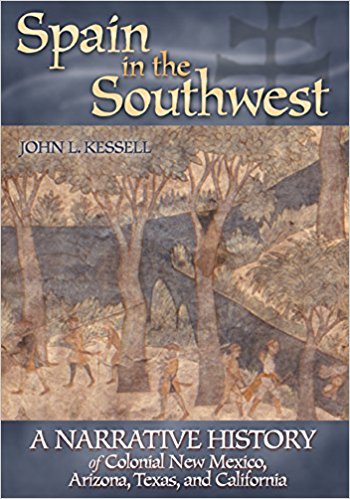
In the early 1500s, the Spanish triumphed over the Aztecs and established a new Spain — an empire forged out of the new world.  The equatorial tropics were only the beginning for Spain, however, as far above them loomed the entire continent of North America,  full of possibility.   The Spanish were lured north with simple and expressed motives: there was oro in them thar hills.  They were teased with stories of great cities to the north, rivaling even the splendor of now-perished Tenochtitlan. Their explorations would take them as deep into the interior as Kansas, and create a new province for colonial Spain: “New Mexico”. The Spanish in the American Southwest is a history of the Spanish empire in the present-day states of New Mexico, Texas, Arizona and California, one which aims to tell the story of cultures in collision — or collusion, as the Spanish often relied on alliances with locals, using chronic warfare between populations to make friends.   The province of New Mexico was named such in the hopes that it would prove as abundantly wealthy as Mexico,  but easy loot wasn’t to be found. Angry natives were, though, and in abundance — constantly resisting the dons and once driving them out of the region entirely. Still, the ‘new Mexico’ would remain a Spanish possession, maintained at great expense for the benefit of seemingly no one but the Church, until Napoleon invaded Spain and provided the opportunity for the New World to declare independence from the old.

As this is billed as a narrative history, what are some of the interesting threads?  Accounts of exploration always have an aura of fascination about them, although the Spanish were more disappointed with the constant lack of golden cities than mesmerized by the landscape.  In this history we see the Spanish grow from explorers to conquerors, and then — as the generations pass — men who belong more to New Mexico than they do Spain. They struggle constantly with the neighbors, whose kin they have effectively enslaved and alienated from the local gods — and later on, the Spanish have to double down on the unproductive province because of other European powers. France is especially aggressive in Louisiana and Texas, and the Anglo-Americans keep eying the west with a certain avaricious glint. The main reason Spain held on to the Southwest prior to strategy becoming a factor, however, was religion, as the religious orders (Jesuits and Franciscans) assured the Crown that they had baptized many souls, people who will be killed by their neighbors should Spain leave.  Speaking of the friars,  don’t think of them as gentle souls living lives of poverty and service to their fellow man. The friars in the southwest were potentates, who relied on the forced labor of the locals and who threatened even the Spanish military and civil powers in terms of authority. One early friar — addled by the desert sun and encouraged by his distance from Italy — claimed to have the full authority of the Pope in the New World, and another effectively ousted the first governor of New Mexico proper when he (Peralta, the Santa Fe avenue’s namesake) challenged the cleric’s rule.

More will follow on the Southwest this year, including a travel account based on Coronado’s first foray into the region, a history of the region between Mexican independence and the American invasion;  and a modern history of the state of New Mexico itself.

Related:
The Spanish Frontier in North America, David Weber
West of the Revolution: An Uncommon History of 1776, Claudio Sant. Covers the Russo-Spanish contest in California
Death Comes for the Archbishop, Willa Cather.

Posted in Reviews | Tagged , , , , , | 7 Comments

Captain to Captain

Captain to Captain
© 2016 Greg Cox
368 pages

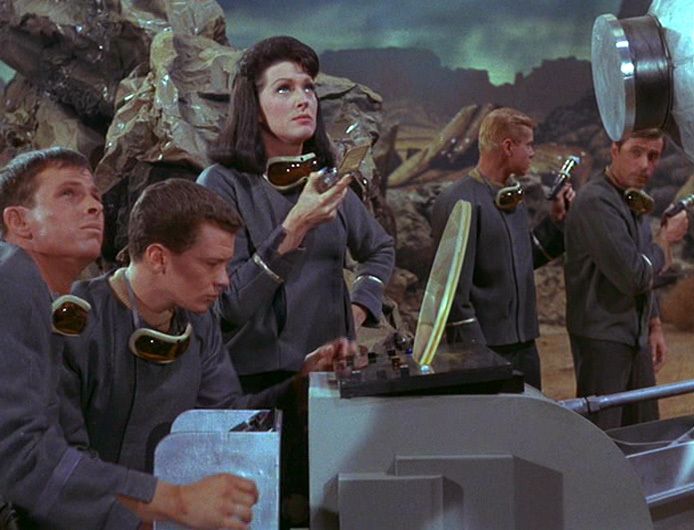
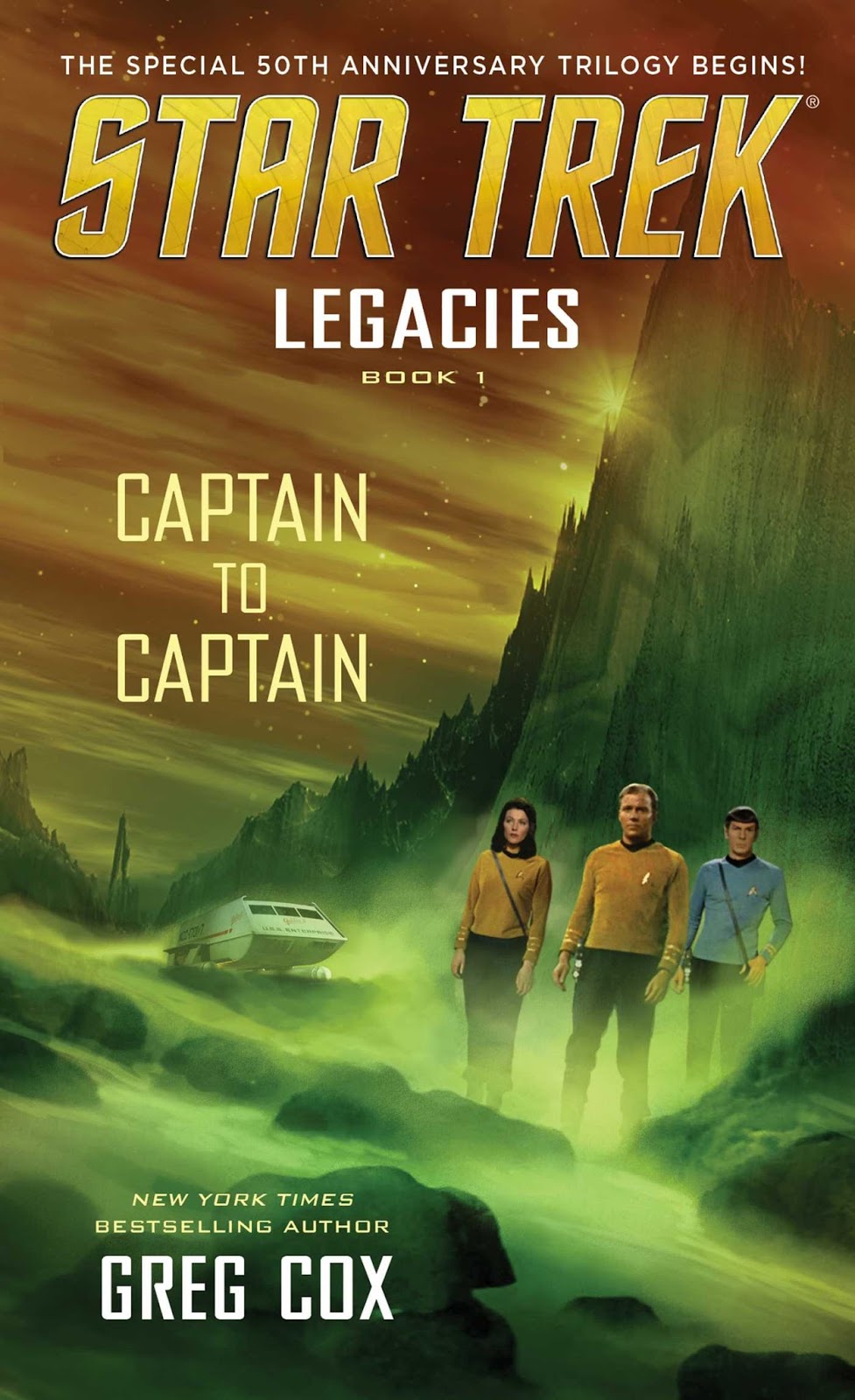
Captain Kirk is surprised to be hailed by the formidable former first officer of the Enterprise, a woman so accomplished she still retains the nickname “Number One”, enroute to a little shore leave. Her stated goal is to visit the Enterprise, where she was once such a commanding presence that her voice is still the model for the shipboard computer’s audio output.  Her unstated goal is to remove something from a secret vault on the ship that only the captain and his first officer — and only the captains and first officers  before him — know about. She has unfinished business with the device,  born of a tragedy incurred while she was a young lieutenant on the Enterprise, and before it’s too late she wants to make whatever amends she can.

Captain to Captain is the first in a trilogy of books by different authors, celebrating Star Trek‘s fiftieth anniversary, and should entice Trekkies immediately with the promise of exploring the mysterious character of Number One.  Appearingly only in Trek’s pilot episode, she played the logical and unemotional first officer, alongside a…well, not quite unemotional Mister Spock.  According to Gene Roddenberry, he was told by network officials that he must get rid of the woman and the alien, so he ‘married the woman and kept the alien, not being able to do it the other way around’. Of course, the woman wasn’t so hard to get rid of: Majel Roddenberry would return quickly as Nurse Chapel, the voice of the computer in every series but Enterprise,  and Lwaxana Troi. But that was later. Number One was the original.

We learn quickly that she is from a planet which is not Earth, and which has given her a name unpronounceable to most Federation Standard ears:  she simply uses the monicker “Una”, a nickname from her Academy years, as her given name. Following her cat burglary aboard the Enterprise,  the book switches to her original mission, under Captain Robert April. Here she is cool and confident, but not impersonal; she has a strong attachment to several of her crewmembers, even indulging one in many jokes despite his being directly under her command.  Perhaps she embraced more reserve after the tragedy that befell her assignment, which started after the Enterprise discovered a formerly-visited planet had suddenly been invaded by a mysterious citadel of obvious alien origin, which was busy destroying rain-forests, enslaving the locals, and being very poor neighbors altogether. 
Captain to Captain begins as a mystery before quickly developing into an action novel, one which peaked a bit early (4/5ths in) and then threw in the Klingons to keep things exciting. I only bought it for Number One and Cox, and got my money’s worth, but could see pursuing the rest of the trilogy later. The second book is by David Mack, for pete’s sake. 

Posted in Reviews | Tagged , , | 5 Comments

Departing England

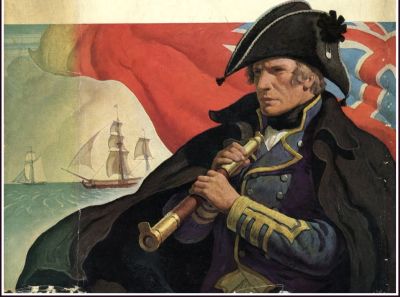
From the cover of Commodore Hornblower

Yesterday we bid goodbye to April, and thus for me, to Read of England 2017.  I believe I found a good balance between literature and history, though next year I may mix in a few biographies, perhaps with a theme — Soldier,  Scientist, Statesman Considering that I logged a couple of classics, I’m generally pleased. I didn’t quite get around to reading a James Bond tale, though. There are a couple of books not reviewed, though one is on the way.   The only thing I can say about Doyle was how oddly surprised I was to find that his first Holmes story was one-third western.

English Literature
A Study in Scarlet, Arthur Conan Doyle
Perelandra, C.S. Lewis
The Merry Adventures of Robin Hood, Howard Pyle
Sense and Sensibility, Jane Austen
On the Shoulders of Hobbits, Louis Markos
From Narnia to a Space Odyssey:  CS Lewis and Arthur C Clarke, ed. Ryder Miller,
The Canterbury Tales, Gregory Chaucer. Modern English interpretation provided by Peter Tuttles.

Historical Fiction, set in England:
The Eagle and the Wolves, Simon Scarrow
Hood, Stephen Lawhead

English History
London at War, Phillip Ziegler
Sister Queens: The Tragic, Noble Lives of Catherine and Juana,  Julia Fox
In the Beginning: The Story of the King James Bible, Alister McGrath
The Armada, Garrett Mattingly
1066: A New History, Peter Rex

With Read of England over, what’s to come in May? Well,  the Discovery of Asia will resume its course, with a little more history incoming. I’ve had a fierce science itch for several weeks now, and am also yearning to return to the Southwest , both in body and in books.  Reading histories and stories from the land of enchantment is easy enough, but I’m hoping to visit the region again personally next spring.   Expect a few English strays and even a Star Trek book in the weeks to come.

Posted in Reviews | Tagged | 11 Comments

The Canterbury Tales

WHOOOOOOOOOOOOOOOOOOO!

*ahem*

If you’ve ever glanced at my Classics Club list, you’ll see Canterbury Tales sitting there, and I’ve regarded it as one of the tougher ones on my list — in the same tier as the Russians,  April is the ideal month for reading the Tales, in part because it’s set during April (“Whan that Aprille with his shoures soote …”),  but mostly because April is a month I’ve dedicated to England for the past several years.  With its girth in mind, I began early, on March 1st.   (That marked the first day of Lent, and I was amused by the thought of reading about a pilgrimage during a time inspired by pilgrimage.)

I will note from the beginning that I did not read the tales in Chaucer’s original English. My library, happily, has a 900+ page volume that presents a column of Chaucer alongside one of ‘modern’ English, and it was the modern English which I largely read. I often compared the two columns, reading as much as I could of Chaucer before having to take a peek at the meaning of words, and I saw enough to realize — based on the fact that certain words were suppose to rhyme – -that Chaucerian English really did sound much different from ours.

I assume most people are aware of the general premise of The Canterbury Tales, but just in case: a large group of people on pilgrimage to Canterbury (intent on honoring Thomas a Becket) converge on an inn. Since they’re all headed the same way, they decide to engage in a little friendly competition: each person will spin a couple of tales there and back again, and when they all return to the inn they will decide who gave the best story, and all pitch in to give that person a free meal.  Such is the General Prologue,  after which various personalities step forward to give a story. The stories vary in length and in mood, as do the storytellers; some are noblemen, like Knights; others are commoners,  some are women, some are members of religious orders.  Some of the stories are noble, some tragic, some sad, and some very silly.

Rather than reviewing Chaucer (rather like reviewing Homer!), I want to share a couple of general comments and then recap some of the more memorable stories from the first half of the Tales, when I was still taking notes.  I was surprised by the varied settings of the stories; some are set as far afield as Russia, Syria, and Greece. As with The Merrie Adventures of Robin Hood, there are grievances aplenty against the landed nobility, including the church.  Lastly, while I’ve heard much about the medieval cult of courtly love, I never appreciated how fantastically silly medievals were for romance until I read through some of this preposterous goings-on.

And now, recaps of a few more memorable tales, complete with a moral:

Knight’s Tale:  Two cousins imprisoned together fall in love with the same woman, and are violently jealous even though they’re in a tower and there is zero chance of them courting her.    Naturally one escapes and the other is pardoned, and upon pursuing the girl they meet in a field and start fighting. Who should discover them but the king who imprisoned them in the first place, who — persuaded by the girl, who turns out to be his sister — allows them to meet one year hence, with their respective armies, and enter into trial by combat to see who shall win her hand.

The moral:   Finders keepers.

The Miller’s Tale:  One woman is pursued by two men while still married to a third. The story involves two occasions of rear ends being kissed by mistake.

The moral: Wait until daylight to kiss people.

The Clerk’s Tale:  A King is pressed by his people to marry and decides to marry a beautiful and virtuous peasant.  Despite her character, wisdom, and beauty, the King is constantly suspicious of her and inflicts a series of Job-like tests upon her which amount to (1) making her believe he’s killed her children,  (2) making her believe he’s going to annul their union and marry someone less controversial, and (3) having her PLAN THE NEW WIFE’S WEDDING.   When the wedding guests arrive, and lo! The “bride” is actually her long-lost daughter, with long-lost son in tow,  everyone enjoys a happily-ever-after moment. (Instead of “What the heck, Dad? moment.)

The moral:   What seems like psychopathic behavior may, in twenty years, turn out to be  a convoluted plan with a happy ending.  So uh, have patience.

The Wife of Bath: After entirely too much information about her five husbands, the Wife of Bath tells the story of a Knight who raped a woman and was brought on trial to the King’s court, whereupon the Queen gave him one year to  solve the question: What do women want?   Having queried high and low to no avail, the Knight resignedly begins returning to the court to meet his death, only to chance upon a horribly disfigured old woman who will give him the answer if he promises to anything she wants.   He gives the answer to the Queen and is promptly confronted by the old woman, who bids him marry her.   He resists by recounting her faults (poverty, age, etc);  she rebuts them by praising poverty, age, etc, and finally he relents to marrying her.  She then asks him:  would he rather she be old and faithful, or young and tempting to others?   He leaves the matter to her, and  she — happy that he has ceded his judgement to hers — decides to become both young and faithful. (Oh,  and the answer to ‘what do women want?’ is ‘to be in charge’.)  Hurrah for…resignation…?

The moral:   Rape is evil, but if you find a witch who wants a husband, you might get away with it.

Middle English prologue read at 1:14
Posted in Reviews | Tagged , , , , , , , | 11 Comments

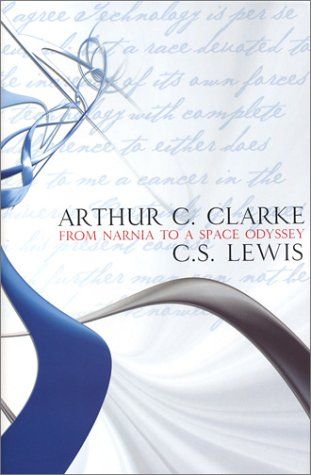
From Narnia to a Space Odyssey

From Narnia to a Space Odyssey: The War of Ideas between Arthur C. Clarke and C.S. Lewis
ed. Ryder Miller © 2003
175 pages

First of all, reader, understand that the title of this book is overstated. It is not a series of letters, a debate held in your hands. The first quarter of the book follows the exchange between Lewis and Clarke — one pensive, one optimistic — about mankind’s seemingly imminent conquest of space, but this is then followed by essays and SF short stories by both Lewis and Clarke. Both men were interested in science fiction as a genre, having witnessed it erupt from obscurity within their own lifetimes. Although Lewis is remembered more as a medieval literature scholar and a Christian apologist. his letters to Clarke evidence a deep familiarity with the SF of the day, from serious novels to pulp trash.

The spirit of the letters is intended to serve as a theme for the stories and essays that follow, though frankly I found it a collection of miscellany. The correspondence begins when Clarke reads Perelandra and takes offense that the scientists are portrayed as grasping imperialists, wanting to subject the whole of the poor solar system to mankind’s vices and ambition. He protests to Lewis that the proponents of rocket societies, both laymen and scientists, are among the most pacifistic and philanthropic people in society. Lewis’ response is that while there may be no “Westons” (his technocratic imperialist character) in the rocket clubs as of yet, they will quickly follow once idealistic explorers have broken the ‘quarantine of space’. The two then chatter about science fiction.

The bulk of the book consists of odd stories and essays by Lewis and Clarke, ostensibly related to the argument. The only real trace I saw of that was in Clarke’s stories, though: in one, “Meeting with Medusa“, an airship probing Jupiter’s oceans of cloud discovers a new kind of life. While not sure it is intelligent, the characters immediately put into effect the “prime directive”, protocols regarding the circumspect treatment of intelligent life — specifically, do no harm. The term prime directive brings Star Trek to mind immediately, and so does Clarke’s optimism that man will learn from his mistakes. In one of the last pieces of the book, Clarke rebuts an enthusiastic essay from an American military personality that the United States should lay claim to the Moon in its entirety, and Clarke appears so disturbed at the naked avarice and nationalistic aggression that he muses that perhaps it would be better for the galaxy if man were kept inside Lewis’ quarantine of space for a while longer.

I’m the odd bird who enjoys both Lewis and Clarke, whose own mind is divided between the hope of Star Trek and the sad wisdom of history, and so I found this collection odd but fun. If nothing else it is an example of two men who — to borrow from Lewis — can argue without quarreling.

Posted in Reviews, science fiction | Tagged , , , , | 4 Comments

1066: A New History

1066: A New History
© 2009 Peter Rex

The list of English kings begins with William the Conqueror, but such a list is really a thing of propaganda; although England’s patchwork of ancient kingdoms were slow to be united against threats like the Vikings, there was a line of English kings, and an England, that existed before the Normans. In 1066, Saxon historian Peter Rex labors to illustrate how long it took the Normans to truly effect their conquest. After a history of the battle itself, Rex then chronicles the many rebellions which erupted against the ‘bastard Duke’s’ rule. The battles of 1066 (there were three) and the rebellions had the effect of wiping out the English nobility, and allowing for their total replacement by the Normans. Rex notes that the English state’s efficient structure allowed William to quickly effect his will even at the shire level. After ten years of intermittent rebellions, England was finally quietened, but the English would have the last laugh: the Normans would, quickly enough, lose first Normandy, and then their French.

Casual readers should note that this is a short but dense book, with more names than the Domesday telephone book.  Parts of it were familiar to me from The English Resistance

Posted in history, Reviews | Tagged , , | 9 Comments

Sense and Sensibility

Sense and Sensibility
© 1811 Jane Austen
409 pages

Sense and Sensibility is the story of two sisters, Marianne and Elinor,  who are left to live on a fixed income after their father perished and the law forced him to leave all of his money to their stepbrother – with the promise that said stepbrother would support the sisters. Unfortunately for the ladies, said stepbrother has  all the moral backbone  of a worm, and his “support” – after taking over their home – was the promise to send fish or game when they were in season.      The sisters and their mother, made to feel like outsiders in their own home, take up residence in the country for a long spell of talking, playing music,  talking, dancing, painting, talking, walking,  and worrying.   Far from their old home they find new friends, each with their own promise and limitations – and this being an Austen novel, romance is in the air.  Both Marianne and Elinor have beaus who prove or seem inconstant, but the two women respond to their social anxiety in very different ways.  Marianne is a leaf from the Romantic  era,  full of intense passion, surging hither and yon like tides crashing on a beach;  Elinor is more reserved, more pragmatic. She feels quite intensely, but she is the image of the expression that still waters run deep –  the picture of self-government, It is she, not her mother or sister, who truly manages the house, and who cares for her sister then things go off the deep end.  Another opposing pair are Edward Ferrars and John Willoughby; one is rooted in honor, the other in self-love.

 Sense and Sensibility defeated me the first time I attempted to read it (one year ago), in part because I only tried it because of its Classic status. The story didn’t interest me, but – having recently watched the film for my Read of England celebration —  I approached the novel this time with genuine appreciation and interest in the story, particularly my appreciation for several of the characters. One of the best moments of the novel is when Elinor expresses admiration for a fellow whose behavior seems to deny her happiness. As much as it pains her, she can look beyond it and see its virtue. Otherwise,  Marianne and her beaus steal the show completely, I think, as Book-Ferrars is largely absent and appears only to stand awkwardly in a corner, mumbling his apologies before he wanders off again.

Incidentally, this experience tested a theory of a friend of mine. He claims that if a person watches the movie first, then reads the book, he will enjoy them both; if he reads the movie, and then watches the movie, he will only complain about how much the movie left out or added.

1995 trailer, with actors such as Alan Rickman and Kate Winslet. Hugh Laurie also appears.

Posted in Reviews | Tagged , , , , | 15 Comments

Shakespeare announcement

Bernard Cornwell chose this, the anniversary of William Shakespeare’s death, to announce his next novel: Fools and Mortals. It will follow young Richard Shakespeare as he tries to make his way in the acting world, dominated by his estranged older brother.  Publication is set for mid-October in the U.K.

On that note, here’s a little piece of fascination I found:

A linguist and a Shakespearean actor, father and son, here comment on how much of Shakespeare’s wordplay is lost  on modern ears,  in part because pronunciation has shifted so much that puns and such are lost.   They take turns reading various passages from Shakespeare (dramas and plays) to demonstrate the difference between modern English (in the Received Pronunciation)  and ‘Original Pronunciation’.   Worth listening to if you enjoy Shakespeare.
If you’re interested in Shakespeare and comedy, a favorite disc of mine is the Reduced Shakespeare Company’s Complete Works of Shakespeare. A trio attempts to do Shakespeare’s entire corpus, including the sonnets, in one night. Below is their run-through of Romeo and Juliet, which will give you some idea as to the tenor of it. 

Today — St. George’s Day, incidentally — starts the last week of Read of England, and it’s gone fairly well, I believe.  Two books are waiting to be reviewed, one of which is from my Classics Club list, and another I’ve been sawing away at for weeks is nigh toppled.  Fifty pages to go!

Posted in Reviews | Tagged | Leave a comment

The Armada

The Armada
© 1959 Garrett Mattingly
443 pages

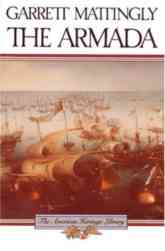
In the late summer of 1588, all of Europe held its breath as an enormous Spanish fleet, consisting of a hundred and fifty vessels of varying sizes, set sail for the English channel. Their mission: to rendezvous with the elite troops of General Parma in the defeated Netherlands, and to transport them to England, there to revenge the execution of Mary, Queen of Scots, and depose Anne Boleyn’s daughter .    That invasion never happened. As is famously known, the Armada met English fire and northern winds, and a third of its number was lost utterly on the shores of Britain and Ireland.  It was for Elizabeth, constantly confronting intrigue from Catholics and Puritans alike, a glorious moment:  here, before all of Europe,   the wind and waves declared that she was the Dread Sovereign of all England.  The Armada is a storied history not just of the Spanish fleet’s doomed voyage into the channel, but how Spain came to launch such an expensive and unwieldy endeavor.

Much of the weight of The Armada gives the background information for the “English Enterprise”.  Europe is in the throes of the reformation, and rebellions against princes carry with them the fervor of holy wars.   France, who might oppose the sudden envelopment of England into the Spanish empire,  is struggling with its own civil war, and every one of the three contenders is a Henry.  The Netherlands have risen against their Spanish lords, with the military and fiscal support of Elizabeth – who is presumably more interested in having enemies of Spain at her doorstep rather than Spain itself, given the two powers’ mutual hostility.     There is a very good chance that Phillip could get away with styling himself the English king:   he’d already enjoyed the title as Queen Mary’s husband,  and Elizabeth reigns over a divided nation. Many of her subjects maintain faith with the Catholic church,  secretly or openly,  and several rebellions and conspiracies intending to restore a Catholic monarch to the throne have already erupted.  If their former king landed and called them to rise against a woman already declared illegitimate by the Church,   how easy would it be for them to bury their fears about civil war and declare for Phillip?

Fortunately for England’s men in arms, and their mothers, it never came to that.  The English engaged in a running battle with the Armada as it made its way towards the Channel; there was no epic showdown, but a series of smaller skirmishes, two of which – when combined with the storms of the Channel – did serious damage to the fleet. By the time they  neared the rendezvous, in fact ,the admirals in command had to view their stores of rotten food, ailing men, and badly leaking ships in the cold light of reality.  The Armada was no longer capable of breaking the Dutch blockade that would allow the Spanish to take on their army and transport it to Spain. It might not even make it home, if it continued to be harassed.  Part of the problem was that the Armada was so enormous and unwieldy.  Its ships were gathered together from across Spain’s domain, and many were Mediterranean galleys built for ramming that were out of place in a battle that involved more artillery than swashbuckling shipboard raids. Even in the age of standardized equipment and radio communications, the Allies required months of planning and stockpiling to prepare for D-Day.  Spain had a similar challenge, but its every piece of equipment might vary from casting to casting, and its barrels of food spoiled as quickly as they could be found.   The Spanish sailed in the hopes of a miracle, but they found none.  When news reached Phillip II, he wrote to the his bishops and could express only thanks that — in the light of the storms — more men were not lost.

I knew virtually nothing of the Armada except that it sailed, met a storm, and failed. Although in retrospect a brief review of the history of the period would have served me well as a reader  (particularly in regards to France, whom I seem to ignore utterly between 1453 and 1789) , the author’s delivery is indeed novel-like. The personalities of the period, like the swaggering Drake, add to the tale’s liveliness.  Although the wars of the day seem far removed from us now, the author’s epilogue couldn’t be more current: he cautions the reader that wars of ideologies are always the hardest to win.

Posted in history, Reviews | Tagged , , , , , | 6 Comments