Factory Girls

Factory Girls : From Village to City in a Changing China
© Leslie Chang
420 pages

China as a whole may have a third more men than women because of the one-child rule and a preference for male children, but in Dongguan it’s a different story. There, women outnumber the men, for it is they who fill the factories and help expand the Chinese economy.  When Leslie Chang learned how many Chinese women — girls, really, for many are teenagers — were leaving their villages to find work on the coast, she wanted to know and tell their story.  In her seven years living in China,  Chang also discovered a link to the lives of these women who opened up to her; her grandfather had once “gone out” of the village and sought his fortune, and both would do their part to build out China’s future. Factory Girls is not an expose, but a long-term project of both journalistic  and personal interest, as Chang befriends a few women to learn about their lives as a whole: their work, their leisure, their aspirations,  and their attempts to find meaning in their associations and relationships.

Chang believes there are two key reasons women are so predominant in China’s factories. First,  they’re more likely to leave home for the factories, as sons are encouraged to stick close to the homes they’ll one day inherit.  Men who go to the city are often relegated to dead end positions as cooks and security guards, because factory owners prefer hiring young women — they being more patient and easier to manage. The Chinese cheerfully embrace sex discrimination in their want ads: tall men are solicited for one job, pretty women for another.  Chang muses that women have embraced the development zones more readily than their male counterparts because they don’t have the security of the family  farm to take for granted.   After moving to the cities, few daughters want to go back home, anyway. They might yearn to see their family and visit once a year, but once there they miss the energy of the cities and resent their parents’ authority. That authority is further compromised given that these families often depend on the money sent to them by their wandering children.

As with Country Driving, Factory Girls bears witness to the sheer amount of energy on China’s southern coast, how companies and people are scrambling. “Jumping factories” to find better positions is the norm, but this does impose a cost on the employees:  no sooner do they make friends at a factory do those friends disappear, sometimes leaving the city altogether.  Although the first generation of migrant employees  were self-conscious of their in-between status, and read magazines and sang songs specifically about the migrant experience,  most women who move to the cities quickly embrace their status as residents of the New China. They constantly re-invent themselves,  trying new hairstyles and styles of clothing seemingly every week.  This is not merely curiosity or vanity;  many takes classes to instruct them in how to find white-collar work, and it’s more about presentation than skills. Skills can be learned on the job; what has to be learned before that is how to sell one’s self as a confident, personable professional who can shake hands and trot out a little English from time to time. There’s also a growing class of courtesans, ‘karaoke girls’, and prostitutes who take ‘selling themselves’ somewhat more literally.  With the right madam, in the right area, ladies of the night can make in a week what their sisters in the factories make in a month.   Chang also notes a search for meaning among these new urbanites, who explore previously forbidden religions, including China’s traditional occult practices with obscure origins.

Chang  occasionally includes chapters about her own search for her roots, and the discovery  that her grandfather had once “gone out” of China, only to return and be killed by the Communists.  Chang sees a big difference between her grandfather’s story and those of her  new friends in China: while he viewed his travels and work as something done to better China and his family, the women were largely concerned with themselves and their own stories. Chang seems to approve of the change, even as she documents the loneliness and restlessness that has resulted from these young people not having any larger purpose in mind in their lives; supporting their parents is obligatory, and done more out of reflexive duty than purposeful choice.

Although this book is approaching its fifteenth anniversary and China’s economy and society have presumably changed much in the past two decades, all of his is consistent with books like Country Driving which were published a few years later. Like Country Driving, the chief appeal here is human interest,  concentrating around the lives of  few young women whose stories illuminate the loves of millions of others. Definitely of interest to those curious about modern China, and particularly its women.

Fun fact: Leslie Chang is married to Peter Hessler, author of Country Driving. No wonder there was so much overlap!  They were working the same territory, so to speak..

Posted in Reviews | Tagged , | 3 Comments

Revelations and Dust

Star Trek the Fall:  Revelation and Dust
401 pages
© 2013 David R. George III

David R. George takes a bullet for the team in The Fall: Revelation and Dust. First in a five-part series with five participating authors, Revelation and Dust largely consists of recap, introduction, and assassination. Well, something had to happen, right? There’s four books after this, so something extraordinary had to hook us for the rest. We’ve had the Borg invasion, we’ve blown up Deep Space Nine already, the Dominion are SO yesterday, and the hostile takeover of the Federation by the Ferengi Alliance is unlikely. So, gunshots it is.

At the end of George’s DS9/Typhon Pact duology, Deep Space Nine was blown up with the lost of most of its hands.  Two years later, the station has been rebuilt, this time as a proper  deep space installation instead of an ore-processing plant turned command post. Its formal opening coincides with the two year anniversary of the old station’s destruction, and now the gang is back together to pay respects to their fallen comrades, and their now-vaporized home.  Tensions from the previous Typhon Pact novels — Sisko’s estrangement from his wife Kasidy,  Bashir and Dax’s falling out over Bashir’s determination to destroy Section 31 from the inside — are buried, making room for new and exciting arguments.The novel largely follows the characters as they make their way to the station and renew old acquaintances, musing over the good times until the speeches and gunfire start. Part of this catching-up is an unfortunate series of chapters that re-uses a plot device from one of the early Relaunch novels:  readers are subjected to completely new characters in some quasi-fantasy setting involving a tribe called the ‘Bajora’.  As with last time this is an extended vision effected by the Prophets,  because the mystical goings-on here translate parable-like to something “real” that has happened . The upshot of this thread seems to be that Sisko can have his life back from Prophets.  He can  have his family and they won’t kill him. Yay. In any case, I don’t want to read about random fantasy Bajorans, I want to read about President Bacco. She’s always fun.

George’s previous DS9 novels have all been great reads, but this one is lacking…story. This is essentially a Star Wars scrolling text intro, expanded to 400 pages.  See for yourself!

(camera pans from starfield to new station)
Posted in Reviews | Tagged , , , | 4 Comments

Country Driving

Country Driving: A Journey through China from Farm to Factory
© 2010 Peter Hessler
448 pages

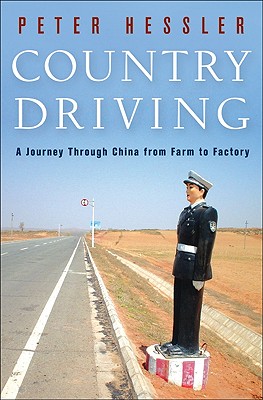
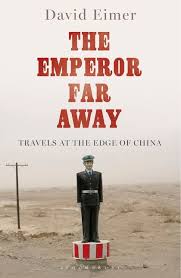
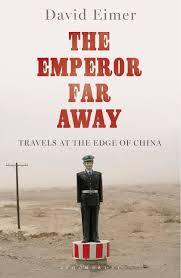
First things first: that statue on the cover intrigued me enough that I bought both books that used photographs of it.  Emperor Far Away made nary a mention, but Hessler comes through in the first third, referencing the statue as part of a scarecrow police system in one of China’s western rural areas, erected along freeways and at roundabouts to discourage reckless driving. Mounted automobile ruins and signs that keep a running count of how many people have perished on the highway are also part of the safety campaign.    Such measures are needed because China is a nation on the move: its villages are emptying out as people move en masse from villages throughout the country towards the southern and south-eastern coasts. There,  China is being remade month by month as factories and people move, chasing opportunities at a frantic pace. In Country Driving,  Hessler drives China’s highways, lives in one of its villages, and explores its burgeoning factory districts.   Country Driving is a China memoir that first seems like a collection of miscellany:  Hessler opens the book like a travel memoir, but halfway through, he’s relating village politics and writing about one of the neighbor boys  turning into a couch potato.  Not until the book’s end in the factories does the subtitle make sense.

Country Driving’s largely appeals on a human-interest basis. The people of China are experiencing the industrial revolution seemingly overnight:  most of the factory managers Hessler spoke with had been farmers as children, and all of them acquired their expertise on the job, often by shoving themselves through the door. Hustling and social connections are more important were more important than degrees.  Lying about one’s age to get a job was nothing offensive:  bosses saw it as a sign that that people wanted to work.   The amount of energy in China’s development zones is attractive read about: these cities are like New York and Chicago in the late 19th century,  growing voraciously and teeming with newcomers who are creating a new society on the fly.  Like those examples,  these boomtowns aren’t necessarily pretty: factory workers often live in dormitories on-site,  and the state-controlled ‘union’ exists more to provide free movies to workers.  Those who want a better deal have to effect it themselves,  arguing with management or simply leaving without notice.

Hessler refers to the rural-urban move in China as the largest migration in human history, and in his early chapters driving beside the Great Wall, he finds deserted village after deserted village:  the young have left for city work, leaving only the old behind. Rural China, it seems, is literally dying. In his rural travels,  the only young people Hessler encounters are those who are hitching rides to visit their families, typically bearing gifts of food.  Country Driving illustrates the concept of liquid modernity fairly well:  things are changing so fast that no one really seems to know what they’re doing. Driving, for instance, is a relatively new skills,  but millions of Chinese are taking to the road: the number of registered drivers doubled in the time that Hessler was living in-country. Driving instructors teach people to use standard-transmission cars in ways that would make a mechanic grimace, and for seemingly arbitrary reasons.  The standard practice is to begin all maneuvers from second gear because it’s more difficult, and more difficult means it’s worth doing — even if no driver will ever need to get their tire onto a single plank of wood, it’s still part of the exam on the merits of difficulty alone.   What is missing, apparently, is any notion of orderly driving beyond “the bigger the car, the more right of way it has”.    Cars jostle against one another the way people rub shoulders in Times Square, and in some cities, no rental agency expects its cars to come back without new dents. Like bugs on the windshield, they are to be expected.

Those who are interested in what life in China is like will find much of interest here, but the organization almost makes it seem unfocused at times. This is the third in a trilogy of China memoirs, however, and might make more sense when combined with the other two — just as the third section here made the first two more connected.

Posted in Reviews | Tagged , , , | 7 Comments

Top Ten Tuesday: Favorite Books from 2017 (so far)

This week’s Top Ten Tuesday from the Broke and the Bookish concerns favorite books for the year, and while there’s still a chance that some amazing book could pop up in the last two weeks of the year,  I’ll go ahead and offer my thoughts. 

1. In the  City of Bikes: The Story of the Amsterdam Cyclist, Pete Jordan.  Rarely does a book give me such joy as this,  a history of Amsterdam’s bike culture and the author’s experiences getting used to it.  I’ll quote my review:

It’s simply a story of humans living well —  Jordan, and the people of Amsterdam as a whole.  It is connected but free, rebellious but highly functional for human needs. If you like the city at its best, or like cycling, or simply have a care for human flourishing, this is a wonderful little book. I loved it before I bought it, I was thoroughly enblissed while reading it, and I already know it’s one I will keep remembering with the thought: this is how life should be.

2. The Twilight of the Presidency, George E. Reedy.  A former Johnson aide who was fascinated by his boss’s isolation during his administration here analyzes how the presidency has become an elective monarchy — and a bad one, surrounded by hundreds of people who shield their king from criticism, and make the imponderable ship of state even harder to move from its course. Crucially, the problem is now structural: it doesn’t matter who is elected, because the same problems have afflicted nearly every man since Hoover. 
3. This Brave New World:  India, China, and the United States; Anja Manuel. This book both reviews the political. cultural, and economic evolution of 21st century India and China, as well as argues for  a prudent American relationship with both (rather than favoring one against the other). 
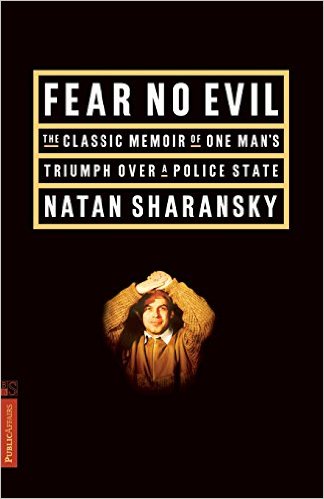
4. Fear no Evil, Natan Sharansky. A Jewish Russian is picked up for his political activism — arguing for easier emigration of Jews  from Russia to Israel — and fights back against the gulag’s psychological warfare. An incredible story of a man who kept his integrity in unimaginably difficult circumstances. 
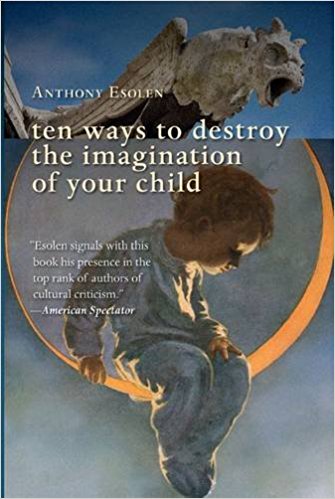
5. How To Destroy the Imagination of Your Child, Anthony Esolen.  This is a tongue in cheek “appraisal” of modern mass culture, and how destructive it is to a humane life and humanistic education.  Esolen abandons the farcial praise in his sequel, Life Under Compulsion: Ten Ways to Destroy the Humanity of Your Child
On its face, Redshirts is a fantastic parody of Star Trek,   more serious than Galaxy Quest but definitely fun. Those codas at the end, however, turned it into a moving story.  I listened to the Wil Wheaton  Audible presentation.
7. Cities of Gold: A Journey Across the American Southwest in Pursuit of Coronado, Douglas Preston. I’d like to think that I would have been thrilled by this book on the basis of its writing alone, its excellent mix of history, travel, and reflections on the Southwest,  even if I didn’t have a fascination with the Southwest that visiting it has only increased.
8. Conquest of the Skies: A History of Commercial Aviation, Carl Solberg.  It’s everything I could ask for in a history of commercial aviation, covering business, society, and technical advance. 
9. The Emperor Far Away: Travels at the Edge of China, David Eimer. A tour of the outer rim of China, covering steppes, mountains, jungles, deserts, and tundra, and mixing stories of China’s revolutions with those of smaller people carried along in China’s wake…from Tibetans to Russians.  Great variety here in terms of the topics discussed — religion,   narco states, Russian architecture…
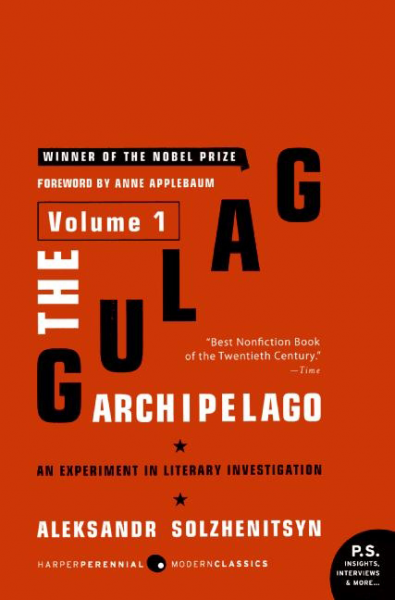
10. The Gulag Archipelago, Aleksander Solzhenitsyn. This one is cheating a bit, since I’m not yet done with the third volume, but it would have merited inclusion here just based on the first volume. 
Honorable mentions:

The Circle, Dave Eggers.  Google eats facebook and Apple and goes evil.   Comedy meets..er, 1984. 
The Fellowship, Literary Lives of the Inklings, Philip and Carol Zaleski.  A four-part biography on C.S. Lewis, JRR Tolkien, Owen Barfield, and Charles Williams. I still haven’t finished a review for this, and frankly — need to re-read it, because the first time around I largely focused on Lewis and Tolkien. 
Ancestral Shadows, Russell Kirk. This collection of short stories features ghostly characters who often don’t know they’re caught in the veil between the living and the dead — and neither does the reader, very often. 
Posted in General | Tagged | 8 Comments

Favorite Covers from 2017

Although we’re not supposed to judge books by their cover, it still happens. A good cover can draw the shopper’s eye, and impart some feeling of what the book has inside.  Perhaps it’s an atmospheric murder mystery, a  grimly functional war story,  or a breathtaking journey into another country.   Any of those can conveyed by the right cover, and some books are worth savoring just for their cover art.

In no particular order, here are my ten favorite book covers from 2017!

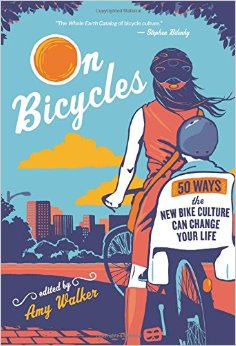
1. On Bikes: 50 Ways the New Bike Culture Can Change Your Life, Amy walker

Facing a city in the sunrise, with a day of adventures ahead of us, this cover is warm, inviting, and optimistic.  I think it’s incredibly effective at delivering the title.

2. Before Plan 9: Plans 1-8 From Outer Space

The utter goofiness of the original movie and many of the stories here is captured rather well by this art.

3. Astrophysics for People in a Hurry, Neil deGrasse Tyson

Here we see both the innocent wonder of a child, and the glory of the cosmos, matched perfectly.
4. Cities of Gold, Douglas Preston
The sun’s rays on an adobe village, which a perfect sky behind them — what a fantastic photograph!
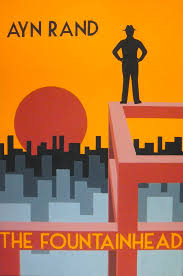
5. The Fountainhead, Ayn Rand
This cover really evokes a man against the world feeling, as well as Roark’s triumph, his love for the energy of cities and the creative work their skylines could show.


It could just be the use of blue and orange, but this one jumps out at me.


Cyberpunks uses contrast even more (red, purple, green, and yellow), but I like the fist and keyboard imagery evoking the rebellion of early technolibertarians. 

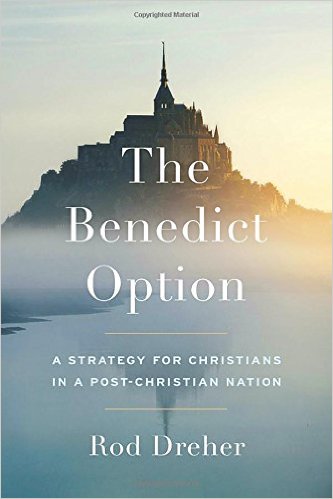
8. The Benedict Option

The Benedict Option’s appeal is completely opposite: instead of contrast and energy, its cover is one of peaceful, serene stability. 
There’s a lot going on in this cover, which makes sense given how the book opens a reader’s eyes to how lively our bodies are.


10. Empires of Light


This cover inspired this list; I checked the book out several times before reading it, and every time I was drawn back by the gloriously lit tower and the art-deco like font.

Posted in Reviews | 3 Comments

Empires of Light

Empires of Light: Edison, Tesla, Westinghouse, and the Race to Electrify the World 
© 2004 Jill Jonnes
464 pages

Empires of Light is less a history of how the United States became electrified and more a biography of three electrical titans – Edison, Tesla, and Westinghouse — as they pursued their own electrical projects in cooperation and bitter conflict. All three were passionate, heedless inventors who loved plowing their money in money into new ideas, sometimes at the cost of bankruptcy. They differed sharply, however, on the best way to distribute electricity. Edison preferred the safe, expensive, and density-demanding direct current. Westinghouse and Tesla both viewed alternating current — which was easy to ramp up the voltage or ‘speed’ of electricity, and transmit at long distances — as far more promising, allowing them to reach places that didn’t have the population density of New York City or Pittsburgh. Alternating current was more dangerous to work with, however, and Edison used his rivals’ volatility for all it was worth. When the State of New York considered using electricity for the death penalty, Edison – borrowing a page from Marc Anthony’s funeral speech lauding Caesar’s assassins – praised the merits of Westinghouse’s AC for killing people. He hopefully speculated that perhaps in the future death row would be the “westinghouse”, and killing someone with electricity would be a verb – “He was westinghoused”. Sheer economics, however, shifted favor to AC’s court, and by 1930 even Midwest towns could count on the lights being on. Edison would return to his phonograph and open the doors for moving pictures and Hollywood, while Tesla – whose AC projects had made possible the electrification of Niagra Falls – would drift from idea to idea, all of which were ‘ahead of their time’, and none of which ever became realized. One that came close was a radio-controlled mini-boat.

Although Empires is often entertaining – between chapters on patent wars, anyway – the combination of biography and business/technical history didn’t quite click for me, possibly because I was chiefly interested in the electrification of the US and less so in the projects (The White City, Niagra) that allowed Westinghouse to prove AC’s worth. Readers will glean only a flicker of information about the pace of electrical expansion, chiefly through the cited sales of AC light bulbs. These men certainly merit reading about: Edison and Tesla are both legends, but Westinghouse made his reputation in brilliant but boring improvements to railroad brakes and such, and his and Teslas’ expansion of the AC system accomplished the same for the electrical infrastructure of the US.

Related:
Phillip Schewe’s The Grid: A Journey into the Heart of Our Electrified World is more about national electrification, but its history jumped from Edison’s early attempts at municipal power transmission to governments co-opting power companies as public utilities.

Posted in history, Reviews | Tagged , , , , | 3 Comments

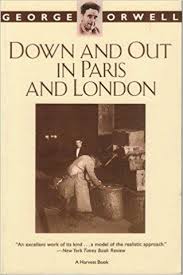
Down and Out in Paris and London

Down and Out in Paris and London
© 1933 George Orwell
224 pages

“Have they no refuge or resource?” cried Scrooge.
“Are there no prisons?” said the Spirit, turning on him for the last time with his own words. “Are there no workhouses?”
(A Christmas Carol)

In 1933, young George Orwell took a room in the warrens of Paris and was promptly rendered penniless when someone broke into his room and stole his savings. Struggling to find work teaching English, Orwell drifted into poverty, until he found himself back in England, living as a tramp. Or…did he?  Down and Out in Paris and London describes itself (in my edition) as a novel;   elsewhere, it is described as a memoir of Orwell’s, one that took real events and made a proper story out of them.   Regardless,  Down and Out delivers a convincing picture of life in the dregs, both employed and not.

The story begins in Paris, where a struggling narrator links up with a Russian friend of his as they both try to avoid being thrown out of their penny flats. They try everything from the circus to  writing Communist propaganda, but most of these opportunities melt away as soon as they get close. (Orwell concludes that  the communists are swindlers; brother, you ain’t see nothin’ yet.)   At last they find work — and plenty of it — in the kitchens of a classy hotel, which is far from classy behind the servants’ doors. There the scene is chaos, insults, heat, and staff wading their way around one another through floors wet with discarded lettuce leaves and oil.  Seventeen hours a day — broken by a mid-afternoon break to relax in the bistros —  is not unusual.  This provides a secure existence until the two friends break away to help launch a Russian restaurant. It never ignites, and eventually Orwell drifts to England where he takes up tramping and tries various boarding houses and so on.

Most of this is strictly memoir, but Orwell pauses to reflect on what he is seeing from time to time. He notes, for instance, that the high class meals are an utter farce: if the gentlemen outside were to witness their food being prepared, they would hesitate to feed the result to their dogs — what between the steaks being rescued from dustbins and the hair grease-tainted soup. The work was badly organized, Orwell wrote, highly inefficient, and he suspected motive at work. Keep the lower classes running hither and yon, and they wouldn’t have time to get in trouble.  Similarly inefficient is the waste of human energy he sees in London:  the tramps spend their time on the move because they’re only permitted to use a given relief house once, so they move from house to house. All of this time spent walking and waiting for hostels to open could be made more productive, Orwell muses, if lodging homes for the poor included some element of farming: those who stayed would work towards their own support.

Down and Out is utterly readable in the Orwell way and despite its subject is funny from time to time. One man is described as rather ambiguous, for he wore sidewhiskers and those were the mark of either an apache or an intellectual — and no one knew how to place him.  In the Paris segment, when the narrator considers a job at the circus, the requirement include: cleaning up litter,  moving benches, and standing astride two chairs so that a lion might pass through one’s legs. One of those things is not like the other.   Orwell captures a great many human stories, some of them curiosities of the time — like the Russians who fled Stalinist Russia.  Part of his argument made a certain sense and others do not. He writes that beggars’ labors should be considered as work, since they perform actions — wailing a song, or drawing on the sidewalk — that are responded to (albeit grudgingly) with money.  What’s the difference between that and a man swinging a pick at the railroad, he asks — they’re both labor.  That would be the labor theory of value, which is of interest to middle schoolers who spend all day half-hardheartedly picking at their bedrooms and then claim they’ve worked all day at it.   The difference between a man paying to go to an Enrico Caruso concert and a man giving a dollar to a street yodeling is that he actually wants to listen to Caruso, and he wants to get away from the yodeler.  The London system does seem inefficient, but equally counterproductive is encouraging unemployed people to remain in one county forever through social support, when there are neither jobs nor the prospect of jobs in then near future. People used to move away when opportunities failed; now problems just fester.  It just goes to show that there are no solutions, merely trade-offs.

Posted in Reviews | Tagged , , , , , , | 8 Comments

Welcome to the Orthodox Church

Welcome to the Orthodox Church
© 2015 Fredrica Mathews-Green 
384 pages

What it means to be liturgical can’t be encapsulated in a creed; liturgy has to be practiced,  experienced.  In Welcome to Orthodoxy,  FMG creates a fictional Orthodox parish and guides readers through it. She begins first with a tour of the church’s physical structure — an outward and visible sign of its theology — before guiding her readers through Vespers, the Divine Liturgy, Pascha, and — the holiest of holies — coffee hour.   FMG isn’t playing tour guide to a fictional landscape, as every step of the way she is sharing the theology and culture of the Orthodox tradition.  Particularly interesting for me is FMG’s statement that the Orthodox regard the Crucifixion differently; for them, Christ died to conquer Death – not to sacrifice himself as atonement for forgiveness of sin.  Kin to this is the Orthodox view of sin, which is regarded as deathly not because sin is like a law that carries the death penalty, but because sin is simply spiritual disease. Anger, lust and so on disrupt the soul’s connection to God, and make people vulnerable to worsened health – -both spiritual and physical. This view is echoed in Stoicism, or at least in the writings of Marcus Aurelius — he urged himself to return to philosophy as a patient to the doctor.   Throughout the book, FMG explains the origin of Orthodox practices that seem strange to ‘modern’ Christians who are largely divorced from history. . Icons, for instance, are viewed as windows into heaven, and when they are kissed it is not the object that is being greeted, but the person who the icon is showing.  I’ve read similar books (The Way, on theology, and FMG’s Facing East, on a year in the Orthodox church), so there weren’t many surprises.  I could see recommending this to someone who was curious about the Orthodox tradition.

Blogger having some technical hiccup, so here are links which would otherwise be in-text:

The Way:
 http://thisweekatthelibrary.blogspot.com/2015/10/the-way.html
Facing East:
 http://thisweekatthelibrary.blogspot.com/2016/02/this-week-usual-suspects.html
The Orthodox Church
http://thisweekatthelibrary.blogspot.com/2016/06/the-orthodox-church.html

Posted in Reviews | Tagged , , | 2 Comments

The Emperor Far Away

The Emperor Far Away: Travels at the Edge of China
© 2014 David Eimer
336 pages

The Emperor Far Away takes readers on a journey along China’s outer rim, beginning in the western steppes where the ‘Chinese’ are a minority,  and following it south to the Tibetan plateau, the jungles of the Golden Triangle, up to the Korean border,  and ending in the far north,  where the snow only melts for three months of the year.   Eimer’s  travels would be fascinating in themselves, given the variety of landscapes and people encountered, but also shed light on the Chinese state’s interactions with its neighbors and internal ‘others’.

The people’s republic of China, like the supposedly vanished empire whose borders it revived,  counts a multitude of peoples as its subjects.  The Chinese state recognizes at least 56 ‘minorities’ within its borders.  The Uighur people of Xinjiang, a larger group,  are more Turkic than ‘Asian’, and hold fast to their own traditions — particularly Islam. This annoys the Party to no end,  and not only because it disdains religion.  The unity of the Chinese state and its people — unity controlled by the party — is a fundamental doctrine of the government.  Separatism is heresy, and since religion’s importance in creating cultural identities is rivaled only by language it remains anathema. Despite this, even its own people drift into religion:  in the section on Tibet, we meet Chinese tourists who are searching for something in the Buddhist temples,  and those near the Korean border are embracing exuberant evangelical sects like Pentecostalism.

The golden triangle is another area of interest. for here there exists narco-states that ignore national boundaries and impose their own authority on their subjects.   These are not necessarily dangerous places, provided one is vouched for. The streets are patrolled by fifteen year olds with Kalushnikovs, and the economy largely consists of growing, processing, and shipping opioids — including little red pills that are not swallowed, but exposed to flames and the smoke inhaled.  China’s southern border encompasses both ‘model minorities’ and unyielding nomads,  the latter of whom are most common in Tibet, where they have traded camels for motorbikes.  Unlike Xinjiang and Tibet, the people in the golden triangle region are free from the fear that their culture will one day vanish: the Han are not settling en masse here as they are elsewhere.

Further north, near the border with Korea, readers encounter the ‘third’ Korea. The Yanbian prefecture of of China sits along the North Korean border, and nearly half of its population is ethnically Korean. Some are refugees from North Korea, others have drifted there more naturally — and like American immigrants, many straddle two identities and refer to themselves as Chinese Koreans.   The region is strongly influenced by South Korean culture, and particularly its abundance of churches. Because of the fusion of North Korean refugees and South Korean culture, Eimer believes Yanbian is an image of what a unified Korea might look like. Even further north Chinese culture mixes with Russian, instead, resulting in blonde-haired blue-eyed people with Chinese names. 

If Emperor Far Away is anything, it is varied. Eimer takes us across steppes, up mountains, down rivers, into the jungle, and finally into areas so cold that the snow is only absent in the high summer.   Eimer’s interest in meeting people off the beaten track makes for interesting reading as he uses his Mandarin, a few contacts, and the curiosity of people to make travel arrangements on the fly.  Sometimes this meant breaking down in the middle of nowhere,  bypassing border checkpoints, and hitching rides on cargo ships.  Those interested in China’s  place on the world stage will no doubt be interested in sections like the one on North Korea, where it is revealed the Chinese government treats North Korea like one of its autonomous prefectures:  it doesn’t respect the Kims as leaders of a neighboring nation so much as it regards them as a necessarily evil.  Better to manage the Kims and keep their economy from dying completely than to see the place collapse and all those starving  Kim captives flood China.  The chapter on the Chinese-Russian border is a reminder of how the Chinese are haunted by the Soviet Union’s sudden collapse,   one of the reasons the Party is so ruthless about political dissent.

Emperor Far Away will easily rank as one of my more memorable and helpful reads this year.

Posted in Reviews | Tagged , , , | 2 Comments

Are We There Yet?

(I am officially curious about that statue/statues…)

This year my study series has been the Discovery of Asia, with a stated goal of reading two books in Asian (primarily Indian and Chinese) history per month.   Other challenges and themes have cut into that, aided and abetted by some general sloth,  and I’m five books shy of making my goal.   But I have a month left, and I’m going to see if I can’t make it!     I have two books in the post (Factory Girls and Country Driving: A Journey Through China from Farm to Factory, both ‘life in modern China’-esque books),   two on my Kindle,   Nehru’s Discovery of India, and my local library’s holdings, so I’m fixed for content.    Speaking of, here’s another micro-review, this time from a book I was reading during my St. Augustine trip and…er, left in the weekend bag when I threw it in the closet.

Dragon Rising uses each geographical region of China to review an aspect of the country; Shanghai stars in a chapter on China’s infrastructure projects, and other areas cover agriculture, manufacture and shipping, the environment, and so on. The final chapter is particularly interesting as it addresses China’s influence on other countries in Southeast Asia and abroad, as in Latin America. The photography is beautiful.

Posted in Reviews | Tagged , | 6 Comments