If the story of Mayor Cleveland’s inaugural message to the city council had to be summarized with one fact it would be this: it so outraged his adversaries that midway through its reading there was a motion to prevent the clerk from finishing it.
Today’s TTT is a total freebie, so I am going to go with……My Favorite December Reads of the Last Ten Years. I’ll begin with 2024 and work backwards.
The Last Decade’s December Favorites!
(1) The Borrowed Life of Frederick Fife, Anna Johnston (2024). A charming story about a bankrupt and elderly man who literally stumbles into someone else’s life.
(3) The World-Ending Fire: The Essential Wendell Berry, ed. Paul Kingsnorth. 2022. My introduction to Kingsnorth!
(4) Ava’s Man, Rick Bragg. 2021. A memoir about Bragg’s grandfather, Charlie Bundrum. I love Bragg’s writing:
He was blessed with that beautiful, selective morality that we Southerners are famous for. Even as a boy, he thought people who steal were trash, real trash. He thought people who would lie were trash. “And a man who’ll lie,” he said, even back then, “will steal.” Yet he saw absolutely nothing wrong with downing a full pint of likker—a full pint is enough to get two men drunk as lords—before engaging in a fistfight that sometimes required hospitalization. He saw no reason to obey some laws—like the ones about licenses, fees and other governmental annoyances—but he would not have picked an apple off another man’s ground and eaten it.
This past week I have been taking care of animals a county away, and have had plenty of time to make further progress on my Chronicles of Narnia audiobook experience. I am listening to the Audible versions, not the full-cast ones narrated by Paul Schofield (!). In this collection, Alex Jennings reads The Horse and his Boy, and Lynn Redgrave reads Prince Caspian.
The Horse and his Boy is one of my favorites of the Narnian stories because of its quasi-middle eastern setting. We open on a young boy who is a slave in “”Calormen”, an area inspired by romantic ideas of the medieval-Islamic world. It’s very Arabian Nights esque, with a strong emphasis on oral storytelling and despotic kings and the like. The boy, Shasta, believes himself to be kidnapped from somewhere else, and as it happens he encounters a horse, Bree, who can talk and therefore knows he is from somewhere else. Only Narnian creatures talk; the rest of the world’s animals are mere beasts. The two decide to escape together, and strike for “Narnia and the North!”. As it happens, this story happens within the timeframe of The Lion, the Witch, and the Wardrobe, wherein Queen Susan and her siblings are living out a full Narnian life and are adults. Queen Susan has visited Calormen to investigate the prospects of a marriage, but finds her intended rather ghastly. The spurned beau resolves to kidnap her, and so while Shasta is going north and picking up a sidekick in the form of a young woman (Aravis) who is also running away from an arranged marriage, the stories get tangled up and soon armies are marching. It’s read marvelously by Alex Jennings, who has a gift for vocal characterization, and Horse has some of my favorite Lewisian lines. (One particular one being that Shasta and Aramis, the young woman, got so used to arguing with one another that when they grew up, they married in order to do it more comfortably.) The only vocal quibble is that Rabadash, the evil prince intent on rapine, sounds a bit campy. (Think Prince Charming in Shrek 2.)
Prince Caspian is set after Lion, the Witch, and the Wardrobe: the children are standing on a platform and suddenly find themselves pulled back into Narnia. Specifically, they are in the ruins of their old castle, which confuses them enormously: the castle looks like it’s been abandoned for centuries. Presently, they find out that Narnia was invaded generations ago by another race of men, the Telmarines, who drove out the talking animals and such. The heir to their throne, however, is a curious young lad who wants to know more about Old Narnia, and his wicked uncle decides to knock him off — as wicked royal uncles and stepmothers are wont to do. Caspian flies for help into the deep wood, where he meets Old Narnian creatures who still remember the days of Peter, Susan, Lucy, and Edmund — and they have a horn that can summon help. Turns out the horn summoned not Aslan this time, but the four children after they’d returned to our world. Lynn Redgrave read this one, and while I was surprised at first at a female narrator, I found she did the characters quite well. As I quickly realized when starting The Voyage of the Dawn Treader, it’s much easier for a woman to sound like a pompous young boy than a man: the man just sounds silly. (Dawn Treader’s vocal interpretation of Reepicheep is positively irritating.) I think this may have been my first ever audiobook with a female narrator. Not sure why: it’s not as if I’ve been avoiding them. Edit: No, it wasn’t. I listened to Scarlett Johannssen read Alice in Wonderland.
I began the month with intentions of focusing on SF, but….well. Things got weird. Well, to be honest, they started with Xanadu so they BEGAN weird, but you’ll see.
NOVEMBER
Xanadu, 1980. XANADU! *clap-clap-clap* XANADU! *clap-clap-clap* XANADU! Some dude falls in love with Olivia Newton John and meets an old guy on the beach who fell in love with the ageless Olivia Newton John back in the Glenn Miller days, and they decide to open a club that fuses the 1940s and the 1980s together and then they discover that Olivia Newton John is a Greek goddess who is supposed to inspire artists like Some Dude and Glenn Kelly and definitely not fall in love with them. Electric Light Orchestra provides music.
Dune, Part 2, 2024. The shadows of Arakkis hide many secrets…..
This is a continuation of Dune, but now Paul and his mother Lady Jessica are accepting their fated role as leaders within the Fremen. They wage war against the Baldheads and their leader ISCREAMINEVERYSINGLESCENE. Great performances from Timothée Chalamet & Stellan Skarsgård.
Also, parts of this movie are unintentionally hilarious having watched Life of Brian.
“I’m not the Mahdi, you understand? HONESTLY!” “Only the true Mahdi denies his divinity!” “What sort of chance does THAT give me? All right then, I AM the Mahdi!!” “He IS the Mahdi!” “Now bugger off!”
“Hope? We are Bene Gesserit. We don’t hope. We plan.”
Paul: If I go South, all my visions lead to horror. Billions of corpses scattered across the galaxy, all dying because of me. Gurney: Because you lose control? Paul: Because I gain it.
Ghost in the Shell, 1995. An interesting Japanese cyberpunk anime film set in a future where human-machine interfacing is fairly common. Some Japanese detectives are on the trail of a mysterious hacker, but the full story delves into questions of machine intelligence and sentience. It’s existential SF that’s visually rich, though sometimes the voice work was wooden. Unexpected quotation of I Corinthians.
Django Unchained, 2012. This appeared on my radar because I was looking for movies in which Christoph Waltz was a dominating presence. Here, he’s sharing the screen with Leonardo DiCaprio and Samuel L. Jackson, but he’s still very much in the game. Well, for two hours, anyway. Herr Waltz plays a German bounty hunter who buys a slave played by Jamie Foxx (Django) who can identify the persons of a particularly lucrative bounty: Waltz’s intention is to set Django free immediately, but he becomes intrigued by the fact that Django has a wife of a German name, one from a powerful German myth, and most of the movie is Waltz und Foxx tracking the woman down and then laboring to free her from Leonardo di Caprio in his first villainous role. Leo kills it as an eccentric dandy, and now I want to see him in The Great Gatesby. (He had my curiosity, but now he has my attention.) I am gob-smacked that he did Django, Wolf of Wall Street, and The Great Gatesby all in a relatively short window of time. Did not like the gratuitously violent ending or the too-frequent intrusion of rap music in the last hour or so. There were quite a few historical anachronisms given that this film is set in 1858: the scene with the “Klansmen” arguing over the efficacy of their eyeholes is hilarious, but nonsensical, as is a later scene with someone wearing a Confederate forage cap. (Lots of language in the aforementioned clip.)
“Oh, monsieur, you can’t imagine what it’s like to not hear your native tongue in four years.” “Hell, I can’t even imagine two weeks in Boston.”
Jumpers, 2008. A teenager plunges into an ice-cold lake while trying to retrieve a gift for his wannabe girlfriend and, approaching death, finds himself in the local library. He has unwittingly realized an ability to ‘jump’, or teleport, anywhere he wants to go. He suddenly transforms into Hayden Christianson, who after eight years or so of traveling the world on money he steals from banks, becomes stalked by Samuel L. Jackson. SLJ is a “Paladin”, someone who irrationally hates “Jumpers” – Hayden is evidently not alone – and wants to kill them because only God can be omniprescent. Nevermind that Jumpers are not omnipresent, they can only be in one place at one time and transfer from place to place with certain restrictions, but whatever. It turns into a thriller with Mace Windu trying to kill young Skywalker before he joins the Dark Side, because he alleges all Jumpers turn to the dark side.
Terminator 2: Judgement Day, 1991. I watched Terminator some years ago, enough that I’ve forgotten most everything but the basic premise and the haunting percussive soundtrack. Bottom line: in the future, sentient machines are waging war on humanity and they want to destroy the leader of the resistance by knocking off his mother. Terminator 2 reintroduces Arnie as The Terminator, a killing machine, but now his former target (the future human rebellion leader John Connor) has reprogrammed some iteration of him to protect John Connor in the past. This is necessary because the machines waging war on humanity have sent back another terminator, this one a shapeshifter, I didn’t realize how much of this movie has saturated pop culture: I recognized line after line. While going in I had some doubts – movies that are just chase scenes and supermen bashing the hell out of each other and destroying property bore me, hence why I watch very few superhero movies – this proved far more compelling than predicted. There was one scene where I thought “WOW! What a great finale!” and then realized – wait a minute, there’s twenty minutes left in this film. Nice twist. The special effects are crazy for 1991, and it’s replete with badass reloads.
All Quiet on the Western Front, 2022. Bloody hell, don’t recommend watching this on the eve of Armistice Day. Also, the Netflix version is dubbed rather than subtitled, so instead of hearing German we see a lot of blokes speaking RP before they get gunned down by other chaps speaking RP. Bit disorienting, that, it’s like an Arsenal & Tottenham Hotspur match. Fortunately I was able to find a way to switch to the original German audio with English subtitles, as things should be. Alles in ordnung, ja? …pretty grim movie, I will say.
The Great Gatesby, 2013. The first 30-40 minutes of this were dreadful, with so much rap that my original notes include the phrase “someone should literally be caned”, but once I was an hour or so in the story started taking shape. There may have been some mood whiplash from watching this right after All Quiet on the Western Front, because I went from Serious and Tragic to watching a bunch of richie riches act like fools and would have actively despised them even WITHOUT the rap. (I will say, though, that the nighttime shots of NYC were gorgeous, especially the street-level perspectives, and the cars were magnificent.) Do not recommend making a drinking game out of every time Leo says “Old Sport”. While there was a LOT of spectacle in this, I think one of my favorite scenes was a quiet moment where Love Interest drops her lighter, then Leo picks it up and lights her up and everyone is staring like yep, we definitely recognize this allusion to sexual chemistry.
St. Vincent, 2014. Bill Murray is a broke misanthropic ….widower? with a drinking problem. Then the house next door to him gets a single mom and her kid, Oliver. Insert Man Called Ove plot, only instead of being a very functional grump, Bill is more of a dysfunctional lush whose bond with Oliver no one understands. I love almost any movie Bill is in, and of course readers know I am an absolute sucker for the “curmudgeon is recalled to life” trope. This one is more gritty than Ove or say, Frank and Red: Murray’s character is deep in hock to loan sharks and has gambling, prostitution, drinking and cigarette addictions. However….as the movie progresses, we realize there’s more to Bill’s story than meets the eye: it’s a tough, tear-terking tale that turns out wonderfully sweet. A very me movie, I will say.
Priest: I’m a Catholic, which is the best of all religions, because we have the most rules. Me: IS THIS THE GUY FROM THE IT CROWD? I need him to tell someone to turn their device off and back on again. (It was.)
Oliver: I’m small, sir, if you haven’t noticed. Bill: Yeah? So was Hitler. Oliver: ….that’s a horrible comparison.
Mom, watching dancer/prostitute: Is that……[Bill’s] baby? Oliver: I prefer to stay away from the whole situation.
Oliver: What’s [Bill] like when I’m not around? Daka: He don’t like people. People don’t like him. Except cat. And you. Why you like him?
Edge of Tomorrow, 2014.
Me: I’m giving a movie called Edge of Tomorrow a taste. Movie Friend: Never heard of it. Me, 20 minutes later: It’s….Starship Troopers meets Groundhog Day.
Europe has been invaded and taken over by hostile alien immigrants. Mad-Eye Moony is sending Tom Cruise and an army of Mechtroopers to do a little reconquista. Cruise is not an action badass, though: he’s a soft-handed PR flak who now gets to prove that with the mechsuits, even an untrained newbie could kill hundreds. I was on the fence about watching this, but when I saw that the late, great Bill Paxton was in this, I had to give it a shot. It gets…..weirder, though. When Cruise (inevitably) gets killed, he finds himself the day before Operation Downfall..again – and again, and again, and with each replay he starts using his foreknowledge to get further. It gets deeper than just “Tom Cruise basically does what video gamers do”, though, as Cruise encounters someone else who has had this experience and works with him. I hadn’t watched any trailers – my chain of thought was “Mm, SF, hmm- oo! Bill Paxton!” – so I was REALLY surprised by the early twist and thoroughly entertained.Interestingly, this was evidently based on a Japanese novel. Loved Bill Paxton in every scene.
Paxton: Private Kimmel, what is my view on gambling in the barracks? Private: You dislike it, Sgt Farrel. Paxton: Nance, Why do I dislike it? West Virginia Nance: Because it entertains the notion that our fate is in hands other than our own. Paxton: And what is my definitive position on the concept of fate, chorus? J Squad: THROUGH READINESS AND DISCIPLINE WE ARE MASTERS OF OUR FATE
Paxton: Haven’t you heard? We’re T-minus haul ass, it’s H-hour!
Cruise: Master Sergeant. You’re an American. Bill Paxton: No suh. I am from Kentucky. Me: ❤ ❤ ❤
Cruise: It doesn’t need to fly. It just needs to get us across that gap with speed. Me: You feel the need. The need for speed. (And…I was imitating Emily Blunt imitating Tom Cruise, to be honest.)
Source Code, 2011. Jake Gyllanhal is an Airborne officer rescued from a disastrous mission in Afghanistan to find himself in a strange cell, where he’s told he has been selected for a top-secret project. The DoD has found a way to cast a personality into an echo of the past so that vital information can be gleaned to understand what happened during disasters, and to pursue those responsible. Gyllanhal repeatedly relives the same eight minutes on a commuter train, each time trying to find where a bomb is, and who the bomber was – because the bomber may very well strike again. It gets much more interesting than that, though, and I can’t say how because of spoilers, but it ends on a sweet note. I was also much amused to see product placement for Bing, and this movie reminds me how much I REALLY miss seeing Jake and Maggie G. in movies.
The Time Machine, 2002. Jeremy Irons!…for like two minutes. There are other actors, and HG Wells The Time Machine happens, sort of, but in New York and with some kind of lunar apocalypse instead of class struggle. The main story, set in 800K or so, had a disappointing execution of the Eloi. The book had them to be small creatures, almost like children – but here they look like Polynesians. The Orcs – er, I mean, the Morlocks – at least look like their ogre-like descriptions in Wells’ original. This is an extremely loose adaptation of The Time Machine, and disappointing on that mark – but it had its visual moments and Jeremy Irons, so all’s right with the world. Nice music, too.
“What are your people called?” “New Yorkers, I guess.” “‘New Yorkers’. Are they friendly?” “Until you talk to them.”
The Last Castle, 2001. Superb drama with James Gandfolini, Robert Redford, and a young Mark Ruffalo. A general (Redford) with a legendary reputation – who was famously tortured in Hanoi but refused early release to remain with his men – is the newest prisoner of a military prison. Gandolfini, the commandant, is immediately torn with admiration for the man, plus his professional need to treat him like any other prison – including abject humiliation. Redford, though, is something of a Stoic, and I am certain Admiral James Stockdale was the inspiration for him. Redford, by personal example and admonition, urges the men to be true to the best in themselves, to comport themselves with dignity. There’s a moving scene where the men gather in formation and sing the USMC fight song in honor of a prisoner who stood on principle and was shot down in cold-blooded murder. Disgusted by Gandfolini’s treatment of the men, Redford moves to take over the prison in an effort have Gandfolini removed from his post as per the Military Code of Justice. (Losing control of your prison = update your resume, sport.) I don’t think I’ve seen Redford in anything else, but I believe I will now. I do have….questions, like HOW DID PRISONERS BUILD A TREBUCHET? One of ending scenes – of Old Glory rising above fire and ruins – gave me shudders. This came out five weeks after September 11, when similar shots could have been taken at Ground Zero.
“Why are you movin’ if I have checkmate in five moves?” “Because I have checkmate in three.”
“Frankly, general, I think he’s losing the plot. He’s become weak and pathetic.” “You may want to watch your word choice. That ‘weak’ and ‘pathetic’ man put these stars on my shoulder.”
Hoosiers, 1986. Gene Hackman. That’s all I needed. This one was a bit of a struggle for me: I had Bill Kauffman’s recommendation, but I know nothing about basketball. I’ve seen plenty of football and baseball games, all the way from high school to the professionals (in the case of baseball, in person), but never a single basketball game. Based on a true story of a small town school winning the state championship, and according to TvTropes the movie’s announcers were the same guys who did the real-world announcing, both in person and on radio.
Student: Progress. Progress is electricity. School consolidation – Me: BOO!
The Taking of Pelham 123, 2009. Continuing my march through James Gandolfini’s works. This film features John Travolta, who takes a subway passenger car hostage; Denzel Washington is forced to transform from transportation communicator into a hostage negotiator; and Gandolfini is the mayor of NYC who was done with this job before psychos threatened to kill a carload of people. The interplay that develops between Travolta and Washington is fascinating character drama. Also, train drama! ”
Denzel Washington: “A good Catholic would know he’s got a trainload of innocent people.” Ryder, with a Y. Ryder: “A good Catholic would know that no one is innocent. And I’m not going to kill all these hostages, I’d give up my leverage!
Mayor Gandolfini: Ten million dollars! Where do they get these numbers? Mook: That’s the limit, sir. You sign a request to the city controller, he forwards it to our lenders, cash gets released by the Federal Reserve. Limit is ten million. Mayor Gandfolfini: Some idiot with a gun wouldn’t know that. I didn’t know that. Mook: ….you’re very busy, sir. Gandolfini: How do YOU know that?
Mook: This is a leadership moment, sir. Mayor Gandolfini: I’m not running for reelection. I’m not running for president. I left my Rudy Giulani suit at home. Mook: You’re being selfish. It will take 30 seconds to reassure them.
Travolta: I told you, man. I told you. We all owe God a death. Washington: I don’t know what you owe God, but you can’t pay it in cash.
The Taking of Pelham 123, 1979. Walter Mathau is grumpy old man who is a lieutenant in the NYPD and has to deal with a bunch of lads with mustaches taking over a train.There’s a Carrie Fisher doppelganger and a young Thomas Sowell doppelganger present as hostages. Some WTC footage, all background. Compared to the 2009 version, I’d say this is a better action movie, even if 2009 is a better character drama.
Walter Matthau: And right in here is our operations manager, Rico Patrone, who on the weekends works for the Mafia. Rico, why don’t you tell them some of our more exciting recent news? Rico Patrone: Well, we thought we had a bomb scare. It turned out to be a cantaloupe.
Passenger: I’m sorry, sir, but shouldn’t we passengers be let in on what’s going on? Gangster: What’s happening, sir, is that you are being held hostage by four very dangerous men. Do what you’re told and nothing will happen to you. Passenger 2: That’s what they told me in Vietnam and I still got my ass shot full of lead.
Mayor: All I know is I am the mayor of the city of New York, the second-most important elected office in the entire country, and you’re telling me I have to suffer like any common schlub?! Nurse: I’m sorry you have the flu, mister Mayor.
Cop: WHY DON’T YOU TAKE A AIRPLANE HOSTAGE LIKE EVERYONE ELSE? Hood: BECAUSE WE’RE AFRAID OF FLYIN!
Cop: I’m only 20 yards away from the train. The supervisor’s been shot with a machine gun. Bigger Cop: Is he dead? Cop: Wouldn’t you be?
Mayor’s Assistant: Everyone’s on the way. But there’s no good running to them, Al. You’re the Mayor, the buck stops with you. Mayor: Oh, ****. Mayor’s assistant: God help us.
.
Nonstop, 2014. Liam Neeson is an air marshall on a plane (instead of a boat, that would be weird) who starts getting text messages that threaten the passengers unless money is paid. After sussing how who he thinks it is – his fellow anonymous air marshall – things happen and Neeson finds himself under suspicion by everyone as The Baddie. It’s quite good as character drama, because the viewer’s suspicions and antagonisms will change throughout the film. There are probably technical liberties taken, but I for one was on the edge of my seat. The movie’s end has….quite the twist.
There were a lot of minor actors in this I noticed, like Lady Mary and That Guy From West Wing, Or Was it House of Cards? AND ANSON MOUNT! I didn’t realize it was him without the vertical hair. It was very nice seeing Lady Mary again, especially since she wasn’t constantly spitting venom at Lady Edith. (I’m pretty sure it was House of Cards, by the way: I associate the character with events too grim to have been in West Wing.)
The Commuter, 2018. Liam Neeson just can’t win with public transportation. He stumbles into a conspiracy where again, the conspirators have targeted him specifically so he has no choice but to cooperate. Again, lots of bonus actors: Lady Crowley and Mike Ehrmentraut. “Ehrmentraut’s” appearance is especially funny because he refers to the MC as Walt. Also, Sam Neil from Jurassic Park: I don’t think I’ve seen him in anything besides JP. Unstoppable is a better train mechanics movie, but I liked this. Again, I am sure there are technical errors and silliness galore, but it worked
FBI Mook: He was your cousin? Tell me what you saw. Me: People just spent two hours trying to kill this person, WHY ARE YOU INTERVIEWING [THEM] OUT IN THE OPEN AIR?
I have driven by this church for 20+ years (Hwy 139, Alabama) and have often waned to take a photo of it. The afternoon light was just right one Saturday. Photo by me; powerlines removed by a friend.
Welcome to Advent! While today is only the last day of November, it does close the liturgical year’s longest season — Pentecost, or “Ordinary Time” — and begin the story of good news again. This morning, my Adult Formation class discussed the difference between Advent and Christmas, and how the latter has completely overwhelmed the former. Granted, Christmas has taken over November, too, and it would probably take over October were it not for costumes and people’s interest in the macabre. I thought it interesting that most of the people in the room disliked the weight of Commercial Christmas — the mandatory gifting, the constant parties and consumption, &c — and yet no one appeared willing to fight it. Personally, if it weren’t for family & social pressure, I’d happily be done with the gift-giving aspects of Christmas myself: while I love giving thoughtful, spontaneous gifts (ooh, they would love this! I’ll get it for them!), I despise the emotional blackmail of Christmas, Father’s Day, Mother’s Day, St Valentine’s Day, etc. Consume or endure resentment, ugh. So here’s to Advent, a season of fasting, penitence, and soberness while all around us everyone is doing the complete opposite.
O come, Thou Wisdom from on high And order all things, far and nigh To us the path of knowledge show And cause us in her ways to go
While it is possible I will finish Heinlein today, it is not likely considering the deep history mood I am in at the moment. November’s reading was intended to be a careful balance between Science Fiction November and science or history, the latter goals aimed at finishing the science survey and ensuring that nonfiction did not get bested by fiction like it did last year. Instead, it started off as science fiction and then…drifted into the American Civil War, because why not? That actually brought back some fond memories: I remember spending all of one Thanksgiving break immersed in either Sid Meier’s Antietam or Sid Meier’s Gettysburg. The Civil War binge was predicated on — I think — my finding that a lecturer on southern folk music had his own Youtube channel, which I plumbed the depths of one weekend. (The linked video is his recollection of visiting New Orleans for a historical conference and deciding that sitting in a ballroom listening to people talk while there’s a historic city out there to explore is just silly.) Funny thing: when I first heard his lecture on southern music, I thought to myself that he sounded just like a Pentecostal preacher. I learned from my binge that he was in fact raised Pentecostal (but is now Catholic) and did hold a preaching license from a Pentecostal organization for a few year before deciding it was not his calling. Anyhoo, he put me in a mood for southern history and soon tramp, tramp, tramp, the ACW books were marching. I do hope we get to meet one day, because he and have similar backgrounds and stories. I even have a used smoking pipe I bought some years ago: I dare not try to smoke it because of my family history with lung cancer, but I enjoy smelling the fruits of past bowls from time to time. Also, I was volunteered to do a class on the real St. Nicholas, so time for research.
Bonus picture!
I was dogsitting at a house in deep woods and was able to get some NICE stargazing in. NO light pollution.
Annual Challenges Look-In
Things are grim on this front, I am afraid. I am not especially afraid for the Science Survey, because it’s two books and the only thing I lack in reading them is attention. (And who has issues paying attention to things in December? It’s not as if other things are going on.) The Grand Tour, however, got mugged in a dark alley somewhere in Lisbon or Madrid and has not been seen since. This is still an avenue I want to pursue, but 2026 will be marked by America @ 250 reading, which I will say more about later. (I.e. in a month’s time.) The Classics Club….um, we’re going to call this year a mulligan and pretend my last year starts in January. I literally didn’t read anything on my list for an entire year. Yes, I still have a month, and if we want to pretend that I am capable of reading 10+ classics in one month, we can also pretend that the next election will produce legislators who care about righting the budget and reducing foreign obligations, &c.
The Unreviewed
The Politically Incorrect Guide to The South. It’s funny that this went unreviewed, given that it inspired the back half of my month’s reading. The book is an interesting one, with some provocative Civil War history bookended by fluff, more or less. The first fluff bookend is on how very interesting the South is, and the latter part looked at southerners in US history. Evidently Dixie ran rampant in World War 2, though the author does call some people like Patton honorary southerners because their granddaddies fought for the Confederacy. It’s the middle bit that I suspect everyone comes for, and it made all kinds of claims like “Grant expelled the Jews” to “Lincoln denied emancipation attempts before 1863”. In researching some of these claims, I have found some of them basically true, but exaggerated, or true but misunderstood or misleadingly framed. Grant did expel Jews from Tennessee, but later apologized for it; and while it’s quite true that Lincoln did not free slaves in the Union (including those in DC, Delaware, Maryland, Kentucky, and Tennessee), given that he ran on an 1864 promise to push for the 13th amendment, I wonder if he actually could. This was the 1860s, after all: the Presidency had not yet been perverted by the Roosevelts, Wilson, and others to become an elective monarchy where executive orders have the effect of law. Back then the Constitution still had force, and more importantly limited government still had more adherents than not — north and south. If my current mood holds, I will be reading things like Year of Meteors and Lincoln and the Decision of War. Doesn’t that sound like delightful Christmastide reading?
Coming up in December
History and science! I am currently still working on James McPherson’s Battle Cry of Freedom, and after several days have actually gotten to the war itself. My intention is two science books + whatever else floats I am currently a third through Battle Cry of Freedom and similar for Man of Iron, though Grover Cleveland will be easier to finish than five years of war and politics. The more I read Man of Iron, the more I like “Big Steve”: he may join Adams alongside my favorite presidents. It’s also Advent, and I usually do some devotional reading: this year that’s a history of the Book of Common Prayer. (I love the BCP, and odds are you’ve heard its marriage and funeral services even if you’ve never stepped foot in an Episcopal/Anglican church.)
Nonbook Commonplace Quotes:
“One of the problems of our fallen humanity is that we’re easily distracted, and we spread ourselves out too thin. Almost all religious practice involves collecting yourself, being present. One of the great phrases of Scripture is Abraham’s response to God, ‘Here I am.’ Here I am. I think that’s become one of the most difficult things for a modern person to say — to anyone, let alone to God. Here! Right here, I am. Because we might be there physically, but mentally we’re all over the place.” – Martin Guit, interview with Dr. Alan Harrellson at the Pipe Cottage. An hour-long convo on pipes, C.S. Lewis, JRR Tolkien, Wendell Berry, and presence
“The Suburban Experiment didn’t just change our geography. It rewired our culture. It trained us to experience isolation as prosperity and consumption as citizenship. By the time the internet arrived, we were already living inside systems too large to understand and too brittle to repair.” – Charles Marohn, “The Gutenberg Moment“.
“I think the old become not just repositories of lived experience, but of the dead, too. (…) I think these absences do something to those of us who remain behind. We are like haunted houses, in a way, and our absences can even transform us so that we feel a quiet but urgent love for those who remain, a tenderness to all of humanity, as well as an earned understanding that our time is finite.” – Nick Cave, quoted in Faith, Hope, and Carnage, quoted on substack. (Said substack is evidently banned in Airstrip One.)
New Acquisitions
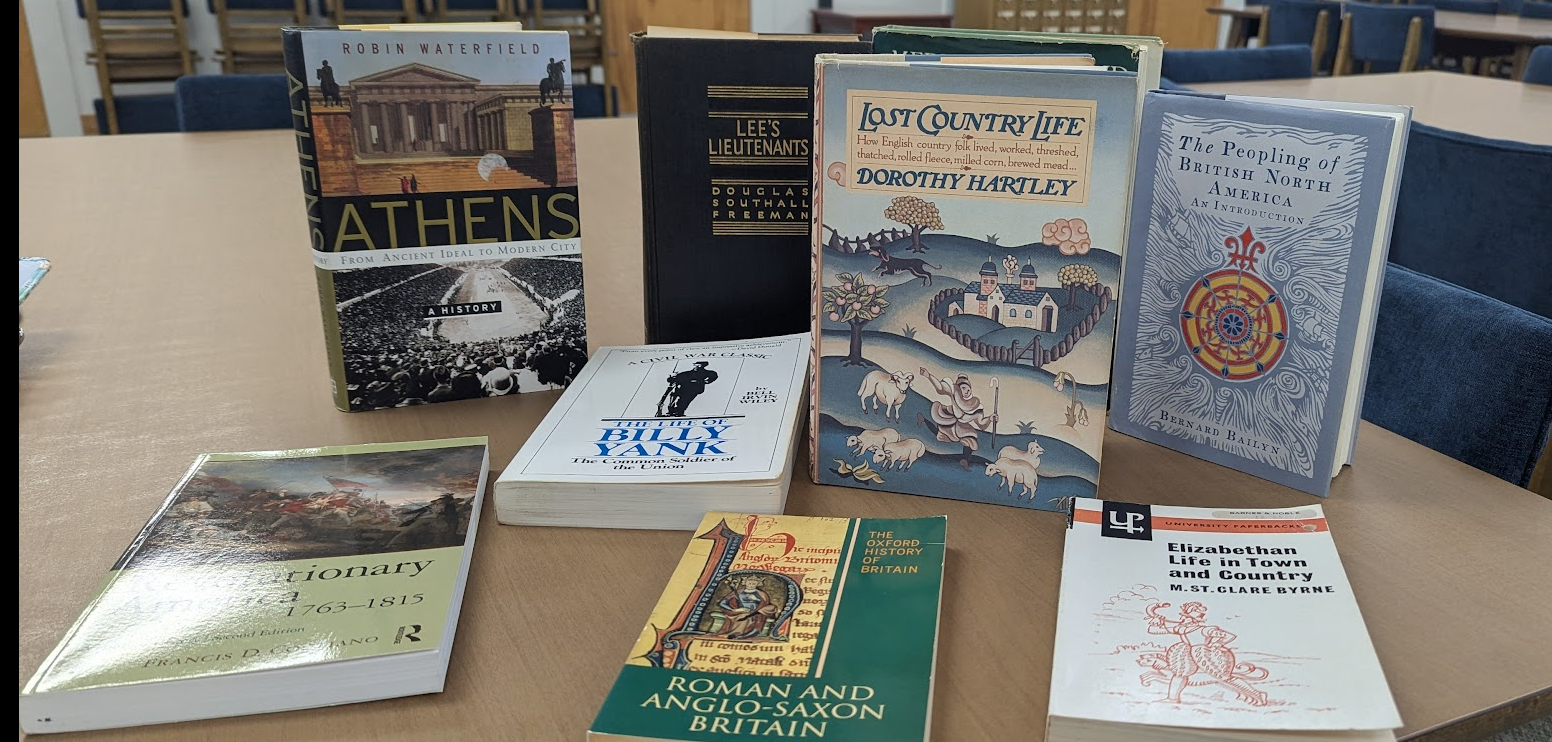
Oh, dear. My alma mater, the University of Montevallo, has been doing a booksale that consists of discards and donations (some from my former teachers’ libraries!): they were being sold at the lovely price of $1-2 each, so I went in with $20 and came away with this pile:
I wound up swapping A Conquering Spirit for The Battle Cry of Freedom after I realized we had Spirit in the library I work in. (Fun fact: we also have Battle Cry but I didn’t think to check for it. Eh, go Falcons.) Most of the collection is England-oriented in scope, though I’d hoped to score some books on Southern history. As nearest I came was the first volume of Lee’s Lieutenants, part of a large trilogy. There are also a few American Civil War titles in there. I’d been meaning to read The Life of Billy Yank after enjoying The Life of Johnny Reb so much a few years ago.
When I checked my bookstats on the ol’ excel sheet, I was disgruntled to find that 12% of my reads were new acquisitions; my standing goal is to keep that at 10% or under. Given the state of my nonfiction v fiction battle, obviously all of my reading for December will have to be library nonfiction! Of course, this year’s stats are all kinds of weird because of CJ Box and Joe Pickett: Mystery/Thriller is the current genre leader by 7%!
I also purchased Man of Iron on sale on Amazon; $2 for a highly-recommended biography of Grover Cleveland is not bad at all! Ditto Bell I. Wiley’s Confederate Women, which I picked up used and very cheap. Movie Watch will wait until Monday: as of the time of writing, it’s raining on a Sunday afternoon and my odds of watching a movie tonight are quite good.
Also, a final video to think on. While book bloggers lamenting the decline of fiction and the dumbification of the general reading public are common, Amy Shira Teitel has contributed her own thoughts. This is noteworthy because she’s not in the book-blogging scene: her focus is on human spaceflight history, and I’ve read several of her books. She’s currently at work on a third, which I will of course scoop up immediately.
In the story of the creation, God makes the world, and everything in it, in six days. On the seventh day he rests. The day of rest is significant because it suggests that the creation required a certain effort on God’s part, that some form of artistic struggle had taken place. This struggle is the validating impulse that gives God’s world its intrinsic meaning. The world becomes more than just an object full of other objects, rather it is imbued with the vital spirit, the pneuma, of its creator.
ChatGPT rejects any notions of creative struggle, that our endeavours animate and nurture our lives giving them depth and meaning. It rejects that there is a collective, essential and unconscious human spirit underpinning our existence, connecting us all through our mutual striving.
ChatGPT is fast-tracking the commodification of the human spirit by mechanising the imagination. It renders our participation in the act of creation as valueless and unnecessary. That ‘songwriter ‘you were talking to, Leon, who is using ChatGPT to write ‘his’ lyrics because it is ‘faster and easier ,’is participating in this erosion of the world’s soul and the spirit of humanity itself and, to put it politely, should ******* desist if he wants to continue calling himself a songwriter.
ChatGPT’s intent is to eliminate the process of creation and its attendant challenges, viewing it as nothing more than a time-wasting inconvenience that stands in the way of the commodity itself. Why strive?, it contends. Why bother with the artistic process and its accompanying trials? Why shouldn’t we make it ‘faster and easier?’
When the God of the Bible looked upon what He had created, He did so with a sense of accomplishment and saw that ‘it was good‘. ‘It was good ‘because it required something of His own self, and His struggle imbued creation with a moral imperative, in short love. Charlie, even though the creative act requires considerable effort, in the end you will be contributing to the vast network of love that supports human existence. There are all sorts of temptations in this world that will eat away at your creative spirit, but none more fiendish than that boundless machine of artistic demoralisation, ChatGPT.
As humans, we so often feel helpless in our own smallness, yet still we find the resilience to do and make beautiful things, and this is where the meaning of life resides. Nature reminds us of this constantly. The world is often cast as a purely malignant place, but still the joy of creation exerts itself, and as the sun rises upon the struggle of the day, the Great Crested Grebe dances upon the water. It is our striving that becomes the very essence of meaning. This impulse – the creative dance – that is now being so cynically undermined, must be defended at all costs, and just as we would fight any existential evil, we should fight it tooth and nail, for we are fighting for the very soul of the world.
The Plain People of the Confederacy takes a look at three often overlooked demographics of the South: poor whites, whom everyone forgets exist; women; and blacks. As it happens, Wiley has written volumes on each of these categories (poor whites being enveloped by but not defining Johnny Reb’s War), but this is more a condensed version, weighing in at scarcely more than 100 pages. It’s technically divided into four sections, poor white folk being considered at both the front and at home, but parts are not evenly divided: a section on “colored folks” is a third of the book, for instance. The result is a quick and illustrative read, if grim.
War’s hell is not only experienced by the men at the front marching in rags and trying to feed on hardtack infested by weevils and meat so spoiled it sticks to surfaces. Women and children suffered at home because their husbands and sons were at the front fighting, overwhelming women and younger children with the amount of work to be done — and that was before Yankee armies rode through and burned homes or stole stock and supplies out of malice. Wiley writes that the Confederate government’s failure to exempt nonslaveholding men who were the sole means of production in their household was a fundamental mistake. Many men deserted over the course of the war because pleas from their wives about the family plight overrode their sense of duty to ’cause and comrade’. Society as a whole was generally disrupted: if a piece of equipment broke down, it might not be possible to fix because the local blacksmith was off at the war, or if he were present he had no access to needed supplies. Common household supplies were in want, both because of the lack of men and material: there were vanishingly few tanners who could continue creating leather, for instance. Even cotton, the prewar South’s signature crop, was unusable for cloth production without steel cards produced by Northern factories. Wiley includes many letters from home from women who plead with their government to send aide, or at least return their husbands to them: they sound like grist in the mill, crying as they are ground up. The section on women is entirely about the deprivations caused by the homefront.
The closing section, “colored folks”, illustrates David C. William’s claim that slavery was done from the moment the South seceded: not only were there fewer men to maintain ‘order’, but the proximity of Yankee armies invited more and more slaves to make themselves “contraband“. There were, however, many ‘colored servants’ who remained affectionate and loyal to the households they’d served — even help hiding valuables from the marauding bluebellies. Wiley notes that this loyalty came from privileged house slaves, however, and not field hands. Slaves who accompanied their masters to the front sometimes threw themselves eagerly into the fight against the hosts of the North. If that is baffling to the modern reader, Wiley also notes that Yankees did not necessarily treat freedmen or ‘contrabands’ well: when escaped blacks joined the Union army, they were assigned the worst details at inferior pay, and Union troops often refused to march with the ‘colored’ battalions.
This was an interesting little book, though once I read Confederate Women and Southern Negroes (1860 – 1865), I may find it’s merely a collection of excerpts from those, just as Wiley borrows liberally from Johnny Reb’s War for the section on soldiers. We shall see, though! I purchased a used copy of one and sent for an ILL copy of the other, so I may end the year on an unexpected Civil War binge. I began James McPherson’s legendary Battle Cry of Freedom on the eve of Thanksgiving, and it’s a proper tome that I’ll be feeding on for at least a week, I think.
Malaria, typhoid, smallpox, pneumonia, scurvy, and pulmonary tuberculosis each took a considerable toll from Rebel ranks. One private remarked in 1862 that “Big Battles is not as Bad as the fever.’ And a prominent Confederate doctor who made a careful study of medical records after the war estimated that for every soldier who died as a result of battle there were three who perished from disease.
And even in defeat the spirit of some remained indomitable. A few years ago when this writer visited relatives near Pulaski, Tennessee, he was escorted to New Zion churchyard to see the grave of a Confederate veteran named Tom Doss. The grave lies north and south with the headstone at the south. This unorthodox arrangement was of Tom’s own planning. Shortly before he died he made his family promise that they would bury him with his feet to the north, so that when Gabriel blew the trumpet on the morn of resurrection he would be in a convenient position to give the Yankees a resounding kick.
Govner Vance, I set down to rite you a few lins and pray to God that you will oblige me. I ame a pore woman with a posel of little children, and I will hav to starv or go neked—me and my little children—if my husban is kep away from home much longer. I beg you to let him come. Tha dont give me but thre dolars a month, and fore of us in the famely. Thay knit forty pare of socks fo the solgers, and it take all I can earn to get bread. If you cud hear the crys of my little children, I think you wod fell for us. I am pore in this world, but I trust rich in heven. I trust in God, and hope he will cos you to have compashion on the pore.
P.S. Apples are good but peaches are better If you love me, you will write me a letter
Much of the love-making was done at church functions, particularly at summer revivals.
In view of the close association between soldiers and body servants, it is not surprising that the latter became thoroughly imbued with war ardor. So much so, indeed, that in a number of instances the blacks picked up guns during the pitch of battle and indulged themselves in a few pot shots at the Yankees. Several servants boasted of taking Federal prisoners.
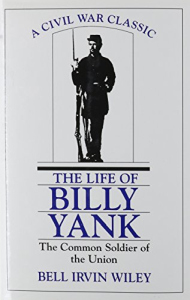
Shortly after Bell Irvin Wiley penned The Life of Johnny Reb, a social history of southern soldiery, he wondered: what about the other fellows? What brought them to the colors, pulled them away from lives of comfort to march thousands of miles over the course of years, risking death by minié ball — or more commonly, disease? The result is The Life of Billy Yank, a social history of Union soldiers, that largely ignores politics to focus on the men and their day-to-day life. Although the author’s sympathies lie more readily with his first subject — Union soldiers are always Yankees, Yanks, or Federals — he does not downplay soldiers’ suffering or humanity here. This was a delightfully deep dive into the camps of those that wore the blue from the man who evidently pioneered social histories of the Civil War: his other works include studies on blacks during the war, as well as Confederate Women. He even addresses the immigrant-soldier experience to some degree: they composed a quarter of the Union army and were mostly German and Irish.
Billy Yank is divided into topics like combat, illness and death, recreation, and morality. Before getting into the lives of soldiers, though, Wiley first visits the motivations of those who volunteered. The overwhelming motive appears to have been simple patriotism — indignation that the Stars and Stripes had been fired upon at Fort Sumter, and determination to squash those who had done it. There were those who expressed a hatred of slavery and a desire to end it, including one soldier who vowed he didn’t care about the Union so long as slavery was destroyed. These appear to be a distinct minority in the early years of the war, though, just as McPherson’s study indicated. Many Yankees evinced outright loathing of the Southerners and the South, viewing the unindustrialized land as primitive and its residents as barbarians. The majority of the book addresses aspects of a soldier’s life: the boredom and terror of campaign life, resentment towards officers, camp conditions and recreation, cooking, and matters of morality. (Bored soldiers often found recourse in liquor and gambling when they were not doing more wholesome things like singing and playing baseball.)
Because the ranks of the Army swelled so quickly, both officers and enlisted men were typically amateur. Officers attended classes in camp at night after the day’s drilling was done, and some studied handbooks on tactics and drill in their free time. Medical reviews of recruits being mustered in were so cursory that numerous women who passed for boys made it into the ranks: some were found out when they were shot, but one lived as a man until 1911 when an auto accident exposed her. The Union army was fairly tolerant of this, even granting pensions to some women who served despite shifting them from infantry to support positions like nursing.The amateur status of the citizen-soldiery also led to massive insubordination issues, since the men were not soldiers by disposition, nor by training. Not only did they not know the many regulations they were breaking in those first few months of service, they didn’t care — and if they had access to liquor, they were violently expressive about communicating their disdain for jumped-up sergeant and officers. Wiley quotes liberally from soldiers’ letters, enough to give an idea for the period’s chaotic spelling. I especially enjoyed the chapter on the music soldiers played and invented to pass the time. I was surprised to read in the chapter on camp food and cooking that the Union army distributed “dessicated vegetables” — or as the soldiers who tried to eat them preferred, “desecrated vegetables”. They were only edible if used in a stew and boiled so long their nutritional value disappeared. Some officers who were courteous mind find themselves invited to eat in southern homes; many enlisted who were not courteous simply stole geese, chickens, and pigs and claimed with straight faces that said livestock had evinced rebel sympathies by hissing at the Union army or the Grand Old Flag.
This was quite an engaging and fun read: while I consider myself fairly versed in this subject there were still a lot of surprises, and Wiley is a talented and thorough writer. This is excellent stuff.
Another Yank of five weeks’ service featured by long marches complained: “If there is anything particularly attractive in marching from 10 to 20 miles a day under a scorching sun with a good mule load, and sinking up to one’s knees in the ‘Sacred Soil’ at each Step, my mind is not of a sufficiently poetic nature to appreciate it.”
“The surgeon insisted on Sending me to the hospital for treatment. I insisted on takeing the field and prevailed — thinking that I had better die by rebel bullets than Union Quackery.”
In the Federal forces four persons died of sickness for every one killed in battle, and deaths from disease were twice those resulting from other known causes.It is a sad fact of Civil War history that more men died of loosening of the bowels than fell on the field of combat.
Of a Virginia belle a New York soldier wrote “She might have been a smart girl but, but she has never done anything but read novels.”
The officer approached a wounded man with the expectation of rceiving a last message for a loved one, but instead was asked, “Colonel, is the day ours?” “Yes”, responded the officer. “Then I am willing to die,” was the soldier’s reply.
WHAT have you finished reading recently? “Shadowlands“, a play about CS Lewis, Joy Davidman, and suffering. I’m also fairly close to finishing The Horse and His Boy, I think. I say “I think” because I am listening to the audiobook, and it’s been so long since I last read Horse that I’ve forgotten the story — but Shasta has escaped and met Aslan and I’m fairly certain Rabadash’s hopes for stealing Susan and forcing her to be his wife, as well as conquering Narnia, are about to be dashed. I’m really enjoying the narrator, but I’ve forgotten his name and Audible’s entry doesn’t list the narrators by association with their book, only as a lump. After youtubing the narrators, though, I think Alex Jennings is the Horse narrator. I’d wondered why he sounded so familiar yet not quite known, and it’s because I first heard Jennings in The Lady in the Van where he does a very different vocal affect. He sounds a bit like Hagrid when he’s doing a dwarf voice here. “Yer a Narnian, Shasta!“
WHAT are you reading now? Well, I’m 70% through The Life of Billy Yank, a social history of Union soldiery; I’m a quarter through Man of Iron, a biography of Grover Cleveland; I’m halfway through Double Star by Robert Heinlein; and then I’ve nibbled bits from Tarkin, From a Certain Point of View, and Firewall, the last three being Star Wars and Star Trek novels. I’ve also started a history of the Book of Common Prayer. Since I schedule these posts beforehand, I may have finished Billy by the time it goes live.
WHAT are you reading next? See above entry, unless I get distracted by something else.
Today’s prompt from Long and Short Reviews is A Genre We Wish Were More Popular. I will say….near-future SF. It’s probably my favorite kind of SF to read, and its best writers that I know of Daniel Suarez and Blake Crouch. I like near future SF because I often learn about tech that’s already at work now, but in experimental or limited ways: in these stories, we see what effects it’s having on society after exploding in use. Exploding is the right word, too: I am amazed by how tech has changed in my lifetime. When unmanned aerial vehicles started being used in the mideast wars, I scoffed when people referred to them as drones. Drones were those things in Star Trek Insurrection that moved around on their own, following and shooting people. UAVs were nothing like that! Now drone warfare is commonplace.
As we approach the end of November, I’m afraid it doesn’t look terribly good for my SciFi month goals. I have a Heinlein novel I’m almost done with, but I keep pecking at several Star Trek and Star Wars novels and not getting sucked into any of them yet. History is also launching an assault, bound and determined to right the scales and restore itself and its nonfiction compatriots to glory. Presently it still trails fiction by three points, but I have faith it will prevail. It doesn’t help that I’ve been writing more this weekend than reading — not for NaNoWriMo, which is evidently extinct from scandal, but just for the pleasure of it. I’ve been playing with two short stories and began reading one of my successful Nanowrimo runs from back in 2018. (It’s fantasy, if you can believe that, based on a Heroes of Might and Magic II scenario I designed in high school.) Anyhoo, today’s TTT is about being thankful, sooo I’ll just link to my Long and Short Review post from last week and let people who click on it blindly be slightly confused. But here is a Teaser Tuesday!
Another Yank of five weeks’ service featured by long marches complained: “If there is anything particularly attractive in marching from 10 to 20 miles a day under a scorching sun with a good mule load, and sinking up to one’s knees in the ‘Sacred Soil’ at each Step, my mind is not of a sufficiently poetic nature to appreciate it.” (THE LIFE OF BILLY YANK)
“When enemies had at him they quickly found that his weight was the least of their difficulties; what really sent them sprawling was the fact that his whole huge carcass seemed to be made of iron. There was no give in him, no bounce, no softness. He sailed through American history like a steel ship loaded with monoliths of granite.” (H.L. Mencken on Grover Cleveland, as quoted in A MAN OF IRON.)
This next one is less of a tease and more of a whole chonka text, but I love the Book of Common Prayer and enjoyed reading this passage. (Yes, I’m nibbling at three nonfiction books and three SF books simultaneously. I am insane. I do get a four day weekend, though.)
Yet for all its modesty and derivativeness, Cranmer’s 1544 Litany was the beginning of something very big indeed. That single rite would be the first installment of a book, the Book of Common Prayer, that would transform the religious lives of countless English men, women, and children; that would mark the lives of millions as they moved through the stages of life from birth and baptism through marriage and on to illness and death and burial; that would accompany the British Empire as it expanded throughout the world. When Cranmer was still alive a version of that book was the first book printed in Ireland; a quarter-century after his death prayers from it were read in what we now call California by the chaplain of Sir Francis Drake; and versions of it are used today in Christian churches all over the world, as far from England as South Africa, Singapore, and New Zealand. That book’s rite of marriage has become for many people, Christian and non-Christian alike, the means by which two people are joined: I participated many years ago in a Unitarian wedding in Tulsa, Oklahoma, that began with the minister’s intoning of the familiar words: “Dearly beloved, we are gathered together here in the sight of God, and in the face of this congregation, to join together this man and this woman in holy Matrimony.” Whatever Cranmer was thinking when he sat among his books in Croydon Palace, in “an obscure and darke place” surrounded by trees, whatever he thought might come of his little exercise in vernacular rite-making, he was imagining nothing even remotely like what would come to pass. (THE BOOK OF COMMON PRAYER, Alan Jacobs)
I especially enjoyed this passage because I remember going through the Book of Common Prayer in one of my first Episcopal services as a visitor, I found the service of marriage and marveled at how influential it was.
I have been given the choice twice in my life. The boy chose safety. The man chooses suffering.
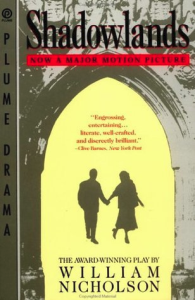
C.S. Lewis died on 11/22/63, a week before his 65th birthday. Over the years, I have taken up the habit of spending “a week with Jack” — reading something of his in that space, to spend time with an author whose letters and essays delight me like no other’s. While looking for a quote of Lewis’ to share on Christmas (specifically, his harrumping at the vulgar commercialization of it), I stumbled upon “Shadowlands: A Play” and was immediately intrigued. A few years ago I watched a movie about the relationship of Lewis and his American friend, and later wife, Joy Gresham — and it shared the same name. While “Shadowlands” is largely about the growth of Jack and Joy’s relationship, the scenes are more confined. Much of the play happens at the Kilns, where Jack and some male friends debate and argue and joke — and where Jack and Joy have more serious conversations. “Shadowlands” is not entirely about their relationship, though. It also draws heavily on The Problem of Pain, in that Lewis and his interlocuators frequently discuss suffering and theodicy. This is not abstract filler, either, as during the course of the play Joy learns that she’s been divorced and must now face the world alone. She doesn’t, of course, as anyone familiar with Jack and Joy’s story knows, but their union will bring its suffering as well as its bliss — as we see later in A Grief Observed. I loved this: the writer had a fairly good handle on Lewis’ voice, I think, even when Lewis isn’t being quoted, and the dialogue is often funny and insightful. As the play develops, it becomes quite serious — with Lewis arguing with himself, finding words written about suffering sound rather different when one is deep in the valley of the shadow of death. Definitely recommended to Lewis fans.
Here I’m going to say something which may come as a bit of a shock. I think that God doesn’t necessarily want us to be happy. He wants us to be lovable. Worthy of love. Able to be loved by Him. We don’t start off being all that lovable, if we’re honest. What makes people hard to love? Isn’t it what is commonly called selfishness? Selfish people are hard to love because so little love comes out of them.
God creates us free, free to be selfish, but He adds a mechanism that will penetrate our selfishness and wake us up to the presence of others in the world, and that mechanism is called suffering. To put it in another way, pain is God’s megaphone to rouse a deaf world. Why must it be pain? Why can’t He wake us more gently, with violins or laughter? Because the dream from which we must be awakened is the dream that all is well.
“We’re like blocks of stone, out of which the sculptor carves the forms of men. The blows of His chisel, which hurt us so much, are what make us perfect. The suffering in the world is not the failure of God’s love for us; it is that love in action. “
I could argue that art has quite the opposite effect. Great art breaks through that separateness, and lets us touch the very heart of reality.
Riley: What I resent about Christmas is the general presumption of good will. I feel no good will towards my fellow men. I feel ill will. Lewis: It’s got nothing to do with how you feel, Christopher. Feelings are far too unreliable.
Lewis: You sound like me, Joy. You’re supposed to be dragging me kicking into the twentieth century.
Joy: Professor Riley, as you know, I’m an American, and different cultures have different modes of discourse. I need a little guidance here. Are you being offensive, or merely stupid?
Joy: Don’t you sometimes burst to share the joke? Lewis: What joke? Joy: Well. Here’s the neighbors thinking we’re unmarried and up to all sorts of wickedness, while all along we’re married and up to nothing at all.



 Reading Freely