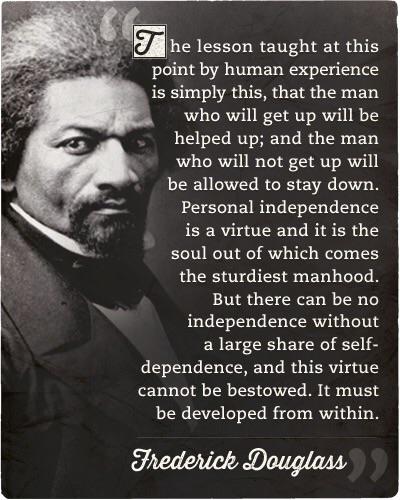
I liberated this screenshot from a facebook group on the psychology of Stoicism and Buddhism. It’s been lingering in drafts for a few weeks because I recognized wisdom in the quote, even though it’s easy to dismiss it out of hand. Marian’s post yesterday brought it to mind again. The take-home lesson for me is that it’s easy to fixate on problems and make them mythical challenges so great that we don’t even try to tackle them, preferring instead to talk about how imposing they are, or why we can’t do this or that…instead of looking for what we can do. This kind of thinking comes a lot in disaster readiness or active self-protection: we must train ourselves to look for what we can do.
I’ve been dog & cat-sitting away from my computer since last week, and without a TV or computer to distract me I’ve been doing that ‘reading’ thing.
First up, I read Just in Case, a prepping-for-newbies book the library acquired right after the hurricane hit, in the forlorn hope that some responsible citizen would want to better brace themselves for The Next Time. No such luck, as I’m the first person to have checked it out. April is typically when Alabama receives its worst and most tornadoes, so I’m trying to get things squared away on that front, preparing for power losses and the like. After an introductory section on the why-and-wherefores of disaster readiness, the author devotes succeeding chapters to separate threats (power loss, extreme cold, fire, pandemic, etc) before wrapping up with skills which are valuable in any scenario. The pandemic section was interesting, as the author predicts runs on supplies and warns readers against relying on surgical or painters’ masks, which will not block something as small as virus. Although my reference in the future will remain When Technology Fails, I like this book as one for the general public.
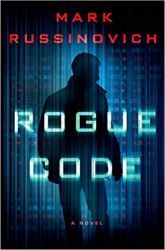
Next up, Rogue Code by Mark Russonovich. In years past I’ve read Russonovich’s Zero Hour and Trojan Horse, part of the same series. Each is a standalone technical thriller in which a retired CIA cybersecurity specialist, Jeff Aiken, is hired to investigate threats to secure networks and the internet as a whole In Rogue Code, Aiken and his partner are hired to check the NASDAQ’s servers for any potential issues, as the IPO for a facebook-killer is looming and the powers that be want no problems. Not only is there evidence of tampering, but when the perps catch on that their work is being examined, they frame Jeff for the theft of millions and force him to shelter from an SEC cop with all the tact of a nuclear missile Russonovich typically mixes in a little action into these books to make them genuine thrillers, and not just prolong scenes of people sitting at desks typing furiously or pondering lines of code, looking for traces of nefarious goings-on. Although Russonovich typically makes his villains interesting, here only their backgrounds in the Brazilian cartel standout: both the chefe and his main mook are your standard-issue evil apes, driven for money, power, and sex. Speaking of which, there are several unexpected scenes of sexual abuse in the novel, just to make sure we don’t start rooting for the cartel which is robbing Wall Street blind. Although I enjoyed the novel well enough, it gets into the weeds of both high finance and code analysis, so it’s not light reading by any means.
I’ve also recently finished Travels with Foxfire, a motley collection of interviews, recipes, folk histories, and hunting stories from southern Appalachia. It’s a buffet of Appalachian culture, you might say: a chapter on the moonshine-running origins of NASCAR is followed by tales of old bear hunts, and then recipes of so-and-so’s old-fashioned country cooking followed up by a history of Appalachian folk music — “Old Time” music, not bluegrass or country. It’s like a Rick Bragg notebook, almost, with lots of the raw material of the kind that one sees worked into his own books. There’s a little witticism on the back of Log Cabin Pioneers, a similar work I’ll be reading soon enough, that says “For them’s that likes this sort of thing, this is the sort of thing they will like”. It’s absurd, but true when applied to a book like this: it has immense appeal for those interested in Appalachian culture, who don’t need a central narrative to guide them through the whole thing. I was particularly interested in the old-time music, and had no idea that popular singers of the mid-20th century had adopted several folk tunes and turned them into copyrighted commercial hits, from Bob Dylan to the Kingston Trio. I’m really looking forward to looking for recordings by some of the artists mentioned here, especially Hedwig “Hedy” West, who used folk songs as her ammunition against the Johnson administration.
Later on I’ll have comments for Ironies of Faith: The Laughter at the Heart of Christian Literature, and will begin going through Purgatory. I’m also currently reading Rebekah by Orson Scott Card: apparently the author of Ender’s Game also did a series of historical novels based on women from the Bible. That seemed worth a look-see, and I’ve been unexpectedly snared by the novel’s humor and lead character. I don’t know any stories or traditions associated with her character other than “Wife of Isaac, mom of Esau and Jacob”.
What makes a natural event — rising waters, a hurricane, a sudden slip of tectonic plates — a disaster? Human suffering — and Illan Kelman argues in Disaster by Choice that that suffering is usually self-inflicted. He posits that there’s nearly no such thing as a natural disaster, because virtually all disaster are a result of humans not making adequate preparations. He allows for some outliers, like ice ages, supervolcano eruptions, and asteroid impacts, but otherwise puts the onus of calamities squarely on our shoulders. A reader can understand Kelman’s belief, to a point: an ice storm that hits a city like Boston with the resources and knowledge to prepare for it will be perceived very differently than an ice storm that hits say, Houston. A tornado that destroys a neighborhood, though, is still disastrous even if 100% of the previous residents were ready for it and squirreled away in their basements. Most of the book consists of evaluations of various disasters, and the human-generated risk factors involved: we built on infill land, we put in levees and assume they won’t break, we pretend earthquakes only ever happen in California and never in New England, etc. Sometimes a certain degree of readiness, like the aforementioned levee, can make us sloppy in other respects: since the levees won’t break, we don’t need to assume our ground floors will flood….even though they stil can, from sources unrelated to hurricanes. Even if we live in hazardous areas, preparations can be made to make people living there far less vulnerable. There are actions that even those living in wildfire-prone zones can take to greatly mitigate their risk.
Far too often, however ,we don’t. Part of this owes to humanity’s perennial short-sightedness: was it Hegel or Twain who commented that the only thing we learn from history is that we don’t? But politicians also neglect basic maintenance and subsidize poor decisions, like bankrolling flood insurance for homeowners who want to live on the beach but don’t want to cover the risk themselves. There are also societal factors, from clothing & gender roles (women in some countries are more at risk to tsunamis and flooding, having not been taught to swim) to poverty and political corruption. . I appreciated Kelman’s perspective, especially in light of the last year: it’s a sober book, one that acknowledges how complicated risk mitigation is, but doesn’t shy away from urging citizens everywhere to take inventory of their and their local community’s array of risks, and to make preparations accordingly.
“When I was a boy in school, we were often encouraged to read banned books. Back then, to censor anyone was about the least hip thing you could do, the province of the glowering churchman and the cordless phone-wielding parent, the least cool of 1990s archetypes. Pitted against them was the heroic liberal-minded librarian, who would sooner raise her voice in the study section than deny a book to a curious student. “READ!” cried colorful signs off of every classroom wall. And if you wanted to READ! Judy Blume, Alice Walker, or William Golding, well, then, far be it from anyone else to stop you. […]
That isn’t to say we no longer censor. Oh, Lord, do we censor. It’s just that our criteria have changed. […]
What happens if critiques of the ruling ideology are no longer easily accessible? What happens when it isn’t the offensiveness of the opposition tract that determines whether it’s allowed but the effectiveness? This is the reality we now confront. You don’t need government to pass a law to shut somebody up; you need only to capture the relevant cultural gatekeepers. “
[…] The impulse that drives these cancellations isn’t progressive and it certainly isn’t liberal. It’s theocratic. Wokeness treats its hierarchies of race, gender, and sexual orientation as unquestionable dogma, with everything else—discourse, literature, art, math—subordinated to its tenets. The left has thus become everything it once claimed to hate. They’re the book banners now, the quaking prudes, the reverend from Footloose, the Savonarola.”
In 2010, as a devout progressive, I stumbled upon The American Conservative while reading articles related to the built environment. I’d gotten turned on about that issue in college and believed it was an issue, like energy or farm policy, that should transcend party lines. To my continuing surprise, TAC was also a very vocal antiwar magazine, and since the anti-war left had taken down its shingle and gone home in the wake of Obama’s election, I was only happy to explore this novelty. TAC has only grown in my estimation over the years — though it helps that the progressive left became so hostile and reckless that I left their camp altogether. Libertarians and many conservatives I can break bread with even when we disagree, but so many modern ‘progressives’ are political Wahhabists who won’t ever stop preaching about their pet issue and are ready to condemn those who disagree as kafir. I’ve been especially disgusted and outraged by the blooming problem of deplatforming and cancel culture. It’s grown to almost absurd levels, and one hopes that the unbridled arrogance of this cultural cancer will provoke pushback. It’s beyond sad when an organization like the American Library Association, which hosts the pious fraud known as Banned Books Week, is party to this nonsense as well.
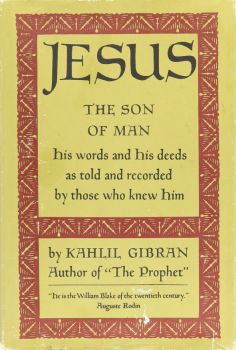
Earlier I posted comments for Kahlil Gibran’s moving Jesus, Son of Man, and now share some quotations from it.
Then He looked at me, and the noontide of His eyes was upon me, and He said, “You have many lovers, and yet I alone love you. Other men love themselves in your nearness. I love you in your self. Other men see a beauty in you that shall fade away sooner than their own years. But I see in you a beauty that shall not fade away, and in the autumn of your days that beauty shall not be afraid to gaze at itself in the mirror, and it shall not be offended. I alone love the unseen in you.”
He would begin a story thus: “The ploughman went forth to the field to sow his seeds.” Or, “Once there was a rich man who had many vineyards.” Or, “A shepherd counted his sheep at eventide and found that one sheep was missing.” And such words would carry His listeners into their simpler selves, and into the ancient of their days. At heart we are all ploughmen, and we all love the vineyard. And in the pastures of our memory there is a shepherd and a flock and the lost sheep. And there is the plough-share and the winepress and the threshing-floor. He knew the source of our older self, and the persistent thread of which we are woven. The Greek and the Roman orators spoke to their listeners of life as it seemed to the mind. The Nazarene spoke of a longing that lodged in the heart.
Many times the Christ has come to the world, and He has walked many lands. And always He has been deemed a stranger and a madman.
And one evening as we sat beside the stream He said, “Behold the brook and listen to its music. Forever shall it seek the sea, and though it is for ever seeking, it sings its mystery from noon to noon. “Would that you seek the Father as the brook seeks the sea.”
And then He said, “Judea would have a king, and she would march against the legions of Rome. I shall not be her king. The diadems of Zion were fashioned for lesser brows. And the ring of Solomon is small for this finger. “Behold my hand. See you not that it is over-strong to hold a sceptre, and over-sinewed to wield a common sword? Nay, I shall not command Syrian flesh against Roman. But you with my words shall wake that city, and my spirit shall speak to her second dawn. My words shall be an invisible army with horses and chariots, and without axe or spear I shall conquer the priests of Jerusalem, and the Caesars. I shall not sit upon a throne where slaves have sat and ruled other slaves. Nor will I rebel against the sons of Italy. But I shall be a tempest in their sky, and a song in their soul. “
He was a mountain burning in the night, yet He was a soft glow beyond the hills. He was a tempest in the sky, yet He was a murmur in the mist of daybreak. He was a torrent pouring from the heights to the plains to destroy all things in its path. And He was like the laughter of children.
But the grave halts not Jesus’ walking to the enemies’ camp to tame and take captive those who had opposed Him.
And when we were sitting about the board, one of the publicans questioned Jesus, saying, “Is it true that you and your disciples break the law, and make fire on the sabbath day?” And Jesus answered him saying, “We do indeed make fire on the sabbath day. We would inflame the sabbath day, and we would burn with our touch the dry stubble of all days.”
They say He raised the dead to life. If you can tell me what is death, then I will tell you what is life. In a field I have watched an acorn, a thing so still and seemingly useless. And in the spring I have seen that acorn take roots and rise, the beginning of an oak tree, towards the sun. Surely you would deem this a miracle, yet that miracle is wrought a thousand thousand times in the drowsiness of every autumn and the passion of every spring. Why shall it not be wrought in the heart of man? Shall not the seasons meet in the hand or upon the lips of a Man Anointed? If our God hsa given to earth the art to nestle seed whilst the seed is seemingly dead, why shall He not give to the heart of man to breathe life into another heart, even a heart seemingly dead?
My friend, you like all other Romans would conceive life rather than live it. You would rule lands rather than be ruled by the spirit. You would conquer races and be cursed by them rather than stay in Rome and be blest and happy. You think but of armies marching and of ships launched into the sea. How shall you then understand Jesus of Nazareth, a man simple and alone, who came without armies or ships, to establish a kingdom in the heart and an empire in the free spaces of the soul?
I loved him and I shall love him forevermore. If love were in the flesh I would burn it out with hot irons and be at peace. But it is in the soul, unreachable.
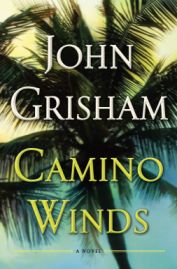
Amid a category 4 hurricane that levels homes and floods an entire town, a man is murdered. The police shake their heads, insisting he was merely struck by storm debris. But falling limbs don’t leave blood splatter inside a home and on a golf club. Falling limbs don’t remove a computer hard drive containing a manuscript with secrets that some unknown parties want kept concealed. When rare book trafficker Bruce Cable realizes that there’s something rotten in the state of Florida, he enlists the help of the very people who nearly fingered him several years ago for the theft of rare manuscripts from Princeton University. As luck would have it, though, the killer falls into police custody in the final quarter of the novel, through circumstances entirely unrelated to the investigation. A novel with a unique setting and promising start is thus abruptly truncated in a manner disappointingly similar to a Deus ex machina conclusion. Lured in by the hurricane, I was disappointed that Bruce wasn’t nearly as fun in this novel as he was in the original Camino Island, and absolutely peeved at the rush-job ending. Grisham might as well be James Patterson at this point.
Far more engaging was my return to Khalil Gibran. I say ‘return’ because I haven’t featured Gibran here in eleven years (Sand and Foam being the last I ‘read’), but I frequently read from both Sand and Foam and The Prophet. Gibran was the first mystic writer I ever encountered, and he ensnared me completely: I often quote him internally, listening to his voice in my head and thinking about the words. This Lent I decided to finally read his Jesus, Son of Man, which I purchased years ago. I found it as beautifully written as I’ve come to expect from Gibran, delivered in prose that carries the grace of poetry. The work is presented as reminiscences of Jesus from those who knew him, with reflections offered in the months or years after his disappearance. Those contributing are many familiar Biblical personages — the disciples, the various Marys, minor characters in the New Testament like Simeon and Joseph of Arimathea, as well as invented ones — Greek traders, Syrian farmers, etc. Their opinions on Jesus vary widely: while most speak of him with awe and love, there are others who still scoff and spit. Beauty prevails, though. When Gibran has Jesus or the disciples speak, their language is drawn from the New Testament but given a certain Gibranian flair. Those familiar with Gibran will recognize his poetic style, interpreting and bringing the beauty of many Gospel stories all the more to mind. I’m going to follow this post with a few quotes; more are available if you follow me on Goodreads. I loved it and was reminded of why Gibran has stayed so close to my mind in the fourteen years I’ve known of him.
Liberated from facebook, mostly likely the “Psychology of Stoicism, Buddhism, Epicureanism, Etc” group page. Douglas is an especially good source for this kind of quote because of his background: he found help to teach himself to read, and he escaped from slavery through his own will. Even in slavery, he was not a subject, but a man, and when he escaped to freedom he only made obvious the independent spirit which already existed in him. Slavery’s power lies not in circumstances.
Annnnnd that’s a wrap for February. I don’t know about the rest of the country, but spring is definitely on the way here: after several weeks of bitter cold, we’re suddenly enjoying balmy 80 degree days – 26 degree days, for the Celsius folk.
Challenge Progress:
Science Survey: Two books read, but only one new category, Local Astronomy, filled.. (The Bird Way was excellent, but a redundant Flora and Fauna entry.) Survey status: 3/12.
Classics: One more (Cold Sassy Tree) down. So far I’ve only been hitting Southern Lit, but English lit will get a good shellacking in April. List status: 4/50.
“Read More Southern Lit/History”: Four more titles!
The Unreviewed:
The Hardest Job in the World: The US Presidency. I just finished this one Saturday morning and will knock out a review within the next couple of days.
The Newly Bought: The War of 1812, John Mahone. A deliciously old book that smells like old books should. It’s bigger than expected, so here’s hoping my interest in the Creek war/ war of 1812 can sustain me through it.
The Metropolis: A History of Humankind’s Greatest Invention. A birthday gift card purchase.
Dark Age Ahead, Jane Jacobs. Published ten or so years ago from the author of The Death and Life of Great American Cities.
Mao’s Great Famine, Frank Dikotter. It happened to be on sale the same week I was reading The Cultural Revolution: A People’s History. Will possibly use as part of a China series.
Why Balloons Riseand Apples Fall: Physics in Bite Sized Chunks, Jeff Stewart. I’d literally just gone inside Books a Million for coffee when I saw this marked half off. (I was in the neighborhood for dog and garden supplies — heaven knows I have enough books already!)
Purgatorio and Paradiso, Dante, translated by Anthony Esolen. These are for the Classics Club. I’m playing with the idea of reading Purgatorio during Lent and Paradiso during the Easter season.
Disaster By Choice: How Our Actions Turn Natural Hazards into Catastrophes, Ilan Kelman.
Okay, no more book purchases for me for a while, except for Read of England prep!
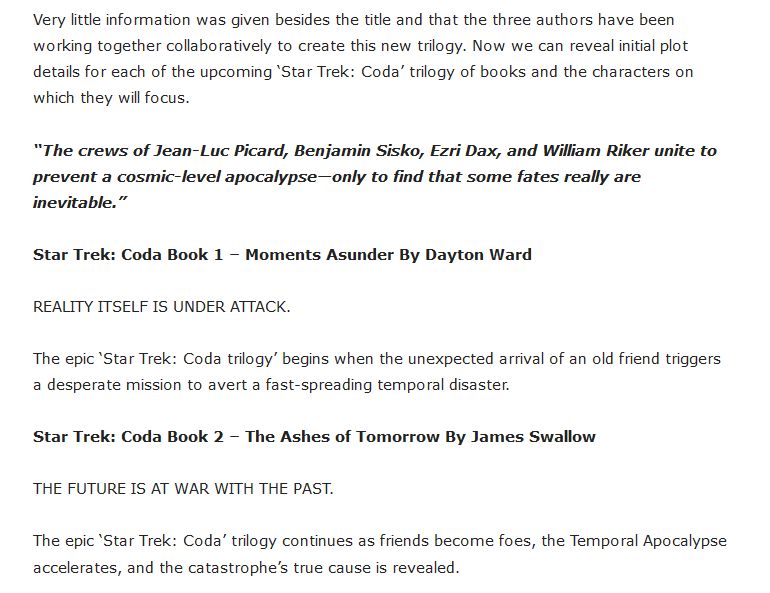
Earlier last year David Mack, one of Treklit’s leading authors, suggested that To Lose the Earth was the last planned book in the Treklit continuity, as future releases would be centered on the current shows. It appears that a finale of sorts is in the works. From TrekCentral:
Not only does the description of the trilogy sound ominous, but “Coda” literally refers to a concluding passage or section of a work. I can’t say I like the idea of an official ‘end’ to the Trek literary universe that’s grown over the last twenty years: at least if it had died by neglect we could always pretend they’d resurrect it. Now the authors sound like they’re being enlisted to snuff out their own creation.
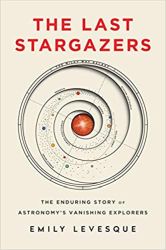
Emily Levesque was drawn to the stars from childhood on. Having realized her dream of studying them for a living, in The Last Stargazers she offers readers a glimpse into the workday lives of astronomers across the spectrum (literally, in this case), and reflections on why we should study the stars to begin with. Levesque draws on her own globe-hopping studies and interviews with other astronomers in the field to create this review of the practice and review of modern astronomy.
Although the brain’s mental image of an astronomer might be someone like Galileo peering through a telescope, discovering the moons of Jupiter, precious few astronomers ever do any direct stargazing. It’s rare, Levesque writes, to find an astronomer who is intimately familiar with the night sky the way the public expects – instantly knowing what star is what. Most astronomers today aren’t directly involved in the observation: even if they’re working at an observatory, they’re usually safely ensconced in another room all together, letting a computerized dome do its observations at their remote-controlled bidding. Instead of directly studying the skies, or plate photographs thereof, they’re receiving data and crunching numbers. To a degree, they don’t even need to be there, and one modern practice allows multiple astronomers to timeshare an observatory by submitting research requests: if there are different requests that dovetail nicely (two astronomers wanting to study the same area, but with different exposures, for instance), the telescope can conduct both studies simultaneously and transmit the respective data to their interested parties.
To the stars’ innate ability to ensnare our imagination, and the fascinating ways scientists collect data (including from a flying observatory), Levesque adds colorful background . Because of the nature of their work, observatories are typically built in remote places where light and radio emissions from human activity are minimized, and in the case of optical observatories, the higher they are the better the ‘seeing’ is. This means astronomers often work in nearly undeveloped locations, with many natural hazards: snowstorms, volcanos, wildlife,etc, Astronomers who are physically present at the station are long removed from help, and have to be able to think on their feet in stressed conditions to make ad-hoc adjustments to save either the machines or their data from unexpected events.
As someone perennially fascinated by the stars and the study thereof, I enjoyed The Last Stargazers thoroughly. It’s rare to find a book that demonstrates how astronomy is done, rather than telling the reader what’s been discovered: Mike Brown’s How I Killed Pluto and Why It Had it Coming is the only other nonfiction title I’ve read that offers such insight. (Carl Sagan’s Contactgot into the nuts and bolts, but it was fiction.) I hope Levesque continues to write in the future: we need more astronomer-authors!




 Reading Freely