Fighting for Space

Fighting for Space: Two Pilots and their Historic Battle for Female Spaceflight
© 2020 Amy Shira Teitel
448 pages
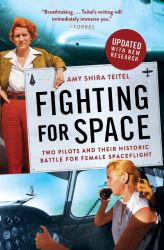
When the age of flight arrived,   women were as eager to take to the skies as men.  Fighting for Space is a joint biography of two women, pioneers from different generations, who  created  extraordinary lives for themselves in the air, and then – as  rockets began  rising above airplanes –  wondered if they might not  be able to push the envelope further, and help put women in space.   Amy Shira Teitel (host of the uber-cool and always interesting space history channel, Vintage Space) here introduces readers to Jackie Cochrane, an entrepreneur who flew with Amalia Earhart and Chuck Yeager;  and Jerrie Cobb,   who arranged to have herself subjected to the same battery of tests as the Mercury 7,  leading the way for another twelve women to do the same – funded by Cochrane.   It’s an expanding story of  early aviation,  growing  opportunities for women in World War 2, and the determination of two women to surpass the expectations of their sex  and beat the Russians to sending a woman into space.  The subjects are admirable, their combined story compelling – but where Teitel really triumphs is creating a history that tells of their struggle without reducing it to a predictable propaganda piece. Instead, our two heroines have flaws, and even actively resent the other – and the men who ultimately frustrate  their ambitions, LBJ and Jim Webb, are  presented not as villains but as men beset with responsibilities, working to fulfill them with the limited resources at hand as best they could. 

Although both of the subjects of this book are remarkable, if I had to choose one over the other, it would have to be Jackie Cochrane. Growing up in poverty, forced to drop out of school and join the workforce before she was a proper teenager, let alone an adult, Cochrane kept her eyes open for opportunities and created a successful salon business for herself. From an early age, she had a forceful self-confidence and was unafraid to confront those who tried to take advantage of her, and business would only get better after she attracted the attention of a business tycoon, who encouraged her to pursue flying to help her grow her market. Flying became more of a joy and a challenge in itself, and she pushed herself to become not only good, but The Best — racing in airshows at a time when flying was far more dangerous than it is now, even when pilots weren’t trying to cross the country as quickly as possible under adverse conditions. Jackie’s prominence as an aviator and interest in creating an American version of the Air Transport Auxiliary (a program in England in which female pilots were used to transport planes from base to base, freeing up men for combat) made her an instrumental part of creating and directing what became the Womens Airforce Service Pilots program, better known as WASPS. After the war, she continued pushing herself as an aviator, enlisting her friend Chuck Yeager’s help to train her to fly the new jet aircraft becoming more popular. Meanwhile, a young Jerrie Cobb fell in love with flying as a teenager, and beat bushes looking for opportunities to work with planes for a living — a hard ask in the postwar years, as the market was glutted with cashiered airmen looking for jobs that could get them back in the air. When the International Geophysical Year and Sputnik propelled the United States toward creating a manned rocket program, Cobb was aggressively interested in seeing if women couldn’t make the cut, either. As it happened, the Lovelace lab was interested in the data generated from women taking the same tests as men: even if NASA wasn’t currently looking for female astronauts, it presumably would eventually. Cobb’s relentless promotion of inclusion for female pilots saw her named (by LBJ, who had made the space program his baby) as a consultant to NASA. With funding from Cochrane, other women were invited t to take the same panel of physical and psychological tests as Glenn, Grissom, and the rest of the Mercury men — though NASA was under such stress at the time to catch up and surpass the Russians that it wanted to focus on astronauts of known quantities, hence the Mercury pioneers being drawn exclusively from test pilots. After the biggest incentive for sending a woman into space — being the first to do it — was removed courtesy of Russia sending up Valentina Tereshkova — Cobb and Cochrane realized that women in space was a lost cause for now, and Cobb switched her flying zeal to doing missionary work. The United States wouldn’t send a woman into space until 1983, when Sally Ride was named to an early space shuttle mission: a year later, Kathryn Sullivan became the first woman to do a spacewalk.

Fighting for Space was the most fun I’ve had reading history in a while: admittedly, early aviation and the Mercury-Apollo era are two of those subjects I can’t read enough about, but Teitel’s research and professionalism made the book a must-recommend. The women are not made inviolate icons despite their dogged triumphs, and the men are not demonized: instead, we get a full, even history that doubles as a great story.

Related:
Fly Girls: How Five Daring Women Defied the Odds and Made Aviation History, Keith O’Brien
Through the Glass Ceiling to the Stars, Eileen Collins. Collins was an early military pilot who was barred from combat missions, but used her experience flying cargo planes to good effect in the Shuttle program. She was the first female commander of an STS mission, and many of the women that Jerrie Cobb led to be tested as prospective astronauts were there to witness her launch.
Rise of the Rocket Girls. Nathalia Holt. This title focuses on NASA’s ‘computers’, women doing the rocketry calculations that allowed the space program to develop from seized German rockets.
The Women with Silver Wings: The Inspiring True Story of the WASPS, Katherine Landeck. Cochrane has a HUGE listing in the index, as you might imagine. On my to-read list.
The Hurricane Girls, Jo Wheeler. The history of Britain’s ATA program, the inspiration for the WASPS. On my “probably to read” list. The reviews indicate it has a lot of technical errors. Cyberkitten reviewed it here.
Posted in history, Reviews | Tagged , , , , , , | 8 Comments

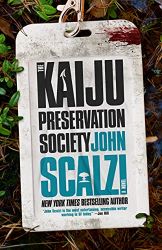
The Kaiju Preservation Society

The Kaiju Preservation Society
© 2021 John Scalzi
268 pages

“You have me monologuing, I’m guessing, to stay alive longer. Yes, I know about monologuing. I’ve watched The Incredibles.”

I don’t know what a kaiju is, but John Scalzi’s name is on the cover so, I’m sold. At least, that’s…what I thought. Turns out John Scalzi isn’t always at his John Scalziest, or perhaps I like him better when he’s not as John Scalzi-y as he is here. We open with our narrator Jamie presenting a pitch to his or her boss (I have no idea, the main character isn’t developed…at all) and promptly being fired, because said boss is a jerk. Happily Jamie receives a mysterious job offer shortly afterward, and learns about another world — a mirror Earth dominated by huge beasts who are studied and protected (from other humans) by an organization known as KPS. However, there’s an Eeeeeeeeevil Corporation out there that wants to Do Bad Things, so the brave selfless scientists and their stalwart assistants (i.e. Jamie) have to thwart their evil plan!

The characters are nonentities: the plot is about as inspired as the Disney Star Wars sequel trilogy, and the author is all-too-eager to remind us of the early days of the pandemic, when we were made subjects of house arrest (except for the politicians!). We get lots of politics — covid policy, hand wringing over The Dreaded Orange One, and references to women as “uterus owners”. I’d make a mean joke about SF writers not knowing what women are, but Scalzi’s married with a daughter, or so his bio alleges. That said, the book still manages to be entertaining: Scalzi is good at writing fun, snarky dialogue, and the entire book is about dinosaur-like creatures the size of small mountains, who have internal nuclear reactors and who are miniature ecosystems. A lot of thought was put into their world and their bodies, and it makes the story incredibly interesting despite the fact that our main character is just there to do Things for the Plot and deliver clever rejoinders in conversations. All of the other characters are there for the same reason: the only one with any personality whatsoever is the villain, and he’s boilerplate Evil Entitled Corporate Jerk. KPS manages to be both obnoxious and fun, like a friend at a party who’s had a bit much to drink but is nonetheless making the scene more bearable through their imaginative drunken ramblings.

Posted in Reviews, science fiction | Tagged , | 1 Comment

Recalled to life

Er. hi. Been a while. Today marks my partial return to work, as I’ve been readjusting to life the last few weeks. I’ve been reading steadily, but have not been home (lots of housesitting), and typing reviews on my laptop is frequently frustrating because of touchpads sending cursors hither and yon. Big hands, small keyboard — not a good fit. Now that I’m home and settling back into my old routines (including wearing pants and socks, a sad change after two months living in gym shorts and sandals), regular posting should resume. For now, an old This Week at the Library-esque wall o’ text!

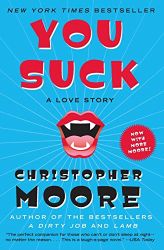
Many young people wake up with regrets after a one-night stand, but it’s a bit more extreme in Tommy’s case: his girlfriend is a vampire, and now so he is.  I stumbled upon You Suck in a secondhand bookshop, so  I didn’t realize there was a prior book in this series, one that explains why  Tommy and his undead gal pal Jody have an ancient evil vampire imprisoned in a bronze statue, as well as a bronze tortoise. In due time said vampire is inadvertently released,  and the immortal lives of our happy couple are imperiled, as well as the life of their newly acquired minion.  I’ve read Christopher Moore before and have never failed to enjoy his absurdist fantasy stories; You Suck was no exception. I may try to find other books in the series around October.

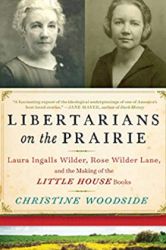
Libertarians on the Prairie dives into the working relationship between Rose Wilder Lane and her more famous mother, Laura Ingalls Wilder.  Rose was one of the ‘furies of Liberty’ mentioned in Radicals for Capitalism, along with Isabel Paterson and Ayn Rand,  as she became increasingly concerned about the state of the American republic as it was deformed by Roosevelt’s new deal and World War 2.   Libertarians opens with a biography of Laura Ingalls, whose nonfiction version of her story formed the basis for the children’s series that she would write at her daughter Rose’s urging and with her help: Rose served as typist and editor,  and regarded the stories as a way to make Americans remember who they were – inheritors of the rugged, self-sufficient pioneers, and not Old Word serfs, bowing before the State.   The book is fairly critical of Rose and labors under the strange idea that she invented the rugged-free-farmer idea.   Interestingly, she didn’t think much of Ayn Rand, regarding her fans  as pseudo-intellectuals.

Rachel’s Holiday opens with a young woman (named Rachel, would you believe it?)  being forced by her family to attend drug rehab. She’s not an addict (she accidentally took too many valiums to counteract the too-pure cocaine she was enjoying the night previous), but she relents because rehab makes her think of saunas, gym time, and juice cleanses.  When she arrives she’s surprised to find that no one else there is an addict, either: their families were also over-reacting. She’s also dismayed to find no gym, no masseuses, and no access whatsoever to good wine.  She has to stay there at least three weeks, though, and as we spend more time with her, we realize that Rachel is an unreliable narrator who is deeply in denial about her problems. Keyes manages to keep her sympathetic  even as Rachel’s serious issues (including self-obsession, theft, and chronic lying) are exposed.  It’s a psychological story at heart with some romance.

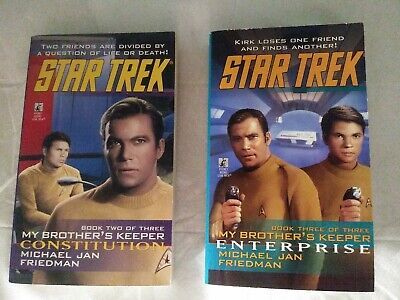
Continuing in Star Trek: My Brothers Keeper, I read the second and third volumes in the trilogy. Constitution  revisits an early Kirk & Mitchell mission in which Kirk is forced to take command and defend a world against an outside attacker with a malevolent satellite system.  We see a lot of character growth here for Kirk, as he’s forced to act more on instinct in a situation that demands quick responses.   In Enterprise, Kirk  is asked by Mitchell’s parents to deliver a eulogy at the fallen man’s funeral, Kirk wrestles with the decision to tell them the truth of their son’s death and his role in it. As part of his reflection, he looks back to another time when he thought Mitchell was dead — to a time when Enterprise was ordered by Starfleet Command to deliver a small team to a barren wasteland, where waited a Klingon cruiser. Kirk knows this is not the first time Starfleet and the Klingons have rendezvoused here, but he has never been privy to the details of these secret meetings — not even now, as captain. Disaster strikes and Kirk soon loses the Enterprise to a small band of augmented Klingons, and must work with Klingon legend-in-the-waiting Kang to free his people and eliminate a threat to the Federation. As a Star Trek novel, this is perfectly fine; it’s an enjoyable adventure with good characterization and humor. As the ending part of this trilogy, though, it suffers for want of Gary Mitchell: he recedes far into the background for most of the book. It’s essentially a Kirk and Kang struggle, with Friedman making an attempt to explain why TOS had human-like Klingons and TNG had Klingon-Klingons. Amusingly, Friedman uses genetic augmentation in the story — taking it the complete opposite direction that ST-Enterprise did.  Mitchell doesn’t play as prominent a role in the third story as one might expect, but the trilogy remains solid light-adventure Trek fun.

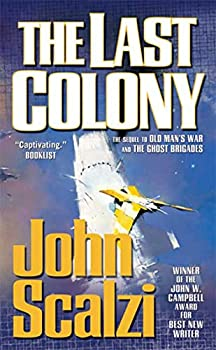
The Last Colony completes John Scalzi’s Old Man’s War series. In it, the heroes of the first two books, John Perry and Jane Sagan, are enjoying retirement on a colony world, farming and occasional settling disputes between the locals.  Perry is asked by the Colonial Defense Forces to oversee the creation of a new colony, though, at a place called Roanoke. (And suddenly, all the history majors raised their eyebrows.)  We saw in The Ghost Brigades that the CDF and the Colonial Union are not quite playing on the square; that continues here, as Jane and John and their adopted daughter are unwitting pawns in a galactic political struggle. They have to get creative to avoid being destroyed either by their own kind or an alien alliance.


And finally, at least for this Wall of Text (there are more books I need to cover), my first Gore Vidal book!  Perpetual War for Perpetual Peace, published just after 9/11 but before DC began its decades-long debacle in central Asia, destabilizing the region, creating generations of new terrorists, and enriching the arms dealers who dictate so much of DC’s foreign policy, condemns the police state that DC was already building and points to the actions of Timothy McVeigh and Osama bin Laden as reactions against a long train of abuses by DC. Vidal does not write in defense of McVeigh and bin Laden: their actions were reprehensible. To dismiss them as crazy, however, or simply Evil — as though they existed only to be comic book villains, creating chaos and sowing destruction for their own amusement — is to remain ignorant. Both men were operating from motives that can be understood — even if not agreed with. Bin Laden opposed DC treating the whole of central Asia as an area to be maneuvered and ordered about in accordance with DC’s own desires: McVeigh opposed DC’s police state and undeclared war on its own citizens, most dramatically broadcast in the Waco massacre and the murderous farce of a police action that was the assault on Ruby Ridge. Vidal is a potent critic, not simply because of his prescience, passion or prose style, but because he can’t be boxed in as an ideologue: he attacks Democrats and Republicans alike, subjects the NY Times and the Wall Street Journal to the same withering rebuke, and would not be embraced by libertarians, either, given his contempt for business mergers and the lack of a National Health Service in the US.

Posted in Reviews | Tagged , , , , , , , , , , , , , , , | 7 Comments

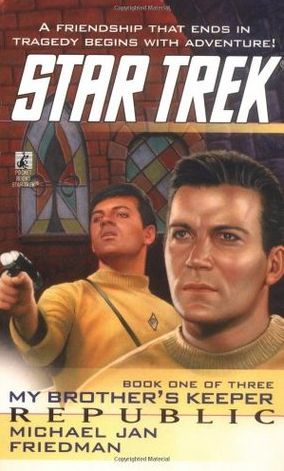
My Brother’s Keeper: Republic

Star Trek My Brothers Keeper: Republic
(C) 1999 Michael Jan Friedman
267 pages

The events of “Where No Man Has Gone Before” forced Jim Kirk to make the brutal decision to kill his best friend Gary Mitchell, after Mitchell had been altered and corrupted by an unknown energy field. Sensing his captain and friend’s enormous grief, Commander Spock approaches Kirk and asks him to tell him more about Mitchell and the bond that he and Kirk shared. Thus begins the My Brothers Keeper trilogy, as here Kirk recounts his meeting with Mitchell and the start of their friendship. Kirk and Mitchell began acrimoniously, but realized both had something to learn from the other. On a training cruise, their respective skills are put to the test when violent ne’er do wells attempt to disrupt a peace conference. Although nineties-era Trek storytelling wasn’t as deep as books from the Relaunch era, Friedman succeeds in showing us a Kirk who is very familiar to the reader, yet not the confident captain we met in the original series, and providing a richer look at his and Mitchell’s growing friendship. Parts of the plot cross into the realm of incredulity (two planets were accepted into the Federation despite being at war with one another, and despite having warp drive they don’t allow anything past preindustrial technology in their capital city?!), but the action exists just to push Kirk and Mitchell to cooperate despite their differences. This isn’t Typhon Pact-level political drama.

Posted in Reviews | Tagged , , | 2 Comments

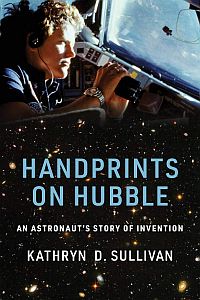
Handprints on Hubble

Handprints on Hubble
(c) 2019 Kathryn D. Sullivan
304 pages

Handprints on Hubble is a unique astronaut memoir, in part because Dr. Sullivan is a scientist first and an astronaut second. Longing to explore, she began her academic life in oceanography before realizing the opportunities the Space Program might offer her. She joined in the class of the Thirty Five New Guys, as the Shuttle Transport System was still being finalized: one of her early projects was to help create the launch checklist for shuttle missions, in fact. When dreams of a large space telescope began to be realized, she was involved extensively in helping figure out how it could be made maintainable by astronauts working in space — developing and practicing procedures and tools that could be applied on a spacewalk. Sullivan lost several friends and classmates when Challenger was destroyed, but the two-year suspension of activity allowed the Hubble team more time to better improve Hubble’s prospects for long-term maintenance. Sullivan was with the team that launched Hubble itself, though she missed the first repair flight, since she’d started transitioning into a career at NOAA as its chief scientist. is more about technical development, engineering, and science than it is a biography or gossipy history of NASA, but it can’t be beaten for someone interested in the development of Hubble — which has only recently been surpassed by the Webb telescope.

Posted in history, Reviews | Tagged , , , | 5 Comments

The Apollo Murders

The Apollo Murders
(c) 2021 Chris Hadfield
480 pages

It’s 1973, and the Apollo program is nearly at its end. One more mission is planned — but it won’t be the mission executed. Instead, the all-military crew of Apollo 18 will be given a secret mission, one even most NASA support staff don’t know about. The Russians are up to something, and it’s vital to find out what. Not only do they have a rover sniffing around on the Moon, but they have a spy satellite in orbit, one that will compromise any and all daylight military operations, Its capabilities and weaknesses need to be assessed, and the rover’s mission on the lunar surface likewise investigated. But even if last-minute mission alterations weren’t a large enough challenge — ops like this require months of sim-testing — there are flies in the soup no one is aware of. Not only do the Russians have more out there than is known, but there’s a rouge element within NASA itself….and they’re perfectly willing to kill to achieve what they desire. The Apollo Murders is a unique thriller, one that begins as a pure technical drama before shifting to one of political intrigue and military action in space. Written by a veteran astronaut, drawing on an often-overlooked aspect of the space race (the USAAF’s Manned Orbiting Lab), and mixing new characters with historical ones like Al Shephard and Gene Kranz, The Apollo Murders is all kinds of interesting.

In real life, Apollo 18 never happened: the last few Apollo missions were cancelled to save money, so the last time men walked on the moon was December 19th, 1972. This gives Hadfield room to play, and he invents a handful of new characters and throws them on a familiar stage — though this is unlike any other Apollo mission. In the wake of intelligence that indicates the Soviets are up to all kinds of mischief, the scientific aspects of 18 are quietly dropped, along with its rover: instead, the crew are given a straightforward military mission that involves surveillance , assessment, and — if possible without being obvious — sabotage. The mission is marked by incidents, though: the original commander dies in a freak accident aboard a Bell helicopter, and then the crew realizes their voice uplink with Houston isn’t working. They can hear instructions, but not communicate back — and boy, do they need to communicate, because the Russians have a few surprises waiting. Unfortunately, I can’t comment on some of the most interesting parts of this novel without giving away the astonishing developments. Let’s just say, though, that Hadfield offers us looks at pioneering space combat (think of scout pilots in 1914 trying to hit each other with revolvers, ‘fighters’ having not yet been conceived of), as well as an unprecedented diplomatic challenge. And then there’s the rouge element….and the woman.

Having previously read Hadfield’s space memoir, and being something of an Apollo junkie, I had high hopes for this. They were not disappointed, though there were some oddities, like a 1970s newspaper using 2020s conventions. This is so unlike anything I’ve read that I was spellbound by it to the very end. There’s not much out there in the way of realistic space fiction (Stephen Baxter’s Voyage is the only other book I’m familiar with), so I’m glad Hadfield tried his hand at fiction. It succeeded enormously in my reckoning!

Posted in Reviews, science fiction | Tagged , , | 3 Comments

The Burning Blue

The Burning Blue: The Untold Story of Christa McAuliffe and NASA’s Challenger Disaster
(c) 2021 Kevin Cook
288 pages

So fickle is the human mind that even Apollo could not keep the public terribly excited for very long after the first moon landings, and the Shuttle program — despite its ambition and engineering complexity — only briefly resparked interest. The shuttles were trucks in space, doing routine work. NASA hoped to revive public passion for space (and safeguard its funding) by expanding spaceflight participation, opening seats on the Shuttle to various categories of civilians. The first would be a “Teacher in Space”, using the unique environment of the shuttle to teach lessons in microgravity. The public relations effort was a triumph: the woman chosen became an instant celebrity, and when her flight lifted off, it was under a national spotlight: everyone was watching. And then — the inconcievable. Everyone saw the booster disintegrate, everyone saw the shuttle explode, and everyone saw the lives of the crew snuffed out in a moment. So ended NASA’s civilian inclusion program, and the delusion that traveling to space was ‘routine’. The Burning Blue is both a biography of Christa McAuliffe, the teacher chosen, and a brief history of the impact Challenger had on NASA’s space program.

Despite being a space junkie as a kid (and now), the Challenger disaster never hit home for me: I was only a year old at the time, and I was more interested in Apollo and space stations than the shuttle that bridged them. When Columbia was destroyed in 2003, it became my generation’s space shuttle disaster; Challenger remained a page from the history books, although I got hints from time to time that for those watching, it carried a lot of emotional weight. Having read The Burning Blue, I can understand a bit of that now. Christa McAuliffe was chosen not because she was some uberfrauen to be idolized, but because of her attractive ordinariness and passion for teaching: she became, in the six months of her training, an American sweetheart who everyone watching identified with. She was the layman’s dream, an inspiration, someone who offered hope that one day ordinary people could find themselves gazing at the Earth from space. She didn’t have the ego of some Right Stuff-era astronauts, or even some of the Shuttle era astronauts (my interest in reading about Sally Ride declined considerably while reading this): she was the woman next door, who triumphed through a dream coupled to hard work and an unwillingness to quit. Through her we also get to meet the other Challenger seven, the most interesting of whom (to me) was Judy Resnik: Resnik had already earned her golden wings on a prior Shuttle mission, and was McAuliffe’s mentor after realizing the young teacher was taking this seriously, and not just a pretty face in a PR stunt. Resnik had to struggle with being taken seriously herself, as people prized her not for her labor but for her diversity checklist status: she was the First Jew in Space, the Second Woman in Space, etc. Resnik radiated contempt for this, wanting to be known for her own achievements, past and future — after Challenger, she hoped to pursue training that would see her jump from the middeck seats of the Mission Specialists to the front seat of the commander and copilot — something unprecedented, since pilots and specialists were two different career tracks altogether.

The lives of these two women and their five crewmates were destroyed in seconds, their craft compromised by a frozen O-ring. NASA could safely launch twelve shuttles a year, but the demands of the government and its commercial contracts were seeing it push well past recommendations and approach twenty launches a year. So frantic was the pace and so demanding was this on the shuttles that parts were actively cannibalized from flight to flight: when Challenger lifted off, she was carrying parts temporarily borrowed from Columbia. Challenger’s own takeoff had been delayed six times before finally getting the go-ahead to proceed on a wintry morning that doomed it. Still, as the investigation that followed showed, the disaster could have been far worse: the shuttle could have exploded on the pad, destroying the tower itself: instead, a fluke (frozen fuel sealing off a compromised area of the hull) allowed the shuttle to clear the tower and even begin its final ascent before the inevitable happened. Cook then follows the aftermath of the disaster, revaling weaknesses in NASA’s chain of command, its working culture, and its partner relationships. Unfortunately, some of those weaknesses returned some twenty years later.

I can’t fairly compare this to any other Challenger books, this being my first: it was successful in making the disaster more real, in letting the reader get to know the crew (McAuliffe, largely) so well before their deaths. It doesn’t go into much technical detail, though. something like Truth, Lies, and O-Rings is probably more thorough on that front. If you’re new to Challenger like me, though, this definitely strikes me as a good starting point.

Posted in history, Reviews | Tagged , , , , , | 3 Comments

Hail, Columbia!

In reading Bringing Columbia Home, the author referred to several videos — a surviving bit of cockpit footage, eleven minutes prior to the disaster, as well as a tribute video created during the recovery period.

“There’s heavy grief in our hearts, which will diminish in time, but it will never go away and we will never forget,” Crippen said. “Hail Rick, Willie, KC, Mike, Laurel, Dave and Ilan. Hail Columbia.

Posted in General | Tagged , , | 2 Comments

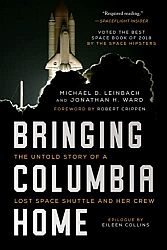
Bringing Columbia Home

Bringing Columbia Home: The Untold Story of a Lost Shuttle and Her Crew
(c) 2018 Michael Leinbach and Johnthan Ward
400 pages

On February 1st, 2003, the Space Shuttle Columbia disintegrated in the skies above Texas and Louisiana, some sixteen minutes from home. Nearly twenty years after the Challenger disaster, the Shuttle program had faded into the background, its launches and landings untelevised and its progress building the International Space Station unnoticed by most. Even the death of Columbia and her crew would soon be overshadowed by the Iraq war, but before that debacle began, something extraordinary happened. Some twenty-five thousand people were drawn together — multiple layers of otherwise territorial government agencies and civilian organizations — to comb the rough country of east Texas and Louisiana amid the last storms of winter, all in an effort to reclaim the bodies of the fallen and to find answers to Columbia’s demise. Bringing Columbia Home is a beautiful history of this extraordinary recovery effort, one that reminds readers that despite human frailties we can be astonishingly noble at times.

The Shuttle Transport System, encompassing both the Shuttle itself and the booster that aides it into space, was a triumph of human engineering. Into the Black, on the launching of Columbia, covered the laborious efforts of the Air Force and NASA to create a reusable ‘space plane’. As complex a craft as it was, a lot could go wrong. One shuttle had already been lost, some seventeen years prior: Challenger blew up as it began its final push to escape Earth’s atmosphere, destroyed by cold-stiffened O-rings. As NASA’s men and women on the ground realized that Columbia had joined her sister ship Challenger in destruction, they could not pause to mourn but instead had to focus on the painful task of finding out answers. As reports of falling debris filtered in, the outlines of a search area began to take shape. Local law enforcement and state forestry agencies were soon working hand in hand with FEMA and NASA to organize a comprehensive recovery effort. Astonishingly, there was no feuding over turf, something so common in investigations: the massive undertaking was broken into different parts and divided among agencies as appropriate. As impressive as this coordination was, it wouldn’t have been possible without support from the people of east Texas and Louisiana, who not only provided boots on the ground but supported the search teams being flown in, helping to feed and shelter thousands of new arrivals — many of whom carried the burden of knowing the men and women they were searching for. As journalists swarmed in like locusts, invading the privacy of mourners and even attempting to capture video of remains being recovered, the people of places like Lufkin closed ranks around NASA and protected the privacy of the dead and those who wept for them. Astonishingly, every member of the crew was located, and enough of Columbia was found to enable NASA to figure out what had happened, using physical remnants in conjunction with the data recovered from Columbia’s flight recorders. During launch, insulating tile from the booster flew off and impacted Columbia’s left wing, fatally compromising it and dooming the craft. Even had Columbia’s crew known about the impact, they had no way of investigating the scope of the damage, or repairing it.

Bringing Columbia Home is a sad, but beautiful history, absolutely moving in what it captures — the generosity of ordinary people, the willing sacrifices of searchers, some of whom lost their lives attempting to find the crew, and the determination of NASA’s engineers to find answers even in their pain.

Posted in history, Reviews | Tagged , , , , , , | 2 Comments

Midyear Book Freakout

Mid-Year Book Freakout Tag 2022

Yoinked from Cyberkitten

  1. Best book you’ve read so far in 2022

How to Think Like a Roman Emperor, Donald Robertson

  1. Best sequel you’ve read so far in 2022
    Crusader, Ben Kane. It followed Richard the Lionheart as he traveled abroad from England, mixing it up with Mediterranean potentates as well as Saladin.
  2. New release you haven’t read yet but want to

An Immense World: How Animal Senses Reveal the World Around Us, Ed Yong. Yong did a great book on bacteria a few years ago. I need to finish this year’s science survey first, though.

  1. Most anticipated release for the second half of the year

Wild Problems: A Guide to the Decisions that Define Us, Russ Roberts. My introduction to Roberts was through his podcast, which at the time was more oriented towards economics. Over the years Roberts has shifted more towards conversations about human flourishing.

  1. Biggest disappointment (so far!)

Amazon’s “Warmer” collection. Almost none of the stories were interesting, and their SF content was unoriginal at best.

  1. Biggest surprise of the Year (so far!)

(shrug)

  1. Favourite new author. (Debut or new to you)

James Holland. I would have finished his WW2 trilogy if people didn’t keep bringing me books in the hospital..

  1. Newest fictional crush

Not something I do.

  1. Newest favourite character

Sergeant Tanner from James Hollands’ WW2 trilogy.

  1. Book that made you cry

Bringing Columbia Home, Michael Leinback. A history of Columbia’s breakup and the massive undertaking to reclaim her crew’s bodies, as well as the remains of Columbia herself, and to piece together what happened to the Shuttle fleet’s flagship. I was moved not only by the ego-less cooperation of so many different organizations, but the generosity of various east Texas communities and the amount of volunteer labor that made it possible to house and feed over 20,000 people involved in the search.

  1. Book that made you happy

Churchill’s Shadow Raiders, because it was a book-level treatment of a raid that I declared should GET a book-level treatment eleven years ago.

  1. Most beautiful book you’ve bought so far this year (or received)

Dangerous Passions, Deadly Sins had good cover art.

  1. What books do you need to read by the end of the year?

All of them. Finishing or at least DNFing-for-good The Oil Kings would be good.

Posted in General | Tagged | 2 Comments