Life and Death in the Third Reich

Life and Death in the Third Reich
© 2009 Peter Fritzsche
384 pages
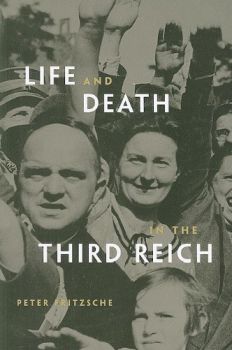
A few years ago I read Peter Fritzsche’s An Iron Wind: Europe Under Hitler, which examined how the Nazi conquest of most of Europe permeated into its culture in the late thirties and forties. Life and Death in the Third Reich does something similar, but focuses more sharply on the culture of Germany. In particular, Fritzsche explores the creation of the Volksgemeinschaft, “The People’s Community”, and how Hitler and his kameraden transformed the land of poets and thinkers into an abattoir for two thirds of Europe’s Jews. He draws heavily on letters and diaries, to follow how German identity became more politicized and the Aryan myth embraced — to the detriment of Germany’s Jews, who became an Other even to Germans who did not accept Hitler’s hostility towards them. It’s both sobering and insightful.

Arguably the most important aspect of Life and Death is the appeal of the People’s Community. Although this can be defined narrowly as a racial community, the idea of the People’s Community came into being at the outbreak of the Great War, when Germans rallied together regardless of religion or politics to defend Germany against its encircling foes. The volksgemeinschaft was a sustaining vision of German society in which everyone included as ‘the people’ were united, along with their interests; capitalists and labor would not be foes arrayed in opposition against one another, but would exist in solidarity: their identity as a middle-class Berliner or a working-class Frankfurter would be overwhelmed by their status as members of the Volk. It’s easy to understand the appeal of this: virtually everyone wants to Belong to something greater than them; it’s why tribes and nation-states (not to be confused with more ideologically-rooted states like DC and the Soviet Union) exist. Most of us also despair of strife and antagonism; we long for peace, and for the people of Germany this would have been a particularly salient desire, accustomed as they were to goon squads of various political parties fighting in the streets, intimidating not only their rivals but the un-aligned who just wanted a cup of coffee. Hitler’s attempted to create this community both through the ideology of German aryan-ness, envisioning Germans as a distinct and superior Race among Europe and the world’s populations, and through politics and economics: fascism promised to align economic interests with those of the nation and its people, and most of society was ‘coordinated’ along the lines of national socialism — schools, civic groups, unions, etc. The idea of national unity was so popular that even those who disliked Hitler and others in the government supported the system he was creating, and the revolution in thinking and doing that he was imposing. It was suddenly springtime for Germany — Germany was restored from its losses-by-treaty twenty years before, redeemed from the shame of Versailles, recovering from the Weimar financial chaos. Such enthusiasm made it easy to ignore those had suddenly been determined to be un-völkisch, chiefly the Jews — especially after the war started. Fritzsche documents the irregular growth of the Holocaust, as both Hitler’s plans and his timing to effect them were greatly altered by Germany’s successes or losses in the fields. By the time the war turned badly for Germany, virtually all of German Jewry was gone, and the concerns of German citizens had turned to themselves — suddenly the target of Anglo-American bombers. Although there was widespread knowledge of something happening in the east (Germans participated in public auctions of Jewish goods, and the sprawling system of export and death required civilian logistical support), the campaign of ‘othering’ the Jews and the collective hardship of enduring the war (one perpetuated, propaganda said, by those wicked capitalist Jews in the West and the wicked communist Jews in the East) diluted the impact. It reminded me a bit of the revelations of grotesque prisoner abuse at Abu Ghraib in the immediate post-9/11 period: most Americans would have ordinarily been scandalized and horrified to learn this was happening in their name, but between the overwhelming memory of 9/11 and the sudden war-footing mentality, virtually no one cared. It was happening to reichsfeinden, so — best let The People in Charge handle it. They know what they’re doing, surely.

Life and Death in the Third Reich is a most interesting book, disturbing in its study of how ordinary men, women, and children could become the willing builders of a revolution and a state so terrible that, 90 years later, they remain the face of evil in the west, despite far more murderous states existing then (Soviet Russia) and afterwards (red China, Mao to the present). Moderns who believe themselves too savvy for this sort of thing, who believe they’d never go along with it, are fooling themselves: we all have hunger that politicians claim they can fill, and we will ignore the poison provided it’s coated with enough sugar. We will happily “other” people: in the past two years people have grown to hate one another for not wearing masks, or for not accepting Pfizer’s jab as their lord and savior –and we will ignore great offenses given sufficient distraction or incentive. Beyond the serious lessons offered by this book, it also offers a glimpse into the everyday live of Germans, sharped as it was by Nazism — creating newfound support for hobbies like genealogy (necessary to prove one’s Aryan credentials) and photography, for documenting the ‘people’s revolution’ as it happened, of being both participants in and documenters of, ‘History in the making’.

Related:
They Thought They Were Free: The Germans, 1933- 1945. Milton Mayer.
Black Edelweiss: A Memoir of Combat and Conscience by a Soldier of the Waffen-SS, Johann Voss. One of the more eye-opening and disturbing books I’ve ever read: Voss’s family were middle class and respectable, and disliked Hitler — but they regarded the dangers he was a safeguard against as more important than his own limitations.

Posted in history, Reviews | Tagged , , , , , , , | 2 Comments

Teaser Tuesday: An innocent man in the arms of a redhead

Teaser Tuesday is a homeless meme adopted by me in which we share excerpts from our current reads. I stumbled upon a seriously entertaining novel in which George Custer survives the ambush at Little Big Horn and becomes a gun for hire.

I flung open the door on one [theatrical wagon], slammed it behind me, and leapt into the arms of a woman seated just inside.
“Well, make yourself at home, why don’t you?”
“Excuse me, ma’am, but I’m an innocent man running for his life.”
“Well, aren’t you unique? I’ve never met an innocent man.”

Posted in General | Tagged , , | Leave a comment

Unstitched

Unstitched: My Journey to Understand Opioid Addiction and How People and Communities Can Heal
© 2021 Brett Ann Stanciu
224 pages

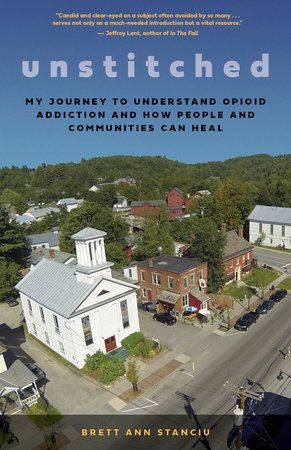
Brett Stanciu had a problem. Someone kept breaking into her small library, pilfering money, and smoking cigarettes.  She knew who the someone was  – Baker, a local drug addict and vagrant who was known to the community as trouble. She even had photographic evidence of him in the library, sitting at her desk, but the police and courts didn’t regard him as enough of a serious threat to address. Even after he was arrested, he was immediately released.  Then, one night,  confronted by a library trustee,  Baker ran out into the night and shot himself.   For most of the town,  this was fuel for a quick run of gossip, a bit of amusement, and nothing else – -but for Stanciu,   it was a tragic end to a frustrating period in her life, and created more questions than relief. Who was Baker?  How had a drug habit led to him dying by himself, his blood pooling next to a woodpile?      This was the beginning of a journey, taking place over a year,  for her search for answers –    sitting down with recovering addicts, substance abuse counselors,  law enforcement, prosecutors, and devastated parents, delving into the whys and wherefores of substance abuse.   Although definitely more of a citizen’s search for answers than a definitive Answer in itself,   it’s a moving story that should provide good context for beginning to understand addiction, particularly opioid addiction, for the lay reader.

Although this is a work of nonfiction, it’s not a conventional ‘just the facts, ma’am’ book. Stanciu presents it as a memoir; it’s more a story that follows her over the course of a year, as she attends conferences and meets people who will sit and interview with her. The reader is invited into her life, her memories during this time, with the physical and social background being drawn for us: Stanciu meditate on the changing weather, the landscape around her; she shares the little conversations she had with her daughters, coworkers, and fellow citizens that kept her thinking about this subject stirred. This was not what I was expecting, but I was quickly won over by it, especially after she mentioned drinking maple-cream coffee and I discovered a recipe for it. The account is especially personal because Stanciu reveals to the reader that she’s in recovery herself, albeit from alcohol rather than opioids. As the year progresses, Stanciu shifts to understanding addiction, not just opioid addiction, as a physical disease: although it begins as an act of will and can be resisted, addiction is a physical disordering of the brain: depending on how it progresses in a person (men and women have different experiences with addiction), it can so rewire their brain that they’re not the same person they were before. There are also other contexts, like family background and abuse: it’s harder for poorer people to recover from addiction, for instance, because even one mishap can destroy them financially. One promising path to recovery that Stanciu discovers is Medication-Assisted Therapy, which uses both drugs to wean users off of opioids, while helping them to figure out what put them on the track to substance abuse to begin with, and re-structure their life to get back on track.

Unstitched is a powerful story, often sad but never hopeless. As a librarian who encounters people whose minds and lives have been destroyed by substance abuse every day, this attempt by a fellow librarian to find answers resonated with me enormously.

Posted in Politics and Civic Interest, Reviews | Tagged , | 8 Comments

Selected Quotes From “What They Forgot to Teach You In School”

Shortly after reading On Love, I found another de Botton title in my library’s e-book collection, What they Forgot to Teach You In School. Unsurprisingly, I soon had four pages of quotes from the book. Below are just a few.

On Love

“Our Romantic culture prompts us to imagine love as a kind of boundless admiration for a perfect being. This estimation forgets that there is another way to live, one in which we can love that which is less than ideal, one in which not every mistake has to be appalling, one in which we’re aroused to sorrow and compassion by the sadness and mishaps of others, one in which we can love flaws rather than always fixate on otherworldly perfection. We can, at our best moments, see the child inside the vulnerable adult and extend mercy and kindness as required. Genuine love isn’t blind to defects; it is compassionate towards them and readily sets them within an awareness of a person’s overall qualities and character.   Hating ourselves is the easy bit. Learning to give ourselves a break is the true, rare, and properly adult achievement.”

s

Repair, don’t Run

“We cling to rupture because it confirms a story which, though deeply sad at one level, also feels very safe: that big emotional commitments are invariably too risky, that others can’t be trusted, that hope is an illusion — and that we are fundamentally alone.”

“It is no doubt a fine thing to have a relationship without moments of rupture, but it is a finer and more noble achievement still to know how to patch things up repeatedly with those precious strands of emotional gold: self-acceptance, patience, humility, courage, and many careful lessons.”

On Moods

“Moods are proud, imperious things. They show up and insist that they are telling us total certainties about our identities and our prospects — perhaps that our love lives will never work out or that a professional situation is beyond repair. Still, we always have an option of calling their bluff, of realising that they are only a passing state of mind arrogantly pretending to be the whole of us — and that we could, with courage, politely ignore them and change the subject.”

“Ou sense of self is naturally fluid: we are, as a reality and a metaphor, largely made of water. We shouldn’t allow a misplaced idea of permanence to add to our sorrows. Though we may be unable to shift a mood, we can at least recognise it for what it is and understand that, in the inestimatable words of the prophets, with the help of a few hours or days, it too shall pass…”

Be Water, My Friend

No one gets through life with all their careful plan As intact. Something unexpected, shocking and abhorrent regularly comes along, not only to us, but to all human beings. We are simply too exposed to accident, too lacking in information, too frail in our capacities, to avoid some serious avalanches and traps.  The second point is to realise that we are, despite moments of confusion, eminently capable of developing very decent plan Bs. […]  It helps, in flexing our plan-B muscles, to acquaint ourselves with the lives of many others who had to throw away plan As and begin anew: the person who thought they’d be married forever, then suddenly wasn’t — and coped; the person who was renowned for doing what they did, then had to start over in a dramatically different field — and found a way. Amidst  these stories, we’re liable to find a few people who will tell us, very sincerely, that their plan B ended up, eventually, superior to their plan A. They worked harder for it; they had to dig deeper to find it and it carried less vanity and fear within it.”

“It’s worth trying to understand, therefore, why happiness ‘ever after’ should be congenitally so impossible. It isn’t that we can’t ever have a good relationship, a house, or a pension. We may well have all this — and more. It’s simply that these won’t be able to deliver what we hope for from them. We will still worry in the arms of a kind and interesting partner; we will still fret in a well-appointed kitchen; our terrors won’t cease whatever income we have. It sounds implausible — especially when these goods are still far out of our grasp — but we should trust this fundamental truth in order to make an honest peace with the forbidding facts of the human condition.   We can never properly be secure, because so long as we are alive, we will be alert to danger and in some way at risk. The only people with full security are the dead; the only people who can be truly at peace are under the ground; cemeteries are the only definitely calm places around.”

Posted in quotations | Tagged , , | Leave a comment

Nixon’s pyramid, the future, and intelligent octopus arms

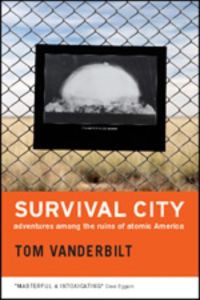
At some point in the last year a book tipped me off to Tom Vanderbilt’s Survival City, in which the author tours ruins and remains of DC’s vast Cold War infrastructure while providing a history of the way popular fears and optimism about the Atomic Age manifested themselves in architecture. I was particularly interested in learning more about Nevada’s “Atomic Survival Town“, which grew out of similar experiments in bombing pretend-German and pretend-Japanese towns during World War 2. (Probably the only time Nevada has contained cities built for people instead of automobiles!) The structures that Vanderbilt covers include missile solos, some of which have been converted to other uses or destroyed; an anti-missile site that was meant to be first of a nationwide array, but which was abandoned immediately after opening (as in, the day after); and….a giant wooden tower that was used to mount bombers with working engines so the effects of atomic explosions on moving aircraft could be studied. Some sites are off-limits to Vanderbilt, but he shares information as available. I was particularly interested in (okay, obsessed by) the creation of an underground elementary school in Artesia, New Mexico. The structure is still standing today, but is not open to tourists; the local school board uses it for storage. If you’re really obsessed with the Cold War, this is worth a venture, but there’s as much information in the linked articles above as in the text. After reading this, Command and Control, and Atomic Awakening, I’m surprised that humanity survived the fifties. The amount of casual and enthusiastic irradiation governments engaged in boggles the mind.

Related: Eric Schlosser’s Command and Control, on the growth of nuclear arms and the history of dangerous near-misses with them, providing context for the book’s central history of the Damascus incident; and Phil Patton’s Dreamland: Inside the Secret World of Roswell and Area 51. This is a piece of investigatory tourism that contains largely useful information about various aviation-development-and-testing sites in the Southwest, along with the expected bit of UFO lore and speculation.

In late September, The Skeptics Guide to the Future was released, and I with a preorder read it immediately. The book first examines the ways science fiction of the past got the future wrong, and looks for patterns into the errors. The authors then examine our future’s prospects in the short, medium, and long term. The authors (the brothers Novella) host two podcasts together; a long-running one on science and critical thinking, and another on science fiction reviews. This project nicely converges them, because they’re fairly restrained in the short term, and only engage in wild speculation over the long term while reiterating we have no idea what’s in store. The tempered enthusiasm is consistent throughout the text; the authors are optimistic about the prospects for gene therapy and possibly growing new organs for those whose parts have failed, but caution that there’s much about development we don’t understand. A liver won’t simply grow in a petri dish: its cells are looking for context. Somehow the body’s environment guides organ developments in concert. Although the authors point out that older technologies often stay in place because they work so well, despite the promotion of more technologically sophisticated rivals, their section on transportation ignores the idea that we might return to designing cities that humans are capable of navigating on foot, rather than continuing to try to create technological solutions to the manifest stupidity, the resource-draining and human-life-sucking spectre that is sprawl. One curiosity I noticed was the authors’ assertion that solar and wind are cheaper than coal, which is so absurd on the face of it that I suspect they’re adding the costs of environmental pollution, etc. They did acknowledge the viability of nuclear, though, especially with Gen-IV reactors that not only produce near-zero waste, but can process prior generations’ waste as fuel. There are generous comparisons to SF projections throughout, especially Asimov’s Foundation. Recommended if you’re into futurism, but I enjoyed the Novellas’ Skeptics Guide to the Universe much better.

Related: Micho Kaku’s Physics of the Future; Steven Kotler’s Tomorrowland; and Kevin Kelly’s The Inevitable.

When Darwin closed The Origin of Species, he commented on Earth’s “endless forms most beautiful and most wondrous”. However spectacular the life of Earth is from the outside, there’s more wonder to be had by stepping inside the animals’ Umwelt — the world as experienced by them. The animals of Earth experience the world in vastly different ways, their senses tailored for their needs, and it is eye-opening to consider how much more different and fantastic the world might appear to other creatures. We’re dimly aware, of course, that many animals have superior senses to our own sets: hawks can see field mice in close detail at distances where humans couldn’t even resolve the grass said mice were hiding in, and we’ve long made use of dogs’ obvious superior schnozzes. But many animals have senses that function at such a high level that the analogies we draw in attempts to understand them are clumsy at best. Elephants, for instance, communicate quite effectively through subsonic rumbles, and bat’s ultrasonic radiation allows them to nail bugs with precision. Other animals approach ‘our’ senses in very different ways: a spider, for instance, might have two eyes in front for focusing on prey, but a multitude of much smaller eyes that are its primary guide in the world. No two species experience the world exactly the same way, and not just because one can see better, or hear more , or have a different vision of the world because it sees the ultraviolent. Some animals experience time differently: bird brains process birdsong so rapidly they can hear messages in patterns that human ears miss altogether, and whales can interpret elongated conversations (the kind we might have between Earth and a Mars colony, for instance) with the same ease that humans do with our own ‘instant’ back to back chatter. For the whale, ten and twenty minute breaks may seem like the 3 and 4 second breaks in human conversation. For some animals, sensation is distributed: octopus arms have neurons, so they can sense and act on their own accord, though the central brain can coordinate them. An Immense World was an incredibly captivating read, and very much recommended. Definitely a multiple “Wow!” kind of book.

Some highlights:

This goes against every stereotype one might have about crocodiles as brutish, unfeeling animals. With jaws that can crush bone and thick skin that’s heavily armored with bony plates, they seem like the antithesis of delicacy. And yet, they are covered head to tail in sensors that, as Ken Catania and his student Duncan Leitch showed, are 10 times more sensitive to pressure fluctuations than human fingertips.

Mosquitoes, meanwhile, have neurons that seem to respond to both temperatures and chemicals. I ask Leslie Vosshall if this means the insects can taste body heat. She shrugs. “The simplest way to sense the world would be to have the senses be separate—to have neurons that taste, or smell, or see,” she tells me. “Everything would be very tidy. But the more we look, the more we see that a single cell can do multiple things at the same time.” For example, the antennae of ants and other insects are organs of both smell and touch. In an ant’s brain, “these probably fuse to produce a single sensation,” wrote entomologist William Morton Wheeler in 1910. Imagine if we had delicate noses on our fingertips, he suggested. “If we moved about, touching objects to the right and left along our path, our environment would appear to us to be made up of shaped odors, and we should speak of smells that are spherical, triangular, pointed, etc. Our mental processes would be largely determined by a world of chemical configurations, as they are now by a world of visual (i.e., color) shapes.”

Posted in General | Tagged , , , , , , , , , | 7 Comments

Teaser Tuesday: Unstitched

This week’s Teaser Tuesday is from Brett Ann Stanciu’s Unstitched: My Journey to Understand Opioid Addiction and How People and Communities Can Heal. I haven’t posted a review for it yet, but it was powerful.

“Would you say you now have the upper hand on alcohol? That you beat your addiction?”
“I’ll never best addiction. It’s here.” He tapped his chest. “But what I have learned is how to live with it. I’ve learned not to take that first drink. I can stand in my neighborhood and tell my neighbor I can’t drink. I can admit I had a problem and lost — and lost almost everything.”

This week’s Top Ten Tuesday is books we’ve read on vacation, which — hrmm. We’ll see what I can remember!

Out of the Silent Planet, C.S. Lewis. Read while flying to New Mexico in 2016.

Azazel, Isaac Asimov. Read while in New Mexico back in 2016. Definitely an outlier among Asimov’s works, it’s a collection of short stories about a little demon named Azazel who does favors for the man who summoned him, but they invariably backfire.

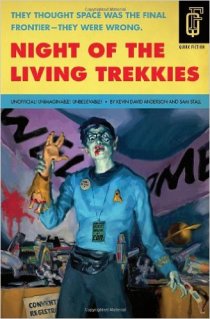
Night of the Living Trekkies, Kevin David Anderson. It’s….about a zombie apocalypse that begins at a Star Trek convention, the main character is named Jim Pike, and every chapter is named after a TOS episode. Absolutely hilarious. Read in Las Cruces during my New Mexico trip.

Cell, Robin Cook. A smartphone that functions as a medical monitoring device goes bad. Read while in St. Augustine.

Mind’s Eye, Douglas E. Richards. A man wakes up in a dumpster not knowing how he got there…and also not knowing why he can now surf the internet with just his brain. Interesting premise but I was not impressed by the delivery. Read while in St. Augustine.

Shiloh 1862, Winston Groom. Read this while visiting the Shiloh Battlefield

Posted in General | Tagged , , | 11 Comments

A thought of Thanksgiving

A year ago I was hospitalized with what could have been a life-ending illness. When I was told that I had chronic kidney disease and would need to be on dialysis for the forseeable future, I thought my life was pretty much over. Instead, a year later I’m the undeserving recipient of a kidney transplant. I’m in a meaningful relationship with a wonderful woman, and I’ve collected a few IT certifications. More importantly, I’ve developed a greater and more intense appreciation for life, the people within mine, and the zeal to make the most out of every day. Even if I hadn’t received the transplant, I could only stand in awe of the blessings of the last year — the people I’ve met, the strength I’ve found and been given. It has been a humbling experience, and I can only respond with gratitude and the resolve to live more worthily.

Posted in General | 1 Comment

Top Ten Tuesday & Teaser Tuesday

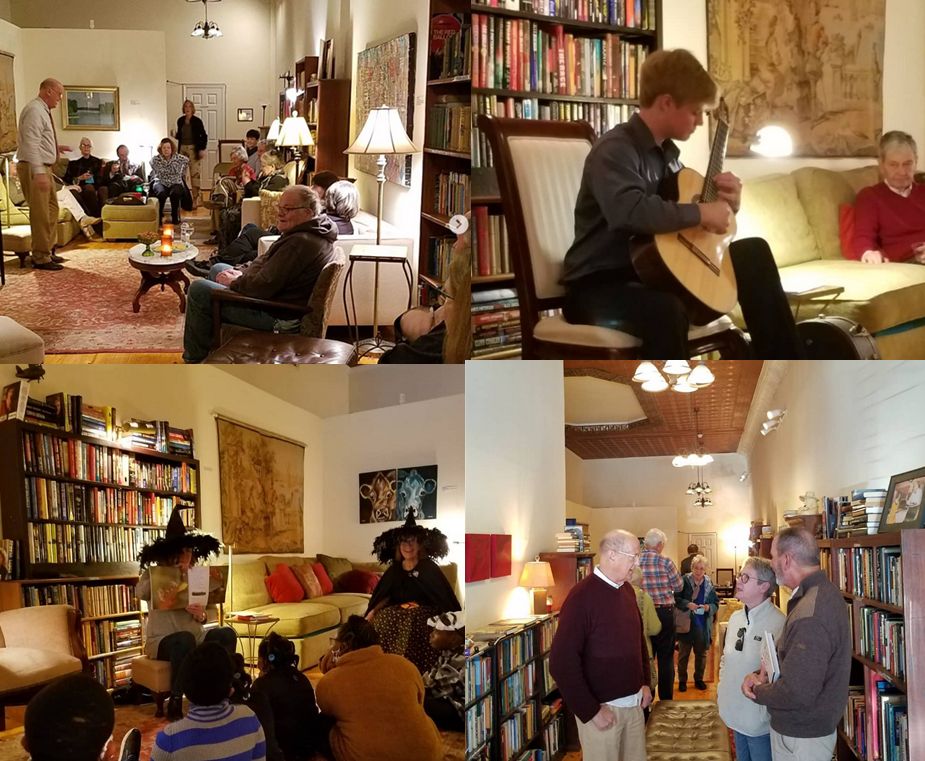
Today’s Top Ten Tuesday topic is “Favorite Bookstores”, or “Bookstores You’d Like to Visit”. As a child of rural post big-box America, I’ve only ever known places like Bookland, Books-A-Million, etc, and until recently could only visit ‘real’ bookstores while on vacation. COAS Books in Las Cruces comes to mind, as does Second Read Books in St. Augustine. Within the last year, though, a retired academic dean and community-minded gentleman has opened up Broad Street Books in downtown Selma — and it’s one of my very favorite places in the city, with a ‘living room’ feel to it. I visit it every Saturday morning and always find good company, coffee, and the odd treat there. The proprietor also uses the space to host book talks and poetry readings. It’s a treasure! If you’re ever in Selma, do drop in.

These shots are all from my instagram ,which is all nature or ‘community life’ type shots. On the subject of Tuesday memes, I used to participant in one called “Teaser Tuesday”, in which members would share a two-line excerpt from their current read. Although the original host has long since hung up her book-blogging hat, and there’s no successor to my knowledge, I always enjoyed going back to see what funny, surprising, or interesting lines I’d shared — so I’m going to start posting teases here again!

From Ed Yong’s An Immense World:

The scale of a whale’s hearing is hard to grapple with. There’s the spatial vastness, of course, but also an expanse of time. Underwater, sound waves take just under a minute to cover 50 miles. If a whale hears the song of another whale from a distance of 1,500 miles, it’s really listening back in time by about half an hour, like an astronomer gazing upon the ancient light of a distant star. If a whale is trying to sense a mountain 500 miles away, it has to somehow connect its own call with an echo that arrives 10 minutes later. That might seem preposterous, but consider that a blue whale’s heart beats around 30 times a minute at the surface, and can slow to just 2 beats a minute on a dive. They surely operate on very different timescales than we do. If a zebra finch hears beauty in the milliseconds within a single note, perhaps a blue whale does the same over seconds and minutes. To imagine their lives, “you have to stretch your thinking to completely different levels of dimension.”

Posted in General | Tagged , | 9 Comments

September 2022 in Review

Well, this was….not a month for being productive on my reading goals, but at least I had fun. I revisited some favorite history books from my teen years and stumbled on two authors who were fascinating and a delight to read, despite being in very different genres (eudaimonia and science fiction). Review in progress for the eudaimonic books.

Classics Club
Persuasion, Jane Austen

Climbing Mount Doom
The Politically Incorrect Guide to American History, Tom Woods
The Lonely American: Drifting Apart in the 21st Century, Jacqueline Olds and Richard Schwartz

New Acquisitions

  • Chasing New Horizons: Inside the Epic First Mission to Pluto. This is a 2023 Science Survey read, for Local Astronomy
  • Invasion! They’re Coming! The German Account of D-Day, Paul Carrell.
  • Love Your Enemies: How Decent People Can Save America from the Culture of Contempt, Arthur Brooks
  • Paul Among the People: The Apostle Reinterpreted and Reimagined in his Own Time, Sarah Ruden. I can’t remember what prompted this — I think I was reading an article and the author said “Read Ruden”, and I replied “Okay!”.
  • Out of the Jungle: Jimmy Hoffa and the Remaking of the American Working Class, Thaddaeus Russell. Considering the subject and the author, this should be…fun.

Coming up in October:
October should be a fun month, I think. I have two Halloween-appropriate science reads, a small stack of SF and fantasy titles with possibilities, and some….interesting history titles. I’d like to read something for Mental Health Awareness month, as well.


Posted in General | Tagged | 3 Comments

On Love

On Love / The Course of Love / Essays on Love
© 2006 Alain de Botton
240 pages

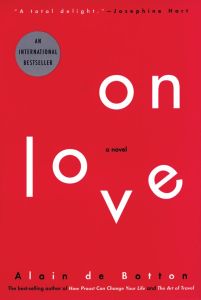
“The philosopher in the bedroom is as ludicrous a figure as the philosopher in the nightclub,” Alain de  Botton offers in On Love,  a novel in memoir form chronicling the course of a love affair over several months.  The memoir is less a story about two people falling in love, and more a prolonged reflection  on what stirs love in the first place, what people look for in the experience, and how such emotionally powerful affairs    can come to an end.  As the course of love proceeds, we witness the pair meet, bond over an airline flight, and hasten into a full relationship that grows for a few months before suddenly peaking and withering.  De Botton’s main character is both intensely thoughtful and introspective, but often  self-defeatingly irrational. Insecurity marks him, from his desperate inflation of subtle clues in his object d’amor’s behavior or mannerisms, to his suspicion that if she likes him,  there must be something wrong with her.    Given that the reader is hardly introduced to the lead before he falls in love, though, it’s hard to say if the insecurity was present before or if the sudden infatuation just “un-bloody-hinged” him, to borrow from Chasing Liberty.    Two observations of de Botton’s stood out for me, though – first,  that we often admire and ‘love’ others for the qualities we see or imagine in them, but that we don’t ourselves possess in sufficient measure  (something true in friendship and romance, I’ve found), and that every relationship (again, true in love and romance) brings out different qualities in the observed parties.  Lewis remarked in his The Four Loves that every friendship has a unique effect on the members involved:   if Tollers, Jack, and Warnie are friends, Tollers brings out aspects of Jack that Warnie would have never otherwise seen, and ditto for qualities within Warnie brought out by Jack that Tollers would have been blind to.  (Names mentioned in this example are purely fictitious and any resemblance to persons living or dead is purely coincidental. I pinky-swear.)   Personally, though the main character  is both pompous and insecure,  and his love affair seemed to be more mutual infatuation than anything substantial, I couldn’t help but enjoy the book.  I’m always magnetized by de Botton’s writing, and recognized in his lead’s foibles my own and other’s frailties.

Some quotations:

Every fall into love involves the triumph of hope over self-knowledge. We fall in love hoping we won’t find in another what we know is in ourselves, all the cowardice, weakness, laziness, dishonesty, compromise, and stupidity. We throw a cordon of love around the chosen one and decide that everything within it will somehow be free of our faults. We locate inside another a perfection that eludes us within ourselves, and through our union with the beloved hope to maintain (against the evidence of all self-knowledge) a precarious faith in our species.

[…] if you asked most people whether they believed in love or not, they’d probably say they didn’t. Yet that’s not necessarily what they truly think. It’s just the way they defend themselves against what they want. They believe in it, but pretend they don’t until they’re allowed to. Most people would throw away all their cynicism if they could. The majority just never get the chance.

Perhaps because the origins of a certain kind of love lie in an impulse to escape ourselves and our weaknesses by an alliance with the beautiful and noble. But if the loved ones love us back, we are forced to return to ourselves, and are hence reminded of the things that had driven us into love in the first place. Perhaps it was not love we wanted after all, perhaps it was simply someone in whom to believe—but how can we continue to believe in the beloved now that they believe in us?

“Is it really her I love,” I thought as I looked again at Chloe reading on the sofa across the room, “or simply an idea that collects itself around her mouth, her eyes, her face?” In using her face as a guide to her soul, was I not perhaps guilty of mistaken metonymy, whereby an attribute of an entity is substituted for the entity itself (the crown for the monarchy, the wheel for the car, the White House for the U.S. government, Chloe’s angelic expression for Chloe . . .)?

Posted in quotations, Religion and Philosophy, Reviews | Tagged , , , | 9 Comments