

What do I know about Benjamin Harrison? Well, he was a core part of the Cleveland Hero Sandwich, the thin bit of meat between two enormous Cleveland halves. And his granddaddy was president for a month before dying and giving John Tyler the chance to go “Look at me. I’m the captain now.”
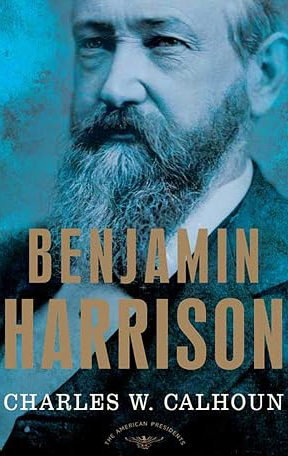
It’s a bad sign that this review is 100% memes, right? I just felt the need to inject some personality, because this book is so Inside Baseball it took me days to read it. Usually I can knock out these American Presidents books in a day, because they’re all 200 pages or fewer. The only other AP book I’ve dragged my heels on was Woodrow Wilson and we all know how I feel about him. I’ve mentioned before that I’ve noticed these AP books have an author whose particular interests add a certain dimension to the text — a surgeon writing about Garfield, a legal historian discussing Taft, a presidential candidate writing about presidential candidates (that’s Lincoln by George McGovern — I may circle back, we’ll see) — but in Calhoun’s case, it’s exhaustive political wonkery. This has come up before; one of my JFK reads spent a ludicrous amount of time following JFK during his 1960 primary season, and I wondered about the author’s priorities. Is it interesting that Richie Rich from Bahston went into West Virginia mining towns? Yes, but is it worthy of that many pages? By the same token, is it interesting that Harrison —

I’m sorry, I bored myself to sleep. Something about precinct maps? The author has done a full BOOK on Harrison’s election, I’m not sure why he decided to rewrite it in miniature. Part of the problem with this book is that I’m binging on Gilded Age politicians, and their resumes are like AI-generated “I Want to Be a Gilded Age President with Fine Facial Hair”. Grow up a farmer, become a lawyer, fight in the Civil War, get into politics, work with James Blaine and watch the poor guy AGAIN fail to be president despite being within grabbing distance. (Blaine is very much the Henry Clay of the Gilded Age: always the bridesmaid (or the priest), never the bride.
One thing that does mark Harrison is his full-throated defense of African-Americans, particularly in the South. A cynical soul might scoff and say “Of course he was courting them, they were the only hope Republicans had of winning in the South!”). This is far too cynical: Harrison appears to have been a sincere antagonist of slavery from the word GO, and a consistent champion of African-American rights. While this was in line with Republican policy at the time, Reconstruction ended in large part because the north was tired of dealing with the South, and his continuing to hold the line was, I think, a mark of integrity. He wasn’t just making speeches, but striving for legislation that would counteract the voter-suppressing measures of the Bourbons, and squelch the horrific enthusiasm for lynching. Some of the measures he advocated for in the ‘Force’ bill later became part of the Voting Rights Act, specifically Federal supervision of elections.
He was also a bit of a harbinger for going forth in search of monsters to destroy — or at least, markets to create, getting the US deeply involved in Samoa. The fever that possessed many in DC in the Gilded Age — that America had ARRIVED, and must needs make itself a world power with all the coaling stations The Influence of Sea Power Upon History might suggest.Was the Constitution made for such a Colossus? Could the “Empire of Liberty” remain a friend of Liberty after grasping the fasces of Empire? Do I like rhetorical questions? (Answers: no, no, and ‘mildly but only in moderation’.) Another ‘sign of the times’ was his interest in reigning in corporate power, supporting the Sherman Anti-Trust act, and if you’re really into monetary policy he also had opinions on the silver-and-gold argument. (I’m a libertarian with strong opinions about the Federal Reserve, and even I only have a faint appreciation of the silver vs gold argument. Basically the gist is that the gold-only standard was better for monetary integrity, buuuuuuuuuuuuut working silver into the currency was easier on the poor folk.)
Putting Finkelman’s treatment of Millard Fillmore aside (into the trash), this may be the most underwhelming biography I’ve read as part of this project. Part of that surely owes to repetition, but there’s such a tight focus on the political machinery that I don’t see the man, and that’s a strong part of why I’m doing this series. Yes, I’m absorbing a lot of American history via it– Whigs and Know-Nothings and Stalwarts, oh my! — but the most interesting biographies I’ve read have let me get an insight into the man. Pierce, seeking out his old friend Jefferson Davis in prison; Cleveland, embracing a woman who was scorned for having a child out of wedlock; Arthur, rising from infamy to become a real stalwart man, not merely a Stalwart Republican. I don’t really GET that from this book, though I do get inklings. Benjamin Harrison is there, but you have to storm into the Cabinet room, throw all the papers onto the floor, and make him present. I can see giving Benjy here a second chance once I finish the first run. (And yes, I know I read three books on Lincoln before moving on, but is Benjamin Harrison Lincoln? No. He’s a good egg, but Lincoln is one of the pivotal figures of America’s story.)
Next up….keepin’ cool with Coolidge! The taciturn Vermonter has just been made president so I probably won’t finish him before tomorrow, but 4/5 ain’t bad.
Quotations
Harrison convinced himself that a prolonged engagement would accelerate her decline. With a typically nineteenth-century mixture of romance and morbidity, he asked, “Shall I marry Carrie now and thus relieve her of those harassing doubts and fears which wear away her life, or shall I agree to stand aside and let her hasten to an early grave?”
Harrison gave an eloquent appeal for such action in his annual message. Blacks, he observed, “have their representatives in the national cemeteries, where a grateful Government has gathered the ashes of those who died in its defense.” In civil life, African Americans were “now the toilers of their communities, making their full contribution to the widening streams of prosperity which these communities are receiving.” And yet, “by various devices,” those same communities barred blacks from exercising their political rights.


