
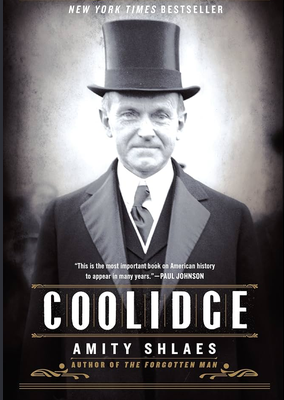
Calvin Coolidge has long been one of my favorite presidents; I think as a child I was drawn to his nickname of Silent Cal, with its reputation for taciturnity; later on, I respected his approach to government — keep the government working efficiently on the few problems within its Constitutional aegis, and let the people otherwise tend to their own lives. Amity Shlaes’ Coolidge is similarly admiring, opening with an “Under Coolidge,” passage that underscores how the economy grew as the government continued to be scaled back, with annual surpluses being applied against the debt of World War 1. Part of the excitement of the Coolidge age owed somewhat to technological progress — the growth of telephones, electricity, and radio — but Coolidge’s policies and interests were part and parcel. While I thought I knew the general gist of Coolidge’s life, there were quite a few surprises in here — and now that I see Shlaes has written other books I’ve already been interested in, I suspect she’s going to appear here again.
Coolidge’s life begins the way a lot of presidential biographies around this time did, the blue-blooded Roosevelts excepting: farmer, law school, public life. Coolidge cut a fairly thorough streak across the range of public offices: city councilman, state legislator, mayor, etc. While Mayor Coolidge had already demonstrated his preference to keep budgets trim and the government clean, it wasn’t until he was Governor that Coolidge achieved a name for himself. Following an attempt of the Boston police to unionize, most of Boston’s cops left their patrols completely, walking off the job. Hooliganism soared in the Hub City, as businesses began being broken into and set fire to seemingly for sheer amusement. Coolidge allowed local authorities the chance to take action first, but eventually — as the threat of solidarity strikes reared its head and people began dying — he would act decisively, arranging for militia troops to restore order in the city and issuing the dictum — “There is no right to strike against the public safety by anybody, anywhere, anytime.” Ultimately all of the striking cops would be fired and replaced — by officers now receiving higher wages. The strike had been broken, but managed to achieve one of its aims — if not for the actual participants. As governor, he maintained his focus on keeping the government on a firm financial basis.
One thing that struck me as interesting about Coolidge was how seriously he took business and economy. He was fascinated by trade and its power, and — as he was elected vice president and then became president — he considered seriously the arguments for free trade. The Republican party at that time was extremely pro-tariff, maintaining that they protected American enterprise and generated healthy income for the State. They did indeed do that, as my last President read (on Benjamin Harrison), indicated: one attack on him was that the government was making too much money from tariffs. However much he was tempted, though, Coolidge ultimately chose to keep using the horse that worked. He was also obsessed with proper budgeting: he paid an enormous amount of attention to the government’s budget and to tax structures and incentives, and was aware of how many politicians thought the laws of economics stopped working if there was an emergency. Even Coolidge’s interest in aviation was dressed up in budget economy: he mused that using airplanes might allow for cost-savings in the navy. (I’m assuming the line of thinking is that if scout planes can survey a wide range of territory, fewer ships are needed to patrol and existing ships can be deployed to where they’re needed — just speculation, though.) Coolidge’s interest in new technologies also applied to the radio, which he made ready use of — to the surprise of modern readers who expect “Silent Cal” to recoil from microphones in horror. The only time he distanced himself from a microphone was at a wedding that was being recorded; presumably he had no interest in his table chatter being saved for the ages.
Midway through his time in office, Coolidge experienced a dreadful loss when his youngest son Calvin Jr died of a blood infection. While I’ve read in other accounts that this destroyed Coolidge’s interest and energy: Shlaes doesn’t give that impression, as the saddened president simply goes back to work fighting Congress over finances. Worst was to come, at least for the nation, as great floods broke out along the Mississippi and the government was hounded for relief. Although Coolidge did dispatch Herbert Hoover to assess the situation, he firmly believed that disaster relief was the province of the State governments, not the national one, and to date most presidents had supported that measure. The scale of this was different, though, as thousands in multiple states were displaced and hard-pressed. Hoover did an impressive job moving some government resources to where they could help, and in organizing private-sector charitable contributions — work that would lay the stage for his own run. (The amount of immediate Federal relief — through military operations and supplies — totaled about $7 million.) When his own Vermont was similarly hit by floods, Coolidge had to take the same policy: he couldn’t do for the goose what he wouldn’t do for the gander. This was consistent and showed integrity, but people in need tend to care less about precedent and principle and more about not dying. He would ultimately endorse federal response at the infrastructure level, just not the “Throw money to say you’re doing something” level. Coolidge chose not to run in 1928, perhaps because between his son dying and the pressures of office — he’d witnessed two men destroyed by it, Wilson and Harding — the Federal City held no more joy for him. Shlaes comments that he also deeply mistrusted the Wall Street boom and suspected a crash was on the way — I may have to read 1929 to see if it remarks on that aspect. He died shortly before the Roosevelt administration took charge, living a quiet life broken only by his frequent shock at Hoover’s deficits.
I don’t want to give the impression that this book is 600 pages of Calvin Coolidge, Frugalimus Rex. The human Calvin frequently shows up — bringing his ailing son Calvin Jr a rabbit to admire from his sickbed, the man patently delighted by airplanes even as he pretends he’s only interested in their efficiency prospects, his patented brand of dry humor — but fiduciary responsibility was a major priority for him, from his days as a mayor on. (Interesting, that — Coolidge has to join Grover Cleveland on the list of POTUSes who have served as mayor and governor, a kind of executive cursus honorum!) At any rate, I greatly enjoyed this and am playing with the idea of reading a Hoover biography, then 1929 or Shlaes’ history of the Depression, THEN reading a proper FDR biography because No Ordinary Time doesn’t quite do it for me.
Yes, dear reader, this year will remain solidly in the hands of History for the moment. But be of good cheer! We all know easily I find other windmills to go a-tilting at.
Quotations
“The great majority of Americans,” continued Barton, “are neither radicals nor reactionaries. They are middle-of-the-road folks who own their own homes and work hard and would like to have the government get back to its old habits of meddling with their lives as little as possible. […] “It sometimes seems as if this great silent majority had no spokesman. But Coolidge belongs with that crowd, he lives like them, he works like them, and understands.”
Nixon: ‘Great silent majority’? Kind of…rolls off the tongue. Yes, I like that.“Isn’t it a strange thing,” he asked Barton, “that in every period of social unrest men have the notion that they can pass a law and suspend the operations of economic law?”
“I do not think that human existence is quite so much on the basis of dollars and cents as he puts it. . . . He nowhere enunciates the principle of service.”
In this strange interregnum period, Coolidge found comfort, and even humor, in humility. One early morning in the Willard bedroom, a sound woke Coolidge. A strange young man had broken in and was going through his clothing. In the morning light, Coolidge could see that the burglar had taken a wallet, a chain, and a charm. “I wish you wouldn’t take that,” Coolidge said. “I don’t mean the watch and chain, only the charm. Read what is engraved on the back of it.” The burglar read the back: “Presented to Calvin Coolidge . . . by the Massachusetts General Court”—and stopped dead in shock. He was robbing the president. It emerged that the burglar was a hotel guest who had found himself short of cash to return home. Coolidge gave the burglar $32, what he called a “loan,” and helped him to navigate around the Secret Service as he departed.
One day, as they walked together down the street, Coolidge held his silence, then finally said to Starling, “Well, they’re going to elect that superman Hoover, and he’s going to have some trouble. He’s going to have to spend money.” He went on, “But he won’t spend enough. Then the Democrats will come in and they’ll spend money like water. But they don’t know anything about money.” They would want Coolidge to come back again, but he wouldn’t be available.


Interesting… I know nothing about him, except that he was president when my father was born, and my grandparents liked him SO much that my father’s middle name is Calvin! Yeah, true story. The thing is, this always bothered my father because he always associated the name with the Calvinists, and being Jewish, it was embarrassing. In fact, if we hadn’t accidentally stumbled upon my father’s military draft card (he was 4F because his eyesight was so bad, he was legally blind), we would never have known.
Oh, that’s not an accident. He was named John Calvin, and his sons were John and Calvin Jr. I think his father was a John Calvin variant!