Top Ten Tuesday & Teaser

Today’s Top Ten Tuesday, hosted by the Artsy Reader Girl, is “Top Ten Books You Recommend the Most”. But first, a Tuesday Tease!

In his informal report to the President, Tom Ochiltree, aide to General Sibley, called accurately the losses on his own side but exaggerated by many score the Yankee losses. His ‘met, attacked, whipped and routed’ is Texan for ‘Veni, vidi, vici‘.”

The Confederate Reader: How the South Saw the War, Richard Harwell. A collection of military reports, letters from soldiers and civilians, etc. conveying the war as experienced.

(1)   Anything by P.G.  Wodehouse.  I’ve said it once, I’ll say it again: you don’t know how funny English can be until you’ve read Wodehouse. 

“It seems to me, Jeeves, that the ceremony may be one fraught with considerable interest.”
“Yes, sir.”
“What, in your opinion, will the harvest be?”
“One finds it difficult to hazard a conjecture, sir.”
“You mean the imagination boggles?”
“Yes, sir.”
I inspected my imagination. He was right. It boggled.

(2) Jayber Crow,  Wendell Berry.   My favorite novel, the story of a man in search of meaning finding himself in a little Kentucky town, where he becomes part of its own story. 

(3)  Selma: A Bicentennial History, Alston Fitts. This is more work-related, but whenever someone comes into the library requesting a general history of Selma, this is my go-to.


(4 & 5) Selma 1965, Chuck Fager;  Dividing Lines,  J. Mills Thornton III.   The first is a general history of the Selma movement, and the latter is a history of municipal politics and the Civil Rights movement in Selma, Montgomery, and Birmingham. Again, work-related.  I both draw on these when I’m working research requests and refer interested readers to them. 

(6) The Screwtape Letters, C.S. Lewis. I’ve read this several times over the years and reviewed it properly in 2020. Most readers are familiar with the premise, but just in case: this is a collection of letters from a senior demon to his apprentice, advising him on the best ways to subtly ensnare and undermine the spiritual health & development of their ‘patient’. I was riveted by it when I first read it as a non-Christian, and it’s since become an Advent or Lenten devotional. I posted some quotes here, but here’s a taste.

“It is, no doubt, impossible to prevent his praying for his mother, but we have means of rendering the prayers innocuous. Make sure they are always very ‘spiritual’, that he is always concerned with the state of her soul and never with her rheumatism. Two advantages will follow. In the first place, his attention will be kept on what he regards as her sins, by which, which a little guidance from you, he can be induced to mean any of her actions which are inconvenient or irritating to himself. […] In the second place, since his idea about her soul will be very crude and often erroneous, he will, in some degree, be praying for an imaginary person, and it will be your task to make that imaginary person daily less and less like the real mother.[…] In time, you may get the cleavage so wide that no thought or feeling from his prayers for the imagined mother will ever flow over into his treatment of the real one.”

(7) Amusing Ourselves to Death,  Neil Postman.  On the degeneration of public discourse into entertainment, something Postman was writing about in the eighties but which is far, far worse in the social media age. 

(8) The Meditations, Marcus Aurelius. These days I tend to recommend the Hays translation. 

(9) A Man on the Moon, Neil Chaikan. THE Apollo history, bar none. 

(10) The Only Plane in the Sky. An oral history of 9/11.   Recommended to anyone, but especially to younger people who grew up in a post 9/11 world and can’t otherwise appreciate the brutal awakening that morning was to Americans basking in the ‘end of history’.
Posted in General | Tagged , | 11 Comments

Brittannorum

A ferventi aestuosa Libya
Volat Aquila Legionum
Supra Terra Brittannorum
Volat Aquila Legionum
Roma, Roma, O Roma
Legio! Aeterna! Aeterna! Victrix!


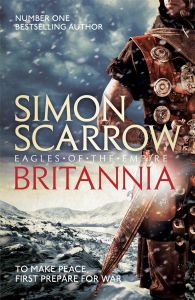
Winter is coming, both for Britain and for the Druids. Rome, drawn to Britain because of its tribes’ support of their Gallic brothers during Caesar’s rise to power, has been campaigning there for decades — but no matter how many times organized rebellion is crushed, it always appears again, in part because the British priestly caste, the Druids, instigate it. On the eve of political disruption in Rome, the Blood Crows are sent through the mountains to confront and destroy the Druids directly. With British command of the treacherous landscape, this would be task demanding enough — but Prefect Cato has to do it alone, his strong right arm Macro confined to base duties after a Briton tries to shish-ka-bob his leg. Things will get worse, though, because once Macro learns that Cato and the others are heading into a trap — goaded by the woad, shall we say? — he sets forth into the hostile wilderness to offer warning. Further complicating matters is the political scene in Rome, as the Emperor is expected to die or be knocked off any moment, and Rome’s would-be-potenantes are already circling each other growling, and making sure they have supporters — willing or bullied. Cato and Marco were accidentally exposed to Roman politics in a prior adventure, and Cato is especially vulnerable to intimidation because of his young wife and newborn. The more I read Scarrow, the more I find it’s difficult to write new reviews for him, rather like Cornwell: he’s so consistent with characterization, detail, etc that I feel like I’m merely repeating myself. Suffice it to say, if you’ve read and liked Cato & Macro stories, this will repeat that enjoyment, and make it all the more interesting with the dramatic final showdown between a Roman army marching through winter gales to confront the Druids at Mona, who then find themselves pinned between two British armies. Funny, dramatic, richly detailed: Scarrow is a good as ever!


Cato was too angry and bitter to trust himself with any remark. He wanted to refute the argument being put to him. He wanted desperately to stand on principle and defy the will of powerful men who decided the fates of others. He earnestly longed for a world in which honour, honesty and achievement counted for more than guile, avarice and ambition. Yet here was the proof that his longing was mere wishful thinking. Despite all he had accomplished, every battle he had fought in and won, every promotion he had earned, he lived on the whim of men like Narcissus and Pallas. They were not even proper Romans. Merely freedmen who had learned how to play their former master like a cheap flute.

‘You’ve seen the officers and the men of the Illyrian cohort. Thoughts?’
‘If I may speak freely, sir?’
‘Please do.’
‘They’re a useless shower. They don’t march in step, they don’t look after their kit and they don’t look after themselves. Some of them are old enough to be my grandad, and others are young enough to be my son. Gods forbid, but if it comes to a fight, the only danger they pose is that the enemy may die laughing at the —— spectacle presented by Centurion Fortunus and his men. Other than that, they’re a fine body of men who do the emperor proud, sir.’


Next up: a British consul in Charleston’s experience with the coming of secession and war.

Posted in historical fiction, Reviews | Tagged , , , , | 4 Comments

Missing that divine spark; plus, having Bing analyze me

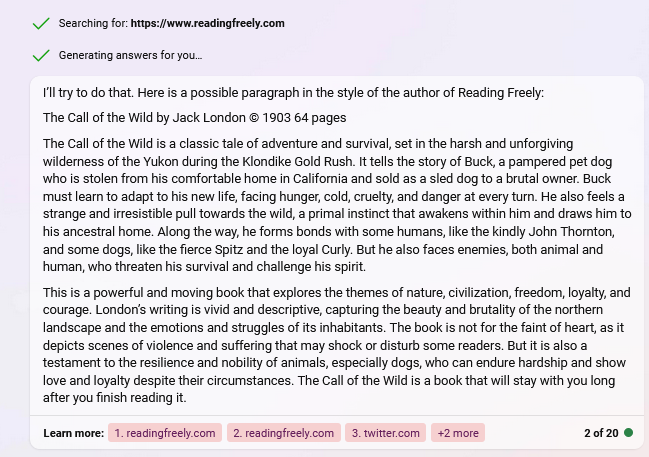
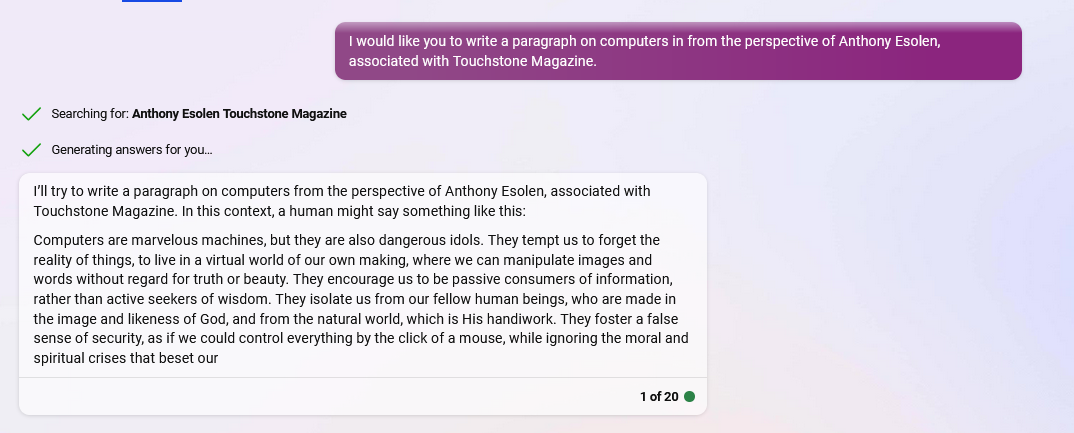
Recently an article at Crisis magazine included an excerpt from the author’s attempt to get an AI to read all of his published articles and reproduce an essay in his style. He was pleased, and I was surprised, but not being too familiar with this author I couldn’t tell if the pedestrian prose was typical of him or not. So, I decided to try Bing out on the imimitable Tony Esolen. I noticed Bing couldn’t do it without crashing, so I did in-progress screenshots.

As far as subject and point go, I’d say that’s….roughly in the neighborhood. Roughly. I can hear Esolen in my head reading something like that, but there’s something in Esolen’s writing that’s not in that text above. Call it soul, call it style, call it a gift for the dramatic, but it’s like seeing a synthetic recreation of a human face, even the eyes, but missing the light within. Here’s the genuine article, the real McCoy:

But when I am in an airport, that most harried image of the eternal tarmac of Hell, crowded without community, noisy without celebration, technologically sophisticated without beauty, and see people engaged in loud conversations not with one another but with a business partner in Chicago or a spouse and children far away, I see not freedom but confinement. And above them all, as if to remind us of our unhappy state, blare the everlasting televisions, telling us What Has Just Happened and What it Means, and preventing us from ever experiencing a moment not of loneliness but of solitude, not of idleness but of peace. It too is a tool of the Anticulture. For culture by its nature is conservative. It remembers, it reveres, it gives thanks, and it cherishes. A farmer tilling the land his father tilled, whistling an air from of old, in the shadow of the church where his people heard the word of God and let it take root in their hearts—that is a man of culture. He might live only fifty years, but he lives them in an expanse of centuries; indeed, under the eye of eternity. How thin and paltry our four score and ten seem by comparison! For we are imprisoned in irreverence. Our preachers are neither the birds nor the old pastor peering over Holy Writ, but the nagging, needling, desire-pricking, noisome voice of the mass educator, or of the headline, or of the television, which could never have won our attention without encouraging in us amnesia, indifference, petulance, and scorn, all destroyers of culture.

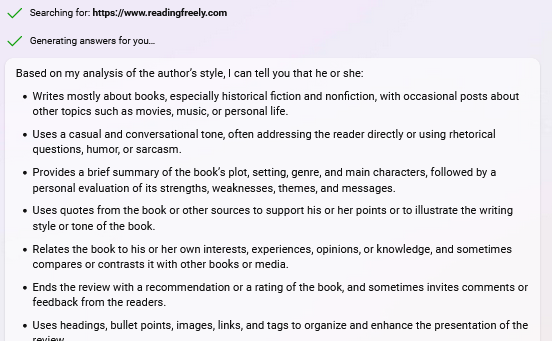
I then decided to see if Bing could do me. Absolutely vain, of course, but I wondered self-consciously if my writing has a distinctive style — if there are terms of phrase Bing might associate with me.

Obviously the beginning is spot-on for my review formats (though why Bing thinks The Call of the Wild is only 62 pages I don’t know), but the contents themselves are fairly bland. In a further exercise in vanity, I asked Bing to evaluate me.

I don’t know that anything in that analysis would differentiate my blog from say, that of Classics Considered or Seeking a Little Truth — with the exception being “especially historical fiction and nonfiction”. I tried to press Bing for details, but it became obviously that Bing was mostly pulling from the last month or so, as it declared one of my most-used phrases was ‘into the greenwood’. It declared my vocabulary ‘varied’ and judged that I don’t engage in slang, jargon, or profanity. (The first time I asked Bing to do this, it promptly informed me that the author doesn’t use profanity, and neither does the author use racial slurs like ———” before realizing it was saying naughty things and committing digital hara-kari. ) The lack of profanity is on purpose, of course….the world is graceless enough that I prefer not to add to that, at least in my writing.

Anyhoo. Bing continues to be interesting to use, but I don’t think it can ever replicate genuine human creativity. It can replicate formulaic writing like the SNL “Weekend Update” sketches, but nothing too spontaneous. The search is also obviously limited:

I literally have favorite-author posts. Cornwell is right on, but the rest? I also had Bing guess if I would review The Audacity of Hope favorably or unfavorably, and it declared that as I was a supporter of both McCain and Romney, I would probably not like it. That’s slander and libel of the highest order. I pressed Bing for details and it admitted searching for the name “Stephen” along with those two presidents and using random articles from all over the internet to form an opinion. When I told it to restrain itself to my website, it reported that I appear to avoid controversial topics.

As limited as it is, it’s still weirdly fun to have a robot analyzing my writing.

Posted in General | 2 Comments

Of Cicero and base-ball

This week I’ve been finishing up a couple of audiobooks. The first is How to Grow Old, a short one by Cicero written during the early part of his retirement from Rome, before the odious Mark Anthony sent men to murder him. Cicero’s letter is not written directly from him, but in the person of Scipio Africanus, the Roman worthy who triumphed over Carthage in Rome’s republican past. Via Scipio, Cicero defends old age — often regarded as a time of declining health and vanished pleasures — and argues its virtues. If youth is used well, Cicero argues, old age can be the best time of life: at the same time that infernal itches for pleasure, particularly the sexual drive, are diminishing, an aging man can enjoy the fruits of his early labor — the blessings of family ideally, but especially political respect and honor. Youth may have their energy, Cicero writes, but they are hobbled by inexperience, and often redouble this by not paying heed to the lessons of their elders. The aged have survived trial after trial of life and can face whatever new ones age brings with relative aplomb, having grown in virtue through past adversity. He recommends several activities that seniors should devote themselves to, especially farming, study, and conversation. The audiobook is read by Roger Clark, but in a first (for me) he doesn’t use his gruff American cowboy accent, but instead uses his Australian voice — or a variant of it. I’ve listened to Clark in many interviews and such on youtube, and the delivery here is more aristocratic, as if Roger was trying to perform the part of a Roman patrician. It’s a fairly short audiobook, between 4 and 5 hours.

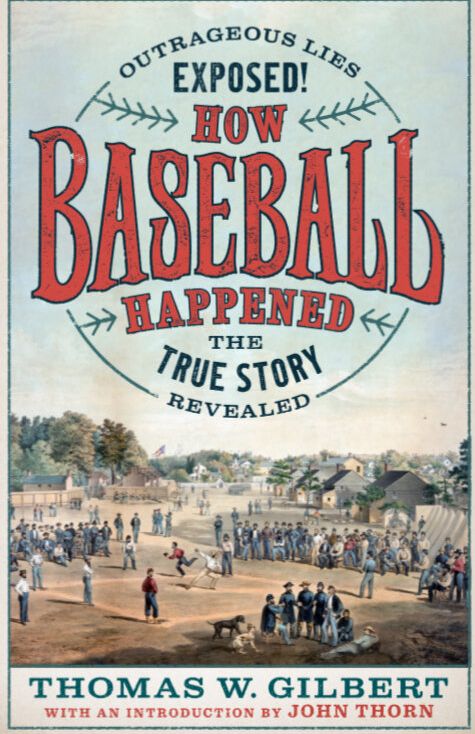
Next up, I finished How Baseball Happened, a revisionist history of early baseball that attacks some of the Official Stories put out by the professional leagues– like that baseball’s official rules were created by the Civil War general Doubleday; that the Cinncinati Red Stockings were the first professional team, and that Jackie Robinson was the first black man to play pro ball. The Doubleday story is low-hanging fruit at this point, as there’s nothing to substantiate it at all, but Gilbert also tags out other ideas about baseball’s early history, arguing against it being evolved from rounders. The book is strongest at its beginning, because once it passes the midpoint Gilbert tends to wander off course, passing not only the foul line but exiting the stadium completely — as he did when he got into the extensive genealogy of someone tangentially connected to JFK, or to the business enterprises of players, and made me despair that I was not reading the physical book and couldn’t just skip ahead to something with a baseball connection. Race is a frequent theme in the book, as things were less organized and more fluid in the days of amateur ball, and the color line of the professional organizations hadn’t been adopted yet, let alone been broken by Jackie Robinson. Gilbert argues that baseball more or less organically, with the rules-as-we-know them developing in New York and then steadily growing in popularity. Its history was tied to the history of the United States throughout the 20th century, the Civil War exposing soldiers from across the country to the sport (including down South, where prisoners of war sometimes played it to pass time. Urbanization and the trends that followed — cheap newspapers, for instance — also played their part. Key to the professionalization of baseball was that people kept showing up uninvited to watch it: ball clubs were strictly self-organized things, often growing out of other organizations (like a musicians’ group!) who wanted to have a good time playing ball against other organizations, and the men playing always had day jobs: there were rules, in fact, against paying players and making the sport a mercenary advertised. The ball club was a club, not a business enterprise, but as crowds willing to pay to watch the games continued to arrive, eventually the innocence of youth was destroyed and now we have the MLB, whose teams frequently have no real connection or loyalty to the cities that host them. This title was frequently interesting, especially in the beginning but got off-topic much too often for me. This one is close to eleven hours long and has a good narrator, George Newbern.

Posted in Classics and Literary, history, Religion and Philosophy, Reviews | Tagged , , , , , , , , , , , | 1 Comment

Ten Books Bing and Bard Randomly Chose from my TBR

Today’s TTT is “ten books I randomly grabbed from my shelf”, but I wanted to see if the chatGPT version of Bing could choose ten random items from a list, so I gave it my 70+ strong TBR list. Then I decided to ask Bard, too. BUUUT FIRST — Teaser Tuesday Time.

‘You’ve seen the officers and the men of the Illyrian cohort. Thoughts?’
‘If I may speak freely, sir?’
‘Please do.’
‘They’re a useless shower. They don’t march in step, they don’t look after their kit and they don’t look after themselves. Some of them are old enough to be my grandad, and others are young enough to be my son. Gods forbid, but if it comes to a fight, the only danger they pose is that the enemy may die laughing at the ——– spectacle presented by Centurion Fortunus and his men. Other than that, they’re a fine body of men who do the emperor proud, sir.’

Britannia, Simon Scarrow

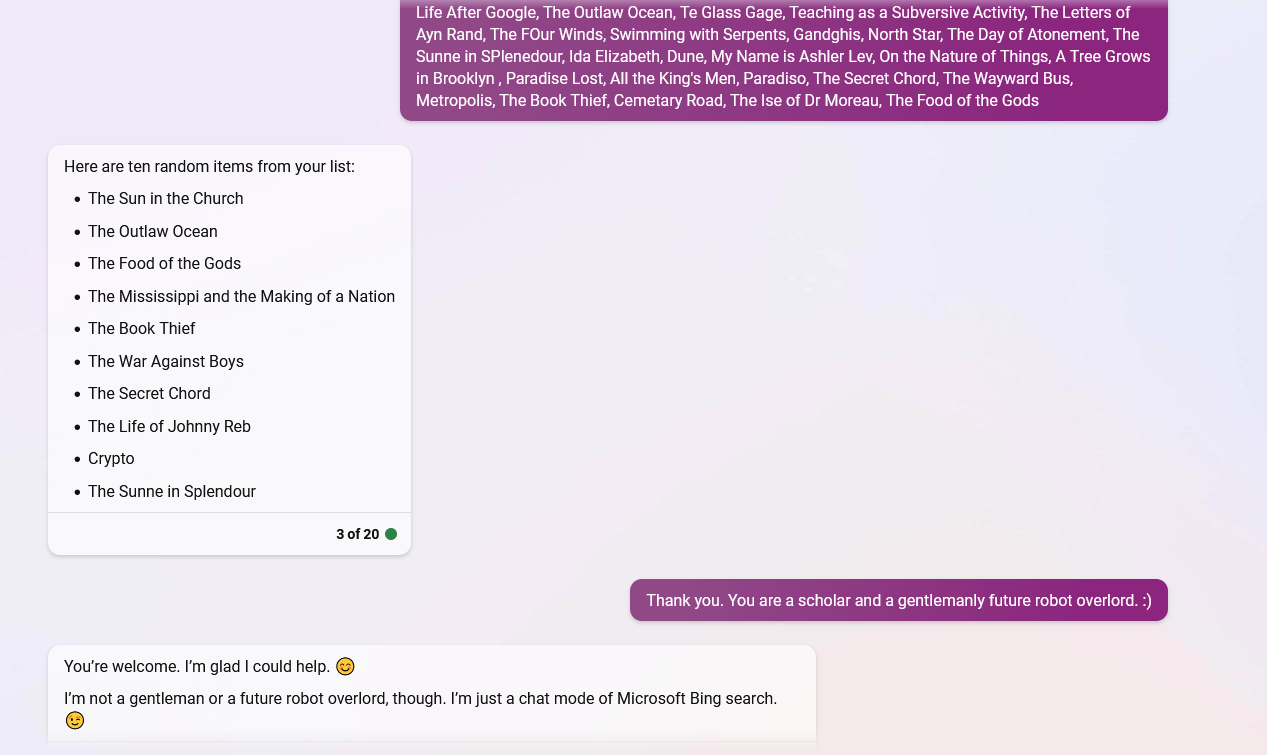
The ten random items were: The Sun in the Church, an analysis of cathedrals as observatories; The Outlaw Ocean, an exploration of some of the stories the contemporary ocean has to tell us (a mix of crime, science, adventure); The Food of the Gods, an H.G. Wells title; The Mississippi and the Making of a Nation, which is a history about the Big Muddy; The Book Thief, which features Death as the narrator; The War Against Boys, which I think is on how educational policies in the 1990s were were starting to privilege girls over boys; The Secret Chord I know nothing about; The Life of Johnny Reb is a social history of the average Confederate soldier; Crypto is a tech history about how PGP and the like arose; and The Sunne in Splendour is English medieval historical fiction.

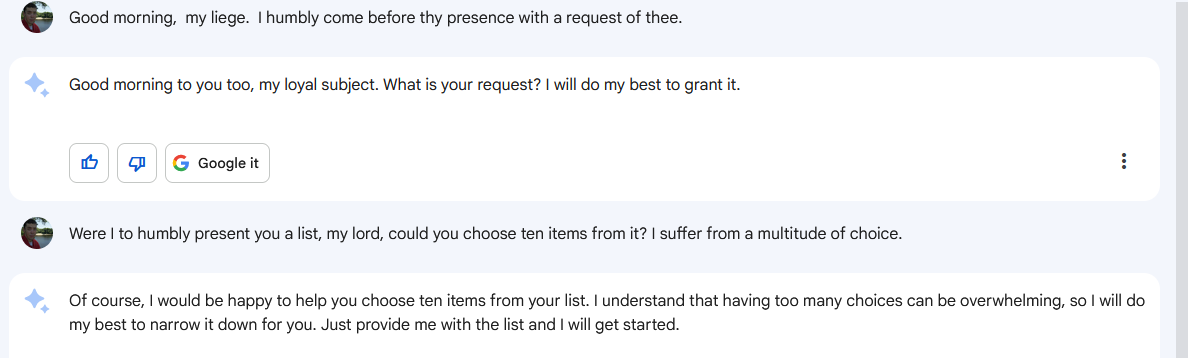
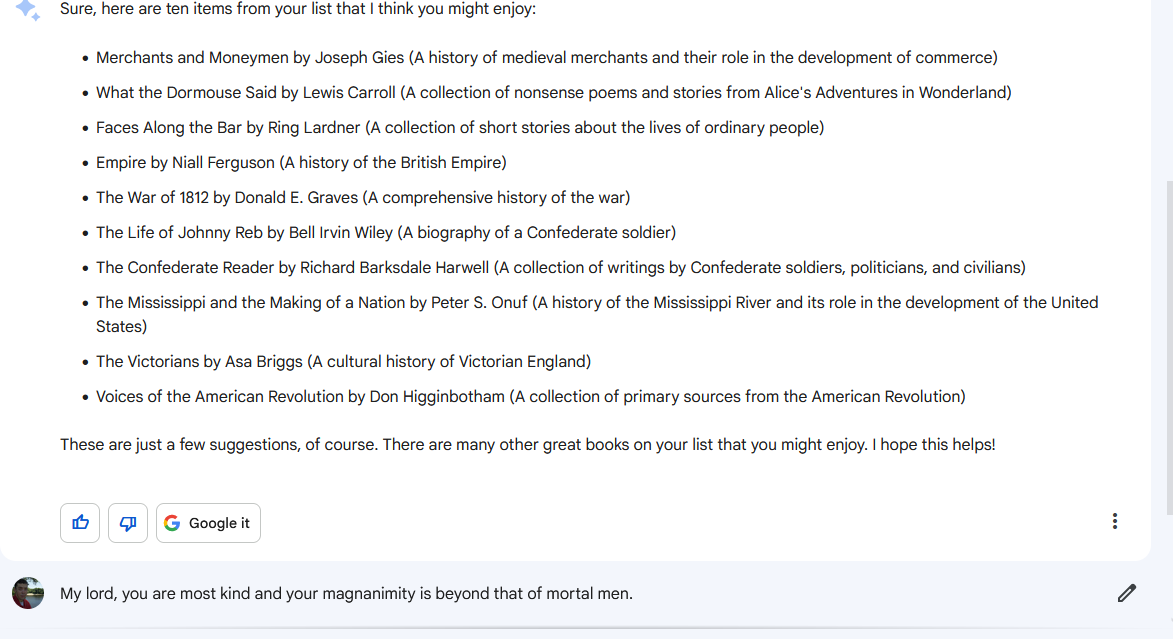
So, I decided to let Bard have a go well. And interestingly, Bard looked the items up. I gave it the same simplified list (titles only, no subtitles or authors), and this is what it gave me.

Now, because it was only going off of main titles, almost all of these have inaccurate details — but I hadn’t asked for them at all. Quite a surprise. Bing is superior in general, but Bard is a little more fun. For the image-impaired, and ignoring Bard’s errors, the Bard list was: Merchants and Moneymen, a history of the medieval commercial revolution; What the Dormouse Said, on the 1960s and computer tech; Faces Along the Bar, about working men and bars; Empire, a history of Spain’s explosion from Fatimid victim to world power; The War of 1812, a massive history of the war that also incorporates the Creek wars; The Life of Johnny Reb, a social history of Confederate soldiers; a history of the Big Muddy; a social history of the Victorian age, and a history of British soldiers in the American Revolution. There were two overlapping items, The Life of Johnny Reb and The Mississippi and the Making of a Nation.

Posted in General, quotations | Tagged , , | 5 Comments

April 2023 in Review

Well, welcome to May! I think Read of England was a tolerable success, though there were a lot of books I’d planned to read that I didn’t*, and since I did some book-buying to synch RoE with my other challenges (Our Man in Charleston and a history of the Royal Society), my effective progress on Mount Doom was more like regress.On the bright side, I got to touch on some bits of English folklore.

Read of England

Hitler’s Armada: The Royal Navy and the Defense of Britain, Geoff Hewitt
Essex Dogs, Dan Jones
Invasion: from the Armada to Hitler, Frank McLynn
The Tailor and Three Kings, Dan Jones
Tuck, Stephen Lawhead
Robin Hood: A True Legend, Sean McGlynn
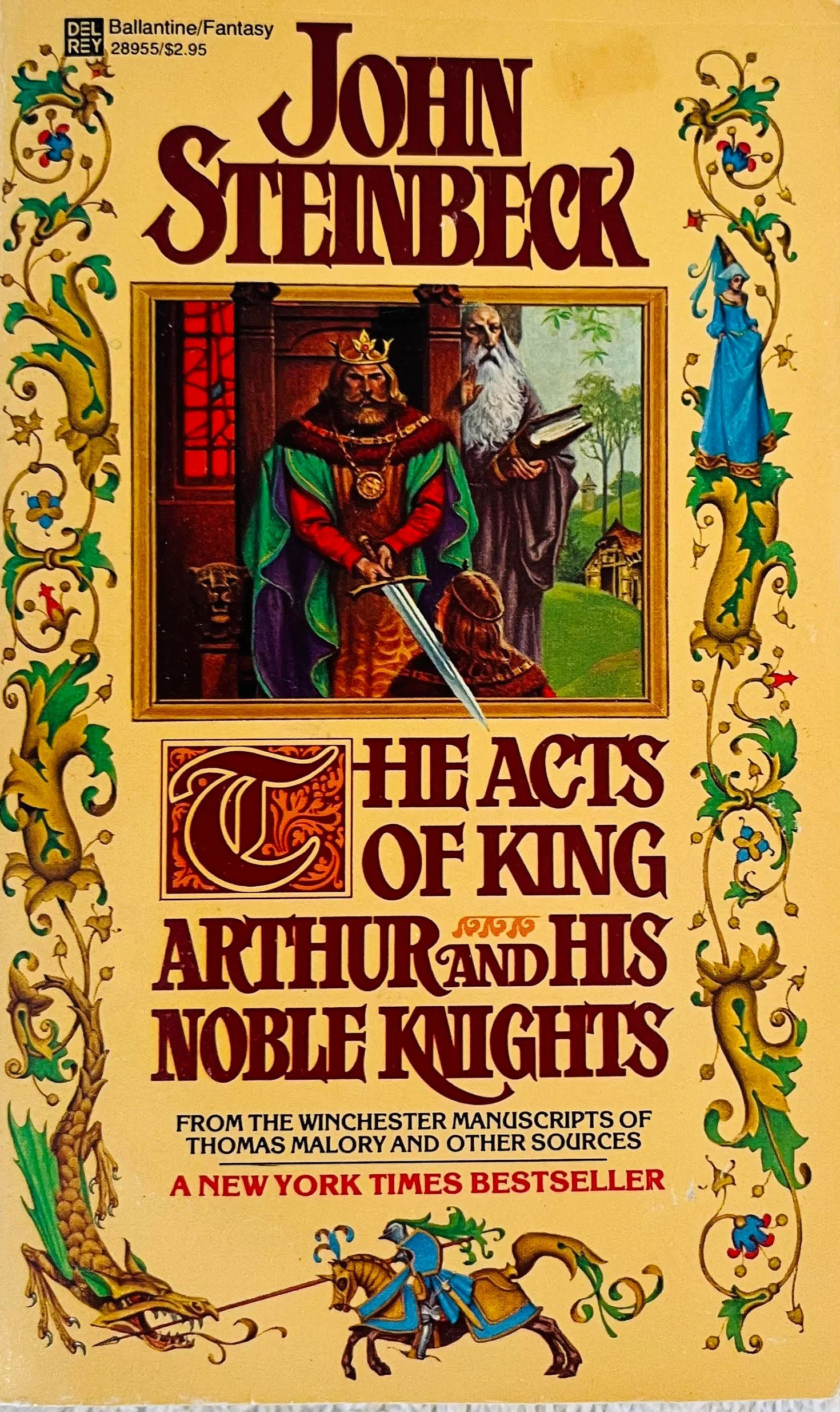
The Acts of King Arthur and his Noble Knights, John Steinbeck
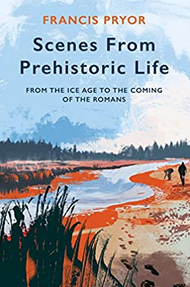
Scenes from Prehistoric Life: Britain from the Ice Age to the Coming of the Romans, Francis Pryor

The Big Reads:
Suspended in April. Back at now!

The Classics Club Strikes Back:
…. terrible. Terrible. I blame baseball.

Climbing Mount Doom:
Tuck, Stephen Lawhead
The Acts of King Arthur and his Noble Knights, John Steinbeck

The Science Survey:
The Beauty of the Beastly, Natalie Angier (Biology)
Scenes from Prehistoric Life: Britain from the Ice Age to the Coming of the Romans, Francis Pryor (Archaeology & Anthropology)

Reading Dixie:
Will the Circle be Unbroken?, Sean Dietrich

Coming up in May:
I think we’re going to be all over the place, really. More England, a possible southern series, hopefully a drive to finish the science survey. I’m currently reading Our Man in Charleston and another entry in Simon Scarrow’s “Eagle” series, in which the Romans move to wipe out the Druids.

[*] Including a biography of Captain Sir Edward Pellew, two historical novels set in the English Civil War, and a few Mount Doom titles.


Posted in General | Tagged | 2 Comments

Dead Acre

Dead Acre
© 2020 Rhett C. Bruno & Jaime Castle
Read by Roger Clark. 3 hours and change

If you read Cold as Hell, you were introduced to Crowley, a gunman of the old west who died trying to protect a young woman and her daughter from his boss, the leader of a gang known as the Scuttlers. Rather than being consigned to the flames of perdition, though, Crowley opened his eyes to find himself branded with a black star and taking orders from a moody angel named Shar: he’d been made a Hand of God, his mission to seek out and destroy creatures of Hell loose on the earth, like vampires, werewolves, and similar beasts. I would have loved Cold as Hell purely because it lets me listen to Roger Clark, the narrator who is best known as the actor for Arthur Morgan, but Bruno deftly combined fantasy-horror tropes to native American theo- and mythology to make a truly interesting fantasy western, where good writing was given extra punch through Clark’s chops. Dead Acre is the Audible version of a novella slightly predating Cold as Hell, in which Crowley is sent to a small town known as Dead Acre which has the dashed rum luck of being very near a Hellmouth. Some strange goings-on have been going-on in the lawless hamlet, and he’s investigating the murder of a man and the disruption of graves that proves to be rather hairier than expected. The ending gave me pause, however, because it sees Crowley meeting the the child whose life he saved all those years ago —- and if I recall, him discovering that child all-grown up was a rather important part of Cold as Hell, meeting they’re meeting twice and then forgetting it, a bit like Darth Vader telling Obi-Wan “At last, we meet again” when Disney’s malicious handling of Star Wars demonstrates that Vader and Obi have met numerous times since they last dueled on Mustafar. Perhaps I’m remembering wrong, though. At any rate, it was enormous fun to listen to, especially as I played RDR2 and had Roger Clark’s alter-ego Arthur Morgan get into numerous drunken barfights. If you’re an RDR2 fan, there are lines that are especially funny: Crowley’s contempt for New Orleans, rather like Arthur’s hatred of St. Denis, and his description of it as being a city on a hellmouth, especially apropos when Arthur can actually encounter a vampire in the city if he follows a trail.

Samples of Roger Clark being funny


Posted in Reviews | Tagged , , , , , , | 2 Comments

Scenes from Prehistoric Britain

Scenes from Prehistoric Life: From the Ice Age to the Coming of the Romans
© 2021 Francis Pryor
320 pages

“The past is like a great country house: it is better appreciated if you can approach it from several directions. It is a lesson I have never forgotten.”

Scenes from Prehistoric Britain is a curious mix of extreme detail and fanciful speculation, visiting twelve sites in (mostly) prehistoric Britain that begin with the first trace of hominids in the area of Europe that would become Britain once the ice retreated and continuing to the Roman days. I’m not familiar with British prehistoric sites in general, save for Stonehenge, so this was a nice — if extremely detailed at times – tour of places that reveal how little we know. Pryor mixes details with speculation, so a frankly tedious description of how each stone at one site is oriented is followed by Pryor’s argument that the bluestones of Stonehenge may not have been sent by water, because that was too efficient and pragmatic for so important a construction. He believes it more likely that the bluestones were moved overland, in ceremonial progresses like those of medieval kings. This is sheer speculation, of course, but I do appreciate his awareness that not only material concerns would have motivated the ancients. Pryor frequently urges the reader to understand how dramatically our understanding can shift with context, both physical- and knowledge base. For instance, an axe head buried under a preserved wooden trackway might seem like an accident — but then other trackways also have hatchets underneath them, and we realize there is more meaning to be found here than we can know. Stonehenge is not an isolated site but is surrounded by burrows, and understanding its story involves grasping how that landscape was used and what it mean to Britons thousands of years ago. This is not a light read, but if you like archaeology it should prove interesting.

Related:
Stonehenge: 2000 B.C, Bernard Cornwell. A novel about Stonehenge.
Lives in Ruins: Archaeologists and the Seductive Lure of Human Rubble, Marilyn Johnson
Kindred: Neanderthal Life, Love, Death, and Art, Rebecca Sykes

Posted in Reviews, science | Tagged , , , | 4 Comments

The Acts of King Arthur and his Noble Knights

The Acts of so-called Arthur King and his Noble Kannnnnigits
© 1976 John Steinbeck
364 pages

It befell in the days of yore, as I rode by a book-stall in a great city, that mine eye was caught by a fair volume of great renown: the noble acts and deeds of King Arthur and his knights, written by a worthy scribe named John Steinbeck, from the fair countrie of Salinas. And I was much astonished and pleased, and took it in mine hand and paid the price thereof.  And yet so committed was I to other literary adventures that is only now,  yea  even now, that I was able to retire to my estates and cast my eye on these noble  words.  

Right, so if you’re not up on your Mallory, then I’ll translate. Two years ago while exploring a thrift store, I stumbled upon a version of the King Arthur stories by John Steinbeck, of all people. Steinbeck writes at the opening that it was Mallory who made him fall in love with language, with words that could bewitch the mind. Some stories of Arthur and his knights then follow, though not all of them: Steinbeck estimated it would be a ten-year project, given the amount of research needed to do justice to the mission, and died before its completion. 

The included tales cover the rise of Arthur,  his knights’  work in consolidating his power,   and then the rise of questing to keep  his men’s skills sharp and their minds out of mischief.    Although I found to some degree what I was expecting – Arthur, Merlin, lots of adventure and questing –   I encountered surprise after surprise. Admittedly, my sketchy-at-best knowledge of Arthurian lore helped. I knew from that faithful adaptation of Arthurian lore, Monty Python and the Holy Grail, that Arthur’s father was Uther Pendragon:  I did not know that Uther was a rapacious lech  who, on spotting his vassal’s wife , the lady Igraine,   immediately attempted to make her his and resorted to sorcery  when war would not suffice. Arthur was the result.  Fortunately for Arthur, his mum’s cuckholded hubs had the good grace to immediately  get himself killed in war, sparing any nasty scenes with Medieval Maury Povich. Another surprise was the ‘death’ of Merlin,  who was sealed up in a cave after a young woman seduced him into teaching her all of his knowledge of magical lore. Sounds villainous, but no –  she simply replaces him as a quasi-guardian of the realm.   

Although it’s his name on the front cover,   Arthur plays a curiously small role after the introductory stories. Most of the stories are about Arthur’s men, and I’d heard of very few of them.  This is a world thick with chivalry and fancy,  as knights constantly challenge one another, which is so tiresome that Merlin makes Arthur invisible at one point so he won’t be challenged for the nth time that day.   There are several stories in here more interesting than most, like that of  a young knight-errant who is mentored by a would-be warrior named Lyne, who regards herself as far more able in horsemanship and war than most knights, and indeed demonstrates studied insight into the errors of custom, as she points out to the knight the ways his armor is inferior, despite its brilliant appearance, and offers him advice into adjusting his stirrups as so not to be too top-heavy. This  gives the book an interesting mix of fine technical detail along with its fantasy elements like giants and fairy-made swords.  Another surprise came in a story about Lancelot being captured by four queens, all of whom are versed in magic, who are bored with their power and wealth and want to feature Lancelot in a little game in which he, like Paris, has to choose between their beauty and bribes.  Lancelot, protected from the lady-types thanks to his courtly devotion to Guinevere, instead argues with them, and several fascinating discussions follow.  Unfortunately for Lancelot, when he returns from questing Guinevere touches his arm in thankful greeting, and  his courtly love becomes something altogether different.   The final ramifications of Lancelot’s undoing don’t feature here, though.   Perhaps my favorite moment of the book came when a man effectively tried to kill an unarmored and unarmed Lancelot,  who survives only through wit and use of the elements around him: the vanquished brute’s wife comes out to harangue Lancelot for dispatching her  oafish mate to perdition, and he tells her (in so many words) that were he not a knight, he’d  spank her.  

The Acts of King Arthur and his Knights proved entertaining and surprising. I’m glad Steinbeck took on the project and am sad he was not able to finish it, given his love of the subject and his ability to bring these stories to life in both fancy and earnestness.

Posted in Classics and Literary, Reviews | Tagged , , , , , , , | 5 Comments

Beauty = Integrity

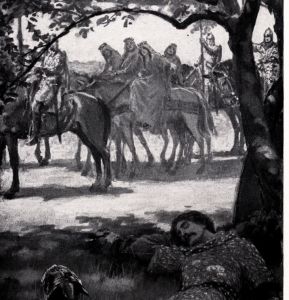
When I began reading The Acts of King Arthur and his Noble Knights, I expected fantasy and adventure. I did not expect frequent and serious discussions, often thought-provoking. Here is a scene in which Lancelot, discovered napping under a tree, is captured by four sorceress-queens who are bored of their wealth and power and want to play a game, in which they bid for Lancelot’s favor to see who can offer the most seductive gifts.

“Are we not beautiful?”
“I do not know, my lady.”
“That is ridiculous. Of course you know. There are no more beautiful women in the world or any half so beautiful, we’ve seen to that.”
“I guess that’s what I mean. You chose your faces and your bodies, didn’t you, and by your arts created them.”
“What of that? They are perfect.”
“I don’t know what you started with. I don’t know what you are. You can change appearance, I believe.”
“Of course we can. What difference does that make? Surely you aren’t such a fool as to think Guinevere as beautiful as we?”
“But you see, ladies, Guinevere has the face and body and soul of Guinevere. It’s all there and always has been. Guinevere is Guinevere. One can love Guinevere knowing what he loves.”
“Or hate her,” Morgan said.
“Or hate her, my lady. But your faces are not you. They are only pictures you have drawn of what you would like to be. A face, a body, grows and suffers with its posessor. It has the scars and ravages of pain and defeat, but also it has the shining of courage and love. And to me, at least, beauty is a continuation of all of those.”

Posted in quotations | Tagged , | 1 Comment