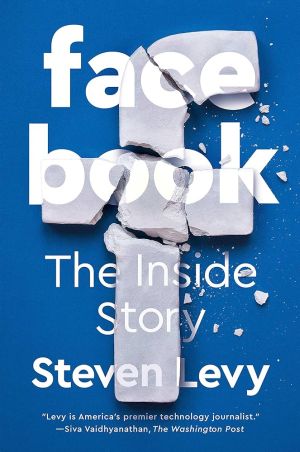
“Look at us,” my buddy chuckled. It was the halfway point of a 3-hour night class, and we’d been given a fifteen minute break to hydrate, caffeinate, and evacuate. Four people immediately flowed into the student common area and occupied the computers there, and all four of us were signing into facebook. It was 2007, and facebook was still in its innocent ascendancy, not yet a household world — but before long, I’d be installing browser extensions to cripple the website’s ability to track me online and regarding it as a necessary evil at best. Facebook’s growth from a Harvard-based social networking website into a global platform for consumerism, meme culture, political turmoil, shopping, etc is covered ably and soberly here by Steven Levy. Levy a veteran tech historian whose post at Wired gave him long exposure to both Mark Zuckerberg and his chief operating officer, Sheryl Sandburg, allowing him to ask questions of the Zuck that other reporters might have been shot down for. Here we witness an interesting project morph first into something with genuine commercial potential, and then into a global and pervasive digital power that is and continues to transform the world, offline and on, and Levy smartly weaves together technical, personal, business, and political threads for an altogether compelling and largely balanced story.
Despite its current importance, I can’t remember when I first heard of facebook: I know I couldn’t register for it, since my community college didn’t have student email back then, and potential users needed a .edu address. But who needed it? I had MySpace, with its blogs, customizable home pages, and ability to inflict music on anyone who visited your page. And yet a year and a half later, it wasn’t MySpace we college students were checking compulsively. Facebook was the latest creation of young Mark Zuckerberg, our contemporary, who grew up with a tech-friendly father and who was constantly creating software on his own time — including a program called Synapse, which used a person’s winamp playlists and playtime to guess what what songs a person wanted to listen to next. Another program allowed students to see which classes their friends were enrolled in, and gave Zuckerberg his first look into how hungry people were for information about their friends, leading him to another project that would become Facebook. The skewed version of events portrayed in The Social Network, based on the one-sided Accidental Billionaires, makes for a fun story, but is off the mark.
Levy covers facebook’s rapid expansion in the era of “move fast and break things”, as it was driven largely by engineering and the desire for growth, and dominated by a group of socially awkward young men captivated by what their new software toy could do and what it might become. Astonishingly, new hires were expected to commit code changes within their first few days at the website, a way of promoting new ideas. (One wonders how many newbie code changes were simply repairs to problems created by previous newbie code changes!) Fortunately for them and their bank accounts, as the company grew it brought in people with actual business experience — chiefly, Sheryl Sandberg, who became The Adult in the Room and gave facebook a less chaotic organizational atmosphere. The history of these years is something of a walk down memory lane for me, making me remember how the site used to be: I can remember the absolute contempt we had for the Newsfeed when it dropped, and the weird years when it seemed like facebook was trying to incorporate messy customization aspects of MySpace. Facebook’s approach was “Do this and see how it lands — if there’s an issue, we’ll remove it, maybe apologize, and throw something else out there”. A big example of this was Beacon, which allowed facebook to plant its flag all over the internet and made it possible for users to share their web activity with their friends — sometimes without meaning to, as when one man’s surprise engagement was ruined when his facebook profile announced that he’d just purchased a ring. His intended was dismayed that he’d bought it on sale. What is love if not going stupidly into debt for shiny rocks?
Facebook got better and better at optimizing the website to attract people’s eyes to it and keep them there, which was good for its ad-oriented business, but also worked towards its mission of ‘bringing people together’. As the 2010s passed middle age, though, the platform that was so great for selling things and bringing people together proved that it was also a great machine for selling….well, everything else, including politics and disinformation. Zuckerberg and co also realized that “bringing people together” can look like a mob burning things down or a conspiracy-theory echo chamber just as easily as it can be a kumbaya circle. In terms of content moderation, it often found itself in the same pickle as YouTube: there were so many people creating so much content at once that responding to everything was impossible, Europe’s demands that it remove offensive posts within 24 hours notwithstanding. There were the same gray areas: is quoting a celebrity saying something vile as bad as saying something vile? Does the historic significance of a nude child running away a burning village scrub away the fact that it’s a photo of a child? Facebook’s obsession with bringing everyone together meant the darker parts of internet culture, like the shock-trolls of 4chan and the like, were suddenly exposed to the innocent and unsavvy, leading to perfectly innocuous soccer moms falling for Qanon theories. Even as it tries to impose order despite its preference for free speech, facebook catches fire from both sides — from one, if it doesn’t do anything, and from another it’s viewed as impartial. It definitely grew more partisan during the coronamania period, but that’s not covered here.
Facebook: the Inside Story is a solid history of a significant period of the digital world’s life, one that doesn’t shy away from facebook’s mistakes and vulnerabilities but which acknowledges that the company is trying to rein in the Gollum of its own creation. A few more books in this vein are coming — The People vs Tech, The Chaos Machine, and antisocial media among `em.
Related: If you don’t like facebook building an ad profile about you based on your web traffic, consider using the Facebook container extension for Mozilla Firefox, and the Disconnect extension for any browser.
[Grandpa]’d say, “You weren’t born, to just pay bills and die” You weren’t born to just pay bills and die Alls you need is a dog, a shack, a crick in the back And a good woman, oh Lord You don’t need that rich man’s gold
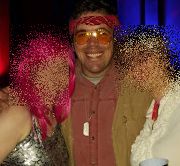
Today’s blogging prompt was ‘most creative costume I’ve worn’, which…erm, should be easy. I’ve only ever gone to two Halloween parties. In one (2019) I dressed as Walter from The Big Lebowski. Tres interesting, since I had an excuse to quote The Big Lebowski all night. (“You want a toe? There are ways, man, you don’t even want to know. Believe me. I can get you a toe by three o’clock, with nail polish.”) Last year, I dressed as a monk. The Walter costume was both less ornate but more involved in creating: I had to get a bandanna, the shades, and a vest. (Oddly enough, I already had dog-tags: when visiting the USS Kidd one of the souveniers was customized tags.) My godsister who throws Halloween parties has moved to another city, though, so I don’t think I’ll be going to one this year. If I am, I’ll put one of my Bass Pro caps and a longneck (ice cold) beer and announce that I’m Luke Combs. (Or, reprise the monk but drop the cross and pretend I’m a Sith lord.)
“DUDE, THE CHINAMAN IS NOT THE ISSUE HERE — OVER THE LINE!!!!! —- THE CHINAMAN IS NOT THE ISSUE HERE! I’m talking about DRAWING A LINE IN THE SAND, DUDE, ACROSS THIS LINE YOU DO NOT — also, Dude, Chinaman is not the preferred nomenclature. Asian-American, please.”
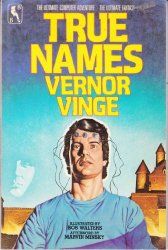
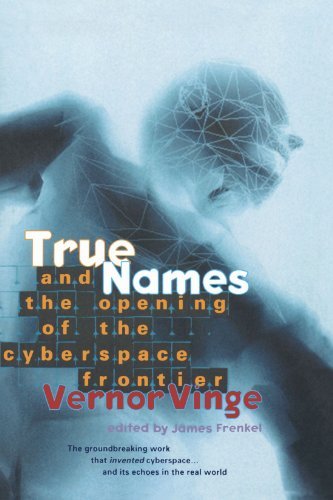
How would you imagine the Internet in 1981? “What a silly question”, say you, “The Internet didn’t exist in 1981! ” Despite this, several authors in the seventies and eighties nonetheless imagined ‘cyberspace’, or as it’s known here, ‘the Other Plane’. Vernor Vinge imagines that other plane as a fantasy realm, in which hackers are warlocks, databases appear as lakes and swamps (literal data lakes!), and security protocols appear as forest sprites. Very little of True Names occurs in ‘meatspace’ (as we called it in the ’90s), instead taking place in a digital realm of mountains, dark forests, and castles built upon clouds of code. When it begins, our main character Mr. Slippery (his rather pedestrian nom de guerre) is picked up by the police in the real world, and ordered on pain of his True Name being leaked — being doxxed, in other words – to spy on his coven, his tightknit community of hackers. There’s trouble brewing: some arch-hacker known as the Mailman is expanding his reach into more and more networks, and is rumored to be behind a recent coup in South America. Could it be possible that digital potentates now have the ability to exercise — and hold — power in the real world? Slips, as he’s known to his friends, shares his predicament with his online BFF Ethyrina, and together the two use an old ARPAnet connection to begin investigating more broadly, risking the wrath of both the Mailman and the feds. Exciting and imaginative, I find it baffling I’ve never heard of this title before.
Twenty years later, to celebrate its anniversary, “True Names” appeared as the center of anthology of works celebrating its vision and persistence relevance. The world wide web had begun fully flowering then, even altering the economy as a dot com bubble appeared and popped, and it was beginning to change from the province of tech geeks into the all-pervasive infrastructure it is today. Most of the essays focus on theme of cryptography: as one of the obsessive concerns of True Names were the warlocks concealing their identities (and the plot turned on their discovering the identity of the Mailman, which — well, no spoilers, but Vinge was pushing into territory we’re still exploring today), so the resonance is understandable. The essays have instant appeal for me given their psuedo-datedness (I love watching videos from the 1990s about the Information Superhighway), but they’re not actually that dated: when Tim May wrote about the need for technological means to conduct anonymous commerce, I could only think of bitcoin and the variety of escrow services used on the dark net. May and authors are empathetic that true privacy, true crypto-tools, must not have a back door accessible by the government — not just to protect individuals from a nosy and aggressive state, but to protect individuals from government incompetence. Carve a back door into the wall, and no matter how strong the door is, the integrity and strength of the wall themselves are diminished. One essay printed in the physical collection is deliberately withheld from the ebook version by request of the author, Richard Stallman — whose “Right to Read” commented on how governments and corporations could use hardware and software to track reading and frustrate readers’ abilities to share, on pain of imprisonment and hefty fines.
I will be reading more of Mr. Vinge! Next up is either Facebook: the Inside Story or The Shockwave Rider.
Turn and face the strange….. Today’s TTT is about bookish jobs.
Well, I work as a reference librarian, so that’s a little on the nose. Of course, my job isn’t very bookish. My library is very social-services oriented, so I spend most of the day helping patrons with the computers, or faxing/scanning, that sort of thing. On Saturdays I hang out at a local downtown book store to get my fill of time with bookish people, and when I was a teenager I wanted to work at a bookstore. In retirement I could definitely see maintaining a cozy spot like Broad Street Books, using it less as a way of earning an income and more as a way to hang out with people, just as the founder and operator of BSB does now. I love thinking about and discussing the themes and ideas of books with people, and some of my favorite authors are in fact people who do just that — like Brad Birzer and Joseph Pearce, both in books and on podcasts. Finally, as with many people who read books, I harbor yearnings to write one myself — I think it’s telling that whenever I play myself in The Sims, he’s invariably a self-employed writer who lives in a little cabin and doesn’t work save for the books he publishes and the garden he tends…
And now, a Trio of Teases!
“You’re about to die. I really don’t think this is the time to be makin’ wisecracks.” “Personally can’t think of a better time to be makin’ wisecracks than when you’re about to die.”
Firefly: Life Signs, James Lovegrove
“Your past is far more intriguing than either your present or your future. Both of those are completely programmed.”
The Shockwave Rider, John Brunner
“I’m telling you, these platforms are not designed for thoughtful conversation,” Wu said. “Twitter, and Facebook, and social media platforms are designed for: ‘We’re right. They’re wrong. Let’s put this person down really fast and really hard.’ And it just amplifies every division we have.”
Tim Wu, as quoted in The Chaos Machine: How Social Media Rewired Our Brain
So there you are, dear reader, engrossed in an interesting story about two airplanes smashing into one another, and of a man named Bill Smith who’s trying to find why. And then, perhaps a half hour into your reading journey, you’re suddenly fifty thousand years into the future, and the actions of an airplane accident investigator are a matter of survival for the entire human race. Millenium is a story told in two parts: the first, taking place in the 1980s and following an increasingly confused airline accident investigator who keeps finding inexplicable details about an airline crash, and the second following a woman from a dying society who are attempting to save the human race from total extinction. The premise is fascinating and gloomy, but contains a warning worth heeding. For aviation-tech fans, it’s a fun period piece.
It is impossible for me to rate this book fairly, as I encountered its story first through the film adaptation of it, produced in 1989. I had no idea it was based on a novel until this past weekend, and immediately searched for it online. This is not the place to compare the two, but suffice it to say my enjoyment of the story in one medium was married to my enjoyment of it in the another — and the movie was one of the first SF titles I ever watched, and have returned to several times over the last 20+ years. As literature, its most compelling asset is its premise. Bill Smith keeps encountering a strange but beautiful woman who doesn’t seem to recognize him despite their having a torrid affair at one point in the story, and the frequency of her appearances increases as he finds strange things in the wreck he’s investigating. Why are the passengers’ watches running backwards? Why does the flight recorder have a pilot screaming like a horrified child because the passengers are dead and burned even though the jet was still in the air at that point? We start getting hints as to what’s happening by the every-other chapters, which follow the female agent Louise. She’s from the last remnant of humanity, in a future where our numbers have been destroyed by atomic wars, and our bodies ravaged by genetically-modified diseases that we cannot escape from: people are born compromised, and live only a couple of decades on average, and that only by steadily replacing their organs with synthetics or becoming organic parts of fixed machines. There are only a few hundred humans left, but they have the ability to transport back into time — which they use to abduct humans who are about to die (third-class passengers trapped on the Titanic, for instance), in the hopes of finding a place where humanity can be resettled.
As fascinating as the plot is, there’s a lot of strangeness to it ,especially the idea that Louise comes from fifty thousand years in the future. Varley doesn’t go into extensive worldbuilding beyond alluding to the wasteland 20th century humanity created through environmental degradation, atomic weapons, and then bioengineering attacks, but it’s improbable to me that the same species capable of genetic weapons couldn’t also be able to create genetic shields — and frankly, blaming a few decades’ worth of humans from fifty thousand years in the future is both sad and amusing. That’s a lot of time to curse the darkness instead of finding a way to create a light. It’s definitely an environmental-awareness kind of novel, but would have made more sense if it were set closer to home — say, the late 22nd or 23rd century. Still, the weird premise goes a long way to creating an interesting story, especially with the horrifying view of humanity in its last days — a bit of organic film atop a machine, a mere residue. It’s very chilling. I watched the film last night, so reads-to-reels to follow.
It amuses me to think that there was a time — even when I was keeping this blog — where I steadfastly maintained that I wasn’t a science fiction reader, that I just liked Star Trek. Part of me even now would like to insist that it was true back then, true until I began reading Asimov’s Foundation series, and then his other SF short stories, and realized that saying “Oh, I’m not a science fiction writer, I just like Star Trek and Isaac Asimov” doesn’t really work. (For the record: the first books tagged as science fiction on this blog are The Stand by Stephen King, and Foundation by Asimov.) But as I began thinking about SF in the last week in preparation for a month-long celebration of the same, I realized it it was present throughout my reading life.
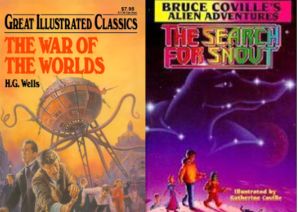
I believe the first science fiction I ever encountered would have been through the Great Illustrated Classics series, in their editions of The War of the Worlds, The Time Machine, and 20,000 Leagues Under the Sea. I can vividly remember the illustrations on these — the slight beauty of Weena, the horror of the Morlocks, the fire and darkness that marked scenes of both War of the Worlds and Time Machine. I don’t know that I conceived of these as ‘science fiction’, or anything at all — they were just stories to me, and most interesting in the drama they depicted. Imagine going on an adventure under the sea, viewing strange creatures from a large viewing point — or witnessing society being destroyed by strange alien machines from space! I was utterly gripped by them. How they shaped me as a person, I can’t say: did The Time Machine make me begin thinking of how society itself changed from age to age, and not just the technology it employed? Perhaps it planted the seed, I can’t say. I remember reading its depiction of the dying Sun with dread, not wanting to think such a thing could ever happen.
I encountered Star Trek in 1992, watching episodes of the original series from a hospital bed, and would feed my interest in it by reading Treklit from the library or with my allowance. There was a juvenile TNG series in which we follow the main characters when they were at the Academy which I remember fondly, and when I encountered Bruce Coville’s space-adventure books I knew they were like Star Trek, in that they featured a crew of aliens from different planets working together. One of the books was even called The Search for Snout, which I recognized later on as a Search for Spock reference. Goosebumps wandered into SF territory from time to time (there was at least one book set on another planet), but was largely horror.
Science fiction continued as a thread in my reading life as I aged, though I only remember two series prominently: Animorphs and Roswell High. The first features a group of middle schoolers having to form a resistance cell when a dying alien tells them that their planet is being invaded, and gives them a gift — the ability to transform into any animal they’ve touched — to fight back. Although this sounds like a simple action-adventure series, it grew dramatically and emotionally troubling as the series developed, as the kids became battle-hardened warriors who struggled with the moral choices they had to make. Especially complicating matters was the fact that the invading aliens were mind-control slugs, and their hosts — who were being killed in battles — were usually moral innocents. The Hork-Bajiir, who looked like they’d been bred for war, in truth were a peaceful species of tree-dwellers who used their many blades to obtain nourishment. It was harder to kill them knowing that, and harder still to kill humans who the kids knew were captives of the very creatures that had drawn fire to them.
Roswell Highdidn’t go into moral ambiguities, but had an interesting story and aliens with unique talents. I’ve commented on it separately. Likewise for the Star Trek literature I was reading at this point, which was usually Deep Space Nine novels I found at Walmart. I believe the only ‘real’ SF I read in this point was Isaac Asimov’s Positronic Man, which I found in my library and read thinking it was the novel version of The Bicentennial Man, which remains one of my favorite films. Still, at this point, I wasn’t reading science fiction for the “science” part of it — for any serious reason. I thought the possibility of aliens and robots was interesting and liked to read stories about them. I did watch a few SF films in these days, beyond Star Trek and Star Wars: what I remember most is Millennium, an interesting movie about humans from doomed airliners being snatched off them and sent to the future to help repopulate humanity after some cataclysm. It was also a light part of my PC gaming, though only through Star Trek and Star Wars related titles.
When did science fiction become science fiction to me — that is, when did I start reading it for the speculation it dwelt in, the questions it raised, the themes it played with? Honestly, I think it began in my early-mid twenties, when I’d devoured so much Asimov, including his writing about science fiction, that I began identifying more with the genre. It helped enormously, of course, that I was starting to seriously think about the world and the future at that point, and SF was a way to do that. That purposeful relationship with SF has marked my reading of it more and more, so that while I’m reading for entertainment, entertainment alone doesn’t quite suffice, though it goes a long way. Likewise, while I frequently pick up books because of the technological premise (Daniel Suarez‘ work, especially), the sweet spot for SF is when it addresses seriously the human condition. What kind of world is being made, what kind of humans? What would it mean if algorithms ran our entire lives, or if stable order was forged by removing from human life all that gave it meaning? This is probably why I’m frequently drawn to near-future titles, and especially cyberpunk which looks at the collision between man and machine, or man and corporations, head on.
Tony Valdez is a dispatcher. In a world where people who die of natural causes stay dead, but people who are killed by others magically appear back in bed, his job is to intercede when people are dying from accidents and not-immediately-fatal stabbings and do the dirty on them, so they’ll technically have been murdered and poof back to bed. Most of the time. One time out of a thousand, the process — which no one understands, which just started happening one day — fails. In The Dispatcher, we saw what happened to one of Tony’s dispatching friends when one of his jobs went awry, and as Tony was assisting the cops with the case, he ran into some shady business types whose schemes he’s more involved with now, thanks in part due to a lack of legit work. Here, he’s an innocent bystander caught in a bank robbery, who is suspected of involvement by the authorities. Quinto gets a larger cast of characters to play with here, and while listening to Quinto doing a gruff bartender with a deep bass voice isn’t quite as funny as his Heath Leader Joker, it’s still a fun change from his own speaking voice, which is soft and high. There’s a little more world-building here, as we see illicit ways people put the weird saved-by-murder mechanic to work, in holding gladiatorial games or using it for return trips home — as well as to how occupations that used to depend on murder as a threat are now having to get imaginative to the point of diabolic. It’s an enjoyable enough way to spend three hours while one is doing something like driving or playing a PC game. There’s a third part of this story, which I’ll probably try during this month.
Non-audio SF titles will appear this month, I promise.
Not to sound like a medieval theologian, but sic et non. I don’t believe in Karma as a metaphysical force that responds to our behavior and creates consequences for us, like some disembodied deity. I do believe, however, that actions beget consequences: if we drink immoderately, we will suffer consequences like hangovers, physical accidents, and liver disease; if we cannot control our emotions or desires, we will create trouble for ourselves and others. If we are quick to anger, we will get in fights or suffer high blood pressure; if we are gluttonous or use food as emotional support, we will be prone to suffering obesity, diabetes, or metabolic syndrome; and if we are sexually profligate, we’ll be prone to bonding problems and STDs. If we persist in bad patterns of thinking — fixating on our woes, our limitations — we can dig ourselves into emotional holes, while focusing what we can change and taking action on it, even the littliest of things, can help us escape such a cyle. Our behavior often prompts the way people respond to us: someone who is outgoing and cheerful will generally be received well, someone who is cold and hostile will be greeted with the same. This is a generality, not a universality: a good person can be readily taken advantage of by a con-artist, and the same con-artists can put a perfect act of warmth and benevolence while being inwardly cruel. Personally, I was extremely socially avoidant in high school, but fortunately a few people looked past that and engaged with me anyway, a prime example of the fact that we sometimes get more than we deserve thanks to sheer human goodness.



 Reading Freely