Media Diary

Another assignment this week in my SLIS class was to record and reflect on our experiences with media throughout the course of a day. Again, since the topic is relevant to the general theme of Reading Freely, I share it here!

My mornings begin with email, my main source of news. I subscribe to different outlets like The New York Times and The Spectator, and they send out different pieces throughout the day. I generally look over the headlines and then click if I see one that interests me, like The New Yorker’s  “What Was Hamas Thinking”, or The Spectator’s “Return of the Hawks:  Israel Redefines the GOP Primary”.  I also receive substack newsletters, some of which are commentary on the news.  I prefer reading news via email, because news websites are visually distracting, and the easy access to other articles drains my attention from the article I’ve clicked on.  There are some news sites I visit, though, in part because they’re more of a “once a week” source instead of a daily source. One example is al-Monitor, a website collecting news from the Middle East.

My phone, a Pixel 6,  is not a source of news,  as I don’t have any news or social media apps on it. I sometimes see articles when I go “back” from the home screen, but this newsfeed appears to be curated from my Google account, and thus tech and gaming news always dominate. The top story today, for instance, is about updates to Google Assistant and Google Wallet; immediately below that is a review of Cities Skylines 2.

I sometimes encounter news in areas where I’m not intending to, like reddit. Reddit is a website where people can follow different ‘subreddits’ that collect discussion around a given topic, like PC repair, the Boston Red Sox, or Star Trek.  Reddit frequently inserts topics from  subreddits I don’t subscribe to into my feed, so today I spot a screenshot of an AP news headline about President Biden endorsing a bill to send money to both Ukraine and Israel.  One of the reasons I quit using Twitter early in 2023 was because it politicized my feed too much. I frequently see the headlines at work, on Yahoo and MSN’s news portals, but I don’t monitor news unless there’s severe weather happening. 

When I get home on this particular today, I’m too tired from a long day of helping patrons and trying to solve technical issues to do thing serious like listening to a podcast that would touch on the news. Instead, I listen to music, read, and eventually fall asleep watching YouTube.  Sometimes I watch news on YouTube, or commentary on the news. One channel I like because of its  international perspective  is WION, or “World is One News”.  During baseball season, I also watch highlights from the teams I follow (Red Sox & Braves), and search for news for particular players, like Shohei Ohtani.

In general, I think my media consumption is more active than passive, as I actively seek out news from specific sources, either for quality or for a balance of perspectives, and I deliberately get my news in ways that lets me focus and reflect on it.  However, I’m also aware of what in anthropology might be referred to as the observer effect — the tendency of a subject to alter its behavior when it knows it’s being observed.  In my case, I suspect if someone were recording my screen for 24 hours and I was unaware,  there would have been a lot more idle browsing of reddit and news-reaction videos on YouTube.
Posted in General | Leave a comment

A day without a phone

One of my class assignments this week is to go 24 hours without touching my phone, and since that aligns fairly well with some of the books I‘ve written about here over the years, I thought I might share my reflection here as well as in the virtual classroom we’re using.

I was looking forward to this experiment because I regard myself as a phone minimalist, but figured there would be hidden dependencies that this day without a phone might expose.  

My first anticipated challenge was waking up. Although I frequently wake up well before my alarm clock goes off, on the foregoing night I’d stayed up rather late watching a documentary on cave disasters, and would have most likely slept in if left to my own devices – or left without them, in the case of my turned-off phone!   Fortunately, I had options ranging from a battery-powered clock with physical bells to my Nest Hub.  I chose the latter, though it felt a little like cheating considering it was still a digital device.  My morning proceeded without any other real differences, save for the music-less drive into town. It wasn’t until I arrived at work that little disruptions began accumulating.

It didn’t help that the morning was unusual: the City is changing life insurance providers, so members of the library staff had to go to City Hall next door and fill out paperwork to update beneficiaries and the like.  The form asked for information about my prospective beneficiaries that I didn’t know offhand and couldn’t find out without my phone, so I had to take the paperwork with me to return later this week. On the walk back to the library,   the shutterbug in me noticed a particularly attractive potential shot of morning light in the trees, but not having my phone I could only stand and admire it.  Upon arriving back at work, I accessed MyBama (e-learning portal) to check the discussion boards, only to be greeted with the news that a one-time password had been sent to my phone. 

I use two-step verification for most everything, from Amazon to Gmail, and realized that was going to constitute a problem. I don’t have a fixed workstation: at my library, the reference staff alternate positions throughout the day, and I work from my personal OneDrive as a result – and now I had no way to access it. Fortunately, I didn’t have anything due today as far as local history and genealogical queries go, so I just worked on new ones that I hadn’t created files for yet, and emailed them to myself with my work address at the end of day to add to my OneDrive once I was home.  At lunch I finished the paperback novel I was reading, and couldn’t simply switch to reading the Kindle app on my phone as I otherwise would have. Fortunately,   I do work at a library.  

The afternoon was busy enough that I didn’t have time to notice my inability to check for messages and phone calls, and the evening was much the same. Once I arrived at home,  I was able to ‘cheat’ a little with regards to the one-time password and logging into MyBama:    I use the Google Messages app, and have it setup to connect to my phone via bluetooth, so if my phone is nearby, I can ‘text’ people on the computer without touching the phone.   

What did the day’s exercise reveal about my habits and phone use?    I missed a few conveniences without the phone, but was generally able to find ways around them – – remembering to bring a paperback book with me to read at lunch, for instance.  My phone use is already so sparing, though –  I’d venture to say that 90% of the time I’m holding it, it’s to read Kindle titles–  that not too much was different.  The only serious obstacle was two-step verification on emails and the like, which is not something I can bypass.   I suspect a more serious (and interesting) challenge would be a day without a computer, though that’s not one I could do on a workday.  This is also the same lesson I drew back in 2019: I’m possibly just as addicted as the phone nuts I frequently mock/bewail/etc, but my addictions are fed through a 40 inch computer monitor instead of a tiny little square.

Posted in Reflection | Tagged | 2 Comments

It is Tuesday, captain….teasing frequencies open

Time for the ol’ Tuesday Teese.

“I have to fly this shoebox into an electrical maelstrom, go looking for a scientist in a jungle where it never stops raining, avoid corrupting a primitive, Prime Directive-protected indigenous culture, and then somehow get this hunk of junk back into orbit without getting vaporized by the Klingons. If I were making wishes, I’d ask you to make the Kepler invulnerable, invincible, and invisible.”
“In five hours I can give you less fragile, mildly intimidating, and vaugely nondescript.”

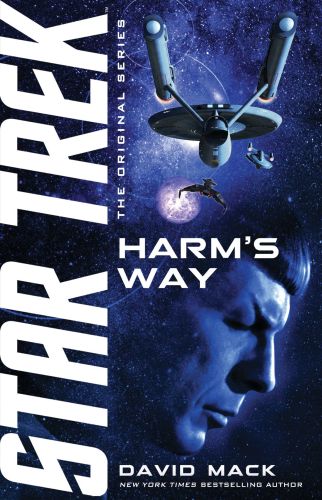
ST TOS: Harm’s Way

“You are not a trusting soul, old man.”
“How do you think I got to be so old,” Boyce replied. “Clean living?”

ST TOS: Child of Two Worlds

‘I’ve never done a séance before. Um… they’re not dangerous, are they? It’s just that I have been warned … ’
‘Trust me,’ he says. ‘All I ask is that you put your life in my hands.’

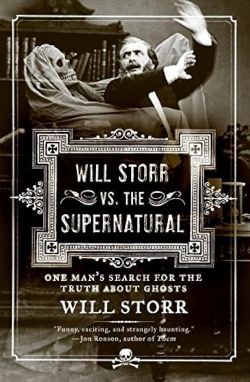
Will Storr vs the Supernatural

“Will you come forward and tell us your name?’ she says.
‘Rarrrrrrrgggggggghhhhhhharrrrrrr!’ says Steve, even louder than
before.
‘Please be gentle on the medium,’ says Penny.
‘Hoooooooaaaaaarrrrrrgghhhhh,’ says Steve, louder still, his neck
jutting out and his head moving from side to side, like a riled T-Rex in an
old Hollywood film.

Will Storr vs the Supernatural
Posted in Reviews | Tagged , | Leave a comment

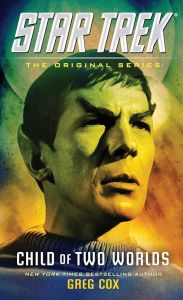
Child of Two Worlds

[Pike] looked over at Boyce. “I don’t suppose you had a chance to do a full psychological analysis while she was choking you?”

The Enterprise is a plague ship enroute to an independent world for a rare medical ingredient when it answers a distress signal and things get…complicated. As in, this couldn’t be worse, could it? complicated, because the rescue creates a no-win diplomatic scenario that puts Enterprise in the sights of both the independent world (which they need to keep the crew alive) and the Klingons — with an away team exposed to mob nuttiness on the planet, and the Enterprise‘s effectiveness declining by the hour and more and more of her crew become incapacitated with the space-plague, to the point where yeomen are being tasked to bridge stations. Sometimes it just doesn’t pay to get out of bed.

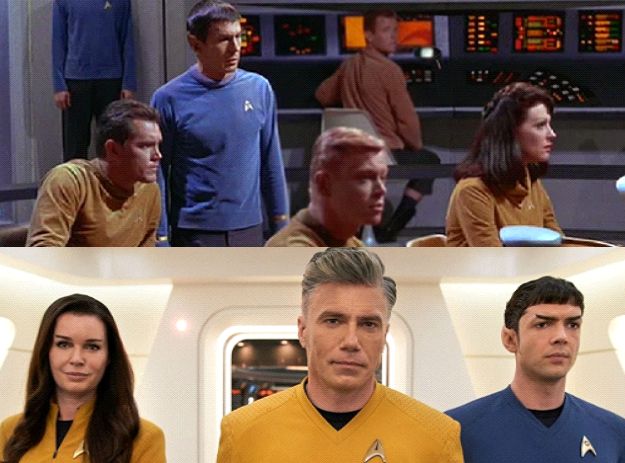
Greg Cox is one of the earliest Trek writers I ever encountered (his Assignment: Eternity from 1998 was the first adult ST title I read), and unlike others from that period I’ve continued thoroughly enjoying his work even as Treklit became more artistically sophisticated in the mid-2000s Relaunch era. Cox has a particularly good handle on the TOS characters, but here he throws a curve: we’re on Pike‘s Enterprise, shortly after “The Cage”. Reading this after Strange New Worlds is a decidedly odd experience, almost like watching two similar movies on the same film, their images interlaced and vying for dominance. Pike, Una, and Spock are all here, but which actor I see and hear behind their lines varies from scene to scene. There’s an interesting mix of book-lore and anachronisms: Una’s background as an Illyrian, created by D.C. Fontana, is here — but not her name, which didn’t appear until the ST Legacies trilogy, so (amusingly) she’s referred to as Number One every single time she appears. This is hand-waved as her real name being too long for most people to handle, so she suggests people merely call her Number One. Sure, she could go by Majel or Rebecca, but that’s for normies. Cox also tries to accommodate odd details from the pilot, like writing Pike as someone with a preference for hard copies. One wonders if that inspired John Jackson Miller to give Pike a history with a Luddite colony in The High Country. Another curiosity is Cox employing phrases like ‘hyperdrive’ and ‘laser pistol’ which are both charmingly raygun gothic and deliberately anachronistic, presumably to press the point that this is a different era in Trek history.

Storywise, Cox creates an opportunity for Spock to shine by making him the foil of the woman whose existence causes all of the plot problems, as they’re both caught between worlds and cultures. We’ll be skirting the edges of spoiler territory here, but the woman in question was abducted during a Klingon attack on the independent planet a decade before, and effectively raised as a Klingon, self-consciously leaning into stereotypes in the way that Worf would a generation later. The trouble starts when her sister tracks her town and ‘rescues’ her — and only grows, because the indie planet insists that Enterprise return THE WOMEN!!! to them (it’s an election year, so returning the grown-up abductee will be great optics for the incumbent), while the Klingons are insisting the same, but less for principle and more because Klingons gotta Klingon. Spock’s struggling with his own identity works well with this woman who rejected her heritage out of self-preservation, but who now has a real choice as to who to be, and the tight action-adventure thriller made this one a fun romp. It even has a Klingon boarding party on the Big E!

Coming up: …well, same as yesterday. Star Trek, Neuromancer, and other SF! I have another Pike novel (Burning Dreams) warming up.

There are, alas, very few Pike books just yet. Anson Mount is fast making him my favorite captain.
Posted in Reviews | Tagged , , | 3 Comments

In Harm’s Way

Scarcely five days after the Enterprise barely escaped an encounter with a giant machine capable of devouring entire planets, a rattled Jim Kirk has another foul assignment land on his desk. A scientist has gone missing on a planet within the Neutral Zone, and his team was pursuing a lead that, should it fall into any hands — not just the wrong ones – -could create genetic weapons of enormous destruction. The last time something like this appeared on the radar, Starfleet and the Klingons both glassed the planet involved with torpedoes to ensure its destruction. How dangerous does something have to be for Starfleet to choose the nuclear option? Now, Enterprise and a Klingon ship are racing toward an encounter that could disrupt the fragile peace between the Federation and the Empire, and potentially unleash a nightmare into the Alpha Quadrant. No rest for the weary, captain!

In Harm’s Way pulls off a nice trick in creating an ST TOS novel that intersects a bit with Vanguard (a series authored in large part by David Mack, with Dayton Ward and Kevin Dilmore also contributing), but without being a Vanguard novel and thus allowing Jean-Luc-off-the-street to pick this up and enjoy the story without knowing any of the background. The novel is rich with story: the primary thread is that of the away team, led by Commander Spock, who are attempting to find the missing scientist and recover his data while avoiding any prime directive violations. Said team is also try to avoid the Klingons, who landed their own away team and couldn’t care less about prime directive violations as they merrily shoot anything that looks like it might fry up nicely. If two large away teams trying to find the same thing without finding each other sounds like an impossible task, well — you’re not wrong. In orbit, Enterprise is playing hide and seek with the Klingon ship, captained by Kang, because neither party is supposed to be in the Neutral Zone. Kirk, who is psychologically worn out by the haunting death of Captain Decker in “The Doomdsay Machine”, isn’t coping with the additional stresses of this mission very well, and has determined that it’s best just to avoid the Klingons — especially since there’s another Starfleet ship in the area, a secret one dispatched by Station 47 itself, which has a crew of officers with Lower Decks style personalities: they’re not The Right Stuff, but they’re fun to read, especially as they try to work with the more straightlaced Enterprise officers. Evidently they’re in their own Seekers series, so don’t be surprised to see that show up next year. The humor is particularly welcome given that Harm’s Way shifts to horror towards the end, as Starfleet and the Klingons both battle against an Eldrich abomination with an army of murderous mind-controlled natives. It’s unusually gory for a Trek novel, when most people tend to die in nice sanitary ways.

David Mack delivers yet again, which is no surprise: I’ve never failed to thoroughly enjoy one of his books. He knows how to create an action tale in a vivid background, with humor and character drama thrown in. The dialogue is especially interesting, and I liked Mack’s treatment of the Klingons: there are several in here, and they’re not all the bloodlusty Space Vikings they tend to get reduced to.

Coming up — Neuromancer, Star Trek, and more as this month-long celebration of SF continues.

Posted in Reviews, science fiction | Tagged , , , | 1 Comment

Astounding

© 2018
544 pages

I don’t remember why I picked up “Foundation” back in 2008, but it would be the beginning of an obsession with Asimov that saw me reading collection after collection of his stories from the 1930s – 1960s, finding greater and greater interest in Asimov’s partially biographical forwards to each story that formed my understanding of modern SF’s beginnings — and for Asimov, the story always began with his reading pulp fiction stories from his father’s candy shop and working up the nerve to walk into the editor of Astounding Stories‘s office and submit his own first effort. Astounding takes readers into that office, being largely a biography of John W. Campbell, married to a partial history of the field of science fiction which he shaped. Although it sometimes meanders off course, through either tangents or gossip, the book as a whole is a fascinating look back at SF in its formative period as a popular product.

The early 20th century was marked by the arrival of mass man and the mass market, creating spectator sports, the penny press, and pulp fiction alike. Although early ‘science fiction’ tales were merely other pulp fiction tropes transposed into new settings, when aspiring physics researcher-turned-magazine editor John W. Campbell took over Astounding Stories, he brought with him a desire to be taken more seriously which formed his approach to choosing stories and cultivating authors who would establish science fiction as something distinct — a unique offering that would shine a light into the future. As such, he incorporated editorials and nonfiction content into the issues. Previous editors had begun moving in this direction, but Campbell was a forceful personality who actively fed his authors suggestions and served as a mentor to the youngest of them, like Isaac Asimov. Asimov’s “Nightfall” was the result of one of Campbell’s suggestion, and remains one of his best-known stories. More people were beginning to look at SF in this period, as modernity’s snowball effect was becoming noticeable among the public, who were seeing speculation in the wildest stories of the imagination become reality in mushroom clouds and rocket liftoffs. Nevala-Lee focuses on Campbell’s general editor role, but continually works in Campbell’s relationship to three of his most prominent authors (Asimov, Heinlein, and Hubbard), and addresses their work to varying degrees Hubbard is better known now as the creator of the bullyboy Scientology cult, and unfortunately given Campbell’s fascination with the ‘promise of Dianetics’, whole chapters are devoted to Hubbard while Asimov and Heinlein have to settle for running guest appearances. The ‘unfortunately’ is experience not just by readers of this biography, but by readers of Astounding back in the day, who were disappointed to see so many stories about ‘psionics’ dominating each issue, instead of the more hard-science offerings Campbell had been known for. Nevala-Lee frequently strays from his subject, frequently drifting into gossip: I have no interest in sex lives of Heinlein and Asimov, and these gratuitous details have no bearing on what the men wrote — a case could be made for Heinlein, I suppose, given that he explored sexual expression in some of his stories, but that’s not how the details are incorporated here. The interesting evolution of Heinlein from someone who voted for Eugene Debs into the author of Starship Troopers and The Moon is a Harsh Mistress is not explored, but written off as the influence of Heinlein’s wife Virginia, and Asimov’s serious thinking about science fiction — its stages of development, from idle Mars adventures to serious examinations of how technology would transform society — are similarly ignored, despite their relevance. We do, however, get informed that Asimov grew from an awkward lover into a charming dirtyish old man with a penchant for bottom-pinching. These have nothing to do with the subject and seem more a way for the author to score cheap shots against men who should have known better but are not around to defend themselves. Interestingly, though, despite harboring the prejudices of his day, Campbell was perfectly willing to publish female authors — something the author mentions but does not expand on.

I enjoyed Astounding for the most part, having almost no familiarity with Campbell at all, and not enough to mention re: Heinlein. I enjoyed getting to know them a little, and as someone who has read nearly a hundred works by Asimov, including his autobiographies, rubbing shoulders with him was a delight as always. I’m so used to think of him as the old man with flaring lambchops and a bolo tie that seeing him in photos and the text here as young and unsure of himself was a nice change of pace. I disliked the parts on Hubbard, dianetics, and Campbell’s psychic obsession enormously, but count that as my very healthy prejudice toward Hubbard’s cult. Readers going in should know that Campbell’s role in shaping science fiction is more the subject than science fiction himself.

Posted in history, Reviews, science fiction | Tagged , , , , , | 5 Comments

The Heinlein Interview

I am closing in on the end of Astounding, which bills itself as a history of golden-age SF, and so far the most interesting aspect of it was the largely-uncommented-on political history of Robert Heinlein. We meet him as an enthusiast of Eugene Debs, encounter him later as among the crowds cheering FDR’s train as it passed, and say goodbye to him as an archly libertarian cold-warrior. Of course, that latter description is interesting and conflicted in and of itself: the Cold War not only expanded the state, but completely destroyed opposition to the state’s power and ambition, turning the traditional check against it (non-interventionist conservatism) into the neocon movement that gave us the GOP until the late 2000s. I began fishing about for a Heinlein biography that might shed some light on the situation. While it’s not a biography — it’s a lengthy interview bookended with Schulman’s reviews of Heinlein’s books — it made for interesting reading, given both my interest in SF and in the school of thought that Heinlein and Schulman both described to, to varying degrees. (Schulman, it should be remembered, wrote Alongside Night, in which a countereconomic anarcho-capitalist society establishes itself underground as the state economy smothers itself with inflation and diktats.)

Schulman is himself an unusual figure, as he describes three authors as those he revers above all others, who continually vie for his soul: Ayn Rand, C.S. Lewis, and Robert Heinlein. I suspect Lewis would be astonished to be sorted in such company , but that’s the marvelous complexity of the human mind for you. (And who am I to judge, with my Russell Kirk and Rand volumes on the same shelf as Howard Zinn?) As the interview develops, we get a sense that Heinlein, while sure in his convictions, nevertheless loved conflicting views: he subscribed to magazines which made various competing arguments, and while he was a staunch advocate of individual privacy and free enterprise (“The justification of free enterprise is that it’s free.”), he nevertheless appears to view something like the state as inevitable because of the “bully boys”. If I understand this view correctly, it means that, given the tribal/gang-oriented nature of H. sapiens, there will always be groups establishing a territory and imposing order on it, whether that take the form of an urban street gang or a state that defuses most resistance to it by tokens of democratic participation. Heinlein offers to Schulman that the Earth is a tough neighborhood and that humans who have survived this long only got that way being tough themselves — mean, tough, and nasty. While he doesn’t believe that excuses people being jerks in everyday society, I suspect he’d take a very dim view to cities allowing gangs of hoodlums to raid stores with impunity, or the violently mental ill to take over entire city streets.

I can’t comment on the book reviews because I’ve read so little Heinlein; The Moon is a Harsh Mistress and Starship Troopers. Heinlein’s commitment to writing different stories, though, no novel like another, makes me want to dive more into his works.

Higlights:

Heinlein, through Dr. Samuel Russell in Have Space Suit—Will Travel, said, “There is no such thing as luck. There is only adequate or inadequate preparation to cope with a statistical universe.”

“We got this way—we got where we are—over the course of a long stretch of evolution, by being survivor types in a very tough jungle. And from all I’ve seen of the human race so far, they’re still that; mean, tough, and nasty. I do not mean that as a derogatory remark, either; I think that’s what it takes to survive. That doesn’t mean you have to be mean, tough, and nasty in your daily behavior. In other words I am not a pacifist, and I do not think the human animal is put together so he can be a pacifist and still survive.”

SCHULMAN: Wouldn’t you say—at least about anarchists—that this statement is irrelevant because anarchists don’t even want protection ‘from’ the state, they want protection against it?”
HEINLEIN: Now. Neil. You have in there an assumption contrary to fact. And that is that there is such a thing as anarchists which agree on any one thing. [Laughter] There are as many sorts of anarchism as there are anarchists and you sure as hell know it by now!

Incidentally, I’m delighted to have both magazines in the house as I frequently find something in each of them that disagrees with my own point of view. It does me no good to read something that agrees with my own point of view. I want to read something that disagrees with my own point of view, follow me? SCHULMAN: Okay. HEINLEIN: You can’t learn from a man who agrees with you.

SCHULMAN: This is a point Dr. [Murray] Rothbard makes frequently. He says we already have international anarchy; why not just decentralize down to the individual level? HEINLEIN: Because along comes the bully boys. And if the bully boys band together then the people who simply want to be left along have to band together.

HEINLEIN: [Isaac Asimov’s] stuff is always stimulating even when you don’t agree with it. Perhaps even most so when you disagree with it.

Posted in Reviews | Tagged , , , , , | 10 Comments

Moriarty, Consulting Criminal and Scroogled

Short rounds! One short story by Cory Doctorow and three short stories by Andy Weir.

The first, Scroogled, is a very short story, just hitting 20 pages. Written in the mid-2000s, when Google was beginning its transformation from Mew to Mewtwo (or from cool website to frightening tech giant), it depicts the consequences of Google pursuing a contract from the state to handle first customs, and then internal security more broadly. The main character, a former employee of Google, opens the tale running afoul of the new Department of Homeland Security because the ads his Google profile is receiving are alarming to the g-men — involving shrooms and rocketry. This is the result of a recent agreement forged between Google and the state, that in exchange for not having to constantly answer requests for core user data, Google is offering metadata (ad information, in this case) to them to browse freely. Anyone who has ever participated in NaNoWriMo is going to be in serious trouble. (Just check the ‘weird things you’ve had to Google‘ thread there.) The main character has a friend at Google who has created a tool to clean up profiles, but things don’t go to plan. The book is technically dated at this point, but the main issue is still — even more so — salient. In 2005, Google had access to its users’ search history and email: shortly after this was published it acquired YouTube, and given how much time people spend on that platform, it’s no doubt developed a very good notion of who someone is.For laughs or terror, check out your Google ad center and see what kind of person Google thinks you are. They don’t show nearly the detail they used to, but there are some basic demographic profiles they guess at users being in, with varying success. (Google thinks I’m married, for instance.) The story is driven by its premise, not its characters.

Andy Weir’s James Moriarty, Consulting Criminal, on the other hand, puts its titular character front and center. You’re there for him, although a book about a Sherlock-type detective who assists criminals would be interesting in its own right. I listened to this on Audiobook, and the narrator Graeme Malcolm excels both in general narration and in voicing Moriarty. (Devout Sherlockians may dispute this based on other Moriartys they’ve seen, but I only have Star Trek TNG‘s to go by.) I enjoyed three stories well enough, but they’re almost all discussion oriented, and the most saliently enjoyable aspect was the narration. Moriarty isn’t developed much as a character.

Posted in Reviews, science fiction | Tagged , , , , , , , | 1 Comment

Tis time for teasing tuesday

American eccentrics are great. They’re more sincere, unabashed and convinced in their madness than any other eccentrics in the world. And they say hilarious things like, ‘Rule number one is don’t freak out.’

They have two cars, two teenage sons, designer stools by their breakfast bar, ‘girl scout cookies’ arranged neatly on a plate and between twenty and thirty bodies buried in their front garden, according to legal depositions from local farmers who once worked the land.

Will Storr vs the Supernatural

Today’s TTT is books with weather events in the title or cover. I thought I wouldn’t come up with anything for this, but wowzers are there a lot of books with “storm” in them.

Historical Fiction:
Eagles in the Storm, Ben Kane. Second in his Roman series, following the aftermath of the Battle of the Teutoberg forest
Warriors of the Storm, Bernard Cornwell. Anglo-Saxon merrie-making, by which I mean scheming and stabbin
The Final Storm, Jeff Shaara. Disappointing Pacific War novel.
The Four Winds, Kristin Hannah. A novel of the Dust Bowl.

History
Isaac’s Storm, Erik Larsen. On early meterology and the Galveston hurricane
Eye of the Storm: Inside City Hall during Katrina
Hurricane Katrina through the Eyes of Storm Chasers
Storm of Steel, Ernst Junger. WW1 memoir & reflection
A Furious Sky: A Five Hundred Year History of American Hurricanes, Eric Jay Dolin
The Worst Hard Time, a history of the Dust Bowl

Science
18 Miles: The Epic Drama of our Atmosphere
The Weather Machine: How We See into the Future

Science Fiction
Children of the Storm, Kirsten Beyer. Voyager mixes it up with an alien species even the Borg took damage from

Regular Ol’ Fiction
Camino Winds, John Grisham. A murder-mystery in a hurricane’s aftermath

Posted in General | Tagged , | 8 Comments

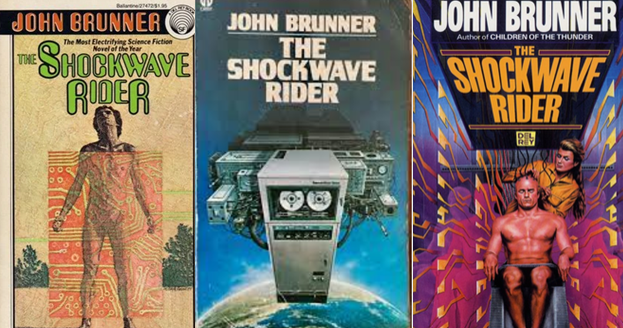
The Shockwave Rider

© 1975 John Brunner
288 pages

Nick Haflinger is a man of many names and identities, on the run from what passes for the government these days. With so much of the population constantly on the move, existing more in the plugged-in virtual realm than in reality — and with reality itself so flexible, people abandoning jobs and spouses and children in the blink of an eye when the whim strikes them — it’s hard to maintain order. Even so, Haflinger, a rebel, will find ways to attract trouble to him. No matter how many times he transforms his identity, his prodigious gifts at manipulating networks draw attention. Shockwave Rider is an exceptionally interesting novel, notable chiefly for its imagination: how, in 1975, did someone realize how radically disruptive networked computers would be to society? How did Brunner think up computer viruses, even coining the word ‘worm’ to refer to one?

The Shockwave Rider is a chaotic novel, frequently switching viewpoints and temporal frames even when its main character is not himself becoming different people. This is presumably deliberate, given that Brunner was writing inspired by the ideas of Future Shock and trying to convey a world even more in flux than our own: while we are on a runaway train called liquid modernity, the upset is worse in Brunner’s future dystopia, where a natural disaster has destroyed much of southern California, and entire populations are constantly on the move, chasing jobs or moving at whim. Society is severely unstable at every level: even families are not real units, since parents swap kids and spouses with as much thought as we do dishes at a restaurant — and readers are given the impression that most people deal with this through sedatives. The main character takes things even more seriously, frequently changing himself to escape the law or to gain access to networks that would otherwise be closed to him. Despite his technical talents, he encounters a young woman who sees through his psuedo-identities, into the man he really is. He’s disarmed by her, and their meeting will usher in a plot of tech-adventure and Nick’s finally taking a stand, instead of fleeing.

The Shockwave Rider is a difficult book to recommend — not because it’s bad, but because it’s somewhat esoteric. In its time, it was enormously far-seeing and experimental, and its artist’s vision makes it doubly interesting to those who take SF seriously, particularly the effects of the digital world on human civilization. Frankly. one reason I’m drawn to cyberpunk (and Shockwave Rider is the granddaddy of that genre) is because I believe whatever the perks, the disruptive energy of the digital revolution, coupled with human instincts that we have a marginal ability to control even under the best of circumstances, will ultimately lead us into nightmarish futures like that of Brave New World‘s — and BNW is arguably on the better end of human futures, since at least there most people are content. They are content because they have been severed from all that makes living real and worthwhile, but they’re not acutely miserable like the people we see in Shockwave Rider. This is definitely an ideas kind of book, and if you think seriously about the world we are creating for ourselves, about the effect the digital has on the real, you will enjoy it. If you’re going into it purely for a plot, though, you may be disappointed. There’s a plot there, but the delivery is rather disorienting — and that’s done pointedly, I think.

Coming up: I’m working on The Chaos Machine, and will be beginning The Neuromancer. Also reading Will Storr vs the Supernatural: One Man’s Search for the Truth about Ghosts. Storr’s Adventures with the Enemies of Science will be on my top ten list at the end of the year, I’m sure, and it’s an appropriate time of year to delve into a journalist’s hanging-around with ghost hunters.

Highlights:
“There’s a lot of brave new misery in our brave new world.”

“Take no thought for the morrow; that’s your privilege. But don’t complain
if when it gets here you’re off guard.”

“One might as well claim that the tide which rubs pebbles smooth on a
beach is doing the pebbles a service because being round is prettier than being
jagged. It’s of no concern to a pebble what shape it is. But it’s very important
to a person. And every surge of your tide is reducing the variety of shapes a
human being can adopt.”

“There was exactly one power base available to sustain the old style of government,”
Nick grunted. “Organized crime.”

Posted in Reviews, science fiction | Tagged , , | 6 Comments