The city with more bikes than cars

I’ve heard of Freiberg before, but one of my favorite channels recently just did a video on it. Enjoy (if you can while intensely coveting, like myself). I’m planning for a bunch of city-related reading in 2024!

Posted in General | Leave a comment

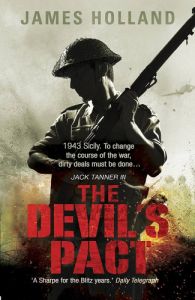
Devil’s Pact


Jack Tanner is just a working class lad from the west country. He doesn’t belong aboard a transport plane, waiting for his turn to jump into the darkness with an aim of landing somewhere in Sicily, hopefully to meet the Allies’ contact on the ground who can facilitate the imminent invasion of the same. It’s time for il duce to be bid arrivederci. That contact is a member of the Society of Honor, and the Allies’ curious collaboration with the Italian Mafia is explored somewhat in this book, giving an otherwise straightforward combat novel an interesting twist along with the usual Jack Tanner versus the Eminently Fraggable Officer thread that’s been used in most of the Tanner novels. It’s especially grating here, as Tanner and his immediate superior Major Peploe both have to contend with a new commander who is both craven and incompetent — not something someone you want leading you into an invasion against the combat veterans of the Wehrmacht.

Devil’s Pact has an odd beginning, in that Tanner is separated from his unit and tasked with escorting someone via paratroop drop to meet a Man of Honor in Sicily; after managing the mission despite things going sideways, Tanner evacuates and we leave behind the small-group action that defined the early novels in this series, going into the fullscale invasion of Sicily after some time back at camp, in which Tanner realizes that some loathsome officer from his early days has just been named his new commander, and still worse — some of the new arrivals to his unit are from the old homestead, and threaten to blab the secrets of a past Tanner is extremely taciturn about. The new officer, instead of focusing on the invasion, is instead wholly fixated on getting rid of Tanner – -again, not good when Germans in fortified positions are concerned, and such pettiness will cost more than a pound of flesh.

The Devil’s Pact was a solid end to this series, assuming Holland isn’t planning on writing any more. The setting of Sicily was fairly new to me (though Jeff Shaara visited it in his The Rising Tide, one of the first books I read on the blog), and I especially enjoyed the presence of the Mafia to add an interesting wrinkle to the Allies’ mission. Another appreciation is that the “Krauts and Eyeties”, as the Brits so lovingly refer to their opponents, are not reduced to Evil League of Evil-esque villains. The Italian officer is wholly sympathetic, unlike Tanner’s nemesis. My only grouse is that Tanner (and the reader, vicariously) don’t get to tackle and punch repeatedly the loathesome officer who gives Tanner such grief. I really hated him.

Posted in historical fiction, Reviews | Tagged , , , , | 1 Comment

Blogging prompt: criticize your favorite

Today’s prompt from Long and Short Reviews is to criticize our favorite film, show, or book. Hmm…

Star Trek Strange New Worlds:

See Boims’ face? That’s my “Strange New Worlds” face.

Strange New Worlds has rocked my world the last two years, and especially the last season. Although I’ve been a Trekkie for thirty years now, between the Abrams movies, the spiritless disappointments that were Discovery and Picard, and the murder of the Treklit extended universe to accommodate DSC/PIC novels, my enthusiasm for Trek was hanging on by a “at least there are older Trek books I haven’t read” thread. Then Strange New Worlds happened, and my phone and computer have SNW wallpapers and I’m thinking about writing ST fanfic. However, I can probably manage a couple of critiques: First, Jim Kirk, who isn’t an officer on Enterprise, has probably had more screentime than his brother George who is an officer aboard the ship. I actually like Wesley’s Kirk, but given that George dies young, I’d like SNW to let us get to know him. Similarly, Ortegas hasn’t gotten much love beyond her running away with “Lotus Eaters”. Her actress shines anytime she’s allowed to, so I’m hoping she gets some more attention in season 3. Thirdly, I’m a little wary about how they’re going to try to keep lore consistent as they push closer to “The Cage”: we’ve not seen either of the older doctors who appeared in “The Cage” or “Where No Man Has Gone Before”, and Dr. M’Benga’s apparently junior position in The Original Series is gonna need some explaining.

Posted in General | Tagged , | 4 Comments

Top Ten Authors I’ve Never Read

Today’s TTT, hosted by the Artsy Reader Girl, is authors we’ve not read. I’m going to be straining a little here- my fiction reading is so specialized (almost entirely historical or science fiction) that I’m not really plugged into who is popular…or who even exists!  But first, teases — these both from Uhtred’s Feast, a curious little volume that’s mostly an Anglo-Saxon recipe book but with three Uhtred short stories and occasional bits of background from Cornwell.

Strangely, not that I am old, I remember the women and never think about the victories. The memories of the women bring me comfort, while the victories are sour with the stink of blood, the death of friends, and the recollection of terror.

‘The Battle of Maldon’ […] was a description of a battle between Byrhtnoth, leader of an army of East Saxons, and a Viking band that hd taken up residence on Northey Island in the River Blackwater, which is not that far from Ashingdon. The Vikings won (again), but I recall a teacher telling us that the poem was ‘fanciful’ because the East Saxons on the bank of the river could have never heard a challenge shouted from Northrey Island; it was too far. That drove me and a few friends to Maldon, where we proved such a challenge was indeed audible, that expedition being the only serious original research I have ever undertaken.

Uhtred’s Feast

And now, authors I’ve not read!

1) Scott Turow.   When I began souring on John Grisham in the early 2010s, I looked for comparable authors and was told that Turow also writes legal fiction. I’ve yet to read him. 

2)  George R.R. Martin and 3) Robert Jordan   Considering how much stabby-stabby historical fiction I read, this epic of politics and fantasy in a pseudo-medieval setting should be right up my alley,  but I’v never taken the bait for these.  

4) Frank Herbert, author of the Dune series. I have the first one but have yet to seriously engage with it.

5) The Sisters Bronte. I’ll probably try Wuthering Heights at some point, if only for the Classics Club or Read of England.

6) PT Deutermann. I’ve heard great things about his historical fiction, but I’ve not yet managed to give him a shot.

7) Hilary Mantel. And not going to. I started Wolf Hall and returned it almost immediately. I cannot abide people who think they’re above punctuation.

8) Liu Cixin, author of Three Body Problem.

9) Phillipa Gregory. Given how many HF novels she has on both medieval England and Rome, two areas my historical reading spends a lot of time in, it’s odd that I haven’t really tried her.

And now to end, a bunch of nonfiction authors all in one go:

10) Arnold Toynbee, Daniel Boorstin, Paul Johnson — three historians who I’ve not gotten round to despite my interest in exploring their work — and Hannah Arendt, a historian/political philosopher who wrote The Origins of Totalitarianism.

Posted in General | Tagged , , | 14 Comments

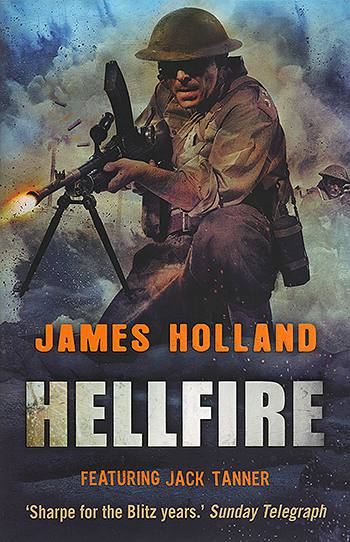
Hellfire

August, 1942. The English and the Germans have been trading punches with bloody noses for a while now, and while American tanks and G.I’s are on the way, the Desert Fox is still plenty dangerous — as he proves when the Luftwaffe assassinates the newest head of the Eighth Army before he even starts his job. CSM Jack Tanner is on medical leave in Cairo following an argument his back lost with an exploding shell, waiting for doctors to give him the all-clear. After looking up an old friend, Jack is asked to pitch in: British intelligence suspects there’s a German spy ring active in the city, and they could use someone with Jack’s street savvy to help sort out who it is. Hellfire is a fun mix of investigation and commando derring-do, and a departure from formula: unlike the first three books in this trilogy, there are neither obstructive British officers or an odiously evil, see-how-I-twirl-my-mustache-and-chuckle-with-menace Nazi present. Instead, Jack’s challenge is the ordinary: the hostile environment of northern Africa, the practiced and competent menace of the Afrika Korps, and…ooh, la la, a lady spy.

Jack Tanner surely gets around World War 2: he began The Odin Mission in Scandinavia, and now he’s arrived in Africa after visits in France and Crete. This series has always focused on small-group combat action, but here Holland mixes things up in several ways: Jack is out of commission at the beginning, engaging instead in some cloak and dagger investigation while waiting to heal up: finding the German spies, especially their potential mole, will become an increasingly important part of the story over all. Jack is thrown into a major battle (Alam el Halfa, I think), and then the book ends with some commando-esque antics that are more in line with the rest of the series. Personally, I liked the variety, and the growing emotional weight that the spy thread adds to the story. It’s utterly absorbing on the whole, so much so that I was late coming back to work from lunch two days running, not minding the clock at all as I read of ominious tanks rumbling in the night, skies made daylight-bright with sustained explosions, and a woman torn between her hatred for the Soviet Union and her unexpected love for an Englishman.

Very much looking forward to the last book, The Devil’s Pact.

Related:
Foxes of the Desert, Paul Carrell. A German history of Rommel’s campaigns in Africa
Operation Compass, a short history of an early Anglo-Italian dustup in Africa

Posted in historical fiction, Reviews | Tagged , , , , , | 4 Comments

Teaser Tuesday, war and body parts edition

This is a paraphrase instead of a quote, I’m afraid..

“What have they done to you? Lieutenant in His Majesty’s Armed Forces?!”
“I think they must have killed all the others off, sir.”

Hellfire, James Holland. Jack Tanner #4.

But when we socialise in disembodied ways online, even as biotech promises total mastery of the bodies we’re trying to leave behind, these efforts to abolish sex dimorphism in the name of the ‘human’ will end up abolishing what makes us human men and women, leaving something profoundly post-human in its place. In this vision, our bodies cease to be interdependent, sexed and sentient, and are instead re-imagined as a kind of Meat Lego, built of parts that can be reassembled at will. And this vision in turn legitimises a view of men and women alike as raw resource for commodification, by a market that wears women’s political interests as a skin suit but is ever more inimical to those interests in practice.

Feminism against Progress, Mary Harrington
Posted in General | Tagged , | Leave a comment

Nonfiction November

I just spotted a reading challenge over at Marianne of Let’s Read’s, called “Nonfiction November“. Given that my nonfiction reading reliably counts for 60% to 70% of my reading, it caught my attention: it looks like a series of reflections about nonfiction. Since I am a bit late to the a party, I’m going to answer both available prompts.

Week 1 (10/30-11/3)

Your Year in Nonfiction: Celebrate your year of nonfiction. What books have you read? What were your favorites? Have you had a favorite topic? Is there a topic you want to read about more?  What are you hoping to get out of participating in Nonfiction November?

I don’t want to say too much here because we’re not that far from end-year wrap-up posts, but it’s been a good year. Completed the science survey early, read into English history, went on a baseball streak, enjoyed Space Camp, went crazy for US presidents for a bit, and finally started reading some books on social media and big tech that had been on the list for a while. And then there was all the other stuff — even with all of the 1990s kidlit I read in early July for the “Blast from the Past” series, nonfiction is over 62% of my reading so far. Favorite NF so far would be Will Storr’s Adventures with the Enemies of Science.

Week 2:

Choosing Nonfiction: What are you looking for when you pick up a nonfiction book? Do you have a particular topic you’re attracted to? Do you have a particular writing style that works best? When you look at a nonfiction book, does the title or cover influence you? If so, share a title or cover which you find striking.

There are some topics I visit on a regular basis: I try to get a nice cross-section of science and nature reading with the Survey, I often focus on Anglo-American history in the spring and summer, etc. Although a fair bit of my nonfiction reading is done purely for pleasure and understanding, what unites much of my reading is the attempt to understanding what the flourishing life is for human beings, and how we might achieve it — something that unites seemingly disparate interests in say, evolutionary psychology, urban design, Stoic philosophy, and sociology. Titles and covers definitely make a contribution as far as attracting my attention: How I Killed Pluto (and Why It Had it Coming) being a prize example.

Posted in General | Tagged | 1 Comment

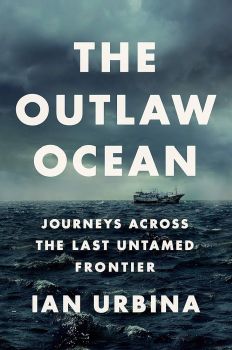
The Outlaw Ocean

The Secret Life of Groceries was a disturbing wake-up call for me last year, exposing as it did how slavery is a core part of the fishing industry that supplies seafood the world around — in which men are trapped on boats and denied an avenue for escape, because their ships never go into port, instead receiving supplies and offloading goods to other ships that frequently service the big trawlers. The Outlaw Ocean takes that kind of exposure and runs with it, diving into the murky spectrum of human behavior that flourishes in the wide open spaces of the great oceans, where the law strains to reach and enforcement of it is difficult in the extreme. Here we find environmental vigilantes chasing poachers, luxury cruise liners dumping trash into the ocean, repo men commandeering boats, slave-based fishing ships operating with impunity, and armed ships fighting for fishing rights in the South China Sea. Here, amid the hardships of life at sea made worse by the cruelties that men inflict on one another, we aslo find little dashes of heroism — men who document sights they could be killed for sharing, and others who sabotage poachers’ equipment and hound them on the high seas. Ian Urbina is crazy, admirable, and tough. Working on the high seas is dangerous and wrenching work by itself, given the sheer force of wind and wave that assails ships and seamen, but in chasing stories, Urbina embedded himself for weeks at a time aboard various ships and sometimes made himself a target through his inquiries, and Outlaw Ocean records a few harrowing moments when he was very possibly the target of some bad actor’s plans. Illegal activity abounds on the high seas for a multitude of reasons: incentive, for one, as there’s always money to be made….and that applies closer to land, as Urbina encounters evidence of gangs/alleged governments/gang-state entities overlooking their own ‘laws’ to reap profit in the form of bribes. The sheer size of the ocean also makes enforcement difficult, as ne’er do wells sometimes turn off their transponders: one of Sea Shepherd’s vessels had to patrol an area the size of Australia while trying to find a Japanese fishing trawler operating illegally in international waters. This was definitely an eye-opener into the complexities of marine law and the debasement its weaknesses allow for.

Related:
The Crimes Behind the Seafood You Eat“, recent New Yorker article by Urbina.
The Secret Life of Passwords”, Ian Urbina. Same author. He’s an interesting journalist.

Posted in Politics and Civic Interest, Reviews | Tagged , , , | 3 Comments

Highlights from People vs Tech

Moments ago, I finally posted a review for a book I read back in September, The People vs Tech.

We won’t witness a repeat of the 1930s, everyone’s favourite analogy. Rather, I believe that democracy will fail in new and unexpected ways. The looming dystopia to fear is a shell democracy run by smart machines and a new elite of ‘progressive’ but authoritarian technocrats. And the worst part is that lots of people will prefer this, since it will probably offer them more prosperity and security than what we have now.

Being always under surveillance and knowing that the things you say are collected and shared creates a soft but constant self-censorship. It might not feel like that when people are screaming abuse on Twitter – but for every angry troll there are hundreds of quiet users, lurkers who watch but don’t post, for fear of the angry Twitter mob, the data collectors, a nosy employer or the hordes of professional offence-takers who shark around the net waiting to be upset.

Developing the faculties to think for oneself requires that people say controversial things, make mistakes and learn from them. But social media creates a strange form of performative politics, where we all act out certain roles and acceptable public responses (this idea is bad! This person is good!), which limits the room for genuine personal growth.

Numbers are intoxicating, because they hold out the promise of a pure, exact, judgement-free answer. Algorithms are doubly so, since they appear to be logical and objective calculating machines which draw on millions of examples.

Nearly five million Brits have already used the voting app ‘iSideWith’ in multiple elections. The fact that five million people asked an app that they barely understood how to fulfil their most important duty as a citizen bothered exactly no one.

McLuhan, the great prophet, was far too smart not to hedge his bets. He also said that conflict and disharmony was possible in a world where everyone was connected to everyone else, because information-at-all-times would be so discombobulating that it would spark a mass identity crisis. ‘The day of political democracy as we know it today is finished,’ McLuhan told Playboy Magazine in a 1969 interview. ‘As man is tribally metamorphosed by the electric media, we all become Chicken Littles, scurrying around frantically in search of our former identities, and in the process unleash tremendous violence.’2 CEOs, high-profile endorsers, hangers-on, early technologists and politicians all tended to ignore this bit, because these sorts of people much prefer optimism to tremendous violence.

At times ‘post-truth’ has become a convenient way to explain complicated events with a simple single phrase. In some circles it has become a slightly patronising new orthodoxy to say that stupid proles have been duped by misinformation on the internet into voting for things like Brexit or Trump. In fact, well-educated people are in my experience even more subject to these irrationalities because they usually have an unduly high regard for their own powers of reason and decision-making.

Kahneman’s main point was that there are two basic systems that govern human behaviour. ‘System one’ thinking is fast, instinctive and emotional. It’s the reptilian brain, running on instinct. By contrast, ‘system two’ thinking is slow, deliberative and more logical.7 It sometimes, but not always, acts as a check on those wilder rages. Modern democracies aspire to run on ‘system two’ logic, and its ideal citizens are McLuhan’s literate man. Its institutions are arranged to arrive at logical, thought-out, fact-driven decisions. The internet, by contrast, more closely resembles ‘system one’: everyone and everything is immediate, instinctive and emotional.

In 2001, cyber-psychologist John Suler explained why this was, listing several factors that allow users of the internet to ignore the social rules and norms at play while offline. Suler argues that because we don’t know or see the people we are speaking to (and they don’t know or see us), because communication is instant, seemingly without rules or accountability, and because it all takes place in what feels like an alternative reality, we do things we wouldn’t in real life. Suler calls this ‘toxic disinhibition’. This is what all the articles about ‘echo chambers’ and ‘filter bubbles’ miss. The internet doesn’t only create small tribes: it also gives easy access to enemy tribes. I see opposing views to mine online all the time; they rarely change my mind, and more often simply confirm my belief that I am the only sane person in a sea of internet idiots.

Over the last 200 years, individual liberty and wealth have grown hand-in-hand, because freedom was good for the economy, and that economy produced more well-off people who valued freedom. What if that self-reinforcing cycle was weakened? What if economic growth in the future no longer depended on individual freedom and entrepreneurial spirit, but on capital and the ownership of smart machines that can drive research and entrepreneurship? What need would the rich then have for the poor they neither knew nor liked? In this scenario, ‘universal basic income’ wouldn’t be a dreamy utopia of satisfied and empowered citizens, but instead a very neat way for the millionaires to keep the poorest in society from rebelling.

The iPhone and web browsers we now all use have carried the Californian Ideology around the world, infecting us all with the alluring idea that disruption is liberation, total individualism is empowerment and gadgets equal progress.

That’s the final realisation of the crypto-anarchist fantasy. A world of lonely one-per-centers, freed from all constraints and social commitment – anonymous ghosts in the machine.

Posted in quotations | Tagged | 1 Comment

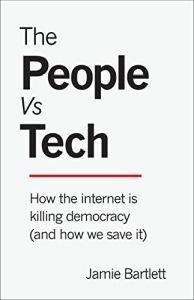
The People vs Tech

249 pages

Democracy must bring big tech to heel, adapt itself to thrive despite big tech, or perish. Born of different times, with different expectations, they cannot coexist in their present date: the latter will surely destroy the other. In The People vs Tech, Jame Barlett examines six aspects of a healthy democracy that big tech is already challenging, or will in the future. These include independent-minded citizens, a shared culture based on a common reality, free elections, an economy allowing for participation and good-enough equality, and trustworthy authority. There is considerable food for thought here, and it’s presented in admirably nonpartisan fashion, so that even if a reader disagrees with Barlett, his view is approachable and understandable.

Much is discussed in his chapters on these six pillars. We begin with how tech nudges us into compulsive behavior, chilling or warping our thinking, and aiding and abetting in our self-infantalization by doing mental work for us. You don’t want to read a pdf? Bing has a helpful new AI companion which will reduce it to a few bullet points to memorize and forget. Were there sudden flashes of insight you might have gotten in reading the article and unexpectedly drawing connections to your own experiences or other reading? Oh, well, that’s life. We move on to how through our own choices and the recommendation engines, users of platforms like YouTube and Facebook sink into narrower and narrower worldviews, losing common frames of reference with citizens beyond their in-group. We see, too, how the hurricane of stimulation that sweeps over us online, the constant demands to Respond! Now! undermines our ability to think deliberately. How can we understand someone else’s worldview when our own has not been developed purposefully, but is instead a pile of reactions? Similarly, the data profiling of consumers which allows micro-targeted ads can be uses to sell politicians based on a single issue instead of people voting on a broad, cohesive platform. We then move into what big tech might do to society at large, if automation creates hyper-inequality and leaves most of the population with no meaningful way to contribute economically, and by moving every bit of civil society onto its platforms. Finally, Barlett examines the potential perils of cryptography: if the main reason people tolerate the state’s incursion to their rights (its taxes, its self-asserted monopoly on violence, its prisons) is security, and cryptography undermines the state’s ability to find and police bad actors, what then?

As someone whose young adult mind was formed by tech critics like Neil Postman and Nicholas Carr, I can’t offer any serious arguments against Barlett here, on the whole. Much of what he says has already been on my radar, although the last two chapters were new to consider, and the latter was particularly thought-provoking given my conflicted sympathies. There was much in here I appreciated being reminded of, of lessons updated for the current day — what we give away in agency and maturity when we rely on machines to do more of not merely our manual labor, but our mental work as well. I’m not convinced that automation will lead to the extreme inequality he predicts, though I can appreciate why he sees that coming. His example of Silicon Valley as a hyper-equal community was off, though: homelessness abounds in southern California not because Google and Facebook’s execs are distorting the labor market, but because the mild climate attracts those in need, and the local governments are generous — to a fault, both in what they give and what they tolerate, behavior wise. One limitation of the book is that Barlett doesn’t offer much in the way of solutions, though these are big problems and the nature of them precludes easy answers. How do you put the crypto-graphical cat back in the bag?

Related:
The Dark Net, Jame Bartlett. On the darker parts of humanity released by the internet, especially the parts hidden from public view.
Player Piano, Kurt Vonnegut. In an automated future, the only people with anything to do are those who manage the machine.
Them: Why We Hate Each Other, Ben Sasse. Chapter on “anti-tribes” is especially relevantt to one of Barlett’s points.

Posted in Politics and Civic Interest, Reviews | Tagged | 3 Comments