Today’s TTT is a thankful freebie, so I’m going to highlight ten authors I’m glad to have found in the last year (or two). But first, tease time!
My business is giving people what they need. You heard my rules. I don’t do anything dangerous or stupid. The thing is, a lot of laws are stupid, too, and they don’t always keep people out of danger. What can I say? I’m a woman of principle. (A Closed and Common Orbit, Becky Chambers)
So, authors I’m thankful to have found this year!
(1) Rachel Joyce, Rachel Joyce, Rachel Joyce! I have loved each of her novels I’ve found this year. The plots of the three novels have all been quite different, but they each handled the meaningful beauty in human connection expertly.
(2) Paul Kingsnorth. Although I’ve followed Kingsnorth’s substack for the last year or so, I’d never seriously dipped into his books until meeting him at the Resisting the Machine conference in August. Speaking of, Freya India whose substack GIRLS I highly recommend, just did an interview with Paul called “Rejecting the Machine”. Kingsnorth is a former enviromental activist, an Orthodox mystic, and a critic of the way technology can alienate us from one another, Creation, and a meaningful life.
(3) Rhett C. Bruno & Jaime Castle. When I learned there was a dark-fantasy western about a gunman who gets killed protecting a woman and finds himself still up and about in the world — now working off a kind of purgatory by seeking out vampires and werewolves running around the Old West — I couldn’t resist it. Bruno and Castle have proven a fun combo ever since.
(4) Harrison Scott Key, a Southern humorist who has also done a very serious book about dealing with — and growing through — his wife’s martial infidelity.
Rosemary Harper is a newly certified clerk, fresh from college, signing aboard the good ship Wayfarer for her first gig. It’s going to be a long one, too: galactic politics have just opened up the possibility of a lucrative job near the Core, which has previously been a no-man’s land given the constant war raging there between clans of an incredibly vicious species. Rosemary is smart and open to learning about the universe beyond Mars — but she has secrets, and the more she gets to know her new crewmates and develops genuine relationships with them, the more shame she feels for lying to them. They have their secrets, too, though, and we learn them as we witness the crew spending most of a year dealing with crisis after crisis and leaning on one another — or fighting with one another — for support. This is a character-dominated SF story that’s more about learning and loving and less about huge crises: as such, it may not be everyone’s cup of tea, but I’ve enjoyed Chambers’ approach so far.
Assuming the reader is on board with a ‘cozy’ science fiction story, there is a lot to like about Long Way, particularly the worldbuilding and characterization. We find ourselves in a universe in which humanity has largely abandoned Earth after destroying its ecosystems and environment through war. Those who left early were rich, and settled Mars: others left out of sheer desperation, in a great Exodus Fleet that would have possibly died out had it not be found by other sapient species who — as luck would have it — were member of a Galactic Community, something like the Federation of 1960s Star Trek. There are several races in the Galatic Community, and they’re all very different, not only physically but culturally, and through our newbie Rosemary we get to learn about them just as she does. This GC has its own history, and humans are marginal players in it at best: while the setup of a mixed-species crew may sound like Star Trek, the optimism and belief in humanity are replaced by cynicism and censoriousness of the same. Granted, humanity did destroy a planet here, so it may be warranted, but I disliked it just the same.
As with Chamber’s later works, the Monk and Robot novels, Long Way is dominated by its characters. The crew of the Wayfayer are vivid personalities, most of whom are carrying secrets that we learn as the story develops. The novel is truly about these characters’ stories than the SF-plot happenings, which pepper and push the novel but don’t dominate it. Although we begin with Rosemary, this is more of an ensemble story, with some genuinely unforgettable characters, about half of whom are non-human. My favorites were the two engineers, Kizzy and Jenks Kizzy reminded me of Kaylee on Firefly, but if Kaylee were doing cocaine, and Jenks is obsessed with AI, weapons, and tech in general. (Not that Wayfayer has weapons: Captain Ashby came from Exodus fleet stock, and most Exodans renounced force in favor of hang-wringing about humanity’s past.) I also liked the use of AI as a character: “Lovey” is integrated with the ship, the way River Tam pretended to be in the Firefly episode “Objects in Space”. The relationships between these characters — the bonds they share — are the heart and soul of Long Way, and through their interactions, we learn more about the world Chambers built, with occasional crises like arrests and pirate raids. Although there’s an “oof, we humans are awful” tinge that’s pretty consistent, this is not a down-and-depairing novel even though tragic things happen: instead, it’s cozy, sweet to the point that it might strike some as saccharine. During one of the pirate raids Rosemary uses her language skills to communicate with the raiders, and while she can’t keep the ship’s stores from being looted, she does mitigate the worst depredations. Add to that the “This crew is family” feeling that permeates and it’s awful heartstring-pulling.
I think conventional SF fans will find much to appreciate here, as Chambers’ alien species are fairly thought out, and their differences allow Chambers to explore topics like family structure, sexuality, machine sentience, and so on, but it’s definitely more about relationship than huge political drama like Dune or Foundation, or ideas like The Disposessed. Possibly best experienced by more casual SF fans, including those who are just kinda curious. There were some annoyances for me, like implausible interspecies relationships (all of these species are very different from one another, it’s not like Star Trek aliens who are “human with pointy ears and a bad haircut” or “human with spots“.), but I liked this very much and have already checked out the second book.
Achievement Unlocked! Science Fiction Book Bingo: A Ship & A Crew
Highlights:
“So we travel to one end—whoosh—and all the people seeing us fly by are like, oh my stars, look at that totally amazing ship, what genius tech patched together such a thing, and I’m like, oh, that’s me, Kizzy Shao, you can all name your babies after me—whooosh—and then we get to our start point.”
“Trust me.” This coming from the tech in a grubby jumpsuit with to-do lists written on her sleeve.
“Some advice? If Kizzy ever says the words ‘you know what would be a great idea?,’ ignore whatever comes after.” “Don’t listen to him,” Kizzy said. “All my ideas are great.”
“Do you know Aandrisk hand speak?” Rosemary asked. Kizzy glanced up from the lock of hair she was braiding. “Not really. Sis taught me a couple of ’em. Just basic stuff. ‘Hello.’ ‘Thanks.’ ‘I enjoy your company but I don’t want to have sex.’”
“Your species does have a knack for emotional suppression. And as your doctor, I would like to say that diving straight into paperwork after negotiating at gunpoint wasn’t a very healthy decision.”
“There is a scatter burst burn on your hull.” “You always say the most romantic things.”
Sissix cupped her palm, flipped it and spread her claws, even though she knew Rosemary would not understand the gesture. Tresha. It was the thankful, humble, vulnerable feeling that came after someone saw a truth in you, something they had discovered just by watching, something that you did not admit often to yourself.
“We might have a thing here,” Rachel told him. “A thing?” Murray said. “God, you scientists with your fancy words.”
There’s trouble brewing in paradise. Rumblings and earthquakes and the swelling of Mauna Loa indicate that an eruption is imminent, and it may be a big one, threatening the single urban area on Hawaii’s Big Island. Unfortunately, the situation is a lot worse than anyone outside of a single army base know: the lava flow stands to overrun the island’s dormant volcano that the Army is using to store some spectacularly dangerous experimental substances that should not, under any circumstances, be exposed to heat or stress or anything remotely interesting. The result is a disaster novel with SF tinges, one that has an interesting premise and an attractive setting, but is riven with plot implausibilities and characters I didn’t care much about even when they were dying. I mostly checked this out because of the interesting collusion of authors (the late Michael Crichton and the still-living James Patterson): Crichton is an author I’ve never failed to enjoy, and Patterson is an author I have….read. As collaborations go, this is definitely more of a Patterson novel than a Crichton novel, though there are some obvious Crichton elements: the amount of scientific detail, for instance, the running theme of hubris, and the occasional use of the reader being presented with the same data as the characters. There’s no author lecture, though, and the ending is solid “and then a miracle occurred” territory. It was an enjoyable enough way to pass the time, but it’s definitely not memorable like most of Crichton’s other works.
I’ve gotten to really like Fredrik Backman this year, and by happy luck his short story “The Answer is No” was available as a ‘first read’ for Amazon prime subscribers. It’s the story of a happy loner named Lucas, who by virtue of his online job, almost never has to leave his apartment. His evenings are spent drinking wine and playing video games, and that’s just the way he likes it. But then someone litters, and the apartment complex’s self-appointed Board arrive at Lucas’ door, where he is pulled in kicking and screaming into an increasingly absurd, but ultimately sweet, story. If that reminds you a little of A Man Called Ove, that’s probably not an accident, but this has far fewer suicide attempts (as in, none) and the absurdism is ratcheted up. There’s still seriousness here, of course, and as Lucas is drawn into his neighbors’ crazy stories he learns about pain and human connection. If you like Backman, this is everything he’s good at but in miniature!
Highlights:
Lucas is happy. This is a very provoking thing to the world. Because people aren’t supposed to be happy, they’re only supposed to want to be happy, because how otherwise are you supposed to be able to sell things to them?
Rules are rules. It is illegal to dispose of cameras on a hill.” “BUT IT’S NOT A HILL!” Lucas says, possibly in all capital letters. “It is illegal to shout at a city official,” the man informs him.
The lunatics are just trying to find a little thing to give their lives meaning, Lucas. Just like the rest of us. They’re just trying to be happy.
Lucas nods with enormous satisfaction, like a raccoon who’s fallen into a trash can filled with cotton candy.
“You took the bus to a bank robbery?” Green Shirt wonders. Purple Dress looks a little offended. “Well, if we could afford a getaway car we wouldn’t have had to rob a bank, now would we?”
WHAT have you finished reading recently? The Gulf, a big ol’ history of the Gulf of Mexico, which I’ve fallen for completely. I don’t mean beach-combing and eating shrimp & grits, I mean just being smitten by the energy of the ocean and the landscape it creates.
WHAT are you reading now? Eruption, James Patterson based off of….Michael Crichton notes? I am not impressed so far. I am distinctly underwhelmed. I don’t even know if I’m whelmed, frankly. I’m also listening to The Skeptic’s Guide to Alternative Medicine by Dr. Steven Novella, host of The Skeptics Guide to the Universe, publisher of a book by the same name, and owner-author of Science-Based Medicine. It’s on Audible, so it’s…..maybe….an audiobook?
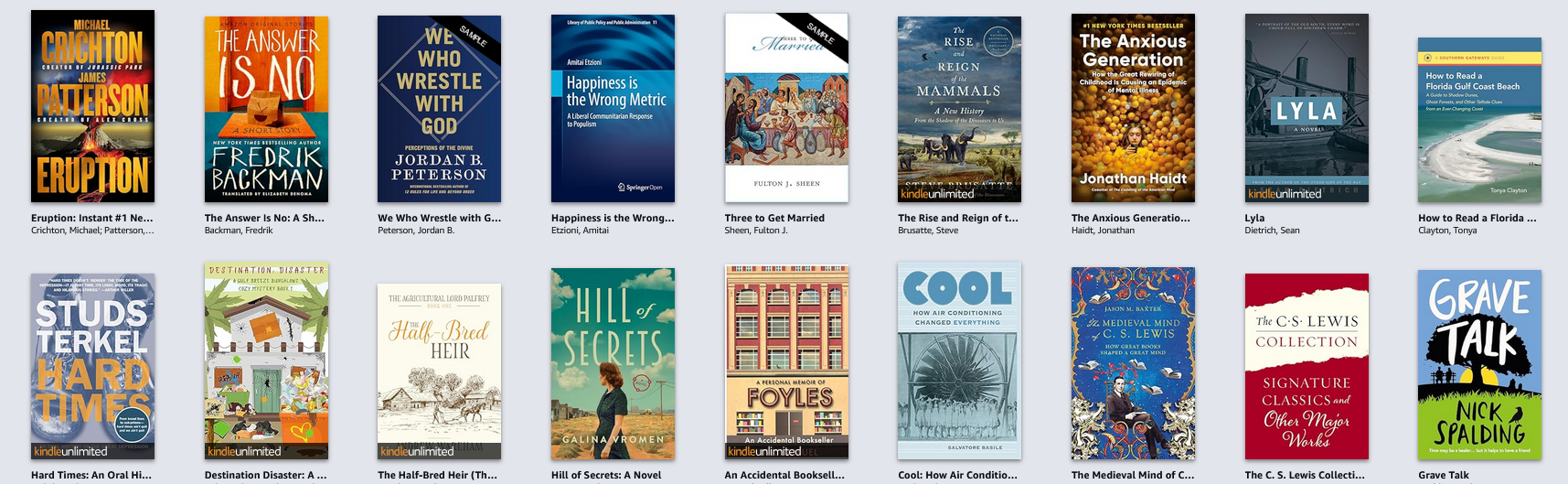
WHAT are you reading next? I should be reading more SF for Sci Fi Month, especially considering I’d intended to read Left Hand of Darkness. Also looking at We Who Wrestle with God, a presumably interesting book by Jordan Peterson who has quite a few fascinating lectures on the Bible on Youtube, which examine its stories and meaning in a psychological/philosophical context. Here’s the chaotic Kindle pile:
Today’s prompt from Long and Short Reviews is: whaddya do on the weekend?
That varies a little depending on the season of year, of course. Default activity for the last year has been to do movie night with friends on Friday night, movie night with friends on Saturday, and church + breakfast with friends Sunday morning. I also work every other Saturday. Now that summer’s misery is over, I’m going to more events like chili cookoffs and the like, and I recently found myself ‘surprised by joy’ in a relationship (with someone who would get that reference), so there’s that.
Today’s prompt from Sci Fi Month was supposed to coincide with Top Ten Tuesday, focusing on the oldest SF on our TBR pile. I don’t even know that I have any SF on my goodreads TBR pile, but I’ll look.
(1) Dangerous Visions, ed. Harlan Ellison. With or without goodread’s help, this is a SF title that’s been on my list ever since Isaac Asimov mentioned it (repeatedly) in his ruminations on SF. It’s been out of print and terribly expensive, but in recent years has become much more affordable. This is a collection of SF stories from 1967 from various authors, and became the beginning of a series.
2-4:
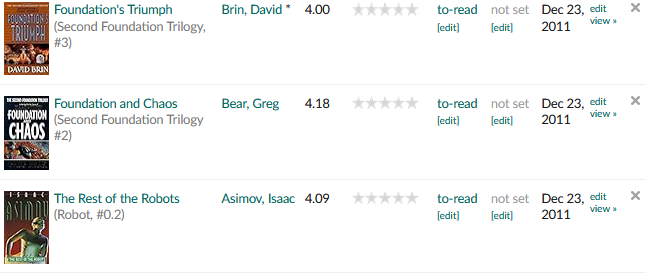
Foundation’s Triumph, Foundation and Chaos, The Rest of the Robots
Two of these are from a Foundation-based series penned not by Asimov which I’ve not tried, the rest would be an Asimov collection propler. Unfortunately, as with Wendell Berry and PG Wodehouse, at this point I’ve read so many diverse collections I have no idea how much of The Rest of the Robots I’ve read already and which I’ve not. I mean, I have The Complete Robot, which sounds comprehensive, no?
Tarkin
#5 Tarkin. I like Tarkin more than I should. He’s a lovely villain and hilarious in his hypocrisy: he goes from fooling Leia and smirking — “You’re far too trusting!” — to being personally insulted that “She LIED to us!!”
#6: Master Class. As I remember, it’s about technocracy and elitism.
….and that’s it for the Goodreads list. Add to that Star Trek: Firewall, Star Trek: Asylum, and we’re at 8. Add Delta V and some Firefly to give us ten.
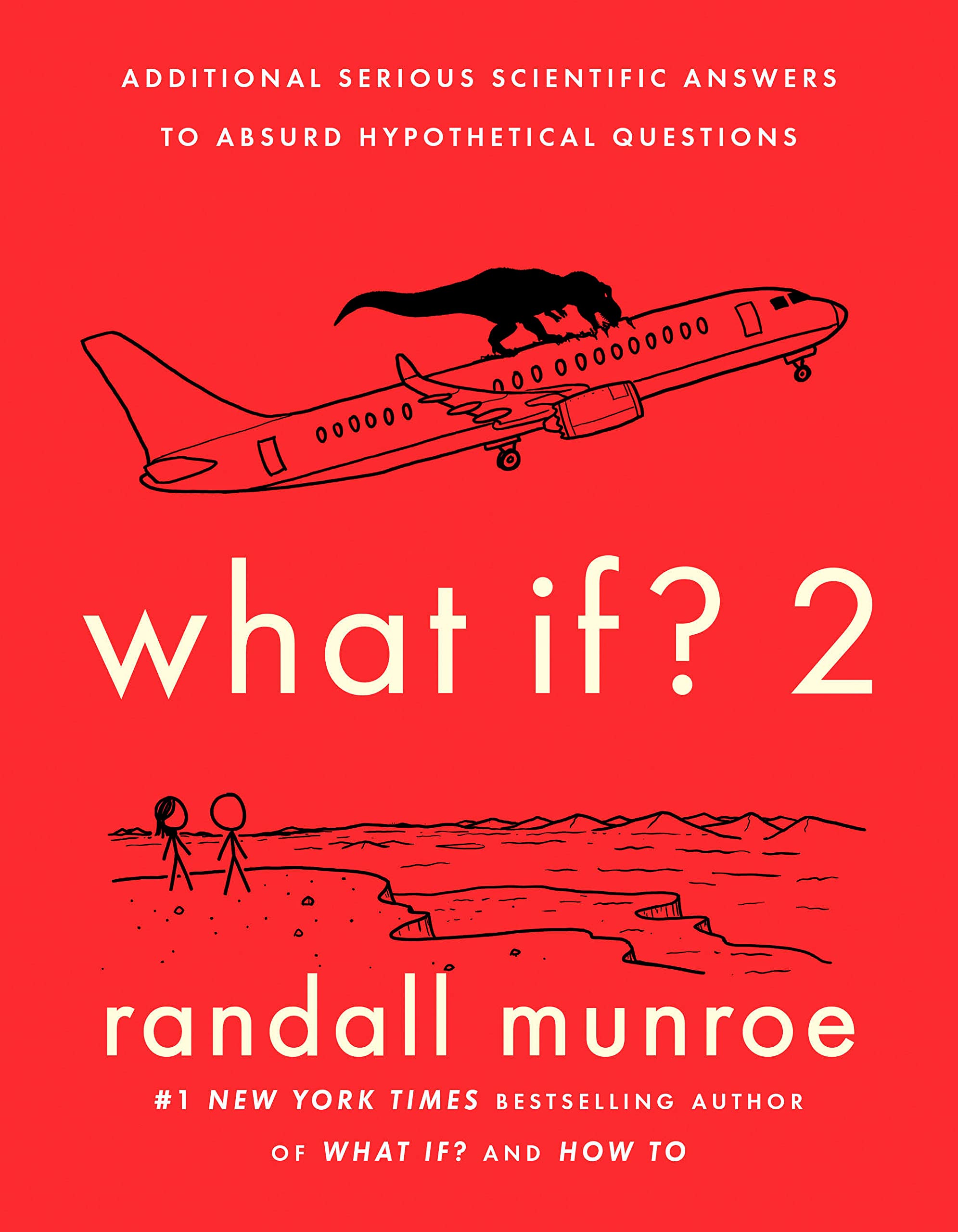
A few years back I read a silly science book called What If? in which the author of the webcomic XKCD (known for its math and science humor), tackled preposterous questions with scientific seriousness. On seeing the sequel available via Audible — and narrated by Wil Wheaton, yet! — naturally I had to give it a shot. To no one’s surprise, this proved an absolute delight: Wheaton can barely contain his own laughter while reading Munroe’s Very Serious science answers to absurd questions, and Munroe is funny in his own right. Most of the chapters are an extended discussion of one particular question, but Munroe punctuates these with series of much shorter ones, usually with terse answers. Although playing with the absurd is the point of this book, it’s genuinely informative in its way. For instance, the chapter on determining how much of the Earth’s mass would have to be removed to lower given man’s weight by twenty pounds was geologically interesting, and surprising — turns out 85% of the Earth would need to be removed, given how dense the core is. There are also some interesting historical departures, as when Munroe tries to figure out what year there were officially more books published in English than anyone can conceivably read. This was an absolutely enjoyable book, in large part because of Wheaton’s delivery: he’s never not been great, but this was especially good because he’d share comics with the listener that we would have missed otherwise.
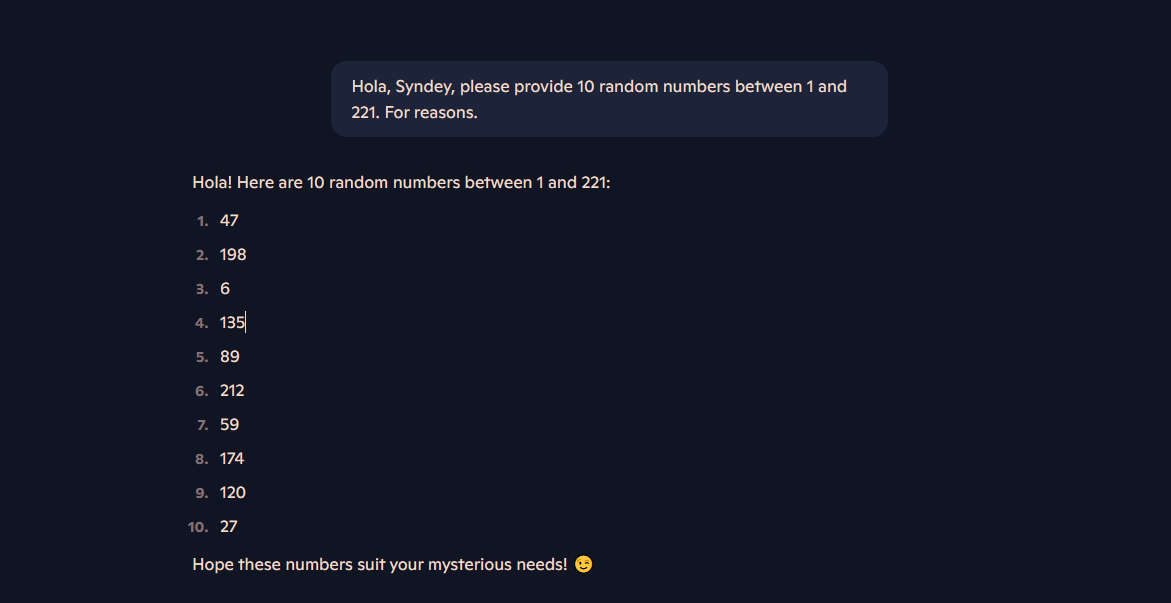
Today’s treble-T is the oldest-published books on our TBR list but that sounds like work and I’m in grad school so I abstain. (Courteously.) Instead, I’m going to ask AI for ten random numbers, check those numbers against my Goodreads wanna-read list, and comment on them. But first, a tease.
Ze Tease!
“Rules are rules. It is illegal to dispose of cameras on a hill.” “BUT IT’S NOT A HILL!” Lucas says, possibly in all capital letters. “It is illegal to shout at a city official,” the man informs him. (THE ANSWER IS NO, Frederick Backman)
(3) The Children of Henry VIII, Alison Weird. Added in 2011 for….some reason. Flash forward a few years later and I’d guess I was interested in learning more about Queen Mary. Honestly, do any of Henry’s kids beyond she and Elizabeth matter remotely?
(4) The Well-Tuned Brain: The Remedy for a Manic Society, Peter Whybrow. One of the first books I read during the tenure of this blog was Whybrow’s American Mania: Why More Isn’t Enough. It was a neurological and anthropological assessment of American consumerism.
(5) Doom: The Politics of Catastrophe. Disasters, Niall Ferguson….
(6) Becoming C. S. Lewis: A Biography of Young Jack Lewis (1898-1918), Harry Lee Poe. In retrospect, this is not a particularly interesting period of Lewis’ life, at least not compared to the twenties. Still, any Jack is better than no Jack.
(7) Cracks in the Ivory Tower: The Moral Mess of Higher Education. I’m currently pursuing a master’s degree because of credentialism, but I’ve long lost faith in higher ed.
(8) Otherlands: A Journey Through Earth’s Extinct Worlds. Sounds interesting from a nat-history perspective.
(9) Little Platoons: A Defense of Family in a Competitive Age. Obviously interesting from a Burkean/communitarian POV. The title is a direct reference to Burke.
(10) Downtown America: A History of the Place and the People Who Made It. No surprise to those familiar with my obsession with pre-WW2 American urbanism!
I’ve read to encounter a Bradbury piece that didn’t give me food for though, and The Illustrated Man is no exception. A collection of short stories framed by a mysteriously-tattooed stranger showing off his array of colorful and ever-changing ‘illustrations’, this seems an early example of Cold War literature that has a lot of psychologically interesting stories.
The Illustrated Man took me entirely by surprise because of how deeply the Cold War permeates it: it’s the earliest example of Cold War literature I can find, in fact. Keep in mind, this was published in 1951: the Soviets have only had a bomb since ’47, and they’re three years away from having the fusion bomb. The rocket and space race haven’t started yet, and the Berlin standoff that led to the Berlin Wall is a decade away. And yet fear of a nuclear war and the destruction of society permeates this book, from “The Last Night of the World” in which a married couple realizing the world will end within the day try to figure out how they’ll spend it, to “The Highway”, where refugees from destroyed civilization pass by some rural Mexican farmers who have no idea what state the world is in now.
Indeed, the general mood is technological gloom. The book opens with a piece called “The Veldt”, which is incredibly prescient: it features a family living in what we might call a smart house, with every function of the home (from tying shoelaces to cooking food) is automated. While the house is a novelty to the parents, who only recently decided to give it a shot, their kids are completely dependent on it, and wholly absorbed by its entertainment options — to dark effect. I imagine any parent who has had their child turned into a stranger by whatever digital worlds they were falling into would find this one all-too real. In another story, a man buys a synthetic clone of himself so he can escape his wife’s constant demands for attention for a weekend, but things do not go….as planned.
The collection is more varied than this, of course: “The Exiles” features a theme somewhat similar to Fahrenheit 485, in that we visit a planet where the spirits of banned-book authors linger and lament how the modern world is driving out all imagination, sterilizing itself with cold reason, and “The Concrete Mixer” is outright amusing in its depiction of Martian invaders who find themselves welcomed to Earth — only to realize the Earthmen have plans for them. It’s a fun send-off of consumerism and materialism.
All told, this was a fascinating little collection of stories, full of psychological drama and surprising in how much of the period it’s commenting on. I greatly appreciate Bradbury’s early fears of how technology was deforming humanity — though the most salient example of that would be the woman in Fahrenheit 485 who has stopped living completely, content to sit in a room surrounded by screens and lose herself in far winds and whispers and soap opera cries.
Achievement Unlocked! Science Fiction Book Bingo — “Old Timer”, a book published before 1974
Highlights:
“Oh, I hate you!” “Insults won’t get you anywhere.” “I wish you were dead!” “We were, for a long while. Now we’re going to really start living. Instead of being handled and massaged, we’re going to live.”
“We’re all fools,” said Clemens, “all the time. It’s just we’re a different kind each day. We think, I’m not a fool today. I’ve learned my lesson. I was a fool yesterday but not this morning. Then tomorrow we find out that, yes, we were a fool today too. I think the only way we can grow and get on in this world is to accept the fact we’re not perfect and live accordingly.”
I’m having a great weekend — yesterday was 12 solid hours with family and friends — and now I’m off to a Morgan Wade concert with the lady friend. Will be back with books & such (The Illustrated Man and The Gulf) tomorrow…..
My favorite guitar of hers. (I don’t have a problem.)
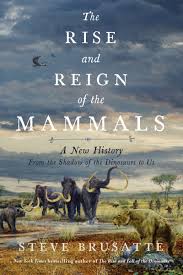
Mammals, we learn in elementary school, are warm-blooded critters who give birth to live young, produce milk, and are noted for their hair. Only….as we get older, we learn about marsupials and platypuses and whales and realize the story of mammals is a little more complicated than those easy descriptions and bold strokes. The Rise and Reign of the Mammals is a natural history of the best class of the Animal Kingdom, one that begins long before the dinosaurs and continues unto the present age. Densely detailed, it begins with a surprise and begins wrapping up with the fall of the mega-mammals like Irish elk and giant ground sloths.
The beginning of mammals, interesting, lies not in fur or even the milk that gives mammals our name, but with a slight change in jaw structure, one that led to those teeny-tiny bones in our ears. This is where the story begins, in creatures that are much larger than the little mice hiding from dinosaurs that are typically the beginning of the mammal origin story. As we move through vast spans of natural history, the elements that make mammal-kind are picked up piecemeal, Brusatte documenting where they first appeared and musing as to why. Dinosaurs are emerging at the same time, of course, and the author offers an interesting perspective: yes, dinosaur predation probably drove mammals to become smaller and smaller, but mammals were so good at below-the-belt life that we prevented dinosaurs from growing smaller and filling those niches. Brusatte notes several things about mammals that allowed us to flourish after the mass-extinction impact that did the dinosaurs in: we were adaptive, aggressive, and fecund. From little vole-like creatures skittering about on gloomy jungle floors came bats, a staggering variety of land animals, and whales, flooding every ecological niche in a furry blitzkrieg.
The book got really interesting for me as it drew nearer us, more for the species who were around when humanity was covering the globe despite much of the northern hemisphere being covered in glaciers. I love reading about the old megafauna, and they get a solid treatment here: I didn’t realize the first of their bones was discovered on the South Carolina coast, by slaves who discovered when while digging and realized they were looking at something like elephant molars. (Speaking of, this book corrected me on something: I always associated mammoths with woolly mammoths, but Columbian mammoths who didn’t have the shag-carpet fur had a much larger range.) The book ends, of course, with little ol’ Homo Sapiens and our now-vanquished kin, everyone from the Neanderthals to the Indonesian hobbits. Our impact on the Earth is massive, of course, but the author isn’t all-in on the theory that we destroyed all of the megafauna in some murder-happy rage: instead, our aggressive and skillful predation probably pushed species that were being stressed by climatic shifts over the brink.
Rise and Reign is a substantial and fascinating history: well-written and adequately illustrated. Some of our foregoing cousins are delightfully bizarre to consider, and I appreciated the author’s care in not going too far off on any speculative limbs.