Grad school has kept me very busy this semester, with serious deadlines every single week. It would be the reason I haven’t posted any reviews in the last week, though there are a couple upcoming, if only in a short-round form. Tomorrow’s assignment was to create a book brochure & accompanying video promoting “Thrillers”. (Thrillers was my topic — others got banned books, Hispanic Heritage month, etc.) I have almost no experience with video editors (having used Windows Media Maker for very primitive projects), so I’ve been getting accustomed to Filmora today. This is the video I uploaded for class, and while it has its problems (some vocal pauses, no transitions, etc), I thought it would be interesting to share here given that all the books I talk about are ones I’ve reviewed here. I should note that this video is presented as if it was part of a bimonthly series, but my library has no YT presence — and that “address” for a mailing list is intentionally incorrect, though the library interior shots are from the actual place I work. The Natchez shots were all taken from my visit there last December, wholly inspired by Iles’ books set there. This was an interesting experience, altogether — writing a script, trying to record without echos/dogs parking/random people screaming/etc, then pairing visuals and audio.
Anyway, I am to finish Precipice tonight and post a couple of reviews to get the week started.
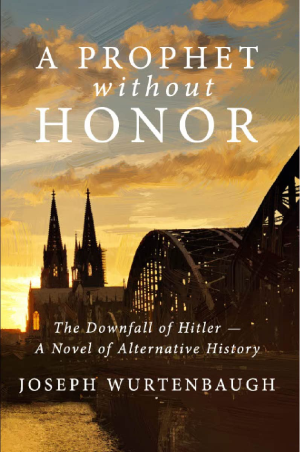
WHAT have you finished reading recently? A Prophet without Honor, an alt-history novel told in letters about a German officer who leads to Hitler’s downfall in 1936.
WHAT are you reading now? Precipice, Robert Harris. As Europe drifts into suicide in autumn 1914, the British p.m. is undone by an affair.
WHAT are you reading next? Will focus on All Power to the Councils, I think, for the Germany interwar series.
Hmm. Science fiction, I suppose. I know that sounds wild because it’s a healthy category, but I don’t feel like I read a great deal of it, and a lot of my SF is just technical thrillers set a bit in the future. Looking back on the year, I’ve read maybe five real SF stories, stuff like Dune,The Dispossessed, and Shelli. There’s so much SF I haven’t read, like almost all of Heinlein, bar a few titles like Starship Troopers and The Moon is a Harsh Mistress. There are other SF greats like Ellison whom I’ve never touched.
Apropos of nothing, here’s some music. I stumbled on it while trying to find the name of the “Play the sunset!” piece in Mr. Holland’s Opus and keep listening to different covers of it.
“My darling Rosamunde, I don’t wish you to remain in suspense during the reading of this letter. This is a proposal of marriage.” (A Prophet Without Honor, Joseph Wurtenbaugh and Manoj Vijayan)
[…] “My demented sister, This morning our mother presented me with news so horrifying my hair literally stood on end. She informed me that Heinrich Haydenreich had proposed marriage to you, and that you had accepted.” (Ibid)
The Confessions is one continued and coherent prayer, a profound profession of faith, and a plea for more, ever more wisdom, ever more love. It is artistic in its whole conception, in its parts and their arrangement down to the merest sentence. It is closer to the Gothic cathedrals that would grace Europe eight hundred years later than to anything that you or I might write about ourselves and our lives. (The Confessions, trans. Anthony Esolen. From the introduction.)
The house of my soul is too cramped for you to enter: make it more spacious. It is falling to ruin; repair it. Much inside it offends your sight; I know it and I confess it. (Ibid)
Today’s Top Ten Tuesday is books we’ve avoided because of the hype, but I think falling so hard and so fast for Harry Potter cured me of that back in 2007. Instead, I’m going to share my top ten favorite book teases from the last year, celebrating two years of perfect-attendance Tuesday Teases. If you like teases, check out last year’s as well!
“You mean you ain’t going to drink no more?” “I mean I’m taking it one day at a time.” “But if you don’t drink no more, then how come you got beer in your refrigerator?” “Hard to say goodbye.” “And you got a lot of whiskey under your kitchen sink too.” “What are you, the Southern Baptist Convention?” (Kinfolk, Sean Dietrich)
McCoy shook his head. “Unbelievable. An emotional Vulcan who’s having problems with telepathic humans. Did we cross over into an alternate universe again? (Star Trek: The Higher Frontier, Christopher L Bennett)
In the end, Lizzie chose insult by way of Shakespeare. It felt more dignified. “I do wish that we could become better strangers,” she said coldly. It took Collins a moment to register her jab, and his faux polite expression darkened into open resentment (Pride and Premeditation)
“Are you busy with something?” said the Major. “You can always call another time, when your paperwork is finished.” “No, no, it’s just a final deal book I have to read—make sure all the decimal points are in the right place this time,” said Roger. “I can read and chat at the same time.” “How efficient,” said the Major. “Perhaps I should try a few chapters of War and Peace while we talk?” (The Major’s Last Stand)
<Jennifer to Beth> Aren’t you missing the point? Clark Kent doesn’t want to be famous. He doesn’t want people to look at him. If they really look at him, they’d see that he’s just Superman with glasses. Plus, he needs to be someplace like a newsroom, where he’s the first to hear big news. He can’t afford to read “Joker attacks moon” the next day in the newspaper. <Beth to Jennifer> You make an excellent point. Especially for someone who doesn’t know that Superman never fights the Joker. (Attachments, Rainbow Rowell)
“This is interesting, meeting you here,” said Madred. Placing his spoon next to his bowl, Garak clasped his hands on the table. “It was my understanding that being forced into exile meant never having to see people I don’t like. Leave it to Central Command to fail at something so simple.” Star Trek: Pliable Truths
He winked at her when he handed over the reins. “The English breed fast horses and beautiful girls, my lady. I enjoyed sampling one of the two.” Millicent mounted quickly and looked over her shoulder at the bold young Welshman. “It is well you chose the one you could handle, my lord,” she said, wheeling the horse around and digging her heels into its flanks. (The Broken Realm)
Boredom, I knew, was a dangerous thing. For some children, it led to experiments with sex, and drugs, and alcohol, and lighting one another on fire, sometimes with the alcohol. For some of us, the never-ending rural ennui led to destructive habits with literature. (The World’s Largest Man, Harrison Scott Key)
If we let ourselves, we shall always be waiting for some distraction or other to end before we can really get down to our work. The only people who achieve much are those who want knowledge so badly that they seek it while the conditions are still unfavourable. Favourable conditions never come. (The Weight of Glory, C.S. Lewis)
Will you come forward and tell us your name?’ she says. ‘Rarrrrrrrgggggggghhhhhhharrrrrrr!’ says Steve, even louder than before. ‘Please be gentle on the medium,’ says Penny. ‘Hoooooooaaaaaarrrrrrgghhhhh,’ says Steve, louder still, his neck jutting out and his head moving from side to side, like a riled T-Rex in an old Hollywood film. Will Storr vs the Supernatural
. ‘And you do not believe this is betrayal?’ ‘My Fuhrer, I have never confused the Nazi Party with the German nation,’
A Prophet Without Honor without a doubt one of the more interesting alt-history novels I have ever read, in part because it is told not through a straight narrative, but via a collection of excerpts from letters, journals, telegrams, and histories with varied viewpoints. The reader realizes quickly we are heading into a different timeline than our own — one in which the Wehrmacht rebelled against Hitler in 1936 — but the story is learning how that happened, and more pointedly in getting to know the man who was most chiefly responsible for that rebellion. This is the story of Karl von Haydenreich, the grandson of a vicious anti-Semite, the son of a principled aristocrat and the stepson of a Jewish woman who the Spanish flu bore away to eternity. Although interesting for its initial premise, this novel’s commanding character drama drove it into the ranks of superb storytelling.
A Prophet without Honor is first and foremost wonderful character drama. We are first introduced to the Haydenreichs via Karl’s father, Heinz, a man who has been forced to deal with tending to his family’s estate after creditors realized his father was absolutely hopeless on financial matters, and his elder brother was little better. Heinz is largely alienated from his family, who regard him as a spineless effete with far too much tolerance for Germany’s enemies, even permitting his wife Lottie to maintain a close friendship with a Jewish woman named Rosamund. When Lottie dies in childbirth giving the world young Karl, Rosamond becomes the children’s unofficial governness — and then, their stepmother, after Heinz and Rosamund fall in love over the course of time. Although Karl will have a youthful dalliance with the exciting Nazi party in his teens, thanks to a summer spent with his hateful grandfather, he is far more his father’s son than his grandfather’s, and joins the army (Reichwehr) out of concern that Germany is sailing into treacherous territory and will need a stabilizing force if it is to survive. The interesting thing about A Prophet is that, beyond the core “Nasties”, few people in this novel are absolutely rotten or virtuous: Heinz’s brother repents of being a bigot on his deathbed, and Karl’s best friend Albert remains wholly sympathetic to the causes of National Socialism even as he aids in some of Karl’s late-novel plans to save those who can be saved. Another character, who is steadily sympathetic, exposes himself at the end as fundamentally lacking in character. Karl’s own experiences as a teenager during the 1923 putsch — witnessing Hitler flee the scene rather than stand and fight with his men — privately galvanize him against the ‘little corporal’, even as he enjoys favor from the upper ranks thanks to his impetuously joining the party as a teenager, and his grandfather’s material support of the NSDAP. A key component of the story is the accidental friendship that emerges between an American officer stationed in Germany after the war — some fellow named Eisenhower who later becomes a military attache — and the Haydenreichs, so much so that “Ike” becomes a godfather and mentor to Karl. When Karl begins expressing doubts about the integrity of Hitler, Eisenhower is only happy to offer him support — and their bond becomes a means of intelligence passing into Allied hands that make the re-militarization of the Rhineland quite different.
In short, this is quite a compelling novel, though it’s unclear as to what happens in Europe after Hitler is removed from the scene: there are occasional hints that de Gaulle rises to power and gets up to mischief, and other hints that Bolshevism runs riot, but these are coming from contradictory sources who we have gotten to know over the course of the novel, and can’t completely trust. While I certainly don’t profess to be an expert in German history, the interwar history has been of morbid interest to me for decades, and lately I’ve been reading more into it: Wurtenbaugh appears to tack pretty close to the changing zeitgeists of the age, made especially obvious in characters whose spirit and morality are sometimes hard to box up. Definitely recommended to alt-history fans who want something more than “WW2 but Hitler wins” or “WW2 but there are space lizards“.
Highlights:
My darling Rosamunde, I don’t wish you to remain in suspense during the reading of this letter. This is a proposal of marriage.
My demented sister, This morning our mother presented me with news so horrifying my hair literally stood on end. She informed me that Heinrich Haydenreich had proposed marriage to you, and that you had accepted.
We are going to be coming home to a different world, a different Germany than the one we left, Willy. There are too many angry men, too many grieving women – too much blood, too many tears, for anything to be left unchanged. Does anybody even remember why this war began? Or what is the great reason why so much human misery had to be inflicted? I surely don’t. The people will demand answers, and there are none to give.
There is a French saying, si jeunesse savait, si vieillesse pouvait – if youth but knew, if age but could.
But it is my belief that it befalls to every man to meet one woman who haunts his life, who both comforts and afflicts him.
‘I feel I must justify this in my own life somehow,’ [Karl] said. ‘There must be a reason why I alone am left out of all of them.’
These [SA] men were not traitors to Adolf Hitler. The truth was that they were fanatically devoted to him, always had been, and remained devoted even now. They had exhibited that devotion throughout the morning, making grim, comic fools of themselves – pledging their loyalty to, or attempting to salute, a man shouting maniacal denunciations in their faces — even as they were being thrown into cellars. Murderers, sadists, pederasts, human vermin – all true. But traitors? Perhaps this was the only accusation of the lot that was not true. The truth was he was the traitor to them. Hitler continued to rage, refusing to be calmed. The word ‘rabid’ sprang to mind. At times, he had actually foamed at the mouth. He knew that the accusations he was shouting were absolute lies. I knew he knew and then, all at once, I fully understood the mechanism. He used the sheer magnitude of the lie to his benefit. He transformed the energy he had to exert to force himself to believe this preposterous hypocrisy into a manic, hysterical rage that swept aside all opposition, including his own awareness of the truth. The objects of his fury were too cowed and intimidated by its intensity to give him the lie. As I watched, he drove himself to even stormier heights.
I’d already seen and heard enough of the Third Reich to know where my real duty lay. The hell with practicality.
‘It is your honor that must compel you, Werner. The pistol is only there in the event you misjudge it.”
“I will use my little broom to brush away what muck I can. It is not possible to cleanse it all, but the house can be made cleaner. That will be my life’s work.”
Reagan, 2024. Biopic released 20 years after the Gipper’s death, this is an adoring take on Reagan’s life, based off of a Paul Kengor book called Crusader. It’s framed as an aging Soviet (Jon Voight) trying to explain the effect Reagan had on the last years of the Soviet empire, and highlights Reagan’s optimism and charisma without shying away from stuff like Iran-Contra. There’s very little policy involved: it more highlights’ Reagan’s hatred of Communist authoritarianism and fervent belief in Americanism – and I suspect that’s on purpose, to combat the bitter cynicism and division of today. It’s very optimistic, hopeful, and “joyful”. I thought Quaid did a good job of trying to capture Reagan’s voice and mannerisms. Greatly appreciated the ways Reagan’s humor was incorporated into the movie, and the casting in general. Saw some favorites like Dan Lauria and Nick Searcy, both of whom were in From the Earth to the Moon. . The book generally tracked with what I know of Reagan’s life — I read Dutch back in 2004/2005, right after he died. The credit scenes were especially good: NO ONE left the theater during the credit bits with footage from Reagan’s funeral, especially the Nancy scene which had a lot of people crying. (The Ron-Nancy relationship is a big part of the movie.)
Rushmore, an early (1999) Wes Anderson movie in which a high school student who is INCREDIBLY active in school but dismal in grades teeters on expulsion, then falls for one of his teachers, becomes friends with a classmate’s father Bill Murray, then nearly destroys both relationships out of jealousy when Bill becomes sweet on the teacher. He subsequently grows as a Person. The student, who I will dub Teenage Stanley Tucci with Hair, is also being pursued (inexplicably) by a very cute nerd girl who he treats with utter coldness. Enjoyable film: I will watch anything with Bill Murray, and this one had a lot of interesting character drama and growth.
California Split, 1974. Elliot Gould and some other guy meet gambling. They do much more gambling.
Freeway, 1996. Reese Witherspoon plays Vanessa, a girl from a….challenged background. After her mother is arrested for prostitution and her molester-stepfather is hauled away for various crimes, Vanessa tries to hitchhike north to LA where her grandmother is, only to be picked up by a serial killer. After an incredibly disturbing sequences of scenes where the serial killer reveals himself as a creepy-necrophiliac-murderer, Vanessa shoots him and then scampers off. Alas, she didn’t do the creep in, and winds up being thrown into the corrections system. Film turns into a weird black comedy that was enjoyable. As a southerner, I got a kick out of Witherspoon’s accent here. (“Git your [gorram] hands off my anatomy!”).
(Lots of language….)
Polyester, 1981. A John Waters film, so that should probably give the general idea — especially as it stars Divine. Divine is “Francine”, a mom to two very screwed up kids and future ex-wife to a man with absolutely no good side besides the fact that he makes money. Francine has a friend who can’t act and who in another life was obsessed with eggs, but she’s come into money and is obsessed with doing what people on the Social Register do — playing polo and tennis, mostly. After Francine realizes her husband is cheating on her, she files for divorce and things get progressively worse until they’re all of a sudden better, and the viewer who has see John Waters before is waiting for the twist. And sure enough, multiple homicides follow. We watched this because of Hurricane Francine.
Brazil, 1985. I watched this for the odd pairing of Michael Palin and Robert de Niro, but both have minor parts. It’s something of an SF film, set in a dystopian world beset by bureaucracy and machines. The main character keeps having dreams where he’s a fantasy figure, a hero, but IRL he’s just a cog in the machine. As the movie progresses he begins to resist his own programming and is targeted by the state/machine/etc. If you are a fan of ductwork, it’s visible here in abundance.
Rommel, 2012. German film about the last weeks of Field Marshal Rommel’s life: his efforts at optimizing Germany’s defensive strategy against the prospect of an Allied invasion are undermined by his being implicated in Operation Valkyrie, in which Tom Cruise and the Wehrmacht would assassinate Hitler and end the war. (But not without making a deal with Christoph Waltz.)
Philadelphia, 1993. Every time I mention The Philadelphia Story as my favorite movie, people invariably confuse it with this one, so I finally decided to watch it. Tom Hanks plays an attorney with AIDS who is fired, and files a discrimination lawsuit against his former employers. Denzel Washington, despite his prejudice towards gay men, takes on the case after witnessing Hanks being a victim of discrimination in a law library. Very well-constructed drama.
Probably the clip that convinced me to watch this. Such great acting from Washington & Hanks.
Stardust Memories, 1980. Woody Allen plays Woody Allen under another name, an increasingly emotionally conflicted director who is no longer satisfied making comedies, but who wants to make seriously depressing films about the human condition that no one wants to watch. The movie is presented in an interesting way in which we see Woody involved in three different relationships, and it’s a bit ‘meta’ in that the decor in his NY apartment reflects his mood at the time. Everyone in this film is a little crazy.
River’s Edge, 1987. Strange teen crime flick in which a teenager kills one of his friends, shows his other friends the body, and they just….carry on. One of them gets obsessed with protecting the murderer, while the other two (including Keneau Reeves) feel like turning him in. Featuring all kinds of things, from nudity to murderous kids with nunchunks. Loosely based on a true story. Or was it this true story?
Gosford Park, 2001. Part of Maggie Smith Memorial Weekend. Downton Abbey meets CLUE, with a VERY packed cast, including talent like Michael Gambon, Stephen Fry, Emily Watson, etc. Reminded me a bit of Rules of the Game, at least the shooting scene. Stephen Fry plays a detective who has an amusing disregard for clues or forensics or…..anything detective-y besides asking questions and posing with a smoking pipe. My introduction to the VERY cute Kelley MacDonald. Well, technically I’ve seen Trainspotting, but that was such a horrible film I’ve managed to purge my memory of everything but the toilet scene, which would be the main motive for wanting to purge the memory.
Weekend, 1956. Goddard, French film. Um…so there’s this couple who are awful and they want to kill the woman’s father to take his money. They go on a trip to visit him but run into incredible auto carnage, and wind up hitchhiking and meeting imaginary characters, men singing in telephone booths, and cannibals. It’s….weird. It is very weird. This has replaced Muholland Drive as “The weirdest movie I’ve ever seen”, which itself replaced The Tenant. Has a tracking shot Martin Scorcese would be envious of.
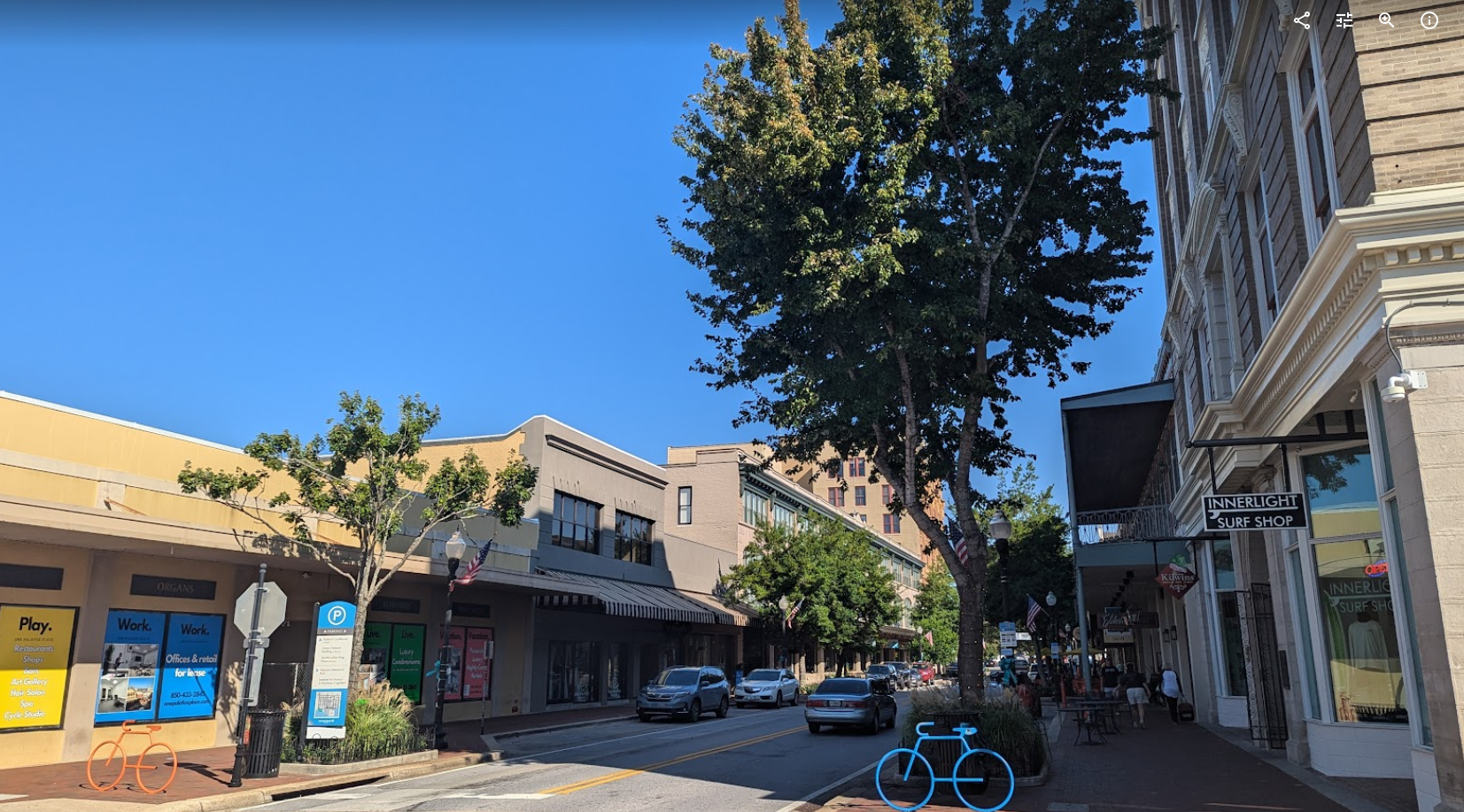
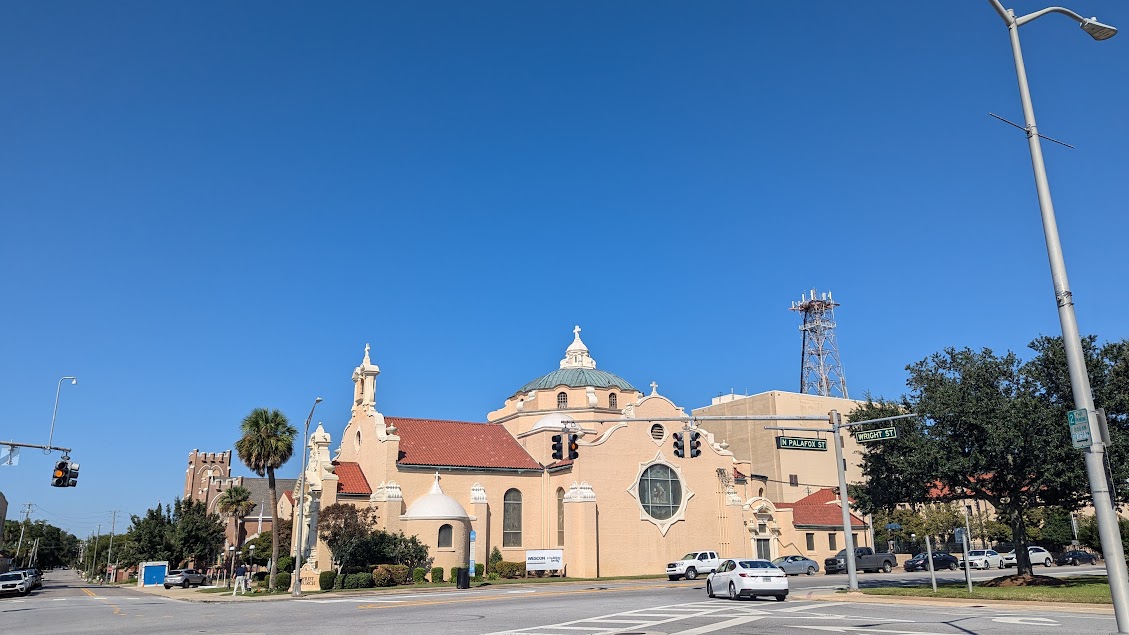
Palofax Street, Pensacola. See ya in November, Florida!
It is entirely possible that I’ll finish another book tomorrow (I’m reading an interesting alt-history novel that’s told via letters, and depicts the failure of the Nazi regime in 1936), buuuut I wouldn’t bet on it given that I have class tomorrow and right now I’m mostly reading papers on library website UX design for an upcoming paper. Anyway, this was a fun month, though again dominated by fiction. Out of curiosity, I checked “Books — The Spreadsheet” on my onedrive, and fiction has completely turned the tables on nonfiction, flipping the usual 60/40 radio in its own favor. Honestly, I think summer (with no grad school) was nonfiction’s best hope at a comeback, but we shall see. I’ll remember September chiefly for my Pensacola trip, although today’s worship service saw me as the only choir member present, meaning that instead of doing one solo of “Dona Nobis Pacem“, I was a one-man choir for over an hour. Oof. Not in 13 years of attendance have I been the only person in the choir!
Favorite Quote/Highlight:
“You mean you ain’t going to drink no more?” “I mean I’m taking it one day at a time.” “But if you don’t drink no more, then how come you got beer in your refrigerator?” “Hard to say goodbye.” “And you got a lot of whiskey under your kitchen sink too.” “What are you, the Southern Baptist Convention?” (Kinfolk, Sean Dietrich)
The Unreviewed: The Practice of the Precense of God, Brother Lawrence. Just finished this Friday. May wait for a review as a friend of mine and I are re-reading it together. Hitler’s Heralds: review to be posted in German interwar series.
…the Publisher file I use to keep up with this is at work, so I’ll update this in….a few hours.
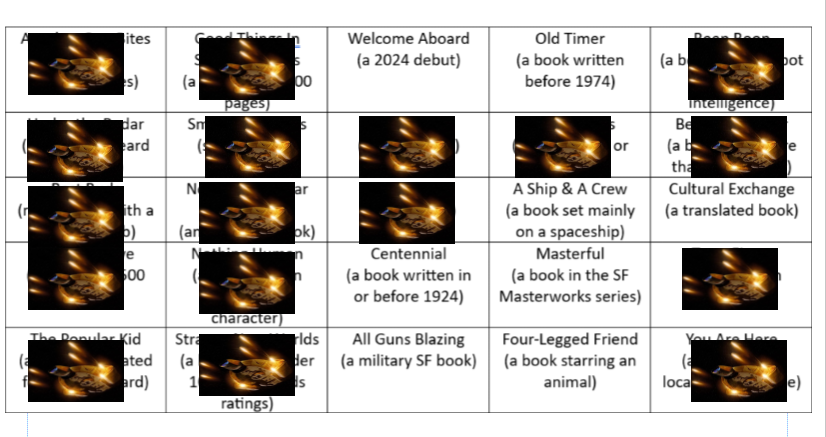
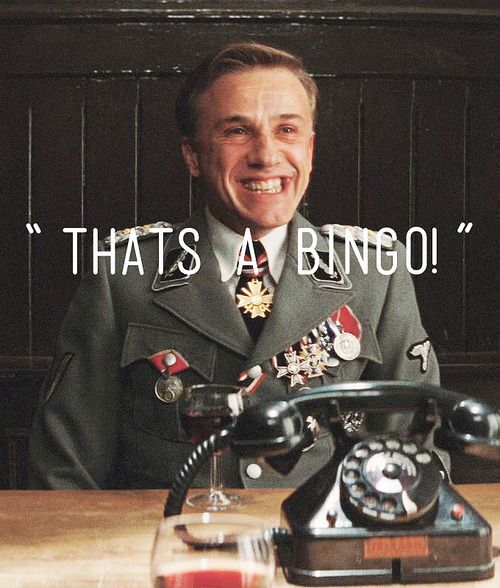
“…we just say bingo.” “BINGO! How fun! :D”
New Acquisitions: The Confessions, St. Augustine. Translated Anthony Esolen. Will replace one instance of Plutarch on my Classics Club list. Also, an Amy Winehouse magazine, but I don’t think that counts.
Coming up in October… I usually do a nod to German history in early October, but this month I’m going to do a series — following German interwar history from the abortive revolution of 1919, to the creation of Weimar and all that followed, culminating in the rise of the Nazis. Expect one book on the socialist uprising of 1919, one book on the Freikorps, something on Weimar, and then something on the Nazi takeover. I found a book on Bismarck in a little free library recently, so I may throw that in just for fun. Ordinarily, this series would run in the first week of October (tied to October 3rd being the Tag der Deutschen Einheit, in which the GDR and DDR did the whole ‘reunited and it feels so gute‘ thing), but school work is competing for brainspace ATM.
Albert Entwhistle has had the same routine for years: he goes to work, making his rounds as the village postman while carefully avoids any prolonged conversation, and then he goes home to spend the evening watching TV with his cat Gracie, whose company offers the only bits of light in an otherwise colorless life. But things are about to change: Albert is only a few months from mandatory retirement, and Gracie is dying of cancer. As the rug is about to be pulled from under him, Albert must be ‘up and doing’ — and soon finds himself connecting to his coworkers, his neighbors, and a man he left behind decades ago — himself, before he shut himself up to the world and began dying that slow death of loneliness. The Secret Life is a story of a man waking up to himself and deciding to “color in” the black and white lines of himself before it’s too late.
This was on Kindle Unlimited, so I snapped it up from the basic premise alone, not realizing there was another and extremely important dimension to the story: the reason Albert is the man he is, a man who avoids society and sticks to the safe and prescribed, is because he’s a man attracted to other men, and grew up in a time when that was grounds for being not only constantly harrassed and beaten, but arrested by the police. He hides who he is from everyone, including himself, retreating into a safe cocoon of TV and cat-petting. As his safety net is unraveling, though, Albert takes stock of his life and realizes what a waste it’s been — and begins reaching out. He is especially haunted by having failed to be courageous in his youth, and subsequently having destroyed a relationship he regards as the love of his life. In ways, this book is somwhat like A Man Called Ove or The Unlikely Pilgrimage of Harold Frye, in that we have an older man trapped in his routines and cautious personality suddenly having to ‘go forth in life’ (as Marley put it to Scrooge), despite the threats of potential rejection. Cain wrote this explicitly as a coming-out story, though, so there’s a lot of emphasis on Albert coming to terms with his own identity and then being bold enough to reveal it to those around him. It’s not all about him, though, because in opening himself to others, he finds others opening their lives to him, and becoming part of their stories: he becomes a mentor to a young woman who is struggling in her own relationship, for instance, and her story has parallels to his in that she thinks her boyfriend is ashamed of her for being a mixed-race single mom and wonders if she should just cut bait and run rather than take the risk of being hurt.
Although I could’ve done with less politics (Cain frequently works in allusions with no relation to Albert’s story), my taste for “curmudgeon regains humanity” stories made this a sweet, surprising read for me. I liked that Cain included interviews with men of Albert’s generation to show how Albert’s experiences aligned with reality.
Related:
He really didn’t understand why he now needed three remote controls, a mobile phone, and a consistent Wi-Fi signal just to watch TV. Is that supposed to be progress?
But then he caught sight of himself in the mirror and stopped. There was no denying that, with his personality-free clothes and short-back-and-sides haircut, anyone who saw him would think he was dull and boring. He looked like the kind of man people would call a “drink of water.” But he didn’t feel like that inside; inside he felt like he was a whole bundle of fun. Or at least I would be, if I could only work out a way of getting the fun out of me.
“But don’t you think it sounds a bit daft?” he argues. “Oh, so what if it is?” says George. “There are worse things in life than sounding a bit daft.”
Albert could see now that for decades he’d been loosely holding on to an empty, gray life. But today was a new day. As of today, he wanted to take his life in both hands and squeeze it tightly, to get everything he could out of it while he still could. And he was ready to make whatever changes were necessary for this to happen, however difficult they might be.
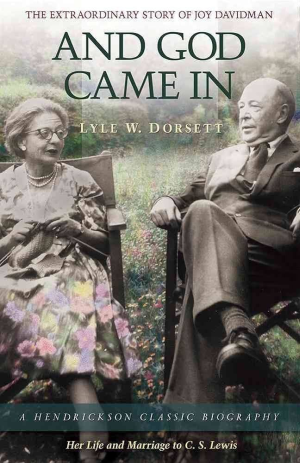
A friend lent this to me, knowing of my love of all things C.S. Lewis. It’s a biography of Joy Davidman, a Jewish-American convert to Christianity who befriended Lewis over letters, then later moved to England and became his great love, writing companion, and wife. Although I knew a fair bit of Joy from the various Lewis books I’ve read over the years, especially the letters and Lewis biographies, the closest I’ve come to a direct biography of her is Becoming Mrs. Lewis, a novelized version of her relationship with Lewis. And God Came In is a small but engaging work, one that emphasizes Joy’s intellectual gifts and love for argument — both qualities of which made the Lewis boys, Jack and Warren, instant fans once they’d met her. We meet Joy as the child of two secular Jews, who have no use for religion and pass that along to their daughter, who — as she ages — becomes interested in the social promises of Communism, and joins a local communist party. Despite this, Joy evinces an inexplicable interest in Jesus and the Crucifixion, and as her intellectual talents begin disassembling the arguments of Marx and Lenin, she simultaneously had an experience with the Divine which would put her on the path to converting to Christianity. Interestingly, she choose the closest church to her, a Presbyterian one, and appears to have taken on its animosity toward the Roman Catholic Church, as her writings frequently attack it and its doctrines and practices. If I’d known Joy had a connection to leftist politics, I’ve long since forgotten it, so reading this portion of her life was interesting. Although Joy loved to write, she found her talent was best applied as a collaborator, and this made her and Lewis into working partners as well as friends when she moved to England to get away from her abusive drunk of a husband who was also having an affair with her sister. I enjoyed encountering her here as a thinker and critic in her own right.
Related: The Long Loneliness, Dorothy Day. Autobiography of another activist for whom the love of the poor manifested itself in both politics and religion. Davita’s Harp, Chaim Potok. Secular child of Jewish socialists grows to find meaning through Judaism, not politics.
Quotes:
“Joy had a tendency to view people in one of two ways: either they were her pupils ad she lectured them, or they were her teachers and she pressed them hard for knowledge. As her brother remarked, Joy saw hardly anyone as equal.”
“Nothing had been done to [the Kilns] for about thirty years: the walls and floors are full of holes; the carpets are tattered rags — in fact,” she assumed, only half-facetiously, that the house is being held up by the books that line all the walls and if we ever move a bookcase All Fall Down!”
WHAT have you finished reading recently? And God Came In, a biography of Joy Davidman, who became C.S. Lewis’ dearest friend, writing collaborator, and wife.
WHAT are you reading now? Oh, so much. I just bought a new translation of The Confessions yesterday and have been nosing in it for a bit. May save it for Advent, when I usually do a devotional read or two.
WHAT are you reading next? Probably something in German history as I’m prepping for a series of reviews in October that will cover German inter-war history. All Power to the Councils, possibly.
Today’s prompt from Long & Short Reviews is to “describe your sense of humor”. I’m not entirely sure how I would, but I can tell you I am inordinately fond of wordplay, especially puns.
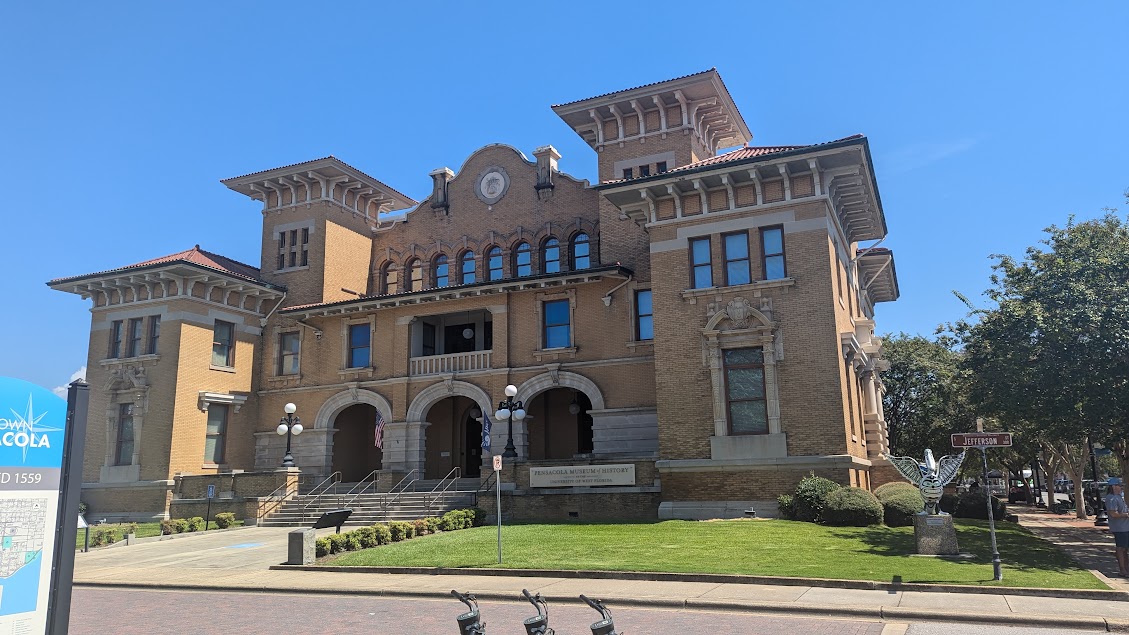
I spent the last weekend in Pensacola, and left it so enamored I’ve already reserved a room for a return trip in November. They have a zoo and I missed it. Here’s a taste of what I saw!
Every Saturday, Palofax Street hosts a multi-block craft/food fair. I had no idea. I found mochi, mead, and a poet for hire. Christ Church, exterior. A Spanish Revival Episcopal church! Christ Church, interior. I attended the 8:00 am service and was blown away by their organ and choir. Hannah of Historic Pensacola Village was a wonderful guide to local history. Impassioned and funny, she did a walking tour of nearly an hour. The Big E! I’m strictly here for the propeller crew, but seeing Blue Angels this close is pretty cool. This Dauntless survived Pearl Harbor, sank a Japanese carrier, was landed on Midway Island after Lady Lex was sunk, then became a Marine trainer before a trainee flew it into Lake Michigan. There it sat for 50+ before being pulled out. Perdido Beach
Hah! As if I have a defined TBR these days, so I’ll front-load this with upcoming releases. First the tease, per usual:
Social media platforms are therefore the most efficient conformity engines ever invented. They can shape an adolescent’s mental models of acceptable behavior in a matter of hours, whereas parents can struggle unsuccessfully for years to get their children to sit up straight or stop whining. Parents don’t get to use the power of conformity bias, so they are often no match for the socializing power of social media. (The Anxious Generation)
(1) The Anxious Generation, Jonathan Haidt. Preordered this in April, haven’t focused on it. Restarted my read of it this weekend.
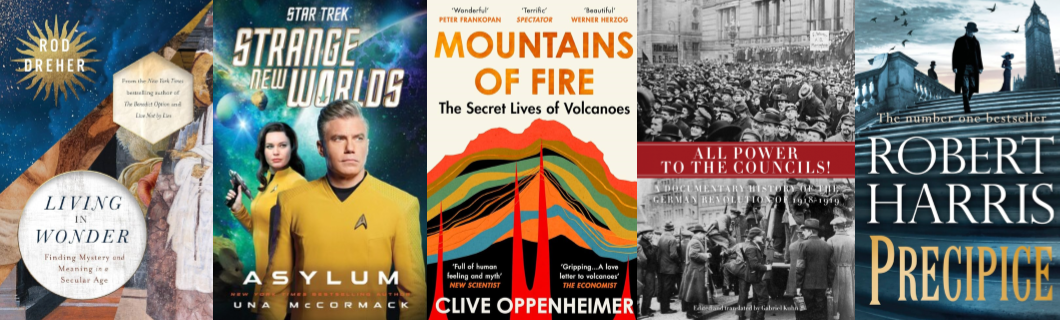
(2) Living in Wonder, Rod Dreher. On the need for enchantment, and the ways — good and bad — people are seeking it out. Preorder. I’m hoping to catch the book launch in October, since Rod and Paul Kingsnorth are doing an event together in Birmingham.
(3) Precipice, Robert Harris. My library has this on order but it hasn’t come in yet. Robert Harris is a -must-read for varied thrillers.
(4) Star Trek: Firewall, David Mack. The Seven of Nine Voy-Pic bridge novel. Not looking forward to the Picard setting, but Mack is a great author and Seven is one of Voyager’s most interesting characters. I have this one but haven’t finished it.
(5) Star TrekStrange New Worlds: Asylum, Una McCormack
(6) Selma’s Mayor, Jenney Eggertson. This is a biography of Mayor George Evans of Selma, which he had been collaborating on until his sudden death last spring. Mayor Evans was an inspiration to many in this area, myself included.
(7) All Power to the Councils!, Gabriel Kuhn. A history of the socialist uprisings that swept Germany at the end of World War 1. Will be part of a review series covering interwar Germany.
(8) Mountains of Fire, Clive Oppenheimer. I’ve been pecking at this for most of the year. The problem is the chapters are non-successive, so I read at random and have no idea how much of the book I’ve finished. Will have to do a straight re-read.
(9) A Long Way to a Small, Angry Planet, Becky Chambers.
(10) Confessions, St. Augustine. I’ve been meaning to re-read this to see how my take has changed after 12 years, but what sells is is that Anthony Esolen — the masterful translator of the Divine Comedy — published a translation late last year.










 Reading Freely
