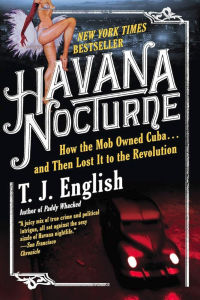
I used to be obsessed with la cosa nostra, but its Cuban ambitions never popped on my radar until I watched The Godfather II. I’ve long been curious about the Mafia’s role in developing Cuba and inadvertently feeding the revolution that swapped out one dictator for another, but not until recently did I come across this book. I went for it it immediately, teasing me as it did with the promise of information as to how Lucky Luciano and the Syndicate helped the Allies in World War 2. As it happens, that WW2 connection is marginal at best, but this is still the fascinating story of how the Italian-American Mafia began building Cuba up as an off-shore power base, only to lose everything to a rich boy turned revolutionary. (Odd how left-wing dictators are so often the children of privilege and right-wing dictators begin as poor populists, Stalin being an exception.)
The story of the Mafia and Cuba begins with the close friendship of Meyer Lansky and Charles “Lucky” Luciano, two men who revolutionized organized crime in the United States. As his last name might hint, Lansky was no Siciliano; he was, instead, the son of Polish Jews who’d fled pogroms in Russia to come to the United States. Meyer, despite his small stature, was cunning and ambitious, and as he aged he joined forces with similarly ambitious men like Luciano: “Lucky” would conspire to knock off the heads of the two largest Mafia families in New York, Massiera and Marazano, and create something new: the Syndicate, modeled on corporation-esque lines. Lansky, a man whose fortune grew on gambling operations, saw in Cuba an opportunity for expansion — but his dreams continued to be deferred, first by economic depression and then by the incarceration of Luciano. The Syndicate wasn’t as ethnically closed-off as the traditional Sicilian Mafia, but it still wasn’t going to let some “little Jew” dictate policy: for that, Lansky needed his buddy Charlie, who despite his imprisonment and later exile remained the de facto CEO of the syndicate. Luciano legally escaped prison by using the muscle of the Mafia to rout German saboteurs on the New York waterfront, then later supplied information to help the Allies invade Sicily; then, pushing his luck, he decided to emigrate to Cuba to begin realizing his and Lansky’s dream of a gamblers’ paradise in the Caribbean.
Cuba was enormously popular with Americans, both for the climate and the emerging Afro-Caribbean musical scene. Capitalizing on the amount of traffic already coming in by creating new entertainment venues to suck up tourist dollars was a no brainer. This was accomplished through both the mob’s existing money and Lansky’s longstanding contact with a certain Batista, the on-again off-again ruler of Cuba. The timing couldn’t be better, since American lawmen were taking an inconvenient hard line against gambling operations in the States. As it happened, Lansky and Co.’s desire to make big moves in Cuba coincided with Batista returning to power — this time as a coup disguised as a pre counter-coup. Although Luciano wouldn’t be part of it, DC having pressured the prior government to deport him back to Italy, the door was already open to Mafia investment. Soon financial institutions were in place that bought Cuba’s government and Syndicate money into full collusion, even as resentment to Batista’s bare-faced power grab brewed on the streets. The disparity between those in power and those not grew ever larger as casinos and nightclubs — the latter hotbeds of license, libertinism, and outright depravity — became gathering places for both Batista’s people and those connected to the Syndicate. Big names from the United States, including Sinatra and JFK, especially enjoyed the fleshpots. With firebrands like Castro in jail, though, and business booming, all seemed well.
Unfortunately for the mob’s ever-expanding array of hotels, clubs, and one-armed bandits, Batista got a little too cocky. He released the Castros from prison, and they fled the country to foment revolution in Mexico the way Khomeini worked from France during his own exile from Iran. Castro’s attempt to stage a comeback was at first a dismal failure — he and his men returning by boat were delayed by bad weather that failed to sink him, and his men in place in Cuba were slaughtered by Batista’s army. Upon finally landing, Castro linked up with his remaining men and continued to meet defeat after defeat, until Batista unwittingly declared him dead when in fact he was merely in hiding. Castro and his followers began rebuilding their numbers, importing weapons, and antagonizing the government through petty actions like raiding banks and setting things on fire. Disaffection towards Batista continued to grow even wealth flowed into the island: Lansky was actively planning Havana’s largest, most entertainment-oriented resort yet when the bottom fell out. Although some of the mafiosi were aware of Castro’s rising influence, they dismissed it: even if he did take over, he wouldn’t be so stupid as to close the casinos. Then, on New Years Eve, Meyer Lansky was told that Batista had taken money and run: Castro was on his way to claim Havana. Although Lansky scrambled to tell the Syndicate’s casinos to get their money out of the country, the people on the ground were slow to move, and soon Castro was actively working on undermining Cuba’s tourist-based economy by closing the casinos and nationalizing the hotels. Although some wealth managed to escape the country, the principal investors were largely ruined: Lansky died with less than $50,000 in the bank.
This was a fascinating history on two levels, both in providing a very cursory introduction to Castro’s takeover, and in diving into how the Mob had worked its way into so much of Cuba’s government and financial sectors. Thinking about what might have happened had Castro and his inner circle died at sea during the beginning of the “July 26 Movement” — as they very nearly did — is tantalizing. Imagine no Cuban Missile Crisis, a redoubt for the Mob after RICO hits, a Caribbean war between wiseguys and Escobar’s organization! It appears the author has written a lot on gangs of the 20th century, including Irish gangs, so I may read more of him: he may be a modern Herbert Asbury.
Related:
The Little Man, biography of Meyer Lansky. Later released as The Thinking Man’s Gangster.
Quotes:
Siegel was always the wild card in the group. Devilishly handsome even at a young age, he was a ladykiller metaphorically, and a killer of men in a more literal sense.
“When the day comes that a person becomes beyond the pale of justice, that means our liberty is gone. Minorities and undesirables and persons with bad reputations are more entitled to the protection of the law than are so-called honorable people. I don’t have to apologize to you or anyone else for whom I represent.”
“I look upon you in amazement,” said the senator.
“I look upon you in amazement,” countered the attorney, “a senator of the United States, making such a statement.”
In March, Life magazine published an article entitled “Mobsters Move in on Troubled Havana.” Complete with photos of Meyer, Jake Lansky, Trafficante, Fernández Miranda, and Batista—a virtual who’s who of the Havana Mob—the article suggested that the mobsters were swooping in to take advantage of political instability in Cuba. Of course, nothing could have been further from the truth. The mobsters had been there from the beginning.