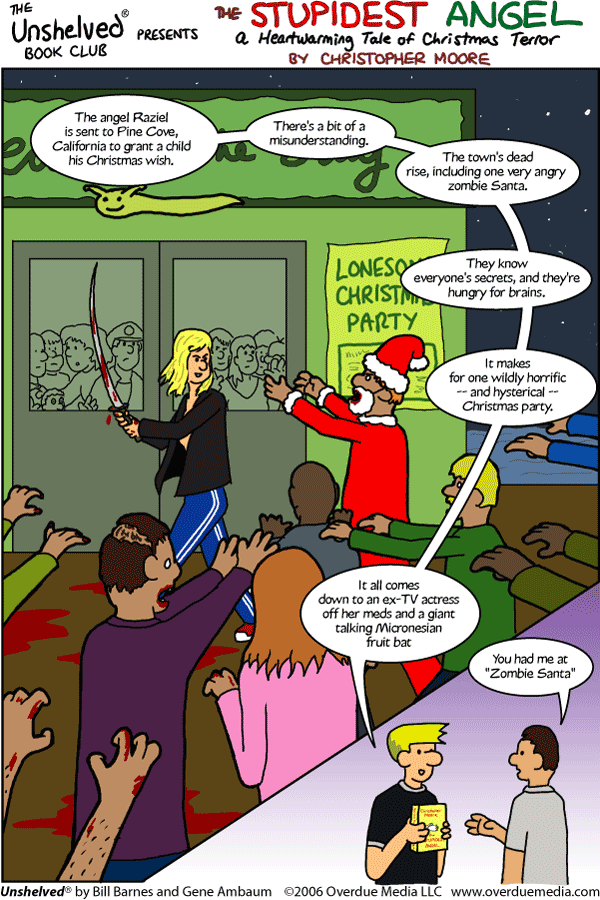
The Stupidest Angel

The Stupidest Angel: A Heartwarming Tale of Christmas Terror
© 2004 Christopher Moore
288 pages

In another Christmas story, Dale Pearson, evil developer, self-absorbed woman hater, and seemingly unredeemable curmudgeon, might by visited in the night by a series of ghosts who, by showing him bleak visions of Christmas future, past, and present, would bring about in him a change to generosity, kindness, and a general warmth toward his fellow man. But this is not that kind of Christmas story, so here, in not too many pages, someone is going to dispatch the miserable son of a bitch with a shovel. That’s the spirit yet to come in these parts. Ho, ho, ho.

It’s Christmas in quiet Pine Grove, California: the Salvation Army bell-ringers are being walloped by sacks of ice, husbands and wives are at each other’s throats, and someone just buried Santa Claus in the woods. Looks like this town needs a Christmas miracle to get back into the spirit of things.  Good thing Heaven always sends an angel to Earth to perform exactly one miracle at the behest of a child every Christmas week. Unfortunately, the angel this year is Raziel, a celestial servant as bright as a bag of rocks. His attempt at restoring Christmas goes wrong — terribly wrong. Hilariously wrong.

Christopher Moore digs into his back of goodies and bestows upon the reader heaping amounts of absurdism. This starts with the characters, two of whom are a married couple consisting of a hippie constable and a legendary if retired porn actress known as the Warrior Woman, who’s just schizophrenic enough to chop down the world’s tallest pine tree with her own broadsword in the name of the Worm God. Everyone in this town acts as though they’re in a Monty Python sketch. The narrator   is just as eccentric as the lives it details: halfway through the book, it pauses to look at the Christmas photos of the main characters, and some chapters consist of nothing but the local community of decaying corpses in the church cemetery talking to themselves — gossiping, mostly. I manage to avoid any spoilers, and when I realized just how the angel’s miracle had gone wrong, I hit the floor in mirth.

Short and sweet, a laugh-out-loud treat for Christmas time.

Related:

Posted in Reviews | Tagged , , , | 1 Comment

Beneath the Raptor’s Wings

The Romulan War: Beneath the Raptor’s Wings
© 2009 Michael A. Martin
450 pages (Trade Paperback)

Humanity’s enthusiastic expansion into the Cosmos and Earth’s leadership in forming the Coalition of Planets have earned it an enemy in the Romulan Star Empire. Ambitious, sinister, and ruthless, the Romulans  intend on striking down all those they cannot control. After repeated failed attempts to sow discord between the Coalition allies,  the Star Empire decides on a more direct approach: war.  Armed with fleets of their own and the ability to hijack the computers of other ships,  “those who march beneath the raptor’s wings” are intent on crushing humanity beneath them.

Though the Coalition Compact supposedly guarantees Earth  support from her allies,  the Vulcans are reluctant to be drawn into a conflict with their long-seperated cousins, whose very existance embarrasses them. Andor and Tellar are far more enthusiastic, but when their flagships are turned into Romulan playthings,  they, too question the use of coming to Earth’s defense.  Earth, defended only by a handful of NX-class starships and a dozen or so older Daedaluses, stands alone against enemies whom they’ve never seen face to face. Captain Archer and his fellow captains must hold the line in the wake of multiple defeats while political intrigues and episonage abound.

The TOS episode “Balance of Terror” set a few elements of the Earth-Romulan war in stone. It was a primitive affair, fought with nuclear bombs and missiles, and fought expressly between Earth and Romulus. Martin manages to reconcile this with the much more modern feel of Enterprise and the existence of the Coalition, while at the same planting seeds for the idea of a stronger union — the future Federation. Beneath the Raptor’s Wings is a busy story: though Archer and Tucker’s separate stories constitute most of the book, they’re joined by more than few other plot threads and viewpoint characters, including Romulans. While this isn’t disjointing, the frequent thread shifts (there are 85 short chapters) did take some getting used to. As is common with most Trek books in this generation, Martin seeds continuity references and in-jokes all over the place.

The book is essentially a combination of war story and espionage thriller with a good bit of politics thrown in. It kept me reading — I think I read most of its 450 pages in one day, which was rather wearisome but I did not want to stop.  (It was well after midnight when I finished, and I came close to going to sleep on the floor where I was reading.)  Though I know the war eventually concludes in a rough draw (which established the Neutral Zone), Martin still managed to make me feel concerned about Earth’s extensive losses, and I could never predict the course of the action.

Treklit readers, especially Enterprise relaunch fans, will find it worth their while.

Related:
Starfleet: Year One, Michael Jan Friedman. This book is set in the last part of the Earth-Romulan war, though it was published before Enterprise and is sadly not reconcilable with the modern canon. That’s a shame, too, because this book along with the first Stargazer book sold me on Friedman, and offers a compelling look into the founding of the Federation and the formation of Starfleet and its mission goals. It’s also very much in the feel of TOS — a believable predecessor.

While Daedalus are treated as obsolete buckets from yesteryear in Raptor’s Wing, in Starfleet: Year One, they’re the cutting edge and every captain in Earth’s space fleet wants to sit in the prototype’s captain’s seat. 
Posted in Reviews | Tagged , , , , | Leave a comment

Booking through Thursday: Life-Changing

Booking through Thursday wants to know:  which book changed your life?

A few months ago I started writing a post called “Top Ten Books that Changed My Life”: when I started searching for similar lists by other readers, I stumbled upon the Broke and Bookish’s ‘Top Ten Tuesdays’ game.  I have never posted my list, because my explanations of how the books influenced my thinking were altogether lengthy.

I’d like to answer BTT’s query, though, so I’m going to post the list but minimize elaboration.

1. Guns, Germs, and Steel. Jared Diamond (2004 or 2005)
Contribution:  One, it made me realize that nothing happens in a vacuum, that history is best understood when supplemented by other disciplines (geography, politics, sociology).  Two,  it forced me to consider how human history is influenced by matters beyond human control.

2.  Shadows of Forgotten Ancestors, Carl Sagan (2006)
Contribution: Led to my embracing the naturalistic worldview.

3. Universe on a T-Shirt, Dan Falk (Summer 2007)
Contribution: Made me realize that science was a search for meaning and understanding, not just a collection of facts.

4. The Meditations, Marcus Aurelius (Thanksgiving 2007)
Contribution: Introduced me to Stoicism and impressed upon me the advantages of mindfulness and a philosophical life.

5. The Communist Manifesto, Karl Marx (Summer 2008)
Contribution: The Manifesto is not a political blueprint, but a work of historical and social criticism in which Marx presents a view of history as being not just influenced by, but solely driven, by economics. While it didn’t make me stand up and start preaching about the Historical Dialectic,  after reading Marx I never thought about politics or the media the same way again.

6. Technopoly, Neil Postman (Summer 2008)
Contribution:  Made me realize that the use of technology carries with it values: for instance, the ubiquity of wireless communication allows everyone to be “connected” virtually all of the time, and brings with it the assumption that this being connected is normal and good.

7. Amusing Ourselves to Death, Neil Postman (Winter 2008/2009)
Contribution: Postman believes that technologies change the way we interact with the world, and that electronic media enforces triviality by treating information as entertainment. Much of the book examines television with a critical eye, condemning it for reducing intellectual discussion and debate to talking points and put-downs

8. A Life of Her Own, Emile Carles (Spring 2009)
Contribution: Carles expanded my political horizons significantly. Before reading her biography, I thought of socialism and communism in terms of Big States like the Soviet Union and China. I never realized there was a strong, vital democratic spirit in these movements, and that anarchism and libertarianism were not far removed from them.

9. The Zinn Reader, Howard Zinn (Fall 2009)
Contribution: Zinn changed the way I thought about democracy. I once thought being a good citizen meant voting and such, but  Zinn and Thoreau taught me that democracy meant action. Democracy is the labor strike, the slave revolt,  the protest march: it is people taking control of their lives, not casting votes for ‘represenatives’ whom they do not know and have no business trusting.

10. Red Emma Speaks, Emma Goldman (Spring 2010)
Contribution:  Goldman’s philosophy of anarchism brought together many various threads of my intellectual and personal life, best summarized in this quotation:

“Anarchism, then, really stands for the liberation of the human mind from the dominion of religion; the liberation of the human body from the dominion of property; liberation from the shackles and restraint of government. Anarchism stands for a social order based on the free grouping of individuals for the purpose of producing real social wealth; an order that will guarantee to every human being free access to the earth and full enjoyment of the necessities of life, according to individual desires, tastes, and inclinations.”

Posted in General | Tagged | 8 Comments

This Week at the Library (15 Dec – 22 Dec)

Slow week, really. I’ve been…distracted, and a minor eye infection didn’t help matters. It’s hard to read while squinting like a pirate. I wound up reading a history book instead of concentrating on either my wolf book or my Cornwell novel, so I read a  good bit of all three and all of none.

I did finish William Leisner’s Losing the Peace and Asimov’s Whiff of Death, though, both of which were enjoyable. I’ve never read Leisner before, but his character drama was top-notch. He’s only written a few Trek works, but I’ll keep my eyes peeled regardless. Bill Bryon’s A Walk in the Woods was considerably entertaining — I still think of think of Bryson for his A Short History of Nearly Everything, but he’s obviously a successful humorist and travel guide. I also listened to Lords of the North, which I’ll post full comments on later.

Selected Quotations:
“Some people weren’t above ‘crying wolf’ when it suited their purpouses. In Puritan New England, the regularity of wolf attacks on sheep just prior to church services every Sabbath, and the resulting drop in attendance, led some ministers to regard certain members of their own flock with suspicion.” – p. 69, The Great American Wolf;  Bruce Hampton

“You realize, I hope, that you had no real authority to land and disassemble this vessel. […]”
“Excuse me?” she answered, giving him a mock-stern glare. “Is this the same man who kidnapped two Federation political leaders and brought them here against their wills, lecturing me?”
“‘Kidnapping'” is such an inflammatory term…”  – p. 306, Losing the Peace. William Leisner.

“What chance has the truth got when priests begin to tell tales?”, The Lords of the North; Bernard Cornwell.

Next week’s potentials:

  • I’ll be finishing off Bruce Hampton’s The Great American Wolf, Cornwell’s Sword Song, and  — since I spent so much time with it THIS week — The Golden Door, by Isaac Asimov. I’m reading about Teddy Roosevelt and Progressivism at the moment, so I’m not far from the book’s endpoint in 1918. 
  • I think I’ll be reading Beneath the Raptor’s Wings by Michael A. Martin, the start of the Romulan War series in ST: Enterprise’s relaunch. 
  • I may spot a book or two I want to investigate the library today, since I’m writing this prior to my usual visit there. 
  • ..and there’s also Eye of the World, which I really need to read through to page 230. I have been promised that if I make it two hundred pages in, the book will hook me. I figure the first sixteen chapters are enough to decide whether or not I want to continue in the book.

Though I imagine I’ll post a comment or review before Saturday, I’d like to wish a Merry Christmas to everyone in case I do not.  Merry Christmas, Happy Solstice, Joyeaux Noel, Fröhliche Weihnachten,  Feliz Navidad, and Thank You For Shopping, Please Come Back Again!

Posted in Reviews | Tagged | 1 Comment

A Walk in the Woods

A Walk in the Woods
© 1998 Bill Bryson
274 pages

Bill Bryson was so startled to find an entrance to the Appalachian Trail in his backyard that he figured, why not hike it? End to end, it’s only a little over two thousand miles of hills, moutains, dense woodlands,  and bear dens.  Nothing a man in his forties can’t handle!  As soon as spring arrives, Bryson and his friend Stephen Katz drive to Georgia and start a grueling hike through some of America’s wildest country. Neither of them have any idea what they’re in for.

This story of two sarcastic middle-aged men bumbling through the woods and mountains is unavoidably entertaining. Bryson prepares himself by reading a book full of grisly bear attacks, and on their first day out Katz decides to start flinging supplies into the woods to lighten his load — including essentials which doom them to eating soup for weeks on end while they choke on mouthfuls of black flies, attempt to ditch an obnoxious co-hiker who latches on to them, and dodge peril a time or two, all the while ranting and raving enthusiastically.  The two don’t attempt the trail all at once, and indeed don’t even walk it in full: after realizing they’ll never finish in one season, they opt to concentrate on particularly lauded legs of the trail. Though their adventures in the wilderness are entertaining enough, Bryson complements this with running historic and scientific commentary.  I heard of the book when searching for information on Centralia, Pennsylvania, which Bryson visits: a long-running underground coal fire turned the area into a wasteland of collapsed roads and noxious fumes belching from the ground. His descriptions there, as throughout the rest of the book, are evocative.

A Walk in the Woods has whet my appetite for Bryson as a travel guide and humorist; I understand he’s recorded his adventures living and hiking in Europe and Australia,  which though I don’t have library access to, I hope to read at some point. I’ve already recommended this to a couple of my hiking friends, and  but even if you’ve no interest in the outdoors at all, this book is worth your while just for the laughs.

Posted in Reviews | Tagged , , | Leave a comment

Losing the Peace

Losing the Peace
© 2009 William Leisner
365 pages

Somewhere, up ahead, were people in trouble, in need of help. Picard allowed himself a small, private smile. And the Enterprise is on its way.

Losing the Peace is the first TNG novel set after Destiny, and like  A Singular Destiny it follows right behind David Mack’s heels, covering the last great Borg War’s aftermath.  Singular Destiny provided a political mystery that leads into the Typhon Pact,  but Losing the Peace is more personal, focusing on our characters as they attempt to pick up the pieces of their lives and those of their fellows in the wake so much destruction and death. Entire worlds are gone, and others have been hit badly: billions are dead, including friends and family of the Enterprise crew.

For whatever reason, I didn’t expect much of the book: I didn’t know the author and its cover art isn’t exactly provocative. I regarded Greater than the Sum the same way before reading it, though, and like it Losing the Peace cast my preconceptions aside and stunned me. While Captain Picard and the Enterprise mount general search-and-rescue operations, Dr. Beverly Crusher travels to Pacifica to investigate claims of a humanitarian crisis related to the refugee camps there.  While the work is disheartening enough — disease is rampant among the refugees, and when the Enterprise finds precious little good news in its own searches — the reaction of Federation worlds who did not taste the bitterness of war adds insult to injury. Refugees are seen a pesky burden by many, and the governor of  Alpha Centaur is so disgruntled about having to divert resources to help distressed planets like Vulcan and Tellar that he threatens to lead his planet to secession.  While the Federation survived this great Borg war,  it may yet tear itself apart.

As difficult all that sounds, this is a good story — one of the human spirit struggling to its feet in triumph not just over an outside evil, but over despair, bitterness, and desolation. Our heroes are thrown into the rubble but persist in picking themselves up and rooting around to find the good which remains. Losing the Peace is very much about the characters, and Leiser is as good as Beyer, Mack, and Bennett in that department, judging by this: dialogues is also strong,  and the book touched me as a few books do. I laughed, I got teary-eyed, I stood to my feet in indignation and fell back down again in laughter at Picard’s Kirk-like response to a diplomatic quandary.

Losing the Peace is an excellent conclusion to the Destiny story: readers who are interested should note that it, A Singular Destiny, and Full Circle unfold concurrently:  Losing starts before either,  and ends shortly after A Singular Destiny but before Full Circle.

The below image is an alternate bit of cover art, one considerably more varied and attractive.


Related

Posted in Reviews | Tagged , | Leave a comment

A Whiff of Death

A Whiff of Death
from A Whiff of Death & Murder at the ABA
© 1958 Isaac Asimov
Pp. 3- 146

“Death sits in the chemistry laboratory and a million people sit with him and don’t mind. They forget he’s there.” 

Louis Brade is an assistant professor of chemistry, supervising PhD candidates and lecturing freshmen on the wonders of valence bonds. He is settled, sedentary — not keen on attention, position, or great wealth, he only wants to pursue the research that interests him and fulfill his responsibilities to his students. It thus comes as a great shock to him to find one of his more promising wards dead on the laboratory floor, having apparantly mistaken a flask of sodium acetate for a flask of sodium cyanide.  It’s a simple error, but not one any chemistry student worth his lab coat would make, and certainly not a graduate student approaching his university career’s culmination. Though the university — eager to avoid a scandal — is quick to dismiss the death as an accident, or even possibly suicide, something about the situation doesn’t sit right with Brade.  He has to find out what happened, but must proceed cautiously lest he attract the police’s attention.

The story unfolds in less than a hundred hours.  While mulling over possibilies in his mind, Brade must lecture on carbonytes, spend time with his daughter, humor his demanding mentor’s ‘requests’ to proofread a history of organic chemistry,  entertain a visiting  colleague, and avoid ruffling his wife’s feathers — and she, hell-bent on him achieving tenure, is considerably less than delighted at his decision to stir up trouble by looking into the boy’s death.  Though the means of death is chemistry, Asimov’s Brade explains it as neatly to the reader as to the very curious detective who takes an interest in the case and determines that if murder is involved, Brade’s the only man with enough knowledge of the deceased’ pecuilar work habits to do the job.

More a novella than a longer mystery story, A Whiff of Death is short and sweet. Asimov relies on his experience as a chemistry professor (at Columbia University, where he taught while building a reputaiton as a science and history populizer)  to give the reader an inside look into the world of biochemical acadamia.  I never suspected the killer, being put off-guard by Asimov’s simple charms. The ending is particularly good — not for the conclusion of the mystery, but in seeing how much Brade’s character has grown in the short space alloted. A perfectly enjoyable afternoon diversion for me, and I think it interesting that the book is paired with Murder at the ABA in this collection: Asimov was a chemist by training and an author for a living, so this volume contains looks into both his worlds.

A Whiff of Death was originally known as The Death Dealers, though why the publishers referred Dealers to his Whiff I can’t fathom. He tended to republish works under his own, preferred titles later on. The original cover amuses me, though: it’s completely unrelated to the story within.  I suppose a beautiful woman, a smoking gun, and a dead body are more eye-catching than this, though.

Posted in Reviews | Tagged , | 6 Comments

This Week at the Library ( 8 Dec -15 December)

This past week has been an excellent one. I started off by reading two similar Trek books; Martin and Mangel’s’ Kobayashi Maru, which continues in the Enterprise relaunch and leads directly into the Romulan War, and Julia Ecklar’s The Kobayashi Maru, which features Kirk’s command officers entertaining one another with their attempts at the Kobayashi Maru command scenario, a scenario partially based on the ‘historical’ events of Martin and Mangel’s work.  Despite their titles, they were completely different. The Enterprise story is more a political/suspense novel leading to a larger war series, while Ecklar’s work is vintage TOS — episodic, simple, but fun.

Coal: A Human History gave the week a strong start, and I’ll recommend it to anyone interested in the industrial revolution.  I finished off Hawking’s The Grand Design,  in which he identifies M-theory as the Grand Unified Theory that will unite all the sciences. While that’s certainly interesting to imagine, his explanation of what M-theory IS was a bit too abbreviated for me to grasp the full effect.

I also continued in the ever-amazing Saxon Chronicles with Lords of the North, and finished the week off with my first Oliver Sacks book, The Mind’s Eye,  which was of course fascinating. I also read some of Eye of the World, which has an interesting setting and characters. The main story hasn’t grabbed me yet, though.

Next week’s potentials…

  • A Whiff of Death, Isaac Asimov. Mystery novel.
  • The Sword Song, Bernard Cornwell. Looks like Alfred is going on the offensive this book, which ought to be interesting.
  • A Walk in the Woods, Bill Bryson.  I’m reading this because it records a visit by Bryson to Centralia, a  ghost town in Pennsylvania made dead by the presence of an underground coal fire that releases noxious fumes into the air. I started reading about Centralia while enjoying Coal: A Human History. I also intended to read a Dean Koontz novel set in a town like Centralia, but it was considerably longer than I’d been told.
  • The Great American Wolf, because…I like wolves.
  • Either Losing the Peace by William Leisner, which is the first post-Destiny TNG novel, or The Romulan War: Beneath the Raptor’s Wings by Michael A. Martin.  I think I’ll go with Leisner, as I’ve never read him before and I want to see Lieutenant Chen again. My copy of Beneath the Raptor’s Wings got a bit…bent out of shape in the To-Read basket  and is currently going therapy, sandwiched between history texts.
  • …and I’ll be listening to The Lords of the North on audio tape, performed by Jamie Glover. Alas, it appears abridged.  Good thing I read the book first.
  • ..and reading from The Confessions and Eye of the World. Actually, I’ve been very lax about reading Augustine. 
Posted in Reviews | Tagged | Leave a comment

The Mind’s Eye

The Mind’s Eye
© 2010 Oliver Sacks
263 pages

Few things are more pertinent to the study of the human experience than the exploration of our minds, our brains — just what are they capable of, and how thoroughly do they create our version of reality?  After reading V.S. Ramachandran’s Phantoms in the Brain, I realized that reality as I see it is something like a computer-rendered experience,  one created by my brain. When the brain’s abilities and qualities are changed, the rendered experience changes as a consequence.  In The Mind’s Eye, Oliver Sacks examines cases of his which display people and their brains’ ability to adjust to being diminished.  The cases recorded here vary greatly, detailing the accounts of people who have lost abilities we take for granted — like recognizing faces and reading.

Though Sacks is a neurological doctor,  the brain is such a delicate organ that attempting to undo damage caused by strokes is largely impossible at our current technological level. Instead, he attempts to understand  what is causing  a given person’s loss of perception and marvels at how resilient we can be.  In one initial case,  a stroke victim who lost her ability to read text and music learned to rely to memorize new material strictly by sound:  she even gained the ability to transpose music in her mind, then play it intuitively without having an outside reference like sheet music or notes. In another chapter, a man who lost his sight claimed that he could ‘read’ the landscape by listening to the rain beat upon it. Sacks does not specify as to why some faculties increase in the absence of others, but I would think I likely explanation is that of interference:  if the brain no longer has visual input to contend with,  we can pay more attention to auditory stimuli.  I’d also wager that the increased capacity for memory is a function of necessity: how impressive would we moderns find the memory of people who lived before writing and who depended on oral tradition for the transmission of grand mythological stories?

Some of the case studies involve other neurologists, and Sacks is no exception: he includes his own experiences in the chapter on face blindness, and records his visual distortions during a bout with cancer in his eye. He includes journal entries from his hospital trips and pictures in which he attempted to convey how his central vision was making the world appear to them.  Though not, strictly speaking, a science text, Sack’s approach is considerably closer to Ramachandran’s than Gary Small’s. Reading it impressed me all the more the idea that reality is not something we view through the windows of our senses — but something constructed from within our brainpans. This was a fascinating look inside, and I’m eager to read more of Sacks. Though The Man Who Mistook His Wife for a Hat is of most interest, An Anthropologist on Mars also sounds fun.

Related:

Posted in Reviews, science | Tagged , , , | Leave a comment

Lords of the North

Lords of the North
© 2007 Bernard Cornwell
317 pages

“Where the tides of fortune take us, no man can know.”

“They’re tricky, those tides…”

(Sisko and Gowron, “By Inferno’s Light“. Deep Space Nine.)

Only months ago, Uthred Ragnarson followed Alfred, the defeated king of Wessex, into the swamps and stayed by his side for a year, defending a man he hated despite their mutual contempt of one another. Now Alfred has returned to power, a triumph engineered by Uthred — but there is no place for a Saxon warrior with a Dane’s soul in Alfred’s Christian kingdom. Scorning the meager and worthless scrap of land he is offered in return for his services, Uthred departs Alfred’s court to settle a blood feud with an old adversary — Kjartan the Cruel, who destroyed Uthred’s home, killed his beloved adoptive father, and stole his sister-in-spirit away in a forced marriage. Armed with his two swords (Serpent-Breath and Wasp-Sting), his wiles, and a penchant for the dramatic, Uthred sets into the wilderness of 9th-century England, navigating through kingdoms of competing Danish lords and Saxon madmen.

Lords of the North is a marked improvement over The Pale Horseman, not that Horseman was less than stellar. Uthred is at his best and most entertaining when allowed to act as his own man, a rogue element in the constant power struggles that dominant the land. He’s a magnificent beast of a character, wild and free — and his quest to destroy Kjartan excuses him from the side of the so-far unlikeable King Alfred. The hallmarks of this series are all present — excellent characterization, a vivid setting,  and dramatic but effectively blunt writing —  — but Uthred’s fate is far less predictable. Throughout the series, Uthred references the Three Spinners, whose wheels plot out the fates of all men. Their work has everyone in their grasp, and they do as they please, prompting Uthred to mutter “Wyrd bið ful aræd — fate is inexorable”  on more than one occasion. Cornwell shocked me repeatedly throughout the book, as triumphs are followed by betrayal and redemption from unlikely corners. Lords of the North offers the exhilarating literary equivalent of crashing through white-water rapids in a longboat.

Cornwell again captivates me in Lords, a great pleasure to read. Though the book is excellent, I’m also glad to see that Alfred is shaping up as a character. The series is about his rise to greatness, but so far he’s seemed like nothing but an impediment to Uthred’s story.

On Wednesday I intend to check out the audiobook of this tale, just so I can experience it all over again.

“It is the three spinners who make our lives. They sit at the foot of Yggdrasil and there they have their jests. It pleased them to make Guthred the slave into King Guthred, just as it pleased them to send me south again to Wessex. While at Bebbanburg, where the grey sea never ceases to beat upon the long pale sands and the cold wind frets the wolf’s head flag above the hall, they dreaded my return. Because fate cannot be cheated, it governs us, and we are all its slaves.”

(314)

Posted in historical fiction, Reviews | Tagged , , , , , , | 2 Comments