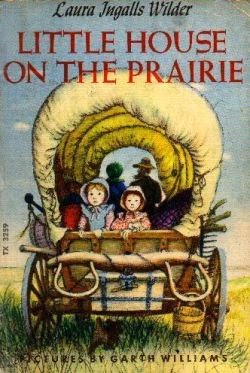
Little House on the Prairie


© 1933 Laura Ingalls Wilder


I would say that Little House on the Prairie brings back fond memories, but in truth the volume I remember so happily was Little House in the  Big Woods, which recounts author Laura Ingalls Wilder’s accounts of growing up in the Wisconsin wilderness in the 19th century. In Little House in the Prairie,  little Laura and her family — Ma, Pa, big sister Mary and baby sister Carrie —  leave the big woods behind. Wisconsin, once the frontier, is now brimming with people — and Pa has decided to move the family to Indian country, to the plains. Little House on the Prairie is the story of their journey westward, and of their first year among the wolves, wind, and natives.


 Wilder’s account, partially based on her own childhood, is charming, beginning with its opening – “once upon a time, when all the grandparents were babies” —  exciting, and educational. There’s no end to the dangers faced by the Wilders on the frontier; not only is the landscape rife with creatures that find humans edible, like wolves and panthers, but carving a house out of the wilderness is perilous work.  Gas within the ground poisons men digging wells, the timbers of homes fall, and storms appear out of nowhere.  And then there are the Indians, to whom the country belongs and who have a pretty good idea that the increasing appearance of white settlers within their territory isn’t a harbinger of peace.  Published in 1933, this is not a book that would fare  well among publishers today, given Ma Ingall’s outright loathing fear of the Indians, and the cheerful assertions that the white men have got to take the land in hand and make something of it, creating a civilization where these Indians have let the wilderness remain.  The stories are lessons in history, as when Wilder describes Pa building the cabin in exact detail, or comments on how the settlers didn’t know that the disease that swept through their farms was malaria. 

Long after publication, Little House on the Prairie remains a lovely story about American history, giving children an idea of what it was like to head into the wilderness and begin to make a home for themselves. Although today’s readers are more removed from Laura’s world than her initial audience, the Ingalls remain immanently relatable. 

Posted in historical fiction, Reviews | Tagged , , , , , , | 4 Comments

The Other Side of Western Civilization

The Other Side of Western Civilization: Readings in Everyday Life,
© 1979 ed. Stanley Chodorow
363 pages


The Other Side of Western Civilization collects readings in social history ranging from antiquity to the Renaissance. Its subtitle Readings in Everyday Life is largely accurate,  for the articles contributed by diverse authors largely ignore the halls of power and tell instead the stories of the common man, or detail the historic aspects of everyday life; there are pieces on the  adventures of traveling on medieval roads, for instance, and on family life in Renaissance Italy. Others move near ‘traditional’ historiography – one article covers the Battle of Agincourt – but maintain the ‘everyday’ focus;  “Feudal War in Practice” examines Agincourt from the perspective of the foot soldier,  taking into consideration how much room for movement there might have been if every archer in the English line had planted a stake in front of him, as official records of the battle establish. Principally, the collection covers trade, city planning, family life, social relations, and religion. Each piece is introduced by the editor, whose commentary attempts with some success to connect them together,  comparing different articles’ coverage of medieval women for instance. While readers will no doubt find some pieces easier reading than others based on their individual interest,  it’s generally accessible. Also of note is the fact that this collection doesn’t have a political edge to it; the ‘other side’ of western civilization  simply concerns topics ignored by  conventional military-political histories, like “Ancient Ships and Shipping” or “The Operation of a Monastery”.  This is accompanied by a second volume, which covers the Renaissance to the early modern period.

Contents:
“Ancient Ships and Shipping”
“Cities of the Roman Empire”
“Women in Roman Society”
“The Appeal and Practice of the Mystery-Religions”
“The Conversion of the Germans”
“German Tribal Society”
“Peasants and the Agricultural Revolution”
“Jews in a Christian Society”
“The World of the Crusaders”
“The Training of a Knight”
“The Role of a Baron’s Wife”
“Mother and Child”
“Traveling the Roads in the 12th Century”
“The Workday of a Bishop”
“The Operation of a Monastery”
“Hunting Subversion in the Middle Ages”
“The Peasants in Revolt”
“The Organization of the Late Medieval City”
“The Relevance of a University Education in 14th Century England”
“Touring the Holy Land”
“A Community Against the Plague”
“City Women and the French Reformation”
“Cultural Patronage in Renaissance Florence”
“Parent and Child in Renaissance Italy”

Posted in history, Reviews | Tagged , , , , , , , | Leave a comment

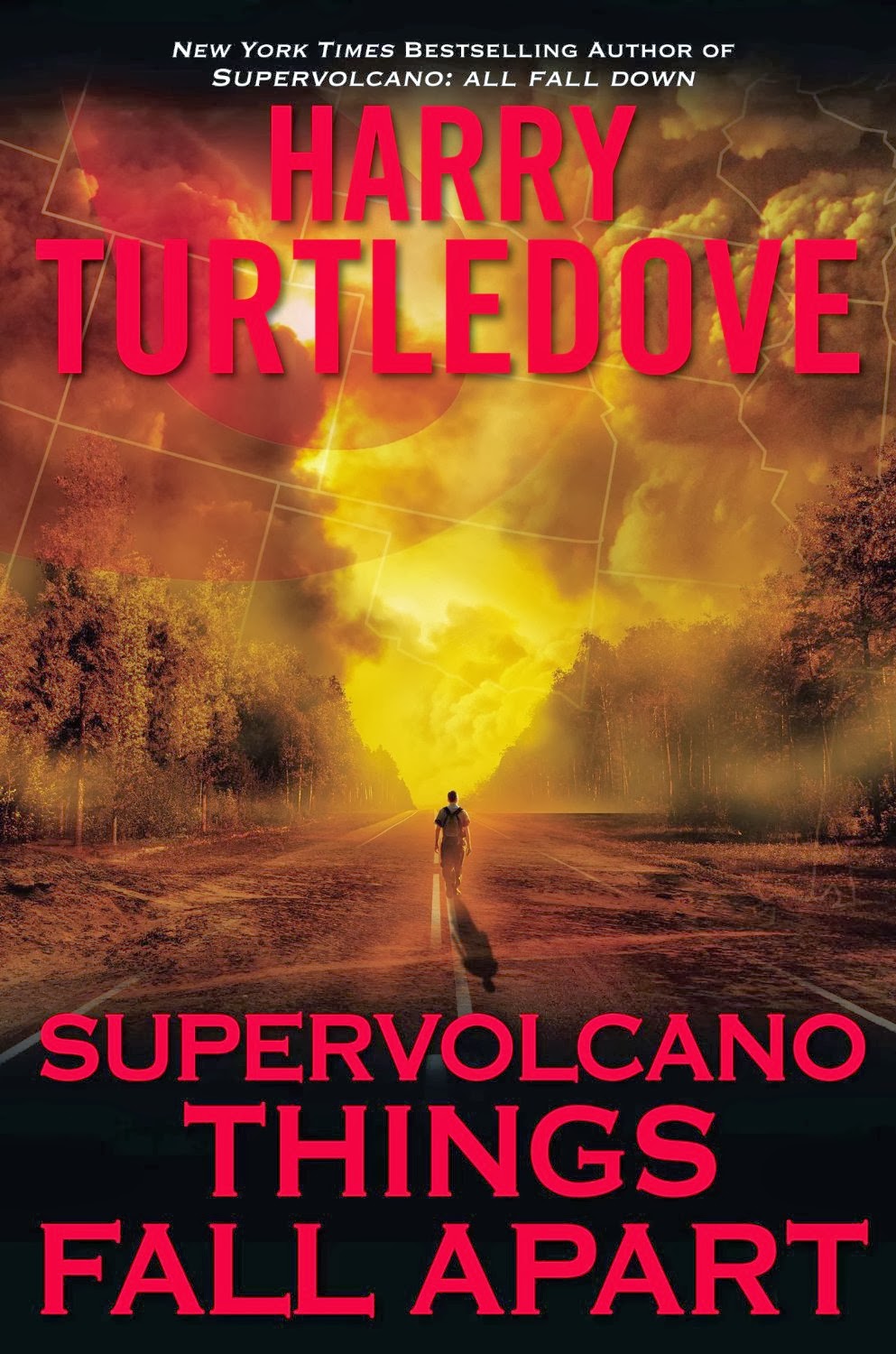
Things Fall Apart

Things Fall Apart
© 2013 Harry Turtledove
400 pages

What was the difference? Just a little timing. There wasn’t a person in the world who didn’t have a story like that. If you’d been a little late or a little early, if you hadn’t had that fender bender, if that woman in the store with you had bought the secondhand book that changed your life when you read it, if this, if that, if the other thing, your whole life would be totally changed. | It made you wonder. It really did. Ordinary lives were so easy to jerk around that way. What about the lives of nations? If your destiny could twist like a contortionist slipping on a banana peel, what about your country’s?  (p.379)


Almost ten years ago, a supervolcano buried under Yellowstone National Park erupted, vaporizing a few deer and covering most of the American west with ash. That ash and dirt filled the air, too,  killing millions and blocking out sunlight.  As a year without a summer becomes a decade without one, the odds that the planet is slipping into another ice age look increasingly large.  Like the books that preceded it, Things Fall Apart follows the lives of the scattered Ferguson family as they continue to adjust to the new facts of life — or in one character’s case, continue to whine about it.  It is essentially a soap opera with a mildly interesting background — for ten years into the crisis, changes are everywhere.

While most of the characters live in the greater Los Angeles area, two one lives on the fringe of habitable land in Nebraska and another lives in the wintry wasteland of Maine. Their county is now virtually autonomous, forgotten about by the US Government in its attempt to find food and shelter for the millions who are still displaced, a decade after mounds of ash moved quite rudely into their neighborhoods overnight. The few who remain there eke out a living growing turnips in greenhouses, hunting moose, and chopping wood, though ten years of such harvests have fallen to meager pickings. After a decade of intermittent power and scarce resources, the 21st century has been pushed back: now typewriters sit upon desks, notes are taken by hand on paper, and virtually everyone bicycles. In the cities, many still crowd onto public transportation, but aging and overworked buses are breaking down with no parts available to replace them. As people emigrate between the states — or in Europe, flood from the north away from a dying Gulf Stream to invade Greece and Spain — tension between the long-time residents and newcomers surge.

All this is background, however, the scenery to a plot consisting of a police officer retiring, his oldest son having an affair with a married woman and then being dumped by her; his oldest daughter having all of her money stolen by her Serbian revolutionary-boyfriend, and his two younger sons (well, son and almost-son-in-law-who-he-thinks-of-as-a-son)   being cold and having wives in Nebraska and Maine.  Oh, and his wife begins dating a middle-aged man who can’t get enough of European football and Broadway musicals.

Things Fall Down is really As the World Turns….into an Ice Age. or, The Young and the Restless and the Very Cold.  Or, Coronation Street Ice-Plow Capers.  At any rate, if you’re looking for science fiction, this isn’t it:  science-as-plot was over after the eruption, and now it’s scenery. If you want post-apocalyptic thrills, then sorry, out of luck. Now, if you want characters eating oatmeal and taking showers and brooding over their love lives while it snows outside, then hey —  this is the book for you.

Posted in Reviews | Tagged , | 3 Comments

This week: Nature Wants to Kill You with Jack London, Ernest Hemingway, and Harry Turtledove

Craving manly tales of outdoor adventure, I checked out a handful of short-story collections by Ernest Hemingway and Jack London. I started with the titular story of Hemingway’s The Snows of Kilamanjaro, having seen the movie earlier in the week. and was surprised when the main character died, instead of being rescued by plane as he was when portrayed by Gregory Peck — surprised because in the story, he was rescued by plane — but that was, alas, the dream of a dying man.  I switched to To Build a Fire (And Other Stories), only to be treated to the account of a man freezing to death in the Yukon wilderness, having cheerfully blundered into the snow despite even his dog knowing -50 degrees is too cold for country walks.  I decided to stop reading those and find something slightly happier, like The Men Who United the States.  At the library, though, I spied that we’ve recently acquired Things Fall Apart, the latest piece in Harry Turtledove’s supervolcano-induced ice age death of civilization series.

Thus, death-by-nature seems to be a theme among the books I’m spending time with as we head into winter, but surely all of Hemingway and London’s stories collected in the volumes I have can’t end in death. I intend on reading the Snows of Kilamanjaro collection through, if only because the only Hemingway I’ve read is The Old Man and the Sea.  He feels like an author I should have read much more of.   So, this week I’ll be finishing off Small is Beautiful, then entertaining myself with tales of the outdoors. Distracting me will be The Men who United the States and The Other Side of Western History,  the latter of which contains historical pieces on everything from shipping traffic during the classical era to the daily minutia of being a  Renaissance bishop — war in the morning, graft in the afternoons. Work, work, work!

Posted in Reviews | Tagged , | 3 Comments

Down the River

Down the River
© 1982 Edward Abbey

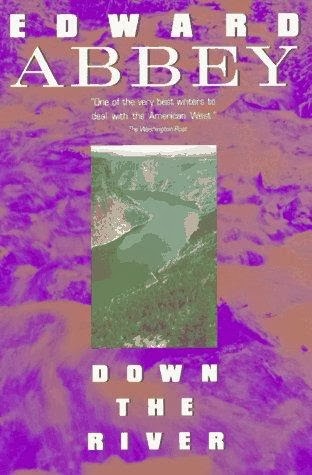
In Desert Solitaire, Edward Abbey collected contemplative pieces he had written while a park ranger in the high desert, putting his passion for the wilderness into action by working to conserve it. The volume mixed poetic descriptions of the wild beauty of the desert with reflection on the value of wilderness; not as an avenue of resources yet-to-be-exploited, but as a place for reflection and the realization of an authentic life. Down the River follows the same course, though the pieces here are connected not to a season living as a park ranger, but to various adventures Abbey embarked upon while exploring the rivers of the American Southwest.  Abbey simultaneously recounts his journeys with friends with the thinking the landscape inspired, and since often he made a journey to find something out, those thoughts are not as random as might be supposed. In one essay Abbey explores an area that will soon be off limits to him, for it will be shut to the public to protect an incoming missile installation.  Here his descriptions of what is seen combine with condemnation of the military-industrial complex and thoughts on Cold War geopolitics in general. This at least has a happy ending, for Abbey’s kindred spirits in the region were able to rouse enough local protest to prompt President Reagan to put off building the complex. This is certainly a happier piece than the similar essay in Desert Solitaire which saw him exploring Glen Canyon River shortly before it was dammed up.  There are a few odds and ends, like his faux-review of Zen and the Art of Motorcycle Maintenance from the perspective of a Hells Angel who critiqued the book on its mechanical advice.  This is presented in all seriousness.

Although not quite on the level of Desert Solitaire, Down the River is worth reading  purely for its opening essay, “Down the River with Henry David Thoreau”.  Abbey is a modern Thoreau, in that their works see them retreating into Nature in search of a more authentic life; they find solace and fullness in the wilderness, and distantly removed from ‘civilization’ they can reflect both on its merits and flaws more objectively. The principle difference is that while  Thoreau is a gentle Puritan from the forest; Abbey a cantankerous free spirit in the desert. Thoreau ruminates, Abbey complains, but while Thoreau is a lonely sage of the wilderness, Abbey is almost never alone and always in the middle of a good time. Whether he’s touring with cowboys in Desert Solitaire or swapping jibes with boatmen here in Down the River,  Abbey is plainly enjoying the wilderness. Regardless of the sheer animal pleasure Abbey takes in the wild, he is thoughtful, as well. Thoreau appears through the volume, for in Abbey’s words his is a spirit which has only grown larger through the ages as we continue to replace the wild with lifelessness. In addition to again defending the virtues of the wilderness — both for its own sake, in its beauty, and for the practical importance the wild has as a place of refuge or comparison for the civilized man — Abbey continues his grousing against the 20th century’s fondness for size and complexity, in abandoning small,  resilience farms run by homesteaders for massive agribusinesses run by men in suits whose every solution is even more energy- and system-dependent.

Again I owe a debt of gratitude to the commenter who suggested I might like Abbey a few years ago.

Related:
Desert Solitaire, Edward Abbey
Walden,  I to Myself, Henry David Thoreau
The Unsettling of America, Wendell Berry, which he references
Small is Beautiful, E.F. Schumacher

Posted in Reviews | Tagged , , , , , , | Leave a comment

This week at the library: NaNoWriMo! Victorians, Napoleon, and a cantankerous Thoreau

Yaay.
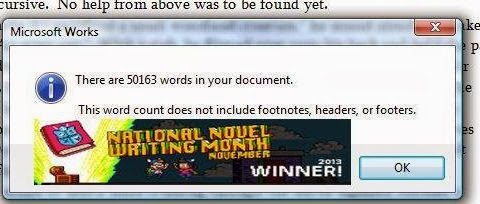
Is it weird that I was more excited to hit 45,000 words than to actually ‘win’ NaNoWriMo? I suppose that’s because when I hit 45,000, it was the evening I added a few days’ work from different files into the body of the text, and the word-count soared 10,000+  with one Ctrl-V and I realized I was going to do it, there were only a few days left and the odds weren’t good that something could derail me completely.  The lesson I learned from NaNoWriMo is that I should take a audio recorder out with me on my morning walks and jogs, because that’s when my brain starts being productive. It’s terribly hard to write notes while running, especially when you’re dodging puppies at the same time.
I didn’t do an enormous amount of reading last week, or writing outside of NaNoNo, so there are still reviews pending for several works. This past week I finished the excellent Sharpe’s Revenge, finished No Plot? No Problem? A Low-Stress High-Velocity Guide to Writing a Novel in Thirty Days, and read through Edward Abbey’s Down the River.   No Plot No Problem is allegedly the same size text that NaNoWriMo winners produced during the month. The goal of the month is simply to write, to kickstart the creative engine of the brain and deliver to aspirin authors the less than yes, if they make themselves sit down and write  every day, they can produce something. Baty’s advice ranges from the generally helpful to the NaNo-specific. He explains the basis process of figuring out setting and characters, provides in-text buttons that the reader is supposed to press to turn off their inner editor and so on, and in general does everything he can to encourage readers to just sit down and write.  In the end he offers would-be-writers some perspective: even if you never get published, maybe that’ not the point. Maybe the point is the satisfaction gained in writing, in expressing yourself creatively, in seeing what worlds you can create and what inspiration strikes your brain. 
NaNoWriMo having been accomplished,  I’m going to be unwinding these last few weeks of the year, with novels. Writing fiction of a sort has made me want to read more of it, though at the moment I’m happily in the middle of a book which has arrived in the post. What book?
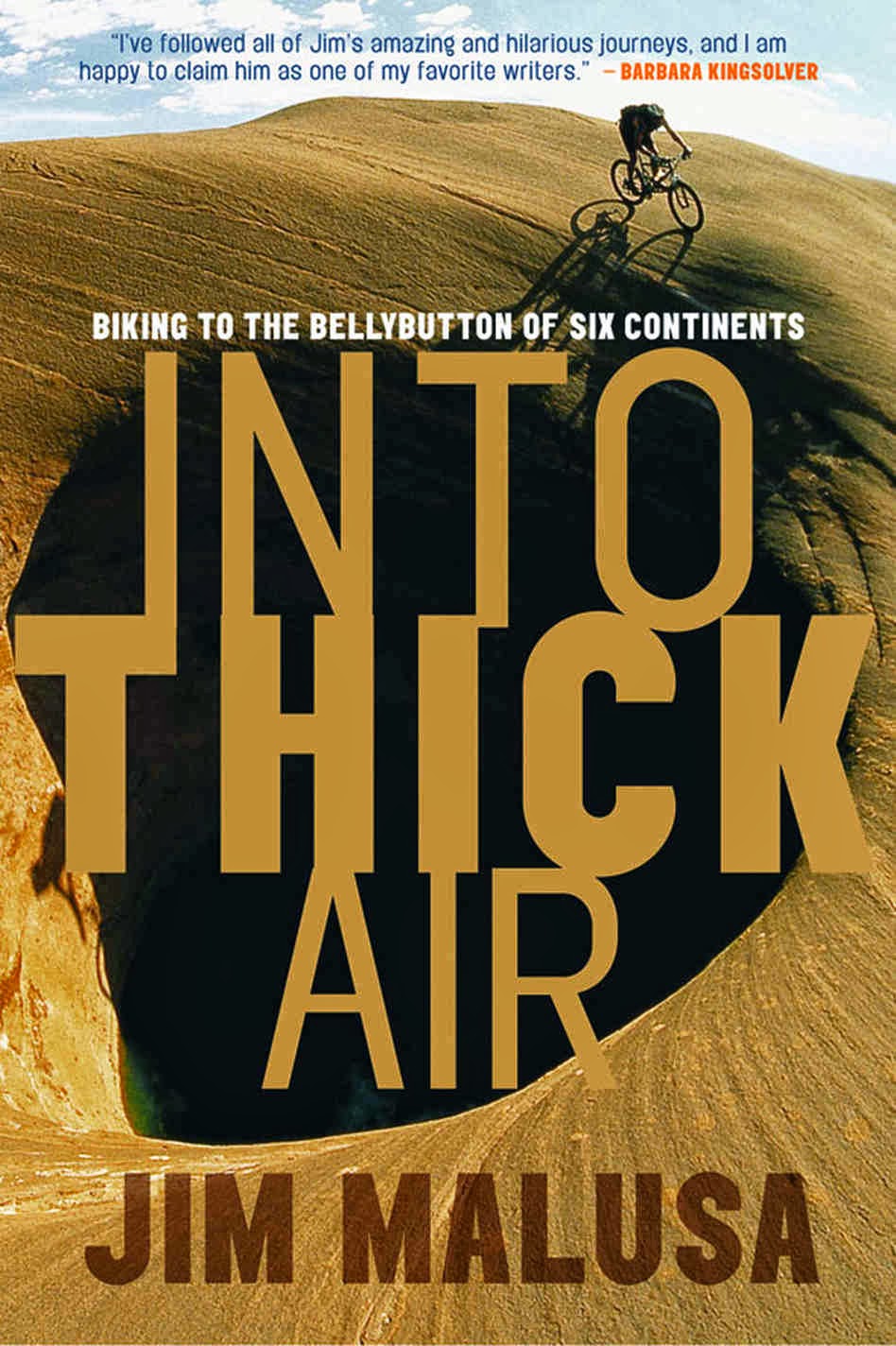
Into Thick Air!  When I saw it on Amazon (related reads for The Man Who Cycled the World), I couldn’t resist reading it, given that I had just finished Into Thin Air.  It’s a treat so far;   the author reminds me of no one more than Bill Bryson.  After that, I’m not certain — I have a few nonfiction reads on the table, but I may poke my nose into Harry Turtledove’s WW2-with-dragons-and-wizards series.  Like alien lizards and WW2, it’s such an odd combination I have to investigate it.  I’m probably going to be reading more of Jack London; not only am I craving outdoor adventure books, but London’s works have such philosophical interest that I want to consider more of him. 
Posted in Reviews | Tagged , , | Leave a comment

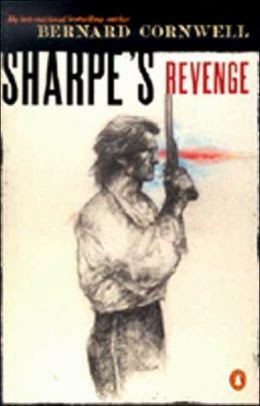
Sharpe’s Revenge

Sharpe’s Revenge
© 1989 Bernard Cornwell

Englishmen in Toulouse, Prussians in Paris — there are foreigners everywhere, and for Napoleon the war is over. Not for Sharpe, though, not by a long shot. His old enemy Pierre Ducos has seen fit to ensnare Sharpe one last time before the piece is signed, and it will cost Sharpe more than he ever imagined.  Sharpe’s Siege takes the reader  through what seem to be the last skirmishes of the war, and then into the peace, which is far more dangerous. Accused of murder and grand theft,  Sharpe is left to wander through France avoiding the armies of l’Empereur and the English Crown, for both have become his enemy.  Sharpe’s Siege is one of the more agonizing pieces in this series, but satisfies in a way few have.  The plot is vaguely familiar (I’m sure this isn’t the first time Sharpe has been on the lam from his own army with no one but Patrick at his side),  but the late game is more than mere military adventurism.  Sharpe’s own soul is tortured here, and while it’s painful for him it’s great reading — and it is moments like those crafted in here that will be remembered long after the series is finished and the epic battles scenes have evaporated from memory.  I rather doubt Sharpe’s Waterloo can top this, but we’ll see.

Posted in historical fiction, Reviews | Tagged , , , , | Leave a comment

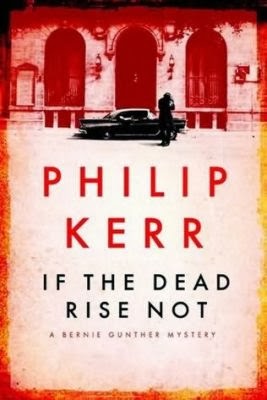
If the Dead Rise Not

If the Dead Rise Not
© 2011 Phillip Kerr
464 pages

            Bernie Gunther would be your standard-issue world-weary detective were it not for the fact that he just killed a Nazi.  Gunther has no love for the Nazis, who took power in his beloved Germany a year ago, and have in the year 1934 managed to reduce it to a joyless place for those who enjoy fast talk and loose women. Gunther is especially fond of both. Having quit his position in the police department to avoid having to fuss with the cretins in power, Gunther became the house detective of Berlin’s grandest hotel.  As it turns out, however, he has by no means removed himself from danger, and when an obnoxious American gangster claims a Ming dynasty artifact was stolen from his room, Gunther meets a man whose schemes will see the wisecracking detective arrested, and hauled out into the open ocean to be killed.  Though the man Max Reles appears to be a boorish businessman with a few shady operations, in actuality he’s in bed with Hitler – or intent on making der Fuhrer his purse. The political intrigue doesn’t stop with Hitler, as the last fifth of the novel takes place in pre-revolutionary Cuba. The odd coupling of time and place that also appeared in Field Grey works here as well. If the Dead Rise Not is in turns disturbing and spectacularly funny;  one of the reasons Gunther can’t avoid trouble is his tendency to shoot off his mouth, and the book features a rolling barrage of one-liners, mostly taking shots at the Nazis. There are the usual thrills, of course – chase scenes, murders, numerous points wherein he seems well and truly doomed – and the obligatory twist and turn of the plot. Disturbing comes with all of the characters tendency to live in moral grey ares; the villain, who by actions ought to be detested, is one of the most entertaining men to read. Even Bernie, for whom he is a principle villain, can’t help but be tempted by liking him.  Happily,  everyone reaps what they sow, and eventually Reles meets the usual end of people who work with those like Meyer Lanksy.

Quotations

“A Nazi is someone who follows Hitler. To be anti-Nazi is to listen to what he says.” p. 70

“German history is nothing more than a series of ridiculous mustaches.”  p. 73

“These days a considerate German is someone who doesn’t knock on your door early in the morning in case you think it’s the Gestapo.” p. 86

“A German is a man who manages to overcome his worst prejudices. A Nazi is a man who turns them into laws.” p. 88

Posted in Reviews | Tagged , , | 1 Comment

This week the library: NaNoWriMo, Sharpe, and histories

We’re in the last week of National Novel Writing Month, and I can cheerfully report that I am not woefully behind, having faithfully plugged away almost every night. If I can make up for a couple of missed days, I should manage my 50,000 words. I’d regale fellow nano-writers out there with tales of my zany characters and oddball plot, but it’s no grant adventure what I’ve been writing, just bits and pieces of a coming-of-age story in which a largely unsympathetic main character persists in prolonging misery by hiding from his own life, but keeps meeting people who, inexplicably, wish to draw him out into it. These include a redneck Marxist and a kindly priest.  Once I’ve gotten the 50,000 words, I really must on making the main character somewhat likeable. At the moment he’s scarcely more than a grouch.

But speaking of books I am reading, or have read, instead of one I am pretending to write, this past week I finished a couple, including another Phillip Kerr novel which comments are largely ready for. Moments ago I finished Tom Standage’s The Victorian Internet, which made a lot more sense once I realized it had been written in 1998. It will receive comments later in the week. On a more serious note, last week I finished two works of history, The South vs the South and Train Time. Train Time deserves more consideration than a brief mention here, but The South was largely disappointing despite being well put together. It is largely focused with the role of slaves in the war, covering the politics of wartime emancipation splendidly. My interest in reading this was in discovering more about the effect of dissent and rebellion of white farmers and townsfolk against the Confederacy, and they are ignored wholly:  they only featured in a chapter on the border states which reveals how apathetic southerners could be about the planters’ republic.  David Williams had  a far more interesting canvas, but then his didn’t have nearly the detailed documentation. If only I could have the best of both worlds — well, there’s always The Free State of Jones,  which is another in this genre of historical nonfiction I’ve found.

This week, I’m with Richard Sharpe in France, where he’s almost hoping Napoleon will give up without further fighting — hardly surprising considering the bloody road through Spain he’s taken to get to Toulouse. I am expecting in the mail another book on travel and physical adventure. It was irresistible given the title. That will probably wait until December, though — Sharpe will keep me company as I try to finish my own little campaign.  I look forward to reporting success on Sunday or Monday!

Posted in Reviews | Tagged , , | Leave a comment

Martin Eden

Martin Eden
© 1908 Jack London
381 pages

For its first two thirds, Martin Eden is a uplifting tale of art and romance about a man of humble means who hauls himself up to a better station in life in pursuit of a woman, discovering his own soul in the process. This inspiring story turns quickly to tragedy, however, when it reveals how quickly and utterly lost a soul can be when disappearing on the heights of achievement, boasting about its own success.

Martin  Eden is a working-class sailor, positively rippling with masculine virility and sharply intelligent.  When he saves the life of a soft, pampered Oakland scion named Arthur Morse, he’s invited to dinner by him in gratitude. Arthur warns his family that he’s bringing home a wild man, but his sister Ruth is positively undone by Martin’s sheer presence. He, too, is wowed by her; while he embodies everything wild, masculine, and rough, she embodies (very prettily) everything civilized, feminine, classy, and tender. The two worship one another within their own minds, but he realizes she is as far above his grasp as the angels, unless he can learn to talk as her family talks, and about the same subjects they deem fit: art, literature, and philosophy. Armed with curiosity, will, and the ability to master any subject through independent study, Martin submits to Ruth’s desire to civilize him. But Ruth unwittingly creates a monster: drunk with love, idealism, and the thought of becoming a great author, Eden abandons all but study and art. The book records his quest of self-cultivation through study, self-expression through his struggling writer’s career, and ultimately, self-aggrandizement. It is the latter that turns this story of accomplishment into tragedy, for Martin’s triumph is achieved only by the loss of everything  within him worthwhile.

Martin Eden bears a close resemblance to Wolf Larsen, the fearful beast-man antagonist of The Sea Wolf, who like Eden was a self-taught intellectual master, but simultaneously a physical titan.  Both hold themselves to the ideal of the Nietzschean superman, the man shackled by nothing — no chains on their thoughts, their bodies, or their hearts.  They were to be men without limit, who conquered the world before them and recognized no law save that of the wild: kill or be killed, triumph or perish. While Wolf Larsen was countered by a soft professor who became a ‘man in full’, full of wild strength but tempering it with civilized morality,  Martin encounters no worthy adversary. Having rejecting all, he is without anything, and though having achieved his goal he feels no joy in it  he is left with nothing but bitter loneliness, the kind of deep-seated alienation that leads inevitably downward.  I found it profoundly depressing, and imagine this to be London’s goal; Martin is a tragic figure, almost Lucifer-like in his fall , and the greatest sadness is that he never recognizes that he  has done himself a disservice in embracing the philosophy of the Self over all.  Martin Eden has beautiful prose, and inspired characters, but the cautionary tale has such a harrowing ending that it almost prompts regret in having read it, thought nothing so thought-provoking and insightful should be ignored.

Related:
The Sea Wolf, Jack London
The Pearl, John Steinbeck

Posted in Reviews | Tagged , , , , | 3 Comments