The Gift of Good Land

The Gift of Good Land
© 1981 Wendell Berry
281 pages
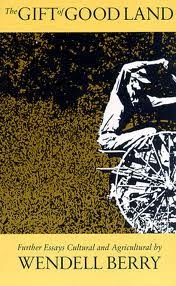
Wendell Berry is a philosopher, poet, and more, but before all else he is a farmer. He is a faithful son of Kentucky devoted to the land, to the stewardship of the Earth, to the obedience to the first commandment given in his religious tradition: to dress and keep the garden. Berry has produced other collections of essays that focused primarily on agriculture, but this is the first I’ve read, and while I haven’t set foot on a proper farm since elementary school, Berry’s crafted hand makes a man ache to experience the gift of land he writes on here.  Although these essays primarily address farming, life is the subject; when Berry writes on the virtues of mowing with scythes, the essay is on man’s relation with his tools. Does he use them to his intended ends or is he compelled to use them toward theirs?  A piece on the role of horses addresses the need for appropriate solutions, for sensible and sustainable approaches to the cultivation of food. A few essays simply reflect on the thoughts a farm naturally brings to mind, like those of motherhood when Berry is helping deliver a calf; he is profoundly grateful, not annoyed, to have been able to play a part in bringing the new life into the world.  Berry is an author who radiates wisdom; he notes, in considering the discovery of the New World, that we, like our ancestors come “with visions, but not with sight. We did not see or understand where we were or what was there, but we destroyed what was there for the sake of what we desired. The partial purpose of these essays is to generate an understanding, not of what we know, but of how little we know.  As Berry muses on the patterns of nature, and attempts to teach readers how to discern and plan within those patterns — to solve agricultural problems through agricultural means, for instance — his study reveals how painfully arrogant we have been in the 20th century, to simply decide life was a machine that could be engineered to produce whatever outputs we wanted. Life remains stubbornly organic, temperamental even,  and responding to it requires the watchful eye, gentle hand, and sharp mind of a careful husband of the flock, a steward of the land; a farmer.

Related:
Folks, This Ain’t Normal, Joel Salatin
Posted in Reviews | Tagged , , , , , , , , | Leave a comment

The Martian

The Martian
© 2013 Andy Weir
369 pages

I was elated!  This was the best plan ever! Not only was I clearing out the hydrogen, I was making more water! 

Everything went great right up to the explosion

p. 43

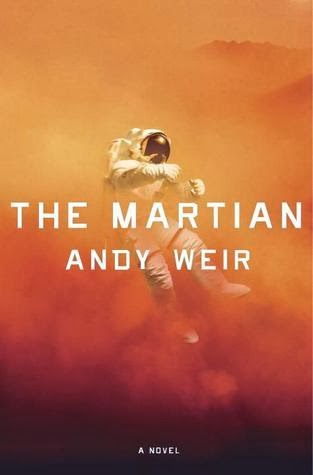
Mark Watney never thought his Mars mission would make history. He was the eighteenth man on the planet, a member of the third  mission there; who remembers the third man to set foot on the Moon, let alone the fifteenth?  But when a dust storm threw a communications setup into his chest and his colleagues were forced to quit the planet before recovering his body lest their ride home be destroyed,  Mark woke up to find himself the only man on the planet – the only man around, in fact, for millions of miles. Robinson Crusoe, you ain’t seen nothin’ yet.  Fortunately for Mark, not only did the aborted mission leave him with his five crewmates’ supplies, but he’s a botanist and a mechanical engineer.  Mark’s own mind – his scientific experience and creativity,, along with a   if-this-doesn’t-work-I’m-dead-anyway intrepidity — is his best resource, though. Not even rationing his rations will see him through the four years that will pass before the next Ares mission lands. And so Mark tries to find a way to survive, to turn his limited equipment and Mars’ land and air into life.  The result is The Martian, a captivating and absolutely hilarious memoir of survival that sees him battling physics with ingenuity and despair with laughter ’til the very end.

The Martian is easily the most entertaining science fiction novel I’ve read, a story of  relentless problem-solving and dogged humor.  It’s not Mark’s story alone — Weir  occasionally zooms back to Earth as NASA tries to cope, and  he occasionally shifts to a third-person narrative when something colossally bad is about to happen to our stubborn survivor — but most of The Martian is told, journal-form, recording Mark’s reactions, plans, and thoughts on life so far from humanity. He is never free from worry; no sooner has he found to solve a problem by physics, chemistry, botany, or setting something on fire, than does something else go wrong. Sometimes solutions create their own problems, because his resources are limited and not even an engineer-botanist can think of everything. Add to that the fact that Mars is an environment hostile to human life, a severe place that punishes mistakes with death (freezing, exploding,  starving, take your pick), and there’s no end to his troubles. But he never stops trying, and he never becomes dispirited permanently. There’s no one on the planet to have  a pity party with, and nothing to do but try to put the pieces back together again and move on.  Eventually the story widens; Mark can’t communicate with Earth, but they do have satellites, and the only bit of life on the entire planet can’t avoid being noticed forever. If he can only find a way to endure!  Despite the seriousness of his situation, the narrative is easy-going, almost light-hearted. Mark is keeping logs to keep track of his progress and maintain his sanity, not give an audience a respectable tale of man vs. the elements. He records in detail his thinking about wrangling technical problems, but he’s also constantly joking or complaining or chattering.. (“I tested the brackets by hitting them with rocks. This kind of sophistication is what we interplanetary scientists are known for.”)  Part of the appeal of The Martian is the fact that, though this is science-fiction, it’s not far removed from contemporary technology; the people in this novel  don’t need any background, because they’re us. This is an immensely personable science-adventure story, abounding in puzzles and smart remarks.  It’s quite impressive considering it’s Andy Weir’s first work, and I would definitely recommend  it, especially to those with any interest at all in space flight.

“[The laptop] died instantly. The screen went black before I was out of the outlock. Turns out the ‘L’ in ‘LCD’ stands for ‘Liquid’. I guess it either froze or boiled off. Maybe I’ll have to post a consumer review: ‘Brought product to surface of Mars. It stopped working. 0/10’.”

Related: 
Founding Father“, Isaac Asimov. Also about astronauts trying to survive in a hostile world after things go badly.

Posted in Reviews, science fiction | Tagged , , , | 7 Comments

Forgotten Voices of the Great War

Forgotten Voices of the Great War
© 2004 ed. Max Author
336 pages


                        Forgotten Voices of the Great War is a chronicle of the first great war,  a story told not by one author but many. Interviews and written recollections from soldiers and civilians, young and old, give readers a first-hand view of the debacle as it unfolded. The editor divided the book into five year-by-year sections, and begins each with a brief (two-page long) summary of the year’s fighting before allowing the participants of history to give the full, intimate account.  Aside from the occasional insertion of dates and battle names, the narrative consists of first-hand excerpts, generally no more than a paragraph long.  There are distinct home front and military sections, and no bias as far as the soldiers’ attitudes go:   the account begins with feelings of thrill and anxiety at the war’s declaration, but by the first few months virtually everyone sounds weary. There’s no polemicizing here, though after witnessing the despair of soldiers enduring these long years at the front  what reader can escape antiwar sentiment?  All of the combat accounts are set on the Western Front or in Gallipoli,, but there are accounts of Germans, French, and Americans mixed in with the Commonwealth nations’ excerpts,  constituting half the work. Forgotten Voices leaves grand narrative behind and allows readers to experience the grisly details – the stories of soldiers tripping through dark trenches filled with cables, of the wounded sinking into muddy shell holes and attempting to effect their rescue by singing loudly amid the clamor of combat;  and of course, the rats, living in the legions of bodies and growing as large as dogs, with shooting them a dismal option because their own bodies will only add to the stinking foulness. It’s not pretty, but such is the nature of war and modern readers would do well to heed these voices instead of those singing of war’s glories.
Posted in history, Reviews | Tagged , , , , | 2 Comments

From Chunk to Hunk

From Chunk to Hunk: Diary of a Fat Man
© 2003 Fred Anderson
242 pages

Fred Anderson had an epiphany while munching on snack cakes and watching TV; as he witnessed the amputation of a diabetic man’s leg, he realized: this is my future.  Horrified at the thought of losing mobility, and frustrated by not being able to play with his daughter, Fred began watching what he ate and exercising daily. Two years later, he was down over a hundred and fifty pounds. From Chunk to Hunk is his record of that time, a journal doubling as a fitness coach to readers. Its focus is mental;  Anderson makes no dietary claims beyond Pollanesque observations that if a foodstuff needs a tv commercial, it’s probably no good for you; instead, he preaches throughout on attitude adjustments, on how to form new habits, how to change attitudes towards food and exercise, and so on. In this two-year account, Anderson not only sheds a man’s weight worth of fat, his health-focused lifestyle frees him from diabetic treatment. He doesn’t forth a dietary or exercise regimen, maintaining that people are sensible enough to recognize “real” — healthy — food. The challenge is consistency, both in eating well and exercising. Anderson begins by treading water,  but shifts to daily intensive walks and adds in weight lifting, eventually alternating running days with weight-lifting and cycling days. Persistence is his motto: it doesn’t matter if he makes the odd mistake, he exercises every single day, aside from a once-weekly rest day, and eats well the overwhelming majority of the time.  He isn’t a puritan about coveting or abhorring one element or another;  he instead makes his ally Time, by simply making the same good choices every day.  Aristotle observed that our character is the sum of our actions; excellence is achieved by habit.   Anderson’s candor, and the absence of a program being sold, make this a refreshing weight-loss account, one that doesn’t pretend to nutritional wisdom. It’s a bit on the preachy side — despite not being religious, Anderson often quotes from the Bible and uses the same communicative tropes as some folksy preachers —  but this is forgivable, as is the sometimes too personal details he includes sporadically. I read this primarily to see how his journey paralleled my own — both of us, in the twilight of our twenties, had a wake-up call and lost over a hundred pounds, with no magic except daily, vigorous exercise and moderate eating of natural foods.   I haven’t embraced weight-lifting or running as enthusiastically as he have, but I very well may..

Posted in Reviews | Tagged , , | 3 Comments

And Then There Were Nuns

And Then There Were Nuns: Adventures in a Cloistered Life
© 2013 Jane Christmas
292 pages

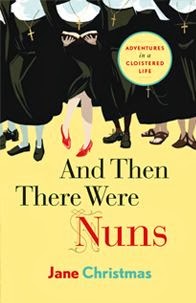
When Jane Christmas’ boyfriend proposed to her, she gave him the most obvious reply: she said she wanted to join a nunnery.  It wasn’t that he had driven her to the cloister; she had been tempted by it for most of her life, but it wasn’t until her beau was down on bended knee that she realized it was now or never. And so she spent the better part of a year living in monastic communities, with nuns and monks alike, in Canada and in Britain, while her extraordinarily long-suffering fiance kept in contact by letter. And Then Were Nuns is a slightly humorous account of an endeavor seriously undertaken: to see if the author truly felt called to be a nun. The result for readers is a look into a world normally out of mind, and an exploration of the value of a monastic life to the religiously-inclined.

Religious orders are the Anglican church’s best-kept secret, Christmas writes, and that’s probably the case, for whoever associates nuns with the Church of England? Nuns are black-habited sisters stalking the halls of private schools or hospitals, thumping children with rulers or humorlessly flipping protesting hospital patients on their backsides to administer shots in their hinterlands. But the Anglican church does have religious orders, male and female, throughout the world, and Christmas begins by spending four weeks at a convent in Toronto, where she’s treated as if she’s on retreat. The initial bit of self-examination unlocks some inner demons, and before making a decision whether to marry her finance or Jesus, she decided a more intensive sojourn is in order, a multi-month stay at a convent in Britain. As she travels there, she stays with nuns and monks at two religious communities on the Isle of Wight, flirting with the Catholic church before an indignant mother informs her that no she bloody well can not join the Romans and become a nun with three marriages to her name. Her experiences there affirm her association with the Church of England, however theologically indecisive and socially regressive it might be. Eventually Jane realizes this time spent living among religious orders wasn’t meant so much to help her make a decision about becoming a nun as to face down a harrowing sexual episode years before.

Christmas has a reputation as a humorist, and Then There Were Nuns combines serious introspection and discussion about the spiritual and material value of the nuns’ work with wry reflections. Awed and nervous by the exploration she’s undertaken, Christmas sometimes escapes the intensity with jokes to herself. This isn’t a laughing trip through the world of intentional religious communities, however; she is a woman on a mission. Eventually the mission bears fruit, if not exactly in the way she would have predicted; always a seeker of the simple, quiet life, Christmas is drawn to the convent for its freedom from outside distraction,  constant exhortations to spiritual mindfulness, and above all — meaningful work.  The monotony of everyday experience, however, and the inviting presence of her children and would-be spouse outside, diminish the allure. She finds her path, however, and for the religiously-inclined or spiritually-interested reader, And Then There Were Nuns will prove informative and engaging; it is a humanizing look at people who seem to have an otherworldly existence.

Posted in Reviews | Tagged , , , , , , | 5 Comments

An Excerpt

“But then that’s the problem, isn’t it? We get older, we get no wiser, the wars of FDR and Truman turn into the wars of Kennedy and Nixon, the Gulf War of Bush I reappears as the Gulf War of Bush II, an we the people never do get together, except as atomized watchers of Desperate Housewives. We are, in the main, sitting fat and happy in what Robert Nisbet, in his splendid The Quest for Community, called ‘the heart of totalitarianism’: for we are ‘the masses; the vast aggregates who are never tortured, flogged, or imprisoned, or humiliated; who instead are cajoled, flattered, stimulated by the rulers; but who are nonetheless relentlessly destroyed as human beings, ground down into mere shells of humanity.’  The totalitarian, wrote Nisbet, seeks ‘the necessary destruction of all evidences of spontaneous, autonomous association,’ leaving us a mass of anchorless individuals whose wasted lives are lighted only by the hideous bluish glare of the TV set.
Hey, what’s on tonight?”

–  Bill Kauffman, Look Homeward, America! In Search of Reactionary Radicals and Front Porch Anarchists  p. 141

Posted in Reviews | Leave a comment

This week at the library: desire, war, and traditions

Dear readers:

It’s been a slow start for February despite the miserable weather that keeps everyone indoors, possibly because I’ve spent the last week nursing a cold and it’s easier to watch movies than to coordinate book-holding, page-turning, and nose-tending all at the same time. I’ve finished off season one of The Vikings, which I would have never been interested in were it not for Bernard Cornwell waking me up to how fascinating their culture was.  Earlier in the week I did read his The Pagan Lord, the latest book in his series about the wars between the Saxons and Danes for control of Britain; that was another fine adventure. Toward the latter part of the week I became interested in And Then There Were Nuns, which is not an Agathie Christie mystery but a Jane Christmas recollection, the story of a woman who spends a year living in convents and a monastery.  Comments will follow for that this week, but yesterday I read Michael Pollan’s Food Rules, which is not so much a book as it is a pamphlet that looks like a book. It essentially distills his argument in In Defense of Food into 60 rules-of-thumb for eating. If you have read Pollan, most of the rules bear out specifically what he’s written about previously: he emphasizes eating whole, organic foods in moderation, but also works in advice for building a personal food culture — eat meals, not snacks; eat at a table, not just anywhere; eat with friends, not alone.  All good advice, it struck me, but $11 is a lot to pay for a collection of rules when many of them don’t have extensive explanations because they’re similar to one another.
This week I’ll be finishing Forgotten Voices of the Great War, which is a collection of first-hand recollections of the conflict,   and then — who knows? I’ll be doing a review for Wendell Berry’s The Gift of Good Land ,which is about the virtues of traditional farming and the importance of treating the land arightly,  and yesterday at the university library I found a book entitled dirt: the erosion of civilization which may be similar. That was a book picked up in afterthought, though; the main reason I went to the library was to check out On Desire: Why We Want What We Want, by William Irvine. Some readers may know him as the author of A Guide to the Good Life:  The Ancient Art of Stoic Joy. 
I also came home with:
  • Floods, Famines, and Emperors: El Nino and the Fate of Civilizations, Brian Fagan, on the historical impact of sudden climate shifts
  • The Age of Empathy: Nature’s Lessons for a Kinder Society, Frans de Waal, and;
  • What’s Wrong with the World,  G.K. Chesterton. This is one of the books that introduced Chesterton’s advocacy of distributism, so I want to tackle it to both read something by the man (given his reputation) and to ponder his response to industrialism as it was happening. This book was published in 1910. The language looks heady, but if I can get through Augustine I can get through anything. 
One book I was sorely tempted to buy was Alain de Botton’s The News: A User’s Guide, but I’d rather pair it with Neil Postman’s How to Watch TV News.  Right now I have entirely too much unread books sitting around, including The World Until Yesterday by Jared Diamond.
Well, happy Valentine’s Day to those who have been Cupid-stricken, and happy reading to the rest!
Posted in Reviews | Tagged , , | 2 Comments

The Pagan Lord

The Pagan Lord
© 2014 Bernard Cornwell
320 pages

Uhtred of Bebbanberg is having a bad week. First his hall was burned by an old rival-enemy, Cnut Ranulfson, in retaliation for Uhtred kidnapping his children, which Uhtred did not do. Uhtred of Bebbanberg is many things, but he doesn’t kidnap kids. After clearing that little mess up at Cnut’s place, he returns home to find the rest of his estate burned down by the church in retaliation for his accidentally killing a priest who attacked him when he attempted to prevent his eldest son Uhtred from becoming a “Christian wizard”. Uhtred didn’t mean to kill the priest; he just has that effect on them, like carbon monoxide.  Driven from Christendom by an excommunicated mob and hated by the Danes,  there’s really no place to go but up — up into Dane-held Britain, to the fortress Bebbanburg, his ancestral home stolen long ago by a treacherous uncle.  It could be all so simple:  take the fortress with a little derring-do and turtle up, allowing his enemies to cut one another to pieces. Alas, Cnut Ranulfson has complicated schemes afoot, and to get out it and lead the Saxons to triumph will involve a ship,  borrowed children, and a dead priest on a stick. That’s life in Anglo-Saxon Britain, and the tale of The Pagan Lord.

Cornwell’s Saxon Stories series, featuring a warlord of divided loyalties — a Saxon raised by Danes who served the Saxon king Alfred in his quest to defend Britain against Danish invasion – has so far consisted of superb odd-number books bridged by good even-numbered books. Pagan Lord is a bridge despite its odd-numbered status, but as solid as the Roman span Uhtred uses here while being pursued by an army five times his size. Pagan Lord is battle- and politics heavy, and consists largely of travel: Uhtred’s first response is to buy a boat and go ‘viking’, but as he begins to put together the pieces of whatever diabolical scheme his Norse rivals are up to.  In younger years Uhtred might have abandoned the Christian Saxons altogether and taken his home fortress with  Danish help, but his lingering attachment to his ‘own’ people is magnified by his love for a Christian woman who stands to be treated badly if the Danes win.  So once again he kills men he admires and aides men who despise him, because of a woman; Cornwell’s heroes tend to have that honorable flaw.  The Pagan Lord wasn’t quite the novel I expected: happily, it’s not the conclusion of the Saxon stories, even though Uhtred advances into the gates of his ancestral home.  The novel seems to move toward its conclusion in the middle before Uhtred’s plan goes awry, and he has to retreat into the mouth of Chaos, where he and all of Saxon Britain engage in war against the schemes and horde-strong armies of the Danes.  The Pagan Lord is on the short side, but’s a fine tale of adventure set during the Viking age.

Posted in historical fiction, Reviews | Tagged , , , , , , , | 6 Comments

Teaser Tuesday (4 Feb)

“We asked for help,” said the other priest, “to ensure that the light of the gospel isn’t extinguished from Britain, so that the pagans defeated utterly, and so the love of Christ will fill this land.”
“What he means,” Pyrlig explained, “is that he knew you were in the shit, and so he came to me and asked for help, and I had nothing better to do.”

p. 275, The Pagan Lord, Bernard Cornwell

Teaser Tuesday is a weekly event in which people share teasers from their currents, hosted by Should be Reading.

Posted in General | Tagged | Leave a comment

When Elephants Weep

When Elephants Weep: the Emotional Lives of Animals
© 1995 Jeffrey Masson and Susan McCarthy
291 pages

Humans pride themselves on not being  animals,  going so far as to describe any behavior we’re shamed of as ‘animal’.  Beasts have rude instincts; we have exalted Emotions,  gifts of the gods.  We may begrudgingly grant animals fear, or perhaps even affection – but love? Joy? Aesthetic reverence?   In When Elephants Weep, authors Masson and McCarthy explores the spectrum of animal emotions, from recording the patently obvious to flirting with anthropomorphism.  In their view, animals across the kingdom  can share the same basis emotions, and offered as evidence are hundreds of anecdotal claims of animals expressing behavior interpreted as emotional. Most of the subjects are mammals, but birds pepper the text and even insects make a stray appearance. Although anecdotes  are dismissed as evidence among purists of the scientific method,  many of the primate examples are corroborated in Jane Goodall and Frans de Waal’s work, and considering their frequency and similarity – and the fact that these two scientists made observations on different populations of chimpanzees —  many of the examples are respectable enough. The author does reach  sometimes, but the agenda here isn’t so much as to present an body of evidence convincing skeptics that  animals have emotions as it is to create room for suspecting they do; in the book’s conclusion, the author argues that considering the diversity of emotions animals seem to display, we should treat them with more consideration; if they are capable of loneliness, despair, grief, and the like, perhaps keeping them in captivity or experimenting on them at length is more than problematic.  The variety of examples is commendable; there are primates, cetaceans, elephants, lions, tigers, and yes even bears.   Emotions are easier to believe among the higher mammals, and some — anger, happiness, sadness — more likely than more esoteric feelings, like awe at a sunset. The authors use any account that brings to mind human emotions, but

When Elephants Weep is enjoyable more as a reflection on animal behavior and than a sterling scientific enterprise, but enjoyable all the same. 

Related:
Any work by Frans de Waal or Jane Goodall
Silent Thunder: Among the Elephants

Posted in Reviews, science | Tagged , , | Leave a comment