This week at the library: Civil War and Sea People

Dear readers:

This weekend I finally posted comments for Away Down South, completing my unintentional miniseries of Books Whose Titles Came from the Chorus of “Dixie”.   The traditional verses offer a lot of other phrases ripe for titles; imagine a cookbook called Buckwheat Cakes and Injun Batter, or a thriller named The Gay Deceiver.  Those books have started what may turn out to be a longer trend, an extended series concerning the South.

I’ve recently completed The World Until Yesterday by Jared Diamond, and have thus started in earnest  on my quest to take down the To Be Read list, that array of nonfiction titles I’ve purchased but not read in the last view weeks. My next conquest will be The Vikings,who I’m sure will be worthy foes.  Expect comments for Diamond within the week. For leisure I have Jeff Shaara’s latest Civil War novel to enjoy, set during the Battle for Chattanooga.  This is especially fun because despite having been to Lookout Mountain where part of the Confederate force viewed its foe in the city, I’ve no knowledge of how the battle transpired.

To Be Read Takedown Challenge

Antifragile, Nassim Nicholas Taleb
The Vikings, Robert Ferguson (in progress)                                              Power, Inc; David Rothkopf
An Edible History of Humanity, Tom Standage
Small-Mart Revolution, Michael Shuman
The World Until Yesterday, Jared Diamond (5/29/14)
Fighting Traffic: the Dawn of the Motor Age in the American City, Peter Norton
Earth, Richard Fortey
Age of Empathy, Frans de Waal
Galileo’s Finger, Peter Atkins

Posted in Reviews | Tagged | Leave a comment

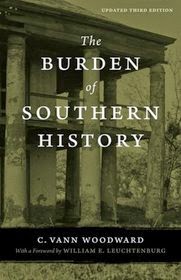
The Burden of Southern History

The Burden of Southern History
© 1960, 1968, 1970 C. Vann Wordward
250 pages
Louisiana State University Press

The publication of these essays on southern character and its tragic history, from Civil War to the abandoned civil rights efforts of Reconstruction could not have converged more significantly with its time when the volume first appeared in the 1960s. Even as Woodward reflected on reconstruction,  drawing out why it failed to substantively change the condition of southern blacks, a new movement had begun on the ground.  Woodward is a moderate, holding loyalty to the South without being defensive (in the manner of I’ll Take my Stand), and writing to urge justice and reconciliation in race relations.Three of the essays concern the failure of reconstruction and of civil rights, with Woodward charting emancipation and enfranchisement as political motives for the Union throughout the conflict, darkly concluding that the chief reason northerners pushed through the amendments that, in the count of one, two, three, transformed millions of slaves into millions of voters, was to prevent the defeated aristocracy from triumphing at the ballot-box instead of on the battlefield. The other major theme is southern identity and the South’s role to play in the United States. Woodward sees the southern states occupying a unique role in the American experiment. The United States in 1960 had never known anything but victory; every problem, every foe, it hitherto conquered through force of arms, or new inventions; for it, history was something that happened to other people. This put the nation in great danger of engaging in catastrophic mistakes like preventive wars. The south, however, had experienced history; had known defeat and occupation. It could offer to America  a humbling perspective.  The south’s view was used as a check on American hubris in literature before; in one essay Woodward  demonstrates how various  northern authors, including John Quincy Adams’ grandson Henry Adams, employed southern characters to shine a spotlight on the rest of the nation’s sins. Although most of the book is dated by now, including the comparison between the Cold War and the feud between abolitionists and slavers,  encountering a white southern voice from the 1960s arguing for civil rights is a breath of fresh air considering the usual Civil Rights narrative casts white southerners as villains.

Posted in history, Reviews, Society and Culture | Tagged , , , , , , | Leave a comment

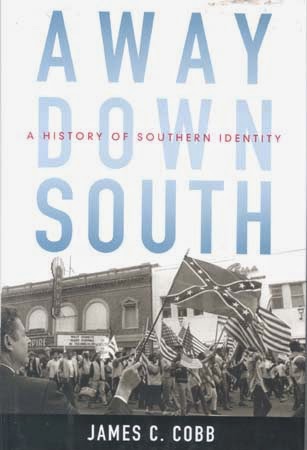
Away Down South

Away Down South: A History of Southern Identity

© 2007 James C. Cobb
416 pages


            What does it mean to be southern, beyond a fondness for turnip greens and cornbread?  The answer is an evolving one, as the South’s distinctiveness has changed its expression throughout the United States’ history. Away Down South follows national and southern attitudes about southern-ness from settlement days to the present.  The Civil War, the South’s stand against the rest of the nation, sets the stage for most of the book, including reconstruction and the continuing problem of race relations. The work  looks at the southern mind and heart, exploring not only intellectually-steeped expressions of the South like I’ll Take my Stand and The Mind of the South, but delves deeply into southern literature, black and white.  The South as a concept remains negative throughout. Not that the South is without its virtues, but from the country’s beginnings James C. Cobb maintains that the south has been seen both by itself and the rest as a country as a place apart; first a wild frontier infested by poisonous snakes and Indians, a no-man’s-land fit only for criminals, and later as the cesspool of American culture; the hiding place of aristocracy, slavery, ignorance, and all things foul. Having no France across  the Channel, or a Germany across the border, the South is the “other” which the rest of the country, with progressive, industrial New England as its model, can hold itself superior.  The  south’s wild gave way to plantations and then Jim Crow, but regardless of changes the taint of ‘other’ remained.  This is a view not preached by Cobb, a man of the south himself, but the attitude haunts the imagination of the southern intellectuals and artists who later claim the story. What makes Away Down South stand out for me is the space given to black southerners, who left the fields for the  northern cities only to return in part to the southland. Despite its tragic history, its story is one they share;  the southern scene is the one fixed in their memories of home. That coming-to-terms with the past can’t help but hold a fascination for a southern student of history such as myself.


Posted in history, Reviews | Tagged , , , , , , | 2 Comments

Who Killed Homer?

Who Killed Homer? The Demise of Classical Education and the Recovery of Greek Wisdom
© 1998 Victor Davis Hanson
290 pages

For hundreds of years, the study of the classics was at the heart of a liberal education, thought essential to the cultivation of free men.  Yet today speaking Latin would be regarded as a sign of eccentricity, not erudition. People now attend university for technical  expertise in fields like business, engineering, or nursing, and such a focus is lauded as practical.  A degree in Greek literature would be derided as useless as a degree in art history, the epitome of wasted public finance.  Victor Hanson argues that vocational training is not the point of a university education; an education is not what you know, but how you behave. In Who Killed Homer? he examines the soul-forming virtues of the classical tradition and contemplates their reason for their unnecessary but imminent demise.

Hansen begins by arguing that the greatest virtues of western civilization have their origin, and sustaining permanence, in the Greek tradition.  Drawing from philosophical treatise (to the Greeks, a category broad enough to cover politics, science, and more) in addition to extant literature, Hanson reviews a spectrum of values with origins in Greece.  These range from concepts given overt legal protection (consensual government and the open criticism thereof, armies subordinate to civil power, free enterprise, etc) to ideas understood at a deeper level, and contributing to the others.  These more fundamental appreciations include the belief that every polis’ wellbeing depended on the average middling citizen, not the aristocracy or the mob, and that the world was fraught with meaning. Mysterious yet rational, the world was a place imbued with limits — limits that extended to man. Part of the Greek heritage are more obvious than others; the very shape of US government structures bears witness to their past, and most histories of science will begin with the Greek enterprise. Other appreciations have been forgotten;  like the belief that man was nothing without the polis;  only the power of culture and threat of sanction by others kept the human animal from behaving worse than beasts.  It is in civilization than man finds salvation from his own destruction. This is a hard lesson given an obscene and brutal summation by Hanson: “Man is nothing without the state.”  Ultimately, classical education imparted a cohesive view of the world in which science, politics, and philosophy were knit together, a part of the whole.

If these truths are indeed timeless, how have they fallen by the wayside during the 20th century? Hansen lays the blame solely at the feet of the Classicists, who have thrown away the responsibility of their tradition in the pursuit of status and fortune. They ought to know better, and here Hanson’s attitude reveals how seriously he takes his belief that education was the moulding of character, not acquisition of knowledge. To Hanson,  those who have committed themselves to knowing the Greek mind, who have studied it in earnest, bear responsibility for practicing it. Just as we expect a minister to conduct himself with greater care than the average parishioner, so to does Hanson expect classicists to be, if not moral champions, at least contenders;  he expects them to live the values of the Greeks, to take their place in the hoplite ranks of the mind and defend what is theirs, to rise to the challenge of revealing the classics’ enduring relevance. Instead,  they focus on increasingly more pointless esoterically in pursuit of esteem,  viewing fellow classicists as competition to be beat for choice university positions in which they can focus on their ‘research’ and leave the actual teaching to grad students, producing not keen minds but papers on mathematical relationships governing the use of similes in The Illiad.  The comprehension of the whole is lost, and insult is added to injury when said scholars apply tortured modern interpretations,laying waste to The Odyssey by accusing it of being the wellspring of western sexism. Instead of defending and advancing the Greek way, classicists have allowed it to become the scapegoat for every moral self-doubt of the west. After outlining his case against his colleagues, Hanson proposes ways to put the focus back on the meaning of the classics,  in part by forcing classicists to teach.”Publish or perish” is anathema to this professor who sees his primary vocation as  giving young people a structured education, not advancing his own  prestige. The work ends on a bitter note, however, as he does not expect the modern world’s slide into the moral abyss to be arrested. Instead,  we will probably have to wait for civilization to collapse and demand strong men again, men who will rediscover the Greek truths.

That final bitter retort casts a pall over a strongly-argued book already shadowed by contempt for the modern world, especially ideologies like multiculturalism and relativism. The Greeks understood nuance, but in Hanson’s view they stood by everlasting truths. Hanson’s own stand is strident at times, to the point that he’s less a Pericles calling forth citizens to stand with him and more a Leonidas rallying the troops before a final stand. His appraisal of Greek contributions is surpassed by the analysis of why classical studies have faltered, but Who Killed Homer does double duty as a traditionalist critique of modernity and a passionate appraisal of how much value the tradition still holds, even for moderns overawed by their own cleverness. As a classical partisan myself, I found it invigorating, but Hanson’s zeal may spook the unconvinced.

Related:

Posted in Politics and Civic Interest, Reviews | Tagged , , , , , , , , , , , , | 6 Comments

Ten in the life of Sharpe

Since 2010 I have been steadily reading through Sharpe’s series, a set of historical novels following the storied career of the fictional Richard Sharpe, an orphan turned soldier who became an officer after saving the Duke of Wellington’s life in India.   I wanted to commemorate the series’ end  by sharing ten moments from the series, but there were so many to choose from I went with  mostly quotes, along with my tentatively-favorite book.

1. From Sharpe’s Battle:

 “You did what, Sharpe? A duel? Don’t you know dueling is illegal in the army?”
“I never said anything about a duel, General. I just offered to beat the hell out of him right here and now, but he seemed to have other things on his mind.”

2.  A recent highlight was the scene in Sharpe’s Waterloo, in which a blood-spattered Sharpe storms into a dinner party to inform the generals present that Napoleon is invading. As soon as he entes the doors, his adulterous wife (who ran away with his money to shack up with a more genteel aristocratic ponce) begins screaming bloody murder, and the aristo flees in terror. They’re so pathetic by comparison its almost gratuitous, but made good by the fact that Sharpe ignores them because he’s go his mission. Challenging a cuckholding coward to a duel can wait.

3. From Sharpe’s Gold:

“Get him out, sir? There’s two regiments there!”
“So? That’s only eight hundred men. There are fifty-three of us.”

4. From Sharpe’s Escape

“Lieutenant Slingsby,” the Colonel said, “tells me that you insulted him. That you invited him to duel. That you called him illegitimate. That you swore at him.”
    Sharpe cast his mind back to the brief confrontation on the ridge’s forward slope just after he had pulled the company out of the French panic. “I doubt I called him illegitimate, sir,” he said. “I wouldn’t use that sort of word. I probably called him a bastard.

5.  Sharpe’s Prey is a rare Sharpe book, one taking place not on the battlefield but in the staggeringly beautiful port city of Copenhagan, in which Sharpe — alone in a strange city — must engage in dazzling heroics and prevent an entire fleet from falling into enemy hands by destroying it himself.

6.  From Sharpe’s Challenge,  movie version:

Harper: So, you and me are going to stop a rebellion?
Sharpe: Well I don’t see no bugger else.

.
7. Likewise:

“Don’t know your place, do you, Sharpie?”
“Maybe not, but I know how to stand  before a French column.” 

8. From Sharpe’s Havoc:

 “So what do you believe in?” Vicente wanted to know.
“The trinity, sir,” said Harper sententiously.
“The trinity?” Vicente was surprised.
“The Baker rifle,” Sharpe said, “the sword bayonet, and me.”

9. From Sharpe’s Eagle, movie version:

“You can’t stop Captain Sharpe, sir. You can walk away from him or you can stand behind him, but don’t ever try and get in his way.”

10. From Sharpe’s Waterloo

“‘Educated, Sharpe! Think of that! My whole lifetime has been devoted to the study of warfare, and shall I tell you what is the one lesson I have learned above all others?’
‘I should like to know, sir.’ Sharpe admired his own tactful restraint, especially as the Prince was just twenty-three years old and Sharpe had been a fighting soldier for twenty-two.” […]
‘They took two Eagles! Two!’ The Prince clapped his hands. ‘You should go and take a look, Sharpe. It’s not every day you see an Eagle!’
‘Sergeant Harper and I once captured an Eagle,’ Sharpe’s voice was filled with an unmistakable loathing. ‘It was five years ago when you were still in school.'”

Posted in Reviews | Tagged | 4 Comments

Teaser Tuesday

Marvin interrupted. “Suppose I don’t want to spend my life on anti-Communist work but I feel — a calling to fight the Communists on as many fronts as I can. Am I an altruist then?”
“Yes,” Lee said. “And you are contaminating freedom. You’re putting someone else’s interests — the anti-Communist cause — on a higher order than your own. In that way you are rejecting the moral dimension of liberty.”
“Balls,” Woodroe permitted himself.

p. 237, Getting it Right, William F. Buckley

Posted in General | Leave a comment

Getting it Right

Getting it Right
© 2006 William F. Buckley Jr
2003

        Getting it Right is a political history disguised as a love story,  both tales told amid the radically shifting political climate of America’s 1960s, as Americans reacted to the growing global power of the Soviet Union and the increasing role of government in their own lives.  Woodroe Raynor is an earnest young Mormon whose narrow escape from Russian soldiers invading Hungary cements his contempt for the Soviet Union, who finds similarly zealous spirits in the nascent John Birch Society. Leonora Goldstein is a bright young Jewish girl in the employ of the Objectivists, who adopts Ayn Rand as her mentor.  Through  the tumultous years of Kennedy and LBJ, the two  test their ideas against one enough, struggling to build a relationship on their mutual conservatism despite different values. The real stars of the novel are the historical characters for whom Raynor and Leonora are mere appendages, including General Edwin Walker, Ayn Rand,  JFK, and Barry Goldwater. Buckley incorporates a lot of historically-derived quotations into their dialogue, which makes some passages seem overly formal, but such casual pompousness would not be out of character for Ayn Rand.  The story can’t help but be personal for the late Buckley, a central figure in the movement, and one whose National Review denounced both the Birchers and Objectivists in his day. Buckley’s highbrow scorn for the paranoid and self-impressed fringe is initially dampened in the novel. Both of its central characters initially find a world of meaning in their respective organizations, rising to high positions within them throughout the Kennedy administration, but by the reign of LBJ both have reconsidered as the founders reveal themselves to be utterly mental.  The plot climaxes in the failed Goldwater challenge for the presidency, an election in which Johnson played on the public’s fears that Goldwater’s extremism would lead to global war. The famous “daisy” commercial isn’t mentioned here, but the crackup of both the Birchers and Objectivists takes the wind out of the more moderate conservatives’ sails. It’s a quite a piece of work, an extended debate about political philosophy enmeshed in a lively retelling of the 1960s, a period which contributes action scenes in the form of assassinations and rioting.  If the specter of Ayn Rand talking can be endured, most readers of a moderate bent will find this engaging.

Related:

Posted in historical fiction, Politics and Civic Interest, Reviews | Tagged , , , , , , | 2 Comments

Captain of Rome

Captain of Rome
© 2010 John Stack
400 pages

The Mediterranean is awash in blood as the first Punic War steeps in intensity.  Having risen to the challenge and successfully confronted Carthage on the high seas,  the Republic of Rome  is swaggering under the influence of expected victory. Its fleet greatly enlarged, its sailors gaining their sea legs, the early humiliating losses seem to have been left behind. But Hamilcar Barca is far from beaten, planning a brutal counterstrike that will imperil Italy itself.  None in Rome are wise to the danger, its politicians fighting to claim credit for the presumed victory. To the laurel-seeking politicians, the military is a route to glory, including the men of the good ship Aquila, its crew and the Ninth Legion which it serves.   Its captain, Atticus, is an outstanding tactician, having snatched victories from the teeth of defeat and prevented some losses from turning into catastrophes. His success is resented, however, by some Romans who see in him nothing but an uppity Greek, a wily Ulysses with suspect loyalty. His reputation highlights the failures of others; if a Greek can do it, why can’t they? Such a failure is Tribune Varro, a  pup given high rank by his daddy’s gold, who makes Atticus the object of resentful sulking. As Carthage’s plan ripens and the hour for a crushing blow to Rome arrives, Atticus is deep in the snare of petty politicians and endangered not only by Barca’s great fleet, but assassins from his own lines.  In Captain of Rome,   Atticus must survive not only the threat of enemy ships, but the aftermath of his own earlier successes.

 The promising setup is fulfilled by Stack’s execution, delivering action not only on the sea, but on land and in political chambers.  Atticus isn’t the only officer whose future is threatened by others’ ambition; the Carthaginians have their own Varros.  The ongoing tension between Atticus and his counterpart in the Ninth, Septimus, is especially well done; although the two are comrades-in-arms and fast friends, Septimus’ hostility towards his sister’s romantic relationship with Atticus threatens to drive them apart. The tension is never dispelled in one big confrontation; whenever  their repartee declines, circumstances impel the two to work together and ally again. It’s not a clean back and forth, either, but an area of muddy water the two are never quite out of, even during the epic-scale battle at the end.  The strength of their friendship amid these stresses is an unexpected and added strength to a novel that already has plenty of appeal, considering the familiar-yet-exotic nature of classical-era naval combat, and the scheming (Carthaginian and Roman) that delivers a series of crises for the characters.  Readers will also appreciate the handling of the Carthaginians, who aren’t villainized, though there are villains among their ranks;  instead, through Atticus’ experience we see in the war’s contenders  two powers alike in ambition, served by both honorable warriors and loathsome cretins.  Captain of Rome is another triumph in this fascinating trilogy of historical naval fiction.

Posted in historical fiction, Reviews | Tagged , , , , , | 2 Comments

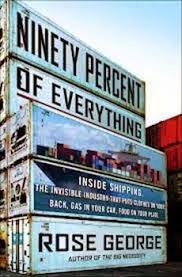
Ninety Percent of Everything

Ninety Percent of Everything:  Inside Shipping, the Invisible Industry That Puts Clothes on Your Back, Gas in Your Car, and Food on Your Plate.
© 2013 Rose George
287 pages


UK Title: Deep Sea and Foreign Going: Inside Shipping […]


What is 1300 feet long, travels the distance to the Moon nearly annually, and is nigh-invisible? The answer is any container ship, fleets of which convey the overwhelming majority of all goods traded between cities and continents, but which most people never think about.  This may be so because so few people work in modern sea-shipping, or because in the age of terrorism ports are severed from the cities they serve, blocked away by miles of walls and checkpoints.  In Ninety Percent of Everything, journalist Helen George spends several months aboard a ship owned by Maersk, a Danish commercial giant,  meeting the men and women who keep the fleets float in an effort to understand their experience and the importance of the shipping enterprise in the 21st century.

Like the containers the ships are filled with, Ninety Percent is a glorious grab-bag of topics; a little history, a little science, a little travel, a little military action on the high seas.  The Maersk Kendal, George’s home for most of the trip, is lead by Captain Glenn, a man who lived through the revolution in shipping that followed “the Box”, or the advent of containerization. Once a young seaman on a tramp steamer that moved from port to port, picking up small articles,  he witnessed the death of old harbors that were closed to make room for the far larger equipment needed to handle the containers. He is a romantic figure who can navigate the seven seas on a sextant alone, even if the march of time has forced him to spend his days a wheelhouse that resembles a computer lab.  Steaming from city to city, through monsoons and canals, ships like his can arrive in a harbor and completely turn over hundreds or thousands of containers in less than 24 hours  before departing into the night. 


The seamen’s experience remains as it has for thousands of years — lonely, dangerous, and often boring.  The views from the ship are of nothing but a long expanse of boxes piled another, and the work is similarly dull for most,  constantly cleaning and painting the ship, or tending the house-sized engine.  Most sailors come from developing countries the world over, and especially from the Philippines since their ability to speak English is prized. Dismal and unnoted as the work is, like most jobs it’s better than starving. As the captain of the Kendal laments, even today when the fast container ships have reduced the globe from the world to a village, their crews are treated like the ‘mere scum of the earth’.  Ms. George  also includes a segment spent on a military vessel hunting Somalian pirates (taking a decidedly unromantic attitude towards the sea-going thugs who are the object of so much fascination by the western press), and visits a portside organization that does its best to ameliorate the condition of the sailors, offering them counseling and sending them goods from home.  Although the book concerns modern shipping, George keeps it grounded in history as she can, retelling the story of World War 2’s merchant marine sailors who endured the same danger for the same purpose as the Navy, but with little honor or compensation rendered.  One positive aspect of the sailors’ experience is their time spent in the company of the sea’s abundance of life, especially dolphins 


Ninety Percent of Everything succeeds in going aboard the massive machine that is a container ship and giving its lifeless expanse of hull and rows of containers a human face;  for all the automation, the sealanes still remain the province of sailors who have brain enough to engineer solutions against fickle winds and waves. While George doesn’t spend a great deal of time about the mechanics of shipping (nor should she, seeing how that territory was well done in The Box),  her account of the human side makes for fantastic reading. Her Yorkshire ancestors would surely be pleased. 


Posted in Reviews | Tagged , , , , , , , , , | 4 Comments

Teaser Tuesday (20 May)

     “Sometimes all a reader can do is sit back and watch the words go by:

The same arrested relay of emulative métis underlies Oydessean architectural theory. For in the female invention ‘of making threats adhere to one another’ is also the beginning of architecture. The Vitruvian myth of aboriginal architects ‘imitating’ the weaving and daubing of birds’ nests continues a widespread aetiology. (A.L.T. Bergen, ‘The (Re)Marriage of Penelope and Odysseus: Architecture Gender Philosophy, A Homeric Dialogue’ in The Ages of Homer, J.B. Carter and S.P. Morris, eds. [Austin, 1995], p. 210)

     It is hard to know whether we are reading about Homer or poring over the Time-Life series on home remodeling.”

p. 138, Who Killed Homer? The Demise of Classical Education and the Recovery of Greek Wisdom, Victor Davis Hanson and John Heath

Posted in quotations | Tagged , | 4 Comments