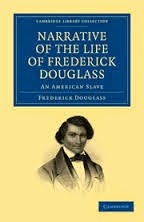
A Narrative of the Life of Frederick Douglass

A Narrative of the Life of Frederick Douglass
© 1845 Frederick Douglass
144 pages


Although modern readers take for granted the idea that slavery is “bad”, its horrors can only be fully appreciated  by the shared experience of those who were subjected to it. No finer conveyor is available than Frederick Douglass, an escaped slave who became an abolitionist leader, who achieved such renown in his lifetime that he dined in the White House.  The Narrative of the Life of Frederick Douglass was penned by Douglass for the benefit of an abolitionist society to arouse sympathy in the north. Douglass later authored other biographies, but The Narrative is limited to his years in bondage, and – considering its intended purpose — focuses on the evil slavery was in practice. The tale of constant beatings, of the culture of subservience, of the dehumanizing ways slaves were forced to live is surely enough to set anyone’s blood on fire, though the modern mind may be numbed by the thought of the Holocaust, or the obscenities we subject ourselves to voluntarily through the daily news.  The antidote to rage and despair are joy and hope, both offered by Douglass’ story. Cause for hope stems not from the fact that he escaped — he is very coy about how he did it, so slaveholders cannot use his narrative to improve their security —  but the fact that he made himself a man.  Douglass’ greatest triumph is not in escaping physical slavery, but escaping the enslavement of his mind and spirit. Given a start by a briefly sympathetic mistress, Douglass learned to read — but even after she abandoned her kindness, her soul corrupted by the conceit of owning another man,  he pushed himself forward. In defiance of the slave-culture created by the plantation owners, Douglass pursued what he recognized as the sure route to liberty, and sought out every opportunity to make advances. He taught himself to write as well, enough to forge passes in an abortive escape attempt, and enough to write with a command of style that was doubtless a boon to the abolitionist cause. His strength of spirit would make him a free man even if his body were in chains.

Posted in Reviews | Tagged , , , , | 2 Comments

The Scarlet Letter

The Scarlet Letter

©  1850 Nathaniel Hawthorne
180 pages          

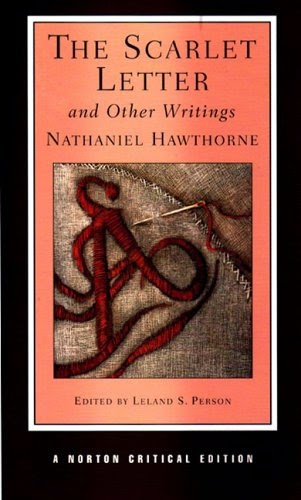
         In 18thcentury Boston, a young woman stands upon the gallows in the center of town, facing down the contempt of the assembled mob. Having broken the laws of her adopted Puritan home, Hester Prynn must endure its punishment for her crime:  lifelong ignominy. Having conceived a child out of wedlock – and with a man not her absent husband – she will wear forever on her breast the  prominent letter “A”. The Scarlet Letter is a story of morality, persecution, and redemption;  an American classic whose readability belies its status as a classroom staple. 
        Though Nathaniel Hawthorne was writing in a setting a century before his, and including historic personalities like John Winthrope, The Scarlet Letter is less a gritty historical tale and more a legend – and, like all good myths, one with a point. Its heroine is a legend in her own time, a woman whose morality could not be contained by her community. Judged a sinner,  Prynn accepts the verdict of her community, knowing she has broken its rules. She wears the scarlet letter with quiet dignity, but her own skills as a seamstress and moral center give her a strength that carries her through the years, despite being an outcast.  She does not run away from her moral imperfections, nor their consequences, but embraces it,  making her life’s work the support of the poor and infirm — combating passion with selflessness. Though she bears the titular mark of indiscretion, the piece’s true sinners are her husband and the local minister, both with secrets. The husband arrived in town just in time to see his near-abandoned wife on the scaffold. Perhaps it’s the months spent imprisoned by Indians, but hubby dear is a decidedly nasty sort who decides to adopt the false name Roger Chillingworth, and give himself the quest of finding out who cuckolded him and then destroying the man.   The Reverend John Dimmsdale, who – as you might guess is the third part of this little love triangle —  is equally responsible for Hester’s sin, but cowers from accepting it, fearful of the consequences. Though he professes an admirable concern for his congregation’s welfare, his and Chillingsworth’s actions through the piece most decidedly are not, and by its end all actions have found their inevitable fruit. Prynn is redeemed, and the others…well, not so much.
        I expected dreariness of a novel set in the Puritan world, but Hawthorne’s characters are highly spirited, especially Prynn and her little daughter, Pearl. Hawthorne writes in clear condemnation of the Puritans’ severity, though  it is doubtful that he condemns their morality in general considering Prynn’s decision to live in a spirit of penitence thereafter. Although the dialogue is purposely stilted (the Puritans seeming to take the KJV bible as their guide in speech), this is a novel filled with passion that roars along, with moral arguments along for the ride.  The Scarlet Letter is quite laudable. 

Posted in historical fiction, Reviews | Tagged , , , , , , , | 4 Comments

American Sphinx

American Sphinx: the Character of Thomas Jefferson
© 1998 Joseph Ellis
464 pages


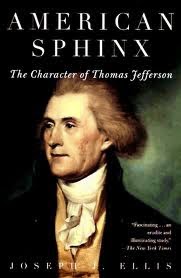
Principle author of the Declaration of Independence, partial broker of the Franco-American alliance,  third president —  there is no denying Thomas Jefferson’s pivotal place within the revolution.  He is a constant presence in Joseph Ellis’  prior histories concerning the revolutionary period, cast as a complex character — quixotic one moment, pragmatic the next.  American Sphinx shines a spotlight on his contradictory character, being a study in character by way of a biographical sketch.

Little is known of Jefferson’s early life,  owing to his parents’ appalling lack of foresight in not realizing future generations would want to know everything about their little scion, and to a fire that consumed what  little documentation of his early life existed. Jefferson would make up for that in his adult life, being a prolific author;  indeed, he is best known for his literary output, like the Declaration of Independence. No fiery orator like John Adams or Patrick Henry, he no less set fire to the world. In Ellis’ account, Jefferson appears for the first time on the political stage, producing a series of works that make the patriotic case against British abuses in ever-sharper and ever-seeping language. Jefferson will continue to write on the themes developed in such works as A Summary View of the Rights of British America and the Declaration.  It is the tension between the values he defended, and the actions he committed, that most of the works concerns itself with.

Of all the founding fathers, it is Jefferson’s spirit which is most invoked today, hailed by liberals for his commitment to equality and by conservatives for his deep distrust of centralized power.  Jefferson was in turns a liberal and a conservative;  his love affair with the French Revolution, even amid its violence, demonstrated that he had no aversion to destroying the old order completely; but such was his faith in the rationality of man that he believed justice would prevail once the old founts of inequality like monarchy and religion were destroyed.  Government must be kept at minimal levels, however, to ensure that the babe of equality was not smothered in its cradle by power-mad despots (Alexander Hamilton), military juntas (Alexander Hamilton)  and malicious big bankers (Alexander Hamilton*).    Thus he looked for conservative ends through liberal means.

Contradictions abounded elsewhere; though rightly lauded as the author of the Declaration, the words of which have been an ideal Americans have struggled to realize in full ever since — “We hold these truths self-evident, that all men are created equal….”  — he did, in fact, keep slaves. Ellis examines both the facts of Jefferson’s plantation and his expressed thoughts;   despite his frequent cooing over the nobility of American yeoman farmers,  Jefferson devoted little care to his fields himself, taking an interest only at harvest time. The slaves he spent the most time around were his house servants, mulattoes who appeared to some visitors closer to white than black, and treated with intimate familiarity. They were a world apart from the grisly, bloody reality of most slavery. Even when Jefferson was around his field hands, it was only when he employed them in the farm-saving work of being apprenticing in his nail factory. Yes, Jefferson the agrarian only found solvency by creating a little workshop on the premises. By giving hands such marketable work, he reasoned that he was preparing them for the day when emancipation was possible.

These are only two instances of Jefferson almost being a man of two-minds, but such contradictions are the prevailing theme of the work.  Ellis isn’t a sharp critic of Jefferson — who could be? — but the work reveals him at worst a romantic, a man who exalted farmers but took little real interest in his, who believe great things but did not take great stands lest they imperil his other dreams. At his best, however, Jefferson was an idealist who could be pragmatic when it counted, as the many compromises through his presidential career showed —  and as even his enemies admitted.  American Sphinx is as promised a fascinating look into Jefferson’s mind, though  it’s not quite a complete biography.

Related:
Thomas Jefferson: Author of America, Christopher Hitchens.
Alexander Hamilton, Rob Chernow. A look at the Jefferson-Hamilton ragefest from the other side..

Posted in Reviews | Tagged , , , , | 5 Comments

No Time Like the Past

No Time Like the Past
© 2014 Greg Cox
400 pages

Question: why is the heroic, resolute-looking face of James T. Kirk carved Rushmore-like into a mountainside in the middle of the Delta Quadrant?  In search of an answer, Seven of Nine is thrown across space and time into the middle of a firefight, whereupon she rescues Kirk and company from Orion pirates and enlists his and the Enterprise‘s help in returning home  Her quest for home won’t be easy, and is made even more difficult by a bureaucrat’s big mouth; after the pirates learn there’s a woman from the future among them, they badger the Enterprise relentlessly, turning a mystery novel into a running battle. No Time Like the Past is a TOS novel with a Voyager twist, a fantastic adventure novel rendered by veteran author Greg Cox.


In the course of sorting out the mystery, Seven and the TOS crew will revisit the battlegrounds of some of the original series’ odder episodes, including “The Apple”.  Although some premises stretch plausibility (the planet riven by race war between people who are black on the right side, and white on the left, or the reverse),  Cox succeeds in fleshing them out enough for readers to take seriously. Cox has an easier job handling the characters; a veteran Trek author,  his Spock/McCoy salvos are right on the mark.  The Voyager crew are in character as well.  The story is one of a mystery-turned-scavenger hunt punctuated by frequent battle scenes and an explosive finale as the frustrated Orions try to  board and seize the Enterprise itself.  All this makes for a story that moves speedily along, with plenty of action and time spent with beloved and familiar characters.  Their interactions with Seven provide even more to enjoyed.  As they have no idea of her backstory, her cybernetic modifications horrify the doctor, but her rational personality and strength impress Kirk and Spock.  The big TOS three and Seven have a lot of fun together, the many scenes of peril aside, and so too will the reader.

Posted in Reviews | Tagged , , , , , | 7 Comments

This week at the library: American colonies and apes

Dear readers:

Last week saw another entry struck from the To Be Read list, as well as the completion of The Odyssey. I’ve been meaning to read the full story properly for years.  I’ve mostly been reading the first entry in my annual Fourth of July set since,  Joseph Ellis’ American Sphinx: the Character of Thomas Jefferson.  In previous years I’ve read biographies of George Washington, John Adams, and Alexander Hamilton, so it’s past the red-headed Virginian’s turn.  The other two books in this year’s set are The Men Who Lost America: British Leadership, the American Revolution, and the Fate of an Empire as well as The American Tory, a collection of first-hand dissenting arguments from the revolutionaries’ contemporaries who had no interest in severing American bonds from the English homeland.  The fourth is still two weeks off, though, so they won’t be immediate reads.  For the moment, I’m unsure as to where to go;  a weekend spent watching The Planet of the Apes (original), The Planet of the Apes (2001) and The Rise of the Planet of the Apes (2011) might see me read Good Natured, on the origins of morality in primates, but then too there’s The Last of the Mohicans which I am trying to get into. We shall see!

Quotable

“The more history I learn, the more the world fills up with stories. Just the other day I, I was in my neighborhood Starbucks, […] enjoying a chocolatey caffê mocha when it occurred to me that to drink a mocha is to gulp down the entire history of the New World. From the Spanish exportation of the Aztec cacao, and the Dutch invention of the chemical process for making cocoa, on down to the capitalist empire of Hersey, PA, and the lifestyle marketing of Seattle’s Starbucks, the modern mocha is a bittersweet concoction of imperialism, genocide, invention, and consumerism served with whipped cream on top. No wonder it costs so much.”

p. 42, The Party Cloudy Patriot, Sarah Vowell

“Dogs! You have been saying all the time I never should return out of the land of Troy; and, therefore, you destroyed my home, outraged my women-servants, and –I alive — covertly wooed my wife, fearing no gods that hold the open sky, nor that the indignation of mankind would fall on you hereafter. Now for you and all destruction’s cords are knotted!”

p. 279, The Odyessy. Homer; translated by George Herbert Palmer 1884

“For him democracy was to politics as agrarianism was to the economy or health was to the human body. It could never be completely perfect, but the more of it, the better.” 

p. 262, American Sphinx: The Character of Thomas Jefferson, Joseph Ellis

To Be Read Takedown Challenge

  1. Antifragile, Nassim Nicholas Taleb
  2. The Vikings, Robert Ferguson (6/7/14)                                       
  3. Power, Inc; David Rothkopf (6/14/14)
  4. An Edible History of Humanity, Tom Standage
  5. Small-Mart Revolution, Michael Shuman
  6. The World Until Yesterday, Jared Diamond (5/29/14)
  7. Fighting Traffic: the Dawn of the Motor Age in the American City, Peter Norton
  8. Earth, Richard Fortey
  9. Good Natured, Frans de Waal
  10. Galileo’s Finger, Peter Atkins
Posted in Reviews | Tagged | Leave a comment

The Odyssey

The Odyssey
© 1884 trans. George Herbert Palmer, original author Homer
313 pages

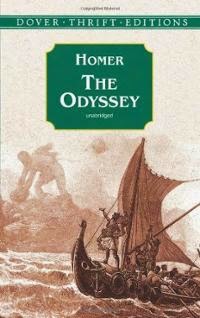
Three years ago I read The Illiad, and intended to follow it shortly with The Odyssey. Like Odysseus, however, my own attention was blown of course. This is course a classic, second only to the aforementioned Homeric poem in terms of hallowedness. Virtually everyone knows the story;  a veteran of the war against Troy, the architect of its defeat, attempts to return home, only for a quick jaunt across the Aegean into a ten-year journey, full of monsters and the ill will of the gods. An early escape from the monster cyclops Polyphemus earns our hero Odysseus and his crew the enduring wrath of Poseidon, who throws every obstacle he can at them. Fortunately the clever hero is much-loved of Athena, goddess of craft, and she offers able assistance to both the hero and his young son.They’ll need it, because while the master of the house is lost at sea, his manor is filled with suitors who want his wife Penelope to wed them. Literally eating him out of house and home, they intend to kill young Telemachus and force Penelope to wed.

I know the Odyssey as Odysseus’ story, but his perilous adventures only occupy a fifth of the book. Instead the tale opens with the gods considering his plight, and Athena embarking on a mission to inspire young Telemachus to go searching for news of his father.  A third of the way in, the focus switches to Odysseus, who — captive by a goddess who wants him to bed her —  makes his escape with a little help from his divine friends. After washing up on one island and massacring its inhabitants without so much as a cross word exchanged between them,  he is driven into the sea and finds refuge among an island of friendly folk who urge him to tell his story. Enter the cyclopes and the rest.  The book by and large consists of a great deal of dialogue, of people making speeches and delivering flourished stories to one another; Odysseus himself seems to use a different name, and invents a different backstory, every time he makes land.  Even after he’s home safely, he spins a yarn for his father, seemingly for the pleasure of saying “Just kidding, it’s me!”

Although the speeches and such aren’t exactly scintillating reading, the language makes up for that a touch;  the Odyssey began as a oral tale, we know, and the expressive language and use of repetition bear that out. Athena is ever the grey-eyed, Odysseus lordly, the dawn rosy-fingered. (In one stance it is also fair-haired.)  The amount of names,  people and place, dropped here is staggering, putting even The Illiad to shame. I’m glad to have finally read the Odyssey, considering its place in western literature, and enjoyed much of it, but I think I have to count The Iliad my favorite of the two.

Posted in General | Tagged , , , , , , , , | Leave a comment

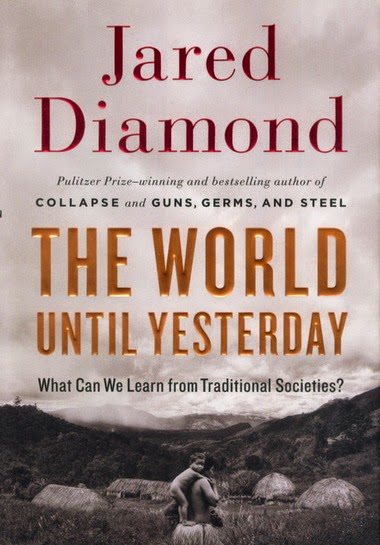
The World Until Yesterday

The World Until Yesterday
© 2012 Jared Diamond
481 pages


            Earth has been the province of mankind for hundreds of thousands of years, and for most of the time he has transversed it in small tribal groups, hunting and foraging, living a life on a knife-edge of danger. Several thousand years ago, however, cities and farms appeared, civilization flourished, and the human race filled the globe, teeming into the billions.  Despite that vast difference in accomplishment, however, Jared Diamond holds that traditional societies, for all their tribalism and perilous lives, have much to teach modern man. For despite centuries of technological and social evolution, our bodies are as they were eons ago, and the great horde of wisdom contained within old tradition has not lost use.  In The World Until Yesterday,  Diamond surveys the practices of traditional people throughout the globe, predominantly in Africa and southeast Asia, for what they may yet teach us.


             Elements of Until Yesterday have been given consideration by others; witness the primal movement and the more widespread paleo diet, which hold that since our bodies evolved for the small-village, hunting-and-gathering lifestyle, our minds will feel more at home, and function at their best, recreating that behavior. It’s easy to agree to a point;  few would dispute that apples are better for you than AppleJacks, or that daily exercise is more healthy than spending all day in chairs or couches. Diamond’s own approach is more nuanced and pragmatic rather than idealistic. Modern approaches are still new, very much wet-behind-the-ears. Traditional approaches are more seasoned, more mature, and their experience  can be used to temper our novel approaches, combing old wisdom with modern power.  One example of this Diamond uses is that of the legal structure;   western law has its place,  but something is lost from the old ways in which criminals were confronted by the victims in a court of those who knew them, and forced to make personal restitution — instead of being tried, defended, and judged by strangers,   then thrown into a prison where their crimes lose all significance, lost in a sea of others.  The victim, meanwhile, is expected to be detached, surrendering their pain and lust for justice to the impersonal apparatus of the state. But the law cannot feel, it cannot bleed, it cannot flush with anger, and it cannot substitute impersonal punishment for personal crimes. 

       Until Yesterday quickly drives home the point made by other anthropologists that “humans have found many ways to be human”.  A tremendous variety of practices exists between traditional societies, even between those living close by as in on the island of New Guinean.  A grisly example is that of elder ‘care’; while some societies ritually kill the old, others simply abandon them. Yet in most, the aged are revered, not only because the stories and functional knowledge of the tribe are contained within their heads, but because their long practice makes them master craftsmen, and even when their physical bodies deteriorate they can still care for children, leaving adult parents to hunt and forage.  The book’s scope covers justice, war, childrearing,  gender roles,  the elderly, health. and more, but each category bears witness to the glorious diversity of mankind.  Some lessons are familiar, as with health. Some were forgotten by most, but live on in others, like educational approaches;   which is more productive, Diamond acts, sitting in chairs all day memorizing facts, or experiencing the world directly? Opponents of conventional schooling, especially the unschoolers, know how important tactile and immediately-relevant lessons learned are. Traditional children learn to make the tools they will need to live by, and study the animals and rhythms of nature that sill sustain them;  they absorb the stories of the past that inform them of the dangers to come.  Their tests are not academic exercises.  Still other lessons have been lost to us entirely;  in the developed world, living amid plenty in environments divested of all predators and woes, we have become so blind to the thought of a dangerous world that we cross streets with eyes locked on phones, texting and assuming traffic will stop around us. For traditional peoples, however, the world is alive with danger, from animals who can easily  eat your young, or tribal enemies who will do the same if you trespass.

      The World Until Yesterday has much to offer, even with Diamond’s thesis aside. It is if nothing else a survey of over a dozen distinct tribal cultures, all providing a wealth of fascinating, living in climates as disparate as the frozen Arctic sea  and the equatorial jungles.  They display how utterly different the human experience can be from the global sameness of modern living; each tribe faces different challenges,  hunts different prey, makes different adaptations.   Diamond’s idea does hold, however, that there are lessons to be learned here, that the way we do things presently is not necessarily the most productive or satisfying way. There’s much about traditional living no sane person would invite back — the constant threat of famine, the utter lack of medicine — but these people are wily and strong, firmly connected one another and committed to their families in ways few moderns can rival.  At any rate, the book offers insight without prescription,  not preaching but demonstrating and leaving it to the reader to consider.


Posted in Reviews, Society and Culture | Tagged , , , , , , , , | 1 Comment

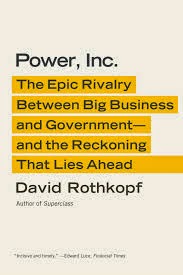
Power, Inc

Power, Inc: the Epic Rivalry between Government and Big Business
© 2013 David Rothkopf
448 pages


Historians of western civilization are used to viewing its late medieval and early modern period through the lens of a church versus state battle; the reformation owes as much to the desire for German princes to be free of the Roman pontiff’s command as it does belief  in theological purity.  Concurrent with the battle between Crown and cathedral, however, was another war; one between the crown and commerce. In Power, Inc, Alexander Rothkopft gives a history of the modern world, of the economic tides that eventually created polities greater than many states: corporations. The history, which covers economic entanglement in wars of the period as well as the evolution of Law, doubles as a plea for sharper control of corporations by the government. 

      Although Rothkopf draws on a variety of examples throughout the work, his anchor is the Stora corporation. Granted a charter in 1347, what began as a copper-mining operation turned Sweden into a power to be reckoned with during the Thirty Years War, but outlived its beneficiary by continuing to adapt to the modern world long after Sweden had been overshadowed once again by Germany, France, and England.  Although the economic forces unlocked by the scientific and industrial revolutions were initially used primarily for the benefit of the king,  governments soon lost control; the developing rule of law in modernizing country soon triumphed over the king’s will, but instead of protecting all parties the law  in America eventually became the faithful servant of corporations. Granted fictional personhood, and all the rights (but none of the responsibilities) thereof,  corporations became ‘super citizens’ whose globetrotting power now rivals the majority of nations. Loyal to none and increasing free of legal restraints (courtesy of globalization),  their might has prompted nation-states to adopt their methods   But countries are not businesses, and if maximizing economic profitability becomes the standard for good governance we will be in a bad way, riven even more by inequality and utterly beholden to economic titans.

     Power is organized smartly,  linking a breadth of information;  this is a lesson in the rise of the rule of law from military might and kings as well as the tale of the global economy’s transition from medieval marketplaces to fiendishly complex financial markets.  The golem-like creation of corporations delivers appropriate horror, but Rothkopf sees the battle between states and corporations as one sided, with corporations cast as the villains and governments diminished victims. Although he mentions the revolving door that sees corporate executives occupying seats within the government ‘overseeing’  the businesses they once worked for, and will again when they are out of office,  the way government is used to increase the power of corporations — through subsidies, or through legislation that smothers smaller businesses but leaves the big-business beasts intact —  are absent altogether. Sterner regulation, even when applied through global bodies, will only lead to more of the same. 

Power, Inc doesn’t quite live up to its name  in giving an account of people being pawns between government and business, but it does offer a look as to how corporations are becoming utterly lawless in the global era. 

Related:
No Logo and The Shock Doctrine, better anti-corporate books by Naomi Klein

Posted in history, Politics and Civic Interest, Reviews, Society and Culture | Tagged , , , , , , , | 2 Comments

The Partly Cloudy Patriot

The Partly Cloudy Patriot
© 2003 Sarah Vowell
197 pages


          The Partly Cloudy Patriot sees cheeky Yank Sarah Vowell muse on history, politics, and American life in general through a series of essays written in 2001. Her familar mixture of absurd and melachoic humor is well on display; she’s especially put out by the triumph of George W. Bush. Seperate essays hail the virtues of Clinton and Gore, the latter of whom she lionizes as a fellow nerd who should have run on his pocket-protector-abiding principles.  Every essay is a mixed bag; that piece on Clinton features her visiting the presidential shrines of Eisenhower, Nixon, LBJ, and Kennedy to study how each man’s term in office was dealt with and presented for posterity, where she leaves with a grudging respect for Nixon and LBJ despite their deficiencies in office.  The meaning of American identity comes up a time or two; Vowell admits to being more American than she would like to believe,  embracing cowboy individualism even against the ideals of conforming, polite Canada which she otherwise admires. A more common subject is that of history, Vowell’s reliable companion, filling her world with stories and creating meaning.  She takes her title from Thomas Paine’s urging that the revolution is no time for seasonal soldiers and sunshine patriots; she is, for all her misgivings about  George Bush, the south, and heroes who don’t live up to their hype, a devout American. 


Posted in history, Reviews | Tagged , , , , | Leave a comment

The Great War at Sea

The Great War at Sea: History of Naval Action 1914-1918
© 1965 A.A. Hoehling
346 pages


            The Great War is not called the first world war for nothing, taking place as it did not only across the sprawling expanse of Eurasia and Africa, but in the skies above and in the great oceans girding the continents. The Great War at Sea  is a narrative history of the naval war between the United Kingdom, Germany, and to a lesser extent the United States.Written in 1965, it’s a work definitely keyed toward popular audiences; though the author mentions sinking and shipping statistics, he focuses on blow-by-blow retellings of ship battles for which there exists plenty of record, relying on both British and German accounts. The narrative which knits these battle-tales together will render a general understanding of how the naval war unfolded,  including the stresses placed on the British and German economies by their attempted blockades.   The heavy use of dialogue and lively storytelling make it a quick read,  most suitable for a lay audience who don’t want to sink too deeply into details. The maps and illustrations included, however, are superb and would complement even more scholarly works; the battle diagrams are even artful.  As might be expected from a work produced in 1965, The Great War at Sea has a patriotic spirit, though the incorporation of German accounts removes bias.  He takes the attitude that both English and German sailors did their bit for king and country, dying noble deaths deserving of praise. It’s a ‘nice’ history, but on the light side.


Posted in history, Reviews | Tagged , , , | Leave a comment