Seeing like a State

Seeing like a State: How Certain Schemes to Improve the Human Condition have Failed
© 1999 James Scott
464 pages


            Seeing like a State scrutinizes the organizational approach of state governments and other large institutions from the Renaissance era onward. In essence ,James C. Scott demonstrates how reductionist top down attempts at understanding and planning tend to be.  In attempting to render comprehensible complex systems – whether those systems are forests, cities, or national economies – vital information is lost.  Scott argues that the greatest value of aggressive organization is to increase the power and control of the organizer; this is in fact the pointof organization in most cases, as with mandating last names. In  other cases, like the creation of forest management, power is achieved more indirectly through the state consolidating and advancing its economic agenda.  In reducing forest farming to one species, however, and planning it rigidly, the rich variety that makes a successful forest thrive is lost. The farm becomes susceptible to vigorous disease; monoculture produces the same results everywhere. The order imposed is accomplished at the cost of life; cities disintegrate when their rich diversity is broken up, rigidly segregated with zoning laws, and lumped together in sprawling clumps. Reviewing dying forests, moribund cities, and nations with collapsed collectivist economies,  Scott argues for decentralized approaches that allow practical, experiential knowledge — metis — to predominant, instead of abstract, general knowledge, or techne.  The difference between them can be found in ecologically savvy farming of the kind practiced by Joel Salatin, who instead of imposing a system of agriculture on farms he is invited to steward, fleshes one out on an individual site basis, figuring out which natural cycles can be recreated. This decentralized approach works well with cities and farms, which are complex enough to defy successful planning from on high;  it is hard to imagine a revival of manufacturing lead by artisans instead of industrialists, however.  Scott’s case leaves no doubt that organization leads to greater power for the organizers,  but is it avoidable?


Posted in Politics and Civic Interest, Reviews, Society and Culture | Tagged , , , , , , , , , | 4 Comments

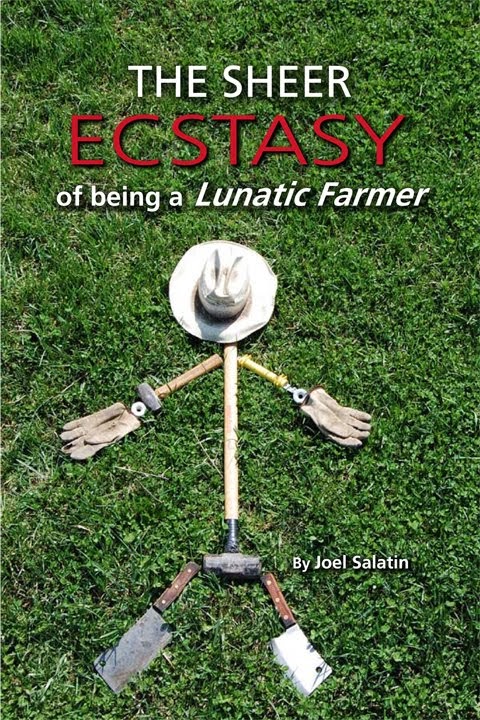
The Sheer Ecstasy of Being a Lunatic Farmer

The Sheer Ecstasy of Being a Lunatic Farmer
© 2010 Joel Salatin
300 pages


Joel Salatin is crazy and glad to be so;  in print and in media like Food, Inc and Fresh, he gleefully rejects what the late 20th century produced as conventional farming.  The Sheer Ectasy of being a Lunatic Farmer is a defense of farming, and in particular a defense of his  kind of farming. While grounded in traditional knowledge, Salatin’s delivery incorporates a lot of modern ecological connections.  His style is folksy in the extreme, the narrative a conversation. Salatin is no rube, though,   His and his father’s approach redeemed a swath of dead land, turning it into a thriving business — and Salatin himself has become a leader in the local foods movement.

Sheer Ectcstasy opens with a history of how Salatin’s father gave new life to their purchased farm. They made the foundation of their farm not a good range of machinery, but the health of the soil. Take care of the soil, and everything else will follow. Salatin’s work emphasizes closing the nutrient cycle as much as possible; while some nutrients invariably escape (their selling as food being the point of a farm), modern farming is dominated by inputs and outputs. After importing seed, farmers rely on mountains of fertilizer, pesticides, and antibiotics to bring the crop (be it corn or cows) to its marketable size. Every stage relies on finance and import, and nothing from the farm’s crop is used to sustain it other than its sale. Salatin’s Polyface Farm is different.


Instead of taking his cue from a machine, Salatin looks to nature. Deeply religious, he sees a providential plan in the design of nature, and holds that any human plan that goes against it will ruin itself eventually; it is patently unsustainable. While the libertarian Salatin disdains the label ‘organic’, being now a certified label issued by a government he regards with contempt, the approach is nevertheless one inspired by life.  Salatin relies an ecological understanding of plants and livestock to power his farm.  While he never lays out his entire plan of operation in the book, each chapter reveals another element, and taken together Salatin appears a genuine maestro conducting a symphony of  eating and excreting.  Cows graze a field, and chickens follow, removing parasites that spread disease. The cows’ winter bedding packs are mixed with corn and given over to pigs to root in, creating compost. Instead of being penned in one place, animals are moved on a daily basis in a simulation of their species’ natural grazing patterns.   His animals aren’t merely the ends of the farm; they are its means.  Salatin sees them as cocreators, with man and beast working together for their mutual advantage.  Salatin’s life-inspired approach applies toward disease prevention;  while the natural parasite removal and mock-migrations do their part, he also employs the time-honored method of selective breeding to produce stock that is robust and naturally disease-resistant.


Salatin has been fighting convention for so long he  embraces it on purpose. This sometimes brings him to the border of quackery, as when he investigates the possibility of a tool that collects ‘cosmic energy’  and prevents drought. It doesn’t work, of course, and he cheerfully admits it, but he’s impressed by the salesman’ dousing taking him straight to the spot that Salatin would have picked to stick it. This is an example of being in tune with the land. More skeptical minds (mine) would say it’s an example of being cold-read. I would not be surprised if the douser picked up on Salatin’s body language that inclined him toward a spot, visual tics that told a sly mind when he was getting warmer to Salatin’s ideal spot.  Salatin only prescribes advice that is based on evidence, however, on his careful study of the landscape.

On the whole, Sheer Ecstasyis a fun first look at how agriculture can adapt to sustain itself.

Posted in Reviews, Society and Culture | Tagged , , , , , | 4 Comments

Remembering

Remembering
© 1988 Wendell Berry
112 pages

            Andy Catlett is a man far from home, wounded in spirit and in body. His right hand was eaten and destroyed by mechanized farm equipment,  and in attending an agricultural conference he sees only plans to destroy his and his people’s entire way of life. Sinking steadily into a pit of despair and sorrow, thinking of a dying marriage and a threatened town,  he is ultimately restored by a long reflection. The bulk of the novel consists of stories from his family’s history as lived in the town, moving from the Civil War onward.  Ultimately the memory of how he and his wife took an abandoned farm, long broken, and restored it to productive health seems to rescue Andy from merely depressing himself with memories of loss. Although this is a short story about healing — healing the land and seeing to the soul as well —   there’s also a brief defense of family farm agrarianism against agribusiness when Catlett revisits his time spent as a young journalist preparing an article on scientific farming.  It’s a fine story for Berry’s friends, but it’s not consequential enough that I’d reccommend to someone who hasn’t first read a larger story like Jayber Crow or Hannah Coulter and already been wooed  to a love of the membership of Port William. 
Posted in General | Tagged , , | 1 Comment

Inch by Inch: A Reading

“If the last and worst act of the whole regime had come immediately after the first and smallest, thousands, yes, millions would have been sufficiently shocked — but of course this isn’t the way it happens. In between come all the hundreds of little steps, each of them preparing you not to be shocked by the next. Step C is not so much worse than Step B, and if you did not stand at Step B, why should you at Step C? And so on to D.

“And one day, too late, your principles, if you were ever sensible of them, all rush in upon you. The burden of self-deception has grown too heavy, and some minor incident collapses it all at once, and you see that everything, everything, has changed and changed completely under your nose. The world you live in — your nation, your people — is not the world you were born in at all. The forms are all there,  all untouched, all reassuring, the houses, the shops, the jobs, the mealtimes, the visits, the concerts, the cinema, the holidays. But the spirit, which you never noticed because you made the lifelong mistake of identifying it with the forms, is changed.

“Life is a continuing process, a flow, not a succession of acts and events at all. It has flowed to a new level, carrying you with it, without any effort on your part. On this new level you live, you have been living more comfortable every day with new morals, new principles. You have accepted things you would not have accepted five years ago, a year ago, things your father, even in Germany, could not have imagined.

“Suddenly it all comes down, all at once. You see what you are, what you have done, or more accurately, what you haven’t done, You remember those early meetings of your department in the university when, if none had stood, others would have stood, perhaps, no one stood. You remember everything now, and your heart breaks. Too late. You are compromised beyond repair.

“What then? You must shoot yourself. A few did. Or ‘adjust’ your principles. Many tried, and some, I suppose, succeeded; not I, however. Or learn to live the rest of your life with your shame. This last is the nearest there is, under the circumstances, to heroism: shame. Many Germans became this poor kind of hero, many more, I think, than the world knows or cares to know.”

p. 171-172, They Thought They Were Free: the Germans, ’33-’45

Posted in General | Tagged | Leave a comment

The Age of Voltaire

The Age of Voltaire: A History of Civilization in Western Europe from 1715 to 1756
898 pages
© 1965 Will and Ariel Durant

            The ninth work in Will Durant’s sweeping Story of Civilization, The Age of Voltaire picks up with the death of the Sun King in the dawn of the Enlightenment.   It’s an age of tumultuous change; though its survey ends before the French revolution, Europe is already in the throes of the industrial and scientific revolutions. New worlds are opening; not only are new goods flowing in from the recently-discovered parts of the globe,  but western man’s entire worldview is shifting. The modern age is dawning.


           Voltaire follows the titular philosopher as he travels from France to England, Germany, and later Switzerland, though the first three countries are Durant’s focus here.  As with the rest of Durant’s integral history,  this book carries weight because it examines not only political and military history, but considers in depth the literary, artistic, philosophical, and religious developments of the time. These ideas are not isolated from one another;   individualistic philosophy drives changes in both politics and religion, weakening the claims of absolutist monarchy and state churches alike. England grows with the times;  her king is superseded by Parliament and the prime minister. France hardens and resists, but the tide of history sweeping Europe will break it as surely as the waves break shorelines. 


           Of course, in this era it’s less a gentle tide and more of a water-cannon. The radicals of the era are not content with careful, prudent change; no, things must be set on fire. Christianity is beyond reform for the rising philosophes; the world must be overturned, priests must die, churches must be burned. This is the  cradle of the French revolution, the nursery of those who would  take a machete to society until their ideals are satisfied. On a more constructive note, science and technological prowess are abounding, and Durant sets aside a large segment of the book to look at it seperately. 

       Durant is a genteel moderate on the religion and philosophy debate; from Our Oriental Heritage on, he has favored religion as an institution offering stability, comfort,  beauty, and more to the human race, though he is never blind to its abuses. His conclusion, a dialogue between a pope and Voltaire, makes plain his attitude that the tumultuous era his history is heading into is one of mixed blessings; while Durant is thankful that the rise of the philosophes advanced human liberty, checking the abuses of monarchy and organized religion alike, in their enthusiasm they became arrogant.

Benedict: You thought it possible for one mind, in one lifetime, to acquire such scope of knowledge and depth of understanding as to be fit to sit in judgment upon the wisdom of the race –upon traditions and institutions that have taken form out of the experience of the centuries. Tradition is to the group what memory is to the individual; and just as the snapping of memory may bring insanity, so a sudden break with tradition may plunge a whole nation into madness like France  and the revolution. [….] We should be allowed to question traditions and institutions, but with care that we do not destroy more than we can build. 


p. 788

As with his judgment of the impact of the reformation, the entire dialogue puts his tender appreciation for both sides, and the wisdom in appreciating them both, on display.  I suspect his criticism will grow a little sharper in the next volume.

Posted in history, Reviews | Tagged , , , , , , , , , , , , , , | Leave a comment

This week: airplanes with Jesus, Kurt Vonnegut, and Voltaire

            This past weekend I read through A Day with a Perfect Stranger, not a difficult task given that it’s less than 100 pages. A sequel to Dinner with a Perfect Stranger, which featured overworked businessman accepting a dinner invitation with a man who turned out to be Jesus,  A Day’s approach is slightly different. Whereas Jesus argued Nick into accepting a relationship with him,  A Day is more of an episode of Touched by an Angel.  Nick’s wife, Mattie, is contemplating leaving him for his newly-found Jesusfreakness,  and so doesn’t hesitate for too long when the very interesting fellow she met on the airplane asks to join her for lunch during their airline layover. Their prolonged conversation through the day (including two air trips and a layover)  is something of an exercise in counseling, as the stranger moves Mattie to consider what she’s really worried about. Eventually he delivers the God loves you line, if not in an Irish accent with golden light and doves, and vanishes with Mattie in tears reconsidering her life. It’s nice in the Touched by an Angel way,  with lots of warm fuzziness that you probably have to be in the mood for.
            In other news,  I finished Seeing like a State, with comments to follow this week, and a review for The Age of Voltaire is imminent.  I considered checking out Rousseau and Revolution, but it’s only a hair shorter than the monstrous Age of Faith, and not nearly as enticing.   One day I’ll take it on, but not until the TBR list is complete.  Yesterday I picked up a handful of library books, largely history with some novels to boot. My next Great War read will be The Forgotten War, also on the Eastern front. One of the novels is by Kurt Vonnegut, so that should be fun – in that kindly, wearily cynical way. I had hoped to read H.G. Wells’ Wheels of Chance, but it was only an e-book. Alas.  
Posted in General | Tagged , , | Leave a comment

The Crucified Rabbi

The Crucified Rabbi: Judaism and the Origins of Catholic Christianity
© 2009 Taylor Marshall
236 pages

Take for granted Christianity’s inseparable connection to Judaism, but what does it mean, beyond knowing that Jesus was Jewish and died during Passover?  The Crucified Rabbi is the first volume of a Catholic history trilogy, and examines the close links between the early Christian church and those of Judaism.  That they abound shouldn’t be surprising, given that the early Christians were Jewish. I had no idea, however, how much Jewish heritage had been passed through the Catholic tradition.
Taylor Marshall opens with the obvious, Christianity’s central claim that Jesus was the Jewish messiah.  His arguments probably won’t turn any practicing Jews into Messianics but after that things get more interesting. Subsequent chapters address shared elements of the two religions. Some ties are easier to see than others, like related holidays, prayer hours, and vestments. Others will be a harder  sell for the author, though his arguments are certainly interesting. Take for instance the idea that Jews were predisposed to Marian worship because of traditional devotion to the Queen Mother; this strikes me as problematic given that 1st century Jews were long removed from their monarchy.  In the same vein is the teaching that the Ark of the Covenant was a antecedent to Marian worship, because Mary like the Ark hosted the spirit of God. 
In addition to examining their shared religious history, Marshall reviews the political relationship between the Catholic church and the Jewish people;  things were not always so cozy. Though Catholic scholars have a long history of appreciating the Torah, the Church and its people have branded themselves with the mark of Cain many times, especially during the Crusades.  I did not realize how aggressively John Paul II pushed for reconciliation with Jews, I suspect the book is written in the same spirit. Though heavily footnoted with biblical and Vatican references, the book is on the light side, but an easy introduction to how much of early Christianity was simply Judaism in an altered context. 

Related:

  • The Misunderstood Jew: the Church and the Scandal of the Jewish Jesus, Amy-Jill Levine
  • Mudhouse Sabbath: An Invitation to a Life of Spiritual Discipline, Laura Winner;  a work on how Jewish spiriutality can inform others, especially Christian. 
Posted in Reviews | Tagged , , , | 1 Comment

One Second After

One Second After
 © 2011 William R. Forstchen
528 pages

When the power blinked, Colonel John Matherson wasn’t alarmed. These things happen. But they don’t happen at the same exact time as failing phones, stalling cars, and falling planes.  As night fell and nothing changed, he began to suspect the worst: that America had been attacked. One Second After turns a Norman Rockwell life into a horror story, taking readers through a town trying desperately to hold on to survival after its entire world collapses.

Like any horror story, this is grisly and exciting; as Matherson quickly realizes, his city has been the victim of an electromagnetic pulse,  probably generated by a nuclear detonation in the atmosphere.  Virtually every electrical device is now kaput. Cars, computers, even telephones and clocks are dead.  One character notes in alarm that they’ve been thrown into the Civil War era, but their fate is far worse than that; as the historian Matherson notes, the world of 1865 had its own infrastructure. That was a world of widespread farming and home industry, of self-reliance. With electricity went every tool and system the modern world depends on; the trucks, trains, and ships that moved food from across the continents;  the computers that managed the money. The integrated world economy, David Ricardo’s dream coming true, meant the utter dependence of every community on thousands of others.  With thousands of people needing medicine and food every day, and without the means to produce it or import it again as needed, One Second After is a tale of slow death.

The technological order having collapsed, and the old traditional skills having been forgotten,  the people of town are in a bad way. An early scene in a nursing home overwhelms Matherson and readers with a hint of the tragedy that is to come;  its staff unable to come to work, and medications running low,  four medical personnel are alone in a building filled with dozens of elderly who need constant care. Matherson is there to evacuate his father in law, but when he arrives he finds death, disease, and despair; the staff are overwhelmed, unable to cope.  It’s a gut-wrenching scene, but devastation won’t be limited to the nursing home. Those dependent on medications in the civilian population are first to decline; food poisoning, disease, and strife ravage the population in turns.  Without comforts, ferality rears its head; as some give in to their inner beasts, Matherson and others do their utmost to preserve some dignity. They study the situation, make plans for the future, organize defense against what mobs and nature are throwing at them, and  strain not to break themselves.

While rock bottom is never reached, and there is some marginal reason for hope at the end, this is a truly harrowing story. There are minor issues with the style —  the characters often remind themselves  that “we’re still Americans”,  invoking memories of higher ideals, but in too unvarying a way —  but this is a small fly in the soup. As devastating as the barrage of crises is,  the main character continues to hold on, making it inspirational. There’s no question that this novel was written as a warning; the story is bookended with notes from a  congressman and a military intelligence officer who remark on the dire need to prepare for the aftermath of this kind of an attack. That warning applies not just for Congress, however, but for people, too;   Matherson’s city profits from the skills of a few survivalists and hardcore Civil War reenactors, but  the townsfolk on the whole are not prepared. Accustomed to buying everything as needed from the store, no one has any extra provisions or supplies set aside.  Little wonder ‘prepping’ booklists often include this one.

While I don’t know how likely an EMP attack is, One Second After is a chillingly effective warning of how fragile everyday life has become.

Related:
Lucifer’s Hammer.  An apocalyptic novel following an asteroid impact, this also has a cannabalistic horde. It’s also more firmly a science fiction novel.
World Made by Hand, James Kunstler.  This is far gentler, since it’s set long enough after the peak oil scenario that collapses the modern world that characters have adjusted to living in the 19th century.
Supervolcano: Explosion, Harry Turtledove.  Similar scenaro

Posted in Reviews, science fiction | Tagged , , , | 2 Comments

An Honourable Defeat

An Honorable Defeat: A Hiastory of German Resistance to Hitler
© 1994 Anton Gill
293 pages


No civilized nation on Earth is as haunted as its history as Germany. For twelve years, one of the worst governments conceivable reigned over the heart of Europe, and the people in the land of poets and thinkers seemed content to let it be so, even to do his bidding. But some acted on that disquieting sense that something was amiss with the NSDAP;  some took action. An Honourable Defeat examines the record of those Germans who did more than quietly dissent, those who took action.  In the end their efforts did little to drive the monsters from power, but they were the nation’s conscience, and reflecting on what they thought and attempted to do can only work to the good.

An Honourable Defeat sees resistance against Hitler and company being driven by a few main groups:  youth movements,  the Catholic Church, disenfranchised political rivals on the left, and — lastly, conservative forces within the army.  Of these, leadership from the army was the most effective,  although at war’s end all it could show for itself were a few stalled assassination attempts and one destroyed conference room.  In general, resistance took two forms, passive and active. Youth groups often engaged in passive resistance, organizing literary circles and  groups to dance to music forbidden by the regime.   Dissenting officers within the military threw the odd wrench in the wheel, fighting against their own sense of duty and obedience to do so. Some were placed in truly awful positions; one “SS spy” had to oversee a death camp while collecting and forwarding information.  In terms of active sense, no mention is made of any organized attempts to sabotage war material production, but Gill does cover youth leaflet campaigns,   pulpit condemnation, and (of course)  military officers’ attempts to effect a coup. 

In many ways this is a tragic history; in addition to the people destroyed by Hitler and his memory, and the tortuous stress endured by many members of the resistance who lived double lives, there remains the fact that not much was accomplished. In some cases, plots were ruined by bad luck, or misinformation; one early attempt to blow up Hitler’s plane in flight failed because of the cold at high altitude. The military officers were slow to take decisive action, struggling with where their duty lay; this was especially quarrelsome once the war began in earnest. It was one thing to kill Hitler for merely threatening conquest, but once Germany was embroiled in a fight to the death against Russia, who would dare leave the nation leaderless?  The civilians who took action were limited by their lack of experience; one promising leader’s career was cut short early on when he was seen out in public wearing a “ROT FRONT” button. First rule of resistance: don’t advertise being an enemy of the state.

An Honourable Defeat is by no means complete (efforts by civilians to shelter Jewish neighbors are overlooked, for instance), it demonstrates how early and how varied German resistance to tyranny was. While it never brought forth the kind of world-shaking fruit anyone would prefer, the fact of that little seed of righteous defiance existing within us offers hope against the threat of future malfactors.

Posted in history, Reviews | Tagged , , , , , | Leave a comment

Collision of Empires

Collision of Empires
488 pages
© 2014 Prit Buttar


       A quirk of the Great War is that its initial contestants usually cease to be subjects of interest to the historical imagination once Europe’s titans are involved.   The Great War conjures up images of the western front, of  France and the United Kingdom in a bloody grapple with Germany, dug into the fields of Belgium.  The war began, however, in the east, ‘over some damn foolish thing in the Balkans’ – over Austria’s reaction to the assassination of its heir by a Serbian national. Collision of Empires looks at the war where it started – Austria.  Covering only the war’s beginning in 1914,  Pritt Buttar examines the brutal, clumsy opening to the conflict between Austria-Hungary and Germany against Russia and Serbia. 

The author’s title is well-chosen, for despite the intricate timetables developed by the respective’ empires general staffs,  the powers involved were plainly not ready for modern war.   Austria’s commander worshiped the indomitable Spirit of the Offensive, just as Italy’s commander did. That attitude, which led to twelve Battles of the Insonzo on the Italian front, is similarly productive here. Some problems, like a mass of men with repeating rifles, machine guns, and solidly defensible territory, cannot be solved simply by throwing another mass of men at them.  From the Baltic to Serbia, here mighty armies are thrown at each other and rebound with sickening thumps. Such was the advantage of defensive combat that the Dual Monarchy failed even to subdue tiny Serbia.  The attack at all costs mentality failed across the front, from plains and lake country to the hills and mountains of the Austrian invasion routes. At the year’s end, the only power capable of feeling remotely capable of its accomplishments would again be little Serbia.

Collision of Empires is highly detailed, as one might suspect considering its sharp focus on the first few months of the war. The author begins with respective chapters on Germany, Austria-Hungary, and Russia’s political and military cultures before covering the opening campaigns.  Illustrations are generous, but the maps leave one wanting;  there are precious few of them, they only show attack routes, and they’re so zoomed in that an atlas is in order to get a reader’s bearings.  There’s no faulting the overall narrative, though, which combines a seasoned east-European historian’s commentaries with a fast retelling of the war.  According to an interview with Buttar, this is the first part of a trilogy. I look forward to the rest.

Related:
Ten Things You Probably Didn’t Know about the Eastern Front“, Prit Buttar. 
The White War, Mark Thompson

Posted in history, Reviews | Tagged , , , , , | 3 Comments