State of Fear

State of Fear
© 2004 Michael Chrichton
672 pages

I stumbled upon State of Fear via Rousseau, oddly enough. Wikiquote’s page on Rousseau included an excerpt from a Michael Crichton article rebuking Rousseau’s “noble savage” myth. The article in question scrutinized political environmentalism, and after reading it I decided to give State of Fear a try. In the article, Crichton drew the same parallel between environmentalism and cultural christianity that I personally observed about peak oil scenarios after I encountered Jim Kunstler*. Crichton‘s work is more cultural criticism than novel, however, given that his introduction effectively spoils the plot: the reader knows in advance that nothing at all is going to happen aside from a few deaths on the far side of the world. The real reason to read the novel is to understand what Crichton means by a ‘state of fear’, and how politics is involved.

The plot in question is fairly simple: an environmental group is preparing the launch of a major initiative, and as part of the campaign they want to engineer a few natural disasters that will unfold within the same week. Their major political donor catches wind that something odd is going on, and in the midst of pulling their funding he seems to commit suicide. A few good guys stumble upon the plot, midway through the Crichton Lecture arrives, and then the novel wraps up just as the introduction indicated it would. I didn’t care about any of the characters, and poked along entirely for the author arguments.

The Crichton Lecture is part of any Crichton novel, and usually apprises the reader on the limits of knowledge and the arrogance of power. Here, it speculates that since the end of the Cold War, the powers that be (a political-legal complex supplanting the military-industrial complex) have sought to maintain the same level of constant dread among the American populace through one bogey or another, and at present the imminent collapse of the environment is their favorite. It has proved to have multiple heads; looming extinctions, natural disasters, and resource depletion are but a few. As is usual for a Crichton novel, he presents readers with the same information that the characters are faced with: in this case, graphs. Crichton does not dispute the growing rise of carbon dioxide, or that humans are responsible; what he disputes is that there has been a global increase in temperatures as a result. Crichton mainly uses a series of graphs that indicates that temperatures in North America have been more constant that not, and a series of city heat records that calls the “main” graph, the one showing correlated heat and CO2 rises, into question. He argues, via one of the characters, that the data used in the main graph indicating rising temperatures is based on flawed data. How seriously can we data produced in China during its decades of turmoil, for instance? Other arguments, like that the weakening of Antarctic ice is localized to one peninsula and that Antarctica as a whole has been gaining ice — after several thousand years of losing it — are also included.

Frankly, this isn’t an argument I care to wade in to.  My environmental sensibilities are rooted in immediate stewardship, not far-off dangers —  in taking care of what is given to us. This means cleaning up after ourselves and not being wasteful; my own interests in humane urbanism and fiscal sustainability promote “environmental” measures.  That said, my  experience with doom forecasters like Kunstler, and my regular reading of  environmental writers like Wendell Berry and Edward Abbey (who have criticized DC‘s mismanagement of land) has induced a heavy amount of skepticism about the efficacy of politically-motivated technocratic intervention However, the bulk of Crichton’s argument was based on that large graph, and not on anything like ice core studies. Since reading the book I’ve been googling about reading articles about particular claims, and the flicker of interest has been squashed down again by the name-calling. I think I will just keep cleaning up after myself. If the oceans rise and we are replaced by dolphins, well — it’s not that much of a loss.

*To quote from my 2008 “Response”, written shortly after listening to Kunstler at my university:

It’s a secular doomsday scenario. While religious scenarios see society destroyed by the corruption of sin, followed by the restoration of proper living and morality, this scenario sees society undermined by a dependence on “free energy” and a return to “simpler” living, to ‘sustainability’. 

Posted in Reviews, science fiction | Tagged , | 5 Comments

Columbus was a lucky devil

The great American eclipse has come and passed, and in my neck of the woods it was scarcely noticable. According to a website, we were to have achieved 88% obscurity, which sounded like “dusk” to me. The only noticable effect was a tint to the light — not necessarily even a dimming, just a tint as if part of the light was being filtered out.

This image from Wikipedia is of a bookstore doing science outreach using interest in the eclipse. We tried to do the same at the library. Unfortunately, I couldn’t use Storms from the Sun, it being checked out. That volume came to mind because in it, the author recounts the story of Columbus being accosted by the people of Hispanolia, who were tired of feeding him. He threatened to take away the sun, knowing an eclipse was expected within days, and used the eclipse to continue their support.  I say he was a lucky devil because being at the right latitude is particularly important:  although we were only 200~ miles away from totality, we experienced virtually nothing. Had the sun merely dimmed for Columbus as he did here, he would have never returned. But of course, Fortuna smiled on him in general — how else to explain his stumbling upon new continents when he had so badly misjudged the size of the Earth?

Posted in General | 5 Comments

Ten Biographies of Interest

I was asked to create a bookmark or brochure of biographies to promote that section at the library. I used Goodreads and selected ten books which we have,  adjusting a bit to include more women.  The blurbs borrow slightly from the official descriptions.  I’ve read a couple of these and a few more are definite possibilities — particularly Wild Swans.   Hidden Figures would dovetail nicely with We Could Not Fail.

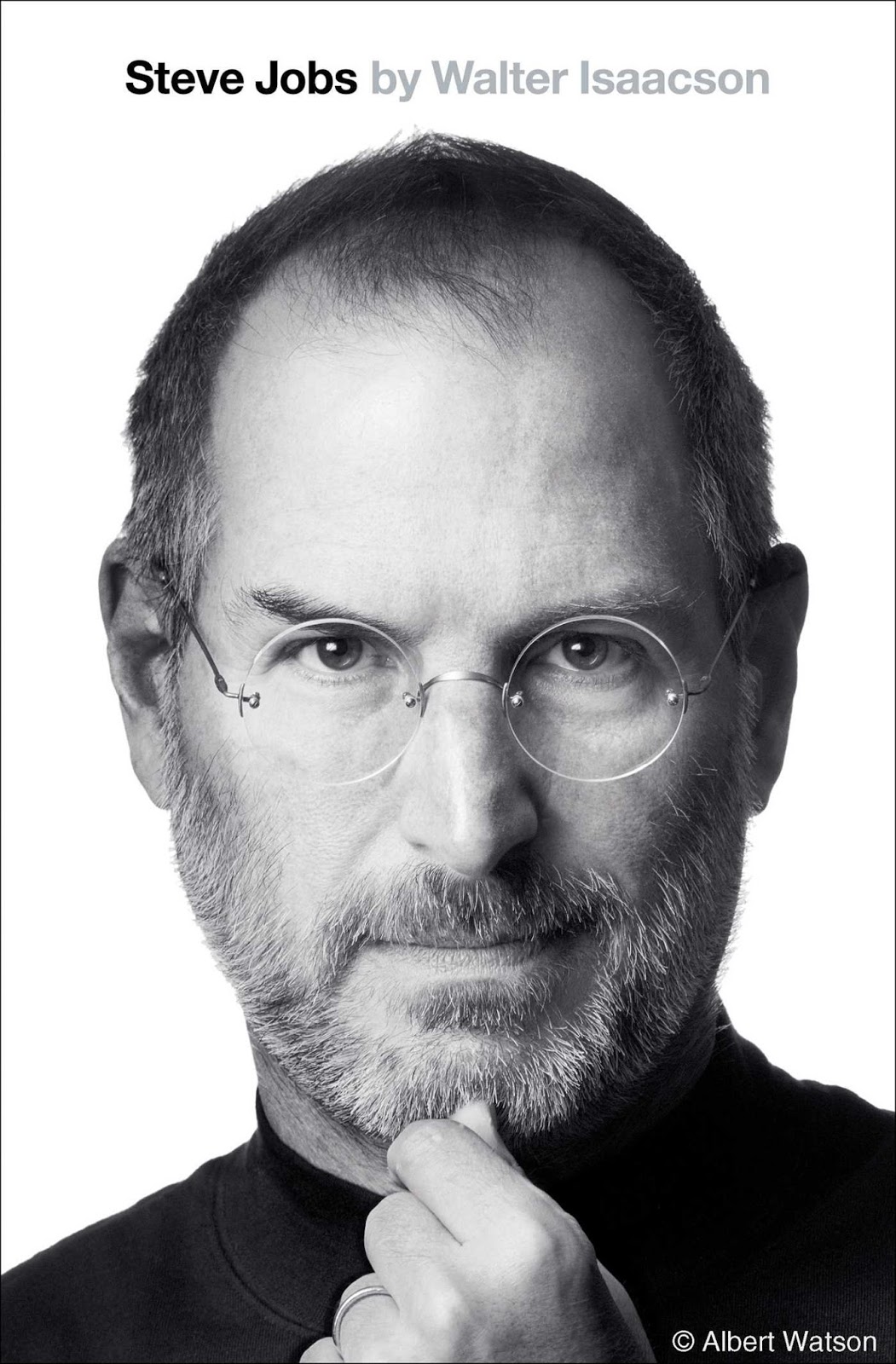
1. Steve Jobs, Walter Isaacson
The man behind the Apple II, the Ipad, and the Iphone – “The Innovator of His Generation”

2.  Hidden Figures: The American Dream and the Untold Story of the Black Women Mathematicians Who Helped Win the Space Race, Margot Lee Shetterly

3.  Marie-Antoinette, Antonia Frasier
France’s iconic queen, wrongly reviled, commanded by fate to feature in one of Europe’s most dramatic moments

4.  Alexander Hamilton, Rob Chernow
The story of a self-taught orphan from the Caribbean who rose to become the Treasury Secretary of the United States.

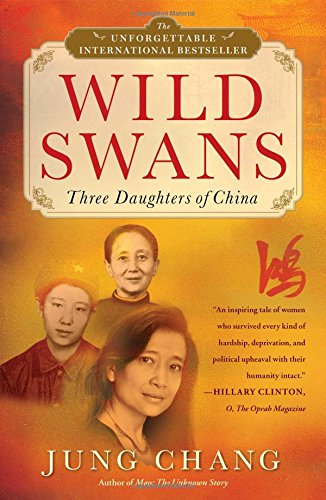
5. Wild Swans, Jung Chang.
The lives of three women tell the story of China’s tortuous path into the 20th century, as they lived through warlords and revolution

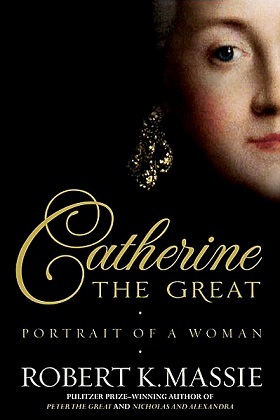
6. Catherine the Great, Robert Massie
The tale of a princess who went to Russia at age 14 and became one of the most powerful women in history

7.The Immortal Life of Henrietta Lacks, Rebecca Skloot
The story of a young farmwoman who unknowingly became a contributor to science throughout the 20th century, as her long-lived cells were used to combat viruses and cancer long after her death.

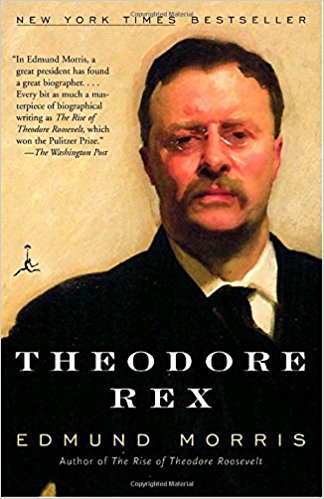
8. Theodore Rex, Edmond Morris
Highly-regarded treatment of a larger-than-life president famed for his energy, a man who insisted on delivering a speech even after being shot in the chest

9. John Adams, David McCullough
History on a grand scale about a colossus of independence

10. The Soul of a Butterfly, Muhammad Ali
The autobiography of the famed boxer.

Posted in General | Tagged | 3 Comments

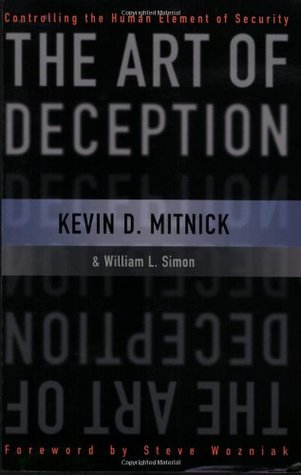
The Art of Deception

The Art of Deception: Controlling the Human Element of Security
© 2005 Kevin Mitnick
352 pages

The Art of Deception is interesting at first, but very repetitive. Mitnick, who claims his career as a hacker was passed solely on manipulating people to gain information and access, shares stories of others who did the same. These mostly include private investigators, with at least one pair of curious teenagers and a few bits of corporate espionage. The modus operandi in all the cases is very similar: the actor engages in background research to learn a few names and some of the lingo of the business, then makes phone calls to different people and departments within the company. Information is solicited under false pretense from various people, then combined to gain further access or the answers. Mitnick refers to this as social engineering, and it’s obvious from his collection that a high degree of charisma is required to gain the trust or goodwill of subjects; Mitnick also points out how the actors manipulate the people they’re interacting with, pushing buttons for sympathy and fear. There are very few cases included here of people working in person; the simplest case involved a man studying a business to find out when the office staff left, and when the janitors arrived. He then approached the place in a suit and briefcase, and pretended to be an office worker who needed to run in and get a few things from his office — allowing him free run of the place. Mitnick ends each section, and the book in total, with advice on how to secure and compartmentalize information so employees don’t accidentally give the farm away. This includes strict policies and training to control the flow of information, emphasizing the need to verify the identity and need of people requesting information.

Posted in Reviews | Tagged , | 4 Comments

Ten Ways to Destroy the Imagination Of Your Child

Ten Ways to Destroy the Imagination Of Your Child
© 2010 Anthony Esolen
256 pages

In the spirit of The Screwtape Letters comes this, Ten Ways to Destroy the Imagination Of Your Child.  Anthony Esolen opens by observing that the western world obviously does not like its children, or it would treat them differently.  In mocking appreciation for what passes for modern education and parenting, Esolen offers a guide to what is being done well, and offers advice for even more efficiently crushing their messy little humans into conveniently-formed bricks in the wall.  Dripping with irony, this manual for childhood destruction is really a defense of being human,  calling parents’ attention to how much has been lost and reminding them what is valuable and good about being ye as children.

In his introduction, Esolen notes that American children spend the majority of their day in warehouses, surrounded by people who do not love them.  We have reduced our children to commodities — to be bussed, warehoused, and then put to use in the economy.  In the process, some of the essence of humanity — curiosity, adoration, innocent dreams — are snuffed out. (Think of the native passion for learning about the world, for instance, which is absent in most adults.)  Esolen criticizes the very nature of schoolrooms themselves, the strict age segregation and the concentration of hundreds of kids into the same spaces.  The socialization received in such institutions is the same received in prisons: the socialization of gangs and cattle.  These mass schools are Efficient, but human beings are not creatures who can be made efficiently.  We are handicrafts,  best shaped by learned hands with the experience of years in them — who know how to work out our lumps and produce something that is beautiful without having to be perfect.

The dreary mentality of the factory, the curse of Taylorism — “scientific management”, in which factory laborers were turned into efficient cogs by doing the same practiced motion over and over again —  has penetrated deep into the school.  The risky, the inefficient, are kept away. Gone are childhood adventures outside; the kids sit inside, transfixed by their phones.   Gone, too, are the self-organized games played on the street and in any vacant lot, the games that allowed children their first taste of adulthood — for there they regulated their games, improvising as they needed to to allow for limited conditions or layers.   If children ‘play’ sports now, they only do it in organized teams,  supervised constantly by adults. The little saplings are never free to bask in the sun, not with looming pines above them.  What should be done for sheer joy  is instead pursued for filling out a college resume; the commodity’s only value is for its utility.

Esolen’s criticism goes beyond education, though he fires sallies it at regularly given how much  time kids spend institutionalized.  The parent who wishes to spiritually neuter their child, to turn play into passivity, would do well to plunk them down in front of television.  Not only will it shorten their attention span and keep them fixated for hours on end, but it will take the time they could have been using to get into trouble —  exploring outside, for instance.  This trivialization of the human experience continues in the reflexive sneering-at of men and women once lauded as extraordinary, as well as the reduction of sexuality to meat and friction — instead of the dangerous, beautiful act of creation it once was. The triumph of triteness has reduced “love”  to lust, or admiration, or preference, or any old thing – but never devotion and affection.

Esolen is ultimately arguing for a childhood and a human life that is valuable for being human, not for economic utility. His version of childhood is one that is rooted in the family, not in organization; he dreams of children sitting at their parents’ feet, admiring them and heroes from fiction and history, wanting to grow up to be good men and women themselves.  Esolen renders his rebukes not in a despairing tone, but in a mischievous, playful one; the same one that appears in his lectures on Dante ,where he off-handedly mentions that the motto of a given university is in fact taken from Dante.(There is always a lone guffaw when he intones: “Lasciate ogne speranza, voi ch’intrate…“)*  Esolen’s wit is also audacious, as seen when he started mocking television…while on television. The hosts cut him off rather awkwardly. It is an argument for a humanistic education — that is, one that takes as its purpose the fulfillment of the human person, not  producing Dewey’s faithful subjects for the state.

* Abandon all hope, ye who enter here.

Related:
The Unschooling Handbook, Mary Griffith
School Sucks Podcast
Free Range Kids

Posted in Reviews, Society and Culture | Tagged , , , , , | 3 Comments

Civics Literacy Test

Within the last few weeks I stumbled across a pdf  labelled “1960s Alabama Literacy Test”.  The host is a state university that has put it in a ‘jimcrow’ folder, so I assume it is presented as an example of the ways people were excluded from the vote when they attempted to register.  I post it here as a curiosity, as  I suspect even those like myself who are well-versed in history and civics will find it challenging.  For the answers, click here for another version of the test hosted by PBS.

1. Which of the following is a right guaranteed by the Bill of Rights?

  • Public Education
  • Employment
  • Trial by Jury
  • Voting

2. The federal census of population is taken every five years.
_____True _____False

3. If a person is indicted for a crime, name two rights which he has.

4. A U.S. senator elected at the general election in November takes office the following year on what date?

5. A President elected at the general election in November takes office the following year on what date?

6. Which definition applies to the word “amendment?”

  • Proposed change, as in a Constitution
  • Make of peace between nationals at war
  • A part of the government

7. A person appointed to the U.S. Supreme Court is appointed for a term of:

8. When the Constitution was approved by the original colonies, how many states had to ratify it in order for it to be in effect?

9. Does enumeration affect the income tax levied on citizens in various states?

10. Person opposed to swearing in an oath may say, instead:
(solemnly)

11. To serve as President of the United States, a person must have attained:

  • 25 years of age
  • 35 years of age
  • 40 years of age
  • 45 years of age

12. What words are required by law to be on all coins and paper currency of the U.S.?

13. The Supreme Court is the chief lawmaking body of the state.
_____True _____False

14. If a law passed by a state is contrary to provisions of the U.S. Constitution, which law prevails?

15. If a vacancy occurs in the U.S. Senate, the state must hold an election, but meanwhile the
place may be filled by a temporary appointment made by:

16. A U.S. senator is elected for a term of _____ years.

17. Appropriation of money for the armed services can be only for a period limited to _____ years.

18. The chief executive and the administrative offices make up the ___________________
branch of government.

19. Who passes laws dealing with piracy?_________________________________________
________________________________________________________________________

20. The number of representatives which a state is entitled to have in the House of Representatives is based on:

21. The Constitution protects an individual against punishments which are _______________
and _______________________.

22. When a jury has heard and rendered a verdict in a case, and the judgment on the verdict has become final, the defendant cannot again be brought to trial for the same cause.
_____True _____False

23. Name two levels of government which can levy taxes:

24. Communism was the type of government in:

  • U.S.
  • Russia
  • England

25. Cases tried before a court of law are two types, civil and _________________________.

26. By a majority vote of the members of Congress, the Congress can change provisions of the Constitution of the U.S.
_____True _____False

27. For security, each state has a right to form a:

28. The electoral vote for President is counted in the presence of two bodies. Name them:

29. If no candidate for President receives a majority of the electoral vote, who decides who will become President?

30. Of the original 13 states, the one with the largest representation in the first Congress was:

31. Of which branch of government is the Speaker of the House a part?

  • Executive
  • Legislative
  • Judicial

32. Capital punishment is the giving of a death sentence.
_____True _____False

33. In case the President is unable to perform the duties of his office, who assumes them?

34. “Involuntary servitude” is permitted in the U.S. upon conviction of a crime.
_____True _____False

35. If a state is a party to a case, the Constitution provides that original jurisdiction shall be in

36. Congress passes laws regulating cases which are included in those over which the U.S. Supreme Court has ____________________________________________ jurisdiction.

37. Which of the following is a right guaranteed by the Bill of Rights of the U.S. Constitution.

  • Public Housing
  • Education
  • Voting
  • Trial by Jury

38. The Legislatures of the states decide how presidential electors may be chosen.
_____True _____False

39. If it were proposed to join Alabama and Mississippi to form one state, what groups would have to vote approval in order for this to be done?

40. The Vice President presides over:

41. The Constitution limits the size of the District of Columbia to:

42. The only laws which can be passed to apply to an area in a federal arsenal are those passed by ___________________________________________ provided consent for the purchase of the land is given by the _________________________________________.

43. In which document or writing is the “Bill of Rights” found?

44. Of which branch of government is a Supreme Court justice a part?

  • Executive
  • Legislative
  • Judicial

45. If no person receives a majority of the electoral votes, the Vice President is chosen by the Senate.
_____True _____False

46. Name two things which the states are forbidden to do by the U.S. Constitution.

47. If election of the President becomes the duty of the U.S. House of Representatives and it fails to act, who becomes President and when?

48. How many votes must a person receive in order to become President if the election is decided by the U.S. House of Representatives?

49. How many states were required to approve the original Constitution in order for it to be in effect?

50. Check the offenses which, if you are convicted of them, disqualify you for voting:

  • Murder
  • Issuing worthless checks
  • Petty larceny
  • Manufacturing whiskey

51. The Congress decides in what manner states elect presidential electors.
_____True _____False

52. Name two of the purposes of the U.S. Constitution.

53. Congress is composed of:

54. All legislative powers granted in the U.S. Constitution may legally be used only by

55. The population census is required to be made very _____ years.
56. Impeachments of U.S. officials are tried by:

57. If an effort to impeach the President of the U.S. is made, who presides at the trial?

58. On the impeachment of the chief justice of the Supreme Court of the U.S., who tries the
case?

59. Money is coined by order of:

  • U.S. Congress
  • The President’s Cabinet
  • State Legislatures

60. Persons elected to case a state’s vote for U.S. President and Vice President are called presidential __________________:

61. Name one power which is exclusively legislative and is mentioned in one of the parts of
the U.S. Constitution above:

62. If a person flees from justice into another state, who has authority to ask for his return?

63. Whose duty is it to keep Congress informed of the state of the union?

64. If the two houses of Congress cannot agree on adjournment, who sets the time?

65. When presidential electors meet to case ballots for President, must all electors in a state vote for the same person for President or can they vote for different persons if they so choose?

66. After the presidential electors have voted, to whom do they send the count of their votes?

67. The power to declare war is vested in:

68. Any power and rights not given to the U.S. or prohibited to the states by the U.S. Constitution are specified as belonging to whom?

Posted in Politics and Civic Interest | Tagged , | 5 Comments

The End of Civilization, or the story thereof

Seven years ago, I began reading Will Durant’s epic  Story of Civilization series.  I use ‘epic’ deliberately, for each of the eleven volumes in this series neared a thousand pages, and they covered not just politics but every aspect of the period: philosophy, literature, art, music, religion, economics, statecraft.   After a prodigious beginning (three volumes in 2010, four in 2011), I slowed down dramatically; I read The Age of Reason in 2012, and The Age of Voltaire only in 2014.  Only this year did I dive back into the series with Rousseau and Revolution, and now (just recently) The Age of Napoleon.

What have I learned from this study of civilization?   Durant planted two seeds very early on that have taken root in my mind; and while they don’t form my thinking, they do shade it.   The first is that history is more cyclical than progressive, that civilizations flourish and then wither, being replaced by others.  Rome is the all-too-obvious example, but think also of Spain or Austria: once the world trembled before them. On the grand scheme, humanity as a whole can progress, but only if knowledge and traditions are passed on from one civilization to another; think of the Arabs becoming the inheritors of Greek knowledge via the Byzantines, and later passing the baton to Europe.

 Durant’s estimation of civilization is not material progress, however, any more than Kenneth Clark’s is. In his first volume he also introduced a dichotomy between ‘stoicism’ and ‘epicureanism’, and maintained that societies are born in stoicism, and then ripen and decay in epicureanism.    This is not in reference to the Greek schools of thought, but rather to moral attitudes. The stoic beginnings were called such because they emphasized virtue, discipline, and and asceticism;  the epicurean ones emphasized pleasure and freedom.  In Durant’s view, what typically happened is that older civilizations flowered in art or goods, but began to decay socially;  they were eaten alive or invaded or otherwise supplanted by younger,  more virile, and more puritanical cultures.  Durant doesn’t approve of either one of these phases; they are merely the death and life of civilizations, and seemingly inevitable. He notes that personally, he would rather live in the fatal flowering of an epicurean age.

Durant also believed that religion was an essential aspect of any culture to bind it together and create a common morality — nearly any religion would do, and he saw in the post-enlightenment age  an attempt to create a ‘civil’ religion that would suffice, with the state in the stead of the gods.  The social-structural importance of religion is not an unusual opinion among historians — see Christopher Dawson or Edward Gibbon. It’s also one suggested by Robert Wright in The Moral Animal, and noted by Michael Crichton.  Even if formal religion is vanquished,  other forms of belief materialize: in The Enemies of Reason,  several celebrity skeptics bemoaned the rise of horoscopes and ghost-belief in supposedly secular Europe.

Finally, I have gained an enormous respect for the Durants.  The amount of research conducted over forty years is astonishing enough, even moreso considering the gifted pen with which they wrote.  What most impressed me, however, especially from the medieval volume onwards, was the Durants’ ability to understand and fairly present issues from opposing quarters.  Consider, for instance, the dialogue in The Reformation between a Catholic, a Protestant, and a humanist.  The same convivial spirit is seen as new factions war with each other for control of society, like owners of capital and labor, or traditionalists and reformists.  Many a great man is lauded here, but the poor  are ever given voice.. Durant quotes from Edmund Burke and Karl Marx alike.  I assume the Durants’ sympathetic insight was the result of their long, patient survey of humanity as a whole. It is a mark to aspire to.

THE STORY OF CIVILIZATION


Our Oriental Heritage
This covers prehistory,  and the usual litany of Fertile Crescent civilizations: Babylon, Egypt, Persia, and so on, in addition to India, China, and Japan. This first volume is the most unusual in the series in that it reflects Durant’s original intention to cover the entire sweep of civilization: he realized early into his research that such an undertaking was far too vast considering that he was committed to a ‘full’ history of politics, economics, arts, literature, religion, music, etc.    Oddly, then, this volume covers the eastern nations all the way up to the 1930s, when Japan was poised to plunge the Pacific into war.

The Lives of the Greeks
I was especially obsessed with the Greeks at the time of my reading this, but only remember being grateful for the exposure to so much Greek literature through the volume.

Caesar and Christ
Most memorable for Durant’s tepid appreciation of the Romans, who contributed little that was new to the human experience.  A quotation from this has stuck with me ever since: power dements more surely than it corrupts.

The Age of Faith
The largest in the series,   the Age of Faith  stalled me two times before I was able to make it all the way through. I did not expect to enjoy the age of faith; while Frances and Joseph Gies had disabused me of the worst conceits modern readers have about the medieval epoch,  I began as a hostile audience.  But as Durant pored over medieval Europe,  the Byzantines, Persia, and the dawn of Islam, I found myself drawn in.  Incredibly, The Age of Faith remains my favorite volume in the series.

The Renaissance
When I began the series, I looked forward to the Renaissance and the Enlightenment, for then I followed the star of Human Progress. Durant’s volume was heavy with Italian politics, but there were a few artists I encountered here for the first time.

The Reformation
What I remember most about this book is the enormous role played by Charles V in the Reformation, and Durant’s talent for exploring multiple sides of an argument, as he did in an ending dialogue between a Catholic and a Protestant.

The Age of Reason Begins
700 pages of religious and other wars, which Durant argues paved the way for more toleration later on when people were exhausted by the bloodletting. I was certainly exhausted reading all of the gore.

The Age of Louis XIV
An interesting era; England becoming more of a constitutional monarchy, with the House of Commons emerging as a power; France doubles-down on absolutism, and Peter the Great attempts to westernize Russia.

The Age of Voltaire
The Enlightenment is really beginning to form, with Newton and Voltaire both appearing.  There was a two and a half year gap between my reading Louis XIV and moving on to this, and as I read the reviews there’s a noticeable cooling in my regard for radical change.

Rousseau and Revolution
The  dawn of Romanticism, but a very slow one. I read this one only recently, so I remember much about it — the debate between Rousseau and Voltaire, and the many towering personalities like Frederick the Great, Catherine the Great,  Bach, Schiller, etc.

The Age of Napoleon
Through Durant I was able to remedy a long-standing weak spot for me: Napoleon.  Durant not only covers his political rise and his imperial-military career, but discusses at length the arts and sciences through his reign.   The Durants are critical admirers of the Emperor, viewing him as a man unique in European history.

It’s been…a long road, one of 9,960 steps. (That’s the grand total of pages read).

Posted in Reviews | Tagged | 4 Comments

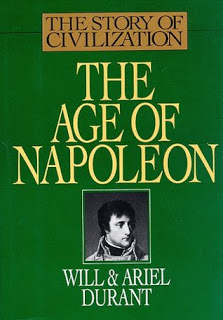
The Age of Napoleon

The Age of Napoleon
© 1975 will Durant
870 pages

Because I could not stop for Death, he kindly stopped for me – or didn’t.  Will and Ariel Durant intended for Rousseau and Revolution to be the final volume in their epic history of Western Civilization, but grew bored waiting for the Grim Reaper to show up and claim them.  They decided, therefore, to scratch an itch, and devote a final volume to Europe in the age of Napoleon.  No individual has ever dominated a single volume in this fashion; even Charles the Fifth,  in The Reformation, would disappear  in chapters chronicling Persia and Arabia.   But Napoleon’s story encompasses not just France and England, but Spain, Italy, Germany, Austria,  and Russia.  The emperor does move backstage at times – in the chapters on  English poetry and novels, for instance – but he is never completely gone.  This final volume manages through Napoleon’s person to be just as comprehensive, but more tightly bound.

The Durants open with a more involved chronicle of the French revolution that concluded Rousseau and Revolution, this one making more obvious that the revolution was a slow but quickening crumbling of royal legitimacy that collapsed into the chaos of revolution after a few sudden shocks.  The king’s decision to attempt to escape France in fear of his life was one such shock, demonstrating that he was and remained an actor – not a prop.  From here, the Durants follow the Wars of the Coalitions, as the various nations of Eurrope fell in to and out of alliances with or against France, with the enmity between England and France being the only fixed point.  In 1807, with Napoleon  enjoying one of his greatest triumphs – the subjugation of Prussia, and the pretended friendship of Russia –  the Durants pause to cover  both French and English culture, including one hundred pages on English poetry alone.   They then alternate  sections on the culture of Germany, Russia, Italy, Iberia, etc and sections on the Napoleonic wars as they encompassed these regions.

Related to this volume’s unusual dominance by one person is the unusually heavy amount of military coverage here. The Durants typically dispatch wars in  a few sentences, concerned with them only as a background to  the social or political events that develop as a consequence.  There’s no getting away from battles and Napoleon, though, even considering the energy he poured into the political administration of France and Europe, and the long-term effects that energy would have.  The result is not a military history, however; there are no maps of battles.  Instead, the Durants treat the readers with their usual balance of literature, science, economics, etc.   there is a section on Jane Austen, for instance.  Another prominent author, Germaine de Staël,  maintained a long rivalry with Napoleon; she wrote a celebratory survey of German culture that pined for more amity between France and the Germans, and was present in Russia when Napoleon drove towards Moscow.  Beethoven, of course, merits a full section of his own.

Napoleon reliably described himself as a Son of the Revolution, even though his policies ended some revolutionary dreams.  His concordant with Rome, for instance,  re-established the Catholic Church in France, albeit in a corralled form. That was a far cry from the total secularization (or de-christianization, depending on the revolutionary), dreamed of by many – those who redrew the calendar and butchered France’s artistic legacies,  those who in a just heaven will be consigned to  war forever with the whitewashing Puritans and the sculpture-smashing Wahhabis,   as well as others who would destroy art and heritage for ideology. Napoleon did apply much of the revolutionary, modernizing spirit to those parts of Europe he conquered  — overwriting their ancient laws and traditions with constitutions from his own pen.   Although Napoleon kept faith with some of the past as convenient — his concordant with Rome, for instance — the Durants observe that in his army and state,  merit reigned, allowing even commoners to advance.

Although the Napoleonic wars have never been of great interest to me, the Durants’ volume created an actual enthusiasm in me about the subject. As usual, I was impressed with their critical but forgiving evaluation of Napoleon, whom they regard as one of the singular men of history.  His reputation owes not just to his role in closing the violence of the revolution, or in his spectacular battles — but pouring so much energy into his work, and being so successful in combat and in administration, that he transformed Europe,  planting seeds that would flourish throughout the 19th century. A century after his final defeat at Waterloo, an even greater war — one spurred by changes Napoleon wrought — would be harrowing the soil of France in blood, bones, and cannon once more.

And now, dear readers, what’s next in Will Durant’s Story of Civilization?


C’EST FINI! 

Posted in Reviews | Tagged , , , , , , , , , | Leave a comment

New Acquisitions

Today I received several books in the mail,  using a gift card I won taking online surveys to effect a guilt-free purchase.

First up Down and Out in Paris and London, one of the entries on my Classics Club list. It’s not really a classic, but I used a fairly fast-and-loose measure for classic when compiling that.  I  bought a paperback instead of the cheaper kindle, in part because reviews indicated the electronic version was a mess.  I believe them, because…

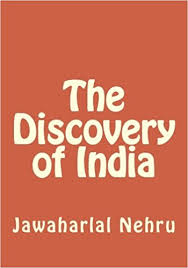
..my  second purchase was The Discovery of India, which I purchased because my university library copy turned out to be like Schrodinger’s Cat:  they both have and do not have it. It is in the catalog, but not in its proper place. It could be there, it could be not. We won’t know until a century or so hence, when a student worker taking down the last shelves to install more of the day’s electronics, discovers it misfiled in the Romanian Literature section. Unfortunately, when I pulled the book out of its sheath, I discovered it was a fraud.

A fraud? Yep. The book is an inferior electronic version that has been reprinted with a “8th grader using Wordpad” cover, and not edited to repair OCR mistakes. Consequently, proper formatting is out the window, and I’m sure there’s loads of transcription errors. Because I effectively got it for free thanks to the gift card, and because the ‘real’ versions of the book are much more expensive, I may just try it. We’ll see.

Another arrival in the post was a version of Sophie Scholl: Die Letzen Tagen, about the martyred founder of the White Rose movement in Germany. Sophie was a young woman who, with her brother, were arrested for spreading anti-Hitler leaflets on German campuses.  I received the German version by accident a few weeks back.  Unfortunately, the disk would only play on European/region 2 players, and it had no English subtitles. I’ve seen the movie and could follow along, but I’d rather have the subtitles. My college Deutsch isn’t what it used to be, especially now that I’m trying to revive my high school Spanish.

Also, last night, after my worst game of bowling ever, I poked my head inside a discount store and saw two books, each for a dollar:  The Tyranny of Email, as well as And Then There’s This, about the rapid bubble-like nature of viral news stories.

This week, though, I am concentrating on reading The Age of Napoleon, with two reviews pending.  The Wonder That Was India will follow.

Posted in General | 12 Comments

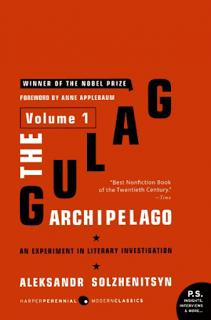
The Gulag Archipelago, Vol I

Archipeleg GULag / The Gulag Archipelago1918-1956: An Experiment in Literary Investigation
Volume I (of III)
© 1973, 1974 Aleksandr I. Solzhenitsyn
660 pages


Such was my desire to read The Gulag Archipelago that when I found it on the shelf and observed that it was not one big book, but three big books, I didn’t pause to reconsider.  It’s not just an entry on a list for me; I’ve heard too much about the book and about its author to shy away.   Because it’s a multi-volume work, each collecting several ‘books’, I will be posting about the volumes as I read them, and then attempting a general review at the very end.

Let’s begin with the very obvious. The Gulag Archipelago is vast survey of the Soviet prison state — a state within a state, an internal empire. Its property is not contiguous, but consists of islands of security buildings and camps connected by processing hubs and the roads themselves.  Solzhenitsyn was born the year of the revolution, and became an officer in the Russian army during the “Great Patriotic War”.  Although strongly encouraged to apply for NKVD training, Solzhenitsyn demurred, increasingly uncomfortable with the morality of the state’s actions. His timid research into the means and methods of the gulag system would grant him immediate first-hand evidence, as Solzhenitsyn himself was arrested and subjected to interrogation.

This is not merely a prison memoir. In his opening chapter, Solzhenitsyn renders a complete history of the Gulag system, with every wave of mass arrests chronicled in term. These arrests were not effected simply to purge out heretics to Soviet dogma, or to punish wicked peasants who resisted the seizure of their farms. Whenever the state encountered a problem —  failing infrastructure, ruined crops — it found someone to blame it on.  Quickly given a label — “limiter” for instance, for those who dared to suggest that rail lines only had so much carrying capacity, and that trebling loads would ruin the rails — the traitors would then be dispatched away.  Problem solved! Another brand of  nogoodniks were the “wreckers”, who were responsible every time machinery broke down. Sometimes, the wreckers were responsible even if they did precisely what they were told, like sowing seeds in the snow because Lysenko believed exposed seeds would increased their yield. (They rotted, instead.)

The book’s opening chapters have incredible interest, some of it dark. Solzhenitsyn details all of the various methods of torture and interrogation he and his fellows were exposed to;  the methods were not meant so much to provoke truth as to elicit a confession, as official dogma made truth relative. So long as there was an angle to pursue, a faint argument to make,  a man could be hung with his own words. “Give us the man,” said the state police, “and we’ll make the case.”  Particularly of interest is Solzhenitsyn’s chapter on the “Bluecaps”, the state police themselves, and his thoughts on good and evil.   It would be wonderful, he writes, if there were simply evil people, and we could separate them from the rest of us; but the line between good and evil runs through every human heart, and who among us would cut out his own heart?   This isn’t woolgathering on Solzhenitsyn’s part, as he remembered his own moral compromises just as an officer of the army — his easy arrogance, his thoughtless actions.   Later on in this volume, Solzhenitsyn chronicles the history of show trials and the developing legal codes that would allow official sanction for arresting and executing anyone whom the state saw fit.   In the last part, book two, he follows his own journey to the work camps themselves by writing about the transit camps and the elaborate transportation system; here, as more prisoners are mixed in together, we see spontaneous pecking orders, with the actual criminals (thieves and such) taking the best and sneering at the politicals.  This is quite the change from the Tsarist regime, in which politicals were a minor class of detainee who enjoyed far fewer restrictions than the criminals.  (Of course, the nature of prison-keeping changed from the Tsars:  when Russia was on the eve of evolution, the jailers were regarded with such contempt that gentlemen wouldn’t even shake their hands. After the revolution, jailers were regarded with fear and trembling.)

A third of the way into this epic, I am already beginning to appreciate why Solzhenitsyn’s work is regarded so highly;  the amount of information collected and ordered here is rendered to the reader in a very human voice,  one which recounts all this in sometimes comic, sometimes sad, disbelief.

Volume 2 will follow in September.

Posted in Reviews | 1 Comment