
And I’ve been living here for a long, long time
And I know its been coming down a while now…
(Deer Tick, “Art Isn’t Real”. Original opening song to the KC.)
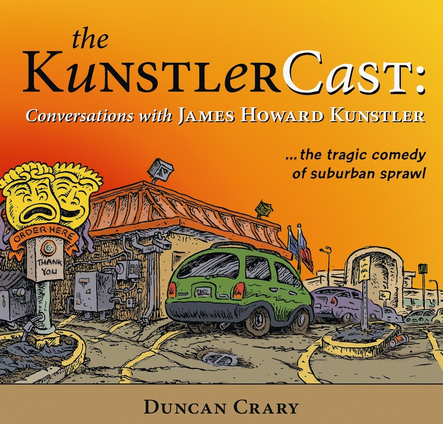
Almost twenty years ago I attended a guest lecture at my university and heard a talk that would prove to be exceptionally influential on my thinking. The talk, by Jim Kunstler, was on how American urban design – the built environment – had become not only ugly and injurious to human happiness, but fundamentally unsustainable. This was an iteration of a talk he’d been giving for a few years, but for the audience that night – who were going home to more dire reports of banks and businesses closing and jobs being lost and a global economy in peril – his diagnosis was particularly dire. He gave me a lot of food for thought; a vocabulary to articulate things about traditional city design versus modern city design; and an interest in energy, housing, and transportation policies that would fundamentally alter my politics and indeed my entire political orientation. Back then, Kunstler was in the middle of a sequence of books with a common theme – essentially, the imminent consequences of our refusal to live within limits, our conviction that the cheap oil era would last forever, and our faith that technology would always save us from said consequences – and as part of his profile, he had a podcast called the KunstlerCast. It’s changed much over the years – these days Kunstler interviews other people, but back then a young journalist was interviewing him about various topics that fell within this wheelhouse. The young journalist, Duncan Crary, turned the early years of the podcast into a book, which i devoured. Recently while looking for a break from St. Augustine, I saw the fun cover of this one on my shelf and decided to revisit it. I have reviewed the book before, so this review will incorporate reflections on what’s changed in 15+ years or so. If you want my original take, head here.
Because of its source, The KunstlerCast is a more varied book than Kunstler’s solo works. Each of those was written with a particular topic in mind, and as I commented in my review of his last nonfiction work, they were a bit like railroad cars: each book connected to the other but all were part of the same train of thought. These interviews reflect that train of thought, but they also have more miscellaneous content that allows Kunstler to broadcast his inner curmudgeon. Kunstler identifies himself as a jovial, upbeat guy, but one who despises the triviality and superficiality of late-2000s American culture. The first half of the transcripts here include discussions on topics within the Geography of Nowhere trainshed: the origins of suburban sprawl, the cheap and performative nature of the buildings and architecture associated with it, and on. If you’ve never encountered Kunstler before, here’s an elevator speech: he is a strong critic of postwar American urbanism who believes that the ugliness of early industrial cities created a hyper-reaction of people not only fleeing the cities, but adopting zoning and building methods that would ensure that those escaping to suburbia would never live anywhere near factories again. This new approach at the built environment reduced all human urbanism to three general categories (Residential, Commercial, and Industrial) and then made pains to separate them far from each other: as a result, urbanism became profoundly car-oriented, and fundamentally anti-human. This anti-humanness is expressed not only by the fact that it reduces everyone to being reliant on cars to do anything, but because it destroys the public realm completely, creating a nation of consumers who get and spend and then go home to watch advertisements for buying more stuff while surrounded by plastic crap they don’t need. To this add Kunstler’s later criticisms that all this is unsustainable because the cheap oil age won’t last forever, and that no, energy-intensive tech is not going to solve the problem because it itself is dependent on cheap energy.
Within Kunstler’s original argument in Geography of Nowhere there were elements that might seem like digressions, but which to Kunstler are still key parts. He often objects to things on aesthetic grounds, like the fake shutters applied to suburban homes that he reviews as cartoony imitations of actual country homes in themselves. The digressions show up more here, because Crary and Kunstler’s conversations are far more informal than a lecture hall. Thus we get remarks on how cartoony Americans themselves are becoming — obese ‘land whales’ shuffling around, dressed like kids who have no respect for themselves because they grew up in a culture that does not take anything seriously, from the built environment to sober evaluation of our future issues. Kunstler can easily come off as a grouch to those who aren’t familiar with him as a person or who don’t share some of his grievances; I’ve been listening to the man since that lectures and have to roll my eyes at some of his substack tirades. He is a fun grump to listen to, though.
How does this stand up, twenty years later? Kunstler these days doesn’t write much about the built environment; he maintains a website with a blog and a monthly feature called “Eyesore of the Month”, but most of his writing is about political culture in general. The fracking revolution of the 2010s appears to have silenced much of the peak oil commentariat: TheOilDrum, which was the biggest peak oil news aggregator back in the day, has been silent and still for many years. Kunstler panned the prospects of fracking back then and in ways it’s a challenge of his argument that technology will not save us — only returning to sane development patterns will, and these development patterns will allow us to recreate something of communal and public life. That said: even if technology allows us to tap into oil sources that we didn’t have access to before, it doesn’t mean that the supply of oil is infinite. Given that the entire damn world seems intent on becoming more dependent on the oil ecosystem — from car-oriented infrastructure to the proliferation of plastic everything — it seems to me that we are driving faster and faster down a road whose endpoint we cannot see, and at such a pace that if we encounter obstacles we’ll have no time to dodge them. The current oil spike as a result of Gulf War II (or whatever future historians wind up calling the Iran War) is one such obstacle. Unfortunately, I imagine we will forget its lessons as readily as we did the OPEC problems of the 1970s once peace is made and the global economy begins to revive in five years or whenever.
Fundamentally, I think this book still holds up because of Kunstler’s original, foundational argument: suburban design spits in the face of thousands of years of urban thought and design, and it has nothing to recommend it unless you are a developer who takes delight in destroying meadows and forests to put up mini-McMansions that now offer the insult of half-mill price tags while at the same time forcing people to live just as cheek-by-jowl as they would in an apartment building that they wouldn’t spend their entire working lives to pay for. The built environment plays a huge role in human happiness along multiple factors — on our ability to get places easily, on our connections with our neighbors, etc — and I think the disintegration of the American city plays a huge role in many of our social maladies. I think many of Kunstler’s convictions are still applicable today, and for me this was a fun visit back to where a lot of my thinking about these topics derives. Kunstler’s particular brand of pugnacious criticsm may not be for everyone, but he’s no lone Jeremiah: StrongTowns has been arguing on the fiscal unsustainability of urbanism for decades itself. This was a fun trip back for me.
Related:
The KunstlerCast, my original review.
Kunstler’s work in general
Urbanism books in general
Quotations
Jim: The problem in America is not that we’re driving the wrong kind of car. The trouble is we’re driving every kind of car incessantly. And we’ve got to find a way out of the incessant motoring — not a punishing way to live without it, but a happy way to live without it. And it means a completely different paradigm for everyday life.
Duncan Crary: Even when [vinyl siding’s] brand new, I don’t like it. To me, it’s just not real.
Jim: Well, it ISN’T real. It’s just pretending to be something else.
Duncan Why do I care that it’s not real? Why does that bug me so much?
Jim: I think that we are disturbed by the inauthentic. Vinyl siding pretends to be wood, and we know it’s not wood, and it pisses us off that we’re being lied to by a physical object.Jim: The thing that astonishes me the most about my generation is how this generation that espoused free thinking and free inquiry and freedom of everything ended up becoming the thought police.
Jim: One thing the American public doesn’t realize is that when you don’t negotiate the circumstances that the universe sends your way, you get assigned a new negotiating partner called Reality. And then it negotiates for you. You don’t even have to be in the room. You can go watch Internet porn, or play poker online, or eat Cheez Doodles and drink Pepsi, or watch TV. And then your life will be negotiated for you.
Duncan: I think a lot about our sense of entitlement to convenience in America. Take all the throwaway plastic bags and plastic spoons out there — we are a people who are so lazy and entitled that we can’t be bothered wiping off a metal spoon and saving it for tomorrow. We create utensils for one-time use, and now the spoon that you ate one plastic cup of yogurt with, and the plastic bag they came in, are all going to be around for eternity in some landfill.
Jim: It’s scary at that at the highest level of American corporate high-tech enterprise, they don’t know the difference between technology and energy. Do you know how fundamental that is, and how dangerous that is, to not understand the difference? Most Americans don’t understand that technology and energy are different — that they’re not interchangable. That if you run out of one, you can’t just swap it out with the other one. You can’t just plug in technology where you were using energy.







 Reading Freely