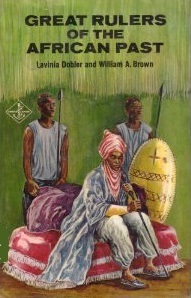
Most of African history is a complete unknown for me; what few kings I can name outside of Egypt and Carthage are familiar to me only through the Civilization series, namely Shaka and Mansa Musa. While in the future I would like to do a study series and get to know the cradle of humanity better, this brightly-illustrated book will serve a taste. It is a history of five men — three Muslim, one Christian, one whatever-makes-you-stop-bothering-me — who created legacies for themselves, either by conquering far and wide or by relentlessly attempting to connect to the outside world and enrich themselves through trade and courting scholars and technicians. Three of these lives unfold in northwest Africa, along the Senegal and Niger rivers; one is set close by, near Lake Chad; and one is alone in being set in the Congo. This book’s size and style indicate it was intended for younger readers, say perhaps middle schoolers, and there are explanations of important places and people which surface, like Mecca — which two kings here make pilgrimages to.
The men chronicled are:
Mansa Musa of Mali, a pious and highly admired king who journeyed to Mecca;
Sunni Ali Ber, forger of the Songhai Empire, who built an empire nearly the size of Western Europe, but disappeared abruptly on campaign
Askia Muhammad, general of the armies to Ali Ber’s successor-son, whose political cluelessness so angered his Muslim subjects that they encouraged Muhammad to seize the throne
Affonso I, a young prince of Congo who converted to Christianity after Portugal initiated first contact between Europe and southern Africa; he was alone in his family in taking the new religion seriously
Idris Alaoma, another king who died in battle, but not before he discovered gunpowder weapons in Egypt and arranged to have some brought home
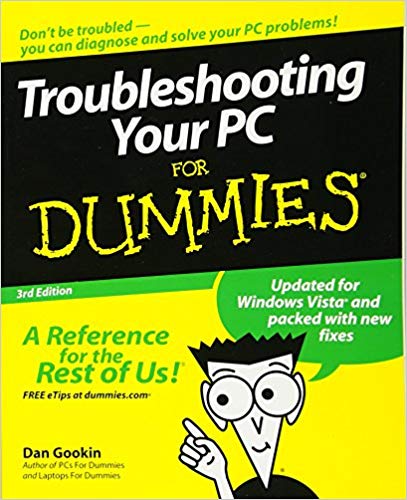
As soon as I opened this package I knew I’d goofed. “Now Updated to Support Vista!”? …well, it’s by the same author as the version I thought I was buying, and I do in fact have a Vista machine which I’ve refused to let die because it can play games that simply don’t play nice with Windows 10. Even if the specific steps are different, the general steps may still apply today. So I read it, and…well, I’ll have to be more careful about buying used books in the future. Troubleshooting Your PC for Dummies, 3rd edition, is definitely a intro computer users’ guide; while it assumes users are generally familiar with using Windows, it doesn’t get into the kind of specifics that the most recent edition does.
The above shot is from the table of contents for Troubleshooting and Maintaining Your PC All in One For Dummies, 3rd Edition, notTroubleshooting Your PC for Dummies, 3rd Edition As you can see, it’s a methodical walk-through of everything that happens during the startup sequence, (I assume) offers information on how to figure out if it’s bad RAM or a failing power supply or whatever. The similarly titled but drastically book I’ve just read was far more basic, explaining what common errors meant, reviewing the proper method of uninstalling programs (instead of just deleting their files), running antivirus and system restores , guiding readers to their Control Panel — helpful to beginners who have never explored beyond the desktop and their documents folders.
Although I still want to add a guide like this to my tech resource library, it won’t be this one, given the relatively shallow level of information and the constant attempts at humor which must have been a for Dummies specification. What’s worse, some of the information is…not quite right. For instance, the author tells readers that if the User Account Control window pops up, they’re probably in the middle of something they shouldn’t be doing. As someone who frequently customizes games — adding clothing and objects to The Sims, say, or custom maps to Civilization — the UAC was a chronic nuisance, refusing to allow even my admin account to unpack files from compressed folders into the Program Files directory, even after I authorized it. I wound up creating a “landing” folder in a directory UAC wasn’t so touchy about, unpacking items there, then moving them from the landing to their intended directory (with UAC demanding I confirm the action, not to be ignored). There’s probably a way to turn UAC off, but I wouldn’t want to disable Windows calling foul on any actual intrusions. In sound troubleshooting, the author suggests a system restore before users have even made sure that a volume problem isn’t just limited to one file, or one program.
Happy Monday! (Or Monday evening, depending on where you are…)
My NaNoWriMo is off to a promising start, as I’ve been logging just over 4,000 words per day, well over the 1667 minimum average requirement. That is completely unprecedented for me; usually I have a strong first couple of days, and two weeks in I’m struggling and just typing stream of consciousness garbage to make any wordcount headway at all. I think the amount of time the particulars of this story have been rattling around in my head has helped grease the runners, so to speak, and I’m going to ride this lead as far as I can. Having a five-point overview with a partial sketch of the narrative also helps. Essentially I have an ensemble group of four factions (a fifth will be introduced at the climax) and am visiting each faction-figure once in turn, a la Harry Turtledove. I’m 1.5 “turns” in.
Last week I finished a couple of books that I won’t be dwelling on in a full review. I should at least mention them, however. The first, Fear, is a history of the first year of the Trump administration, or rather a review of some of the more alarming episodes of that period like the twitter war with the Kim cult, the creation of an economic policy cut from 18th century mercantilist playbooks, and the ongoing chaos of interior organization. Like Fire and Fury this is less an expose than a recap, as we’ve all seen this unfold in public and even Trump supporters I know aren’t sure how to make sense of everything that comes out of DC these days.
The second book I finished in the week was Bikeonomics, a bit of bike advocacy which hails bicycles’ salulatory effect on health, the urban environment, and the bottom line . Unfortunately, I’ve encountered all that before through On Bikes, so it was a bit of preaching to the choir for me.
The Bicycle Diaries combines travel and climate-change advocacy, both literally as a trip and throughout the book. As Kroodsma makes his way through Mexico, Central America, and the mountainous roads of South America, he talks to locals, from retired presidents to impoverished farmers, about the ways their landscape is changing and discusses with them the ways climate change will further alter their homes, health, and livelihood. The book is thus a tour of these regions by bike and a survey of the various ways climate will affect the future, as seemingly every place he visits is imperiled either by development or by climactic alteration.
Although Peruvian villagers aren’t exactly a primary source of problematic emissions, developing countries and their poor are the most at risk to future changes, and Kroodsma wanted to increase awareness on all fronts – communicating what he knew to people young and old as he cycled, learning from his discussions with people about their experiences. This a tale with great appeal, from the travel descriptions of varied landscapes (the beautiful Andes, salt flats the size of New Jersey, stupefyingly rich forests, to the candid interactions with people from the poor and marginalized to the wealthy and powerful. Kroodsma is continually amazed by the hospitality of strangers over the course of the year, and challenged by the fact that many people seem happy with their lives despite having so little. The spread of the internet into very remote places was also a pleasing surprise, as it meant more opportunities at less expense. The virtue of bicycles comes up quite often, as you might imagine — from their travel merits (making it easier for Kroodsma to interact with people), to their environmental impact, to their role in making cities more livable places.
It’s November first, and that means it’s National Novel Writing Month! Every November for the last nineteen years, hundreds of thousands of people across the world devote themselves to the goal of writing a 50,00 page story. I did this successfully in 2013 and 2014, though in the years that followed I’ve either failed or not started. This year I’m more prepared than I’ve ever been, with a story based on a scenario I designed for Heroes of Might and Magic II a…long time ago. We’re talking pre-9/11 here. I have an outline, a map, a dramatic climax, a horrifying plot twist….all I lack is an ending. One bridge at a time, though. Here’s the plot synopsis I posted on NaNoWriMO’s forums:
“A storm is brewing over the twisted mountains of Akkadia. In the north, the merchant-prince Ali has returned to find his clan’s camps destroyed, his farms and mills burned, and his young family dead. There are no survivors to expose who has done this, but Ali knows only man powerful and treacherous enough to attack the Brotherhood: Sargon.
To the far southwest, separated from the land by a great ocean, an ancient wizard has been awakened from his sleep to learn that his daughter was kidnapped. Though once an advisor to the ruler of men, the tragically slain and long-mourned-over Khan , the wizard retreated to his frozen island kingdom after a great war decades ago, despairing of mankind, and has long left the people of the mainland in peace, however much they fear his power. But now they have taken his daughter, envying her power and beauty, and they must pay. Who could it be? Rumor has it that one king on the mainland is anxious for an heir: the sonless Sargon. In the southeast, the murder of the king nearly destroyed the small kingdom of Okan, as brothers fought against one another to claim the crown. Now, the two survivors look with bitterness to the north, and prepare to avenge their dead father — for the man whose hands were red with blood wore the ring of that jealous northern neighbor…Sargon.
Decades ago, Sargon left his homeland and tried to find adventure in the north. He found a land riven in war against darkness, squabbling states beset by an army of foul beasts and sinister magic that would command even the dead. The war left much of the land wasted and barren, and many quit it in despair. But Sargon was ambitious and resilient, and from the ruins he built an empire for himself, his dominion limited only by the lifeless mountains in the north, the cursed swamps to the south, and the dragon-guarded ocean to the west. He has never known complete peace, but a lifetime of war has made Sargon its master. From his castle in the barrens, Sargon reigns happy — and unsuspecting.
Might, guile, and magic are soon to be arrayed against the warlord, but there are darker storms a-brewing, and evil waiting to be waked. “
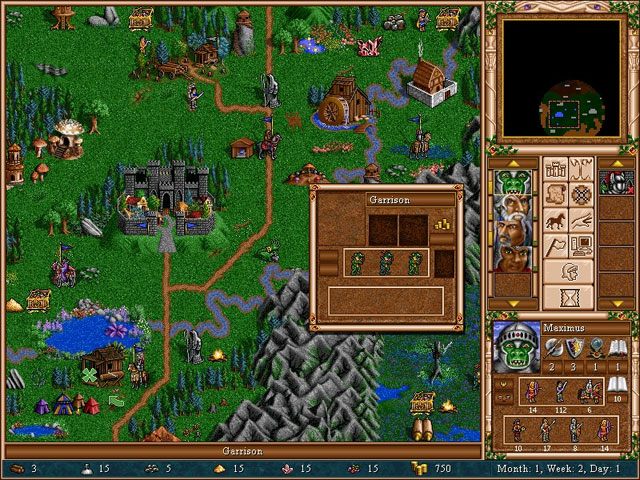
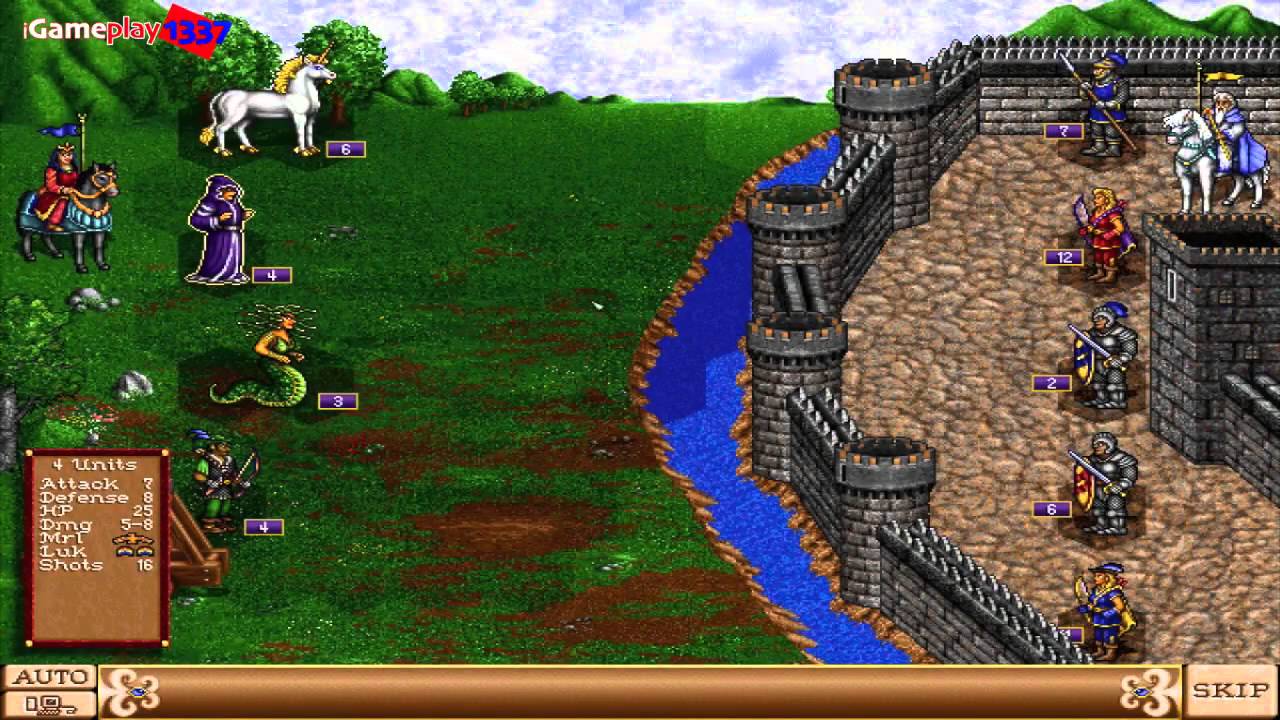
As hinted from some of the names, I’m drawing on Earth’s history and landscapes for inspiration, using a range from the Mesopotamia to the Indus for the areas mentioned in the story. (I also recently read The Prince in part to give me ideas for Sargon’s ruthless performance as a ruler.) Just for laughs, here’s a couple of screenshots from Heroes of Might and Magic 2. These aren’t my own, and they aren’t from my scenario which was on a computer long lost to me. (It disappeared into a storage shed long before I had any inkling that data could be recovered…) The story is inspired only by the plot of my scenario, not by game mechanics. It’s been so long since I played HoMM2 I can’t even remember most of the units, beyond the usual suspects of dragons, genies, and sword-wielding skeletons.
Star Trek and its iterations have produced many kinds of shows — adventures, romances, mysteries, action thrillers, spy dramas — but its horror episodes are particularly memorable. Since we’re nearing Halloween, I thought it would be fun to share some the more appropriate episodes. This isn’t an objective list compiled from a survey; there are just episodes I remember as being creepy or appropriate, and naturally there’s a bias toward Deep Space Nine given that it’s my favorite.
“Catspaw“, TOS (02×07) Although I don’t find “Catspaw” particularly scary, it’s gotta be here considering that it was deliberately filmed for and aired on Halloween. After losing contact with a landing party, Kirk and his senior staff beam down to find a fog-covered arena of mystery, apparitions of witches warning them away in a threatening chant, and a gloomy gothic castle shrouded in the mist. Inside the castle, their lost landing party waits for them in a dungeon, under the control of a malicious “wizard”.
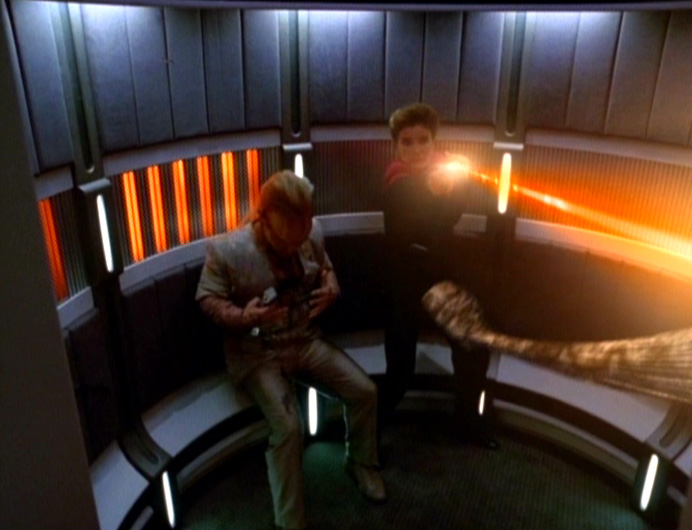
“Macrocosm“, ST-VOY(03×12) Captain Janeway and Neelix return to a Voyager which is strangely empty, except for occasional noises deep in the interior, and see evidence that the crew left their stations abruptly. But there is something else on the ship that’s alive…
“Night Terrors“, ST-TNG (04×17) The Enterprise-D is caught in a spatial anomaly that denies the crew the ability to really sleep. As they sink into hallucinations and violence, Deanna Troi — who keeps hearing the voice within her head intone “EYES IN THE DARK, ONE MOON CIRCLING” — tries to find an answer to what is happening. A nearby ship adrift, filled with the bodies of a crew that murdered itself, is an ominous reminder of what will happen if she doesn’t.
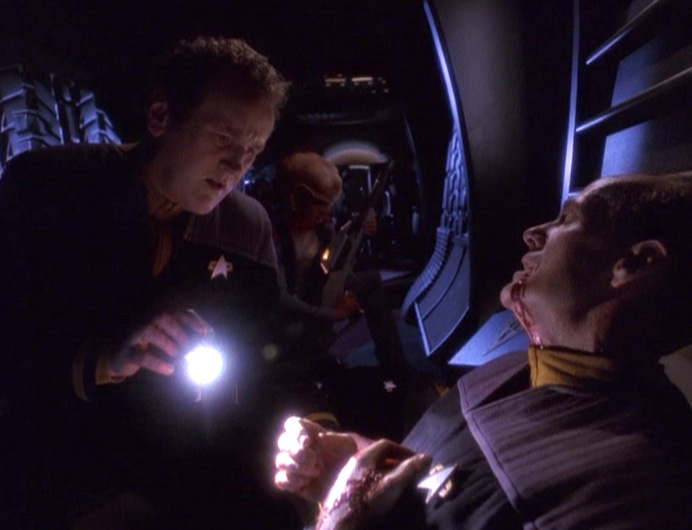
“Whispers“, ST-DS9 (02×14) “Whispers opens with Miles O’Brien escaping from…Deep Space Nine, where his friends and coworkers have inexplicably begun treating him like an enemy in disguise. One of the many “abuse O’Brien” episodes of DS9, viewers witness poor Miles suffering cold distrust from first both his wife and his command, and then everyone — even children. After using his engineering know-how and knowledge of the station’s innards to escape, he looks to Starfleet Command for reprieve. In a related episode, “The Assignment“, Mile’s wife is possessed by a malevolent alien who wishes to attack Bajor…and if the chief doesn’t assist the creature, it will kill his wife and daughter.
“Distant Voices“, ST-DS9 (03×18) Shortly after being physically attacked by an alien in his lab, Dr. Julian Bashir wakes up to a seemingly abandoned and crippled station. What’s more, he’s aging — rapidly, and hears faint voices all around him. When he finally finds a few scattered members of the crew, they’re acting uncharacteristically. When Bashir’s failing faculties seem to align with the crew being killed by a monstrous assassin, the doctor realizes he is fighting for his sanity within his own head.
“One“/“Doctor’s Orders” ST-VOY/ST-ENT (04×25 | 03×16) An effective enough story that it was recycled between shows, “One” features Voyager entering an area of space dangerous to most of the life on the ship. Seven of Nine and the Emergency Medical Hologram are immune to the effect, but everyone else must be put into medical stasis. At first, matters go smoothly…but then the EMH is compromised, and Seven is left alone to battle both technical problems and the creeping terror of being alone for weeks on end. ENT re-used the story, but Seven’s status as someone still establishing her own identity apart from the Borg collective made the original far more compelling, with Borg hallucinations driving Seven’s panic. The filming of “One” used a lot of perspective shots that made it look like Seven was being followed or stalked.
“The Haunting of Deck Twelve“, ST-VOY (06×25) Voyager, for reasons undeclared to the viewer, is shutting down all engines and drifting through a nebula more mysterious than normal. While Starfleet’s finest will be at their stations during the darkness, monitoring something Very Important, Neelix is assigned to take care of four children whom Voyager rescued. To entertain them, he tells them a “ghost story” about why it’s important that the ship is powered down and at full alert, which mixes fact and fantasy and keeps the kids and viewers alike spellbound. There are comedic elements as well, because one of the children is older and keeps asking about the plot holes.
“Schisms”, ST-TNG (06×05) The Enterprise crew is overtaken by creeping paranoia, flashes of memory from a terrible place, and feelings of being out-of-time. When Crusher and Troi begin comparing notes, they realize there are common points of reference, and begin to suspect that the crew are being abducted in their sleep.
“Empok Nor“, ST-DS9 (05×24) A sudden crisis aboard Deep Space Nine forces a small team to raid an abandoned Cardassian outpost for supplies. Because the outpost is booby-trapped, mysterious Cardassian exile Garak comes along to watch for and disable any traps. But the station isn’t quite abandoned, and as members of the team begin to be murdered one by one, a psychotropic toxin turns friends against one another. The experience is harrowing enough that a season later, a survivor’s behavior is influenced by it while in another tense situation.
1. “Frame of Mind“, ST-TNG (06×21). Commander Riker wakes up in an asylum, accused of having murdered a man. He has no memory of the event, and everyone treats him like he is insane. What’s more….he is. What Riker experiences and the reality around him constantly conflict, and even when members of the Enterprise crew show up to check on him, they prove only to be part of the delusion. The episode is a complete mindscrew, keeping the viewer and Riker completely unsettled. “Frame of Mind” is the reason I made this list to begin with, and I went ahead and made it number one before anything else.
Back in the early 2000s, a guy named DarkMateria did three remix songs, using TNG clips and music — one for Picard, one for Worf, and one for “Frame of Mind”. I’m including a fan-made vid above using the music.
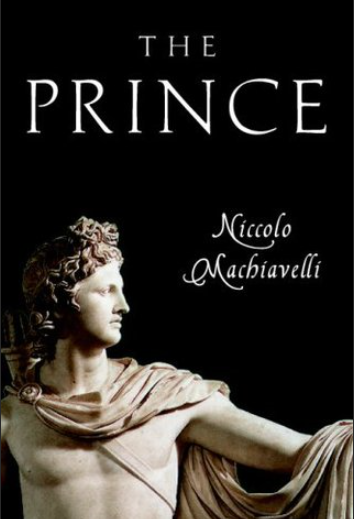
Italy, circa 1500, was a rough neighborhood. Divided between powerful city-centered states and frequently threatened by outside empires, few rulers could rest on their laurels and enjoy a prolonged peace. Even if someone outside didn’t want to take over, someone inside might want to effect a little regime change. In such an environment, Nichola Machiavelli chose to present his newly-acclaimed ruler with a gift of advice. The Prince is a brief, grimly realistic review of how states work and how best to manipulate them, drawing on Italian or Mediterranean history for case studies.
I’ve grown up to associate the term Machiavellian with sinister calculation, usually of the wheels-within-wheels kind, and especially with cold-blooded calculation that doesn’t hesitate to burn bridges, step on toes, and secure pointy knives in the back of friends who have outlived their use. The Prince doesn’t quite do that reputation justice, but it’s easy to see where it lies. Most of the beginning advice is analytical, as Machiavelli reviews different types of states and ways to rise to power — He argues that a feudal state like France is relatively easy to compromise and invade, but nearly impossible to consolidate because of the heavy local basis of government.. An autocratic regime, on the other hand, where the weight of the state is on the ruler’s shoulders and not supported or drawn from civil society, is harder to invade because of the central power but relatively easy to subdue thereafter. He appraises different sources of effective defense, from the best (a native, professional army) to the worst (foreign auxiliaries). It’s later on, though, that things get….interesting.
Machiavelli argues that morality has little place in politics; politics is about what is rather than what should be. He does not equivocate: men are wicked. You cannot account on their affection, because it evaporates quickly. You cannot count on loyalty, because everyone looks instinctively to their own interest in the pursuit of power and wealth. It is better, then, to be feared rather than loved — so long as one is not hated. Rulers should make and break their word with the same ease of a mechanic breaking down equipment to replace or mend its parts. This should not done flippantly or obviously — it’s always important to maintain the appearance of virtue if not the substance of it — but a prince is judged by his results and nothing else. The best way for a prince to solidify his power, in fact, is for him to make himself indispensable, a man whose fall would cause more trouble than his continuing in office. In weighing the virtues of generosity and parsimony, Machiavelli concludes that it is far better for a prince to be faulted for stinginess than liberality: recipients of gifts are never as grateful as they should be, and the giving of gifts and favors only spurs resentment among those who do not benefit, induces greater expectations for future, more fulsome giving, and empties the state’s coffers. In a worst case scenario, the liberally-giving prince can earn the hatred of the people by taxing them to give them gifts they do not regard as favors but rather as entitlements. All this advice is not intuitive: while one might expect advice to a dictator to urge disarming the rabble so they don’t protest, Machiavelli instead maintains that keeping the population armed is a wiser choice. A ruler who disarms his subjects broadcasts his distrust of the people, and so cultivates their contempt. The strength of the ruler lays in his ability to defend against threats, and an armed populace is the best means of doing so.
The Prince has all kinds of related advice in it, from choosing wise-but-not-too-wise counsel, to squelching conspiracies. Some of the advice has modern application which anyone would applaud, like the avoidance of sycophants and foreign auxiliaries (how much money did DC waste in Afghanistan trying to create a native security force?). Some of this is material which I think we all suspect but rarely want to admit — like the necessity for leaders to appear decisive and strong even if they are internally conflicted. That can easily lead us into folly if leaders focus too much on appearances rather than reality, but it is possible to change one’s mind in light of growing evidence and still appear decisive. None of us would want to live in states where leaders lie and manipulate the people, but judging by the popularity of shows like House of Cards, we suspect we do already. Although I would not advocate The Prince as a way to government — I put personal stock in virtue, honor, truth, all that dated and impolitic stuff — I suspect even good, well-intentioned people who come into power find themselves enacting its lessons as they settle into office. The Prince has enormous value for me in its naked view of man the political creature, admitting as it does the limitations of building societies from the crooked timber of humanity.
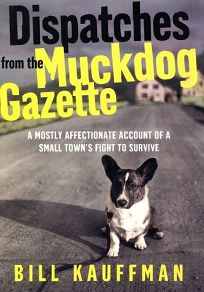
Bill Kauffman, as a kid, went places. Starting from a little town in upstate New York, he journeyed as far afield as Los Angeles and D.C., for a time serving on the staff of a Democratic senator. Then, disillusioned, he returned home and started lobbing colorful grenades at those very places, becoming an ardent champion of local cultures and places over homogeneity and the politics of Big. Although much of his writing has concerned localism within America in general — celebrating regional literature, for instance, or chronicling with joy the history of self-rule movements in the US – he often makes allusions to the place he has called his home, and in Dispatches from the Muckdog Gazette he looks at it fully.
Batavia, NY, is not Mayberry. From Kauffman’s writings both here and elsewhere, it’s a place whose downtown was gutted by “Urban Renewal”, whose businesses were shuttered after the big box stores arrived in the periphery, and it’s had its share of ethnic conflict between Italians, English-types, and a few black immigrants. But when Kauffman looks at Batavia, he looks at through eyes of love: “It ain’t much, but it’s better than nothin.'” “Nothing” is what prevails today — in rootless politicians and tycoons whose detachment makes it much easier for them to act like brutes in power. Distanced from the consequences of their actions, they deal in ideas and abstractions. Consequences, whether they be blown-up weddings in Yemen or dead towns in Ohio, are a far-off notion. Within these Dispatches, Kauffman celebrates local figures, some of whom are known abroad, like John Gardener. Kauffman also recounts the decline of Batavia’s downtown, shares quirky stores from its past like a sudden rush of anti-Mason hatred, and hails its locally-owned ballclub. All this is not just flavor or local color, because mixed within the recollection is reflection. Kauffman values his local team not for some sentimental attachment to baseball (though there is that), but for the fact that his town owns that team. When so much of Batavia has been lost to the bulldozers of progress (“progress” is always a four-letter in a Kauffman book), the ball club is a locus for continuity, tying generations together. Young attendees become older players and then — in their maturity — may sit on the board that manages the team. Kauffman himself served as a president. Likewise, in the chapter on a few local politicians, Kauffman ruminates on the vast gulf between local voting and national voting. Politics matters at the local level, and elections can swing on a single vote, and the people put into office are close enough to keep accountable. (“Close enough to kick”, as GK Chesterton put it).
Although a book like this only seems to be of interest to those who live in Batavia, or at leas Gennessee County, I don’t think that’s the case. Batavia’s is an American story; I’ve never found a town yet whose downtown wasn’t riddled with shuttered buildings or proud buildings reduced to yet another parking lot, and cookie-cutter sprawl camped nearby. All Americans are affected by the distance of DC, even those with the misfortune of living near the Virginia-Maryland border, and estrangement and frustration with the system seem to increase every year. Even if we can’t fix the system — and I know of no polity in history which has passed into empire and then restored itself — we can still within the span of our lives re-turn our attention to what matters — our places, our families, our quirks and histories. It may not be much, but it’s better than nothing.
“Now Old Jack, who was the last of that generation that Wheeler looked to with such fililial devotion, is dead. And Wheeler is fifty-two years old, as old as the century, and younger men are looking to him. Now he must cease to be a son to the old men and become a father to the young.” p. 163
For years, Old Jack Beechum has been a fixture on the porch of Port William’s downtown hotel, where he sits staring into the distance until the arrival of a friend or the call to supper disturbs him from his reverie. Old Jack is a widower whose daughter long abandoned him for the bright lights of the city, but he’s far from a man alone, instead being a source of admiration for most of the men in town. Jack is the last of a generation which can remember the Civil War, the last of the men who were the true husbands of their fields and not merely the drivers of machines. He is notoriously stubborn, careful, and devoted — and The Memory of Old Jack takes readers on a journey both through his life and his final day as he is lost in memories while approaching that final rest.
As Jayber Crow noted in his own account of the town of Port William and the membership thereof, “telling a story is like reaching into a granary full of wheat and drawing out a handful. There is always more to tell than can be told”. That is ever the case with any Port William story, for they are richly interconnected with one another and with the town’s story through time. The passage of time is a theme in every Berry story that I’ve read — considering as he does the maturation or degradation of characters and the community itself — and that, combined with the fact that we encounter the same characters and some of the same stories from different angles in different books, means this is a fulsome fictional experience. Berry affects me like no other author in taking me through the full gamut of human emotions — youthful romance, debt-induced desperation, deep satisfaction in work well done, sadness and estrangement over an ill-considered marriage, rage and regret, and the deep sorrow of a parent whose child has become a stranger to them. I’ve encountered Jack in other stories, and was entranced by him here. As with any Port William story, this is not one of saccharine and happy endings; tragic things happen, and life goes on, characters making the best lives they can for themselves, and — fittingly — the story does not end with Jack’s death. He lived within a community, within a family, and their response to his death is just as important as its happening. One of the more touching moments of this particular novel is when a few of Jack’s younger friends, silver-haired men who he had mentored, gather after the funeral and swap their favorite Jackisms.
Berry’s fiction is exquisite, and The Memory of Old Jack easily ranks among my favorites along with Jayber Crow and Hannah Coulter.
“Please, sir, I want some more.” I had never read or otherwise encountered Oliver Twist before this month, but I immediately recognized that quote. Something about little Oliver sticks in the minds of other readers, just as it stuck in the mind of many characters who encountered him. Oliver Twist is the story of an orphan who seems to escape and again from the clutches of uncaring or malicious adults, only to find himself right back in trouble. It was trouble that started before his birth, for as this narrative follows young Oliver’s birth until he is about eleven or twelve, its happenings eventually reveal a more elaborate family drama. While Oliver is passing in and out of the hands of hostile adults — first uncaring taskmasters, then criminals, who capture him after he escapes — the arrival of a man with a mysterious past heightens the mortal danger to the boy, far beyond that of ordinary neglect and abuse. The novel is replete with memorable characters, particularly Nancy — a teenage girl associated with a gang of criminals, who helps them kidnap him for labor but regrets her actions, later laboring to atone for them. Although this story is more grim than anything else I’ve read of Dickens, I appreciated the earn-your-happy-ending type conclusion, in which Oliver finally finds happiness but at the cost of a dear friend.















 Reading Freely
