Today’s TTT is a Halloween freebie, and while that should make things easier, it doesn’t. I’m not much for Halloween: my family didn’t celebrate it as a kid, and while I’ve enjoyed quite a few costume parties in. So, I’m really leaning into thewhole freebie thing. But first, the tease:
The momentum of a state is always towards the centre; always towards the agglomeration of more power. No ‘conspiracy theory’ is necessary for any of this to be true, and neither do the people running the state need to be evil or ill-intentioned. It is simply the logic of the thing. A state is like a vortex or a black hole: at a certain point, it begins to suck in everything around it. As it grows, it will tell stories that justify its existence. (Paul Kingsnorth, AGAINST THE MACHINE)
So, now to the freebie. I’m going to go with “Ten Books I’ve Been Looking At on Amazon”. I was going to do “Top Ten Strange Things People Died From in Colonial Alabama,” but the book I like to amuse tourists with is not where it should be. (Whenever I show people the library’s local history room, I like to point out some of the more interesting resources, as well as genealogical volumes with funny names like “IT’s MCCRAW, NOT MCGRAW!” )
(1) Ask Old Paths: Medieval Virtues and Vicesfor a Whole and Holy Life, Grace Hamman (2) Those were the Vaqueros, Arnold Rojas (3) Watch With Me: and Six Other Stories of the Yet-Remembered Ptolemy Proudfoot and His Wife, Miss Minnie, Née Quinch, Wendell Berry (4) Long Live Latin: The Pleasures of a Useless Language, Nicola Gardini. Trans. Todd Portnowitz. (5) Rebel Cornbread and Yankee Coffee: Authentic Civil War Cooking and Camaraderie, Garry Fisher (6) Tyranny, Inc.: How Private Power Crushed American Liberty–and What to Do About It, Sohrab Amari (7) Creators, Conquerors, and Citizens: A History of Ancient Greece, Robin Waterfield (8) Solaris, Stanislaw Lem (9) Taking Religion Seriously, Charles Murray (10) The Myth of the Great War, John Mosier
. . . The machine appeared In the distance, singing to itself Of money. Its song was the web They were caught in, men and women Together. The villages were as flies To be sucked empty. God secreted A tear. Enough, enough, He commanded, but the machine Looked at him and went on singing.
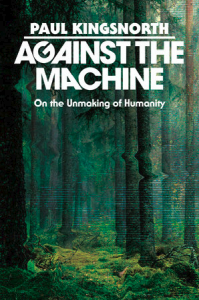
At some point during college, I tried to work out what an ideal human society might look like. This was back when I still strongly identified with the left, but my dreams were not of a world state and a carefully-managed economy. Instead, I imagined something on the order of a small town, one in which the shops were owned by locals, and surrounded by farms that were also locally owned and operated. This was a small-scale vision, a humane one, and it made me realize I might not be much of a leftist after all. The vision was in fact nostalgic, a look at a world that agri-industrialization and globalization have since destroyed. I found kindred spirits and dreams in Chesterton and Wendell Berry, and now, in Paul Kingsnorth but his Against the Machine goes deeper than dreams. Against the Machine is a critique of how we came to be here, speculation that we have become victims of our own devices, increasingly captive creatures in the hands of a lustful and hungry god – the Machine. Kingsnorth draws on an impressive variety of authors – Marx, Berry, Mumford, others whom I’ve never heard of but will assuredly be looking into.
Against the Machine is fundamentally a critique of what might be called modernity, but it’s a deeper and yet more personal critique than one might expect. Kingsnorth opens the title on that personal level describing his love of Nature even as a child and his yearning for a deeper relationship with it. Relationship is a fundamental part of this book: our relationship with the Earth, with our tools, and with our Creator. Although this is not a “religious” book in the sense that it’s written for an audience of believers on a topic that’s “within” religion, it is religious in the sense that Kingsnorth has an ‘enchanted’ view of the cosmos. It was a view that led him to be an early environmental activist, and then become despairing when he witnessed the take over of environmentalism by beancounters and other apologists for the global consumer-machine. His reaction upon arriving at Mount Athos – a Greek Orthodox island-mount monastery so strict that women are not allowed – turned from reverence to dismay when he witnessed the brothers constantly pulling out phones from their robes and staring at them. “Even here?”
What is the machine? It is something inescapable. It is the industrial-consumer-financial order that owns the entire planet, except for pockets of jungle or some caves in Afghanistan. Its material form is The Grid, the vast mesh of powerlines, data centers, and smothering blankets of oil-soaked tarmac that now cover so much of the globe – and the factories and financial centers and big box stores that urge ever more getting and spending. It’s a fusion of powers – financial, corporate, culture – that lusts for more power. This is not, however, just a critique of the effects of industrialism on society, or the unintended side effects of consumer capitalism on communities and human culture. Kingsnorth’s critique goes deeper than that, though, because fundamentally he sees our dilemma as a theological and spiritual problem: the modernist worldview is simply a return to the Serpent’s original promise to Eve in the Garden: ye shall be as gods. Indeed, Yuval Harari unselfconsciously titled his book on the promises of the future as Homo Deus. The Future, however, the dream of Progress, has no attraction for Paul Kingsnorth. Nor does nostalgia, strictly: he realizes that the moving finger has writ and cannot be pushed back to cancel a line. He emphasizes, though, that it is importance to realize what has happened to us so that we may best figure out how to respond.
At the beginning of the book, Kingsnorth addresses the collapse of transcendent order in the West, its replacement by the control-and-consume ethos, and the great challenge the Machine poses to human flourishing. We need rootedness and meaning, Kingsnorth argues, and modernity offers us nothing even as it directly attacks those sources of happiness. – indeed, often the opposite case is true. Human culture has been savaged by modernity in more ways than we can even begin to appreciate. Homes full of amateur musicians entertaining one another in the long hours have turned to boxes of disconnected people staring at their respective devices, their heads filled not of folklore and the songs of their nation but the latest commercial jingle and pop/rap dopamine dance. Notions of particularity and tradition are replaced by meaningless dreams of cosmopolis and globalism; our places and people mean nothing to us, and we leave them without a thought to chase mammon elsewhere. Breathes there the man so dead? Yes, by the multitudes.
There is so much to take in these four hundred pages that I doubt I can write a review that can do it justice. Kingsnorth writes at the beginning that he feels as though he’s been writing around this issue all his life, and that this is his best effort to see the problem in full. I greatly sympathize with Paul on this point, because the concerns he muses over here are those I’ve had since I have been an adult, from the moment I realized on a factory floor that a life working just for money, or worse getting money just to spend it on DVD sets and clothes, was not for me. Those criticisms developed philosophical and political layers as I moved to college, but Kingsnorth goes beyond. The conception of the Machine a something with a life of its own, with a desire to expand itself, to use us to achieve its ends, is darkly fascinating. And yet when one reads about AI scientists feeling some strange compulsion to make the Golem they are making bigger and better even though they don’t like what it’s doing now and they don’t even understand how it’s doing it, something in the mind itches, and I am reminded of Rod Dreher’s opening line in Living in Wonder: “The world is not what you think it is.”
I have been looking forward to this book for months, and I read it slow, both for the complexity of its ideas, the deliciousness of spending time with someone who had the same concerns as I but had found words to address it, and the means to begin resisting it in his own life. Some of its arguments, especially when they get more theological as King compares the Machine to the spirit of Antichrist, will a little much for strictly secular readers. There is a great deal written here, though, that has broad appeal. I could see my college self or my later early -young adult self devouring this title – but it was that same self who, despite being an agnostic, found inexplicable interest in the company of priests and preachers, because they remained more interested in the inner yearning of humanity than merely our material comfort. The Machine offers comfort and ease, but at the cost of all else that matters.
In short: book of the year, no question. I have over a hundred highlights of this on Kindle and will try to post a best-of tomorrow or Wednesday.
When I was a wee bairn, in the olden days when the Earth was new and dinosaurs roamed the land, I cut my teeth on reading Kathryn Tucker Windham’s collections of ghost stories. KTW, or “Kathryn” as Selmians still call her, was a journalist who loved story telling and oral history: she collected stories and shared them, and I have fond memories of attending festivals at Dallas County’s ghost town, Old Cahawba, and listening to her speak. Her most known books were the 13 ____________ Ghost and Jeffrey” series: I read every single one my library had multiple times. I thought it might be fun to revisit it. This won’t be a formal review, as such, but more of an exercise in reflection.
I should begin by explaining who “Jeffrey” is: Jeffrey was KTW’s mascot, of a sort, a ghost she insisted lived in her home in Selma. This book opens with her experiences with Jeffrey, and I suspect (but cannot remember enough to be certain) that the other books also include a Jeffrey story before she shares ghost stories of Georgia, Mississippi, and so on. She was good enough at promoting him that there’s still a little ‘marker’ of him on our main downdown street:
The parking lot that replaced the Pollard building in 1966, because why not tear down a beautiful building to make room for cars?
What follows after the Jeffrey story are thirteen different ghost stories taken from across Alabama, two from my home account of Alabama. They’re all 19th century stories, which is not something I paid attention to as a kid but seemed very salient reading as an adult. One of my coworkers once asked me why I thought ghost stories always seemed to gravitate toward the mid-19th century, and I speculated that it had something to do with the rise of Spiritualism, and that naturally people would have looked to the generation before theirs that was now “lost”. That’s just speculation, of course, and if I wanted to really get out into the weeds I might add that it had something to do with the horrors of the Civil War — the South was littered in death and ruin, and telling stories about spectres from the past kept their memory alive, somehow, or at least provided some way to muse or grapple with the past. Indeed, the War is very much part of most of these stories: a young soldier and his intended taking a walk and being harrassed by spectral balls, a young woman throwing herself to her death after seeing a rider coming with news that her own beau had fallen in battle, and so on. The Selma story included is here one connected to the War, concerning a Mr. John Parkman who made some bad investment choices with Federal money and found himself imprisoned when the market soured. He then escaped, and was somehow killed: I say ‘somehow’ because the manner of his death varies on the manner of his escape:there are various stories as to how he was killed. At any rate, some three years later the servants at his house in Selma (now known as Sturdivant Hall, an exquisite example of antebellum architecture that is now an art museum) began reporting that ol’ Mr. John was….back. I do not know why it took him three years to mosey ten miles from Cahawba to Selma, nor why he seems to refer the rear corner of the estate where a fig orchard used to be, but that is how the story goes.
While most of the stories involve visual ghostly presences, there are other stories where the spirits make themselves known by sound: one young woman evidently enjoys tip-toeing down the hall and then playing popular music of the 1860s, though she’s shy and stops if someone tries to sneak into the room. As a kid, the creepiest of these was “The Hole That Never Stays Filled”, the site of a hanging where the resentful ghost continues to maintain the pit that did him in. I was raised in a church where you weren’t supposed to believe in ghosts, so I used to dismiss most of these stories as just people’s imagination. A hole that wouldn’t stay filled, though? Kid-me was not creative enough to think that perhaps locals kept an eye on the place and maintained the hole just to attract tourists. At any rate, the Chattahoochee River destroyed the hole, and that vacuous object we call ‘progress’ has also destroyed the site of Montgomery’s “Red Lady” at Huntington College. Presumably not longer being able to annoy popular society ladies who snubbed her in real life, she now wanders the nearby streets. I can recommend that she haunt the Capri theater nearby: it’s not too far a float, and it’s sufficiently old that new stories can pop out to explain her way.
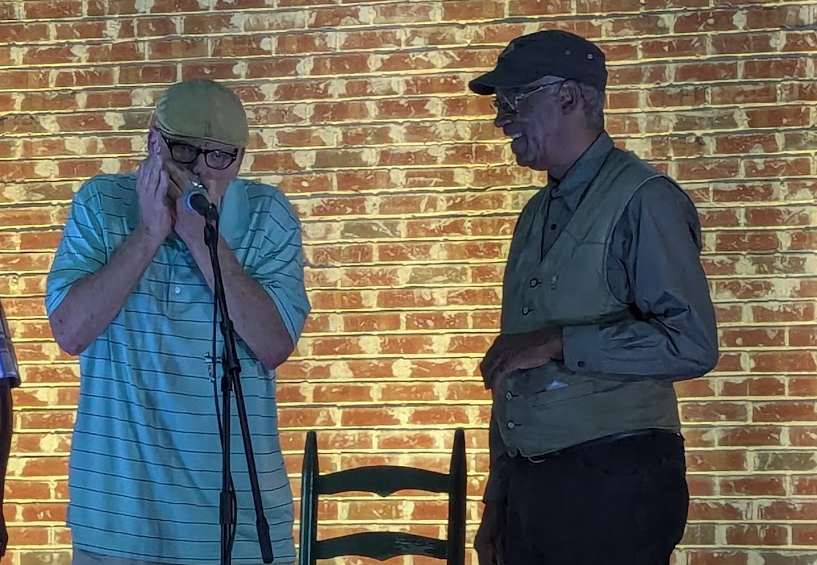
I am not one to believe in ghosts, but the older I get the more I appreciate folk-memory and folk stories and the cultural continuity they are part of. That is a hope that seems more and more forlorn in these days of liquid modernity, though. Even so, I may read a couple more of these volumes before All Hallows’ Eve, just to re familiarize myself with some of “Kathryn’s” work. Part of my inspiration for reading this was attending the 42nd annual Tale-Telling Festival in downtown Selma last week, a festival Kathryn started. Originally, professional storytellers would share their favorites with the crowd, and then at the “Swapping Grounds”, Selmians who had a gift for telling a yarn would have their own time at bat. These days it’s more about the professional, but folk elements are still included through music — and this last year, a local who likes to sit in the downtown diner and talk loudly to anyone in earshot was invited to speak a little bit.
The Downtown Declaimer and Charlie “Tin Man” Lucas
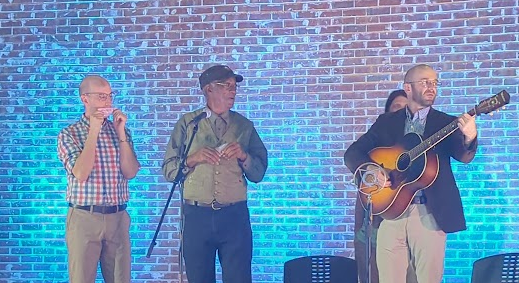
Adam Booth, the star comedian; Mr Charlie; and a musician whose band name I didn’t quite get
Adam from a prior year’s performance, with Kathryn looking on from the portrait
The….Greater Dallas County Bluegrass and BBQ Research Group, I think this band called themselves. As a testament to living in small towns, I know almost everyone in this band, and half of them from my church.
Yes, yes, I know. I said I wouldn’t read more in this series until I’d hit some nonfiction first — but the last book ended with the Dome of the Rock being blown up! How could I resist? The Impossible Nazi takes us further into truly alternative history, as there’s increasingly little about this 1942 that we’d recognize. At the moment most of the fighting is between Dai Nippon and the United States, and even that’s minimal: both sides lost the majority of their carrier fleets, and the US is buying German unterseebooten to prey on Jap shipping lanes. The English have lost all of Africa and have written off Australia for the time being, and yet Churchill persists in maintaining a state of war with Germany and exchanging air raids with Berlin. Both the American president, Henry Wallace, and the German chancellor Schloss are befuddled: why won’t the old man just write off France and Poland, and join forces with his American brothers to strike back against the Rising Sun? The events of Impossible Nazi, though, will shake things up multiple times.
Impossible strikes me as a transition novel, because while some major things happen, they don’t happen until the end of the story. For the most part, Herr Schloss — in his capacity as the German chancellor — is fending off attempts at assassinations from reactionary Nazis who resent his change of policies. This series is now poorly titled, in fact, because the Fuhrercouncil consists of almost entirely non-Nazis: they’re technically members of the party, sure, but Himmler and Hess are dead, von Ribbentrop has been shifted to making commercial treaties, and Goering is increasingly sidelined. The policy of Schloss’s Germany is no longer recognizable as Nazi, either: after inexplicably appearing in 1941 Germany in command of the Nazi party in the wake of Hitler’s death, Schloss has completely changed history to prevent Germany’s degradation and ruin. As mentioned in the first book, he is no moralist who wants to suddenly turn Germany into some comfortable democracy in Europe notable for its pretzels and lager: he’s more in the mark of Otto von Bismarck. He wants Germany to be the great power on the continent, so formidable that no one will mess with it. To that end, he has turned the Amis from near-enemies into near-friends; he has avoided war with Russia and is waiting for Stalin’s paranoia and the inherent stupidity of command economics to drag it down; and he has turned into The Friend of the Jews, facilitating the creation of the State of Judea. Here, his greatest enemy is not the English air force, Stalin, or even the Munich Nasties: it’s an increasingly desperate Winston Churchhill, who throws the dice and plunges both the United States and the United Kingdom into constitutional crises.
As my pace indicates, I’m enjoying this series very much — not only because Schloss is an interesting character, and not only because of the more inexplicable elements like the mysterious housekeeper who seems to know that Schloss is a man out of time. There are other ‘differences’ in the timeline, like Queen Margaret reining instead of George or Elizabeth (they were both killed in a bombing raid before the series even began), and the reader is as surprised to encounter these as Schloss is. It’s a lot less dangerous for us, though, because when he makes a misstep it feeds some rumors that he’s been replaced by the English, somehow, or has been sent by the gods as punishment for betraying Hitler’s vision. There are also amusing perversities happening, like the US Navy sailing U-boats, the Luftwaffe kitting itself out with B-17s, and so on. (The B-17 has a sadly shortened life in this universe: since there’s no Eighth Air Force constantly bombing Festung Europa from Britain, and B-17s don’t have any actionable range in a Pacific controlled by the Japs, only 500 were produced.) As with the other books, this one ends with a twisty hook — but one I will do my best to ignore for the present.
Highlights:
“Do you ever lie, Harry?” The senator stared at the president. “Mr. President, lying is a diplomatic tool that becomes quickly dulled from use. It is best exercised as little as possible.”
The difficult we can accomplish immediately. The impossible takes a bit longer.
“Have you thought we might have children, Darling?” she asked. “We have talked about it,” he replied. “But, I have a lot on my schedule this morning.”
“Please, Your Majesty,” Attlee said. “We are civilized people. There are ways we can murder one another without bloodshed.”
In The Accidental Nazi, a historian from 1981 West Berlin was astonished to find himself inexplicably standing on a tarmac in 1941 Berlin, watching a plane carrying Adolf Hitler plow into the pavement and completely reroll the dice on Germany’s future. He was himself, and yet not himself: Heinrich Schloss in 1941 Germany was the leader of the Nazi Party, now a member of the small fuhrercouncil responsible for leading Germany until a new fuhrer could be appointed. Schloss, though confused, was desperate to prevent both Operation Barbarossa and the Holocaust — and after months of political maneuvering, the reckless Hess finally set events into motion that saw both himself and Himmler dead. Schloss was hailed as the new king of town, master of a Germany whose future he cannot quite predict. Reactionary forces within Germany want him gone and the tenants of Nazism restored, and the world scene is utterly unpredictable. But Schloss is a man on a mission: to machen Sie Deutscherland großartig again!
This second book in the series takes us into utter terra incognita, foreign-policy wise. At this point, mild spoilers for the first book will follow, so proceed at your literary peril, meine Damen und Herren. Schloss was largely successful in meeting his goals in the first book, largely because his background as an historian makes him extremely familiar with the characters and technology of the day. He was able to exploit his knowledge of late war technical improvements, in fact, to increase his bona fides with a lot of military figures who were impressed by how much he knew about the jet-engine proposals and the next-gen u-boat concepts. Schloss is also good at manipulating people. Now, however, things are changing to such a degree that he can no longer lead his targets: he must take events as they come. And…boy, do they come, with repeated attempts on his life by one Reynard Heidrich. Because of the events of the first novel. Heidrich was busy elsewhere on the night he would have been shot by Czechs; now he is the standard-bearer for the hardline Nazis who attracts those who point out that “Hey, our whole Nazi thing is about attacking the Jews, and now we’re giving them free transport to the middle east?” Geopolitically, things are also very messy: Japan launched a much more potent Pearl Harbor assault this time, and has apparently succeeded in not only taking Hawaii but threatening Australia. Most of Australia’s troops are in Africa, fighting a losing war against the Germans who control the entirety of the med. Despite this, he refuses to bow out, even though the Germans point out that they could help his armies exit Africa with guns and men intact. Honor must be satisfied, apparently. Other events are going on: Franklin Roosevelt dies of natural causes in Warm Springs, being replaced by Henry Wallace, and explosions disable the Panama Canal.
I tend to focus on the military and political scene, but there’s also character work. When Schloss found himself in 1941 Germany, he also found himself in possession of a family — children, a sister and brother-in-law, and a red-headed girlfriend whose cunning is as remarkable as her beauty. (Heinlein lives!) There is also a curious houseskeeper who knows far more than she should — she knows without being told that Schloss comes from a world where the hammer-and-sickle of the bolshies once flew over a ruined Berlin, and that Russian boots once tread on German necks. Schloss’s bonds with these characters, particular his brother-in-law who rises to join the fuhrercouncil, seem real. While some events of the novel seem improbable — the Japanese running wild in the Pacific — and I’m still wondering WHERE IS CHINA in all this. Are the Japanese so empowered because they don’t have men tied down there? The book creates an interesting Middle East plot thread, which leads to an EXPLOSIVE twist at the end and urges me to continue in the series. I must resist until nonfiction has triumphed over novels, though.
Highlights:
“I wouldn’t hold my breath, Karl. Anoxia is an unpleasant way to die.”
“I do not consider myself to be ruthless,” he said. “It’s just that I have learned that it does no one any good when you postpone decisions. The problems simply fester. It is sometimes painful to make decisions, but if you don’t, then you have to endure the ongoing pain.”
“You know,” he said, “sometimes I wished I smoked. Then I could busy myself with pulling out a cigarette and lighting it as I studied the scenery. Then I could think of something to say. You have left me speechless.” (I use a coffee mug for the same thing.)
“How have you managed not to have someone punch you out on the Senate floor?” “The Senate is a civilized place, Mr. President. My opponents have merely threatened to punch me out.”
Can you imagine the Russians marching through Berlin? And the Americans and the British in the Ruhr? It would be the end of everything.” “It almost seems as though you can see the future,” she said. “Do you think you can change it?”
On a visit to the airport, Heinrich Schloss has inexplicably found himself there in 1941, watching an airplane plow into the tarmac. Its passenger, Adolf Hitler, is now dead – and history will change. Schloss has no idea why he has transported back in time forty years, and he’s dumbfounded to find himself as the Parteileider, a position that in his memory was held by Martin Bormann. Evidently his alter-ego, this other Heinrich Schloss, shot Bormann and assumed his position. Schloss, who grew up in a West Berlin dominated by the threat of Soviet violence, knows two things: one, he needs to exploit his inexplicable arrival in this time and in this seat of power to prevent the Russians from invading Germany – and two, he needs to stop the Final Solution. Although the premise is a bit sketchy (we get a prologue in which scientists five centuries ahead of us do something and then go “…oh, that’s going to do some weird stuff in the multiverse”), the execution is surprisingly good.
Although Schloss has no idea how he got here, and he’s equally mystified and creeped out by the fact that the man he replaced was some instance of himself – same voice, face, handwriting – but has two advantages in using the position to pursue his primary goal of saving Germany from a hubristic attack on Russia. One, he was a teacher of German history with a specialty in World War 2, presumably in the area of vergangenheitsbewältigung, or reckoning with Germany’s Nazi past. Two, he’s good at parsing personalities and manipulating people, and he takes some pleasure in the act of doing so. When he’s suddenly made part of a small group of men who are responsible for navigating the Reich through these waters, those two skills combine nicely. He quickly emerges as one of the two power players at the table, and even as the fuhrer-council navigates through 1941 – considering Barbarossa, the air war against the Englanders, and keeping the Amis from wading further into the war – Schloss and Himmler are slowly maneuvering for the big seat. This is Highlander politics, though: in the end, there can only be one.
Character-wise, this novel is all kinds of interesting, in large part because Schloss is not the moralist readers are expecting, Yes, he does want to avoid the Final Solution, but his first priority is keeping Germany from HItler’s midwar mistakes that saw the Fatherland broken up and occupied by foreign powers. He is a German patriot, someone who wants to magnify its power even while scaling back the things that made Nazi Germany a reprehensible polity like mass murder and the police state. He wants Germany, not Russia, to dominate the continent, and he’s willing to take risks like annoying Himmler to do it. There’s a subtle complication, too: the “alter-Schloss”, the counterpart he appears to have replaced, is seemingly present within Schloss himself. He has the man’s ease with a Walther PPK, for instance, and some places and people seem familiar in a way he can’t explain. And then there’s the ambition, ambition that led alter-Schloss to murder Boremann and accuse the man of treachery. Are Schloss’s own desires to lead Germany into a greater future for itself his own – or are they alter-Schloss’s, now being moderated through Schloss’s own morality?
Connectedly, Wagher succeeds in creating a character-driven novel wherein most of the supporting characters are the Nasties themselves! We spend a lot of time seeing Schloss talk and argue with Goering, Himmler, Hess, Ribbontrop, and (to a much lesser degree) Goebbels. This extensive characterization muddies things for the reader. Not for a moment do we forget that they’re Nazis, of course, but when seen through Schloss’s eyes – as he evaluates their usability and their weaknesses– we see them as human villains rather than just the baddies. They are human not in the sense that Wagher is redeeming them, but in the sense that we’re getting a clearer view of their foibles and their interior drama. (The exception is Himmler, who is consistently antagonistic and often leaves meetings in a Huff.) Goering, for instance, is all kinds of awful – a thief, a glutton, and a morphine addict– but he becomes a key ally for Schloss. Hess, too, despite being somewhat erratic, proves to be excellent at giving speeches and spends most of the book being the figurehead for the council in a way that reminded me of Malenkov in The Death of Stalin.
As alt-history goes, this was really fun. Things are getting quite different but in believable ways, and the more they drift from our history’s course, the harder it is for Schloss to predict what to do: by the end he’s more dependent on his own instincts as a leader and his history with these men. The geopolitical situation gets lively, too, and I’ve already started the second novel where Herr Schloss is steaming into the complete unknown. There are other elements I appreciated, like a good sprinkling of German expressions for flavor, and for Schloss’s dark, sarcastic humor – what Phillip Kerr called the Berliner Schnauze. I was not expecting this to be as good as it was, given the self-published nature of the cover.
Today’s Long and Short review is….”Things that Scare Me”. Swarm insects that sting/bite, obviously. Falling off bridges into deep water. The increasing dystopia of the 21st century, as technology further destroys our ability to be human and AI begins destroying our ability to act like sentient creatures. themselves. The prospect of having a stroke and being a prisoner in my own body. Also, the white cougar level in Red Dead Redemption 2 still gives me the heebie-jeebies even though I’ve played the game through more times than I can remember. The player enters a dark cave where mauled bodies show up periodically, the player hears his partner get attacked, and as he gets deeper and deeper into the cave he can hear the thing growling and pacing WAITING and COUGARS ARE SCARY ENOUGH IN BROAD DAYLIGHT! There’s just that flash of white, and if you don’t go into deadeye fast enough to shoot it, you’re going to die and get to be terrorized again. Seriously, in 25+ years of gaming that cougar mission creeps me out like nothing else.
WHAT have you finished reading recently? The Normans: From Raiders to Kings, Lars Brownworth.
WHAT are you reading now? Still working on finishing Against the Machine (80+ highlights to date), and I started nosing into biographies of both Grover Cleveland and Otto von Bismarck. Clearly, I’m in a “Known for their Mustaches” mood.
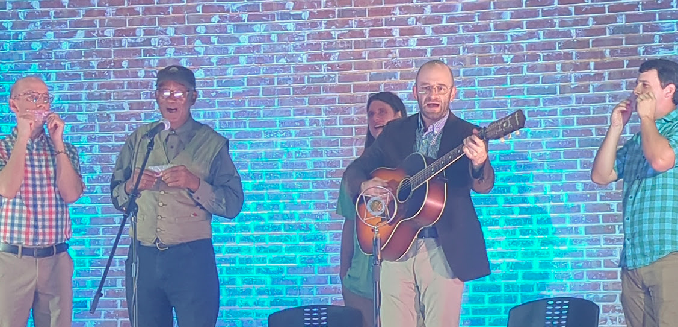
Comedian/storyteller Adam Booth, Charlie “The Tin Man” Lucas, two musicians, and the current president of Arts Revive
WHAT are you reading next? I should focus on Devil in the White City: not only is it a library loan, but it seems like it would be good for Halloween week, what with the murder and such. However, Kingsnorth is making me want to read Brave New World again. However, I’m also planning on re-reading 13 Alabama Ghosts and Jeffrey, a small collection of Alabama ghost stories — inspired by both the season and the fact that I recently enjoyed the 44th Annual Tale-Telling Festival in Selma, an event inspired — and originally led by — Kathryn Tucker Windham, a journalist, folklorist, and storyteller who settled in Selma.
In my lifetime, in my part of the world, the notion and meaning of ‘home’ has steadily crumbled under this external pressure until it is little more than a word. In a Machine anticulture, the home is a dormitory, probably owned by a landlord or a bank, in which two or more people of varying ages and degrees of biological relationship sleep when they’re not out being employed by a corporation, or educated by the state in preparation for being employed by a corporation. The home’s needs are met through pushing buttons, swiping screens or buying-in everything from food to furniture; for who has time for anything else, or has been taught the skills to do otherwise? Phones long ago replaced hearth fires. Handily, a phone, unlike a fire, can be kept under the pillow in case something urgent happens elsewhere while we sleep. We wouldn’t want to miss anything.
Paul Kingsnorth, Against the Machine.
Today’s Top Ten topic is….cozy reads. Well, alrighty then!
(1) The Awakening of Miss Prim. A young woman accepts a position in a strange little village that time and modernity have appeared to have forgotten. It’s a philosophical novel, but not in the Brothers Karamazov read-it-three-times and suddenly your life is irrevocably changed sense. It’s more of “…I never thought about that before.”
You say you’re looking for beauty, but this isn’t the way to achieve it, my dear friend. You won’t find it while you look to yourself, as if everything revolved around you. Don’t you see? It’s exactly the other way around, precisely the other way around. You mustn’t be careful, you must get hurt. What I am trying to explain, child, is that unless you allow the beauty you seek to hurt you, to break you and knock you down, you’ll never find it.”
(2) What You are Looking for Is in the Library. This one borders on the edge of magical realism because a librarian’s uncanny ability to find a book, and an object, that will change a person’s life. The plot is simple: in each story, a person in distress finds themselves in a community center’s library, in search of a book. When they tell the librarian what they want, however, they receive something different: what they need. I’m hoping more of this author’s work goes into English translation.
(3) The Invisible Heart:An Economic Romance. Boy meets girl, they fall in love. Problem is….he’s a classically liberal economist and she’s a modern liberal English teacher. Arguing over politics seems an improbable way to build a romance, though it’s worked for me in many of my friendships. Anyhoo, this is a sweet story full of discussion. Its author, Russ Roberts. hosts a weekly show called EconTalk which these days is more about human flourishing. Unfortunately, its audio quality suffered after he moved to Israel and had to do phone interviews only, but the dear man offers transcripts for free. Reading a conversation is nothing near the same as sitting and listening to two intelligent, urbane people hashing out an issue, but it’s not nothing. Speaking of…
(4)The Black Widowersseries. Six men meet at a dinner club every month, taking turns to host and bring a guest. The guest, invariably, brings a mystery. The six professionals then try to logic their way through the puzzle, applying their reason along with their knowledge of history, literature, geography, etc. The mystery is always solvable by the reader, with the possible exceptions of “The Acquisitive Chuckle” and “The Obvious Factor”. When I eat at home, these are go-to companions.
(5) Possibly my strangest entry, The Kunstlercast: Conversations with James Howard Kunstler on the Comic Tragedy of Suburban Sprawl. I find this “cozy”, I suppose, because there’s a huge amount of nostalgia for me. Listening to Kunstler lecture at my university back in ’08 or ’09 was a life-changing experience for me, making me understand why I found old American cities fascinating and modern development so ugly and depression. These are transcripts of conversations between Jim and his friend Duncan Crary, who at the time I knew from another podcast, on some issue related to urbanism and its relationship with human flourishing.
(6) Anything by Rachel Joyce. I stumbled into her last year and fell head over heels with her stories, all of which are about human connection.
(7) Most anything by PG Wodehouse. I say most anything because he wrote an awful lot, and I’ve only explored his Jeeves and Wooster stories for the most part.
(8) Old Star Trek novels I’ve re-read so many times that the covers are worn off and I know most of the dialogue and sometimes confuse scenes in books for scenes in the actual shows.
(9) Before the Coffee Gets Cold. This is Japanese magical realism about a coffee shop with a twist: one chair in this shop can transport you to a moment in time in the coffee shop. That doesn’t seem like much, especially since the past can’t be changed, but sometimes the past can change us. I’m amazed by the fact that the author is able to get so many stories from the same basic premise.
(10) Anything by Wendell Berry, whether that be his Port William novels or his essays. I’ve even read his poetry and memorized one, “The Peace of Wild Things”.
When despair for the world grows in me and I wake in the night at the least sound in fear of what my life and my children’s lives may be, I go and lie down where the wood drake rests in his beauty on the water, and the great heron feeds. I come into the peace of wild things who do not tax their lives with forethought of grief. I come into the presence of still water. And I feel above me the day-blind stars waiting with their light. For a time I rest in the grace of the world, and am free.
“Remove justice, and what are kingdoms but great robberies? For what are robberies themselves, but little kingdoms?” ~ St Augustine
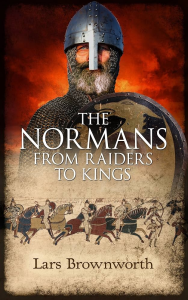
I can still remember being scandalized in seventh grade when I opened the next chapter in our western civ text to discover we would be studying THE CONQUEST OF ENGLAND. England, conquered? At that age, for whatever reason, I had a notion of England as an impregnable island fortress: from that time on I regarded the Normans with enmity. Recently, though, I found myself in possession of a generous gift card and a desire to find out just what those Normans got up to outside of England. As a regular reader of medieval European history, I’m always stumbling upon them getting up to mischief, and figured a survey would be helpful. Given Lars Brownworth’s adjacent research into the Byzantines, Rome, and the Crusades, From Raiders to Kings is not only a very readable survey, but one that brings in useful context without getting long-winded.
The story of the Normans begins, of course, with the story of the Vikings — aggressive Norse and Danish raiders who savaged Britain, France, and other parts of Europe while also vigorously exploring across the Atlantic and into what we now call Russia. Viking predations caused the coasts of France to depopulate themselves, as people moved away from areas of easy access to the raiders; when the Franks decided to bribe the Norsemen with land, sea-facing Normandie around Rouen seemed an obvious place. There the Northmen in Frankland — the Normans — slowly began slipping into respectability. After first following the French Normans and their eventual attack on Britain — where other Vikings had also been attacking, leading to poor Harold Godwinson having to fight attacks back to back in different areas of the country — Brownsworth moves to the arguably more interesting Sicilian Normans. The Norman arrival in Sicily was amusingly mercenary; they were at first hired to fight one side, then switched the other when geld proved shiner and more numerous there; eventually they began a conquest of Sicily. The Med was…..complicated back then, and most of the book focuses on the constant political wrangling that goes on between the Norman powers, the Eastern Empire, saracens of various sorts, the Papal States, and other European powers. Because of the focus on the Sicilian Normans, my animosity toward the conquerors of Anglo-Saxon Britain was quickly put aside in the very entertaining history of the Normans in the Med. One chapter is called “William the Bad”, followed by “William the Worse”: What’s more, even while the Normans frequently shifted allegiances over the years — especially where the Eastern Empire was concerned, since Constantinople could be both patron and arch-rival — they also fought against misplaced enemies like Anglo-Saxons in the Varangian guard. Englander displaced by the arrival of zis people with outrageous accents were delighted to be able to seek vengeance against the Normans, even if they weren’t quite the same Normans.
The Normans, in short, was an unexpected ball of fun. It added enormously to my appreciation of the medieval Mediterranean world, even if I don’t quite buy Brownsworth’s hypothesis that the sheer amount of energy the Normans added to Europe transformed its history and helped propel it into global dominance, at least for a few centuries. What is obvious is the Normans’ gift for adaptability: they always took what they had and grafted it on to the existing culture to create systems that not only worked, but flourished. This led to some institutional strength that persisted even if a strong man perished and was succeeded by someone with an inferior skillset. Alas, I think I’m almost done reading Brownsworth unless I can find a copy of his Macedonian book. Perhaps I’ll put a word in with his uncle the indie bookstore shop owner….
The alliance with the Lombards was short lived. Even with Norman arms stiffening their forces, they were crushed by Byzantine forces in the first real clash. The battle was enough to prove the worth of Norman swords to the Byzantines, however, and they immediately hired them to quash the troublesome insurgents. Abandoning the cause of Lombard freedom as easily as they had picked it up, the Normans cheerfully set to work enforcing the imperial will.
Under the brilliant Macedonian dynasty of Byzantium, the empire had turned the tide against the caliphate and was engaged in a great push to clear the eastern Mediterranean of Muslim pirates. The Macedonian line had ended with the death of Basil the Bulgar-Slayer in 1025, but although the emperors who followed him were weak, the army Basil had created was still formidable and won a string of victories in Syria and along the Anatolian and North African coast.
Charismatic, headstrong, and larger than life in nearly every respect, Maniaces had a reputation as imposing as his physique. Even the usually unflappable members of the imperial court seemed stunned in his presence. After reporting that the general was ten feet tall and had a roar that could frighten whole armies, the imperial historian Michael Psellus concluded by saying that “those who saw him for the first time discovered that every description was an understatement”.
Maniaces gave every sign of panic, assuring the Saracens that at first light he would appear in their camp with every bit of treasure the city possessed. As a gesture of his good intentions, he sent along a large amount of food and drink for the victors to enjoy. The wine in particular had the intended effect as the Saracens were parched and in the mood to celebrate. Before long they were hopelessly drunk and Maniaces’ soldiers slipped into their camp and butchered every last man.
The Crusades are usually thought of as single armies, or single waves of armies, launching themselves in a certain year. However, they were more like continuous movements; not armies so much as armed men moving in ebbs and flows to the East. There was no single route they chose to travel, and no single recognized leader, just a vague agreement of the leading princes to gather at Constantinople.
Andronicus was a curious figure, possessing all of the brilliance of his family with none of its restrain. In 1182 he was already in his sixties but looked two decades younger, and his exploits, both on the battlefield and in the bedroom, were legendary. By the time he marched on Constantinople he had already seduced three cousins, been banished twice, and had acquired a reputation as an innovative — if slightly eccentric — general.
It would have been difficult to pick a more unsuitable group of people to run a government. The three advisers, a eunuch named Peter, a notary named Matthew, and the English archbishop Richard Palmer, spent most of their time trying to assassinate each other.”
WHAT have you finished reading recently? In Distant Lands, Lars Brownworth
WHAT are you reading now? I just started The Normans: From Raiders to Kings by Lars Brownsworth.
WHAT are you reading next? Perhaps The Devil in the White City, Erik Larson. A coworker has recommended to me on multiple occasions and frequently expresses her disbelief that I’ve not yet read it.









 Reading Freely