Today’s TTT is….books that inspire candle scents? I got nothing, so here’s some historical gore instead.
“Harris dashed forward only to have another mine shred his abdomen and legs; after flicking grenades into a line of pillboxes, he sprinkled sulfa powder onto his protruding intestines, cinched his web melt to keep the innards in, and wandered down to the beach to find a medic.” THE DAY OF BATTLE, Rick Atkinson
Boy, makes grumbling because of red-lights and poor-tasting coffee pale in comparison.
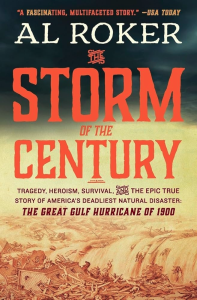
In 1900, a powerful hurricane swept Galveston Bay and destroyed a boomtown that in time may have become the New York of the Gulf. In ways, Al Roker’s Storm of the Century is rather similar toIsaac’s Storm, in that both chronicle the growth of the storm, American meteorologists’ failure to predict its course, and the immediate aftermath of virtually the entire town being flattened. The book even opens with an extensive section on Isaac Cline, the hardworking and talented meteorologist who worked Galveston, whose industriousness failed to overwhelm his acceptance of the prevailing dogma that hurricanes always broke east after hitting Cuba. What makes Storm different is its extensive coverage of the aftermath, as Galveston’s civic leaders struggled to deal with the thousands of bodies and complete shambles of their city. Ten thousand souls and nearly three thousand buildings gone in a single night: the 1900 hurricane remains America’s deadliest natural disaster over a century later. The Storm of the Century is an immersive history of Galveston’s — and America’s — worst hurricane, one that’s already gotten me looking for more from the author.
The book opens with Isaac Cline, a meteorologist who had distinguished himself in the field and yet was powerless to prevent a catastrophe. Mr. Cline was an impressively industrious man, someone who was not content in distinguishing himself in meteorology — he earned laud for predicting floods that DC’s national boys didn’t even put on the radar — but apparently strove to be a Renaissance man. In addition to pursuing a medical degree and later a PhD, Cline also invested himself in Galveston after being stationed there and became a contributor to the local newspaper. He went far and beyond his required duties as a weatherman, taking readings throughout the day instead of his four mandated intervals. Despite this, a combination of the scientific establishment’s dismissal of Jesuit hurricane studies and entrenched dogma on how hurricanes behaved led him to not realizing that a potent threat was headed for Galveston. The deceptively placid sea and skies, combined with a stable barometer, gave him no cause for challenging the assumption that Cuba’s storm would break east and hit Florida. No one in Galveston had any reason to worry until massive swells began hitting the city and the Gulf began claiming the city as its own. When the barometer plunged, Cline scrambled to warn citizens — but it was too late for most. The Gulf flooded Galveston, and then came the savage winds and rain. The wind was arguably worst, knocking over wooden buildings with ease and then turning their parts into battering rams to destroy more of the city. A long night passed in which most Galvestonians lost their homes, and thousands their lives — drowning in the ferocious black night, the air filled with danger as debris flew past with deadly speed.
The aftermath was literally horrific. Most of the city was gone, and across the bay the plains were littered with debris and bodies for miles. The city government condensed itself into a three-member commission and declared martial law, focusing itself on the biggest challenge of getting rid of the thousands of bodies: they chose funeral pyres, which burned for weeks. The American people were quick to respond to Galveston’s need for help. One of the few amusing stories in this history is that of Winifred Black, a female reporter who used a male disguise and local help to sneak herself into the city to earn a scoop for Hearst newspapers: part of her reporting included a call for assistance, and it came so readily — some funneled through the Hearst corporation — that she was told by her bosses that she was now the coordinator for Hearst relief work. The reporter soon found herself managing a school in Houston that had been converted into an emergency hospital, a shining example of the maxim that those who work hard will be rewarded with more work. The history continues for several years after the disaster, ending with the erection of Galveston’s seawall, an engineering feat that has been steadily improved upon over the years.
This was quite the read: written by a meteorologist, it had a good mix of science, history, and human interest. Having read Isaac’s Storm, I expected not to finish this, but the other stories Roker pulled in, plus the expanded section on the storm’s aftermath and recovery, made it more than worth reading. Roker has written a few other history meets weather esque books, and I will probably have a look at them.
Quotes/Highlights:
One [weather] observer pawned all his weather instruments to raise cash for gambling. At least that one kept up his reports: he went down to the pawnshop every day to take readings.
Other houses were down because the wreckage of buildings had itself become a cause of further destruction. The waves tossed ruined timbers and roof structures again and again against standing walls, driving down walls and roofs together. Then the newly fallen wreckage added greater and greater power to an assault on the standing houses.
But soon the relief train slowed to a halt. The tracks were gone. This was still well inland, more than six miles from the point where the bridge began. The team couldn’t yet see anything of Galveston, of course. What they could view, here on the coastal prairie, was shocking enough. The plain was strewn with dead bodies. Along with those corpses, huge pieces of lumber were littered about the flat ground as far as the eye could see. Roofs. Packing trunks. Pianos. From the stopped train, the relief team saw a whole steamship. It was wrecked—all the way up here on land. They stared, amazed. The ship seemed to have been tossed out of the bay.
Louise lived to experience nearly all of the amazing advances of the American Century: interstate automobile highways, jet travel, television, the moonshot. Yet she never forgot her terrifying experience, as a seven-year-old, of what nature can do to all that human aspiration.
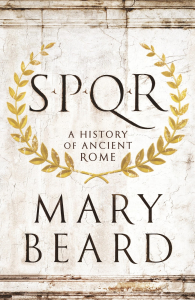
SPQR is an unusual history of Rome, one that largely ignores the imperial period to focus instead on ancient Rome — first, the early city-state, and then the expansive republic it grew into. It also ignores a general narrative, choosing instead to jump chronological periods and then comment on figures and topics relevant to that period. This leads to strange relationships between pagecount and subject: the Punic Wars get astonishingly short shrift while digressions on the meaning of the Romulus and Remus wolf-suckling myth goes on for page after page. As a fan of Tully, I liked that Beard often used Cicero’s confrontation with Catalina as a callback moment. For her, Cicero’s legal takedown of the would-be tyrant is an exercise in ambiguity: was Catalina a revolutionary, or a corrupt and broke aristocrat using the pain of the poor to create a base of power for himself? Beard sees the conventional narrative of Cicero defeating Catalina’s lawlessness as a story Rome wanted to believe about itself. Sometimes the questioning of traditional history can be interesting, but it often struck me as revisionism for revisionism’s sake. During the 1970s, for instance, it became popular to dismiss the claims of child sacrifice on the part of the Carthaginians as a lie created by the Romans — only it proved to be true. Yes, it’s true that stories about Catalina or his enabler Clodius Pulcher largely originate from their foes, but that doesn’t necessarily mean they weren’t morally rotten. I was willing to give Beard leeway until her comments regarding Marcus Aurelius, in which she refers to The Meditations as “cliched” and chastises Aurelius for severity against the Germans. I’m sorry that this man dealing with aggression from both Germany and Parthia at the same time as plague outbreaks, a treacherous co-emperor, and a cheating wife couldn’t , in his few moments of peace, write down reminders to himself that were completely sui generis! While there are many good points in the text, I definitely wouldn’t recommend it as a primer or survey: I think the novice reader would be lost given her many jumps, and the lack of a narrative to tie them together. I’ll probably read Beard again, if only to see if this is representative.
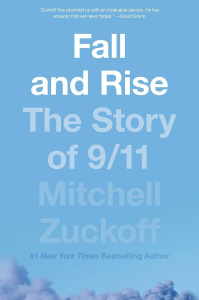
24 years ago today, the ‘severe clear’ skies above New York were overwhelmed by ash and smoke, by ignorance and hate. Fall and Rise is a history of that day, one that was good enough to be favorably compared to The Only Plane in the Sky. While the books are alike in being comprehensive histories of the day, Fall and Rise is more of a conventional narrative while Only Plane was oral-history focused. The goal of the book, Zuckoff writes at the beginning, was to make the day come alive for those who had only experienced it as “history”, as ink on a page. To that end, I think it succeeds: though as someone who did experience that day, for whom it was profoundly disturbing and formative, it’s hard for me to say it definitely does. It brought the day back to life for me, though, and its ending — which shows how survivors used the day as motivation to do more good in the world while they could — allows it to be slightly inspirational as well.
Fall and Rise‘s history section unfolds in two parts. The first introduces us to various passengersand air crew: we learn about them as people — their hobbies, their off work responsibilities, their passions, their stresses — and follow them as they rouse themselves and begin heading to work that fateful Tuesday. There’s also a mercifully short section on the cretins who perpetuated it. We follow the passengers and crew all the way until their respective ends, at which point the second section begins. The ground section has a much larger selection of ‘characters’, drawn from WTC workers, first responders, etc. Zuckoff manages the frenzied timelines well, by occasionally doing a zoom-out to remind readers that while this is happening here, this and that are happening there. This helps readers stay abreast of so much action scattered across theaters. It’s also useful to the narrative itself, because things did not happen in a vacuum: while the passengers and crew of American 11 died before anyone knew what was going on, as the hour dragged on information from various sources finally began filtering up to authorities who could put the pieces together. This was what allowed the passengers of United 93 to learn what had happened elsewhere in the US, and resolve to take action, overwhelming their captors and ensuring that at least part of the devil’s work went unaccomplished. The final section is much smaller, but allows the reader to find hope in the darkness — as survivors, or family and friends of victims, share how they have used the tragedy as inspiration to spread goodness in the world.
This was quite a good read: while I still champion Only Plane in the Sky, I can see why someone would prefer this one given the meaningful last section. Its stories of people helping each other out of the towers, or out of the darkness of the burning Pentagon wedge, are inspiring. Remembering the shared horror of 9/11, followed by the unity and resolve of 9/12 is bittersweet this September 11, given the current state of partisan rancor.
WHAT have you finished reading recently? A couple of memoirs about people who escaped from the North Tower on 9/11.
WHAT are you reading now? SPQR by Mary Beard (~70%through) and Fall and Rise: The Story of 9/11, Mitchell Zuckoff. Fall and Rise is taking priority because I want to do a Thursday review of it, and SPQR isn’t taking off for me the way I figured it would be. I am enjoying it well enough, but it’s nothing like Tom Holland’s Rubicon. (Speaking of, he’s got several other Roman books…considering I listen to his podcast every week, time to get cracking on reading those!)
WHAT are you reading next? Most likely The Day of Battle: The War in Sicily and Italy, 1943- 1944 by Rick Atkinson. September is proving to be a month for chunksters, beginning with The Great Deluge and continuing.
Today’s prompt from Long and Short Reviews is, “What is your superpower?” I don’t know if it’s a superpower, but I’m pretty good at spontaneous history lectures. I work as a local history librarian, so that comes in handy.
Today’s TTT is “Villains”. We did this one ….over a decade ago, so I’m going to compose this list without looking at that prior list, and try to focus on recent villains I’ve read. Turns out it’s…a lot of science fiction. But first, a Tuesday Tease!
With time, news becomes history. And history, it’s been said, is what happened to other people.For anyone who lived through September 11, time might dull the anger and grief that followed the death and destruction caused when terrorists turned four commercial passenger jets into guided missiles. But the memories won’t die. The pain of the deadliest terrorist attacks in American history cut too deep, leaving knots of psychic scars that make each day an experience of before and after, of adapting to a world changed physically by every security checkpoint and psychologically by every mention of the “homeland,” a word seldom used in the United States prior to the events now known as 9/11. (FALL AND RISE: THE STORY OF 9/11, Mitchell Zuckoff
(1) The daemon, DAEMON. DAEMON is a novel about a machine intelligence that begins recruiting human agents to help it take over/restructure society. It’s really creepy.
(2) The antagonist in HUSK. I read this recently and still don’t want to spoil it for people, but it’s slightly similar to DAEMON in being a distributed intelligence. Imagine a villain that can watch you from every camera and take over robots to attack you.
(3) Alt-Jason, Dark Matter. Blake Crouch. A man fights for his family against….himself from another timeline, a man who resents the choices he made.
(4) Dallas, the Joe Pickett series. Dallas Cates is my favorite-to-hate villain of the Pickett series, in part because he’s such a believable psycho – a charismatic and abusive rodeo star. His multiple confrontations with Joe are far more memorable than the made-for-TV villains like Axel Soledad.
(5) The Party, 1984– or more specifically, O’Brien.
(6) The Circle/The Every. Dave Eggers. This is the same company, evolving from a social media giant in The Circle to one that monopolizes the consumer market as well. Imagine a fusion of Apple, Facebook, Google, Youtube, tiktok, wechat, Amazon, etc – a company so huge and pervasive it dominates culture.
(7) The Bureau of Technological Control, Influx. Daneil Suarez. Not going to spoil anything, but the BTC are even more invasive than O’Brien.
(8) Baron Harkonnen, Dune. Probably the most physically repulsive villain. He’s like a human Jabba the Hutt. (Actually, there was a human Jabba the Hutt, and every iteration of Harkonnen has been uglier.)
….honestly, I don’t read many books that have villains. For the last two, I’ll say…
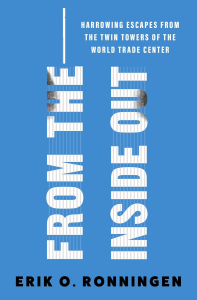
Erik Ronningen came close to death several times on 9/11 as he made his way from the heights above Manhattan to the relative safety of the sidewalks below. The day after, while comparing notes with his wife, Ronningen was struck with the idea that living through an event such as this merited writing about. He began interviewing fellow survivors with an idea of writing a book for the first anniversary, but found that both they and he grew weary of contemplating such an awful day in their lives. After many years, he finally finished From the Inside Out, a narrative that incorporates his and other people who were inside the North Tower during 9/11. It makes sense that everyone he talked to escaped from the North Tower: that was where he worked, after all, and they were the people he labored with to get down and out before anything worse happened. The book is divided into three parts: Before, Impact, and Collapse. I’ve read the definitive oral history of 9/11, Only Plane in the Sky, and didn’t figure for any surprises here — and yet still there were a few. It took far longer for people to realize the enormity of the plane’s impact than it should have, depending on the floor: one man who had survived the 1993 bombings assumed this was more of the same, and spent precious time inventorying his file cabinets to remove documents and computer media that he didn’t want to be separated from during the downtime. Another surprise was how insulated the people in the North Tower were from events outside: those who escaped were moving down stairwells full of other escapees, and when they emerged to find the plaza littered with paper, debris, and — horrifyingly — bodies, they were dumbfounded. Still worse, when they looked up they saw that the South Tower was also on fire, even worse off than its sister tower — the pilots of the United flight hit it at speeds surpassing AA-11, speeds that would have cased breakup in flight — and soon realize they weren’t out of the danger zone yet. This is an immersive narrative but is far surpassed by Only Plane.
Then the blizzard began—a blizzard of falling paper, debris, and rubbish forced out of the upper tower from the explosion, resembling a midwinter, Great Plains storm. So intense was the raining wreckage that the beautiful view of New York Harbor could no longer be seen. A FedEx package came spiraling down in the mix made Erik immediately think of the Tom Hanks’ movie Cast Away. The mind is a curious mechanism.
.
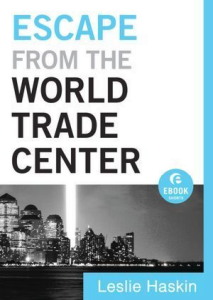
Leslie Haskin’s memoir is rather different: for one, it’s a personal memoir, and it’s very introspective. If this were fiction, it would be counted as a novella given its length (just over a hundred pages): it ostensibly focuses only on her own experience, though it does include a section with vivid description that could have only been sourced through speaking to others. (She describes the collapse of the South Tower as if she were in the area, whereas she was sitting on the commuter boat traumatized and learned about it through people screaming about it.) Haskin worked in an insurance office on the North Tower, and while dozens of floors below the impact zone, she describes a harrowing scene of ceilings collapsing, visible fire, etc. On first reading this didn’t make much sense to me because Ronningen’s account has him much closer to impact, but with none of the “The building is about to fall!!” drama that Haskin records in her office. After thinking about it, though, I realized Haskin’s floor could have been hit by the fireball that swept through the elevator shafts — that seems especially likely given that her floor was very close to the first skylobby where people changed elevators, and that she encountered severe burn victims on her own way down. Her prose is vivid to the point of florid, but given that she was put into a state of severe mental distress after the event. I’m not inclined to be critical.
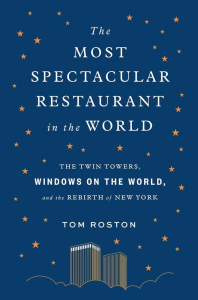
I’ve been collecting WTC photos since high school, haunted by watching the Towers burn and fall on live tv. Some of the most interesting I’ve seen have been inside Windows of the World, a restaurant that occupied two of the top stories on the North Tower. It was due to celebrate its 25th anniversary a month before the obscene assault that was 9/11, having made itself New York’s premiere dining experience. The Most Spectacular Restaurant in the World is a history of not only the restaurant, but of New York City’s postwar rise, its struggle in the 1970s, and the role of the Trade Towers in revitalizing it — and of Windows in broadcasting it. As I’ve never read a formal history of how the Trade Towers came to be, that was fascinating in its own right — but the focus on Windows brought other subjects into consideration. I was astonished to learn, for instance, that most of the Towers’ food services were centrally owned and organized, and that food served by the Windows staff was prepped over a hundred stories below where food from other restaurants was also being made ready. It was an unexpected look into how the Towers actually functioned. There were also some astonishing stories, like the arrest of a robber at Windows while said robber’s wedding reception was kicking off: in the audience were interesting figures like Paul Castellano, Gambino crime family kingpin, and members of the Bonanno family.
The major figure of The Most Spectacular Restaurant is Joe Baum, a New York restaurateur who rose to fame through a series of themed restaurants like The Forum of the Caesars and the Four Seasons. He focused on making restaurant dining an experience, not just a time of eating well-prepared food in comfortable conditions. Baum was known for his high attention to detail, whether in perpetuating the aesthetics of the restaurant — the Roman restaurant served wine in iced buckets modeled after centurion helmets — or in customer service. “Every thing we do is marketing,” he said — everything a guest would see or touch or taste was a way to impress and sell the restaurant. Given that his establishments attracted major clientele like the Kennedys — Marilyn Monroe gave her infamous serenade to JFK in Baum’s restaurant — he was chosen to create a restaurant to headline the Trade Towers. The importance of the restaurants was deemed such that Baum’s need for wider windows forced a change that would ripple throughout both towers, not just the North tower where Windows would be. Amusingly, Baum also headed the design of a cafeteria that would serve construction workers during the Towers’ build-out: he incorporated wood and concrete into its aesthetics and called it “The Loading Zone”. Baum would be responsible for bringing Windows to life, and then — after a long removal from the restaurant — overseeing its redesign and reopening after the bombing of the towers. Although cost overruns were the norm with Baum (“the only man who can blow an unlimited budget”) his knack for anticipating what would bring in customers was such that after he left Windows, he was paid $250 million to advise on revamping the restaurant at Rockefeller Center. There are other figures, though, like Kevin Zraly — an intense oenophile who guided the creation of Windows’ approach to wine and taught a wine-appreciation class to members of the Club, an elite social group headquartered at Windows.
Most of the 1980s and early 1990s are passed over: the restaurant appears to have maintained overall fiscal success despite losing its luster over the years, finding itself outstripped by newer restaurants. After Baum leaves the scene, the book has a brief transition period before jumping into the 1993 bombing of the Trade Towers. While the parking lot bomb didn’t cause any direct damage to the restaurant itself, aside from smoke damage, the food-prep and mechanical utilities it relied on were so destroyed that it was forced to close. Baum returned to oversee a redesign of the interior, and nearly three years later Windows was officially reopened. (There’s an amusing article about the reopening called “Windows 96”, a play on Microsoft Windows 95’s staggering launch the prior year.) The redesign also affected the menu: while the original Windows was very French, the new Windows incorporated more food trends of the 1990s, like sushi and kabob, despite Baum’s resistance to “New American Cuisine”. He oversaw the launch, but would surrender to prostate cancer within two years — probably a great mercy given that it meant he wouldn’t see the destruction of what he’d poured so much of himself into across the course of decades.
The book ends, as the reader might expect, with the horror of 9/11: Windows was directly above the impact zone and its staff and morning guests were quickly overwhelmed by smoke. The morning manager called for help several times, but with both stairwells blocked, there was precious little the dispatcher could do. Close to eighty Windows employees lost their lives that day, and survivors — those not on shift, or who were seeing to business in other areas of the complex or the city — clung together, helping one another find work. Some even created their own restaurant together, one that reflected Windows’ increasingly cosmopolitan menu. This spoke volumes to me about the camaraderie that existed at the restaurant in its “city in the sky”
This was quite an interesting read; the author wrote it as a tribute to a restaurant that was a large part of his life, the site of many “occasion” dinners — birthdays, anniversaries, etc. It’s based on hundred of interviews and the research and records already created by Zraly and Baum. The sommelier Zraly had begun work on a book like this before, but found it too emotionally difficult to begin writing: he was able to connect Roston to many of the people whose memories are recorded here. The book also draws extensively on newspaper articles and the like. The under-the-hood restaurant workings might be tedious for some readers, but I enjoyed learning about restaurant operations — and the inner workings of the Towers — along with the story of the restaurant itself. Occasionally the author tries to connect the story to that of broader New York, but that angle makes marginal contact with the ball at best. The only exception for me was getting the “Windows” version of what happened the night New York’s five boroughs all lost power in 1977. Suddenly being at the top of a 110 story skyscraper in a sea of darkness — and later, violent looting — would be nightmarish. This was a history that proved to have multiple points of fascination, and was clearly written with affection.
Highlights:
“‘Windows is the most important thing in this complex. I don’t care if the place is burning down. If Windows has a problem, you fix it first,’” Bob DiChiara, then the top electrical operations supervisor for the building, recalls Tozzoli saying. “That was Guy’s mantra. Windows had to be successful. If it failed, he failed.”
Baum was also overseeing the essential task of creating a kitchen 109 floors below, on the B2 level of the World Trade Center, to streamline food production through an efficient system that took advantage of economies of scale. There were to be twenty or more different food services operations. On the 107th floor were the five restaurants and bars, plus catering, that fell under the Windows on the World rubric.
Windows on the World would do a greater share of its preparation work in its own kitchen, but the rule for the restaurants and food stations below the 107th floor was to have Central Services, which covered twenty-seven thousand square feet, provide almost all the initial preparation of raw materials. For instance, cabbage would be sliced and slaw dressing mixed, and then the food services employees in the separate sites could mix the two together. “The only difference between us and a high-school cafeteria is care,” Baum said to a journalist of his future food Shangri-La.
As if he didn’t have enough on his plate. He was chasing down porcelain Rosenthal ashtrays, importing Sambonet coffee thermoses from Italy, and getting the proper materials for a brass railing that would hold up a movable ladder used in the City Lights Bar. “Everything we do is marketing,” Baum would say, meaning every item that a guest would see or touch or taste was another way to sell the restaurant.
Criminality was part of the culture. You could barely walk a block without seeing a car with a pathetic NO RADIO or THE LAST GUY GOT EVERYTHING sign. The clamor of car alarms at night was the city’s sick spin on chirping crickets.
We love Joe, but he’s the only guy who can outspend an unlimited budget.
Joe Baum is buried in a cemetery in Westchester. His children had his gravestone fabricated from the same green granite that he’d chosen for his kitchen countertops. On it, they inscribed, No more changes . . . Yet.
Related: Windows on the World article that mentions the restaurant being spotlit by New York magazine, as well as the “Windows 96” article.
In September 2005, I remember watching the approach of Hurricane Katrina with a wary eye; just a year before, my own area had been savaged by Hurricane Ivan. I had no desire to live through that again, especially now that I was working in a glass factory. As luck would have it, Katrina wandered steadily west, and we were largely spared — but the TV images of the aftermath have stuck with me for twenty years, especially people stranded on the interstates and parking lots full of flooded busses that could have been used in evacuations. Last week was the 20th anniversary of Katrina’s landfall, and I figured it was high time I read this history — which I’ve been eying for at least fifteen years. It was published very quickly after the storm itself, and does not pretend to be an impartial history in the least. It’s instead written with teeth bared, with specific targets like Ray Nagin in mind. Its transparent passion serves the narrative more than diminishing it, I think, recalling Americans’ horror and shame at seeing residents of a major city neglected — and their anger, too, as we realized many of the Guardsmen who could have been deployed were instead being uselessly shot at in Iraq.
As with San Francisco in 1906, the worst destruction came not from the disaster itself but from its aftermath. In San Francisco, fires consumed the city; in New Orleans, the levees cracked under stress, and the city filled like a muddy and increasingly toxic punchbowl. Faulty engineering played its part — some levees were old, neglected, or shoddily built — but government incompetence turned vulnerabilities into catastrophe. Confusion reigned over who was in charge. FEMA, which had handled several earlier storms that year, saw itself mainly as a coordinator: local officials requested aid, and FEMA matched them with public or private suppliers. That model collapsed when the city was cut off from the outside world, its bridges impassable, communications dead, and its mayor hiding in a hotel. (It didn’t help that for much of its early life, FEMA’s leadership was often staffed with political favorites of the reigning administration, disaster-response experience not required.) Florida’s officials, drilled by annual hurricanes, responded effectively; New Orleans, by contrast, hadn’t been hit hard in decades, and it showed. Evacuation was delayed until it was too late for many — even assuming the poor had the means to leave. Buses that could have saved lives were left idle and flooded, while the National Guard concentrated their forces in a zone directly in Katrina’s path. Governor Blanco handled things better at the state level, putting Fish & Wildlife into service and making sure they had boats stationed at diverse areas to better serve the people. As in subsequent disasters, the private sector also stepped up: Walmart poured resources into the area, and the “Cajun Navy” was born: that was a particular surprise for me, as I associated the name with the private rescue navy that erupted after Hurricane Harvey drowned Texas a few years back.
The problems only grew worse as the days ticked by: the people of New Orleans felt abandoned, and amid the heat and stress bad behavior grew all around. The first responders here were residents of New Orleans: they had lost their own homes, they were concerned about their own parents and children, and some like the police cracked under pressure, turning down their empathy toward those in need. Others deserted their posts, and some participated in criminal behavior themselves. It didn’t help that in the early hours opportunists began looting in earnest, behavior that grew to the point that the mayor redirected police attention from search and rescue to squelching the open theft that was taking place all over the city. This looting was not food and water , as criminal apologists would have it: one hardware store owner saw people trying to steal a washing machine before he and other business owners began defending their livelihoods with firearms A lot of the criminality wasn’t just opportunism, it was outright barbarism: stores were trashed (and desks defecated upon) for no reason other than that social norms had been disrupted. The criminal element was also defending its crimes, shooting at Coast Guard helos and the like who approached trying to bring aid — and they were industrious in their perverse way, breaking into one business’s vehicle yard, stealing its trucks, and using them to pick up stolen goods. There were still hope spots, though, like citizens taking it upon themselves to rescue those in danger, and the fact that most of the zoo’s 1500 animals survived: it helped that the Zoo had firm disaster-response plans in place.
This was a harrowing book to read, but informative. While I’d long heard of Katrina as a case study in mismanagement at every level, this account illustrates it vividly — from Mayor Nagin hiding in the Hyatt, to FEMA’s passivity and its director’s obsession with optics over action. The flood’s aftermath emerges here as a mix of nobility and savagery, though barbarism seems to have had the upper hand. That tension is one of the reasons I find reading about disasters so compelling — they lay bare the best and worst of human behavior at once. One hopes that both New Orleans and FEMA learned lessons from this and are more prepared for the next Big One, but given the abandonment of the mountain country during Hurricane Helene last year, I have my doubts about the feds at least.
Today’s prompt from Long and Short Book Reviews is, “Books I Keep Meaning to Read But Haven’t”. But first, WWW Wednesday.
WHAT have you finished reading recently? The Great Deluge, a quasi-history of Hurricane Katrina and the devastation of New Orleans. I say quasi- because it was written within a year of the storm striking, and the author obviously has targets to attack. I also finished listening to Anthony Esolen’s four-hour lecture series on The Inferno, which originated within Catholic Courses but which is now available on Audible. While it’s not a book, it’s literature related so I figured it bore mentioning. While I’ve read Esolen’s translations of Inferno, Purgatorio, and Paradiso before, this lecture added the pleasure of Esolen quoting from the book in medieval Italian when he wanted us to hear the music in Dante’s writing.
WHAT are you reading now? I’m….sort of listening to Napoleon’s Hemorrhoids, a collection of “Golly gee, if it wasn’t for this one little thing, then this one BIG thing would be like, totally different!!!!” anecodotes that encompass science, history, politics, etc. It’s interesting as far as trivia goes, but not impressive. That’s just in-car listening, though. I also cracked open SQPR by Mary Beard.
WHAT are you reading next? Hopefully The Day of Battle, on WW2 in Sicily and Italy after OPERATION HUSKY.
Long and Short Prompt: Books We Keep Meaning to Read
(1) Democracy in America, Alexis de Tocqueville. This is a book that frequently comes up in other stuff I read. I would also like to make good Iran’s president Khatami’s faith that Americans are familiar with it:
(2) The Shahnameh, which I’ve wanted to experience since encountering quotes from it in the writings of Anita Amirrezvani’s Persian historical fiction.
(3) Persian Gulf Command: A History of the Second World War in Iran and Iraq, Ashley Jackson. The beginning of DC’s long entanglement.
(4) SQPR, Mary Beard. A history of Rome up until the early Republic. Haven’t tried Beard out as an author and I’ve heard good things. I did pick this one up yesterday to start looking into.
(5) The Story of Philosophy, Will Durant. Durant’s magisterial Story of Civilization remains one of my favorite reads of the last twenty years, so I want to see what he has to say about the pursuit of wisdom.
(6) The Life We’re Looking For: Reclaiming Relationship in a Technological World, Andy Crouch.
(7) Tarkin, James Luceno. This is a Star Wars novel about Grand Moff Tarkin, once brilliantly played by Peter Cushing in Star Wars.
(8) The Horse, the Wheel, and Language: How Bronze-Age Riders from the Eurasian Steppes Shaped the Modern World, David W. Anthony. I’ve had this on my amazon wishlist for twenty years and it’s never once dipped under $20.
(9) Neither Here Nor There: Travels in Europe, Bill Bryson. The rare BB title I’ve not yet read.
(10) The Sopranos Sessions, Matt Seitz. A rare Sopranos book I’ve not red.



 Reading Freely