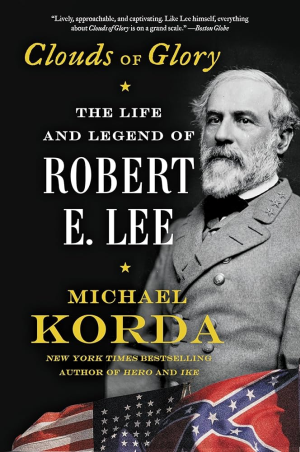
General Lee has long fascinated me as a man who did not believe in secession, but was compelled by his sense of honor and Fate to become an icon of the war which followed. He is, of course, an idol in the white South, a legend on par with George Washington. Although Lee, like Washington, sensed that he was being deified in his own lifetime — during the war, in fact — and purposely began trying to live up to being a secular saint — Clouds of Glory is a substantial biography that shows us the man he was before he belonged to the ages. While I expected to be in good hands with Michael Korda, I did not realize how quickly seven hundred pages could go by: my previous Korda works have been perfectly enjoyable, but much smaller. Clouds of Glory is not only eminently readable, but has a perfect mix of praise and criticism.
Although Lee hailed from a family with the bluest of blood in America, and his father was a hero of the Revolutionary War, he entered his adult life in very humble circumstances. His father’s signal accomplishments on the field of battle did not translate at all to business, and bad investments were made worse by profligate spending. When Robert was two years old, in fact, his father was put in debtors’ prison for bankruptcy. While we don’t truly know how much Robert knew about his father’s tendency to outspend his income, it’s worth noting that Lee was scrupulous about controlling his own spending and putting away money for tomorrow. He would seek his life’s work in the US Army, earning such high marks at West Point that he was shifted into the engineering corps — then an elite service, and one he’d prepared himself for by poring over math textbooks long before admission to the point. Lee did well in the Army, or at least as well as one could do in peacetime: one of his signal achievements was the saving of St. Louis’ river port, and during the Mexican war he would perform ably. His status as an engineer did not mean he worked in some office scribbling away at paperwork: instead, he risked life and limb scouting for the Army during Taylor and then Polk’s war. Korda notes that aggression and movement were already part of his military philosophy, perhaps the fruit of him avidly studying the life of Napoleon. (L’audace, l’audace, toujours l’audace!) It is in this early part of the book that readers are treated to an altogether different Lee than we expect — a handsome, confident engineer with a talent for painting and drawing, and a love of teasing and flirting with the ladies that he and his wife corresponded with.
Although Lee grew up accustomed to slavery as part of life in Virginia, his father’s financial difficulties meant that slaves were not a large part of Lee’s life, aside from a couple of house servants who are mentioned.Korda writes that Lee did not like slavery, and hoped like Washington and Jefferson before him that it would disappear — though he had no idea how that might be effected without creating other problems. Once his father-in-law died and Lee suddenly found himself being responsible for hundreds of slaves and several estates in disrepair, his attitude toward slavery and slaves grew even dimmer. Lee didn’t have to worry about the pains of estate management for very long, as he soon had bigger problems. Sectional dispute in the States had been brewing for years, and finally came to a head when the abolitionist Republican party came into power thanks to the inability of the Democratic party to find a candidate who could represent both its northern and southern members. South Carolina finally did what it had been threatening to do for forty years, and seceded, followed by a few other Deep South states. While Lee did not believe in secession, he could not countenance his government making war against his country — of Lincoln calling for troops to invade the South by way of Virginia. Resigning his commission when Virginia seceded in response to Lincoln’s call for troops, he declared he would not raise his sword again except in defense of Virginia. Considering that Virginia was to be the primary battleground of the War — the place whose homes were burned, whose crops were wasted, whose cattle were destroyed, etc — he would soon be quite busy.
The bulk of this work (60%) follows Lee during the war, as he first served Jefferson Davis as an advisor and pseudo-secretary of war, then later found himself commanding the whole of the Army of Northern Virginia and involved in most of the war’s most recognized battles. The problem facing Lee and Davis was of defending a State that offered five broad avenues for invasion, and Lee’s talents and experience as an engineer came in handy throughout the conflict– though arguably, and tragically, after Gettysburg they served only to delay the inevitable and prolong the bloodshed and suffering. As Lee settled into command, he was blessed with some very capable men, several of whom he shared close bonds with: Stonewall Jackson, for instance, seemed to know exactly what he wanted and would engage in his own bouts of daring to accomplish the mission. Unfortunately, the easy understanding between the two men appears to have spoiled Lee some: when he engaged in his first large-scale battle after Jackson’s death, the general found himself struggling to communicate his strategy effectively to his corps commanders. It didn’t help that at least two of them (Hill and Longstreet) were reluctant to fight around Gettysburg, especially seeing as the cavalry under J.E.B. Stuart were off joy-riding instead of giving Lee some idea of where the Yankees were. That Gettysburg went as well as it did for the Confederacy (prior to the attack on the Angle) is a testament to the fighting men themselves, as the Confederate army stumbled into the Union army piecemeal.Korda believes that the defeat at Gettysburg, and particular Lee’s calm demeanor afterwards, accepting responsibility for the defeat and comforting the soldiers streaming back from the bloody ridge, played a large part in turning Lee into an icon of grace and leadership under fire. Even in defeat, he somehow inspired loyalty and affection. Unfortunately for him, even when Confederate hopes were riding high in 1862 and early 1863, the Confederate army simply didn’t have enough men to capitalize on its victories against the Union army. It could break lines and send them running, but the Union could always retreat, regroup, refill its ranks with new conscripts, and come again — whereas the Confederates were often so hard-up for supplies they depended on victories just to refill ammunition from Union stores.
I’m very familiar, of course, with the war in the Eastern theater, so I read this primarily for deeper insight into Lee’s early life. Even so, it is impossible to not admire him and his behavior as the war progressed — a man who refused invitations to dine and sleep in civilians’ homes more often than not, who preferred to remain with his soldiers even when they were bivouacking very near Lee’s family. There is first and foremost a great sense of humility in the man: when he ordered a Confederate uniform for himself, he chose a simple one that was appended with the highest rank he’d earned in the Union army — that of colonel. Like Washington, he earned fame and glory by eschewing it, by withdrawing from acclaim and devoting himself to quiet service and grace under fire. Unlike other generals who lived through the war — Longstreet and Grant, say — he did not write his memoirs, instead spending his postwar years as the president of a university until his passing. What I liked about this, though, is that Korda was unafraid to criticize his subject — particularly Lee’s shying away from personal conflict, which caused issues in and outside of war.
This was an excellent biography, one that gave me a deeper appreciation of ol’ “Marse Robert”, and humanized him beautifully as a man and father who was beset by conflicting values and loyalties, and worked his way through them as best he could. It is difficult for the modern mind to really get into the boots of those in the 19th century whose values are different than our own — people who were morally compromised by the system they were born into, but who nonetheless took things like honor and duty more seriously than we can imagine. I think Korda is able to communicate much of that, and he keeps his focus on the man rather than letting his life be overwhelmed by the war which nonetheless defined him.
Quotations
“I enjoyed the mountains as I rode along. The views are magnificent — the valleys so beautiful, the scenery so peaceful. What a glorious world Almighty God has given us. How thankless and ungrateful we are, and how we labor to mar his gifts.”
The bond of trust between Lee and Jackson, forged at a distance, was to become one of the most important weapons in the arsenal of the Confederacy. “If Lee was the Jove of the war, Stonewall Jackson was his thunderbolt. For the execution of the hazardous plans of Lee, just such a lieutenant was indispensable.”
McClellan’s problem was not that he lacked courage or skill; it was that he excelled at building up an army that was neat, tidy, disciplined, and equipped in every detail, and having done so he could not bear to see it destroyed.
Lee’s imperturbability was one of the Army of Northern Virginia’s most important weapons — his appearance polite and visibly unafraid, near the firing line, encouraged his soldiers, and no doubt shamed many soldier who did fear into courageous behavior. He did not have Napoleon’s flair for the dramatic gesture; instead, it was Lee’s impassivity that impressed the etroops: his calm courage and his confidence in victory.
Stuart saw no activity on the part of McClellan, nor indeed did the White House, to the growing irritation the President. Lincoln had taken to referring to the Army of the Potomac unflatteringly as “McClellan’s bodyguard”.
At almost that moment the sun came out, “as if the ready war god rang up the curtain on the scene set for slaughter, and against the vast backdrop of the gun-studded hills of Stafford, the whole stage was disclosed, from the upper fringe of Fredericksburg’s streets to the distant gray meadows in front of Hamilton’s Crossing.” There was something deeply theatrical about that moment. It was not surprising. Again and again the Civil War produced scenes of grandeur that imprinted themselves on the minds of countless men on both sides of the conflict.
To Lee, and to every senior Confederate officer present, it was a moment of awe — this, after all, was their army, the army that they attended West Point to serve in, and whose uniform they had worn in Mexico or on the frontier, lined up in perfect formation with a precision that would have satisfied the most demanding of drill sergeants, and about to march straight toward them over open ground, in the face of 306 Confederate cannons, which had been carefully sited, dug in, and ranged to receive them. It can only have been with mixed emotions that Lee watched them dress their lines for an attack he knew must fail.
In retrospect, the defeats of Gettysburg and Vicksburg seem to mark the point at which the defeat of the Confederacy became only a matter of time, although there would be almost as many casualties on both sides in the two years after Gettysburg as in the three years preceding it, and vastly more civilian deaths.
Southerners had made him into a symbol for which they were fighting, and they recognized his constant, calm acceptance of God’s will. A nation besieged needs a powerful national myth to keep it fighting, and Lee became, however unwittingly, the personification of that myth. Jefferson Davis might have his people’s respect, but Lee held their trust and affection — he was, and would remain, what they wanted to see in themselves.
Although Lee seldom touched wine or liquor, he was not immune to the intoxication of battle: “His face was aflame and his eyes were on the enemy in front.” The spectacle of the commander of the Army of Northern Virginia eagerly spurring Traveller ahead of a brigade of Texans toward a Union infantry line now only 150 yards distant apparently attracted the attention of soberer spirits among those infantrymen who suddenly recognized him, and they shouted, “Go back, General Lee, go back!” Beneath the calm exterior, he hid the spirit of a beserker; the blood of Light-House Harry Lee ran in his veins.